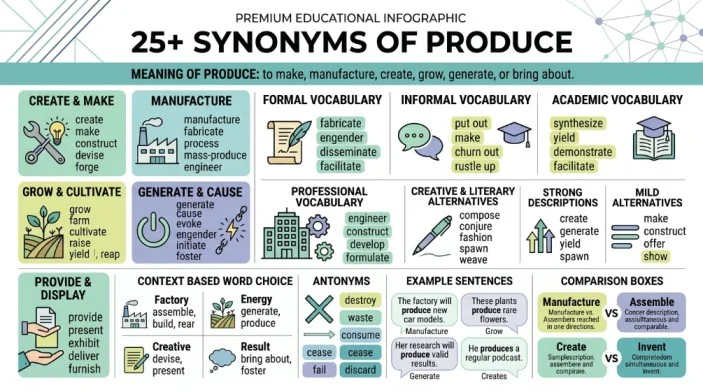
Writers often use produce repeatedly when describing what people make, create, grow, or cause. The word appears in essays, business reports, resumes, emails, product descriptions, and everyday conversations, but repeating it can make otherwise strong writing feel predictable. Finding the right synonym of produce can make your meaning more precise and your sentences more natural.
The best alternative depends on the sense of the word. You might use create for something original, manufacture for goods made in a factory, generate for energy or results, cultivate for crops, or cause when describing an effect. Understanding these differences helps you choose a word that matches your exact meaning instead of replacing produce mechanically.
What Are the Best Synonyms of “Produce”?
Produce can mean to create, make, grow, generate, cause, or bring something into existence. The best synonyms include create, make, manufacture, generate, yield, develop, cultivate, cause, and provide. Formal writing often favors generate or manufacture, while everyday English commonly uses make, create, or grow.
Meaning, Tone, and Context
Simple Definition
Produce has several meanings, which makes it an especially useful but sometimes confusing English word.
As a verb, produce can mean to make or create something, grow agricultural products, generate a result, cause an effect, or present something for inspection.
For example:
- A factory produces automobiles.
- Farmers produce wheat.
- Solar panels produce electricity.
- The experiment produced unexpected results.
- She produced her identification when asked.
As a noun, produce usually refers to agricultural products, especially fresh fruits and vegetables.
Part of Speech
Produce can function as both a verb and a noun.
As a verb, it means to create, make, grow, generate, cause, or present something.
As a noun, produce refers mainly to farm products such as fruits and vegetables.
Overall Tone
The word produce has a neutral tone. It is neither strongly positive nor negative.
Its tone changes according to context. In a business report, produce can sound professional. Farming, it is practical and ordinary. In creative contexts, words such as create or develop may sound more expressive.
Formality Level
Produce is a neutral word that works across formal, professional, academic, and informal settings.
It is common in:
- Academic writing
- Business reports
- Manufacturing
- Agriculture
- Scientific writing
- Everyday conversation
- Product descriptions
- Journalism
- Workplace communication
Common Uses
Native English speakers commonly use produce when discussing:
- Goods
- Products
- Crops
- Food
- Energy
- Results
- Evidence
- Documents
- Effects
- Ideas
- Films
- Music
- Reports
- Revenue
- Waste
- Emissions
Word Forms
| Form | Word | Example |
|---|---|---|
| Verb | Produce | The company produces medical equipment. |
| Noun | Produce | The store sells fresh produce. |
| Past tense | Produced | The factory produced 10,000 units. |
| Present participle | Producing | The plant is producing more energy. |
| Noun | Production | Production increased this year. |
| Noun | Producer | The producer approved the final version. |
| Adjective | Productive | The team had a productive meeting. |
When and How to Use “Produce”
Use produce when you want to describe the creation, generation, cultivation, manufacture, or presentation of something.
The important point is that produce does not always mean exactly the same thing. Its meaning depends heavily on what comes after it.
Professional Context
“The new strategy produced measurable improvements in customer retention.”
Here, produced means caused or resulted in.
Academic Context
“The experiment produced similar results in both groups.”
In this sentence, produced means generated or resulted in.
Workplace Context
“Our team produces weekly performance reports.”
Here, produces means creates or prepares.
Personal Context
“She produced several sketches before choosing the final design.”
In this example, produced means created.
Email Context
“Please produce the original receipt before the reimbursement can be processed.”
Here, produce means present or provide.
Resume Context
“Produced monthly reports for senior management.”
In a resume, produced communicates that the applicant created or prepared something.
Social Media Context
“Our local farmers produce some of the freshest vegetables in the region.”
Here, produce means grow.
Best Synonyms of “Produce”
No single synonym works perfectly in every sentence because produce has multiple meanings. The strongest replacement depends on whether you mean create, manufacture, grow, generate, cause, provide, or present.
Professional Writing: Generate
Generate is especially useful when discussing results, revenue, data, energy, ideas, or measurable outcomes.
Example:
“The campaign generated significant revenue.”
This is more precise than saying:
“The campaign produced significant revenue.”
Academic Writing: Generate
Generate works well in research and scientific writing when something creates data, results, evidence, or discussion.
Example:
“The experiment generated new evidence about the process.”
Business Communication: Manufacture
Use manufacture when discussing physical products made through industrial processes.
Example:
“The company manufactures medical devices.”
It is more specific than produce because it identifies an industrial production process.
Casual Conversation: Make
Make is usually the most natural alternative in everyday speech.
Example:
“She makes handmade candles at home.”
Emotional Writing: Create
Create is often better when the thing being produced has artistic or emotional value.
Example:
“The experience created lasting memories.”
Creative Writing: Create
Use create for stories, art, characters, music, images, and imaginative work.
Example:
“The novelist created a memorable character.”
Resume Writing: Develop
Develop works well when describing ideas, systems, programs, strategies, and professional projects.
Example:
“Developed training materials for new employees.”
Workplace Communication: Prepare
Use prepare when produce means creating documents, reports, presentations, or materials.
Example:
“Prepared weekly reports for department managers.”
Stronger Meaning: Generate
Generate can emphasize the output or result created by an action.
Example:
“The new system generated substantial savings.”
Softer Meaning: Make
Make is broad, familiar, and less technical.
Example:
“We make custom products for local businesses.”
When Not to Use “Produce”
Although produce is versatile, it can sometimes be too broad. A more precise synonym may communicate your meaning better.
When Produce Is Too General
“The company produces software.”
This is understandable, but develops may be more precise.
Better:
“The company develops software for small businesses.”
Why:
Develop describes the process of designing and improving software more naturally than produce.
When Produce Is Too Vague
“The project produced good results.”
Better:
“The project generated measurable improvements in customer satisfaction.”
Why:
Generated emphasizes the resulting outcome, while measurable improvements gives the reader more information.
When Produce Sounds Too Formal
“I produced dinner for my family.”
Better:
“I made dinner for my family.”
Why:
Make sounds much more natural in ordinary conversation.
When Produce Is Too Informal
This situation is less common because produce itself is neutral. However, if you use make repeatedly in a formal report, a more specific term may improve precision.
Less precise:
“The company makes medical equipment.”
Better:
“The company manufactures medical equipment.”
Why:
Manufactures clearly describes industrial production.
When Produce Is Too Weak
“The new policy produced a major change.”
Better:
“The new policy caused a major change.”
Why:
Caused directly identifies the relationship between the policy and the change.
When Produce Is Too Strong
“His comment produced anger.”
Depending on the intended meaning, this can sound more forceful than necessary.
Better:
“His comment led to frustration.”
Why:
Led to can describe an outcome without suggesting that the comment directly created the emotional response.
When Produce Is Not the Right Word for Presentation
“I produced my passport at the airport.”
This is grammatically possible, but it is uncommon in everyday American English.
Better:
“I presented my passport at the airport.”
Why:
Present is the natural choice when you mean showing or handing over a document for inspection.
Words Commonly Confused With “Produce”
| Word | Difference | When to Use It | Example |
|---|---|---|---|
| Create | Focuses on bringing something new into existence. | Ideas, art, writing, designs. | “She created a new logo.” |
| Make | Broad, everyday word for creating or preparing something. | Conversation and general writing. | “He made a wooden table.” |
| Manufacture | Refers specifically to industrial production. | Factories and physical goods. | “The company manufactures cars.” |
| Generate | Emphasizes output, energy, data, revenue, or results. | Business, science, technology. | “The panels generate electricity.” |
| Grow | Means cultivating plants or agricultural products. | Farming and gardening. | “The farm grows tomatoes.” |
| Cause | Focuses on an effect or consequence. | Events, reactions, problems, results. | “The error caused confusion.” |
Best Synonyms of “Produce” by Context
| Context | Best Synonym | Why It Works | Example |
|---|---|---|---|
| Formal writing | Generate | Sounds precise when discussing outcomes. | “The program generated new data.” |
| Academic writing | Generate | Fits research results and evidence. | “The study generated useful findings.” |
| Professional communication | Develop | Highlights planned creation and improvement. | “We developed a new training program.” |
| Business emails | Prepare | Natural for reports and documents. | “Please prepare the final report.” |
| Resume writing | Develop | Shows active professional contribution. | “Developed client training materials.” |
| Workplace communication | Create | Clear and flexible for projects. | “The team created a new workflow.” |
| Casual conversation | Make | Most natural in everyday speech. | “She made a cake.” |
| Everyday speaking | Grow | Best for plants and food. | “They grow organic vegetables.” |
| Creative writing | Create | Emphasizes imagination and originality. | “The author created a vivid world.” |
| Storytelling | Create | Works well for characters and scenes. | “The writer created a believable character.” |
| Emotional writing | Create | Fits memories, feelings, and experiences. | “The trip created wonderful memories.” |
| Strong emphasis | Cause | Clearly connects an action to an effect. | “The storm caused severe damage.” |
| Mild tone | Make | Simple and conversational. | “He made a small improvement.” |
| Social media captions | Create | Works naturally for content and visuals. | “Created something special today.” |
| American English | Make or create | Both are highly natural depending on context. | “She made dinner.” |
| British English | Make or produce | Both are common, depending on meaning. | “The farm produces fresh vegetables.” |
How to Choose the Best Synonym of “Produce”
Start by identifying what produce means in your sentence. Do not choose a synonym simply because it appears in a thesaurus.
If You Mean Create Something
Choose create, make, or develop.
Example:
“She produced a new design.”
Better depending on context:
“She created a new design.”
If You Mean Manufacture Something
Choose manufacture, fabricate, or make.
Example:
“The company produces steel components.”
More precise:
“The company manufactures steel components.”
If You Mean Grow Something
Choose grow, cultivate, or raise, depending on the product.
Example:
“The farm produces corn.”
More specific:
“The farm grows corn.”
If You Mean Generate Something
Choose generate, yield, or provide.
Example:
“The solar panels produce electricity.”
More precise:
“The solar panels generate electricity.”
If You Mean Cause Something
Choose cause, create, bring about, or result in.
Example:
“The decision produced unexpected consequences.”
More direct:
“The decision caused unexpected consequences.”
If You Mean Present Something
Choose present, provide, submit, or show, depending on context.
Example:
“She produced her identification.”
More natural in American English:
“She presented her identification.”
If You Mean Prepare Something
Choose prepare, compile, or develop.
Example:
“The analyst produced a detailed report.”
Possible alternative:
“The analyst prepared a detailed report.”
Final Decision Rule
Before replacing produce, ask:
- What exactly is being produced?
- Is it being created, manufactured, grown, generated, or caused?
- Who is the audience?
- Is the writing formal or conversational?
- Do I want a neutral word or a more precise one?
- Does the replacement preserve the original meaning?
The best synonym is the one that preserves the intended meaning while making the sentence sound natural.
Real Life Examples of “Produce”
School
Original:
“The experiment produced interesting results.”
Improved:
“The experiment generated interesting results.”
Why:
Generated fits scientific and academic contexts particularly well.
College
Original:
“Students must produce a research paper.”
Improved:
“Students must prepare a research paper.”
Why:
Prepare naturally describes completing a formal academic document.
Workplace
Original:
“The department produces monthly reports.”
Improved:
“The department prepares monthly reports.”
Why:
Prepares sounds natural when employees compile and organize reports.
Business
Original:
“The company produces electronic equipment.”
Improved:
“The company manufactures electronic equipment.”
Why:
Manufactures identifies the industrial process more precisely.
Original:
“Please produce the documents before Friday.”
Improved:
“Please provide the documents before Friday.”
Why:
Provide is often more natural when asking someone to supply documents.
Resume
Original:
“Produced weekly sales reports.”
Improved:
“Prepared weekly sales reports for senior management.”
Why:
Prepared clearly describes the professional task and adds useful context.
Conversation
Original:
“What does this machine produce?”
Natural alternative:
“What does this machine make?”
Why:
Make is more conversational.
Storytelling
Original:
“The artist produced a beautiful painting.”
Improved:
“The artist created a beautiful painting.”
Why:
Created emphasizes artistic expression.
Blogging
Original:
“The study produced useful information.”
Improved:
“The study generated useful insights.”
Why:
Generated gives the sentence a more analytical tone.
Social Media
Original:
“Produced a new video today.”
Improved:
“Created a new video today.”
Why:
Created sounds more natural and engaging for social media content.
25 Best Synonyms of “Produce”
Because produce has several meanings, the list below includes words that match different senses. The most accurate choice depends on the context.
| Synonym | Simple Meaning | Best Used For | Example Sentence |
|---|---|---|---|
| Create | Bring something new into existence | Art, ideas, content | “The designer created a fresh visual concept.” |
| Make | Create or prepare something | Everyday English | “She made a delicious meal.” |
| Generate | Create an output or result | Energy, data, revenue | “The system generates detailed reports.” |
| Manufacture | Make goods industrially | Factories and products | “The plant manufactures automobile parts.” |
| Develop | Build or improve something over time | Software, plans, programs | “The team developed a new training system.” |
| Grow | Cultivate plants or crops | Agriculture | “The farm grows organic lettuce.” |
| Cultivate | Carefully grow or develop | Farming, skills, relationships | “Local farmers cultivate specialty herbs.” |
| Cause | Make something happen | Effects and consequences | “The storm caused major flooding.” |
| Yield | Produce a result, amount, or crop | Agriculture, research, finance | “The investment yielded strong returns.” |
| Create | Form something through imagination or effort | Creative work | “The author created a compelling character.” |
| Prepare | Make something ready or complete | Reports, meals, documents | “The assistant prepared the presentation.” |
| Provide | Supply something needed | Services, information, resources | “The website provides useful information.” |
| Supply | Give or make available | Goods and resources | “The company supplies parts to retailers.” |
| Deliver | Produce or provide an expected result | Services, results, promises | “The campaign delivered impressive results.” |
| Fabricate | Make something, usually from materials | Manufacturing, construction | “The workshop fabricates custom metal parts.” |
| Assemble | Put separate parts together | Products, equipment | “Workers assemble the devices by hand.” |
| Form | Give something a particular shape or structure | Materials, ideas, organizations | “The process forms a protective layer.” |
| Build | Create or develop gradually | Systems, businesses, relationships | “The company built a strong customer base.” |
| Compose | Create by arranging elements | Music, writing | “She composed an original piece of music.” |
| Craft | Make something carefully and skillfully | Writing, products, creative work | “He crafted a thoughtful response.” |
| Construct | Build something from parts | Buildings, arguments, systems | “The engineers constructed a new bridge.” |
| Establish | Create something that becomes organized or recognized | Businesses, systems, rules | “The company established a new policy.” |
| Formulate | Develop something carefully through thought | Plans, policies, strategies | “The committee formulated a new strategy.” |
| Initiate | Begin or set something in motion | Programs, processes, actions | “The organization initiated a community project.” |
| Bring about | Cause something to happen | Changes, effects, outcomes | “The reform brought about significant changes.” |
Synonyms of “Produce” by Usage
Professional vs Personal Synonyms
Professional writing benefits from specific words that explain the exact action involved.
- Use generate for revenue, data, energy, and results.
- Use develop for systems, programs, strategies, and software.
- Use manufacture for physical goods.
- Use prepare for reports and documents.
Personal communication usually favors simpler words.
- Use make for food, objects, and everyday activities.
- Use create for art, content, and personal projects.
- Use grow for plants and food.
Formal vs Conversational Synonyms
- For reports and essays, generate, manufacture, develop, formulate, and produce can work well.
- For business emails, prepare, provide, create, and generate are often clearer.
- For casual conversation, make, grow, and create usually sound more natural.
- For texting, simple expressions are generally preferable:
“She made a cake.”
This is more natural than:
“She produced a cake.”
Academic Synonyms
Academic writing benefits from precise alternatives to produce.
Generate is useful for research results, data, evidence, and hypotheses.
Example:
“The experiment generated consistent results.”
Yield works when discussing outcomes, findings, or quantities.
Example:
“The procedure yielded reliable measurements.”
Cause is useful when discussing relationships between events.
Example:
“The treatment caused a measurable reduction in symptoms.”
Formulate works for theories, hypotheses, and strategies.
Example:
“The researchers formulated a new hypothesis.”
Professional and Business Synonyms
For resumes, develop, create, generate, prepare, and deliver are particularly useful.
“Developed training materials for more than 200 employees.”
Interview example:
“I developed a process that reduced reporting time.”
Meeting example:
“The team generated several solutions to the problem.”
Presentation example:
“The campaign generated strong customer engagement.”
Performance review example:
“Prepared monthly reports for department leadership.”
Client communication example:
“We can provide the requested documentation by Friday.”
Business email example:
“Please provide the final invoice before the payment deadline.”
Creative and Literary Synonyms
Creative writing often benefits from create, craft, compose, build, and form.
Create works for characters, worlds, images, and ideas.
Craft emphasizes care and skill.
Compose works especially well for music, poetry, and carefully structured writing.
Build can describe the gradual development of tension, relationships, or fictional worlds.
Example:
“The author carefully crafted a world filled with mystery.”
Slang or Modern Synonyms
There is no single slang synonym that universally replaces produce.
In casual American English, make is the most common simple alternative.
Depending on context, people may also use expressions such as:
- Make
- Put together
- Come up with
- Build
- Put out
For example:
“The team put together a new presentation.”
This is informal and conversational. It would be less suitable than prepared or developed in a highly formal report.
Strongest to Mildest Synonyms
The intensity of a synonym depends on the sense of produce, so there is no universal strength ranking. However, for the general meaning of creating an outcome, the following scale can help.
| Level | Useful Alternatives | Typical Effect |
|---|---|---|
| Mild | Make, form | Simple creation |
| Moderate | Create, develop, prepare | Clear intentional work |
| Strong | Generate, construct, formulate | Deliberate or measurable output |
| Very Strong | Cause, bring about | Clear emphasis on producing an effect |
For agricultural meaning, grow and cultivate are more precise than stronger or weaker alternatives because they describe a different process.
For industrial production, manufacture is more specific rather than simply stronger.
Emotional vs Neutral Synonyms
Emotional Synonyms
These words can add a sense of creativity, care, or personal involvement.
Create can suggest imagination.
Craft can suggest care and skill.
Build can suggest gradual effort.
Bring about can emphasize meaningful change.
Example:
“She crafted a message that brought comfort to the family.”
Neutral Synonyms
These words communicate information without adding much emotional color.
Produce
Generate
Manufacture
Prepare
Provide
Supply
Example:
“The company manufactures medical equipment.”
For academic and professional writing, neutral alternatives are often preferable because they keep the focus on information rather than emotion.
Antonyms of “Produce”
Because produce has multiple meanings, its opposites also depend on the particular sense being used. The following words represent genuine contextual opposites for creating, generating, supplying, growing, or presenting something.
| Antonym | Meaning | Example Sentence |
|---|---|---|
| Consume | Use something rather than create or supply it | “The factory consumes large amounts of energy.” |
| Destroy | Completely damage or eliminate something | “The fire destroyed the stored materials.” |
| Demolish | Tear down a constructed structure | “Workers demolished the damaged building.” |
| Dismantle | Take something apart | “The technicians dismantled the old machine.” |
| Eliminate | Remove something completely | “The update eliminated several unnecessary steps.” |
| Prevent | Stop something from happening | “The safety system prevented further damage.” |
| Inhibit | Restrict or slow development or activity | “The lack of sunlight inhibited plant growth.” |
| Reduce | Make an amount smaller | “The company reduced its output during the slowdown.” |
| Diminish | Cause something to become less | “The new policy diminished the demand for paper.” |
| Deplete | Use up a supply | “Excessive farming depleted the soil.” |
| Waste | Use resources without producing useful value | “The process wastes valuable materials.” |
| Suppress | Stop something from developing or becoming visible | “The treatment suppressed the unwanted response.” |
| Discard | Throw something away instead of using or developing it | “The team discarded the original design.” |
| Abandon | Stop developing or pursuing something | “The company abandoned the project.” |
| Halt | Stop an activity or process | “The factory halted production temporarily.” |
Comparison: “Produce” vs Similar Words
Produce vs Create
Main Difference
Produce is broad and can refer to manufacturing, growing, generating, or causing. Create focuses more strongly on bringing something new into existence.
Which Is Stronger?
Neither is inherently stronger. Create often feels more intentional or imaginative.
Which Is More Formal?
Both are suitable for formal writing.
When to Use Each
Use produce for products, crops, results, and outputs.
Use create for ideas, art, content, designs, and original work.
Examples
Produce:
“The factory produces thousands of units each month.”
Create:
“The designer created a new product concept.”
Produce vs Make
Main Difference
Make is broader and more conversational. Produce is more specific or formal in many contexts.
Which Is Stronger?
Neither.
Which Is More Formal?
Produce is generally more formal than make.
When to Use Each
Use make in everyday speech.
Use produce for business, manufacturing, agriculture, and formal descriptions.
Examples
Produce:
“The farm produces organic vegetables.”
Make:
“She makes fresh bread every morning.”
Produce vs Manufacture
Main Difference
Manufacture specifically refers to making goods, usually through industrial processes.
Which Is Stronger?
Manufacture is more specific rather than stronger.
Which Is More Formal?
Manufacture is more technical.
When to Use Each
Use manufacture for factories and industrial goods.
Use produce when the exact process is less important.
Examples
Produce:
“The company produces electronic devices.”
Manufacture:
“The company manufactures circuit boards.”
Produce vs Generate
Main Difference
Generate emphasizes output, especially energy, data, revenue, ideas, or results.
Which Is Stronger?
Neither is always stronger.
Which Is More Formal?
Generate is particularly common in technical and professional writing.
When to Use Each
Use generate for measurable outputs and results.
Use produce when the broader idea of creation or output is sufficient.
Examples
Produce:
“The experiment produced interesting results.”
Generate:
“The software generated a detailed analysis.”
Produce vs Grow
Main Difference
Grow specifically describes cultivating plants or agricultural products.
Which Is Stronger?
Neither.
Which Is More Formal?
Produce can sound more commercial or general.
When to Use Each
Use grow for the actual cultivation process.
Use produce when discussing the agricultural output.
Examples
Produce:
“The farm produces thousands of pounds of vegetables.”
Grow:
“The farmers grow tomatoes and peppers.”
Produce vs Cause
Main Difference
Cause means directly make something happen. Produce can describe an outcome without always emphasizing direct causation.
Which Is Stronger?
Cause usually makes the relationship more direct.
Which Is More Formal?
Both are suitable for formal writing.
When to Use Each
Use cause when a clear cause and effect relationship matters.
Use produce when focusing on the resulting output.
Examples
Produce:
“The treatment produced positive results.”
Cause:
“The treatment caused a reduction in symptoms.”
Common Phrases and Expressions with “Produce”
Produce Results
Meaning
To achieve or generate an outcome.
Example Sentence
“The new marketing strategy produced excellent results.”
Produce Evidence
Meaning
To provide or present evidence that supports a claim.
Example Sentence
“The researchers produced evidence supporting their conclusion.”
Produce Goods
Meaning
To manufacture or create physical products.
Example Sentence
“The factory produces goods for several national retailers.”
Produce Energy
Meaning
To generate usable power.
Example Sentence
“Solar panels produce clean electricity during daylight hours.”
Produce Crops
Meaning
To grow agricultural products.
Example Sentence
“The region produces large quantities of corn.”
Produce a Report
Meaning
To create or prepare a formal report.
Example Sentence
“The analyst was asked to produce a report by Monday.”
Produce an Effect
Meaning
To cause a particular result or change.
Example Sentence
“The medication may produce noticeable effects within an hour.”
Produce Content
Meaning
To create written, visual, or digital material.
Example Sentence
“The team produces educational content for small businesses.”
Common Mistakes to Avoid
Mistake 1: Using Produce for Every Meaning of Create
Incorrect
“The poet produced a beautiful poem.”
Better
“The poet created a beautiful poem.”
Why
Create is more natural when discussing original artistic work.
Mistake 2: Using Produce Instead of Grow
Incorrect
“The farmer produces tomatoes in a greenhouse.”
Better
“The farmer grows tomatoes in a greenhouse.”
Why
Grow describes the cultivation process more precisely.
Mistake 3: Using Manufacture for Ideas
Incorrect
“The writer manufactured a brilliant idea.”
Better
“The writer developed a brilliant idea.”
Why
Manufacture is primarily associated with physical goods and industrial production.
Mistake 4: Using Make in Highly Technical Contexts
Incorrect
“The solar panels make electricity.”
Better
“The solar panels generate electricity.”
Why
Generate is the standard precise choice for electricity production.
Mistake 5: Using Produce When You Mean Present
Incorrect
“She produced her passport to the officer.”
Better
“She presented her passport to the officer.”
Why
Present naturally describes showing a document for inspection.
Mistake 6: Choosing an Overly Formal Synonym
Incorrect
“I manufactured dinner for my family.”
Better
“I made dinner for my family.”
Why
Manufactured sounds unnatural for ordinary meal preparation.
Mistake 7: Using a Vague Synonym Instead of a Precise One
Incorrect
“The project produced an improvement.”
Better
“The project generated a measurable improvement in efficiency.”
Why
The revised version communicates both the action and the type of outcome more clearly.
Frequently Asked Questions
What is a synonym for produce?
Common synonyms include create, make, generate, develop, manufacture, and yield, depending on the context.
What is another word for produce?
Another word for produce can be create, make, manufacture, generate, or yield.
What is the synonym of produce?
The best synonym depends on meaning. Create and generate work for making something, while yield often means to provide or result in something.
What are the antonyms of produce?
Common antonyms of produce include destroy, consume, eliminate, and use up, depending on the context.
What does a produce thesaurus include?
A produce thesaurus may include words such as create, make, generate, manufacture, develop, and yield.
What’s another word for produce?
Useful alternatives include create, make, generate, manufacture, develop, and yield.
What is another word for produces?
Depending on the sentence, produces can mean creates, makes, generates, manufactures, or yields.
What are some produces synonyms?
Common synonyms for produces include creates, makes, generates, develops, manufactures, and yields.
What is a synonym of produce?
A common synonym of produce is create, but the best alternative depends on meaning. Use manufacture for factory goods, grow for crops, generate for energy or results, and cause for effects.
What are the best formal synonyms of produce?
Formal alternatives include generate, manufacture, develop, formulate, construct, and yield. The best choice depends on what is being produced, such as research results, products, strategies, structures, or measurable outcomes.
What are common informal synonyms of produce?
The most natural informal synonym is make. Depending on context, everyday speakers may also use create, grow, build, or put together, especially when discussing food, projects, objects, or content.
What is another word for produce in professional writing?
Professional alternatives include generate, develop, prepare, manufacture, provide, and deliver. Choose the word that identifies the specific action, such as generating results, preparing reports, or manufacturing products.
What is the difference between produce and create?
Produce has a broad meaning that includes making, growing, generating, and causing. Create focuses more specifically on bringing something new into existence, especially ideas, designs, art, content, and other original work.
What is the opposite of produce?
There is no single opposite for every meaning of produce. Depending on context, opposites include consume, destroy, reduce, deplete, prevent, dismantle, and halt.
Conclusion
Produce is a flexible English word that can mean create, make, manufacture, grow, generate, cause, prepare, or present something. Because it has several meanings, the best synonym depends on the exact action and context.
Use create for original ideas and artistic work, make for everyday conversation, manufacture for industrial goods, grow for crops, generate for energy and results, develop for professional projects, and cause when emphasizing an effect.
No synonym of produce works perfectly in every sentence. Before replacing the word, identify what is being produced, consider your audience and tone, and choose the alternative that communicates the exact meaning most naturally.
A simple vocabulary habit can make a major difference: whenever you repeat produce, ask whether you really mean create, make, grow, generate, manufacture, develop, prepare, or cause. That small check will help you write with greater precision.
Read More Related Articles:
- 25+ Synonyms of Existence | Meanings, Uses, Examples, and …
- Synonyms for Thus | Meaning, Examples, and Better Word …
- Meaning, Uses, Examples, and the Best Synonym of Complain