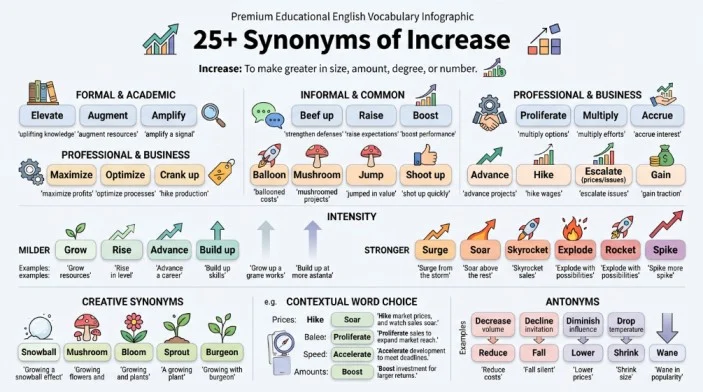
Finding the right word can make your writing clearer and more precise. The best synonyms for increase depend on what is growing, how much it changes, and the tone of your sentence. In everyday writing, words such as rise, grow, and add may work well. In professional or academic contexts, expand, boost, escalate, or augment can express a more specific idea. Knowing the difference helps you avoid using the same word repeatedly.
This guide explains the most useful increase synonym choices with clear meanings and practical examples. It also covers synonyms of increase, increased synonym options, and another word for increase based on context. Whether you need synonyms for increase, increase synonyms, a synonym of increase, or a synonym for increase, you will find natural alternatives here. The guide also explains when to use synonym increased and related forms correctly.
What Are the Best Synonyms of “Increase”?
A useful synonym of increase depends on context. Grow and rise are natural everyday choices, boost and raise often suggest deliberate action, augment suits formal writing, expand works well for size or scope, and escalate usually describes a rapid or concerning increase.
For formal and academic writing, consider augment, expand, elevate, amplify, or increase itself. For professional communication, boost, raise, improve, expand, and strengthen are often more natural. In casual conversation, grow, rise, climb, jump, and go up are common. Creative writing may benefit from expressive choices such as surge, swell, soar, or intensify.
Meaning, Tone, and Context
Simple Definition
Increase means to become greater in amount, number, size, level, degree, strength, value, or importance. It can also mean to make something greater.
For example:
The company increased its annual revenue.
Here, the company caused revenue to become greater.
Customer demand increased during the holiday season.
Here, demand itself became greater.
The word can therefore describe both an upward change that happens naturally and an upward change caused by someone.
Part of Speech
Increase can function as both a verb and a noun.
As a verb:
Sales increased by 12 percent.
As a noun:
The company reported an increase in sales.
The pronunciation changes slightly. As a verb, the stress normally falls on the second syllable, while the noun commonly receives stress on the first syllable.
Overall Tone
Increase is generally neutral. It does not automatically suggest that the change is good or bad.
For example:
The number of employees increased.
This simply reports a change.
The emotional or evaluative meaning comes from the surrounding context:
The increase in profits was encouraging.
The increase in pollution was alarming.
Formality Level
Increase is neutral and highly versatile. It works in:
- Academic writing
- Business reports
- Professional emails
- News writing
- Everyday conversation
- Technical writing
- Resumes
- Presentations
It is usually safer than an overly dramatic synonym because it clearly communicates upward movement without adding unnecessary emotion.
Common Uses
Native English speakers commonly use increase when discussing:
- Prices
- Sales
- Revenue
- Profits
- Costs
- Population
- Demand
- Production
- Temperature
- Interest
- Pressure
- Speed
- Strength
- Frequency
- Quantity
- Risk
- Awareness
- Engagement
- Performance
- Opportunities
Word Forms
| Form | Word | Example |
|---|---|---|
| Verb | increase | Sales increased last quarter. |
| Noun | increase | We noticed an increase in demand. |
| Adjective | increased | The company faced increased costs. |
| Related noun | increase | The increase was unexpected. |
When and How to Use “Increase”
Use increase when you want to communicate upward change clearly without adding a special emotional or stylistic meaning.
Professional
The company increased its customer retention rate by improving support services.
This is appropriate for a report because it is direct and objective.
Academic
The study found that exercise increased participants’ overall activity levels.
The word works well because academic writing often values precise and neutral language.
Workplace
We need to increase productivity without reducing quality.
This sounds natural in meetings, planning documents, and workplace discussions.
Personal
I want to increase the amount of time I spend reading.
The sentence is clear and conversational.
We may need to increase the project timeline because of the additional testing.
This is suitable for professional communication.
Resume
Increased website traffic through targeted content campaigns.
On a resume, increased clearly communicates an achievement and works especially well when followed by a measurable result.
Social Media
We’re increasing our weekly content to share more useful tips with our audience.
The wording is simple and accessible.
Best Synonyms of “Increase”
No synonym is identical to increase in every situation. Some alternatives describe gradual growth, while others suggest deliberate action, rapid change, greater intensity, or physical expansion.
Best for Professional Writing: Boost
Boost is useful when an action produces a positive improvement or upward result.
The new campaign boosted online engagement.
It sounds energetic but remains common in professional communication.
Best for Academic Writing: Augment
Augment means to make something greater by adding to it. It is more formal than increase and is useful when additional resources, evidence, or components are involved.
The researchers augmented the original dataset with additional observations.
Best for Business Communication: Raise
Raise works particularly well when someone deliberately causes a measurable value to go higher.
The company raised its prices in response to higher operating costs.
Best for Casual Conversation: Grow
Grow is one of the most natural alternatives in everyday English.
Her small business continues to grow.
It sounds less technical than increase and often suggests gradual development.
Best for Emotional Writing: Intensify
Intensify is appropriate when feelings, conflict, pressure, pain, or another quality becomes stronger.
The argument intensified as both sides became more frustrated.
Best for Creative Writing: Swell
Swell can create a vivid image of something gradually becoming larger or stronger.
A wave began to swell beneath the darkening sky.
It is more expressive than the neutral increase.
Best for Resume Writing: Boost
Boost can make an accomplishment sound active and results focused.
Boosted customer engagement by 28 percent through targeted campaigns.
For resumes, however, increased may be preferable when precision and measurable results matter more than style.
Best for Workplace Communication: Raise
Use raise when a person or organization intentionally moves something upward.
We should raise the quality standards for the next project.
Stronger Meaning: Surge
Surge suggests a sudden and often substantial increase.
Demand surged after the product was featured in the media.
Softer Meaning: Grow
Grow often suggests gradual development rather than a dramatic jump.
The audience grew steadily over the year.
When Not to Use “Increase”
Although increase is highly useful, it can sometimes be too general.
When the Change Is Rapid
If something rises suddenly and dramatically, surge or soar may communicate the situation more clearly.
General:
Prices increased suddenly.
More vivid:
Prices surged after the supply shortage.
When the Change Is Intentional
If someone deliberately causes an upward change, raise or boost can identify that action more precisely.
General:
The company increased employee salaries.
More specific:
The company raised employee salaries.
When the Meaning Involves Physical Expansion
For size, territory, capacity, or scope, expand may be more precise.
General:
The business increased its operations.
More specific:
The business expanded its operations.
When Intensity Is the Main Idea
For emotions, conflict, pain, pressure, or urgency, intensify often sounds more natural.
General:
The tension increased.
More precise:
The tension intensified.
When the Word Sounds Too Repetitive
If several sentences use increase, replace some instances with contextually accurate alternatives.
Repetitive:
Sales increased. Revenue increased. Customer interest increased.
Improved:
Sales increased, revenue climbed, and customer interest grew.
The alternatives create variation while preserving the overall meaning.
Words Commonly Confused With “Increase”
Increase vs Grow
Difference: Increase emphasizes becoming greater in amount, level, or number. Grow often suggests natural development or gradual expansion.
When to Use Grow: Use it for businesses, audiences, children, plants, skills, and other things that develop over time.
Example:
The number of customers increased this year.
The business grew rapidly after opening its second location.
Increase vs Raise
Difference: Increase can describe a change that happens by itself. Raise usually indicates that someone deliberately causes something to become higher.
When to Use Raise: Use it for salaries, prices, standards, questions, concerns, and physical objects.
Example:
Interest rates increased.
The bank raised interest rates.
Increase vs Boost
Difference: Boost usually suggests an intentional action that creates a positive or noticeable improvement.
When to Use Boost: It works well with sales, confidence, productivity, visibility, engagement, morale, and performance.
Example:
The campaign increased website traffic.
The campaign boosted website traffic.
Increase vs Expand
Difference: Increase focuses on becoming greater. Expand emphasizes becoming larger in size, range, scope, capacity, or coverage.
When to Use Expand: Use it for businesses, markets, services, facilities, programs, and ideas.
Example:
The company increased its workforce.
The company expanded its workforce and opened two new offices.
Increase vs Escalate
Difference: Escalate suggests that something becomes more intense, serious, costly, or difficult, often over time.
When to Use Escalate: It is common with conflict, tension, costs, risks, disputes, and problems.
Example:
Costs increased throughout the project.
Costs escalated after several delays.
Increase vs Rise
Difference: Rise commonly describes something moving upward without focusing on who caused the change.
When to Use Rise: It is especially natural with prices, temperatures, levels, rates, numbers, and quantities.
Example:
The temperature increased overnight.
The temperature rose overnight.
Best Synonyms of “Increase” by Context
| Context | Best Synonym | Why It Works | Example |
|---|---|---|---|
| Formal writing | Augment | Adds a formal sense of making something greater | The program will augment existing resources. |
| Academic writing | Amplify | Works for increasing effects, signals, or influence | The findings amplified concerns about the issue. |
| Professional communication | Boost | Sounds active and results focused | The redesign boosted engagement. |
| Business emails | Raise | Clearly communicates deliberate upward change | We may need to raise the budget. |
| Resume writing | Boost | Highlights an achievement or improvement | Boosted conversion rates by 18 percent. |
| Workplace communication | Raise | Natural for standards, salaries, goals, and concerns | We should raise our quality standards. |
| Casual conversation | Grow | Natural and familiar | My interest in photography has grown. |
| Everyday speaking | Go up | Very conversational | Grocery prices keep going up. |
| Creative writing | Swell | Creates a visual or emotional sense of expansion | The river began to swell after the storm. |
| Storytelling | Surge | Adds movement and immediacy | Her confidence surged after the victory. |
| Emotional writing | Intensify | Shows increasing emotional strength | His anger intensified. |
| Strong emphasis | Soar | Suggests a dramatic upward movement | Demand soared during the promotion. |
| Mild tone | Grow | Often implies gradual change | Interest grew slowly. |
| Social media captions | Boost | Short, energetic, and accessible | Boost your productivity with these tips. |
| American English | Increase | Standard and widely understood | Costs increased this month. |
| British English | Rise | Very common in similar contexts | Prices rose again. |
How to Choose the Best Synonym of “Increase”
Choosing another word should begin with meaning, not variety.
Step 1: Identify What Is Changing
Ask what is becoming greater.
- If it is a number or amount, increase or rise may work.
- If it is a business or market, grow or expand may be better.
- If it is emotional intensity, intensify is often more precise.
Step 2: Decide Whether the Change Is Intentional
If someone deliberately makes something higher, consider raise or boost.
The company raised salaries.
The campaign boosted sales.
If the change happens without an identified actor, increase, rise, or grow may be more natural.
Step 3: Consider the Speed
For gradual change, use grow, expand, or climb.
For sudden change, consider jump, surge, or soar.
Step 4: Consider Formality
For everyday writing, grow, rise, and boost are accessible.
For formal or academic writing, augment, amplify, expand, and elevate can work when their specific meanings fit.
Step 5: Consider Emotional Strength
Use neutral vocabulary when you simply need to report information.
Use surge, soar, escalate, or intensify when the context requires greater force.
Step 6: Read the Sentence Aloud
A technically correct synonym may still sound unnatural.
Compare:
The company’s customer base augmented rapidly.
The company’s customer base grew rapidly.
The second sentence sounds much more natural because grow commonly describes a customer base.
The best synonym is therefore the one that preserves meaning while sounding natural to the intended audience.
Real Life Examples of “Increase”
School
Students can increase their vocabulary by reading a wide range of books.
A more specific version:
Students can expand their vocabulary by reading a wide range of books.
College
The research showed that exercise increased concentration.
More precise:
The research suggested that regular exercise improved concentration.
Workplace
We need to increase productivity without sacrificing quality.
Alternative:
We need to boost productivity without sacrificing quality.
Business
The company increased its market share during the second quarter.
Alternative:
The company expanded its market share during the second quarter.
Please let me know if we need to increase the project budget.
Alternative:
Please let me know if we need to raise the project budget.
Resume
Increased website traffic by 35 percent through content optimization.
The measurable figure makes the achievement especially clear.
Conversation
My interest in cooking has increased over the past year.
More conversational:
I’ve become much more interested in cooking over the past year.
Storytelling
The wind increased as the storm approached.
More vivid:
The wind intensified as the storm approached.
Blogging
Consistent internal linking can increase page visibility.
Alternative:
Consistent internal linking can improve page visibility.
Social Media
We want to increase engagement with more useful posts.
More energetic:
We want to boost engagement with more useful posts.
25 Best Synonyms of “Increase”
The following list focuses on words that can genuinely express upward change in appropriate contexts. They are not all interchangeable, so the usage column matters.
| Synonym | Simple Meaning | Best Used For | Example Sentence |
|---|---|---|---|
| 1. Grow | Become greater over time | Businesses, skills, audiences, quantities | Her audience grew steadily throughout the year. |
| 2. Rise | Move to a higher level | Prices, temperatures, rates, numbers | Housing costs rose again this spring. |
| 3. Raise | Make something higher | Prices, salaries, standards, levels | The company raised employee salaries. |
| 4. Boost | Increase through an active effort | Sales, confidence, engagement, performance | The campaign boosted online sales. |
| 5. Expand | Become larger in scope or size | Businesses, markets, services, capacity | The company expanded its services nationwide. |
| 6. Augment | Make greater by adding something | Formal and academic contexts | The team augmented the database with new records. |
| 7. Amplify | Make stronger, louder, or more noticeable | Effects, messages, influence, signals | Social media amplified the campaign’s message. |
| 8. Elevate | Move to a higher level or status | Standards, quality, position, awareness | The training elevated the team’s performance. |
| 9. Escalate | Become more serious, intense, or costly | Conflict, costs, risks, problems | The dispute escalated after negotiations failed. |
| 10. Intensify | Become stronger | Feelings, pressure, conflict, effects | The pressure intensified near the deadline. |
| 11. Enlarge | Make or become physically bigger | Objects, spaces, images | The designer enlarged the image for printing. |
| 12. Magnify | Make something appear or become greater | Effects, importance, images | The mistake magnified the project’s difficulties. |
| 13. Strengthen | Make stronger or more effective | Skills, relationships, systems, arguments | The evidence strengthened her argument. |
| 14. Heighten | Increase intensity, awareness, or effect | Tension, awareness, concern, anticipation | The announcement heightened public interest. |
| 15. Multiply | Increase greatly in number | Quantities, opportunities, effects | The new system multiplied the available options. |
| 16. Accelerate | Increase the speed of a process | Growth, development, progress | The investment accelerated economic growth. |
| 17. Swell | Become larger or fuller | Water, crowds, emotions, poetic descriptions | The crowd swelled as the concert began. |
| 18. Climb | Rise gradually or steadily | Prices, rates, numbers | Fuel prices continued to climb. |
| 19. Soar | Rise very quickly or dramatically | Prices, profits, demand, numbers | Demand for the product soared. |
| 20. Jump | Rise suddenly | Prices, numbers, rates | The number of applications jumped in May. |
| 21. Surge | Rise suddenly and strongly | Demand, traffic, energy, numbers | Website traffic surged after the article was published. |
| 22. Proliferate | Increase rapidly in number or spread | Technology, organisms, ideas, problems | New digital services proliferated during the decade. |
| 23. Upgrade | Improve to a higher standard or level | Systems, equipment, services | The company upgraded its security system. |
| 24. Advance | Move forward or make progress | Knowledge, technology, development | The discovery advanced medical research. |
| 25. Enhance | Improve or increase quality, value, or effectiveness | Features, quality, appearance, value | Better lighting enhanced the presentation. |
Synonyms of “Increase” by Usage
Professional vs Personal Synonyms
Professional writing often benefits from precise words such as increase, raise, boost, expand, enhance, and strengthen.
Personal communication can sound more natural with grow, rise, climb, or go up.
Professional:
The company boosted customer retention.
Personal:
My confidence grew after the presentation.
Formal vs Conversational Synonyms
For reports, academic papers, and formal business writing, choose augment, expand, amplify, elevate, or increase when their meanings fit.
For conversation and texting, grow, rise, go up, jump, and climb usually sound more natural.
Formal:
The intervention amplified the observed effect.
Conversational:
The effect got much stronger.
Academic Synonyms
Academic writing benefits from precision rather than unnecessarily complicated vocabulary.
Useful choices include:
- Increase
- Rise
- Grow
- Expand
- Amplify
- Augment
- Intensify
- Elevate
- Strengthen
- Accelerate
For example:
The intervention increased participation.
This is often better than replacing increase simply to sound sophisticated. If the research specifically concerns scope, expand may be more accurate.
The intervention expanded participation opportunities.
Professional and Business Synonyms
For resumes, interviews, meetings, presentations, performance reviews, client communication, and business emails, the strongest choices are often:
Boost: emphasizes a positive result.
Boosted customer engagement by 24 percent.
Raise: emphasizes deliberate action.
Raised service standards across three departments.
Expand: emphasizes growth in scope.
Expanded the client portfolio by 30 percent.
Strengthen: emphasizes improvement in effectiveness.
Strengthened relationships with key accounts.
Increase: emphasizes measurable change without extra interpretation.
Increased annual revenue by 18 percent.
Creative and Literary Synonyms
Creative writing often benefits from words that create movement or emotional texture.
Swell can suggest physical or emotional expansion.
Hope swelled in her chest.
Surge creates a feeling of sudden force.
A surge of excitement swept through the crowd.
Intensify works for rising emotional pressure.
The silence intensified as the door slowly opened.
Soar suggests dramatic upward movement.
Her spirits soared when she heard the news.
Creative alternatives should serve the scene rather than simply replace increase.
Slang or Modern Synonyms
There is no single slang word that consistently replaces increase across contexts.
In casual American English, phrases such as go up, get bigger, ramp up, and level up may appear.
Ramp up means to increase the amount, speed, or intensity of an activity.
We’re ramping up production before the holiday season.
It is acceptable in casual and professional workplace speech, but it can sound less formal than increase.
Level up usually means to improve or advance to a higher level, especially in gaming and informal online culture.
She leveled up her design skills.
It should generally be avoided in academic papers and highly formal business documents.
Strongest to Mildest Synonyms
Intensity depends heavily on context, but this general scale can help.
Mild
Grow, rise, increase
These words can describe ordinary upward movement without implying dramatic change.
Moderate
Boost, expand, strengthen, elevate, climb
These suggest a more noticeable or purposeful improvement or movement.
Strong
Escalate, intensify, surge, jump, amplify
These communicate stronger movement, greater intensity, or a more noticeable change.
Very Strong
Soar, multiply, proliferate
These can suggest a dramatic increase, although the correct choice depends on the subject.
For example:
Prices increased.
Neutral.
Prices climbed.
More noticeable.
Prices surged.
Sudden and substantial.
Prices soared.
Very dramatic upward movement.
Emotional vs Neutral Synonyms
Emotional Synonyms
These words can add stronger feeling or emphasis:
- Surge
- Soar
- Intensify
- Escalate
- Swell
- Heighten
- Magnify
Example:
Excitement surged through the audience.
The sentence creates a stronger emotional image than:
Excitement increased among the audience.
Neutral Synonyms
These generally communicate information without strong emotional coloring:
- Increase
- Rise
- Grow
- Expand
- Raise
- Augment
- Elevate
Example:
The population increased by 4 percent.
This is appropriate when the goal is factual reporting.
Antonyms of “Increase”
The opposite of increase is generally a decrease or reduction. The most appropriate antonym depends on whether the subject becomes smaller, lower, weaker, less frequent, or less serious.
| Antonym | Meaning | Example Sentence |
|---|---|---|
| 1. Decrease | Become or make smaller | Sales decreased during the winter. |
| 2. Reduce | Make something smaller or lower | We need to reduce unnecessary expenses. |
| 3. Diminish | Become less in amount, importance, or strength | Her concern gradually diminished. |
| 4. Lessen | Make or become less | The medicine helped lessen the pain. |
| 5. Lower | Move something to a lower level | The company lowered its prices. |
| 6. Decline | Become smaller, weaker, or less | Customer interest began to decline. |
| 7. Drop | Fall to a lower level | Temperatures dropped overnight. |
| 8. Fall | Move downward or become lower | The unemployment rate fell slightly. |
| 9. Shrink | Become smaller in size or amount | The market shrank during the recession. |
| 10. Contract | Become smaller in size, scope, or activity | The economy contracted during the period. |
| 11. Curtail | Reduce or limit something | The organization curtailed unnecessary spending. |
| 12. Cut | Reduce an amount or level | The company cut operating costs. |
| 13. Weaken | Become or make less strong | The signal weakened as the storm approached. |
| 14. Subside | Become less intense or severe | The tension eventually subsided. |
| 15. Dwindle | Gradually become smaller or fewer | Their savings dwindled over several months. |
Comparison: “Increase” vs Similar Words
Increase vs Grow
Main Difference: Increase focuses on becoming greater. Grow often suggests natural, gradual, or developmental change.
Which Is Stronger? Neither is automatically stronger. The context determines intensity.
Which Is More Formal? Increase is generally more neutral and suitable for formal measurement.
When to Use Each: Use increase for quantities and measured changes. Use grow for development, businesses, audiences, skills, and natural change.
Examples
Increase:
Sales increased by 10 percent.
Grow:
The company grew rapidly after its launch.
Increase vs Raise
Main Difference: Raise usually identifies an intentional action that makes something higher.
Which Is Stronger? Neither is inherently stronger.
Which Is More Formal? Both are suitable for professional writing.
When to Use Each: Use raise when someone deliberately changes a level, price, salary, or standard.
Examples
Increase:
Interest rates increased.
Raise:
The bank raised interest rates.
Increase vs Boost
Main Difference: Boost often suggests an active effort that produces a favorable improvement.
Which Is Stronger? Boost can sound more energetic.
Which Is More Formal? Increase is slightly more neutral.
When to Use Each: Use boost for marketing, performance, engagement, morale, and similar results.
Examples
Increase:
The campaign increased traffic.
Boost:
The campaign boosted traffic.
Increase vs Expand
Main Difference: Expand emphasizes greater size, range, capacity, or scope.
Which Is Stronger? Expand does not necessarily indicate greater intensity.
Which Is More Formal? Both are suitable for professional and academic writing.
When to Use Each: Use expand when something becomes broader or larger in scope.
Examples
Increase:
The company increased its services.
Expand:
The company expanded its services into new markets.
Increase vs Escalate
Main Difference: Escalate often suggests that a situation becomes more serious, intense, costly, or difficult.
Which Is Stronger? Escalate usually carries more force.
Which Is More Formal? Both can work in formal writing, but escalate has a more specific meaning.
When to Use Each: Use escalate for conflict, risks, costs, disputes, and serious problems.
Examples
Increase:
Costs increased.
Escalate:
Costs escalated after repeated delays.
Increase vs Rise
Main Difference: Rise commonly describes something moving upward without emphasizing an outside cause.
Which Is Stronger? Neither is inherently stronger.
Which Is More Formal? Both are neutral and widely accepted.
When to Use Each: Use rise naturally with prices, temperatures, rates, levels, and numbers.
Examples
Increase:
Prices increased again.
Rise:
Prices rose again.
Common Phrases and Expressions with “Increase”
Increase the Chances
Meaning: Make something more likely to happen.
Example Sentence:
Regular practice can increase your chances of performing well.
Increase Awareness
Meaning: Make more people conscious or informed about an issue.
Example Sentence:
The campaign aims to increase awareness of online safety.
Increase Productivity
Meaning: Produce more work or better results within available resources.
Example Sentence:
The new workflow helped increase productivity.
Increase Demand
Meaning: Cause or experience greater interest in a product or service.
Example Sentence:
Lower prices may increase demand.
Increase Revenue
Meaning: Generate more income for a business or organization.
Example Sentence:
The company introduced new services to increase revenue.
Increase Efficiency
Meaning: Improve how effectively time, money, energy, or resources are used.
Example Sentence:
Automation can increase efficiency without reducing quality.
Increase Pressure
Meaning: Make physical, emotional, social, or situational pressure greater.
Example Sentence:
The deadline increased pressure on the team.
Increase in
Meaning: A rise in the amount, number, level, or degree of something.
Example Sentence:
The report showed an increase in online purchases.
Common Mistakes to Avoid
Mistake 1: Choosing a Vague Synonym
Incorrect:
The company made the customer experience bigger.
Better:
The company improved the customer experience.
Why: Bigger does not clearly describe quality. Improve communicates the intended meaning more precisely.
Mistake 2: Confusing Increase With Raise
Incorrect:
The manager increased employee salaries.
This sentence is grammatically acceptable, but it may be less direct when emphasizing the manager’s deliberate action.
Better:
The manager raised employee salaries.
Why: Raise clearly identifies an intentional action.
Mistake 3: Using an Informal Word in Formal Writing
Incorrect:
The number of participants went up significantly.
Better:
The number of participants increased significantly.
Why: The first sentence is understandable, but increase is more appropriate for formal academic or professional reporting.
Mistake 4: Using an Overly Dramatic Synonym
Incorrect:
The number of library visitors soared from 100 to 105.
Better:
The number of library visitors increased from 100 to 105.
Why: Soared suggests a dramatic rise. The measured change does not justify that level of intensity.
Mistake 5: Repeating the Same Word Too Often
Incorrect:
Sales increased. Revenue increased. Traffic increased. Engagement increased.
Better:
Sales increased, revenue climbed, traffic grew, and engagement improved.
Why: Appropriate variation improves readability without sacrificing meaning.
Mistake 6: Choosing the Wrong Emotional Tone
Incorrect:
The conflict boosted after the disagreement.
Better:
The conflict escalated after the disagreement.
Why: Boost generally suggests a beneficial or positive improvement. Escalate fits conflict and worsening tension.
Mistake 7: Using Slang in Academic Writing
Incorrect:
The results show that participation ramped up a lot.
Better:
The results show that participation increased substantially.
Why: The second sentence is more precise and appropriate for academic reporting.
Frequently Asked Questions
What is a good synonym for increase?
A good synonym for increase is rise, growth, boost, gain, or expansion, depending on the context.
What is another word for increase?
Growth, rise, boost, gain, expansion, and improvement can be another word for increase.
What is the synonym of increased?
Common increased synonyms include raised, boosted, expanded, enlarged, elevated, and enhanced.
What are the synonyms of increase?
Common synonyms of increase include grow, rise, expand, boost, raise, and increase in quantity or size.
What is the synonym for increases?
Depending on usage, increases can mean rises, grows, boosts, expands, or gains.
What are the best synonyms of “increase”?
The best synonym of increase depends on context. Grow, rise, boost, raise, expand, augment, amplify, intensify, surge, and escalate are useful choices, but each communicates a slightly different type or degree of upward change.
What are the best formal synonyms of “increase”?
Strong formal synonyms of increase include augment, expand, amplify, elevate, enhance, strengthen, and intensify. Choose based on meaning rather than formality alone, because these words are not interchangeable in every sentence.
What are common informal synonyms of “increase”?
Common informal alternatives include grow, go up, climb, jump, and ramp up. Grow and go up are especially natural in everyday conversation, while ramp up often appears in casual workplace speech.
What is another word for “increase” in professional writing?
In professional writing, useful alternatives include boost, raise, expand, strengthen, enhance, and increase itself. Boost suits measurable improvements, while raise works well for deliberate changes to prices, salaries, standards, or goals.
What is the difference between “increase” and “grow”?
Increase emphasizes becoming greater in amount, number, level, or degree. Grow often suggests gradual development or natural expansion. For example, sales can increase, while a business, audience, skill, or relationship can grow.
What is the opposite of “increase”?
The opposite of increase is generally decrease. Depending on context, alternatives include reduce, diminish, lessen, lower, decline, drop, fall, shrink, contract, curtail, and dwindle.
Conclusion
Increase is a flexible, neutral word for describing something becoming greater in amount, number, size, level, strength, or degree. Because it works in both everyday and professional English, it is often the safest choice when you need clear and objective language.
Still, the best synonym depends on your purpose. Use grow for natural development, rise for upward movement, raise for deliberate action, boost for positive results, expand for greater scope, intensify for stronger conditions or emotions, and surge or soar for dramatic upward movement.
No synonym works perfectly in every sentence. When choosing a synonym of increase, consider the audience, tone, purpose, intensity, and exact meaning you want to communicate. A practical vocabulary tip is to replace a repeated word only when the alternative makes the meaning more precise, natural, or effective.
Read More Related Articles:
- Synonyms for Everything | Meaning, Examples, and Better …
- Synonyms for Unexpected | Meaning, Examples, and Better …
- 50+ Synonyms of This | Meanings, Uses, Examples, and Best …