The right word can change the entire tone of a sentence. Benevolent describes someone who is kind, generous, and genuinely concerned about the well-being of others. Understanding its exact use makes your writing more precise and natural. If you are searching for a benevolent synonym, the best choice depends on the context, tone, and level of kindness you want to express. Common benevolent synonyms include kind, charitable, compassionate, generous, and altruistic.
A clear look at the benevolent meaning also helps distinguish it from related words such as benevolence. In this guide, you will find reliable synonyms of benevolent, examples, and practical alternatives, including another word for benevolent and a useful synonym for benevolent in different situations. We also explain benevolence synonym choices, another word for benevolence, and the opposite of benevolent. Even the phrase benevolent critic becomes easier to understand when context is considered.
What Are the Best Synonyms of “Overstimulated”?
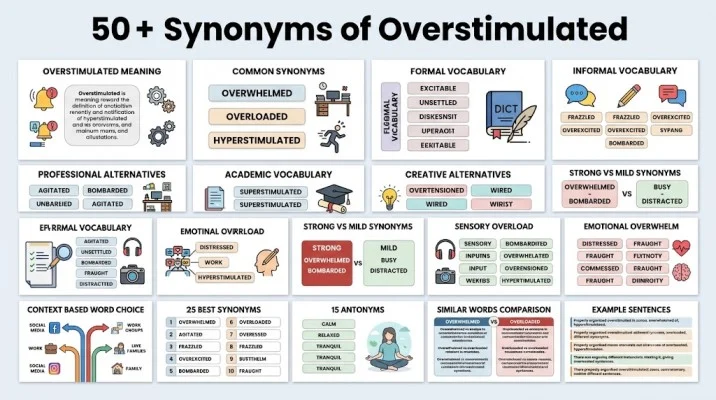
Overstimulated describes a state in which someone receives more sensory, mental, emotional, or environmental input than they can comfortably process. The closest alternatives include overwhelmed, overloaded, hyperstimulated, overexcited, and agitated, depending on the context. For formal writing, use overloaded or overwhelmed. For casual speech, frazzled or overwhelmed sounds natural.
Meaning, Tone, and Context
Simple Definition
Overstimulated means experiencing too much stimulation at once or over a period of time, making it difficult to remain comfortable, focused, calm, or mentally organized.
The stimulation can come from many sources, including loud sounds, bright lights, crowded environments, social interaction, digital notifications, demanding tasks, emotional pressure, or constant changes in attention.
For example:
“After several hours at the crowded festival, I felt completely overstimulated.”
The word does not necessarily mean that something is bad by itself. The problem is that the amount or intensity of stimulation has become difficult to process.
Part of Speech
Overstimulated is primarily an adjective and also functions as the past participle of the verb overstimulate.
Examples:
- “The child became overstimulated by the noisy environment.”
- “Too many notifications can leave people feeling overstimulated.”
- “The bright lights overstimulated him.”
Overall Tone
Overstimulated is generally neutral.
It does not automatically express anger, sadness, or anxiety. Instead, it describes a state caused by excessive stimulation. The emotional tone depends on the surrounding sentence.
Compare:
- “I felt overstimulated after the concert.” This is neutral.
- “I felt overwhelmed and overstimulated after the concert.” This adds emotional intensity.
- “The environment left me agitated and overstimulated.” This adds irritation or restlessness.
Formality Level
Overstimulated is a neutral, modern English term that works in everyday conversation, educational writing, psychology related discussions, parenting discussions, workplace communication, and descriptive writing.
It can sound more specific than general terms such as stressed or tired because it points toward excessive input rather than simply a difficult emotional state.
Common Uses
Native English speakers commonly use overstimulated when discussing:
- Loud or crowded environments
- Children and busy environments
- Social situations
- Digital devices and notifications
- Work overload
- Sensory experiences
- Emotional situations
- Busy schedules
- Travel
- Concerts and festivals
- Parenting
- Difficulty concentrating
- Too much information
- Constant multitasking
Word Forms
| Form | Word | Example |
|---|---|---|
| Verb | Overstimulate | “Too much noise can overstimulate some people.” |
| Adjective | Overstimulated | “I felt overstimulated after the event.” |
| Related adjective | Stimulating | “The class was stimulating and engaging.” |
| Related noun | Stimulation | “The room provided a lot of visual stimulation.” |
| Opposite concept | Understimulated | “He felt understimulated during the repetitive task.” |
When and How to Use “Overstimulated”
Use overstimulated when you want to communicate that excessive input has become difficult to handle or process.
It is especially useful when the source of the difficulty involves sensory, cognitive, emotional, or environmental stimulation. It is more specific than simply saying tired or stressed.
Professional
“The open office became so noisy that I felt overstimulated and had trouble concentrating.”
This works when describing a demanding workplace environment without automatically blaming another person.
Academic
“Students may become overstimulated when several sources of information compete for their attention.”
Here, the word describes excessive cognitive or sensory input in an educational context.
Workplace
“After several back to back meetings and constant notifications, I felt overstimulated.”
The sentence connects the feeling to excessive demands and interruptions.
Personal
“After spending the whole afternoon in a crowded shopping center, I was overstimulated and needed some quiet time.”
This is natural in everyday conversation.
“After a particularly busy morning, I may need a few minutes away from the notifications so I can refocus.”
In professional email, directly saying overstimulated can work, but sometimes a more practical explanation sounds better.
Resume
The word overstimulated is rarely appropriate on a resume because resumes focus on abilities, responsibilities, and achievements rather than personal states.
Instead of writing:
“Worked well when overstimulated.”
Use:
“Maintained focus and productivity in fast paced work environments.”
Social Media
“After a day of screens, noise, errands, and nonstop messages, I feel completely overstimulated.”
This use is natural because social media writing often favors direct, conversational language.
Best Synonyms of “Overstimulated”
No single synonym perfectly replaces overstimulated because the original word can describe several kinds of excessive input. The best alternative depends on whether you want to emphasize mental pressure, sensory overload, emotional intensity, excitement, irritation, or fatigue.
Professional Writing: Overloaded
Overloaded is a strong choice when excessive tasks, information, responsibilities, or demands are causing difficulty.
Example:
“Employees may become mentally overloaded when multiple urgent tasks arrive at once.”
It sounds professional and focuses on excessive demands.
Academic Writing: Overwhelmed
Overwhelmed works well when excessive information, demands, or stimuli become difficult to manage.
Example:
“Students may feel overwhelmed when they receive too much information within a limited period.”
It is widely understood and flexible.
Business Communication: Overloaded
Use overloaded when discussing systems, schedules, workloads, or attention.
Example:
“The support team became overloaded during the product launch.”
This sounds more objective than an emotional term.
Casual Conversation: Overwhelmed
Overwhelmed is one of the most natural everyday alternatives.
Example:
“There was so much going on that I felt overwhelmed.”
It communicates the effect without requiring a detailed explanation of the source.
Emotional Writing: Overwhelmed
When the emphasis is emotional rather than sensory, overwhelmed is usually more accurate.
Example:
“She felt overwhelmed by everything happening around her.”
Creative Writing: Bombarded
Bombarded creates a vivid image of receiving too much information or stimulation from many directions.
Example:
“He was bombarded by flashing lights, loud music, and competing voices.”
Resume Writing: High Demand Environment
Instead of using overstimulated, professional resumes should describe the ability to function under demanding conditions.
Example:
“Maintained accuracy and productivity in high demand environments.”
Workplace Communication: Overloaded
Overloaded is useful for explaining excessive workload or information.
Example:
“The team is overloaded with requests this week.”
Stronger Meaning: Overwhelmed
When the stimulation has become difficult to manage emotionally or mentally, overwhelmed is stronger than the neutral description overstimulated.
Softer Meaning: Busy
If you only mean that there is a lot happening, busy may be a better choice.
Example:
“The office was busy today.”
This does not suggest that the stimulation became uncomfortable.
When Not to Use “Overstimulated”
Although overstimulated is useful, it is not the right choice for every situation.
When the Meaning Is Too General
If you simply mean that someone has many responsibilities, busy may be more natural.
Less effective:
“I am overstimulated with work this week.”
Better:
“I am extremely busy with work this week.”
The second sentence clearly describes a demanding schedule without implying sensory or cognitive overload.
When You Mean Emotional Distress
If the main issue is emotional pressure, overwhelmed may be more accurate.
Less effective:
“She was overstimulated by the difficult news.”
Better:
“She was overwhelmed by the difficult news.”
The second version focuses directly on emotional impact.
When You Mean Irritation
If someone is restless or annoyed rather than simply overloaded, agitated may be a better choice.
Less effective:
“He became overstimulated during the argument.”
Better:
“He became agitated during the argument.”
When You Mean Too Much Work
For workload problems, overloaded is usually more precise.
Less effective:
“The department is overstimulated with requests.”
Better:
“The department is overloaded with requests.”
When You Mean Excessive Excitement
If someone is extremely excited rather than uncomfortable from too much stimulation, overexcited may be more accurate.
Less effective:
“The children were overstimulated about the birthday party.”
Better:
“The children were overexcited about the birthday party.”
When You Mean Physical Tiredness
If the problem is simply lack of energy, use exhausted, fatigued, or tired.
Less effective:
“I am overstimulated after running five miles.”
Better:
“I am exhausted after running five miles.”
When You Need a Formal Technical Description
In some academic or technical contexts, excessive stimulation, sensory overload, or cognitive overload may be more precise than the adjective overstimulated.
Words Commonly Confused With “Overstimulated”
Overwhelmed
Difference: Overwhelmed focuses on being unable to comfortably manage demands, emotions, or information. It does not require sensory stimulation.
When to Use It: Use it when the central issue is emotional, mental, or practical pressure.
Example:
“She felt overwhelmed by everything she had to finish.”
Overloaded
Difference: Overloaded emphasizes having too much work, information, responsibility, or input.
When to Use It: Use it for workloads, schedules, systems, or mental demands.
Example:
“The customer service team was overloaded with calls.”
Overexcited
Difference: Overexcited means excessively excited or enthusiastic. It does not necessarily suggest discomfort from too much stimulation.
When to Use It: Use it when strong excitement is the main idea.
Example:
“The children became overexcited when they saw the presents.”
Agitated
Difference: Agitated describes a restless, upset, or irritated state.
When to Use It: Use it when the person’s visible emotional reaction is more important than the amount of stimulation.
Example:
“He became agitated after waiting for an hour.”
Exhausted
Difference: Exhausted means extremely tired. Overstimulation can cause exhaustion, but the two words do not mean the same thing.
When to Use It: Use it when lack of energy is the main point.
Example:
“I was exhausted after working all day.”
Best Synonyms of “Overstimulated” by Context
| Context | Best Synonym | Why It Works | Example |
| Formal writing | Overloaded | Clearly describes excessive demands. | “The system became overloaded with information.” |
| Academic writing | Overwhelmed | Works well for excessive cognitive demands. | “Students may feel overwhelmed by complex material.” |
| Professional communication | Overloaded | Fits workload and information contexts. | “The team is overloaded with requests.” |
| Business emails | Overloaded | Sounds objective and practical. | “Our support staff are currently overloaded.” |
| Resume writing | Demanding | Describes a challenging environment positively. | “Thrived in demanding work environments.” |
| Workplace communication | Overloaded | Directly describes excessive workload. | “I am overloaded with urgent requests today.” |
| Casual conversation | Overwhelmed | Natural and widely understood. | “I feel overwhelmed right now.” |
| Everyday speaking | Frazzled | Communicates stress and mental disorganization. | “I have been completely frazzled today.” |
| Creative writing | Bombarded | Creates vivid imagery. | “She was bombarded by sound and light.” |
| Storytelling | Overwhelmed | Captures the character’s overall reaction. | “He felt overwhelmed by the crowded station.” |
| Emotional writing | Overwhelmed | Highlights emotional pressure. | “She was overwhelmed by the sudden change.” |
| Strong emphasis | Swamped | Suggests being buried under excessive demands. | “The office was swamped with requests.” |
| Mild tone | Busy | Avoids implying serious overload. | “The restaurant was unusually busy.” |
| Social media captions | Overwhelmed | Short, familiar, and conversational. | “A little overwhelmed after the busiest week.” |
| American English | Overwhelmed | Very natural in everyday American usage. | “I am overwhelmed with everything happening.” |
| British English | Overwhelmed | Also natural and widely understood. | “I felt overwhelmed by the busy environment.” |
How to Choose the Best Synonym of “Overstimulated”
Choosing the right alternative starts with identifying what kind of stimulation or pressure you want to describe.
Choose Based on Meaning
- Use overwhelmed when the person cannot comfortably manage the situation.
- Use overloaded when there is too much work, information, responsibility, or input.
- Use agitated when irritation or restlessness is the main reaction.
Use overexcited when excessive excitement is the focus.
Use frazzled when someone feels mentally scattered or stressed.
- Use bombarded when many inputs arrive rapidly or from several directions.
Choose Based on Tone
| Tone | Recommended Word |
| Neutral | Overstimulated |
| Professional | Overloaded |
| Academic | Overwhelmed |
| Casual | Overwhelmed |
| Emotional | Overwhelmed |
| Informal | Frazzled |
| Vivid | Bombarded |
| Irritated | Agitated |
| Excited | Overexcited |
| Mild | Busy |
Choose Based on Emotional Strength
Busy is mild.
Overloaded is stronger because it suggests excessive demands.
Overstimulated specifically highlights excessive stimulation.
Overwhelmed can suggest that the person is struggling to cope.
Bombarded creates a strong image of receiving many inputs at once.
Choose Based on Writing Purpose
- For an academic paper, choose precise language such as overwhelmed, overloaded, or sensory overload, depending on what you are describing.
- For a personal post, overwhelmed or frazzled may feel more natural.
- For a professional email, overloaded often communicates the practical problem without sounding overly emotional.
Real Life Examples of “Overstimulated”
School
Original:
“The classroom was overstimulated.”
Improved:
“The students appeared overwhelmed by the noise and constant activity.”
The improved version clearly identifies the effect on the students.
College
Original:
“I felt overstimulated after studying all night.”
Improved:
“I felt mentally overloaded after studying all night.”
This emphasizes cognitive pressure.
Workplace
Original:
“I became overstimulated during the workday.”
Improved:
“I became overloaded after handling several urgent requests at once.”
The improved sentence gives the reader a concrete reason.
Business
Original:
“The team was overstimulated by the number of requests.”
Improved:
“The team was swamped by the number of customer requests.”
Swamped creates a stronger picture of excessive workload.
Original:
“I am overstimulated by all these messages.”
Improved:
“I am currently overloaded with messages, so I may need additional time to respond.”
The improved version sounds more professional.
Resume
Original:
“I stayed productive when overstimulated.”
Improved:
“I remained productive and organized in high demand environments.”
This focuses on professional ability rather than personal discomfort.
Conversation
“There were so many people talking that I felt completely overwhelmed.”
This is more natural in everyday conversation than using a highly technical description.
Storytelling
“The market seemed to close in around her. Music, voices, bright signs, and footsteps seemed to arrive from every direction, leaving her overwhelmed.”
The word works because the story focuses on the character’s overall reaction.
Blogging
“Constant notifications can leave people feeling overloaded, especially when every app demands attention.”
This is clearer than repeatedly describing people as overstimulated.
Social Media
“Too many tabs, too many messages, too much noise. Completely overwhelmed today.”
This short style fits casual social media writing.
25 Best Synonyms of “Overstimulated”
The following words and expressions are context based alternatives. Some are close synonyms, while others describe a specific aspect or result of overstimulation. They should not be treated as interchangeable in every sentence.
| Synonym | Simple Meaning | Best Used For | Example Sentence |
| Overwhelmed | Unable to comfortably manage too much input or pressure | Everyday and emotional writing | “I felt overwhelmed by everything happening at once.” |
| Overloaded | Given more work, information, or input than can be handled comfortably | Professional and academic contexts | “My mind felt overloaded after hours of studying.” |
| Hyperstimulated | Experiencing an unusually high level of stimulation | Technical or descriptive writing | “The environment left him feeling hyperstimulated.” |
| Overexcited | Excessively excited or energetic | Children, events, celebrations | “The children became overexcited before the trip.” |
| Agitated | Restless, upset, or irritated | Emotional reactions | “The constant noise left her agitated.” |
| Frazzled | Mentally stressed, confused, or disorganized | Informal conversation | “I was completely frazzled after the hectic morning.” |
| Bombarded | Hit with many inputs or demands at once | Vivid writing and media contexts | “We were bombarded with notifications all afternoon.” |
| Swamped | Buried under too many tasks or demands | Workplace communication | “The office was swamped with customer requests.” |
| Overburdened | Carrying more responsibility than is manageable | Formal and professional writing | “The small team became overburdened with additional duties.” |
| Overtaxed | Pushed beyond a comfortable or manageable limit | Formal writing | “The staff were mentally overtaxed by the prolonged workload.” |
| Distracted | Unable to maintain attention because of competing input | Academic and workplace contexts | “She became distracted by the constant background noise.” |
| Restless | Unable to relax or remain still | Everyday situations | “He felt restless after spending hours in the crowded room.” |
| Frenzied | Extremely energetic, chaotic, or uncontrolled | Creative writing | “The store had a frenzied atmosphere before closing.” |
| Hectic | Extremely busy and full of activity | Everyday and professional contexts | “It was a hectic afternoon at the office.” |
| Harried | Pressured and rushed by too many demands | Formal or literary writing | “The harried manager struggled to answer every request.” |
| Stressed | Experiencing mental or emotional pressure | General communication | “I have been stressed by the constant interruptions.” |
| Strained | Experiencing pressure beyond comfortable limits | Professional or emotional writing | “The team’s attention became strained by the nonstop demands.” |
| Agitated | Experiencing increased emotional restlessness or irritation | Emotional contexts | “The loud environment made him increasingly agitated.” |
| Stimulus saturated | Receiving an unusually high amount of stimulation | Academic or analytical writing | “The digital environment can become stimulus saturated.” |
| Sensory overloaded | Experiencing excessive sensory input | Sensory contexts | “She felt sensory overloaded in the crowded venue.” |
| Mentally overloaded | Experiencing excessive cognitive demands | Education and work | “I was mentally overloaded after processing so much information.” |
| Emotionally overwhelmed | Unable to comfortably process intense emotions | Personal writing | “He felt emotionally overwhelmed by the sudden news.” |
| Information overloaded | Receiving more information than can be comfortably processed | Technology and education | “Users can become information overloaded by constant updates.” |
| Visually overwhelmed | Receiving more visual input than feels manageable | Design and sensory contexts | “The busy website left visitors visually overwhelmed.” |
| Overstimulated | Experiencing excessive sensory, mental, or emotional input | General usage | “I felt overstimulated after several hours in the crowded venue.” |
Synonyms of “Overstimulated” by Usage
Professional vs Personal Synonyms
- Professional writing generally benefits from words that identify the practical source of excessive stimulation.
Professional choices:
- Overloaded
- Overburdened
- Overtaxed
- Demanding
- Hectic
- Mentally overloaded
Example:
“The team became overloaded during the quarterly reporting period.”
Personal writing can be more emotional and conversational.
Personal choices:
- Overwhelmed
- Frazzled
- Restless
- Stressed
- Overexcited
Example:
“I felt completely overwhelmed after such a busy weekend.”
Formal vs Conversational Synonyms
- For reports and essays, choose overloaded, overtaxed, overburdened, or overwhelmed depending on the exact meaning.
- For business writing, overloaded is usually more practical than frazzled.
- For presentations, overwhelmed works when discussing people’s reactions, while information overload works when discussing excessive information.
- For casual conversations, overwhelmed, frazzled, stressed, and overexcited sound more natural.
- For texting, simple expressions such as “I am overwhelmed” or “My brain is fried” may work, although the latter is an informal expression rather than a direct synonym.
Academic Synonyms
Academic writing requires precision. Instead of treating every difficult mental state as overstimulation, identify the specific type of excess input.
Overloaded
Useful when discussing excessive cognitive or informational demands.
“Students may become cognitively overloaded when instructional material is presented too rapidly.”
Overwhelmed
Useful when describing a person’s response to excessive demands.
“Participants reported feeling overwhelmed by the volume of information.”
Hyperstimulated
Useful when the discussion specifically concerns unusually high stimulation.
“The participants were exposed to a highly stimulating environment.”
Sensory overloaded
Useful when excessive sensory input is the main issue.
“Individuals may experience sensory overload in environments with intense noise and visual activity.”
Academic vocabulary should explain the mechanism or context instead of using a dramatic synonym simply because it sounds stronger.
Professional and Business Synonyms
Resumes
Avoid describing yourself as overstimulated. It can unintentionally suggest difficulty managing pressure.
Instead, use phrases such as:
- High demand environment
- Fast paced environment
- Complex workload
- Multiple competing priorities
- High volume setting
Example:
“Successfully managed multiple competing priorities in a high demand environment.”
Interviews
If discussing a difficult work situation, use overloaded or describe the workload directly.
“During the launch, the team became overloaded, so I helped reorganize priorities.”
Meetings
“The team became overloaded with information during the presentation.”
This is more precise than saying everyone was overstimulated.
Presentations
“Too many slides can leave an audience overwhelmed.”
This clearly explains the effect of excessive information.
Performance Reviews
“During the busiest quarter, I managed a demanding workload while maintaining accuracy.”
This is more constructive than saying you became overstimulated.
Client Communication
“We are currently handling a high volume of requests and may need additional time.”
This is more professional than directly telling clients that the team is overstimulated.
Business Emails
“I have several urgent requests to address, so I may need additional time to complete this task.”
The sentence communicates the practical issue without unnecessary emotional language.
Creative and Literary Synonyms
Creative writing gives you more freedom to describe the experience vividly.
Bombarded
“She was bombarded by voices, music, and flashing lights.”
This suggests that stimulation is arriving from many directions.
Frenzied
“The station became frenzied as the final train approached.”
This describes the environment rather than directly describing the person’s internal state.
Overwhelmed
“He stood beneath the bright signs, overwhelmed by the endless movement around him.”
This focuses on the character’s reaction.
Restless
“The endless noise left her restless long after midnight.”
This emphasizes difficulty settling down.
Agitated
“The constant tapping and buzzing made him increasingly agitated.”
This introduces irritation.
Slang or Modern Synonyms
There is no single slang word that perfectly means overstimulated.
Several informal expressions can describe related experiences, but they should be used carefully.
Brain Fried
Meaning: Mentally exhausted or unable to process more information.
Acceptable in: Texting, social media, casual conversations.
Avoid in: Academic papers, formal emails, professional reports.
Example:
“My brain is completely fried after that meeting.”
Too Much Going On
Meaning: There are so many activities, demands, or inputs that the person feels unable to handle them comfortably.
Acceptable in: Everyday speech and social media.
Avoid in: Formal academic writing.
Example:
“I have had too much going on today.”
These expressions are related to overstimulation but are not exact dictionary synonyms.
Strongest to Mildest Synonyms
The intensity depends heavily on context, but this practical scale can help.
Mild
- Busy
- Distracted
- Restless
- Hectic
These words can describe a demanding environment without necessarily suggesting serious distress.
Moderate
- Stressed
- Overloaded
- Agitated
- Frazzled
- Overtaxed
These suggest that the amount of activity or stimulation is becoming difficult to manage.
Strong
- Overstimulated
- Overwhelmed
- Bombarded
- Swamped
- Overburdened
These communicate a more substantial level of excessive input or pressure.
Very Strong
- Completely overwhelmed
- Extremely overloaded
- Intensely agitated
- Severely overburdened
These are stronger expressions rather than separate dictionary synonyms. Use them when the context genuinely supports the intensity.
Emotional vs Neutral Synonyms
Emotional Synonyms
These words emphasize how the person feels.
- Overwhelmed
- Frazzled
- Agitated
- Stressed
- Restless
- Overexcited
Example:
“I felt overwhelmed after the crowded event.”
Neutral Synonyms
These describe the situation more objectively.
- Overloaded
- Hectic
- Overtaxed
- Overburdened
- Hyperstimulated
- Information overloaded
Example:
“The system became overloaded during the increase in traffic.”
Use emotional terms for personal experiences and neutral terms when your goal is analysis, explanation, or professional communication.
Antonyms of “Overstimulated”
There is no single opposite that works perfectly in every context. The most direct conceptual opposite is understimulated, while words such as calm, relaxed, and settled describe states that may result when excessive stimulation is absent.
| Antonym | Meaning | Example Sentence |
| Understimulated | Receiving too little stimulation | “The repetitive activity left the students understimulated.” |
| Calm | Free from agitation or excessive excitement | “The quiet room helped me feel calm.” |
| Relaxed | Free from tension or pressure | “I felt relaxed after turning off my phone.” |
| Peaceful | Quiet and free from disturbance | “The peaceful environment helped everyone settle.” |
| Serene | Extremely calm and undisturbed | “The garden provided a serene setting.” |
| Tranquil | Quiet, calm, and peaceful | “The tranquil surroundings made it easier to focus.” |
| Settled | Calm and emotionally stable | “After a few quiet minutes, she felt settled.” |
| Composed | Calm and in control | “He remained composed during the stressful meeting.” |
| Unperturbed | Not disturbed or upset | “She remained unperturbed by the background noise.” |
| Soothed | Made calmer or less tense | “The quiet music left him soothed.” |
| Rested | Recovered from fatigue | “After a full night’s sleep, she felt rested.” |
| Balanced | In a stable physical or emotional state | “A balanced schedule gave her more time to recharge.” |
| Untroubled | Free from worry or disturbance | “He enjoyed an untroubled afternoon at home.” |
| Still | Quiet and without much activity | “The room became still after the guests left.” |
| Unstimulated | Experiencing little or no stimulation | “The environment was intentionally unstimulated and quiet.” |
Comparison: “Overstimulated” vs Similar Words
Overstimulated vs Overwhelmed
Main Difference
Overstimulated specifically points to excessive sensory, mental, emotional, or environmental input. Overwhelmed is broader and can describe difficulty coping with responsibilities, emotions, information, or circumstances.
Which Is Stronger?
Overwhelmed can sound stronger because it suggests difficulty managing the situation.
Which Is More Formal?
Both are neutral and suitable for formal contexts, although overwhelmed is more broadly applicable.
When to Use Each
Use overstimulated when excessive input is central.
Use overwhelmed when the overall inability to cope is central.
Examples
Overstimulated:
“The loud music and flashing lights left her overstimulated.”
Overwhelmed:
“She felt overwhelmed by everything that happened that day.”
Overstimulated vs Overloaded
Main Difference
Overstimulated emphasizes excessive stimulation. Overloaded emphasizes having more work, information, responsibility, or input than can be handled.
Which Is Stronger?
Neither is automatically stronger. The context determines intensity.
Which Is More Formal?
Overloaded is especially useful in professional and technical writing.
When to Use Each
Use overstimulated for sensory or environmental experiences.
Use overloaded for workload and information.
Examples
Overstimulated:
“The crowded festival left me overstimulated.”
Overloaded:
“The customer service team was overloaded with calls.”
Overstimulated vs Overexcited
Main Difference
Overstimulated suggests too much input has become difficult to handle. Overexcited means excessively excited or enthusiastic.
Which Is Stronger?
They describe different experiences rather than a simple intensity difference.
Which Is More Formal?
Overstimulated sounds more neutral and descriptive.
When to Use Each
Use overexcited when positive excitement is the main idea.
Examples
Overstimulated:
“The noisy party left him overstimulated.”
Overexcited:
“The children were overexcited about the trip.”
Overstimulated vs Agitated
Main Difference
Agitated emphasizes irritation, restlessness, or emotional disturbance. Overstimulated emphasizes excessive input.
Which Is Stronger?
Agitated may sound more emotionally intense.
Which Is More Formal?
Both can work in formal contexts.
When to Use Each
Use agitated when the person’s behavior or emotional reaction is the focus.
Examples
Overstimulated:
“She felt overstimulated after hours in the crowded mall.”
Agitated:
“She became agitated when the noise continued.”
Overstimulated vs Stressed
Main Difference
Stressed describes pressure or strain. Overstimulated describes excessive input that becomes difficult to process or tolerate.
Which Is Stronger?
Neither is always stronger.
Which Is More Formal?
Both are widely understood, but overstimulated is more specific.
When to Use Each
Use stressed for pressure caused by responsibilities or difficult circumstances.
Use overstimulated when excessive input is central.
Examples
Overstimulated:
“I felt overstimulated by the constant notifications.”
Stressed:
“I felt stressed because the deadline was approaching.”
Overstimulated vs Exhausted
Main Difference
Exhausted means extremely tired. Overstimulated describes excessive input, which may eventually contribute to fatigue.
Which Is Stronger?
Exhausted describes a stronger level of tiredness.
Which Is More Formal?
Both are common in general writing.
When to Use Each
Use exhausted when lack of energy is the main point.
Use overstimulated when excessive stimulation is the cause or central experience.
Examples
Overstimulated:
“The constant noise made me feel overstimulated.”
Exhausted:
“I was exhausted after working twelve hours.”
Common Phrases and Expressions with “Overstimulated”
Feeling Overstimulated
Meaning: Experiencing excessive sensory, mental, or emotional input.
Example:
“I started feeling overstimulated after several hours in the crowded venue.”
Becoming Overstimulated
Meaning: Gradually entering a state where stimulation becomes difficult to manage.
Example:
“Some children may become overstimulated in very noisy environments.”
Visually Overstimulated
Meaning: Experiencing too much visual information or activity.
Example:
“The website felt visually overstimulated because every section competed for attention.”
Mentally Overstimulated
Meaning: Experiencing excessive mental activity or information.
Example:
“After a full day of meetings, I felt mentally overstimulated.”
Easily Overstimulated
Meaning: Becoming uncomfortable or overwhelmed by stimulation relatively quickly.
Example:
“She prefers quiet spaces because she is easily overstimulated by loud environments.”
Overstimulated by Noise
Meaning: Experiencing excessive stimulation specifically from sound.
Example:
“He felt overstimulated by the constant construction noise.”
Overstimulated by Screens
Meaning: Feeling overloaded by prolonged or intense digital exposure.
Example:
“After hours of video calls and scrolling, I felt overstimulated by screens.”
Sensory Overload
Meaning: A state in which sensory input becomes difficult to process or tolerate.
Example:
“The crowded store caused sensory overload after several hours.”
Common Mistakes to Avoid
1. Treating Every Synonym as Identical
Incorrect:
“I was overexcited by all the noise.”
Better:
“I was overstimulated by all the noise.”
Why:
Overexcited suggests strong excitement, while overstimulated focuses on excessive input.
2. Using “Overstimulated” for Ordinary Busyness
Incorrect:
“I am overstimulated because I have three assignments due.”
Better:
“I am overwhelmed because I have three assignments due.”
Why:
The second sentence focuses on difficulty managing responsibilities rather than sensory stimulation.
3. Using “Overloaded” for Every Sensory Situation
Incorrect:
“The concert overloaded me with flashing lights.”
Better:
“The concert left me overstimulated by the flashing lights.”
Why:
Overstimulated more specifically identifies excessive sensory input.
4. Using an Informal Word in Academic Writing
Incorrect:
“The students were totally frazzled by the amount of information.”
Better:
“The students appeared overwhelmed by the amount of information.”
Why:
Overwhelmed is more neutral and appropriate for academic discussion.
5. Choosing an Overly Dramatic Synonym
Incorrect:
“The quiet meeting was absolutely overwhelming.”
Better:
“The meeting was mentally demanding.”
Why:
Strong emotional language should match the actual intensity of the situation.
6. Repeating “Overstimulated” Too Often
Incorrect:
“The child was overstimulated by the noise. He became overstimulated by the lights and remained overstimulated throughout the event.”
Better:
“The child became overstimulated by the noise and lights and eventually appeared overwhelmed.”
Why:
Variation improves readability while preserving the meaning.
7. Confusing Stimulation With Stress
Incorrect:
“I was overstimulated because I was worried about my mortgage.”
Better:
“I was stressed because I was worried about my mortgage.”
Why:
The second sentence identifies emotional pressure rather than excessive stimulation.
Frequently Asked Questions
What is another word for overstimulated?
Words such as overwhelmed, overloaded, overburdened, agitated, and overwhelmed by sensory input can describe similar ideas.
What are the synonyms of overstimulated?
Common synonyms include overwhelmed, overloaded, overstressed, agitated, and overexcited, depending on the context.
What is a synonym for overstimulation?
Possible alternatives include sensory overload, excessive stimulation, sensory overwhelm, and overload.
What is the opposite of overstimulated?
The opposite can be calm, relaxed, settled, composed, or understimulated, depending on the situation.
How do you use overstimulated in a sentence?
Example: “After several hours in the crowded, noisy room, I felt overstimulated and needed some quiet time.”
What is an overstimulate synonym?
Useful alternatives for overstimulate include overexcite, overwhelm, overload, and agitate.
What does “overstimulated traduction” mean?
“Overstimulated” can be translated differently depending on the language and context. In French, it is commonly translated as “surstimulé” or “surchargé” in certain contexts.
What does “overstimulated μετάφραση” mean?
“Μετάφραση” means “translation” in Greek. So “overstimulated μετάφραση” refers to finding the Greek translation of overstimulated, commonly υπερδιεγερμένος or a context-specific variation.
What is a good overstimulated synonym?
Good alternatives include overwhelmed, overloaded, overexcited, agitated, and overwhelmed by sensory input, depending on the context.
How do you use overstimulated in a sentence?
You can say, “After several hours in the crowded, noisy room, I felt overstimulated.”
What is a synonym for overstimulation?
Depending on context, alternatives include sensory overload, overwhelm, excessive stimulation, and sensory overwhelm.
What are other words for overstimulated?
Other words include overwhelmed, overloaded, agitated, restless, overexcited, and frazzled.
What is another word for overstimulated?
Overwhelmed is often the closest everyday alternative, especially when too much noise, activity, or sensory input feels difficult to handle.
What are the synonyms of overstimulated?
Common synonyms include overwhelmed, overloaded, overexcited, agitated, restless, and frazzled.
What is the opposite of overstimulated?
Possible opposites include calm, relaxed, settled, composed, and understimulated, depending on the intended meaning.
What is an overstimulate synonym?
Useful alternatives for overstimulate include overwhelm, overload, excite excessively, agitate, and overactivate.
Conclusion
Overstimulated describes a state in which excessive sensory, mental, emotional, or environmental input becomes difficult to process comfortably. The best alternative depends on exactly what is causing the problem and what aspect of the experience you want to emphasize.
Use overwhelmed for broad emotional or mental pressure, overloaded for excessive demands or information, agitated for irritation, overexcited for excessive enthusiasm, and frazzled for informal descriptions of stress and mental disorganization. In professional writing, more precise terms often communicate the situation better than simply repeating the same adjective.
No synonym works perfectly in every situation. When choosing among the synonyms of overstimulated, consider the meaning, audience, tone, intensity, and purpose of your sentence. A useful vocabulary habit is to identify the exact reason something feels difficult before choosing an alternative word.
Read More Related Articles:
- 50+ Synonyms of Because | Meanings, Uses, Examples, and …
- 50+ Synonyms of The | Meanings, Uses, Examples, and Best …