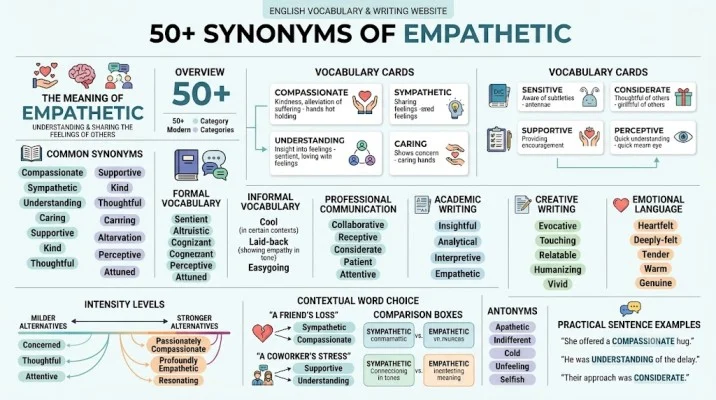
Strong communication starts with understanding how other people feel. Being empathetic means recognizing someone’s emotions and responding with genuine care, patience, and understanding. But repeating the same word can make your writing feel flat. That is where the right empathetic synonym can add precision and variety. Depending on the situation, words such as compassionate, understanding, sensitive, considerate, and caring can express slightly different shades of meaning.
This guide explores the most useful synonyms of empathetic, including practical synonyms for empathetic and the best synonym for empathetic in different contexts. It also explains synonyms of empathic, since “empathic” is a closely related form often used interchangeably with “empathetic.” You will find clear explanations of empathetic meaning synonyms, along with empathetically synonym choices and natural empathetically synonyms for professional and everyday writing. We also cover empathetic antonyms and explain when another word for empathetic works better.
What Are the Best Synonyms of “Empathetic”?
The best synonyms of empathetic include compassionate, understanding, sympathetic, sensitive, caring, considerate, supportive, and perceptive. For formal writing, use compassionate or sympathetic. For professional communication, understanding and supportive work naturally. Emotional and creative writing can benefit from tenderhearted, warmhearted, or caring.
Meaning, Tone, and Context
Simple Definition
Empathetic describes someone who can understand and recognize another person’s feelings, emotions, or experiences, often by imagining what that person may be going through.
An empathetic person does more than simply notice that someone is upset. They try to understand the emotional experience behind the situation and respond with awareness and care.
For example:
“The counselor was empathetic when listening to the student’s concerns.”
The sentence suggests that the counselor understood the student’s feelings and responded sensitively.
Part of Speech
Empathetic is an adjective.
It describes people, behavior, communication, leadership styles, responses, and attitudes.
Overall Tone
The word empathetic generally has a positive tone. It suggests emotional awareness, kindness, understanding, and sensitivity toward other people.
Formality Level
Empathetic is generally neutral to semi formal. It works comfortably in everyday conversation, professional communication, academic writing, psychology related discussions, workplace descriptions, and personal writing.
Common Uses
Native English speakers commonly use empathetic when describing:
- An empathetic person
- An empathetic listener
- An empathetic teacher
- An empathetic manager
- An empathetic leader
- An empathetic response
- An empathetic approach
- An empathetic attitude
- An empathetic conversation
- An empathetic personality
- Empathetic communication
- Empathetic behavior
Word Forms
| Word | Part of Speech | Example |
|---|---|---|
| Empathetic | Adjective | She is an empathetic manager. |
| Empathy | Noun | He showed empathy toward the patient. |
| Empathetically | Adverb | She listened empathetically to her friend. |
| Empathize | Verb | I can empathize with what you are experiencing. |
| Empathic | Adjective | The counselor used an empathic approach. |
Empathetic and empathic are both established adjectives. Empathetic is common in general American English, while empathic is also frequently used, especially in professional, psychological, and academic contexts.
When and How to Use “Empathetic”
Use empathetic when you want to emphasize someone’s ability to understand another person’s feelings or emotional experience. It is especially useful when describing communication, leadership, relationships, counseling, teaching, customer service, and interpersonal skills.
Professional
“An empathetic manager can create a workplace where employees feel heard and respected.”
Academic
“Empathetic communication can influence how individuals respond to difficult social situations.”
Workplace
“Our team needs an empathetic approach when handling employee concerns.”
Personal
“My sister has always been empathetic when I need someone to talk to.”
“Thank you for your empathetic response to my situation.”
Resume
“Developed an empathetic communication style that strengthened relationships with clients.”
Social Media
“Being empathetic does not mean agreeing with everyone. It means taking the time to understand their perspective.”
Best Synonyms of “Empathetic”
No synonym for empathetic works perfectly in every sentence. The best choice depends on whether you want to emphasize emotional understanding, compassion, kindness, sensitivity, support, or awareness.
Professional Writing: Compassionate
Compassionate is an excellent choice when describing someone who understands suffering and responds with concern or a desire to help.
Example:
“She is a compassionate leader who supports employees during difficult periods.”
It works particularly well in healthcare, education, leadership, nonprofit work, and customer service.
Academic Writing: Sympathetic
Sympathetic can work well in academic writing when the meaning involves understanding or sharing another person’s feelings.
Example:
“The counselor adopted a sympathetic approach when discussing the student’s experience.”
It is useful when discussing emotional responses, interpersonal relationships, literature, or social behavior.
Business Communication: Understanding
Understanding is natural and professional without sounding overly emotional.
Example:
“We appreciate your understanding during this transition.”
It works especially well in customer emails, workplace communication, and sensitive business situations.
Casual Conversation: Caring
Caring sounds warm, natural, and conversational.
Example:
“She is one of the most caring people I know.”
It is better suited to everyday communication than highly formal alternatives.
Emotional Writing: Tenderhearted
Tenderhearted describes someone who is especially gentle, compassionate, and emotionally sensitive.
Example:
“His tenderhearted nature made him especially attentive to people who were struggling.”
It creates a stronger emotional impression than the neutral word empathetic.
Creative Writing: Warmhearted
Warmhearted conveys kindness, generosity, and emotional warmth.
Example:
“The warmhearted teacher welcomed every new student as though they already belonged.”
It works especially well in storytelling and character descriptions.
Resume Writing: Supportive
Supportive is often more practical than empathetic on a resume because it describes a workplace behavior that can be demonstrated.
Example:
“Maintained a supportive environment for clients facing complex challenges.”
Workplace Communication: Considerate
Considerate emphasizes awareness of other people’s needs and feelings.
Example:
“She is a considerate colleague who respects different working styles.”
Stronger Meaning: Compassionate
When you want to emphasize both emotional understanding and a desire to help, compassionate is usually stronger than empathetic.
Example:
“The organization provides compassionate care to families facing difficult circumstances.”
Softer Meaning: Understanding
When you want to communicate emotional awareness without sounding overly emotional, understanding is a softer alternative.
Example:
“Thank you for being understanding about the unexpected delay.”
When Not to Use “Empathetic”
Although empathetic is useful, it can sometimes be too broad or less natural than a more specific alternative.
When the Meaning Is About Helping
Less precise:
“She is an empathetic nurse.”
Better:
“She is a compassionate nurse.”
Why:
Compassionate emphasizes both emotional awareness and concern for someone who needs help.
When the Meaning Is Simply Understanding
Less natural:
“Thank you for being empathetic about the delay.”
Better:
“Thank you for being understanding about the delay.”
Why:
Understanding is a more natural choice for everyday apologies, requests, and explanations.
When You Mean Someone Is Kind
Less precise:
“He is an empathetic person who always helps others.”
Better:
“He is a kind person who always helps others.”
Why:
If the focus is general kindness rather than emotional understanding, kind is clearer.
When You Mean Someone Is Sensitive
Less precise:
“She is empathetic to changes in the customer’s mood.”
Better:
“She is sensitive to changes in the customer’s mood.”
Why:
Sensitive can describe the ability to notice subtle emotional signals.
When You Mean Someone Provides Support
Less precise:
“My manager was empathetic during the project.”
Better:
“My manager was supportive during the project.”
Why:
Supportive directly communicates helpful behavior rather than emotional understanding alone.
When the Writing Is Highly Formal
In some formal documents, empathetic may sound less precise than a word that describes the specific behavior.
Less precise:
“The organization uses an empathetic approach.”
Better:
“The organization uses a compassionate and patient centered approach.”
Why:
The revised wording explains what the organization actually does instead of relying on a broad personal quality.
Words Commonly Confused With “Empathetic”
| Word | Difference | When to Use It | Example |
|---|---|---|---|
| Sympathetic | Shows concern or shares another person’s feelings, but does not necessarily imply deeply understanding their experience. | Emotional support and expressions of concern. | “She was sympathetic when I explained the problem.” |
| Compassionate | Combines concern for suffering with a desire to help. | Healthcare, leadership, caregiving, and difficult situations. | “The doctor gave compassionate care.” |
| Understanding | Shows that you recognize someone’s situation or reasons. | Everyday conversation and professional communication. | “Thank you for being understanding.” |
| Sensitive | Shows awareness of feelings, reactions, or subtle emotional details. | Emotional situations and interpersonal communication. | “He is sensitive to the needs of his coworkers.” |
| Caring | Shows concern and affection toward others. | Personal relationships and everyday speech. | “She is a caring friend.” |
| Supportive | Describes behavior that encourages or helps someone. | Workplace, education, relationships, and coaching. | “Her manager was supportive during the transition.” |
Best Synonyms of “Empathetic” by Context
| Context | Best Synonym | Why It Works | Example |
|---|---|---|---|
| Formal writing | Compassionate | Communicates concern with professional clarity. | “The program promotes compassionate care.” |
| Academic writing | Sympathetic | Fits discussions of emotional understanding. | “The study examined sympathetic responses.” |
| Professional communication | Understanding | Sounds natural and respectful. | “We appreciate your understanding.” |
| Business emails | Considerate | Communicates respect for another person’s situation. | “Thank you for your considerate response.” |
| Resume writing | Supportive | Describes a useful workplace behavior. | “Created a supportive client experience.” |
| Workplace communication | Understanding | Works well in sensitive conversations. | “She took an understanding approach.” |
| Casual conversation | Caring | Sounds warm and natural. | “He’s a very caring person.” |
| Everyday speaking | Kind | Simple and widely understood. | “She was kind when I needed help.” |
| Creative writing | Warmhearted | Adds emotional warmth to descriptions. | “The warmhearted neighbor helped the family.” |
| Storytelling | Tenderhearted | Creates a more emotional character description. | “The tenderhearted child rescued the injured bird.” |
| Emotional writing | Compassionate | Strongly communicates concern and care. | “Her compassionate response brought comfort.” |
| Strong emphasis | Compassionate | Adds concern and a desire to help. | “He offered compassionate support.” |
| Mild tone | Understanding | Communicates awareness without strong emotion. | “She was understanding about the mistake.” |
| Social media captions | Caring | Short, friendly, and relatable. | “A little caring can change someone’s day.” |
| American English | Empathetic | Natural and widely understood in modern usage. | “She is an empathetic leader.” |
| British English | Empathetic | Also commonly understood and used. | “He took an empathetic approach.” |
How to Choose the Best Synonym of “Empathetic”
Choosing the best synonym becomes easier when you identify the exact quality you want to describe.
If You Mean Emotional Understanding
Choose understanding or sympathetic.
Example:
“She was understanding when I explained why I missed the meeting.”
If You Mean Concern Plus Action
Choose compassionate.
Example:
“The organization provides compassionate support to vulnerable families.”
If You Mean General Kindness
Choose caring or kind.
Example:
“She is a caring teacher who makes students feel comfortable.”
If You Mean Practical Help
Choose supportive.
Example:
“My supervisor was supportive when I started the new role.”
If You Mean Awareness of Feelings
Choose sensitive or perceptive.
Example:
“He is perceptive enough to notice when someone feels uncomfortable.”
If You Want a Professional Tone
Choose understanding, considerate, compassionate, supportive, or sensitive, depending on the intended meaning.
If You Want an Emotional Tone
Choose compassionate, tenderhearted, warmhearted, or caring.
The strongest synonym is not always the best synonym. The goal is to choose the word that communicates your intended meaning naturally to your specific audience.
Real Life Examples of “Empathetic”
School
Original:
“Ms. Davis is an empathetic teacher.”
Improved:
“Ms. Davis is a compassionate teacher who recognizes when students need additional support.”
College
Original:
“An empathetic professor can help students feel comfortable.”
Improved:
“An understanding professor can create an environment where students feel comfortable discussing challenges.”
Workplace
Original:
“Our manager is empathetic.”
Improved:
“Our manager is supportive and takes employee concerns seriously.”
Business
Original:
“The company needs an empathetic customer service strategy.”
Improved:
“The company needs a customer focused and compassionate service strategy.”
Original:
“Thank you for being empathetic about my situation.”
Improved:
“Thank you for being understanding about my situation.”
Resume
Original:
“Empathetic professional with strong communication skills.”
Improved:
“Compassionate and supportive professional with strong interpersonal communication skills.”
Conversation
Original:
“She’s very empathetic.”
Improved:
“She’s incredibly understanding and always listens without judging.”
Storytelling
Original:
“The king was empathetic toward the villagers.”
Improved:
“The compassionate king listened to the villagers and worked to ease their suffering.”
Blogging
Original:
“An empathetic writer understands the reader.”
Improved:
“A reader focused writer understands the concerns, expectations, and emotions of the audience.”
Social Media
Original:
“Being empathetic matters.”
Improved:
“Being compassionate and understanding can make difficult conversations easier.”
25 Best Synonyms of “Empathetic”
The following alternatives are grouped by practical usage. Some are close synonyms, while others emphasize a specific aspect of empathy, such as compassion, emotional awareness, kindness, or support.
| Synonym | Simple Meaning | Best Used For | Example Sentence |
|---|---|---|---|
| Compassionate | Understanding suffering and wanting to help | Healthcare, leadership | She gave compassionate support to the family. |
| Sympathetic | Showing concern for someone’s feelings | Personal and emotional situations | He was sympathetic when I shared my concerns. |
| Understanding | Recognizing another person’s situation | Everyday and professional communication | My supervisor was understanding about the delay. |
| Sensitive | Aware of feelings and emotional reactions | Workplace and personal settings | She is sensitive to the needs of others. |
| Caring | Showing genuine concern for others | Relationships and everyday speech | He is a caring friend and mentor. |
| Considerate | Thinking about other people’s feelings and needs | Workplace and social situations | She was considerate of everyone’s schedule. |
| Supportive | Providing encouragement or practical help | Work, education, relationships | The team was supportive during the transition. |
| Kind | Friendly and considerate | Everyday conversation | The teacher was kind to the nervous student. |
| Kindhearted | Naturally caring and generous toward others | Personal and creative writing | Her kindhearted nature made everyone feel welcome. |
| Warmhearted | Friendly, affectionate, and emotionally warm | Creative and personal writing | The warmhearted neighbor welcomed the new family. |
| Tenderhearted | Easily moved by others’ suffering | Literary and emotional writing | His tenderhearted nature made him protective of animals. |
| Humane | Showing concern for people’s welfare and dignity | Formal and social issues | The organization promotes humane treatment. |
| Benevolent | Showing a desire to do good | Formal writing | The benevolent donor supported the community program. |
| Solicitous | Showing attentive concern for another person | Formal writing | She was solicitous of her elderly parent’s needs. |
| Perceptive | Quick to notice feelings or subtle signals | Professional and interpersonal writing | He is perceptive about changes in team morale. |
| Attentive | Giving careful attention to another person | Service and relationships | The counselor was attentive to every concern. |
| Receptive | Open to another person’s thoughts and feelings | Communication and workplace settings | The manager was receptive to employee feedback. |
| Thoughtful | Showing care through attention and consideration | Personal and professional writing | It was thoughtful of her to check on the new employee. |
| Gentle | Kind and careful in behavior | Personal and emotional writing | He used a gentle tone during the difficult conversation. |
| Patient | Calmly allowing someone time or difficulty | Teaching and support | The tutor was patient with struggling students. |
| Nurturing | Encouraging growth and emotional well being | Education, parenting, leadership | She created a nurturing environment for young learners. |
| Responsive | Reacting appropriately to another person’s needs | Professional communication | The counselor was responsive to the client’s concerns. |
| Reassuring | Helping someone feel calmer and safer | Emotional support | Her reassuring words helped him regain confidence. |
| Commiserative | Expressing sympathy with someone else’s difficulty | Formal or literary contexts | He offered a commiserative response after the loss. |
| Compassionate minded | Inclined toward compassion and understanding | Descriptive writing | The compassionate minded leader listened carefully to staff concerns. |
Synonyms of “Empathetic” by Usage
Professional vs Personal Synonyms
- Professional settings usually benefit from precise words that describe observable behavior.
Professional choices:
- Compassionate
- Understanding
- Supportive
- Considerate
- Sensitive
- Responsive
Personal choices:
- Caring
- Kind
- Warmhearted
- Tenderhearted
- Thoughtful
- Gentle
For a resume, supportive or compassionate may be more useful than empathetic because they can describe actions and professional behavior.
For personal writing, caring and warmhearted often sound more natural.
Formal vs Conversational Synonyms
Formal writing should favor precise vocabulary that communicates the intended meaning without sounding overly emotional.
Reports:
- Compassionate
- Humane
- Sympathetic
- Sensitive
Essays:
- Sympathetic
- Compassionate
- Understanding
- Sensitive
Business writing:
- Understanding
- Considerate
- Supportive
- Responsive
Presentations:
- Empathetic
- Compassionate
- Supportive
Emails:
- Understanding
- Considerate
- Supportive
Casual conversations:
- Caring
- Kind
- Understanding
- Supportive
Texting:
- Caring
- Kind
- Understanding
Academic Synonyms
Academic writing requires care because several words associated with empathy have slightly different meanings.
Empathic
Empathic is a direct adjective related to empathy and can work well in psychology, counseling, education, and communication research.
Sympathetic
Sympathetic is useful when discussing emotional understanding or a compassionate response.
Compassionate
Compassionate is appropriate when empathy is connected with concern for suffering and a desire to help.
Sensitive
Sensitive works when the emphasis is on awareness of emotional signals or individual needs.
Understanding
Understanding is useful when discussing a person’s ability to recognize another person’s perspective or circumstances.
Academic writing should favor the word that describes the specific behavior being discussed rather than choosing a synonym simply because it sounds more sophisticated.
Professional and Business Synonyms
Resumes
Use supportive, compassionate, considerate, or empathetic when describing interpersonal strengths.
Example:
“Provided compassionate support to clients during complex service interactions.”
Interviews
Use understanding or empathetic when explaining how you communicate with people.
Example:
“I use an empathetic communication style when resolving customer concerns.”
Meetings
Considerate and receptive can work well when describing collaboration.
Example:
“She was receptive to different viewpoints during the meeting.”
Presentations
Empathetic and audience focused are useful when discussing communication strategies.
Example:
“An empathetic presentation considers the audience’s concerns and expectations.”
Performance Reviews
Supportive, considerate, and understanding describe workplace behavior naturally.
Example:
“He maintains a supportive relationship with team members.”
Client Communication
Understanding, responsive, and compassionate can be effective.
Example:
“Our representatives provide responsive and considerate service.”
Business Emails
Understanding is often the most natural choice.
Example:
“Thank you for your understanding while we resolve this issue.”
Creative and Literary Synonyms
Creative writing gives you more freedom to choose words that create emotional texture.
Warmhearted
Useful for characters who make others feel welcome.
Tenderhearted
Useful when describing someone who is deeply affected by suffering.
Compassionate
Useful for characters who respond to hardship by helping others.
Caring
Useful for simple, natural character descriptions.
Gentle
Useful when empathy appears through a person’s behavior or manner.
Kindhearted
Useful when describing a person’s overall character.
Perceptive
Useful when a character notices emotions that other people overlook.
For literary writing, choose the word that reveals something about the character instead of simply replacing empathetic.
Slang or Modern Synonyms
There is no single widely accepted slang word that directly means empathetic.
Casual expressions such as understanding, caring, kind, or a good listener are more natural in everyday American English.
For example:
“She’s really good at understanding what people are going through.”
This sounds more conversational than trying to replace empathetic with an unusual slang term.
Expressions such as emotionally aware and emotionally intelligent are also common in modern communication, but they are not exact synonyms. They describe related qualities rather than empathy itself.
Strongest to Mildest Synonyms
Empathy is not naturally measured on one fixed scale because different synonyms emphasize different qualities. However, the following practical scale can help when choosing vocabulary.
| Level | Useful Words | Main Emphasis |
|---|---|---|
| Mild | Understanding, attentive, considerate | Awareness and respect |
| Moderate | Caring, sensitive, supportive, sympathetic | Emotional concern |
| Strong | Empathetic, compassionate, nurturing | Deep emotional understanding or care |
| Very Strong | Tenderhearted, deeply compassionate | Strong emotional sensitivity |
A word such as critical would not be appropriate here because it describes intensity of importance rather than intensity of empathy.
Emotional vs Neutral Synonyms
Emotional Synonyms
These words create stronger warmth or feeling:
- Compassionate
- Tenderhearted
- Warmhearted
- Caring
- Kindhearted
- Nurturing
- Gentle
They are especially useful in personal stories, character descriptions, emotional messages, and relationship writing.
Neutral Synonyms
These words communicate emotional awareness without adding much sentiment:
- Understanding
- Sensitive
- Considerate
- Supportive
- Perceptive
- Responsive
- Receptive
They are generally better for workplace communication, professional writing, reports, and practical descriptions.
Antonyms of “Empathetic”
There is no single perfect opposite of empathetic in every context. Some antonyms describe a lack of emotional understanding, while others describe indifference, coldness, or active cruelty.
| Antonym | Meaning | Example Sentence |
|---|---|---|
| Unempathetic | Not showing empathy | His unempathetic response made the situation worse. |
| Unempathic | Lacking empathy or emotional understanding | The counselor avoided an unempathic approach. |
| Insensitive | Not considering another person’s feelings | His insensitive comment upset the team. |
| Unsympathetic | Showing little concern for another person’s difficulties | The manager seemed unsympathetic to their concerns. |
| Uncaring | Showing little concern for others | His uncaring attitude affected team morale. |
| Inconsiderate | Failing to consider other people’s needs | It was inconsiderate to interrupt her repeatedly. |
| Callous | Emotionally hardened and lacking concern | His callous response shocked everyone. |
| Cold | Lacking warmth or emotional connection | Her response sounded cold and distant. |
| Indifferent | Showing little or no interest or concern | He appeared indifferent to their concerns. |
| Unfeeling | Showing little emotional sensitivity | The statement sounded unfeeling. |
| Heartless | Showing an extreme lack of compassion | The decision seemed heartless to the community. |
| Detached | Emotionally distant or uninvolved | He remained detached during the conversation. |
| Apathetic | Showing little interest, feeling, or concern | The audience seemed apathetic about the issue. |
| Harsh | Severe or lacking gentleness | Her harsh response discouraged the student. |
| Cruel | Deliberately causing pain or suffering | His cruel behavior deeply hurt the family. |
Comparison: “Empathetic” vs Similar Words
Empathetic vs Sympathetic
Main Difference
Empathetic emphasizes understanding another person’s emotional experience. Sympathetic usually expresses concern, pity, or shared feeling.
Which Is Stronger?
Empathetic often suggests deeper emotional understanding, while sympathetic can be a simpler expression of concern.
Which Is More Formal?
Both are suitable for formal writing.
When to Use Each
Use empathetic when discussing emotional understanding. Use sympathetic when expressing concern for someone’s difficulty.
Examples
Empathetic:
“The counselor was empathetic toward the student’s anxiety.”
Sympathetic:
“The counselor was sympathetic to the student’s difficulties.”
Empathetic vs Compassionate
Main Difference
Empathetic focuses on understanding feelings. Compassionate adds concern and often a desire to help.
Which Is Stronger?
Compassionate can be stronger when action or care is involved.
Which Is More Formal?
Both work well in professional settings.
When to Use Each
Use empathetic for emotional understanding. Use compassionate for care, suffering, and support.
Examples
Empathetic:
“She gave an empathetic response.”
Compassionate:
“She provided compassionate care.”
Empathetic vs Understanding
Main Difference
Understanding is broader and often means recognizing someone’s situation. Empathetic specifically emphasizes emotional understanding.
Which Is Stronger?
Empathetic usually carries a stronger emotional meaning.
Which Is More Formal?
Both are neutral and widely useful.
When to Use Each
Use understanding for everyday and professional communication. Use empathetic when emotional awareness is central.
Examples
Empathetic:
“He is an empathetic listener.”
Understanding:
“She was understanding about my mistake.”
Empathetic vs Sensitive
Main Difference
Sensitive can mean aware of another person’s feelings, but it has several other meanings, including easily affected or responsive to physical conditions.
Which Is Stronger?
Neither is always stronger. Their meanings overlap only in emotional contexts.
Which Is More Formal?
Both are appropriate in formal and informal settings.
When to Use Each
Use sensitive when you want to emphasize awareness of emotional signals.
Examples
Empathetic:
“She gave an empathetic response.”
Sensitive:
“She was sensitive to his discomfort.”
Empathetic vs Caring
Main Difference
Caring describes concern and affection, while empathetic specifically describes the ability to understand another person’s feelings.
Which Is Stronger?
They emphasize different qualities rather than different levels.
Which Is More Formal?
Empathetic is more suitable for professional descriptions.
When to Use Each
Use caring for relationships and personal descriptions. Use empathetic for communication and emotional awareness.
Examples
Empathetic:
“He is an empathetic counselor.”
Caring:
“He is a caring friend.”
Empathetic vs Supportive
Main Difference
Supportive focuses on providing help, encouragement, or assistance. Empathetic focuses on understanding feelings.
Which Is Stronger?
Neither is automatically stronger.
Which Is More Formal?
Both work well professionally.
When to Use Each
Use supportive when the person’s actions matter. Use empathetic when their emotional understanding matters.
Examples
Empathetic:
“She was empathetic toward the employee.”
Supportive:
“She was supportive during the employee’s transition.”
Common Phrases and Expressions with “Empathetic”
Empathetic Person
Meaning: Someone who understands and responds sensitively to other people’s feelings.
Example Sentence:
“An empathetic person can make difficult conversations feel safer.”
Empathetic Listener
Meaning: Someone who listens while trying to understand another person’s emotional experience.
Example Sentence:
“Good counselors need to be empathetic listeners.”
Empathetic Approach
Meaning: A way of dealing with people that considers their emotions and perspectives.
Example Sentence:
“The company adopted an empathetic approach to customer complaints.”
Empathetic Communication
Meaning: Communication that recognizes and responds to another person’s feelings.
Example Sentence:
“Empathetic communication can reduce tension during difficult discussions.”
Empathetic Leadership
Meaning: Leadership that considers employees’ experiences, needs, and feelings.
Example Sentence:
“Empathetic leadership can help employees feel heard.”
Empathetic Response
Meaning: A response that acknowledges another person’s emotional experience.
Example Sentence:
“Her empathetic response helped calm the frustrated customer.”
Empathetic Support
Meaning: Support that combines practical help with emotional understanding.
Example Sentence:
“The counselor provided empathetic support throughout the process.”
Common Mistakes to Avoid
1. Treating Every Synonym as Identical
Incorrect:
“She was compassionate because she understood his feelings.”
Better:
“She was empathetic because she understood his feelings.”
Why:
Empathetic specifically focuses on emotional understanding, while compassionate can additionally suggest a desire to help.
2. Using “Sympathetic” When You Mean Deep Understanding
Incorrect:
“My friend was sympathetic because she understood exactly how I felt.”
Better:
“My friend was empathetic because she understood how I felt.”
Why:
Empathetic more directly communicates emotional perspective taking.
3. Using “Empathetic” When You Mean General Kindness
Incorrect:
“The receptionist was empathetic when she gave me directions.”
Better:
“The receptionist was kind when she gave me directions.”
Why:
The example describes kindness, not necessarily emotional understanding.
4. Using Informal Words in Professional Writing
Incorrect:
“She is a really caring person at work.”
Better:
“She is a supportive and considerate professional.”
Why:
The revised version describes workplace behavior more specifically.
5. Choosing an Overly Emotional Word
Incorrect:
“The manager was tenderhearted during the budget meeting.”
Better:
“The manager was understanding during the budget meeting.”
Why:
Tenderhearted can sound literary or emotionally intense in a business context.
6. Repeating “Empathetic” Too Often
Incorrect:
“She is empathetic, uses empathetic communication, and has an empathetic leadership style.”
Better:
“She is empathetic, communicates thoughtfully, and uses a supportive leadership style.”
Why:
Varied wording improves readability while preserving the intended meaning.
7. Confusing Empathy With Agreement
Incorrect:
“Being empathetic means agreeing with someone’s opinion.”
Better:
“Being empathetic means trying to understand someone’s feelings or perspective, even when you disagree.”
Why:
Empathy involves understanding another person’s experience. It does not require agreement.
Frequently Asked Questions
What is a good synonym for empathetic?
Good synonyms for empathetic include understanding, compassionate, caring, sensitive, considerate, and sympathetic.
What are the common synonyms of empathetic?
Common synonyms of empathetic include compassionate, understanding, caring, considerate, sensitive, and sympathetic.
What are synonyms for empathetic?
Synonyms for empathetic include compassionate, understanding, supportive, caring, sensitive, and considerate.
What is a synonym for empathetic in professional writing?
In professional writing, understanding, compassionate, and considerate are useful alternatives, depending on the context.
What are synonyms of empathic?
Synonyms of empathic include empathetic, compassionate, understanding, sensitive, and caring.
What are empathetic meaning synonyms?
Words with a similar meaning to empathetic include compassionate, understanding, sensitive, caring, and considerate.
What is another word for empathetic?
Another word for empathetic can be compassionate, understanding, caring, sensitive, or considerate.
What is an empathetically synonym?
Depending on the sentence, an empathetically synonym can be compassionately, understandingly, sensitively, or sympathetically.
What are empathetically synonyms?
Common empathetically synonyms include compassionately, sensitively, sympathetically, and understandingly.
What are the antonyms of empathetic?
Common empathetic antonyms include insensitive, uncaring, indifferent, unsympathetic, and inconsiderate.
What are the best synonyms of “empathetic”?
The best synonyms of empathetic include compassionate, understanding, sympathetic, sensitive, caring, considerate, supportive, and perceptive. The ideal choice depends on whether you want to emphasize emotional understanding, kindness, concern, or practical support.
What are the best formal synonyms of “empathetic”?
The strongest formal alternatives include compassionate, sympathetic, sensitive, humane, considerate, and solicitous. For academic and professional writing, choose the word that most accurately describes the specific type of emotional awareness or concern.
What are common informal synonyms of “empathetic”?
Common informal alternatives include understanding, caring, kind, supportive, and thoughtful. These words sound natural in everyday conversations, texts, personal messages, and social media without making the language unnecessarily formal.
What is another word for “empathetic” in professional writing?
In professional writing, useful alternatives include compassionate, understanding, supportive, considerate, sensitive, and responsive. Understanding is especially natural for workplace messages, while supportive works well when describing observable professional behavior.
What is the difference between “empathetic” and “sympathetic”?
Empathetic focuses on understanding another person’s feelings or perspective, while sympathetic usually expresses concern or shared feeling. Empathy often suggests deeper emotional understanding, whereas sympathy can simply communicate compassion or concern.
What is the opposite of “empathetic”?
Common opposites include unempathetic, insensitive, unsympathetic, uncaring, inconsiderate, callous, indifferent, unfeeling, and apathetic. The most appropriate opposite depends on whether you mean a lack of understanding, concern, emotional warmth, or compassion.
Conclusion
Empathetic describes the ability to understand another person’s feelings, experiences, or perspective with emotional awareness. Although it is a useful and natural word, the best alternative depends on what you actually want to communicate.
Use compassionate when concern is combined with a desire to help, understanding for a softer everyday or professional tone, supportive when practical encouragement matters, and caring for warm personal descriptions. Words such as sympathetic, sensitive, considerate, perceptive, and kind each highlight a slightly different aspect of emotional awareness.
The most useful way to choose among the synonyms of empathetic is to identify the exact quality you want your reader to notice. Before replacing a word, ask whether you mean understanding, compassion, kindness, sensitivity, or support. That small distinction can make your writing much more precise and natural.
Read More Related Articles:
- 50+ Synonyms of Because | Meanings, Uses, Examples, and …
- 50+ Synonyms of The | Meanings, Uses, Examples, and Best …