A writer describing a building, a city’s skyline, or the structure of a digital system may quickly use the word “architecture” several times. Repeating the same term in an essay, blog post, design report, or professional document can make otherwise strong writing feel predictable.
Learning the right synonyms of architecture gives you more precise ways to describe buildings, design systems, structural concepts, artistic styles, and organized frameworks. Words such as structure, design, framework, construction, and composition can work in different contexts, but they are not always interchangeable. The best choice depends on what you are actually describing and how formal or technical your writing needs to be.
What Are the Best Synonyms of “Architecture”?
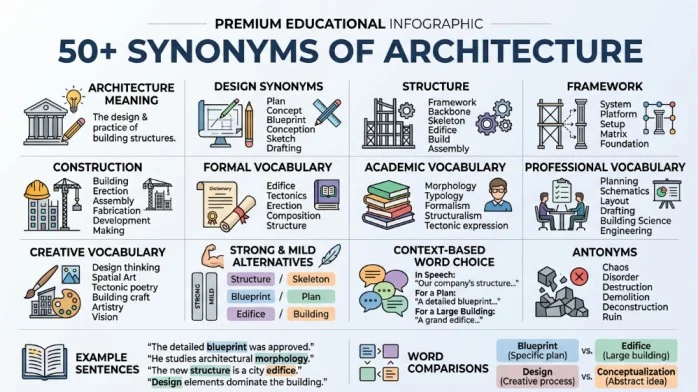
Architecture generally refers to the design and organization of buildings or other structures, and it can also describe the underlying structure of systems. The best alternatives include design, structure, framework, construction, composition, layout, and building design, depending on context. Formal and academic writing often favors structure, framework, or design.
Meaning, Tone, and Context
Simple Definition
Architecture is the art, science, and practice of designing and creating buildings and physical environments. The word can also describe the organized structure of something more abstract, such as computer software, a business system, or an information framework.
For example:
“Modern architecture often combines practical function with visual appeal.”
The word can therefore refer both to the physical result of design and to the principles or organization behind that result.
Part of Speech
Architecture is primarily a noun.
It is usually an uncountable noun when referring to the field or general concept.
Example:
“She studied architecture in college.”
It can also refer to a particular style, design tradition, or structural arrangement.
Example:
“The city’s architecture reflects several historical periods.”
Overall Tone
The word architecture is generally neutral and professional. It can become technical when used in fields such as engineering, software development, urban planning, and information technology.
It does not inherently express positive or negative emotion.
Formality Level
Architecture is a neutral to formal word.
It is appropriate in:
- Academic writing
- Professional reports
- Design discussions
- Construction documents
- Business communication
- Technology writing
- Art criticism
- Urban planning
- Everyday conversation
For casual speech, simpler words such as design or structure may sometimes sound more natural.
Common Uses
Native English speakers commonly use architecture when discussing:
- Building design
- Architectural styles
- Historical buildings
- Urban environments
- Structural organization
- Interior and exterior design
- City planning
- Software systems
- Computer systems
- Information systems
- Business structures
- The design principles behind physical spaces
Examples include:
“She is interested in sustainable architecture.”
“The museum’s architecture attracts thousands of visitors.”
“The software architecture needs to be updated.”
“The city’s architecture combines historic and modern influences.”
Word Forms
| Word | Part of Speech | Example |
|---|---|---|
| Architecture | Noun | Architecture can influence how people experience a space. |
| Architectural | Adjective | The building has architectural significance. |
| Architect | Noun | The architect designed the new library. |
| Architecturally | Adverb | The building is architecturally distinctive. |
When and How to Use “Architecture”
The word architecture is best when you are discussing the overall design, organization, or structural concept of a building, environment, or system.
Professional
“She presented the firm’s approach to sustainable architecture.”
This works well in a professional discussion because architecture refers to a specialized field and design practice.
Academic
“The study examines how architecture influences social interaction.”
Here, architecture refers to the design and organization of physical environments.
Workplace
“Our software architecture needs to support future product updates.”
In technology, architecture refers to how the components of a software system are organized.
Personal
“I have always loved the architecture of old European cities.”
This sentence uses architecture to describe the distinctive building styles and structures found in cities.
“The proposed architecture will give the building a more open and functional interior.”
This works when discussing a design concept with colleagues or clients.
Resume
“Developed architectural concepts for residential and commercial projects.”
The related adjective architectural is appropriate for a professional resume.
Social Media
“Exploring the incredible architecture of Chicago one neighborhood at a time.”
The word sounds natural in a travel or photography caption when discussing buildings and urban design.
Best Synonyms of “Architecture”
No synonym for architecture works perfectly in every situation. The word can describe an entire professional discipline, the design of a building, a structural arrangement, or the organization of an abstract system.
Professional Writing: Design
Design is one of the most useful alternatives when discussing the planning and visual or functional organization of a building.
Example:
“The building’s design emphasizes natural light.”
Use design when you want to focus on how something was planned or created rather than the entire field of architecture.
Academic Writing: Structure
Structure is useful when the discussion focuses on how parts are organized or connected.
Example:
“The structure of the building reflects the principles of modern architecture.”
It is especially effective when the emphasis is on organization rather than artistic appearance.
Business Communication: Framework
Framework works well when architecture refers to an organized system or conceptual structure.
Example:
“The new framework provides a foundation for future development.”
It is particularly useful in technology, business, and organizational writing.
Casual Conversation: Design
In everyday speech, design is often easier and more natural than architecture when discussing the appearance or planning of a building.
Example:
“I really like the design of that house.”
Emotional Writing: Character
When describing the distinctive qualities of a building or place, character can sometimes replace architecture.
Example:
“The old neighborhood has a unique character that modern developments often lack.”
This emphasizes atmosphere and identity rather than technical design.
Creative Writing: Form
Form can be useful in artistic or literary discussions when focusing on shape, arrangement, and visual expression.
Example:
“The building’s unusual form creates a striking presence against the skyline.”
Resume Writing: Architectural Design
For a resume, architectural design is more precise than simply using architecture when describing a professional activity.
Example:
“Experienced in architectural design for residential developments.”
Workplace Communication: Structure
When architecture refers to how a system is organized, structure can provide a straightforward professional alternative.
Example:
“We need to simplify the structure of the platform.”
Stronger Meaning: Framework
When architecture refers to a complex system of interconnected elements, framework can emphasize the organized foundation behind it.
Example:
“The framework supports the company’s long term digital strategy.”
Softer Meaning: Design
When you simply want to discuss how something looks or has been planned, design is usually less technical and more accessible.
Example:
“The building has an elegant design.”
When Not to Use “Architecture”
Although architecture is a flexible word, there are situations where another term provides greater precision.
When the Meaning Is Too General
If you are discussing only the appearance of a building, architecture may be broader than necessary.
Less precise:
“The architecture of the room is beautiful.”
Better:
“The interior design of the room is beautiful.”
The second sentence clearly identifies the part of the environment being discussed.
When You Mean the Physical Arrangement
If your focus is on how components are physically organized, structure may be more accurate.
Less precise:
“The architecture of the bridge is unusual.”
Better:
“The structure of the bridge is unusual.”
When You Mean a Visual Plan
If you are describing the appearance or planning of a product, design is often the better word.
Less precise:
“The architecture of the product is attractive.”
Better:
“The design of the product is attractive.”
When You Mean a Technical System
In technology, architecture is correct when discussing a system’s overall organization. However, framework may be better when referring to a defined development structure or conceptual foundation.
Less precise:
“The architecture helps developers build the application.”
Better:
“The framework helps developers build the application.”
When the Word Sounds Too Technical
Architecture can sound overly specialized in a simple conversation.
More technical:
“I admire the architecture of your house.”
More natural:
“I really like the design of your house.”
When You Mean a Specific Building
Architecture can refer to the style or design of a building, but building itself may be more appropriate when you simply mean the physical structure.
Less precise:
“The architecture was damaged in the storm.”
Better:
“The building was damaged in the storm.”
When You Need to Emphasize Artistic Style
If the main point is artistic appearance, style may communicate the idea more directly.
Less precise:
“The architecture is very colorful.”
Better:
“The architectural style is very colorful and expressive.”
Words Commonly Confused With “Architecture”
Design
Difference: Design focuses on the planning, appearance, and function of something.
When to Use It: Use design when discussing how a building, product, website, or system was planned.
Example:
“The building’s design makes excellent use of natural light.”
Structure
Difference: Structure focuses on how parts are arranged or supported.
When to Use It: Use structure when discussing physical organization or the arrangement of components.
Example:
“The structure of the building was carefully reinforced.”
Construction
Difference: Construction refers mainly to the process of building something.
When to Use It: Use construction when discussing building activity, materials, or the process of creating a structure.
Example:
“Construction of the new library began in June.”
Engineering
Difference: Engineering focuses on applying scientific and mathematical principles to solve practical problems.
When to Use It: Use engineering when the emphasis is on technical performance, safety, and functionality.
Example:
“The bridge required advanced engineering techniques.”
Style
Difference: Style describes the distinctive visual or artistic characteristics of a building or design.
When to Use It: Use style when comparing architectural traditions or appearances.
Example:
“The building combines several architectural styles.”
Framework
Difference: Framework refers to an organized system that provides a foundation for development or operation.
When to Use It: Use framework when discussing software, business systems, theories, or structured processes.
Example:
“The framework provides a clear structure for the project.”
Best Synonyms of “Architecture” by Context
| Context | Best Synonym | Why It Works | Example |
|---|---|---|---|
| Formal writing | Design | Broad and professional | “The design reflects modern principles.” |
| Academic writing | Structure | Emphasizes organization | “The structure of the building influences movement.” |
| Professional communication | Design | Clear and versatile | “The design meets the client’s requirements.” |
| Business emails | Framework | Useful for systems and plans | “The framework supports future expansion.” |
| Resume writing | Architectural design | Precisely describes professional work | “Created architectural designs for residential projects.” |
| Workplace communication | Structure | Easy to understand | “The structure needs further review.” |
| Casual conversation | Design | Natural and accessible | “I love the design of this building.” |
| Everyday speaking | Style | Useful for appearance | “I like the style of that house.” |
| Creative writing | Form | Highlights visual expression | “Its unusual form dominated the skyline.” |
| Storytelling | Character | Describes distinctive identity | “The neighborhood had a unique character.” |
| Emotional writing | Character | Adds atmosphere and personality | “The city’s character comes from its historic buildings.” |
| Strong emphasis | Framework | Highlights an organized system | “The framework supports the entire strategy.” |
| Mild tone | Design | Simple and nontechnical | “The design feels welcoming.” |
| Social media captions | Design | Concise and accessible | “Loving the bold design of this museum.” |
| American English | Design | Common and flexible | “The building’s design is impressive.” |
| British English | Design | Also natural and widely understood | “The design reflects traditional influences.” |
How to Choose the Best Synonym of “Architecture”
Choosing the best alternative begins with identifying exactly what you mean by architecture.
If You Mean Planning and Appearance
Choose design.
Example:
“The building’s design is elegant.”
If You Mean Physical Organization
Choose structure.
Example:
“The structure allows the building to withstand strong winds.”
If You Mean the Building Process
Choose construction.
Example:
“Construction began earlier this year.”
If You Mean Artistic Appearance
Choose style.
Example:
“The architectural style reflects the region’s history.”
If You Mean an Organized System
Choose framework.
Example:
“The framework connects the different parts of the program.”
If You Mean Technical Performance
Choose engineering when the focus is on technical solutions, safety, or physical performance.
Example:
“The bridge’s engineering allows it to carry heavy loads.”
Consider Your Audience
For general readers, design and structure are usually easier to understand.
For architects, engineers, academics, and technology professionals, more specialized terms may provide greater precision.
Consider the Tone
- Use design for a neutral and accessible tone.
- Use structure for a technical or analytical tone.
- Use framework for abstract or system based discussions.
- Use style for artistic descriptions.
Consider the Writing Purpose
A resume may require architectural design.
An academic paper may prefer structure.
A casual conversation may simply use design.
A technical report may require framework or system architecture depending on the subject.
The strongest synonym is not necessarily the most sophisticated word. It is the word that communicates your intended meaning most clearly.
Real Life Examples of “Architecture”
School
Instead of:
“Architecture is an interesting subject.”
Try:
“Architecture is an interesting field because it combines creativity, mathematics, and practical problem solving.”
College
Instead of:
“The architecture of the building was studied.”
Try:
“The structure and design of the building were examined in detail.”
Workplace
Instead of:
“We need to change the architecture.”
Try:
“We need to revise the structure of the system to improve efficiency.”
Business
Instead of:
“The company’s architecture is changing.”
Try:
“The company’s organizational structure is changing as it expands.”
Instead of:
“I have reviewed the architecture.”
Try:
“I have reviewed the proposed design and identified several areas for improvement.”
Resume
Instead of:
“Worked with architecture.”
Try:
“Contributed to architectural design projects for commercial and residential clients.”
Conversation
Instead of:
“I love the architecture of this building.”
You might say:
“I really love the design of this building.”
Storytelling
Instead of:
“The architecture made the city beautiful.”
Try:
“The city’s distinctive character came from its historic buildings and narrow streets.”
Blogging
Instead of:
“The architecture of the website is confusing.”
Try:
“The website’s structure and layout make navigation difficult.”
Social Media
Instead of:
“The architecture of this museum is incredible.”
Try:
“The museum’s design is absolutely striking.”
25 Best Synonyms of “Architecture”
| Synonym | Simple Meaning | Best Used For | Example Sentence |
|---|---|---|---|
| Design | The plan or visual arrangement of something | Buildings, products, general writing | “The building’s design balances beauty and function.” |
| Structure | The way parts are organized or supported | Buildings, systems, analysis | “The structure of the building is remarkably strong.” |
| Framework | An organized foundation or system | Technology, business, abstract systems | “The framework supports the entire application.” |
| Construction | The process or result of building | Building projects | “Construction of the new center began last month.” |
| Layout | The arrangement of elements in a space | Interiors, websites, pages | “The layout creates an open and welcoming environment.” |
| Composition | The arrangement of parts into a whole | Art, design, visual analysis | “The composition creates a strong visual balance.” |
| Form | The shape or physical expression of something | Art, architecture, creative writing | “The building’s curved form attracts attention.” |
| Style | A distinctive design appearance | Historical and artistic discussion | “The structure combines several architectural styles.” |
| Blueprint | A detailed plan for construction or development | Building plans, figurative planning | “The blueprint provided a clear plan for the renovation.” |
| Plan | An intended arrangement or method | General design discussions | “The architect presented a detailed plan.” |
| Scheme | An organized design or arrangement | Formal design discussions | “The design scheme uses natural materials.” |
| Configuration | The way components are arranged | Technology and technical systems | “The system’s configuration was changed for better performance.” |
| Organization | The arrangement of parts or information | Systems and abstract structures | “The organization of the space improves movement.” |
| Arrangement | The way elements are positioned | Interiors, design, general writing | “The arrangement of the rooms maximizes natural light.” |
| Pattern | A repeated or recognizable arrangement | Decorative and structural descriptions | “The facade features a geometric pattern.” |
| Model | A representation of a proposed structure or design | Planning and design | “The team created a model of the proposed building.” |
| System | A connected set of parts working together | Technology and organizational contexts | “The system was designed to process information efficiently.” |
| Foundation | The basic support beneath or behind something | Buildings and abstract systems | “Trust forms the foundation of a successful partnership.” |
| Composition | The way elements are combined | Artistic and visual analysis | “The composition creates a sense of movement.” |
| Formation | The way something develops or takes shape | Historical and structural discussions | “The formation of the neighborhood reflects decades of development.” |
| Blueprinting | The process of creating a detailed plan | Planning and development | “Blueprinting helped the team visualize the project.” |
| Design framework | An organized approach to design | Professional and academic writing | “The design framework guides future development.” |
| Structural design | Planning focused on physical support | Engineering and construction | “The structural design meets modern safety standards.” |
| Building design | The planning and appearance of a building | General architecture discussions | “The building design emphasizes accessibility.” |
| System design | The organization and planning of a technical system | Technology and business | “The system design allows different components to work together.” |
Synonyms of “Architecture” by Usage
Professional vs Personal Synonyms
Professional writing benefits from precise terms such as design, structure, framework, and architectural design.
Personal communication can use simpler alternatives such as design, style, or look, depending on the sentence.
Professional:
“The proposed architectural design meets the client’s functional requirements.”
Personal:
“I really like the style of this house.”
The professional sentence identifies a specialized design activity, while the personal sentence focuses on visual appearance.
Formal vs Conversational Synonyms
For reports, essays, presentations, and business writing, choose words that accurately describe the concept.
Good formal choices include:
- Structure
- Framework
- Design
- Composition
- Configuration
- Architectural design
For casual conversations and texting, simpler terms are often more natural:
- Design
- Style
- Look
- Layout
Example:
Formal:
“The structure of the proposed facility supports efficient circulation.”
Conversational:
“I really like the layout of this place.”
Academic Synonyms
Academic writing requires precision. The best alternative depends on the subject.
- Use structure when analyzing organization.
- Use composition when discussing visual arrangement.
- Use form when examining shape and artistic expression.
- Use framework when discussing an abstract system.
- Use architectural design when referring specifically to professional building design.
Example:
“The structure of the building reflects the social priorities of its historical period.”
Professional and Business Synonyms
Different professional situations require different terms.
Resumes: Use architectural design, design, planning, or structural design.
Interviews: Use design, architecture, or planning based on the role.
Meetings: Use design, structure, or framework.
Presentations: Use architectural design, layout, structure, or system architecture.
Performance Reviews: Use planning, design, or system development when describing responsibilities.
Client Communication: Use design or proposed design because these terms are accessible to nontechnical clients.
Business Emails: Use design, structure, or framework according to the subject.
Example:
“The proposed design addresses the client’s requirements while maintaining a practical layout.”
Creative and Literary Synonyms
Creative writing can benefit from words that focus on shape, atmosphere, and visual identity.
Form emphasizes physical expression.
Style highlights distinctive visual characteristics.
Composition focuses on how visual elements work together.
Character can describe the identity or atmosphere of a place.
Shape can be useful when describing physical appearance.
Example:
“The building’s sweeping form rose above the quiet street like a carefully crafted sculpture.”
Slang or Modern Synonyms
There are no widely accepted slang words that genuinely replace architecture in every context.
In casual speech, people may use expressions such as design, look, or style. These are not exact synonyms, but they can be natural alternatives when the speaker is discussing appearance rather than the broader field of architecture.
For example:
“I love the look of this building.”
This is appropriate in casual conversation but would be too vague for an academic discussion of architectural theory.
Strongest to Mildest Synonyms
Architecture itself does not have a simple emotional intensity scale because it is mainly a neutral descriptive noun. However, its alternatives can vary in specificity and technical emphasis.
Mild and General
Design
Layout
Style
These words are accessible and relatively broad.
Moderate
Structure
Composition
Form
These provide more specific information about organization or appearance.
Stronger and More Technical
Framework
Configuration
Structural design
System architecture
These terms suggest a more organized or technical concept.
Highly Specific
Architectural design
Structural architecture
These phrases are useful when the subject requires professional precision.
The key difference is not emotional strength. It is specificity and technical focus.
Emotional vs Neutral Synonyms
Emotional Synonyms
Some alternatives can add atmosphere or personal feeling.
Character: Suggests identity and atmosphere.
Form: Can sound artistic and expressive.
Style: Can emphasize visual personality.
Beauty: Useful when discussing aesthetic qualities, although it is not a direct synonym for architecture.
Example:
“The historic district has a character that makes it feel timeless.”
Neutral Synonyms
For objective communication, use:
- Design
- Structure
- Framework
- Layout
- Configuration
- Construction
- Composition
Example:
“The structure was designed to improve energy efficiency.”
These terms communicate information without adding strong emotional language.
Antonyms of “Architecture”
Architecture does not have perfect one word antonyms because it describes a field, practice, design concept, or structural organization rather than a simple quality. However, when architecture is used to describe organization or planned design, the following contrasting concepts can be useful.
| Antonym or Contrast | Meaning | Example Sentence |
|---|---|---|
| Disorganization | Lack of orderly arrangement | “The room’s disorganization made movement difficult.” |
| Disorder | A state without clear arrangement | “The disorder made the space difficult to use.” |
| Chaos | Extreme lack of organization | “The interior descended into chaos after the renovation began.” |
| Randomness | Lack of planned order | “The arrangement appeared to result from randomness.” |
| Improvisation | Action without a fixed plan | “The project relied heavily on improvisation.” |
| Informality | Lack of formal structure | “The informal arrangement allowed everyone to move freely.” |
| Simplicity | Minimal organization or complexity | “The design favors simplicity over elaborate structure.” |
| Natural growth | Development without deliberate design | “The village developed through natural growth rather than centralized planning.” |
| Unplanned development | Growth without a coordinated design | “Unplanned development changed the character of the area.” |
| Fragmentation | Division into disconnected parts | “The system suffered from fragmentation.” |
| Breakdown | Failure of an organized system | “The breakdown disrupted the entire process.” |
| Disarray | A confused or untidy arrangement | “The office was left in disarray.” |
| Unstructuredness | Lack of a defined structure | “The unstructuredness of the process created confusion.” |
| Neglect | Failure to maintain or organize something | “Years of neglect damaged the historic property.” |
| Destruction | The removal or severe damage of a structure | “The destruction of the old building changed the neighborhood.” |
Comparison: “Architecture” vs Similar Words
Architecture vs Design
Main Difference
Architecture is broader when discussing the field and practice of designing buildings and environments. Design focuses more directly on planning, appearance, and function.
Which Is Stronger?
Neither is inherently stronger. Architecture is broader, while design is more general.
Which Is More Formal?
Architecture is more specialized. Design is more widely understood.
When to Use Each
Use architecture for the field, discipline, or overall architectural concept.
Use design for the planning or appearance of a specific building.
Examples
Architecture:
“She plans to study architecture.”
Design:
“She created the design for the new library.”
Architecture vs Structure
Main Difference
Architecture focuses on design and organization. Structure focuses on how components are arranged or physically supported.
Which Is Stronger?
Neither is stronger.
Which Is More Formal?
Both can be formal, but structure is often more analytical.
When to Use Each
Use architecture when discussing design principles.
Use structure when discussing organization or physical support.
Examples
Architecture:
“The architecture of the museum is distinctive.”
Structure:
“The structure can withstand heavy winds.”
Architecture vs Construction
Main Difference
Architecture concerns planning and design. Construction concerns the process of building.
Which Is Stronger?
Neither.
Which Is More Formal?
Both are professional terms.
When to Use Each
Use architecture before and during design discussions.
Use construction when discussing the actual building process.
Examples
Architecture:
“The architecture emphasizes natural materials.”
Construction:
“Construction began in March.”
Architecture vs Engineering
Main Difference
Architecture focuses on designing spaces and buildings. Engineering focuses on technical performance, safety, and practical solutions.
Which Is Stronger?
Neither.
Which Is More Formal?
Both are specialized professional terms.
When to Use Each
Use architecture for spatial and design decisions.
Use engineering for structural, mechanical, electrical, or technical solutions.
Examples
Architecture:
“The architecture creates a strong connection with the surrounding landscape.”
Engineering:
“The engineering team calculated the building’s structural requirements.”
Architecture vs Style
Main Difference
Architecture can describe the field or design of buildings. Style describes the distinctive visual characteristics of that design.
Which Is Stronger?
Architecture is broader.
Which Is More Formal?
Architecture is more specialized.
When to Use Each
Use style when comparing visual traditions.
Use architecture when discussing building design more broadly.
Examples
Architecture:
“The city’s architecture reflects its history.”
Style:
“The building has a distinctive Art Deco style.”
Architecture vs Framework
Main Difference
Architecture can describe the organization of a physical or technical system. Framework emphasizes the underlying structure that guides development or operation.
Which Is Stronger?
Framework can sound more specific when discussing abstract systems.
Which Is More Formal?
Both are suitable for professional writing.
When to Use Each
Use architecture for the overall system design.
Use framework for the organized foundation or model supporting that system.
Examples
Architecture:
“The software architecture connects several independent services.”
Framework:
“The framework gives developers a consistent structure for building applications.”
Common Phrases and Expressions with “Architecture”
Architectural Design
Meaning: The planning and design of buildings and spaces.
Example Sentence:
“The firm specializes in sustainable architectural design.”
Modern Architecture
Meaning: Architecture associated with modern design principles and approaches.
Example Sentence:
“The museum is an excellent example of modern architecture.”
Ancient Architecture
Meaning: Building design and construction associated with ancient civilizations.
Example Sentence:
“Students studied ancient architecture to understand how early societies built cities.”
Traditional Architecture
Meaning: Building styles and practices associated with a particular culture or historical tradition.
Example Sentence:
“The village is known for its traditional architecture.”
Software Architecture
Meaning: The overall organization and design of a software system.
Example Sentence:
“The development team redesigned the software architecture to improve scalability.”
Architectural Style
Meaning: A recognizable approach or visual tradition in building design.
Example Sentence:
“The city’s architectural style reflects several historical periods.”
Architecture Firm
Meaning: A professional company that provides architectural services.
Example Sentence:
“She joined an architecture firm after completing her degree.”
Architectural Features
Meaning: Distinctive design elements found in a building.
Example Sentence:
“The building’s architectural features include large windows and decorative stonework.”
Common Mistakes to Avoid
1. Treating Every Synonym as Identical
Incorrect:
“The construction of the building is beautiful.”
Better:
“The design of the building is beautiful.”
Why:
Construction refers mainly to the building process, while design refers to the planned appearance and function.
2. Confusing Architecture With Construction
Incorrect:
“Architecture of the new building will begin next month.”
Better:
“Construction of the new building will begin next month.”
Why:
Construction is the physical process of building. Architecture refers to design and the architectural discipline.
3. Using Architecture When You Mean Style
Incorrect:
“I like the architecture of this particular style.”
Better:
“I like the architectural style of this building.”
Why:
Style specifically identifies the visual or historical characteristics of a design.
4. Using an Informal Word in Academic Writing
Incorrect:
“The building has a really cool look.”
Better:
“The building has a distinctive architectural design.”
Why:
The second sentence is more precise and appropriate for academic or professional writing.
5. Using a Technical Term When a Simple Word Is Better
Incorrect:
“The architectural configuration of my bedroom is nice.”
Better:
“The layout of my bedroom is practical.”
Why:
Layout is simpler and more natural when discussing the arrangement of a room.
6. Confusing Structure With Architecture
Incorrect:
“The structure of the field includes designing buildings.”
Better:
“The architecture field includes the design of buildings.”
Why:
Architecture is the professional discipline. Structure refers to organization or physical support.
7. Using a Vague Synonym
Incorrect:
“The building has a good system.”
Better:
“The building has an efficient design.”
Why:
System is too broad in this context. Design tells the reader what aspect of the building you mean.
Frequently Asked Questions
1. What are the best synonyms of “architecture”?
The best synonyms of architecture include design, structure, framework, composition, form, layout, style, and architectural design. The ideal alternative depends on whether you mean building design, physical organization, artistic style, or system structure.
2. What are the best formal synonyms of “architecture”?
Useful formal alternatives include architectural design, structure, framework, composition, configuration, and structural design. The best choice depends on whether you are discussing buildings, engineering, technology, or an abstract system.
3. What are common informal synonyms of “architecture”?
Common conversational alternatives include design, style, look, and layout. These are not exact synonyms in every situation, but they sound natural when discussing the appearance or arrangement of a building or space.
4. What is another word for “architecture” in professional writing?
Design is often the most versatile professional alternative, while structure, framework, and architectural design provide greater precision. Choose the word based on whether you mean appearance, organization, or professional architectural work.
5. What is the difference between “architecture” and “design”?
Architecture is a specialized field involving the planning and design of buildings and environments. Design is broader and can refer to the planning, appearance, and function of almost any object, space, product, or system.
6. What is the opposite of “architecture”?
Architecture has no single exact antonym because it describes a field or design practice. Depending on context, contrasting concepts include disorganization, disorder, chaos, randomness, fragmentation, and unplanned development.
Conclusion
Architecture refers to the design and organization of buildings and environments, and it can also describe the structure of technical or abstract systems. Because the word covers several related ideas, the best alternative depends on exactly what you want to communicate.
For most situations, design is the most flexible choice. Structure works well when organization or physical support matters, framework suits abstract systems, style highlights appearance, and architectural design provides professional precision. Other alternatives such as form, composition, layout, and construction become useful when the context calls for a more specific meaning.
No synonym works perfectly in every sentence. When choosing among the synonyms of architecture, consider your audience, purpose, tone, and intended meaning first. A practical vocabulary habit is to identify the exact idea you want to express before replacing a word, because precision is more valuable than simply choosing a more sophisticated term.
Read More Related Articles:
50+ Synonyms of Because | Meanings, Uses, Examples, and …
50+ Synonyms of The | Meanings, Uses, Examples, and Best …