Words can look simple but still create confusion when you try to replace them. “The” is one of those words. It is a definite article used to point to a specific person, place, thing, or idea, so finding a direct replacement is not always possible. That is why searches for synonyms of the, synonym for the, and synonyms for the often require a grammar-based explanation rather than a basic thesaurus list.
In most sentences, “the” does not have a true one-word synonym. However, depending on the sentence, you may use words or phrases such as that, this, those, or a descriptive expression to create a similar meaning. If you are wondering what is another word for the, this guide explains the answer through clear examples, usage rules, and context. You will also discover other words for the word the, another word for the, and practical alternatives without changing the intended meaning.
What Are the Best Alternatives to “The”?
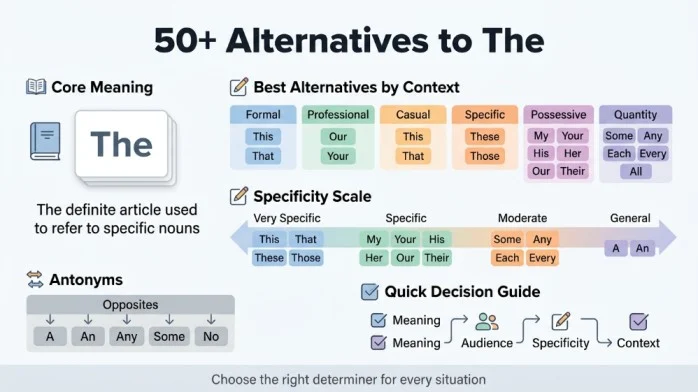
The is a definite article used to refer to specific nouns. Since it is a grammatical function word, it does not have direct synonyms in the traditional sense. However, in many contexts, you can replace the with determiners like this, that, these, those, my, your, his, her, our, their, its, any, some, each, every, all, both, neither, either, several, many, much, few, little, enough, no, and any. The right choice depends on the context, meaning, and level of specificity you want to convey.
Meaning, Tone, and Context
Simple Definition
The is a definite article used before nouns to indicate that the noun is specific or already known to the reader or listener.
Part of Speech
Definite article and determiner
Overall Tone
The word is neutral. It simply points to something specific without adding emotion or emphasis.
Formality Level
The is considered neutral and appears naturally in all types of communication, from casual conversations to formal academic writing.
Common Uses
Native English speakers commonly use the when:
- Referring to something already mentioned
- Referring to something unique or specific
- Referring to something known to both speaker and listener
- Referring to a particular person, place, or thing
- Talking about things that are common knowledge
Word Forms
| Form | Word |
|---|---|
| Definite Article | the |
| Indefinite Article | a, an |
| Demonstrative Determiner | this, that, these, those |
| Possessive Determiner | my, your, his, her, our, their, its |
When and How to Use “The”
The word the works well whenever you want to refer to a specific noun that is already known or understood. However, choosing a more specific determiner can make your message clearer and more impactful.
Professional
“The client requested the updated report before the meeting.”
Academic
“The research methodology was clearly explained in the study.”
Workplace
“The new policy will affect all employees in the department.”
Personal
“The book you recommended was absolutely wonderful.”
“Please review the attached document before the end of the day.”
Resume
“Managed the implementation of key company initiatives.”
Social Media
“The moment I’ve been waiting for finally arrived today.”
Best Alternatives to “The”
The word the is useful because it appears in almost every type of writing, but no single alternative works perfectly in every situation. Some determiners emphasize specificity, while others highlight possession, quantity, or inclusivity. Choosing the right determiner helps your writing sound more natural and precise.
Professional Writing: This
This is one of the strongest professional alternatives to the. It points to something specific and immediate.
Example:
“This report contains the most up-to-date information.”
Why it works:
Business writing benefits from precise language, and this clearly identifies a specific document.
Academic Writing: That
In essays, research papers, and reports, that is often a better choice than the when referring to something previously mentioned.
Example:
“That hypothesis was later proven incorrect.”
Why it works:
It sounds objective, formal, and academically appropriate.
Business Communication: Our
Our indicates ownership and creates a sense of shared responsibility.
Example:
“Our commitment to quality has earned us a strong reputation.”
Why it works:
It immediately communicates inclusiveness and collective ownership.
Casual Conversation: This
For everyday speaking, this sounds natural without becoming overly formal.
Example:
“This is exactly what I was hoping for.”
Why it works:
Native English speakers frequently use this to point to specific things in conversation.
Emotional Writing: Your
When discussing personal experiences or addressing someone directly, your is usually more expressive than the.
Example:
“Your kindness made a lasting difference in my life.”
Why it works:
It emphasizes personal connection instead of general reference.
Creative Writing: My
Creative writing often benefits from personal vocabulary. My helps create a stronger connection with the reader.
Example:
“My heart raced as I approached the door.”
Why it works:
It captures the reader’s attention and adds depth to storytelling.
Resume Writing: My
Recruiters frequently see my because it highlights personal responsibility and achievement.
Example:
“My leadership resulted in a 20% increase in productivity.”
Why it works:
It sounds concise, professional, and achievement-focused.
Workplace Communication: Our
Our emphasizes that something is necessary for success or smooth operations.
Example:
“Our team is committed to delivering exceptional results.”
Why it works:
It communicates necessity while maintaining a professional tone.
Stronger Emphasis: Every
When you need stronger emphasis, every is one of the best replacements for the.
Example:
“Every employee must complete the training module.”
Why it works:
It suggests completeness and universal participation.
Softer Emphasis: Some
Sometimes you want to refer to an unspecified number without making it sound overly specific.
Example:
“Some improvements were made during the quarter.”
Why it works:
It gives moderate emphasis without exaggeration.
When Not to Use “The”
Although the is versatile, it is not always the most effective word. In many situations, a more specific determiner communicates your message more clearly.
When It Sounds Too General
Sometimes the is too broad and fails to specify exactly what you mean.
Less Effective
“The report is on the desk.”
Better
“This report is on my desk.”
Why
This clearly identifies which report and whose desk.
When Greater Specificity Is Needed
If the situation requires precise identification, the may sound too vague.
Less Effective
“The project is due Friday.”
Better
“My project is due Friday.”
Why
My clearly indicates which project belongs to you.
In Academic Writing
Academic writing usually favors more precise vocabulary.
Less Effective
“The findings are significant.”
Better
“These findings are significant.”
Why
These points directly to the specific findings being discussed.
On a Resume
General wording often reduces the impact of your achievements.
Less Effective
“Managed the projects.”
Better
“Managed key projects.”
Why
Key immediately highlights the importance of the projects.
In Creative Writing
Using the repeatedly can make storytelling feel flat.
Less Effective
“The sun set over the hills.”
Better
“A golden sun set over the distant hills.”
Why
Adding descriptive language creates stronger imagery and leaves a lasting impression.
When Expressing Personal Feelings
If something matters because of personal connection, choose a more expressive word.
Less Effective
“The friendship we share is valuable.”
Better
“Our friendship is valuable.”
Why
Our communicates personal significance more naturally.
Determiners Commonly Confused with “The”
| Word | Difference | When to Use It | Example |
|---|---|---|---|
| This | Points to something nearby or immediate | Identifying specific items | “This book is excellent.” |
| That | Points to something farther away or previously mentioned | Referring to something already discussed | “That idea was brilliant.” |
| These | Plural of this | Referring to multiple nearby items | “These documents are important.” |
| Those | Plural of that | Referring to multiple distant items | “Those files need review.” |
| My | Shows possession by the speaker | Personal ownership | “My presentation is ready.” |
| Your | Shows possession by the listener | Addressing someone directly | “Your feedback matters.” |
| His | Shows possession by a male | Referring to a male’s belongings | “His report was thorough.” |
| Her | Shows possession by a female | Referring to a female’s belongings | “Her presentation was excellent.” |
| Our | Shows possession by a group | Collective ownership | “Our team succeeded.” |
| Their | Shows possession by others | Referring to others’ belongings | “Their work was impressive.” |
Best Alternatives to “The” by Context
| Context | Best Alternative | Why It Works | Example |
|---|---|---|---|
| Formal Writing | This | Sounds precise and professional. | “This document requires approval.” |
| Academic Writing | These | Fits research and essays naturally. | “These results are consistent.” |
| Professional Communication | Our | Highlights shared responsibility. | “Our team is committed.” |
| Business Emails | Your | Personalizes the message. | “Your feedback is appreciated.” |
| Resume Writing | My | Emphasizes personal achievement. | “My leadership improved productivity.” |
| Workplace Communication | This | Pinpoints specific tasks. | “This task is a priority.” |
| Casual Conversation | This | Sounds natural in daily speech. | “This is amazing.” |
| Everyday Speaking | That | Common informal alternative. | “That was a great idea.” |
| Creative Writing | My | Adds personal depth. | “My heart was racing.” |
| Storytelling | Those | References prior events. | “Those were unforgettable days.” |
| Emotional Writing | Your | Expresses personal connection. | “Your support means everything.” |
| Strong Emphasis | Every | Indicates completeness. | “Every detail matters.” |
| Mild Tone | Some | Gives moderate emphasis. | “Some changes were made.” |
| Social Media Captions | This | Sounds engaging and natural. | “This is my favorite moment!” |
| American English | This | Frequently used in business and media. | “This is the key issue.” |
| British English | That | Common in formal and everyday usage. | “That is crucial to the plan.” |
Alternatives to “The” by Usage
The word the works in almost every situation, but choosing a more specific determiner makes your writing stronger and more natural. The sections below explain which alternatives fit different types of communication.
Professional vs Personal Determiners
- Professional communication requires precise vocabulary, while personal conversations sound better with simpler, more relatable words.
Professional Determiners
| Determiner | Best Used For | Why It Works |
|---|---|---|
| Our | Reports, policies | Shows collective ownership. |
| This | Business priorities | Points to specific items. |
| My | Resumes, presentations | Highlights personal achievement. |
| Your | Client communication | Personalizes the message. |
| Those | Professional reports | References previously mentioned items. |
Recommendation
Use our, this, my, or your in resumes, business emails, presentations, and reports because they sound more precise than the.
Personal Determiners
| Determiner | Best Used For | Example |
|---|---|---|
| My | Relationships | “My family is everything.” |
| This | Daily conversations | “This is perfect.” |
| That | Casual speaking | “That was fun.” |
| Your | Personal events | “Your support helped me.” |
| Our | Shared experiences | “Our trip was amazing.” |
Recommendation
In conversations with friends and family, natural words like my, this, and that often sound better than overly formal alternatives.
Formal vs Conversational Determiners
Choosing the right level of formality helps your writing match the audience.
| Situation | Best Determiners |
|---|---|
| Reports | These, Those |
| Essays | This, That |
| Business Writing | Our, Your |
| Presentations | This, Our |
| Professional Emails | Your, Our |
| Casual Conversations | This, That |
| Text Messages | That, This |
Example
Formal:
“These findings are significant for future research.”
Conversational:
“That’s a great idea.”
Academic Determiners
Academic writing benefits from vocabulary that sounds precise and objective.
These
Commonly used when referring to specific findings or results.
Example
“These results indicate a clear pattern.”
Those
Best for pointing to previously mentioned concepts.
Example
“Those theories have been widely debated.”
This
Ideal when describing something specific and immediate.
Example
“This study examines the effects of climate change.”
Our
Appropriate when referring to collective research efforts.
Example
“Our research team conducted the experiment.”
Their
Useful when discussing others’ research.
Example
“Their findings contradicted earlier studies.”
Recommendation
For essays and research papers, these, those, and our usually sound stronger and more authoritative than the.
Professional and Business Determiners
Business communication often requires concise and specific language.
Our
Perfect for procedures, policies, and team efforts.
Example
“Our customer satisfaction ratings have improved.”
Your
Highlights client focus.
Example
“Your business is important to us.”
This
Describes immediate tasks and priorities.
Example
“This project is our top priority.”
My
Frequently appears in resumes and presentations.
Example
“My responsibilities included managing the sales team.”
Those
Shows something is necessary for business success.
Example
“Those strategies were implemented successfully.”
Recommendation
Use these determiners in resumes, interviews, meetings, presentations, business emails, and client communication to sound more professional.
Creative and Literary Determiners
Creative writing benefits from expressive vocabulary that creates emotion and imagery.
My
Adds personal connection and introspection.
Example
“My soul longed for the sea.”
Our
Creates a sense of shared experience.
Example
“Our journey was filled with wonder.”
Your
Directly addresses the reader.
Example
“Your eyes held the stars.”
Those
References distant memories or experiences.
Example
“Those days were filled with laughter.”
This
Points to immediate moments.
Example
“This moment would change everything.”
These words make stories, speeches, and descriptive writing more engaging.
Slang or Modern Determiners
There are very few true slang alternatives for the, but native speakers often use casual expressions.
| Expression | Meaning | Appropriate For | Avoid In |
|---|---|---|---|
| That thing | Something previously mentioned | Everyday conversations | Academic papers |
| This one | A specific item | Friends, social media | Business reports |
| Them | Informal plural reference | Casual speech | Formal writing |
Example
Casual:
“Can you pass me that thing?”
Formal:
“Can you pass me the document?”
Strongest to Mildest Determiners
The following scale shows how different determiners express different levels of specificity.
| Specificity | Determiners |
|---|---|
| Very Specific | This, That, These, Those |
| Specific | My, Your, His, Her, Our, Their |
| Moderate | Any, Some, Each, Every, All |
| General | A, An, Any |
| Very General | Many, Much, Few, Several |
Understanding the Scale
- This, That, These, Those point to very specific items.
- My, Your, His, Her, Our, Their show possession.
- Any, Some, Each, Every, All indicate quantity or inclusivity.
- A, An are indefinite and non-specific.
- Many, Much, Few, Several indicate unspecified amounts.
Emotional vs Neutral Determiners
Some determiners express feelings, while others simply communicate information.
Emotional Determiners
| Determiner | Best Used For |
|---|---|
| My | Personal experiences |
| Your | Addressing others directly |
| Our | Shared experiences |
| These | Pointing to meaningful things |
| Those | Referencing cherished memories |
These words add emotion and help readers connect with the message.
Neutral Determiners
| Determiner | Best Used For |
|---|---|
| The | General reference |
| A | Indefinite reference |
| An | Indefinite reference |
| Some | Unspecified quantity |
| Any | Unspecified choice |
Neutral determiners communicate information without adding unnecessary emotion.
Antonyms of “The”
Since the is a definite article, it does not have true antonyms. However, the following table shows indefinite articles and determiners that express opposite meanings in terms of specificity.
| Antonym | Meaning | Example Sentence |
|---|---|---|
| A | Non-specific singular | “A dog barked outside.” |
| An | Non-specific singular before vowels | “An apple fell from the tree.” |
| Any | Non-specific choice | “Any solution would work.” |
| Some | Unspecified quantity | “Some people prefer tea.” |
| No | Zero quantity | “No evidence was found.” |
| Every | All members | “Every student passed the exam.” |
| Each | Individual members | “Each participant received a gift.” |
| All | The whole group | “All children love candy.” |
| Many | A large number | “Many questions remained.” |
| Much | A large amount | “Much time was wasted.” |
| Few | A small number | “Few people attended.” |
| Little | A small amount | “Little progress was made.” |
| Several | More than two | “Several options are available.” |
| Neither | Not one nor the other | “Neither option is ideal.” |
| Either | One of two | “Either choice works.” |
Comparison: “The” vs Similar Words
Although the is the most common determiner, several similar words carry different shades of meaning. Understanding these differences helps you choose the most accurate word for each situation.
The vs This
Main Difference
The is a general definite article. This points to something specific and immediate.
Which Is Stronger?
This is stronger because it identifies a particular item.
Which Is More Formal?
Both work well in formal writing, but this is more precise.
When to Use Each
Use the for general reference.
Use this for immediate or nearby items.
Examples
The:
“The report is on my desk.”
This:
“This report contains the latest data.”
The vs That
Main Difference
The refers to something known. That points to something farther away or previously mentioned.
Which Is Stronger?
That is stronger because it creates distance or refers back to earlier discussion.
Which Is More Formal?
Both are suitable for professional writing.
When to Use Each
Choose that when referring to something previously mentioned.
Examples
The:
“The idea was interesting.”
That:
“That idea was brilliant.”
The vs My
Main Difference
The is neutral. My shows possession by the speaker.
Which Is Stronger?
My is stronger because it adds ownership.
Which Is More Formal?
Both fit professional writing, but my is more personal.
When to Use Each
Use the for general reference.
Use my for personal ownership.
Examples
The:
“The project is due Friday.”
My:
“My project is due Friday.”
The vs Our
Main Difference
The is general. Our shows collective ownership.
Which Is Stronger?
Our expresses shared responsibility and ownership.
Which Is More Formal?
Both fit professional writing.
When to Use Each
Use our when referring to a group’s shared resources or responsibilities.
Examples
The:
“The team achieved its goals.”
Our:
“Our team achieved its goals.”
The vs Your
Main Difference
The is neutral. Your addresses the listener directly.
Which Is Stronger?
Your is stronger because it personalizes the message.
Which Is More Formal?
Your is widely used in business and professional writing.
When to Use Each
Use your when addressing someone directly.
Examples
The:
“The feedback was helpful.”
Your:
“Your feedback was helpful.”
The vs These
Main Difference
The refers to something general. These points to multiple specific items nearby.
Which Is Stronger?
These is stronger because it specifies multiple items.
Which Is More Formal?
Both are suitable for formal writing.
When to Use Each
Use these when referring to multiple specific items.
Examples
The:
“The documents are ready.”
These:
“These documents are ready.”
Common Phrases and Expressions without “The”
Since the is a grammatical function word, there are very few fixed phrases that use it. However, the following phrases show how the appears in common expressions.
| Phrase | Meaning | Example Sentence |
|---|---|---|
| The one | A specific person or thing | “She is the one I was talking about.” |
| The best | The highest quality | “This is the best pizza in town.” |
| The worst | The lowest quality | “That was the worst experience of my life.” |
| The same | Identical | “We ordered the same dish.” |
| The most | The greatest amount | “She was the most qualified candidate.” |
| The least | The smallest amount | “He showed the least interest.” |
| The whole | The complete thing | “I ate the whole pizza.” |
| The rest | The remaining part | “The rest of the team arrived later.” |
Common Mistakes to Avoid
1. Using “The” When “A” Is Needed
Incorrect
“I saw the dog in the park.” (When not previously mentioned)
Better
“I saw a dog in the park.”
Why
A is used for new, unspecified nouns.
2. Omitting “The” When It Is Needed
Incorrect
“Sun is shining today.”
Better
“The sun is shining today.”
Why
The is required before unique nouns like sun.
3. Using “The” Instead of “This”
Incorrect
“The report you gave me is missing pages.”
Better
“This report you gave me is missing pages.”
Why
This clarifies which report.
4. Repeating “The” Too Often
Incorrect
“The manager approved the budget, and the team celebrated the success.”
Better
“Our manager approved the budget, and our team celebrated the success.”
Why
Using varied vocabulary improves readability and style.
5. Confusing “The” with “Their”
Incorrect
“The team submitted the report on time.”
Better
“Their team submitted their report on time.”
Why
Their shows possession.
6. Using “The” When “My” Is Needed
Incorrect
“The project I completed was successful.”
Better
“My project was successful.”
Why
My emphasizes personal achievement.
7. Overusing “The” in Creative Writing
Incorrect
“The wind blew through the trees, and the leaves fell to the ground.”
Better
“A cool wind blew through the tall trees, and golden leaves fell softly.”
Why
Adding descriptive language makes writing more engaging.
Frequently Asked Questions
What Are the Best Synonyms for “The”?
“The” has no exact one-word synonym because it is a definite article. Depending on the sentence, alternatives may include words or phrases such as that, this, specific, particular, or a noun phrase that makes the meaning clear.
What Is Another Word for “The”?
There is no direct another word for “the.” In some contexts, that or this can replace its function, but the correct choice depends on the sentence.
Are There Other Words for the Word “The”?
Yes, but they are usually contextual alternatives rather than true synonyms. Words such as this, that, specific, and particular can sometimes express a similar idea.
What Is the Synonym for “The”?
“The” does not have a standard synonym. It is a definite article used to identify a specific person, place, thing, or idea already known or understood from context.
Can “This” or “That” Replace “The”?
Sometimes. This usually points to something nearby or currently discussed, while that often points to something farther away or previously mentioned. They cannot replace “the” in every sentence.
What Is an Alternative for “The”?
An alternative depends on the sentence. In some cases, this, that, specific, particular, or even removing the article can create a natural alternative.
What are the best formal alternatives to “the”?
Strong formal alternatives include this, that, these, those, our, their, and such. These words work well in academic papers, reports, and business communication.
What are common informal alternatives to “the”?
Common informal alternatives include this, that, these, those, my, and your. These expressions sound natural in everyday conversations and social media posts.
What is another word for “the” in professional writing?
In professional communication, excellent alternatives include this, our, your, my, and those. These determiners make reports, emails, resumes, and presentations sound more precise and polished.
What is the difference between “the” and “this”?
The is a general definite article. This points to something specific and immediate. The is more general, while this is more precise.
What is the opposite of “the”?
Since the is a definite article, it does not have a direct opposite. However, indefinite articles like a and an serve as opposites in terms of specificity.
Conclusion
The word the is one of the most common words in English, but using it repeatedly can make your writing feel repetitive. Learning the best alternatives to the helps you express your ideas with greater accuracy, stronger style, and better clarity.
You’re writing an essay, preparing a business presentation, updating your resume, or having a casual conversation, no single alternative fits every situation. Words like this, that, my, your, our, their, and these each carry unique meanings and should be chosen based on your audience, tone, and purpose.
A simple way to improve your vocabulary is to pause before writing the and ask yourself whether a more specific determiner would communicate your message more clearly. Choosing the most appropriate alternative will make your writing more engaging, professional, and natural.
Read More Related Articles:
- Synonyms for Creativity | Meaning, Examples, and Better …
- Synonyms for Marginalized| Meaning, Examples, and Better …








1 thought on “Synonyms of The | Meaning, Context, Examples & Better Ways to Write in 2026”