Life often tests people through setbacks, pressure, and unexpected challenges, making the right words essential when describing inner strength. If you’re searching for synonyms of resilience, you’re likely looking for expressions that better capture determination, perseverance, and the ability to recover from adversity. Choosing the perfect alternative can make your writing more impactful and emotionally engaging.
This guide explores the best synonyms of resilience, explaining their meanings, differences, and ideal contexts. Whether you’re writing professionally, academically, or creatively, you’ll discover powerful alternatives that improve clarity, strengthen your message, and help your content sound more natural, polished, and compelling for every audience.
What Are the Best Synonyms of “Resilience”?
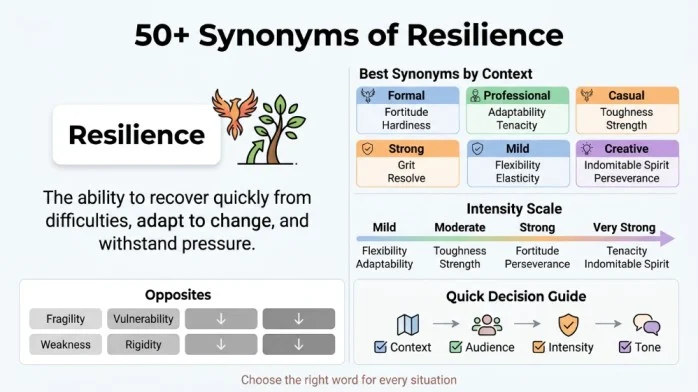
Resilience describes the ability to recover quickly from difficulties, adapt to change, and withstand pressure. The best synonyms include toughness, adaptability, fortitude, perseverance, tenacity, endurance, flexibility, and hardiness. Choose adaptability for professional contexts, fortitude for emotional strength, perseverance for sustained effort, tenacity for determination, and hardiness for scientific or psychological writing.
Meaning, Tone, and Context
Simple Definition
Resilience is the capacity to recover quickly from setbacks, adapt to change, and keep going in the face of adversity. It combines emotional strength, mental flexibility, and the determination to overcome obstacles.
Part of Speech
Resilience is a noun.
Overall Tone
The word has a positive, empowering tone. It suggests strength, courage, and the ability to thrive despite challenges.
Formality Level
Resilience is considered semi-formal to formal. It works well in academic writing, business communication, psychology, and personal development contexts. It also appears in everyday conversation, though simpler synonyms may be more common in casual speech.
Common Uses
Native English speakers commonly use resilience when discussing:
- Mental and emotional strength
- Business and career challenges
- Personal development and growth
- Overcoming adversity or trauma
- Adapting to change
- Sports and athletic performance
- Leadership and management
- Psychological well-being
- Community and social recovery
- Environmental and ecological systems
Word Forms
| Form | Word |
|---|---|
| Noun | Resilience |
| Adjective | Resilient |
| Adverb | Resiliently |
| Related Verb | To bounce back, to recover |
| Opposite | Fragility, vulnerability |
When and How to Use “Resilience”
The word resilience works well whenever you want to describe the ability to recover or adapt. However, choosing a more specific synonym can make your message clearer and more impactful.
Professional Context
“Our team demonstrated remarkable resilience during the company restructuring.”
Academic Context
“The study measured resilience in children exposed to adverse childhood experiences.”
Workplace Context
“Employee resilience is essential for maintaining productivity during periods of organizational change.”
Personal Context
“Building resilience has helped me navigate life’s challenges with greater confidence.”
Email Context
“I appreciate your resilience and dedication throughout this difficult project.”
Resume Context
“Demonstrated resilience and adaptability while managing multiple high-priority initiatives.”
Social Media Context
“Resilience isn’t about avoiding failure. It’s about getting back up every single time.”
Best Synonyms of Resilience
The word resilience is useful because it fits many types of writing, but no single synonym works perfectly in every situation. Some alternatives emphasize emotional strength, while others highlight adaptability, endurance, or determination. Choosing the right synonym helps your writing sound more natural and precise.
Professional Writing: Adaptability
Adaptability is one of the strongest professional alternatives to resilience. It focuses on the ability to adjust to new conditions and changing circumstances.
Example:
“Adaptability is a critical skill for employees navigating rapidly changing industries.”
Why it works:
Business writing benefits from precise language, and adaptability clearly communicates flexibility and responsiveness.
Academic Writing: Hardiness
In psychological and scientific writing, hardiness is often preferred because it describes a specific personality trait associated with stress resistance.
Example:
“The study examined the relationship between psychological hardiness and job satisfaction.”
Why it works:
It sounds objective, formal, and academically appropriate.
Business Communication: Tenacity
Tenacity emphasizes determination and persistence, making it ideal for professional contexts that value persistence.
Example:
“Her tenacity in pursuing new business opportunities helped the company grow.”
Why it works:
It communicates persistence and drive without sounding overly emotional.
Casual Conversation: Toughness
For everyday speaking, toughness sounds natural without becoming overly formal.
Example:
“He showed real toughness after losing his job.”
Why it works:
Native English speakers frequently use toughness to describe mental and emotional strength in casual contexts.
Emotional Writing: Fortitude
When discussing personal struggles or emotional challenges, fortitude is usually more expressive than resilience.
Example:
“She faced every obstacle with remarkable fortitude and grace.”
Why it works:
It emphasizes emotional strength and courage in the face of difficulty.
Creative Writing: Perseverance
Creative writing often benefits from descriptive vocabulary. Perseverance helps create imagery of sustained effort.
Example:
“His perseverance through countless rejections finally led to success.”
Why it works:
It captures the reader’s attention and adds depth to storytelling.
Resume Writing: Adaptability
Recruiters frequently see the word adaptability because it highlights a candidate’s ability to handle change.
Example:
“Demonstrated adaptability while managing multiple projects in a fast-paced environment.”
Why it works:
It sounds concise, professional, and achievement-focused.
Workplace Communication: Grit
Grit emphasizes determination and passion for long-term goals, making it ideal for modern workplace language.
Example:
“Grit and determination are essential qualities for leadership roles.”
Why it works:
It communicates persistence and passion in a contemporary, engaging way.
Stronger Meaning: Tenacity
When you need stronger emphasis, tenacity is one of the best replacements for resilience.
Example:
“Her tenacity in the face of overwhelming odds inspired everyone around her.”
Why it works:
It suggests unwavering determination and refusal to give up.
Softer Meaning: Flexibility
Sometimes you want to recognize adaptability without making it sound like a major struggle.
Example:
“Flexibility has been essential to our team’s success during transitions.”
Why it works:
It gives balanced emphasis without exaggeration.
When Not to Use “Resilience”
Although resilience is versatile, it is not always the most effective word. In many situations, a more specific synonym communicates your message more clearly.
When It Sounds Too Clinical
Sometimes resilience can sound like a psychological term rather than a natural description.
Less Effective:
“She showed resilience after the accident.”
Better:
“She showed remarkable strength after the accident.”
Why:
Strength sounds more personal and less clinical.
When Greater Emotional Weight Is Needed
If the situation involves deep personal struggle, resilience may sound too technical.
Less Effective:
“His resilience through the illness was admirable.”
Better:
“His courage through the illness was inspiring.”
Why:
Courage adds emotional depth and admiration.
When Describing Immediate Reactions
Resilience often implies a longer recovery process, not an immediate response.
Less Effective:
“She showed resilience when she heard the bad news.”
Better:
“She showed composure when she heard the bad news.”
Why:
Composure better describes a calm immediate reaction.
In Creative Writing
Using resilience repeatedly can make storytelling feel flat.
Less Effective:
“The community’s resilience was tested.”
Better:
“The community’s indomitable spirit was tested.”
Why:
Indomitable spirit creates stronger imagery and emotional impact.
When Expressing Personal Strengths
If you’re describing your own qualities, a more relatable word often works better.
Less Effective:
“Resilience has helped me succeed.”
Better:
“Perseverance and determination have helped me succeed.”
Why:
Perseverance and determination feel more personal and less clinical.
When the Context Is Professional but Not Psychological
Resilience is common in psychology but can sound out of place in some professional settings.
Less Effective:
“Our team’s resilience led to success.”
Better:
“Our team’s adaptability and persistence led to success.”
Why:
Adaptability and persistence are more common in business language.
Words Commonly Confused with “Resilience”
| Word | Difference | When to Use It | Example |
|---|---|---|---|
| Toughness | Focuses on durability and resistance | Physical or mental endurance | “He showed toughness during the competition.” |
| Adaptability | Focuses on adjusting to change | Professional and workplace contexts | “Adaptability is essential in fast-changing industries.” |
| Perseverance | Focuses on sustained effort over time | Long-term goals and achievements | “Perseverance led to her eventual success.” |
| Tenacity | Focuses on determination and persistence | Business, sports, personal goals | “His tenacity helped him close the deal.” |
| Fortitude | Focuses on courage in suffering | Emotional and personal challenges | “She faced the tragedy with fortitude.” |
| Grit | Focuses on passion and perseverance | Modern professional and personal contexts | “Grit is the key to long-term success.” |
Best Synonyms of Resilience by Context
| Context | Best Synonym | Why It Works | Example |
|---|---|---|---|
| Formal Writing | Fortitude | Sounds precise and professional | “Fortitude is essential for leadership.” |
| Academic Writing | Hardiness | Fits research and psychology | “The study measured psychological hardiness.” |
| Professional Communication | Adaptability | Highlights flexibility and growth | “Adaptability is key to career success.” |
| Business Emails | Persistence | Concise and professional | “Your persistence is greatly appreciated.” |
| Resume Writing | Adaptability | Emphasizes handling change | “Adaptability in fast-paced environments.” |
| Workplace Communication | Grit | Modern and engaging | “Grit is essential for leadership roles.” |
| Casual Conversation | Toughness | Sounds natural in daily speech | “That took real toughness.” |
| Everyday Speaking | Strength | Common and relatable | “She has incredible inner strength.” |
| Creative Writing | Perseverance | Adds vivid description | “Perseverance became his defining trait.” |
| Storytelling | Indomitable Spirit | Shows unbreakable will | “Her indomitable spirit inspired everyone.” |
| Emotional Writing | Fortitude | Expresses personal strength | “She faced it with fortitude.” |
| Strong Emphasis | Tenacity | Indicates fierce determination | “Tenacity drove her to succeed.” |
| Mild Tone | Flexibility | Gives moderate emphasis | “Flexibility helped us adapt.” |
| Social Media Captions | Strength | Sounds natural and relatable | “Strength comes from overcoming challenges.” |
| American English | Grit | Frequently used in business and media | “Grit is the key to success.” |
| British English | Fortitude | Common in formal and everyday usage | “She displayed great fortitude.” |
Synonyms of Resilience by Usage
The word resilience works in almost every situation, but choosing a more specific synonym makes your writing stronger and more natural. The sections below explain which alternatives fit different types of communication.
Professional vs Personal Synonyms
- Professional communication requires precise vocabulary, while personal conversations sound better with simpler, more relatable words.
Professional Synonyms:
| Synonym | Best Used For | Why It Works |
|---|---|---|
| Adaptability | Reports, policies | Shows flexibility and growth |
| Tenacity | Business priorities | Emphasizes determination |
| Grit | Modern workplace | Engaging and contemporary |
| Persistence | Professional goals | Highlights sustained effort |
| Toughness | Workplace challenges | Indicates durability |
Recommendation: Use adaptability, tenacity, grit, or persistence in resumes, business emails, presentations, and reports.
Personal Synonyms:
| Synonym | Best Used For | Example |
|---|---|---|
| Strength | Personal struggles | “She showed incredible strength.” |
| Toughness | Daily challenges | “Toughness runs in our family.” |
| Grit | Personal goals | “Grit got me through college.” |
| Determination | Personal achievements | “Determination is my greatest strength.” |
Recommendation: In conversations with friends and family, natural words like strength, toughness, and determination often sound better.
Formal vs Conversational Synonyms
Choosing the right level of formality helps your writing match the audience.
| Situation | Best Synonyms |
|---|---|
| Reports | Fortitude, Hardiness |
| Essays | Perseverance, Determination |
| Business Writing | Adaptability, Tenacity |
| Presentations | Grit, Persistence |
| Professional Emails | Persistence, Adaptability |
| Casual Conversations | Toughness, Strength |
| Text Messages | Grit, Determination |
Example – Formal: “The research measured participants’ levels of psychological hardiness.”
Example – Conversational: “She has real grit and determination.”
Academic Synonyms
Academic writing benefits from vocabulary that sounds precise and objective.
Hardiness: Commonly used in psychological and health research.
Example: “Hardiness is associated with lower stress levels and better health outcomes.”
Fortitude: Often appears in philosophical and ethical discussions.
Example: “Fortitude is considered a virtue in many philosophical traditions.”
Perseverance: Suitable for educational and developmental research.
Example: “Perseverance is a strong predictor of academic success.”
Tenacity: Appropriate for behavioral and motivational studies.
Example: “The study examined tenacity as a predictor of goal achievement.”
Adaptability: Common in organizational and developmental psychology.
Example: “Adaptability is essential for thriving in changing environments.”
Recommendation: For essays and research papers, hardiness, fortitude, and perseverance usually sound stronger and more authoritative.
Professional and Business Synonyms
Business communication often requires concise and specific language.
Adaptability: Perfect for describing responsiveness to change.
Example: “Adaptability is critical for success in dynamic markets.”
Tenacity: Highlights determination and persistence.
Example: “His tenacity in pursuing new clients drove company growth.”
Grit: Modern and engaging for leadership contexts.
Example: “Grit and resilience are essential qualities for effective leaders.”
Persistence: Shows sustained effort toward goals.
Example: “Persistence paid off when they secured the contract.”
Toughness: Describes resilience in competitive environments.
Example: “Mental toughness is essential for high-pressure roles.”
Recommendation: Use these words in resumes, interviews, meetings, presentations, business emails, and client communication.
Creative and Literary Synonyms
Creative writing benefits from expressive vocabulary that creates emotion and imagery.
Fortitude: Adds emotional depth and admiration.
Example: “She faced every challenge with extraordinary fortitude.”
Perseverance: Highlights sustained effort over time.
Example: “Perseverance carried him through years of rejection.”
Indomitable: Suggests an unbreakable spirit.
Example: “His indomitable spirit inspired all who knew him.”
Resolve: Emphasizes firm determination.
Example: “Her resolve never wavered despite the obstacles.”
Endurance: Suggests long-term strength and patience.
Example: “His endurance through the long campaign was remarkable.”
These words make stories, speeches, and descriptive writing more engaging.
Slang or Modern Synonyms
There are very few true slang synonyms for resilience, but native speakers often use casual expressions.
| Expression | Meaning | Appropriate For | Avoid In |
|---|---|---|---|
| Grit | Determination | Everyday conversations | Academic papers |
| Chutzpah | Boldness | Informal contexts | Professional reports |
| Stick-to-it-iveness | Persistence | Casual speech | Formal writing |
| Backbone | Strength of character | Everyday conversations | Academic writing |
Example – Casual: “It takes real grit to keep going after failure.”
Example – Formal: “Perseverance is essential for long-term achievement.”
Strongest to Mildest Synonyms
The following scale shows how different synonyms express different levels of resilience.
| Intensity | Synonyms |
|---|---|
| Mild | Flexibility, Adaptability |
| Moderate | Toughness, Strength |
| Strong | Fortitude, Perseverance, Grit |
| Very Strong | Tenacity, Indomitable Spirit, Resolve |
Understanding the Scale:
- Flexibility simply describes the ability to adjust.
- Adaptability shows responsiveness to change.
- Toughness describes durability and endurance.
- Strength emphasizes inner power.
- Fortitude highlights courage in difficulty.
- Perseverance focuses on sustained effort.
- Grit suggests passion and persistence.
- Tenacity indicates fierce determination.
- Indomitable Spirit means an unbreakable will.
Emotional vs Neutral Synonyms
Some synonyms express feelings, while others simply communicate facts.
Emotional Synonyms:
| Synonym | Best Used For |
|---|---|
| Fortitude | Personal struggles |
| Grit | Inspirational contexts |
| Tenacity | Overcoming challenges |
| Indomitable Spirit | Triumph over adversity |
| Courage | Facing fears |
These words add emotion and help readers connect with the message.
Neutral Synonyms:
| Synonym | Best Used For |
|---|---|
| Adaptability | Professional contexts |
| Persistence | Academic writing |
| Hardiness | Psychological research |
| Endurance | Scientific contexts |
| Durability | Physical or material strength |
Neutral words communicate resilience without adding unnecessary emotion.
Antonyms of Resilience
| Antonym | Meaning | Example Sentence |
|---|---|---|
| Fragility | Easily broken or damaged | The fragility of the system was exposed. |
| Vulnerability | Susceptibility to harm | Vulnerability increased during the crisis. |
| Weakness | Lack of strength | Weakness prevented them from recovering. |
| Frailty | Physical or mental weakness | Frailty made recovery difficult. |
| Brittleness | Inability to bend or adapt | Brittleness caused the structure to crack. |
| Inflexibility | Refusal to adapt | Inflexibility led to organizational failure. |
| Rigidity | Stiffness and resistance to change | Rigidity prevented the team from evolving. |
| Susceptibility | Likelihood of being affected | Susceptibility to stress was high. |
| Helplessness | Inability to help oneself | Helplessness set in after repeated failures. |
| Insecurity | Lack of confidence | Insecurity undermined their efforts. |
| Instability | Lack of steadiness | Instability made progress impossible. |
| Sensitivity | Easily affected by external factors | Sensitivity to criticism hindered growth. |
| Delicacy | Easily damaged or harmed | The delicacy of the situation required caution. |
| Tenuousness | Weakness or uncertainty | The tenuousness of their position was clear. |
| Imperturbability | Inability to remain calm | Imperturbability was not their strength. |
Comparison: “Resilience” vs Similar Words
Resilience vs Adaptability
Main Difference: Resilience emphasizes bouncing back from difficulties. Adaptability focuses on adjusting to new conditions and change.
Which Is Stronger? Resilience is generally stronger because it implies recovery from adversity.
Which Is More Formal? Both are formal, but adaptability is more common in business writing.
When to Use Each: Use resilience for overcoming challenges. Use adaptability for handling change.
Examples:
- Resilience: “Her resilience helped her recover from the setback.”
- Adaptability: “His adaptability made the transition smooth.”
Resilience vs Tenacity
Main Difference: Resilience emphasizes bouncing back and recovery. Tenacity focuses on stubborn determination and refusal to give up.
Which Is Stronger? Tenacity is often stronger because it suggests active persistence.
Which Is More Formal? Tenacity is slightly more formal.
When to Use Each: Use resilience for recovery. Use tenacity for relentless pursuit of goals.
Examples:
- Resilience: “The community showed resilience after the disaster.”
- Tenacity: “Tenacity helped her achieve her dream.”
Resilience vs Fortitude
Main Difference: Resilience emphasizes recovery and adaptability. Fortitude emphasizes courage and strength in suffering.
Which Is Stronger? Fortitude is emotionally stronger because it involves enduring pain.
Which Is More Formal? Fortitude is more formal and often appears in philosophical writing.
When to Use Each: Use resilience for general recovery. Use fortitude for emotional courage.
Examples:
- Resilience: “Resilience is key to mental health.”
- Fortitude: “She faced the tragedy with fortitude.”
Resilience vs Perseverance
Main Difference: Resilience focuses on recovery. Perseverance focuses on continuing despite obstacles.
Which Is Stronger? Neither is inherently stronger, but perseverance implies longer sustained effort.
Which Is More Formal? Both are formal, but perseverance appears more in academic contexts.
When to Use Each: Use resilience for recovery. Use perseverance for long-term effort.
Examples:
- Resilience: “Resilience helped him bounce back.”
- Perseverance: “Perseverance led to her eventual success.”
Resilience vs Grit
Main Difference: Resilience is about recovery. Grit is about sustained passion and perseverance toward long-term goals.
Which Is Stronger? Grit is stronger because it combines passion with persistence.
Which Is More Formal? Grit is more modern and less formal.
When to Use Each: Use resilience for overcoming adversity. Use grit for long-term achievement.
Examples:
- Resilience: “Resilience is essential for mental health.”
- Grit: “Grit predicts success better than talent.”
Resilience vs Toughness
Main Difference: Resilience focuses on recovery and adaptability. Toughness focuses on durability and resistance.
Which Is Stronger? Toughness can be stronger in physical contexts.
Which Is More Formal? Resilience is more formal and psychological.
When to Use Each: Use resilience for emotional recovery. Use toughness for physical or mental endurance.
Examples:
- Resilience: “Resilience helped her recover.”
- Toughness: “Toughness carried him through the challenge.”
Common Phrases and Expressions with “Resilience”
| Phrase | Meaning | Example Sentence |
|---|---|---|
| Build resilience | Develop the ability to recover | Building resilience takes time and practice. |
| Show resilience | Demonstrate recovery ability | She showed resilience after the setback. |
| Psychological resilience | Mental ability to cope | Psychological resilience is essential for well-being. |
| Resilience training | Programs to build coping skills | Resilience training is becoming common in workplaces. |
| Community resilience | Collective ability to recover | Community resilience helped the town rebuild. |
| Emotional resilience | Ability to handle emotions | Emotional resilience is key to mental health. |
| Resilience factor | Element contributing to recovery | Social support is a key resilience factor. |
Common Mistakes to Avoid
Using Resilience Too Casually
Using resilience for minor inconveniences can weaken its impact.
Incorrect: “I showed resilience when my coffee spilled.”
Better: “I showed patience when my coffee spilled.”
Why: Resilience is too strong for minor situations.
Confusing Resilience with Endurance
Resilience is about recovery and adaptation. Endurance is about lasting through hardship.
Incorrect: “Resilience helped him run the marathon.”
Better: “Endurance helped him run the marathon.”
Why: Endurance is more appropriate for physical stamina.
Using Emotional Words in Academic Writing
Emotional synonyms can sound subjective in academic contexts.
Incorrect: “The children showed amazing resilience.”
Better: “The children demonstrated measurable resilience.”
Why: Academic writing prefers objective language.
Overusing Strong Synonyms
Using tenacity, fortitude, and grit too often can sound dramatic.
Incorrect: “His tenacity in making breakfast was admirable.”
Better: “His patience in making breakfast was admirable.”
Why: Reserve strong words for genuinely significant situations.
Repeating “Resilience” Too Often
Repeating resilience makes your writing sound repetitive.
Incorrect: “Resilience is important. Resilience matters because resilience helps us recover.”
Better: “Resilience is important. Perseverance helps us overcome obstacles, and adaptability allows us to thrive.”
Why: Varied vocabulary improves readability and style.
Choosing the Wrong Synonym for the Context
Using toughness in a psychological context can sound simplistic.
Incorrect: “The study measured toughness in children.”
Better: “The study measured resilience in children.”
Why: Resilience is the appropriate term for psychological research.
Using Slang in Professional Writing
Slang expressions sound unprofessional in formal contexts.
Incorrect: “We need chutzpah to succeed.”
Better: “We need determination and persistence to succeed.”
Why: Professional writing requires precise and appropriate vocabulary.
Frequently Asked Questions
What are the best synonyms of “resilience”?
The best synonyms of resilience include adaptability, fortitude, perseverance, tenacity, grit, toughness, and hardiness. The right choice depends on the context, audience, and emphasis you need.
What are the best formal synonyms of “resilience”?
Strong formal alternatives include fortitude, hardiness, perseverance, tenacity, and endurance. These words work well in academic papers, psychological reports, and professional communication.
What are common informal synonyms of “resilience”?
Common informal alternatives include toughness, grit, strength, and determination. These words sound natural in everyday conversations and social media posts.
What is another word for “resilience” in professional writing?
In professional communication, excellent alternatives include adaptability, perseverance, tenacity, and grit. These words make reports, emails, resumes, and presentations sound more precise and impactful.
What is the difference between “resilience” and “perseverance”?
Resilience emphasizes recovering and bouncing back. Perseverance focuses on continuing through challenges and sustaining effort over time. Resilience is about adaptation, while perseverance is about persistence.
What is the opposite of “resilience”?
The most common opposites include fragility, vulnerability, weakness, frailty, and rigidity. Each describes a lack of ability to recover, adapt, or withstand pressure.
Conclusion
The word resilience is powerful and versatile, but using it repeatedly can make your writing feel repetitive. Learning the best synonyms of resilience helps you express your ideas with greater accuracy, stronger style, and better clarity.
You’re writing an essay, preparing a business presentation, updating your resume, or having a casual conversation, no single synonym fits every situation. Words like adaptability, fortitude, perseverance, tenacity, grit, and hardiness each carry unique meanings and should be chosen based on your audience, tone, and purpose.
A simple way to improve your vocabulary is to pause before writing resilience and ask yourself what aspect of strength you are describing. Choosing the most appropriate synonym will make your writing more engaging, professional, and natural.
Read More Related Articles:
Synonyms for Creativity | Meaning, Examples, and Better …
Synonyms for Marginalized| Meaning, Examples, and Better …











1 thought on “50+Synonyms of Resilience | Powerful Words for Strength, Grit, and Recovery”