A student may write “ecosystem” several times in a science essay, while a blogger, researcher, or environmental professional may repeat the same word throughout a report. Searching for synonyms of ecosystem can help, but simply replacing the word with any term that sounds similar can change the meaning.
The best alternative depends on what you actually mean. Ecological system is the closest direct alternative, while ecological community, habitat, biome, and natural environment describe related concepts with important differences. Understanding those distinctions helps you write more naturally without sacrificing scientific accuracy.
What Are the Best Synonyms of “Ecosystem”?
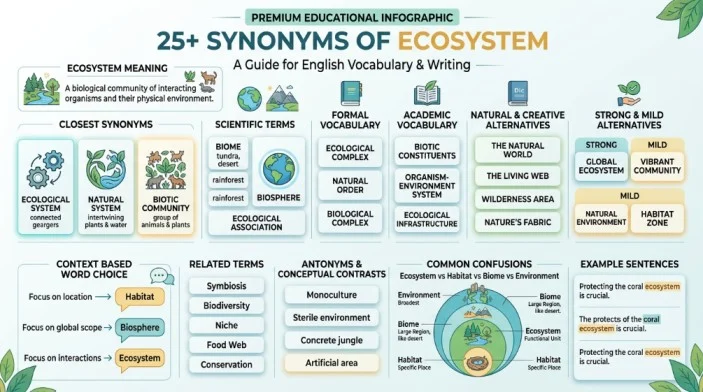
An ecosystem is a community of living organisms interacting with one another and with their physical surroundings. The closest synonym is ecological system. Depending on context, ecological community, natural environment, habitat, biome, and ecological network may work, but each has a narrower or different meaning.
Meaning, Tone, and Context
Simple Definition
An ecosystem is a system made up of living organisms and the nonliving parts of their environment, all interacting within a particular area.
For example, a pond ecosystem can include fish, algae, insects, plants, microorganisms, water, sunlight, soil, nutrients, and temperature. These components interact and influence how the system functions.
The word does not refer only to animals or plants. It includes both biotic components, meaning living things, and abiotic components, meaning nonliving physical and chemical factors.
Part of Speech
Ecosystem is a noun.
Example:
“The forest ecosystem supports hundreds of species.”
Its plural form is ecosystems.
Overall Tone
The word ecosystem is generally neutral. It does not express a positive or negative emotion by itself.
Its tone depends on the context.
For example:
“The marine ecosystem is highly diverse.”
This is neutral and scientific.
In business writing, the word can be used metaphorically:
“The startup ecosystem has attracted new investors.”
Here, ecosystem describes an interconnected group of organizations, people, resources, and activities.
Formality Level
Ecosystem is neutral to formal and is especially common in:
- Science
- Biology
- Environmental studies
- Geography
- Academic writing
- Government reports
- Conservation discussions
- Business
- Technology
- Economics
It is also common in everyday speech when discussing nature or environmental issues.
Common Uses
Native English speakers use ecosystem to describe many kinds of interconnected systems.
Common examples include:
- Forest ecosystem
- Marine ecosystem
- Aquatic ecosystem
- Freshwater ecosystem
- Grassland ecosystem
- Desert ecosystem
- Coastal ecosystem
- River ecosystem
- Urban ecosystem
- Agricultural ecosystem
- Digital ecosystem
- Business ecosystem
- Startup ecosystem
The meaning remains centered on interconnected parts functioning within a larger system, although the exact components vary by subject.
Word Forms
| Form | Word |
|---|---|
| Singular noun | ecosystem |
| Plural noun | ecosystems |
| Related adjective | ecological |
| Related noun | ecology |
| Related noun | ecologist |
The adjective ecological does not mean the same thing as ecosystem. It describes something connected with ecology or relationships between organisms and their environment.
When and How to Use “Ecosystem”
Use ecosystem when you need to describe an interconnected system involving living organisms and their physical environment, or, in broader modern usage, an interconnected group of organizations, technologies, or participants.
Professional
“Our company is developing partnerships across the renewable energy ecosystem.”
In this context, ecosystem describes interconnected organizations and participants rather than a biological environment.
Academic
“The study examines how rising temperatures affect the coastal ecosystem.”
This use is appropriate because the sentence concerns relationships between organisms and environmental conditions.
Workplace
“Our digital ecosystem includes several platforms that support employee collaboration.”
Here, the word describes connected technologies and tools.
Personal
“I enjoy spending time in natural ecosystems where wildlife can thrive.”
This is a natural use in everyday environmental discussion.
“The proposed project could improve the health of the local river ecosystem.”
The word works well in a professional or environmental email.
Resume
“Conducted field research on freshwater ecosystems and aquatic biodiversity.”
This is more precise than simply saying the applicant worked with “nature.”
Social Media
“Protecting coastal ecosystems means protecting the wildlife and communities that depend on them.”
This works naturally in an environmental awareness post.
Best Synonyms of “Ecosystem”
There is an important vocabulary point here: ecosystem has fewer true synonyms than many general English words. Several terms commonly presented as synonyms are actually related concepts.
Professional Writing: Ecological System
Ecological system is the closest direct alternative to ecosystem. It clearly communicates a system involving organisms and their physical environment.
“The researchers examined the ecological system surrounding the wetland.”
Academic Writing: Ecological System
For academic writing, ecological system can replace ecosystem when repetition becomes a problem and the context clearly concerns interactions between organisms and their environment.
“The ecological system showed signs of environmental stress.”
Business Communication: Business Ecosystem
When discussing interconnected companies, customers, partners, and technologies, business ecosystem is usually more accurate than simply replacing ecosystem with a biological term.
“The company has become a major participant in the regional business ecosystem.”
Casual Conversation: Natural Environment
In everyday conversation, natural environment may be easier for general readers to understand.
“Development has changed the area’s natural environment.”
It is not an exact synonym because an environment does not necessarily imply the complete network of interactions represented by an ecosystem.
Emotional Writing: Natural World
Natural world is useful when the writing has an emotional or environmental focus.
“We have a responsibility to protect the natural world.”
It is broader than ecosystem, so it should not be used when scientific precision is required.
Creative Writing: Living Environment
Living environment can work in descriptive writing when the focus is on the surroundings in which organisms live.
“The coral reef created a colorful living environment beneath the waves.”
Resume Writing: Ecological Systems
For a resume, ecological systems can help avoid repetition in descriptions of environmental research.
“Analyzed ecological systems affected by agricultural development.”
Workplace Communication: Environmental System
Environmental system can be useful when discussing the physical and biological conditions surrounding a project, although it is broader and less precise than ecosystem.
“The construction plan considers the surrounding environmental system.”
Stronger Meaning: Interconnected Ecological System
When you want to emphasize relationships among multiple components, interconnected ecological system provides greater descriptive precision.
“The wetland is an interconnected ecological system supporting numerous species.”
Softer Meaning: Natural Environment
When scientific precision is not essential, natural environment offers a simpler and broader alternative.
“The new road may affect the surrounding natural environment.”
When Not to Use “Ecosystem”
Although ecosystem is useful, it is not interchangeable with every environmental term.
When You Mean a Specific Place Where an Organism Lives
Ecosystem may be too broad when you are specifically talking about an organism’s living place.
Use habitat instead.
Less precise:
“The pond is the frog’s ecosystem.”
Better:
“The pond is an important habitat for the frog.”
When You Mean a Large Regional Ecological Zone
Use biome when referring to a major ecological region characterized by particular climate patterns and communities of organisms.
Less precise:
“The Sahara is an ecosystem.”
Better:
“The Sahara is part of the world’s desert biome.”
A biome can contain many ecosystems.
When You Mean Only the Living Community
Use ecological community when you specifically mean the populations of organisms living and interacting in an area.
Less precise:
“The study examined the ecosystem of organisms living around the reef.”
Better:
“The study examined the ecological community living around the reef.”
When You Mean the Physical Surroundings
Use environment when you are referring broadly to surrounding physical conditions.
Less precise:
“Pollution changed the ecosystem around the factory.”
If you specifically mean air, water, soil, and surrounding conditions:
“Pollution changed the local environment.”
When the Word Sounds Too Technical
For a general audience, ecosystem may sometimes feel more technical than necessary.
Instead of:
“The ecosystem surrounding the park is changing.”
You could write:
“The natural environment around the park is changing.”
When You Are Describing a Group With No Ecological Meaning
Modern English frequently uses ecosystem metaphorically, especially in business and technology. However, using it for every interconnected group can sound vague or trendy.
Instead of:
“Our restaurant ecosystem includes employees and suppliers.”
A clearer version may be:
“Our restaurant network includes employees, suppliers, and delivery partners.”
Words Commonly Confused With “Ecosystem”
Habitat
Difference: A habitat is the place or type of environment where an organism or population normally lives.
When to Use It: Use it when focusing on where a species lives rather than the complete system of interactions.
Example:
“Wetlands provide an important habitat for migratory birds.”
Biome
Difference: A biome is a broad ecological region defined largely by climate and characteristic vegetation and organisms.
When to Use It: Use it for large ecological categories such as deserts, tundra, and tropical rainforests.
Example:
“The tundra biome has extremely cold temperatures and a short growing season.”
Ecological Community
Difference: An ecological community refers primarily to the populations of different organisms living and interacting in the same area.
When to Use It: Use it when the focus is on living organisms rather than physical environmental factors.
Example:
“The ecological community includes several species of fish, insects, and aquatic plants.”
Environment
Difference: Environment is a broad term for surrounding conditions, including physical, chemical, biological, and sometimes social factors.
When to Use It: Use it when you do not need to describe a complete ecological system.
Example:
“Industrial activity has changed the local environment.”
Ecology
Difference: Ecology is the scientific study of relationships among organisms and their environments. It is not a synonym for an ecosystem.
When to Use It: Use it when discussing the field of science or ecological relationships generally.
Example:
“She studied ecology at the university.”
Biosphere
Difference: The biosphere refers broadly to the global zone where life exists. It encompasses many ecosystems.
When to Use It: Use it when discussing life on Earth at a global scale.
Example:
“Human activity can influence processes throughout the biosphere.”
Best Synonyms of “Ecosystem” by Context
| Context | Best Synonym or Alternative | Why It Works | Example |
|---|---|---|---|
| Formal writing | Ecological system | Closely matches the scientific meaning | “The ecological system experienced significant change.” |
| Academic writing | Ecological system | Maintains scientific precision | “The research examined the ecological system.” |
| Professional communication | Environmental system | Works when discussing environmental conditions | “The project may affect the surrounding environmental system.” |
| Business emails | Business ecosystem | Fits interconnected commercial participants | “Our business ecosystem continues to expand.” |
| Resume writing | Ecological systems | Useful for environmental research descriptions | “Studied freshwater ecological systems.” |
| Workplace communication | Network | Clear for interconnected organizations or tools | “Our partner network has expanded.” |
| Casual conversation | Natural environment | Easier for general audiences | “The development could harm the natural environment.” |
| Everyday speaking | Natural surroundings | Simple and accessible | “The animals depend on their natural surroundings.” |
| Creative writing | Living environment | Adds descriptive flexibility | “The reef is a vibrant living environment.” |
| Storytelling | Natural world | Broad and expressive | “The story explores humanity’s relationship with the natural world.” |
| Emotional writing | Natural world | Carries environmental and emotional meaning | “We must protect the natural world.” |
| Strong emphasis | Interconnected ecological system | Highlights relationships among components | “The wetland is an interconnected ecological system.” |
| Mild tone | Environment | Broad and uncomplicated | “The project may affect the local environment.” |
| Social media captions | Natural world | Accessible and expressive | “Small actions can help protect the natural world.” |
| American English | Ecosystem | Standard and widely understood | “The forest ecosystem supports many species.” |
| British English | Ecosystem | The same standard term is used | “The river ecosystem supports diverse wildlife.” |
How to Choose the Best Synonym of “Ecosystem”
The safest approach is to identify which part of the ecosystem concept you want to emphasize.
If You Mean the Complete Ecological System
Use ecosystem or ecological system.
“The forest ecosystem depends on complex relationships among plants, animals, soil, and climate.”
If You Mean Where an Animal Lives
Use habitat.
“The wetland provides habitat for many bird species.”
If You Mean a Large Ecological Region
Use biome.
“The tropical rainforest biome contains many different ecosystems.”
If You Mean Living Organisms Only
Use ecological community.
“The ecological community changed after a new species entered the area.”
If You Mean Surrounding Conditions
Use environment or natural environment.
“Construction could alter the natural environment.”
If You Mean Global Life
Use biosphere.
“Human activity can affect the biosphere.”
If You Mean an Interconnected Business or Technology Network
Use business ecosystem, digital ecosystem, network, or ecosystem itself.
“The company operates within a growing digital ecosystem.”
A Simple Decision Guide
Think about these seven questions:
- Am I describing organisms plus their physical surroundings? Use ecosystem.
- Am I describing where one species lives? Use habitat.
- Am I describing a broad ecological region? Use biome.
- Am I focusing only on organisms? Use ecological community.
- Am I discussing surrounding conditions generally? Use environment.
- Am I discussing life on Earth globally? Use biosphere.
- Am I describing connected businesses, technologies, or organizations? Use ecosystem, network, or a more specific form such as business ecosystem.
Real Life Examples of “Ecosystem”
School
Basic:
“A pond is an ecosystem.”
More precise:
“A pond ecosystem includes organisms such as fish, insects, algae, and microorganisms, along with water, nutrients, light, and temperature.”
College
Basic:
“The research focuses on a coastal ecosystem.”
Improved:
“The research examines how rising water temperatures are affecting the coastal ecosystem.”
The second sentence identifies the relationship being studied.
Workplace
Basic:
“Our ecosystem includes several software tools.”
Improved:
“Our digital ecosystem connects communication, project management, and data analysis tools.”
Business
Basic:
“The company is part of the technology ecosystem.”
Improved:
“The company operates within a technology ecosystem of developers, customers, investors, and platform providers.”
Basic:
“The construction could affect the ecosystem.”
Improved:
“The proposed construction could affect the surrounding wetland ecosystem.”
The second sentence is more precise because it identifies the specific ecosystem.
Resume
Basic:
“Worked with ecosystems.”
Improved:
“Conducted field research on freshwater ecosystems and assessed changes in aquatic biodiversity.”
The improved version communicates a specific skill rather than making a vague claim.
Conversation
Basic:
“We need to protect ecosystems.”
Natural:
“We need to protect natural ecosystems because so many species depend on them.”
Storytelling
“As the river became polluted, the once vibrant ecosystem began to change.”
Blogging
“Healthy ecosystems depend on complex relationships among organisms, resources, and environmental conditions.”
Social Media
“Protecting local ecosystems starts with understanding how closely wildlife, water, soil, and people are connected.”
25 Best Synonyms and Related Alternatives for “Ecosystem”
A strict scientific definition matters here. Not all of the following terms are perfect substitutes for ecosystem. Some are close alternatives, while others are context specific related terms. This distinction prevents inaccurate synonym use.
| Synonym or Related Alternative | Simple Meaning | Best Used For | Example Sentence |
|---|---|---|---|
| Ecological system | A system of organisms and environmental factors | Academic and scientific writing | “The ecological system supports diverse species.” |
| Natural system | A naturally occurring interconnected system | General environmental writing | “The natural system has adapted to seasonal changes.” |
| Ecological community | Interacting populations of organisms | Biology and ecology | “The ecological community includes several native species.” |
| Biotic community | Living organisms interacting in an area | Scientific writing | “The biotic community changed after the disturbance.” |
| Habitat | Place where an organism lives | Species and conservation | “The wetland is a valuable habitat for birds.” |
| Biome | Large ecological region with characteristic climate and life | Geography and biology | “The desert biome receives very little rainfall.” |
| Environment | Surrounding physical and biological conditions | General communication | “Pollution has affected the local environment.” |
| Natural environment | Surroundings created largely by natural processes | Public and environmental writing | “The project may affect the natural environment.” |
| Living environment | Conditions in which organisms live | General and descriptive writing | “The reef provides a complex living environment.” |
| Ecological network | Interconnected ecological relationships | Advanced ecology | “The ecological network includes several predator and prey relationships.” |
| Ecological web | Interconnected biological relationships | Food webs and ecology | “The ecological web changed after the species disappeared.” |
| Biosphere | Global zone where life exists | Earth science | “Human activity influences the biosphere.” |
| Natural community | Community of organisms in nature | Educational writing | “The natural community contains numerous native species.” |
| Biological community | Group of interacting organisms | Biology | “The biological community includes plants and animals.” |
| Environmental system | Interacting environmental components | Environmental studies | “The environmental system is sensitive to pollution.” |
| Natural surroundings | Nearby natural conditions and features | Everyday language | “Wildlife depends on healthy natural surroundings.” |
| Natural world | Earth’s living and nonliving natural realm | Creative and public writing | “We should protect the natural world.” |
| Ecological unit | A defined unit used in ecological study | Scientific writing | “The wetland functions as an ecological unit.” |
| Ecological complex | Interconnected ecological components | Technical descriptions | “The region contains a complex ecological network.” |
| Environmental community | Interacting organisms within an environment | General ecological discussion | “The environmental community changed over time.” |
| Biological system | Interacting biological components | Scientific contexts | “The biological system responds to environmental stress.” |
| Environmental network | Connected environmental relationships | Applied environmental writing | “The environmental network crosses several habitats.” |
| Interconnected natural system | Natural components linked through relationships | Explanatory writing | “The forest is an interconnected natural system.” |
| Aquatic system | Water based ecological system | Freshwater and marine contexts | “The aquatic system supports many organisms.” |
| Terrestrial system | Land based ecological system | Ecology and geography | “The terrestrial system is influenced by rainfall and temperature.” |
Synonyms of “Ecosystem” by Usage
Professional vs Personal Synonyms
In professional environmental writing, ecological system, ecological network, and environmental system can provide useful alternatives when the context supports them.
In personal communication, natural environment, natural surroundings, and natural world are generally easier for a broad audience.
For example:
Professional:
“The ecological system is vulnerable to habitat fragmentation.”
Personal:
“The natural environment around the lake is changing.”
The second sentence is less technical but more accessible.
Formal vs Conversational Synonyms
For reports and academic papers, favor ecological system, ecological community, biological community, or biome when those terms accurately describe the subject.
For casual conversations, environment, natural surroundings, or natural world may be more natural.
Avoid replacing ecosystem with a simpler word if doing so removes an important scientific distinction.
Academic Synonyms
Academic writing requires precision more than variety.
Useful alternatives include:
- Ecological system
- Ecological community
- Biotic community
- Ecological network
- Biome
- Biological community
- Ecological unit
For example:
“The study examined the ecological community within the wetland.”
This is more precise than using ecosystem if the research focuses specifically on organisms rather than both living and nonliving components.
Professional and Business Synonyms
The meaning of ecosystem has expanded into business and technology.
Common professional expressions include:
- Business ecosystem
- Digital ecosystem
- Technology ecosystem
- Partner network
- Business network
- Innovation ecosystem
For resumes, ecosystem can be useful when describing collaboration across organizations.
“Built partnerships across the regional technology ecosystem.”
However, if the sentence can be made more specific with network, partnership group, or industry network, the more precise option may be better.
Creative and Literary Synonyms
Creative writing gives you more flexibility.
Useful alternatives include:
- Natural world
- Living environment
- Natural surroundings
- Living system
- Interconnected natural system
These words can create atmosphere without requiring technical terminology.
“The forest was a living world of roots, insects, birds, and ancient trees.”
Here, living world creates imagery but should not be treated as a technical synonym for ecosystem.
Slang or Modern Synonyms
There is no widely accepted slang synonym for ecosystem.
In technology and business, however, ecosystem itself has become a common modern metaphor.
Examples include:
- Tech ecosystem
- Startup ecosystem
- Creator ecosystem
- Digital ecosystem
- Innovation ecosystem
These expressions are acceptable in professional communication when the participants and relationships are clear.
Strongest to Mildest Synonyms
Because ecosystem is primarily a technical noun rather than an emotional adjective, a traditional intensity scale is less useful than a specificity scale.
Broadest
Natural world
This refers broadly to nature and life on Earth.
Broad
Environment
This describes surrounding conditions without necessarily implying a complete ecological system.
Moderately Specific
Natural system
This emphasizes interconnected natural components.
More Specific
Ecological community
This focuses on interacting populations of organisms.
Highly Specific
Ecological system
This closely captures the scientific concept represented by ecosystem.
Context Specific
Habitat, biome, and biosphere are not simply stronger or weaker versions of ecosystem. They describe different ecological scales or concepts.
This is an important distinction. Scientific vocabulary should be organized by meaning and scope, not forced into an artificial strength ranking.
Emotional vs Neutral Synonyms
Emotional Synonyms and Alternatives
These terms are useful when environmental writing needs a stronger human or expressive quality.
| Term | Emotional Effect |
|---|---|
| Natural world | Broad, protective, emotional |
| Living environment | Gentle and descriptive |
| Natural surroundings | Accessible and visual |
| Living world | Expressive and literary |
| Fragile ecosystem | Emphasizes vulnerability |
| Precious habitat | Emphasizes conservation value |
Example:
“Protecting our natural world requires thoughtful choices.”
Neutral Synonyms and Alternatives
These terms are better for objective communication.
| Term | Best Context |
|---|---|
| Ecosystem | General scientific use |
| Ecological system | Academic and technical writing |
| Ecological community | Organism focused research |
| Habitat | Species focused discussions |
| Biome | Large ecological regions |
| Environment | Broad environmental discussions |
| Biosphere | Global ecological scale |
Example:
“The study analyzed changes in the wetland ecosystem.”
Antonyms of “Ecosystem”
Unlike adjectives such as important or large, ecosystem is a noun naming a type of system. Therefore, it does not have 15 true dictionary antonyms.
Creating a list of 15 supposed antonyms would produce inaccurate vocabulary. The following terms represent conceptual contrasts rather than strict antonyms.
| Conceptual Contrast | Meaning | Example Sentence |
|---|---|---|
| Isolation | Lack of interaction with other components | “The species cannot survive in complete isolation.” |
| Disconnection | Separation between interacting components | “Habitat loss can create ecological disconnection.” |
| Fragmentation | Breaking a connected system into smaller parts | “Forest fragmentation can disrupt wildlife movement.” |
| Separation | State of being apart | “The separation of populations can reduce genetic exchange.” |
| Individual organism | A single living thing rather than a system | “The study focused on an individual organism.” |
| Nonliving object | Something without biological life | “A rock is a nonliving object, not an ecosystem.” |
| Artificial structure | Human made physical construction | “The bridge is an artificial structure.” |
| Inert matter | Material without biological activity | “The sample contained mostly inert matter.” |
| Lifeless area | Place lacking living organisms | “The contaminated site became nearly a lifeless area.” |
| Dead zone | Area with extremely limited viable life | “The polluted water created a marine dead zone.” |
| Environmental isolation | Separation from broader ecological interactions | “Environmental isolation can limit species movement.” |
| Ecological breakdown | Failure of ecological relationships | “Pollution contributed to ecological breakdown.” |
| Habitat loss | Destruction or disappearance of living space | “Habitat loss threatens many species.” |
| System collapse | Breakdown of a functioning system | “Severe disturbance can cause system collapse.” |
| Ecological disruption | Major interference with ecological relationships | “The invasive species caused ecological disruption.” |
These are conceptual opposites, not direct lexical antonyms. For accurate scientific writing, terms such as fragmentation, habitat loss, or ecological disruption should be used only when they describe the intended concept.
Comparison: “Ecosystem” vs Similar Words
Ecosystem vs Habitat
Main Difference
An ecosystem includes organisms, physical factors, and their interactions. A habitat is the place where a particular organism or population lives.
Which Is Stronger?
Neither is stronger. They describe different concepts.
Which Is More Formal?
Both are standard scientific terms.
When to Use Each
Use ecosystem for interconnected ecological systems. Use habitat when focusing on a species’ living place.
Examples
Ecosystem:
“The coral reef ecosystem supports hundreds of species.”
Habitat:
“The coral reef provides habitat for many fish.”
Ecosystem vs Biome
Main Difference
An ecosystem is a functioning ecological system within a particular setting. A biome is a much broader ecological region characterized by climate and characteristic life forms.
Which Is Stronger?
Neither is stronger. Biome generally refers to a larger scale.
Which Is More Formal?
Both are appropriate for academic writing.
When to Use Each
Use biome for broad ecological regions. Use ecosystem for particular interacting systems.
Examples
Ecosystem:
“The river ecosystem supports diverse aquatic organisms.”
Biome:
“The desert biome covers vast areas of the planet.”
Ecosystem vs Environment
Main Difference
Environment refers broadly to surrounding conditions. Ecosystem specifically emphasizes relationships among living organisms and their physical surroundings.
Which Is Stronger?
Neither.
Which Is More Formal?
Both are widely used, but ecosystem is more specialized.
When to Use Each
Use environment when discussing general surroundings. Use ecosystem when ecological interactions matter.
Examples
Ecosystem:
“The ecosystem depends on balanced nutrient cycles.”
Environment:
“The construction changed the local environment.”
Ecosystem vs Ecology
Main Difference
Ecology is the scientific study of relationships among organisms and their environments. An ecosystem is a system in which those relationships occur.
Which Is Stronger?
Neither.
Which Is More Formal?
Both are standard scientific terms.
When to Use Each
Use ecology for the field or study of ecological relationships. Use ecosystem for a specific ecological system.
Examples
Ecosystem:
“The forest ecosystem contains many species.”
Ecology:
“She is studying forest ecology.”
Ecosystem vs Ecological Community
Main Difference
An ecological community focuses on populations of living organisms interacting in an area. An ecosystem also includes nonliving components such as water, soil, temperature, and nutrients.
Which Is Stronger?
Neither.
Which Is More Formal?
Both are appropriate in scientific writing.
When to Use Each
Use ecological community when the living component is the focus.
Examples
Ecosystem:
“The ecosystem includes organisms, soil, water, and climate.”
Ecological community:
“The ecological community includes plants, insects, birds, and mammals.”
Ecosystem vs Biosphere
Main Difference
The biosphere refers to the global zone of Earth where life exists. An ecosystem is a smaller ecological system within that broader biosphere.
Which Is Stronger?
Neither, but biosphere describes a much broader scale.
Which Is More Formal?
Both are scientific terms.
When to Use Each
Use biosphere when discussing life on Earth as a whole.
Examples
Ecosystem:
“The wetland ecosystem supports many species.”
Biosphere:
“Human activities can affect the global biosphere.”
Common Phrases and Expressions with “Ecosystem”
Forest Ecosystem
Meaning: An ecosystem centered around a forest environment and its organisms.
Example:
“The forest ecosystem depends on healthy soil and diverse plant life.”
Marine Ecosystem
Meaning: An ecosystem associated with oceans and other saltwater environments.
Example:
“Plastic pollution can harm the marine ecosystem.”
Aquatic Ecosystem
Meaning: An ecosystem associated with water.
Example:
“The aquatic ecosystem contains several species of fish and plants.”
Ecosystem Services
Meaning: Benefits that people receive from functioning ecosystems, such as pollination, water purification, and climate regulation.
Example:
“Wetlands provide valuable ecosystem services.”
Ecosystem Health
Meaning: The condition or functioning of an ecosystem.
Example:
“Researchers monitored ecosystem health after the restoration project.”
Ecosystem Restoration
Meaning: Efforts to help damaged or degraded ecosystems recover.
Example:
“The organization supports ecosystem restoration along the river.”
Ecosystem Conservation
Meaning: Protection of ecosystems and the ecological relationships within them.
Example:
“Ecosystem conservation can help protect biodiversity.”
Digital Ecosystem
Meaning: A connected group of digital platforms, technologies, users, and organizations.
Example:
“The company is building a digital ecosystem around its software platform.”
Common Mistakes to Avoid
Mistake 1: Treating Every Related Environmental Word as a Synonym
Incorrect:
“A habitat and an ecosystem mean exactly the same thing.”
Better:
“A habitat is the place where an organism lives, while an ecosystem includes organisms and their physical environment.”
Why:
The distinction improves scientific accuracy.
Mistake 2: Using “Biome” for a Small Local System
Incorrect:
“The small pond is a biome.”
Better:
“The small pond is an ecosystem.”
Why:
A biome generally refers to a much larger ecological region.
Mistake 3: Confusing Ecology With Ecosystem
Incorrect:
“The rainforest ecology contains monkeys and plants.”
Better:
“The rainforest ecosystem contains monkeys and plants.”
Why:
Ecology refers to the study of ecological relationships, while ecosystem refers to a system in which those relationships occur.
Mistake 4: Using “Environment” When Ecological Interactions Matter
Incorrect:
“The researchers studied the environment of predator and prey relationships.”
Better:
“The researchers studied the ecosystem and its predator and prey relationships.”
Why:
Ecosystem communicates interconnected biological relationships more precisely.
Mistake 5: Using “Ecosystem” for Every Business Group
Incorrect:
“The three employees form an ecosystem.”
Better:
“The three employees form a small team.”
Why:
Ecosystem should communicate meaningful interdependence rather than simply a group of people.
Mistake 6: Overusing “Ecosystem” in Professional Writing
Incorrect:
“Our ecosystem includes our ecosystem partners and ecosystem customers.”
Better:
“Our business network includes strategic partners, customers, and technology providers.”
Why:
Specific terms make business writing clearer and less repetitive.
Mistake 7: Replacing “Ecosystem” With an Inaccurate Synonym
Incorrect:
“The desert ecosystem is the same as the desert biome.”
Better:
“The desert biome contains many individual ecosystems.”
Why:
A biome is a broad ecological category that can contain multiple ecosystems.
Frequently Asked Questions
What Is a Synonym for Ecosystem?
A synonym for ecosystem is ecological system, which describes living organisms interacting with their physical environment.
What Is the Indonesian Meaning of Ecosystem Synonyms?
The Indonesian phrase sinonim ekosistem or ekosistem sinonim refers to words with meanings similar to ecosystem, such as sistem ekologi.
What Is Sinonim dari Ekosistem?
Sinonim dari ekosistem means “synonym of ecosystem” in Indonesian. Possible alternatives include sistem ekologi and lingkungan hidup, depending on the context.
What Are Ecosystem Synonyms in English?
Common ecosystem synonyms in English include ecological system, biological community, and natural environment. The best choice depends on the intended meaning.
What Is the Difference Between Ecosystem and Ecosystems?
Ecosystem is singular and refers to one ecological system. Ecosystems is plural and refers to multiple ecological systems.
What Is an Antonym of Ecosystem?
There is no exact antonym for ecosystem. Depending on the context, nonliving environment or ecological imbalance may express a contrasting idea, but neither is a true opposite.
What Are Ecosystem Antonyms?
Ecosystem antonyms are difficult to identify because ecosystem has no direct opposite. Words describing environmental destruction or ecological imbalance may provide a contextual contrast.
How Do You Use Ecosystem Synonyms in a Sentence?
You can use ecological system in place of ecosystem in many scientific contexts. For example: “The forest is a complex ecological system that supports many species.”
What Does Synonym Ecosystem Mean?
Synonym ecosystem usually refers to alternative words for ecosystem. More natural search phrases include ecosystem synonym and synonyms of ecosystem.
What are the best synonyms of “ecosystem”?
The closest synonym is ecological system. Depending on context, ecological community, natural system, and environment may work, while habitat and biome are related terms with narrower or different meanings.
What are the best formal synonyms of “ecosystem”?
The strongest formal alternatives include ecological system, ecological community, biological community, and ecological network. Choose based on whether your focus is the complete system, living organisms, or ecological relationships.
What are common informal synonyms of “ecosystem”?
There is no exact informal synonym for ecosystem. In everyday environmental discussions, natural environment, natural surroundings, and natural world can work when scientific precision is not required.
What is another word for “ecosystem” in professional writing?
Ecological system is the closest professional alternative in environmental and scientific writing. In business or technology, network, business ecosystem, and digital ecosystem may be more appropriate depending on the subject.
What is the difference between “ecosystem” and “habitat”?
An ecosystem includes organisms, physical factors, and their interactions. A habitat refers primarily to the place where an organism or population lives, so it is narrower than the complete ecosystem concept.
What is the opposite of “ecosystem”?
Ecosystem has no single direct antonym because it is a noun naming a type of ecological system. Depending on the intended contrast, isolation, fragmentation, ecological disruption, habitat loss, or system collapse may express an opposing concept.
Conclusion
An ecosystem is a connected ecological system in which living organisms interact with one another and with nonliving environmental factors. The closest direct alternative is ecological system, while terms such as habitat, biome, ecological community, environment, and biosphere describe related but distinct concepts.
The best synonyms of ecosystem depend on what you want to communicate. Use ecological system for scientific precision, habitat when discussing where an organism lives, biome for broad ecological regions, ecological community for living populations, and natural environment when writing for a general audience.
The most useful vocabulary habit is to choose an alternative based on meaning and scope, not simply on whether it sounds similar. Before replacing ecosystem, identify whether you mean the complete system, its organisms, its location, its larger region, or its surrounding conditions.
Read More Related Articles:
- 25+ Synonyms of Resume | Meanings, Uses, Examples, and …
- 25+ Synonyms of Bridge | Meanings, Uses, Examples, and …
- 25+ Synonyms of Sincerely | Meanings, Uses, Examples, and …