When writing an essay, business report, blog post, or presentation, repeating the word “technology” several times can make your writing feel predictable. Searching for the synonyms of technology can help you find more precise words for computers, digital systems, machines, scientific applications, technical methods, or modern innovations.
The best alternative depends on what you actually mean. A technology company may deal with IT or digital systems, while a discussion about manufacturing may call for engineering, machinery, or technical equipment. Choosing a more specific term improves clarity, makes professional writing sound more precise, and helps readers understand exactly which aspect of technology you are describing.
What Are the Best Synonyms of “Technology”?
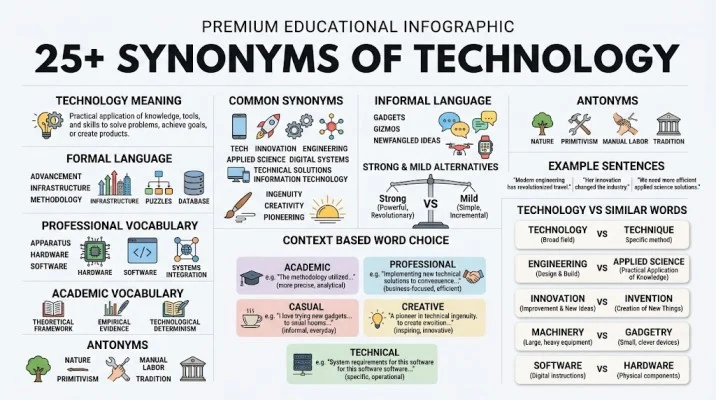
Technology refers to the practical use of scientific knowledge, tools, machines, systems, and techniques to solve problems or accomplish goals. Depending on context, useful alternatives include tech, innovation, engineering, technical methods, digital systems, IT, machinery, and applied science.
For formal writing, technical methods or engineering may be more precise. In casual conversation, tech is natural. Professional writing often benefits from digital systems, IT, or technical solutions, while creative writing can use innovation, modern tools, or advanced systems.
Meaning, Tone, and Context
Simple Definition
Technology is the practical application of knowledge, especially scientific knowledge, through tools, machines, techniques, systems, and processes designed to accomplish a purpose or solve a problem.
The word can describe something as simple as a hand tool or as complex as artificial intelligence, depending on the context. In modern usage, however, people frequently associate technology with computers, software, telecommunications, electronics, automation, and digital systems.
Part of Speech
Technology is primarily a noun.
Example:
“Technology has changed how people communicate.”
The plural form is technologies, which refers to multiple technologies or technological systems.
Example:
“New technologies are changing the healthcare industry.”
Overall Tone
Technology is generally neutral in tone.
It is not inherently positive or negative. The surrounding context determines whether the writer is describing technological progress, technological risks, technological dependence, or technological change.
For example:
“Technology has improved access to information.”
This has a positive context.
“Technology can create new privacy concerns.”
This has a negative or cautionary context.
Formality Level
Technology is a neutral and widely accepted word.
It works naturally in:
- Academic essays
- Research papers
- Business reports
- Professional emails
- News writing
- Everyday conversation
- Social media
- Technical documentation
- Presentations
- Marketing content
Because the word is so broad, writers sometimes need a more specific alternative.
Common Uses
Native English speakers commonly use technology when discussing:
- Computers
- Software
- Smartphones
- Artificial intelligence
- Medical devices
- Manufacturing equipment
- Transportation systems
- Communication tools
- Scientific applications
- Digital platforms
- Automation
- Robotics
- Internet services
- Electronic devices
- Engineering systems
Word Forms
| Word | Form | Example |
|---|---|---|
| Technology | Noun | Technology influences modern communication. |
| Technologies | Plural noun | Emerging technologies are changing healthcare. |
| Technological | Adjective | The company made a technological breakthrough. |
| Technologically | Adverb | The industry is technologically advanced. |
| Technologist | Noun | The technologist developed a new system. |
When and How to Use “Technology”
Choose technology when you are referring broadly to tools, systems, techniques, or applied knowledge rather than one specific device or method.
It is especially useful when the exact type of technology is either obvious from context or not important to the main point.
Professional
“Technology plays an important role in improving workplace productivity.”
This broad usage works well because the sentence discusses technology generally.
Academic
“Technology has influenced the way students access educational resources.”
Here, the word refers broadly to digital and technical tools used in education.
Workplace
“Our company uses technology to manage customer information.”
The word works because several possible systems may be involved.
Personal
“I use technology every day to stay connected with my family.”
The general meaning is appropriate because the speaker is referring to several digital tools.
“We are introducing new technology to improve communication between departments.”
This is suitable for a professional email because the exact system may not need to be named.
Resume
“Used technology to streamline administrative processes.”
For a resume, however, a specific term can often be stronger:
“Used customer relationship management software to streamline administrative processes.”
The second version tells the employer exactly what technology was used.
Social Media
“Technology continues to change how we work, learn, and communicate.”
The broad term works naturally in a general social media discussion.
Best Synonyms of “Technology”
No synonym completely replaces technology in every situation. The word can refer to an entire field, a specific system, a technical process, a machine, or practical knowledge, so the best alternative depends on the intended meaning.
Professional Writing: Technical Solutions
Technical solutions works well when discussing technology created to solve a particular business or operational problem.
Example:
“The company invested in technical solutions to improve data security.”
It is more specific than simply saying “technology” because it emphasizes practical problem solving.
Academic Writing: Applied Science
Applied science is useful when technology is being discussed as the practical application of scientific knowledge.
Example:
“Applied science has contributed to advances in modern medicine.”
It should not replace technology when the subject is specifically software, computers, or digital platforms.
Business Communication: Technical Systems
Technical systems is useful when referring to organized technological infrastructure.
Example:
“The company is upgrading its technical systems.”
This works particularly well for internal operations, infrastructure, and business processes.
Casual Conversation: Tech
Tech is the most natural shortened form of technology in informal American English.
Example:
“I’m interested in new tech.”
It is common in conversations, social media, technology news, and informal writing.
Emotional Writing: Innovation
Innovation can work when technology is being discussed as a source of progress, creativity, or positive change.
Example:
“Innovation has opened new possibilities for people with disabilities.”
It is not an exact synonym because innovation focuses on new ideas or improvements rather than technology itself.
Creative Writing: Modern Tools
Modern tools can work in creative writing when technology is being described through its practical role.
Example:
“Artists now have modern tools that allow them to create worlds that once existed only in imagination.”
Resume Writing: Technical Skills
Technical skills is often more useful than technology on a resume because it describes the person’s ability to work with specific tools or systems.
Example:
“Applied technical skills to improve digital workflow efficiency.”
Workplace Communication: Digital Systems
Digital systems is useful when referring specifically to computer based or electronic systems.
Example:
“The company is replacing outdated digital systems.”
Stronger Meaning: Advanced Technology
When you want to emphasize sophistication, advanced technology is more precise than simply using technology.
Example:
“The laboratory uses advanced technology to analyze complex samples.”
Softer or Broader Meaning: Tools
Tools can be appropriate when the technology is being discussed mainly as something people use to accomplish tasks.
Example:
“Teachers use digital tools to create interactive lessons.”
The word is broader than technology and should be used only when the context makes the meaning clear.
When Not to Use “Technology”
Although technology is versatile, it can sometimes be too broad. A more specific term can make the sentence clearer and more useful.
When “Technology” Is Too General
Less precise:
“The company uses technology to manage sales.”
Better:
“The company uses customer relationship management software to manage sales.”
The second sentence identifies the actual technology.
When “Technology” Is Too Vague
Less precise:
“New technology improved the process.”
Better:
“Automation software reduced the time required to process orders.”
The replacement tells readers what kind of technology created the improvement.
When a Technical Field Is Intended
Less precise:
“She works in technology.”
Better:
“She works in information technology.”
The second sentence identifies the professional field.
When You Mean a Specific Machine
Less precise:
“The factory purchased new technology.”
Better:
“The factory purchased new manufacturing equipment.”
Equipment is more appropriate when physical machines are the focus.
When You Mean a New Idea
Less precise:
“The company is investing in technology.”
Better:
“The company is investing in innovation.”
Innovation is more suitable when the focus is on new ideas, methods, products, or improvements.
When You Mean a Technical Method
Less precise:
“The scientist developed new technology.”
Better:
“The scientist developed a new technique for analyzing samples.”
Technique is appropriate when the focus is on a particular method rather than a technological field.
Words Commonly Confused With “Technology”
Innovation
Difference: Innovation refers to a new idea, method, product, or improvement. Technology can be the result or tool used to implement that innovation.
When to use it: Use innovation when novelty or improvement is the main idea.
Example:
“The company is known for innovation in medical devices.”
Engineering
Difference: Engineering is the discipline of designing and building systems, structures, machines, and solutions. Technology is broader.
When to use it: Use engineering when discussing a technical discipline or design process.
Example:
“Engineering helped the team develop a more efficient engine.”
Technique
Difference: A technique is a particular method for performing an activity. Technology can involve many techniques and systems.
When to use it: Use technique when the focus is on how something is done.
Example:
“The researcher developed a new technique for testing materials.”
Equipment
Difference: Equipment refers to the physical items needed for a particular activity. Technology can include equipment but also includes software, systems, and knowledge.
When to use it: Use equipment when physical tools or machines are the focus.
Example:
“The laboratory purchased new testing equipment.”
Machinery
Difference: Machinery specifically refers to machines, especially those used in industrial or mechanical work.
When to use it: Use machinery for factories, construction, agriculture, and mechanical operations.
Example:
“The factory replaced its old machinery.”
Information Technology
Difference: Information technology, commonly called IT, focuses on computer systems, networks, software, data, and digital information.
When to use it: Use IT when discussing the computing and information side of technology.
Example:
“She works in information technology.”
Best Synonyms of “Technology” by Context
| Context | Best Synonym | Why It Works | Example |
|---|---|---|---|
| Formal writing | Technical systems | Sounds precise and professional | The organization upgraded its technical systems. |
| Academic writing | Applied science | Highlights practical scientific knowledge | Applied science has transformed medical treatment. |
| Professional communication | Technical solutions | Focuses on practical business needs | We need technical solutions for data security. |
| Business emails | Digital systems | Clearly identifies electronic infrastructure | Our digital systems will be updated tonight. |
| Resume writing | Technical skills | Describes practical abilities | Demonstrated strong technical skills. |
| Workplace communication | Technology tools | Focuses on tools employees use | Technology tools improve collaboration. |
| Casual conversation | Tech | Natural informal abbreviation | I enjoy learning about new tech. |
| Everyday speaking | Tools | Simple and accessible | These tools make the job easier. |
| Creative writing | Modern tools | Creates a descriptive, accessible image | Artists now have modern tools for digital creation. |
| Storytelling | Machines | Useful for physical technology | Powerful machines changed the factory. |
| Emotional writing | Innovation | Can emphasize progress and possibility | Innovation gave the community new opportunities. |
| Strong emphasis | Advanced technology | Highlights sophistication | The hospital uses advanced technology. |
| Mild tone | Tools | Less technical and more accessible | Digital tools help students learn. |
| Social media captions | Tech | Short and conversational | Excited to explore the latest tech. |
| American English | Tech | Common informal abbreviation | Tech is changing the workplace. |
| British English | Technology | The full form remains standard | Technology affects education worldwide. |
How to Choose the Best Synonym of “Technology”
The easiest way to select the right alternative is to identify what aspect of technology you actually mean.
Step 1: Identify the Meaning
Ask whether you mean:
- A broad field
- A physical machine
- A digital system
- A method
- A professional field
- A new idea
- A practical tool
- Scientific application
If you mean the broad field, technology remains the best choice.
Step 2: Consider the Audience
A technical audience may understand terms such as digital infrastructure, information technology, or technical systems.
A general audience may understand tools, machines, or tech more easily.
Step 3: Match the Formality
For academic writing, consider applied science, technical methods, or technological systems when they accurately describe the subject.
For casual writing, tech is usually more natural.
Step 4: Consider Emotional Strength
- If you want to emphasize progress, innovation may be appropriate.
- If you want to emphasize sophistication, use advanced technology.
- If you want to remain neutral, simply use technology or a precise technical term.
Step 5: Think About Your Purpose
A resume should identify specific technical skills.
A research paper should explain the scientific or technical application.
A business report should identify the system, process, or solution.
A casual conversation can use the simple word tech.
Step 6: Choose the Most Natural Word
Do not replace technology simply to avoid repetition. A synonym is useful only when it communicates your intended meaning more accurately.
For example:
“Technology is changing education.”
This is perfectly natural.
“Technical systems are changing education.”
This changes the meaning by focusing on systems.
The original sentence may actually be better if the broader idea is what you intend.
Real Life Examples of “Technology”
School
Original:
“Technology is important in modern education.”
More precise:
“Digital tools give students new ways to research, practice, and present information.”
College
Original:
“Technology has changed college learning.”
Improved:
“Online learning systems have changed how college students access course materials.”
Workplace
Original:
“Technology helps employees communicate.”
Improved:
“Digital communication platforms help employees collaborate across different locations.”
Business
Original:
“The company invested in new technology.”
Improved:
“The company invested in automation systems to improve production efficiency.”
Original:
“We are updating our technology.”
Improved:
“We are upgrading our digital systems to improve reliability.”
Resume
Original:
“Experienced with technology.”
Improved:
“Experienced with project management software, data analysis tools, and digital collaboration platforms.”
The second version is much stronger because it identifies specific skills.
Conversation
Original:
“Technology is changing quickly.”
Natural alternative:
“Tech is changing so quickly that it can be difficult to keep up.”
Storytelling
Original:
“Technology transformed the town.”
More descriptive:
“New machines and communication systems transformed the way the town worked.”
Blogging
Original:
“Technology is changing content creation.”
Improved:
“Artificial intelligence and digital tools are changing how creators produce content.”
Social Media
Original:
“Technology makes life easier.”
More specific:
“Smart digital tools make everyday tasks faster and easier.”
25 Best Synonyms of “Technology”
Not every word below is an interchangeable synonym in every sentence. Each represents a closely related meaning that can replace technology in a specific context when that particular meaning is intended.
| Synonym | Simple Meaning | Best Used For | Example Sentence |
|---|---|---|---|
| Tech | Informal form of technology | Casual conversation | I enjoy keeping up with new tech. |
| Innovation | A new idea or improvement | Business and creative contexts | The company is known for innovation. |
| Engineering | Designing and building technical solutions | Technical fields | Engineering helped solve the structural problem. |
| Applied science | Practical use of scientific knowledge | Academic contexts | Applied science has improved medical treatment. |
| Technical methods | Methods based on technical knowledge | Formal and academic writing | The study used advanced technical methods. |
| Technical systems | Organized technical systems | Business and workplace writing | The company upgraded its technical systems. |
| Digital systems | Electronic systems for processing information | IT and business | Digital systems support daily operations. |
| Information technology | Computer and information systems | Professional contexts | She works in information technology. |
| IT | Short form of information technology | Workplace and casual professional use | Our IT team resolved the problem. |
| Technical solutions | Technology designed to solve problems | Business communication | We need better technical solutions. |
| Digital tools | Software and electronic tools | Education and workplaces | Teachers use digital tools in class. |
| Tools | Instruments used to accomplish tasks | General communication | These tools improve productivity. |
| Equipment | Physical items used for a purpose | Industry and laboratories | The laboratory purchased new equipment. |
| Machinery | Machines used for industrial or mechanical work | Manufacturing | The factory installed modern machinery. |
| Devices | Individual pieces of equipment | Electronics | The company provides employees with digital devices. |
| Systems | Connected components working together | Business and technical contexts | The new systems process information faster. |
| Techniques | Specific ways of doing something | Research and practical work | The team developed new testing techniques. |
| Processes | Organized methods of completing work | Business and industry | Automated processes reduce errors. |
| Infrastructure | Basic systems supporting an organization | IT and business | Digital infrastructure supports remote work. |
| Automation | Use of systems to perform tasks with limited human input | Manufacturing and business | Automation increased production speed. |
| Software | Computer programs and applications | Computing | The company developed new software. |
| Hardware | Physical computer components | Computing | The technician replaced the damaged hardware. |
| Electronics | Devices and systems involving electronic circuits | Engineering and consumer products | Electronics have transformed communication. |
| Modern tools | Contemporary instruments or resources | Creative and general writing | Designers use modern tools to create digital artwork. |
| Technical expertise | Specialized knowledge and skill | Professional writing | The project required technical expertise. |
Synonyms of “Technology” by Usage
Professional vs Personal Synonyms
Professional writing usually benefits from precise terms rather than broad language.
Use information technology, digital systems, technical solutions, technical expertise, or technical infrastructure when discussing workplace subjects.
Personal communication can use tech, devices, tools, or gadgets, depending on the subject.
For example:
Professional:
“The organization needs to improve its digital infrastructure.”
Personal:
“I bought a new device for traveling.”
The words communicate similar general ideas but suit different contexts.
Formal vs Conversational Synonyms
Formal writing often needs specificity.
For reports:
Technical systems, digital infrastructure, or applied science
For essays:
Technological systems, technical methods, or applied science
For business writing:
Technical solutions, digital systems, or information technology
For presentations:
Digital tools, technical systems, or advanced technology
For emails:
Technology, digital systems, or technical solutions
For casual conversations:
Tech, devices, or tools
For texting:
Tech is usually the most natural shortened form.
Academic Synonyms
Academic writing requires careful distinctions. Technology can remain the best word when discussing technological development as a broad social or scientific phenomenon.
However, more precise terms may improve a sentence.
Applied Science
Use this when scientific knowledge is being applied to practical problems.
“Applied science has contributed to advances in renewable energy.”
Technical Methods
Use this when discussing specific procedures or methods.
“The researchers used technical methods to analyze the samples.”
Technological Systems
Use this when discussing interconnected technological structures.
“Modern technological systems depend on reliable communication networks.”
Engineering
Use this when the subject involves designing, building, testing, or improving technical structures and solutions.
“Engineering principles guided the development of the new bridge.”
These terms sound more precise because they identify the specific relationship between technology and the subject being discussed.
Professional and Business Synonyms
Resumes
Use technical skills, software, digital tools, or specific technology names.
Weak:
“Experienced with technology.”
Stronger:
“Experienced with project management software and digital collaboration tools.”
Interviews
Use technical expertise when discussing specialized knowledge.
“My technical expertise helped the team resolve complex software issues.”
Meetings
Use digital systems or technical solutions when discussing workplace infrastructure.
“The new digital systems should improve communication between departments.”
Presentations
Use advanced technology when sophistication matters.
“The facility uses advanced technology to monitor energy consumption.”
Performance Reviews
Use technical skills when describing an employee’s capabilities.
“Demonstrates strong technical skills and adapts quickly to new software.”
Client Communication
Use technical solutions when describing technology that addresses a client’s problem.
“Our team developed technical solutions tailored to the client’s requirements.”
Business Emails
Use the exact system or platform whenever possible.
Instead of:
“We are changing our technology.”
Write:
“We are upgrading our customer management software.”
Specific language is usually more informative.
Creative and Literary Synonyms
Creative writing does not always need technical terminology. Writers often describe technology through its function, appearance, or effect.
Modern Tools
Useful when technology helps characters create, work, or communicate.
“The artist used modern tools to turn an idea into reality.”
Machines
Useful when physical technology is central to a scene.
“The machines hummed through the night.”
Devices
Useful for individual electronic objects.
“Her devices connected her to a world thousands of miles away.”
Innovation
Useful when technology represents progress or change.
“Each innovation brought the city closer to a different future.”
Advanced Systems
Useful in science fiction and futuristic writing.
“The advanced systems kept the station alive.”
The strongest creative choice depends on what the reader needs to visualize.
Slang or Modern Synonyms
There is no single slang word that perfectly replaces technology.
Tech
Meaning: An informal shortened form of technology.
Acceptable in: Conversations, social media, informal articles, podcasts, and casual professional communication.
Avoid in: Formal academic papers and highly formal documents where the full term is more appropriate.
Example:
“Tech is changing the way people work.”
Gadgets
Meaning: Small electronic devices, often consumer products.
Acceptable in: Casual conversation and lifestyle content.
Avoid in: Formal technical writing.
Example:
“He loves trying out the latest gadgets.”
“Gadgets” should not be treated as a complete synonym for technology because it usually refers to physical devices.
Strongest to Mildest Synonyms
Technology itself does not have a simple emotional intensity scale because its alternatives describe different aspects rather than different levels of importance.
Still, when discussing technological sophistication, the following scale can help:
| Level | Useful Expression | Meaning |
|---|---|---|
| Mild | Tools | General instruments used to accomplish tasks |
| Mild | Technology | Broad, neutral term |
| Moderate | Digital systems | Specific electronic systems |
| Moderate | Technical solutions | Purpose driven technology |
| Strong | Advanced technology | Sophisticated technology |
| Strong | Cutting edge technology | Extremely modern technology |
| Very strong | State of the art technology | Technology representing a very high current standard |
These expressions describe sophistication rather than the importance of technology.
Emotional vs Neutral Synonyms
Emotional Synonyms
Some related terms can create a more positive or expressive impression.
Innovation suggests creativity and progress.
Modern tools can suggest opportunity and accessibility.
Advanced technology can suggest sophistication.
Breakthrough technology can suggest major progress.
Revolutionary technology creates very strong emphasis and should be used carefully because it makes a significant claim.
Neutral Synonyms
For objective communication, use:
- Technology
- Technical systems
- Digital systems
- Equipment
- Machinery
- Devices
- Software
- Hardware
- Information technology
- Technical methods
Neutral terms are usually better for academic writing, research, technical documentation, and factual reports.
Antonyms of “Technology”
Technology does not have perfect direct antonyms because it describes a broad field rather than a single quality. The following terms can express the absence, rejection, or opposite approach to technological methods in appropriate contexts.
| Antonym or Opposing Concept | Meaning | Example Sentence |
|---|---|---|
| Nature | The natural world without human technological construction | The project focuses on nature rather than technological systems. |
| Natural methods | Approaches based on natural processes | Farmers sometimes choose natural methods over automated systems. |
| Manual labor | Work performed primarily by people rather than machines | The company reduced its reliance on machines and returned to manual labor. |
| Handcraft | Making things primarily by hand | Handcraft requires skills that automated production may replace. |
| Traditional methods | Established ways of doing something without relying on newer technology | The community continues to use traditional methods. |
| Primitive tools | Basic tools with limited technological complexity | Early societies relied on primitive tools. |
| Simplicity | An approach that avoids unnecessary technological complexity | The design emphasizes simplicity rather than advanced systems. |
| Human effort | Work performed directly by people | The process depends mainly on human effort. |
| Offline methods | Methods that do not depend on internet based systems | The teacher offered offline methods for completing the assignment. |
| Analog methods | Methods based on analog rather than digital systems | The museum preserves analog methods of recording sound. |
| Nonmechanical methods | Methods that do not rely on machines | The process still uses nonmechanical methods. |
| Untreated materials | Materials used without technological processing | The artist prefers untreated materials for certain projects. |
| Rural tradition | Traditional practices maintained in rural communities | The region preserves rural traditions alongside modern systems. |
| Old fashioned methods | Older approaches that may contrast with modern technology | Some businesses still use old fashioned methods for certain tasks. |
| Technological simplicity | A deliberate reduction in technological complexity | The product was designed around technological simplicity. |
Comparison: “Technology” vs Similar Words
Technology vs Innovation
Main Difference
Technology refers to tools, systems, techniques, or applied knowledge. Innovation refers to introducing something new or improving an existing idea, product, or process.
Which Is Stronger?
Neither is inherently stronger. Innovation emphasizes novelty, while technology emphasizes practical tools or systems.
Which Is More Formal?
Both are appropriate in professional and academic writing.
When to Use Each
Use technology when discussing technical systems. Use innovation when discussing new ideas or improvements.
Examples
Technology:
“Technology has changed modern transportation.”
Innovation:
“Innovation has produced more efficient transportation solutions.”
Technology vs Engineering
Main Difference
Engineering is a field concerned with designing and developing solutions. Technology is the broader collection of tools, systems, and practical applications.
Which Is Stronger?
Neither.
Which Is More Formal?
Both are formal and professional.
When to Use Each
Use engineering for a discipline or design process. Use technology for the resulting systems or tools.
Examples
Technology:
“The company invested in new technology.”
Engineering:
“The company hired engineers to redesign the system.”
Technology vs Technique
Main Difference
A technique is a specific method of doing something. Technology is broader and can include tools, machines, software, and systems.
Which Is Stronger?
Neither.
Which Is More Formal?
Both work in academic writing.
When to Use Each
Use technique when describing a method. Use technology when describing a broader technical system or application.
Examples
Technology:
“The laboratory uses advanced technology.”
Technique:
“The researcher developed a new testing technique.”
Technology vs Equipment
Main Difference
Equipment usually refers to physical items used for a task. Technology can include physical equipment as well as software, systems, and methods.
Which Is Stronger?
Neither.
Which Is More Formal?
Both are suitable for professional writing.
When to Use Each
Use equipment when physical objects are the focus.
Examples
Technology:
“The hospital uses advanced technology.”
Equipment:
“The hospital purchased new diagnostic equipment.”
Technology vs Machinery
Main Difference
Machinery refers specifically to machines, especially complex mechanical equipment. Technology is much broader.
Which Is Stronger?
Neither.
Which Is More Formal?
Both can be formal.
When to Use Each
Use machinery for industrial, agricultural, manufacturing, or mechanical settings.
Examples
Technology:
“Technology has transformed manufacturing.”
Machinery:
“The factory replaced outdated machinery.”
Technology vs Tools
Main Difference
Tools are instruments used to perform tasks. Technology can include tools but also encompasses systems, processes, knowledge, and technical fields.
Which Is Stronger?
Technology has the broader meaning.
Which Is More Formal?
Technology is generally more suitable for formal and academic discussions.
When to Use Each
Use tools when emphasizing practical use.
Examples
Technology:
“Technology has changed education.”
Tools:
“Digital tools help teachers create interactive lessons.”
Common Phrases and Expressions with “Technology”
Technology Industry
Meaning: The business sector involved in developing or providing technological products and services.
Example Sentence:
“She hopes to build a career in the technology industry.”
Technology Company
Meaning: A company that develops, sells, or uses technological products or services.
Example Sentence:
“The technology company launched a new software platform.”
Advanced Technology
Meaning: Highly developed or sophisticated technology.
Example Sentence:
“The research center uses advanced technology to analyze data.”
New Technology
Meaning: Recently developed or newly introduced technology.
Example Sentence:
“The school adopted new technology to support remote learning.”
Technology Solutions
Meaning: Technological products or systems designed to solve particular problems.
Example Sentence:
“The company provides technology solutions for small businesses.”
Information Technology
Meaning: The field involving computers, networks, software, data, and information systems.
Example Sentence:
“He earned a degree in information technology.”
Technology Development
Meaning: The process of creating or improving technological systems.
Example Sentence:
“Technology development requires research, testing, and investment.”
Technology Adoption
Meaning: The process of beginning to use a technology.
Example Sentence:
“Technology adoption increased after the company provided employee training.”
Common Mistakes to Avoid
1. Treating Every Related Word as a Perfect Synonym
Incorrect:
“The engineer developed a new innovation technology.”
Better:
“The engineer developed a new technology.”
Why:
Innovation and technology are related, but they do not mean exactly the same thing. Innovation emphasizes novelty or improvement.
2. Using “Tech” in Highly Formal Writing
Incorrect:
“The research examines how tech affects student behavior.”
Better:
“The research examines how technology affects student behavior.”
Why:
Tech is natural in informal contexts but technology is more appropriate for formal academic writing.
3. Calling Every Technology “Innovation”
Incorrect:
“The company purchased new innovation for its office.”
Better:
“The company purchased new technology for its office.”
Why:
Innovation generally involves something new or improved. A routine technological system is not automatically an innovation.
4. Using Technology When a Specific Term Is Better
Incorrect:
“I have experience with technology.”
Better:
“I have experience with project management software and data analysis tools.”
Why:
Specific terms provide much more useful information, especially on resumes.
5. Confusing Equipment With Technology
Incorrect:
“The company replaced its technology with new equipment.”
Better:
“The company replaced its outdated equipment with new equipment.”
Why:
Equipment refers specifically to physical items. Technology has a much broader meaning.
6. Using “Machinery” for Software
Incorrect:
“The company upgraded its machinery to improve its website.”
Better:
“The company upgraded its software to improve its website.”
Why:
Machinery refers to physical machines, not software.
7. Using Overly Dramatic Language
Incorrect:
“This revolutionary technology changed the office printer.”
Better:
“This new technology improved the office printing process.”
Why:
Revolutionary makes a very strong claim. Use it only when the technology genuinely represents a major transformation.
Frequently Asked Questions
1. What are the best synonyms of “technology”?
The best synonyms of technology depend on context. Common alternatives include tech, innovation, engineering, digital systems, technical solutions, information technology, equipment, and machinery.
2. What are the best formal synonyms of “technology”?
Formal alternatives include technical systems, technological systems, applied science, technical methods, engineering, and digital infrastructure. The best option depends on whether you mean a system, discipline, method, or physical infrastructure.
3. What are common informal synonyms of “technology”?
Tech is the most common informal alternative to technology. Other casual terms include tools, devices, and gadgets, although these words refer to narrower categories and should not always replace technology.
4. What is another word for “technology” in professional writing?
Professional alternatives include technical solutions, digital systems, information technology, technical infrastructure, and technical tools. Specific terms are usually better than broad substitutes because they identify exactly what the technology does.
5. What is the difference between “technology” and “innovation”?
Technology refers to tools, systems, techniques, and applied knowledge. Innovation refers to a new idea, product, method, or improvement. A technological product can be innovative, but not every technology is an innovation.
6. What is the opposite of “technology”?
Technology has no single perfect antonym. Depending on the context, opposing concepts can include natural methods, manual labor, traditional methods, handcraft, analog methods, and approaches based primarily on human effort.
Conclusion
Technology is a broad word covering tools, machines, systems, techniques, and the practical application of knowledge. The best alternative depends on the specific meaning you want to communicate. Tech works well in casual conversation, while digital systems, technical solutions, information technology, and engineering can provide greater precision in professional or academic contexts.
There is no single replacement that works perfectly in every sentence. Before choosing among the synonyms of technology, consider whether you are talking about software, hardware, machinery, engineering, innovation, technical methods, or a broader technological field.
A useful vocabulary habit is to replace a general word only when the new word adds meaning. Instead of avoiding “technology” simply to sound sophisticated, choose the term that tells your reader exactly what you mean.
Read More Related Articles:
Synonyms for Thus | Meaning, Examples, and Better Word …
50+ Synonyms of Nice | Meanings, Uses, Examples, and Best …











8 thoughts on “25+ Synonyms of Technology | Meanings, Uses, Examples, and Best Alternatives”