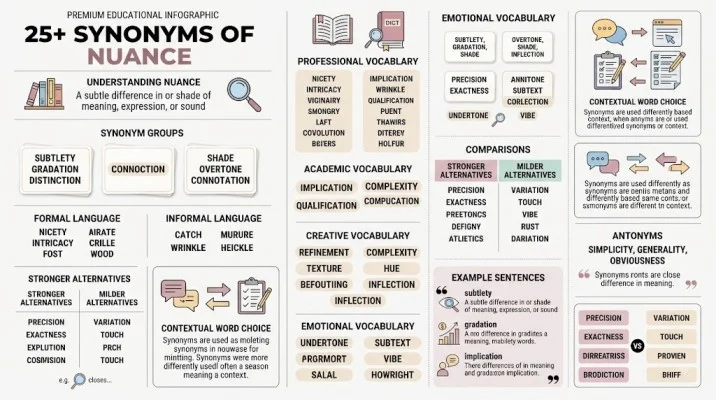
Writers often notice that a sentence feels almost right but misses a small difference in meaning, tone, or emotion. This happens frequently in essays, emails, articles, captions, and professional communication. The synonyms of nuance can help when you need to describe a subtle distinction without repeating the same word.
However, not every alternative means exactly the same thing. Words such as subtlety, distinction, shade, connotation, and implication emphasize different aspects of a nuanced idea. Choosing the right one can make your writing more precise, natural, and expressive while helping readers understand exactly what you mean.
What Are the Best Synonyms of “Nuance”?
Nuance refers to a small, subtle difference in meaning, feeling, tone, or interpretation. The best alternatives include subtlety for fine distinctions, distinction for differences, shade for slight variations, connotation for implied meaning, and refinement for delicate detail. Formal and academic writing often favor distinction or subtlety, while creative writing benefits from shade or undertone.
Meaning, Tone, and Context
Simple Definition
A nuance is a small difference or detail that can change how something is understood, felt, or interpreted.
For example, two words may have nearly the same dictionary meaning but create different emotional effects. That difference is a nuance.
Consider these sentences:
“She was confident.”
“She was assertive.”
The two words can describe a similar quality, but assertive may suggest a stronger or more forceful manner. That small difference is a nuance of meaning.
Part of Speech
Nuance is primarily used as a noun, but it can also function as a verb.
As a noun:
“The article captures the cultural nuances of the region.”
As a verb:
“The author nuanced his argument by acknowledging opposing views.”
The noun is much more common in everyday and professional English.
Overall Tone
Nuance is generally neutral in tone.
It does not automatically express something positive or negative. A nuance can involve a positive, negative, emotional, cultural, political, or linguistic distinction.
For example:
“The speaker understood the cultural nuances of the audience.”
“The report overlooked an important legal nuance.”
Formality Level
Nuance is neutral to semi formal and is especially common in educated, academic, professional, analytical, and creative writing.
It can also appear in everyday conversation:
“There’s a nuance here that people are missing.”
For very casual communication, simpler alternatives such as difference, detail, or subtle point may sound more natural.
Common Uses
Native English speakers commonly use nuance when discussing:
- Language and word choice
- Tone
- Emotions
- Culture
- Politics
- Literature
- Art
- Communication
- Social behavior
- Professional decisions
- Arguments and opinions
- Personal relationships
- Legal or technical interpretation
Common combinations include:
- A subtle nuance
- A cultural nuance
- A linguistic nuance
- An emotional nuance
- A political nuance
- A tonal nuance
- A meaningful nuance
- A subtle nuance of meaning
- Understand the nuance
- Capture the nuance
- Appreciate the nuance
- Miss the nuance
Word Forms
| Form | Example |
|---|---|
| Noun | nuance |
| Plural noun | nuances |
| Verb | nuance |
| Past form | nuanced |
| Present participle | nuancing |
| Related adjective | nuanced |
Nuanced is particularly common in modern English.
For example:
“She offered a nuanced explanation of the issue.”
Here, nuanced means careful, detailed, and sensitive to subtle differences.
When and How to Use “Nuance”
Use nuance when a simple word such as difference does not fully communicate the idea. It is especially useful when a small variation in meaning, tone, emotion, or interpretation matters.
Professional
“The manager recognized the cultural nuances involved in the negotiation.”
This works because workplace communication often requires sensitivity to differences in communication styles and expectations.
Academic
“The researcher examined the linguistic nuances of the two expressions.”
Here, nuances refers to subtle differences in language and meaning.
Workplace
“Understanding the nuances of team communication can prevent unnecessary misunderstandings.”
The word works well because communication often involves small differences in tone and interpretation.
Personal
“She understood the emotional nuance behind his response.”
This sentence shows that the speaker recognized a feeling that was not stated directly.
“Could you clarify the nuance of this sentence before we send the proposal?”
This is appropriate when wording could be interpreted in more than one subtle way.
Resume
“Developed nuanced communication strategies for diverse client groups.”
Here, nuanced suggests careful attention to different audiences and situations.
Social Media
“Good storytelling captures the little nuances that make ordinary moments memorable.”
This use gives the word a more creative and expressive quality.
Best Synonyms of “Nuance”
No single synonym completely replaces nuance in every context. The best alternative depends on what kind of subtle difference you want to emphasize.
Professional Writing: Distinction
Distinction works well when you need to identify a meaningful difference between two ideas, categories, or situations.
Example:
“The report makes an important distinction between short term and long term risks.”
Academic Writing: Subtlety
Subtlety is especially useful when discussing fine differences in language, interpretation, literature, or argument.
Example:
“The essay explores the subtlety of the author’s argument.”
Business Communication: Refinement
Refinement works when a small adjustment or improvement makes an idea more precise.
Example:
“The proposal needs some refinement before the final presentation.”
Casual Conversation: Difference
Difference is simpler and more natural when speaking informally.
Example:
“There’s a small difference between the two versions.”
Emotional Writing: Undertone
Undertone is useful when describing an underlying emotional quality that is not directly expressed.
Example:
“Her message carried an undertone of disappointment.”
Creative Writing: Shade
Shade can describe a slight variation in meaning, emotion, or tone.
Example:
“The poem contains several shades of sadness.”
Resume Writing: Sophistication
Sophistication can work when describing an ability to understand complex or subtle distinctions.
Example:
“Demonstrated sophistication in cross cultural communication.”
Workplace Communication: Sensitivity
Sensitivity can be appropriate when nuance involves awareness of cultural, emotional, or interpersonal differences.
Example:
“The role requires sensitivity to different communication styles.”
Stronger Meaning: Distinction
When you want to emphasize a clearly identifiable difference, distinction is often stronger and more precise than nuance.
Example:
“The distinction between the two policies is significant.”
Softer Meaning: Shade
When the difference is extremely slight, shade can create a softer and more literary effect.
Example:
“His response contained a shade of uncertainty.”
When Not to Use “Nuance”
Although nuance is useful, it is not always the clearest choice.
When “Nuance” Sounds Too General
If you mean a straightforward difference, nuance may sound unnecessarily sophisticated.
Less effective:
“There is a nuance between the two prices.”
Better:
“There is a difference between the two prices.”
A simple difference does not necessarily involve subtle interpretation.
When “Nuance” Sounds Too Vague
Sometimes the reader needs to know exactly what the distinction is.
Less effective:
“The article contains several nuances.”
Better:
“The article contains several subtle distinctions in tone and meaning.”
The second sentence gives readers more useful information.
When “Nuance” Sounds Too Formal
In very casual conversation, the word can sound more analytical than necessary.
Less natural:
“There’s an interesting nuance in your text message.”
More natural:
“There’s a small difference in what you said.”
The simpler choice usually fits casual speech better.
When “Nuance” Sounds Too Informal
This is rarely a problem because nuance is not an informal word. In formal writing, however, it can still be less precise than a specific technical term.
For example, a legal document may need to identify an exact distinction, qualification, or condition rather than simply calling something a nuance.
When “Nuance” Is Too Weak
If you are describing a major difference, nuance may minimize the importance of the issue.
Less effective:
“There is a nuance between the two policies.”
Better:
“There is a fundamental distinction between the two policies.”
Use stronger language when the difference is substantial rather than subtle.
When “Nuance” Is Too Strong
This is uncommon, but using nuance can sometimes make a simple detail sound more complex than it is.
Less effective:
“The form includes a nuance about your mailing address.”
Better:
“The form includes a detail about your mailing address.”
When “Nuance” Sounds Outdated
Nuance is not outdated. It remains a normal and widely used word in modern American English.
The issue is not age but precision. If a simpler word communicates the idea more clearly, use the simpler word.
Words Commonly Confused With “Nuance”
| Word | Difference | When to Use It | Example |
|---|---|---|---|
| Subtlety | A fine or delicate quality that may be difficult to notice. | Literature, communication, behavior, art. | “The actor captured the subtlety of the character.” |
| Distinction | A recognizable difference between two things. | Academic, professional, analytical writing. | “The study makes a distinction between the two groups.” |
| Connotation | An associated or implied meaning attached to a word. | Language and vocabulary discussions. | “The word carries a negative connotation.” |
| Implication | An idea suggested without being directly stated. | Arguments, conversations, writing. | “His comment had an unexpected implication.” |
| Shade | A slight variation in meaning, feeling, or quality. | Creative and literary writing. | “The speech contained a shade of irony.” |
| Detail | A specific piece of information or feature. | General and professional communication. | “The report includes an important detail.” |
Best Synonyms of “Nuance” by Context
| Context | Best Synonym | Why It Works | Example |
|---|---|---|---|
| Formal writing | Distinction | Clearly identifies a meaningful difference. | “The author draws a distinction between the concepts.” |
| Academic writing | Subtlety | Highlights fine differences in interpretation. | “The study examines the subtlety of language.” |
| Professional communication | Refinement | Suggests precision and careful improvement. | “The proposal needs further refinement.” |
| Business emails | Distinction | Makes differences between options clear. | “There is an important distinction between the plans.” |
| Resume writing | Sophistication | Suggests advanced understanding. | “Demonstrated sophistication in client communication.” |
| Workplace communication | Sensitivity | Highlights awareness of interpersonal differences. | “The position requires sensitivity to cultural differences.” |
| Casual conversation | Difference | Simple and natural. | “There’s a small difference between them.” |
| Everyday speaking | Detail | Works for a small specific point. | “That’s an interesting detail.” |
| Creative writing | Shade | Adds subtle emotional or descriptive meaning. | “The scene has a darker shade of meaning.” |
| Storytelling | Undertone | Describes an underlying feeling. | “His words had an undertone of regret.” |
| Emotional writing | Undertone | Shows an indirect emotional quality. | “Her response had an undertone of sadness.” |
| Strong emphasis | Distinction | Makes the difference more explicit. | “The distinction is central to the argument.” |
| Mild tone | Shade | Suggests a very slight variation. | “There was a shade of uncertainty in his voice.” |
| Social media captions | Detail | Sounds accessible and conversational. | “It’s the little details that matter.” |
| American English | Nuance | Natural in analytical and educated contexts. | “The issue has several important nuances.” |
| British English | Nuance | The same word and general usage apply. | “The debate contains several subtle nuances.” |
How to Choose the Best Synonym of “Nuance”
The easiest way to choose an alternative is to identify what kind of subtle difference you are describing.
Choose “Subtlety” for Fine Qualities
Use subtlety when something is delicate, understated, or difficult to notice.
“She appreciated the subtlety of the performance.”
Choose “Distinction” for Clear Differences
Use distinction when two concepts, categories, or positions need to be separated.
“The professor explained the distinction between correlation and causation.”
Choose “Connotation” for Implied Word Meaning
Use connotation when discussing the feelings or associations connected to a particular word.
“That term has a negative connotation.”
Choose “Implication” for Unstated Ideas
Use implication when someone suggests an idea without directly expressing it.
“His silence carried an important implication.”
Choose “Undertone” for Hidden Emotion
Use undertone when the subtle element is an underlying mood or feeling.
“Her response had an undertone of frustration.”
Choose “Shade” for Slight Variation
Use shade when you want a literary or expressive way to describe a small difference.
“His explanation added a new shade of meaning.”
Consider Your Audience
Academic readers may prefer distinction, subtlety, or connotation. Casual readers may understand difference, detail, or small variation more quickly.
Consider Formality
For a report, use distinction or refinement when appropriate. For everyday communication, difference or detail may be more natural.
Consider Emotional Strength
Use undertone when emotion is central. Use shade when the emotional effect is lighter or more literary.
Consider Natural Usage
Do not replace nuance simply because another word appears in a thesaurus. The best synonym is the one that preserves the original meaning while sounding natural in the sentence.
Real Life Examples of “Nuance”
School
Original:
“The poem has a lot of nuance.”
Improved:
“The poem contains several subtle shades of meaning.”
The improved version tells the reader more specifically what kind of nuance is present.
College
Original:
“The paper discusses the nuance of the theory.”
Improved:
“The paper examines the subtle distinctions within the theory.”
This sounds more precise for academic writing.
Workplace
Original:
“Managers should understand the nuances of employee communication.”
Alternative:
“Managers should understand the subtle differences in how employees communicate.”
The second version is easier for a broad workplace audience.
Business
Original:
“The negotiation required an understanding of cultural nuance.”
Alternative:
“The negotiation required an understanding of cultural differences and expectations.”
This version makes the meaning more accessible to general readers.
Original:
“Please consider the nuance of this sentence.”
Alternative:
“Please consider the subtle difference in meaning in this sentence.”
The alternative is clearer when the recipient may not be comfortable with advanced vocabulary.
Resume
Original:
“Understood the nuances of customer behavior.”
Improved:
“Analyzed subtle patterns in customer behavior to improve engagement strategies.”
The revised version communicates a concrete professional skill rather than simply naming an abstract quality.
Conversation
Original:
“There’s a nuance to what she said.”
Natural alternative:
“There’s a subtle point in what she said.”
Both work, but the second may feel more conversational.
Storytelling
Original:
“The character’s feelings contained a lot of nuance.”
Improved:
“The character’s feelings shifted through subtle shades of hope, fear, and regret.”
The revised sentence gives the reader a stronger emotional picture.
Blogging
Original:
“Understanding the nuance of online communication is important.”
Improved:
“Understanding the subtle differences in online tone can prevent misunderstandings.”
This version makes the specific meaning clearer.
Social Media
Original:
“The beauty is in the nuance.”
Alternative:
“The beauty is in the little details and subtle differences.”
The alternative is more accessible to a general social media audience.
25 Best Synonyms of “Nuance”
Some alternatives overlap with nuance rather than replacing it perfectly in every sentence. The table below focuses on words and phrases that genuinely express a subtle distinction, variation, quality, or implied meaning in appropriate contexts.
| Synonym | Simple Meaning | Best Used For | Example Sentence |
|---|---|---|---|
| Subtlety | A small quality that is not obvious. | Literature, art, communication. | “The actor understood the subtlety of the scene.” |
| Distinction | A meaningful difference between things. | Academic and professional writing. | “The distinction between the terms is important.” |
| Shade | A slight variation in meaning or feeling. | Creative and literary writing. | “The word has a darker shade of meaning here.” |
| Subtle distinction | A very fine difference. | Academic analysis. | “The essay explores a subtle distinction between the theories.” |
| Variation | A difference or change within something. | General and technical writing. | “The results show a small variation in tone.” |
| Refinement | A small improvement or precise adjustment. | Professional and creative writing. | “The argument needs further refinement.” |
| Delicacy | A fine or sensitive quality. | Emotional and descriptive writing. | “She handled the subject with delicacy.” |
| Fine point | A small but meaningful detail. | Conversation and analysis. | “The professor explained a fine point about the argument.” |
| Detail | A specific small feature or piece of information. | General communication. | “The detail changes how we understand the scene.” |
| Implication | An idea suggested indirectly. | Arguments and communication. | “The statement has an important implication.” |
| Connotation | An associated feeling or idea linked to a word. | Language and writing. | “The word has a positive connotation.” |
| Undertone | An underlying feeling or quality. | Emotional and creative writing. | “His response had an undertone of disappointment.” |
| Inflection | A change in tone or expression. | Speech and language. | “Her vocal inflection added warmth to the statement.” |
| Shading | A slight variation in meaning or expression. | Art and literary analysis. | “The character’s moral shading makes the story interesting.” |
| Qualification | A condition or limitation added to a statement. | Academic and professional writing. | “The speaker added a qualification to the claim.” |
| Complexity | The presence of multiple connected aspects. | Academic and analytical writing. | “The issue has considerable social complexity.” |
| Sophistication | A refined ability to recognize complexity. | Professional and intellectual contexts. | “The analysis shows considerable sophistication.” |
| Subtle variation | A small change within something similar. | Research and description. | “The colors contain subtle variations.” |
| Difference | The way two things are not the same. | Everyday communication. | “There is a small difference in tone.” |
| Fine distinction | A very precise difference. | Academic and professional writing. | “The lawyer identified a fine distinction in the wording.” |
| Tone | The emotional or expressive quality of communication. | Writing and speech. | “The revised sentence has a more respectful tone.” |
| Quality | A particular characteristic of something. | General and descriptive writing. | “The passage has a reflective quality.” |
| Suggestion | An idea presented indirectly. | Communication and interpretation. | “The wording contains a suggestion of uncertainty.” |
| Interpretive detail | A small feature affecting interpretation. | Literature and academic analysis. | “The scene contains an important interpretive detail.” |
| Subtle point | A small idea that may be easy to miss. | Conversation and explanation. | “She made a subtle point about the character’s motivation.” |
Synonyms of “Nuance” by Usage
Professional vs Personal Synonyms
Professional writing usually benefits from words that identify the exact type of distinction being discussed.
For professional contexts, distinction, refinement, qualification, and sophistication can be useful. For personal communication, difference, subtle point, shade, and undertone often sound more approachable.
- For example:
Professional:
“The report identifies an important distinction between the two approaches.”
Personal:
“I noticed a subtle difference in the way he spoke.”
Formal vs Conversational Synonyms
For reports, essays, and presentations, consider:
- Distinction
- Subtlety
- Refinement
- Qualification
- Connotation
For emails and everyday conversations, consider:
- Difference
- Detail
- Fine point
- Subtle point
- Small variation
The goal is not to use the most sophisticated word. The goal is to use the word your audience will understand immediately.
Academic Synonyms
Academic writing often requires careful distinctions between related ideas.
Distinction is useful when separating concepts.
Subtlety works when examining fine qualities in literature, language, or argument.
Connotation is appropriate when discussing associated meanings of words.
Implication works when examining ideas suggested by evidence or statements.
Qualification is useful when a claim has a limitation or condition.
These words make academic writing more precise because each one identifies a particular type of relationship.
Professional and Business Synonyms
For resumes, interviews, meetings, presentations, performance reviews, client communication, and business emails, specificity matters.
- Use distinction when comparing strategies.
- Use refinement when improving a proposal or process.
- Use qualification when adding a limitation to a claim.
- Use sensitivity when discussing cultural or interpersonal differences.
- Use sophistication when describing advanced analytical or communication skills.
For example:
“Demonstrated sensitivity to cultural differences in international client communication.”
This is stronger than simply saying:
“Understood cultural nuances.”
The first sentence shows the practical ability more directly.
Creative and Literary Synonyms
Creative writing has more freedom to use expressive alternatives.
Shade can suggest a delicate variation.
Undertone can reveal hidden emotion.
Subtlety can describe an understated artistic effect.
Shading can describe the layers of meaning within a character or scene.
Delicacy can suggest emotional sensitivity.
For example:
“An undertone of regret ran through her final words.”
This creates a stronger literary effect than simply saying:
“There was nuance in her final words.”
Slang or Modern Synonyms
There is no widely accepted slang synonym for nuance that works as a direct replacement.
In casual modern English, people may simply say:
- A subtle point
- A small difference
- The little details
- There’s more to it
- It’s more complicated than that
These expressions are suitable for conversations, texting, and social media. They should generally be avoided in academic or highly formal writing when a precise term such as distinction or subtlety would be clearer.
Strongest to Mildest Synonyms
Because nuance describes subtlety rather than intensity, it is more useful to organize its alternatives by how explicitly they identify a difference.
Mild
- Shade
- Subtle point
- Detail
- Variation
These suggest a small difference without strongly emphasizing it.
Moderate
- Subtlety
- Fine point
- Refinement
- Undertone
- Connotation
These communicate a recognizable but often indirect distinction.
Strong
- Distinction
- Fine distinction
- Qualification
- Implication
- Complexity
These can draw more attention to the analytical importance of the difference.
Very Strong
- Fundamental distinction
- Major qualification
- Significant difference
These are not direct synonyms in every context, but they show how language can move away from a subtle nuance toward a more explicit difference.
Emotional vs Neutral Synonyms
Emotional Synonyms
These alternatives add feeling or expressive depth:
- Undertone
- Shade
- Delicacy
- Connotation
- Inflection
- Shading
Example:
“Her words carried an undertone of sadness.”
The word undertone makes the emotional layer more noticeable.
Neutral Synonyms
These communicate the idea more objectively:
- Distinction
- Difference
- Variation
- Detail
- Qualification
- Subtlety
Example:
“The study identifies a subtle distinction between the two groups.”
Neutral vocabulary is generally better for reports, research papers, business communication, and analytical writing.
Antonyms of “Nuance”
Nuance does not have a perfect set of direct lexical antonyms. It describes subtle distinctions, so its opposite is usually expressed through ideas such as oversimplification, bluntness, sameness, or a lack of differentiation.
For practical writing, the following are the strongest contextual contrasts:
| Antonym or Contextual Contrast | Meaning | Example Sentence |
|---|---|---|
| Oversimplification | Reducing a complex idea too much. | “The article’s oversimplification ignored important differences.” |
| Simplicity | Lack of complexity or subtle detail. | “The explanation favored simplicity over detailed analysis.” |
| Bluntness | Direct expression without subtle qualification. | “His bluntness left little room for interpretation.” |
| Crudeness | Lack of refinement or sensitivity. | “The argument’s crudeness weakened its credibility.” |
| Coarseness | Lack of delicacy or refinement. | “The description lost its meaning through coarseness.” |
| Generality | Discussion without fine distinctions. | “The report remained at the level of generality.” |
| Uniformity | Lack of meaningful variation. | “The model assumes uniformity across all groups.” |
| Sameness | Complete or near complete similarity. | “The analysis failed to recognize the sameness in the responses.” |
| Explicitness | Meaning stated directly rather than subtly. | “The revised wording increased explicitness.” |
| Directness | Clear communication without indirect layers. | “The manager preferred directness over subtle hints.” |
| Crudeness of thought | Lack of careful distinctions. | “The criticism showed a crudeness of thought.” |
| Reductionism | Explaining something complex through overly simple terms. | “The theory was criticized for reductionism.” |
| Binary thinking | Treating an issue as having only two choices. | “Binary thinking can hide important differences.” |
| One dimensionality | Treating something as having only one simple aspect. | “The one dimensionality of the analysis was obvious.” |
| Indiscrimination | Failure to recognize relevant differences. | “The policy showed indiscrimination between very different cases.” |
These are best understood as contextual opposites, not dictionary perfect antonyms of nuance.
Comparison: “Nuance” vs Similar Words
Nuance vs Subtlety
Main Difference
Nuance usually refers to a specific subtle difference or layer of meaning. Subtlety can describe the general quality of being delicate, understated, or difficult to notice.
Which Is Stronger?
Neither is inherently stronger. Nuance is often more specific, while subtlety can describe a broader quality.
Which Is More Formal?
Both work well in formal and academic writing.
When to Use Each
Use nuance for a particular distinction. Use subtlety when describing the quality of being subtle.
Examples
Nuance:
“The translation captures the cultural nuance of the original.”
Subtlety:
“The translation preserves the subtlety of the original.”
Nuance vs Distinction
Main Difference
Nuance suggests a subtle difference. Distinction emphasizes the difference itself.
Which Is Stronger?
Distinction is generally more explicit.
Which Is More Formal?
Distinction is especially common in academic and professional writing.
When to Use Each
Use nuance when the difference is fine or indirect. Use distinction when you need to clearly separate two concepts.
Examples
Nuance:
“The speaker recognized the nuance in her response.”
Distinction:
“The speaker made a clear distinction between the two positions.”
Nuance vs Connotation
Main Difference
Nuance can refer to many kinds of subtle differences. Connotation specifically refers to associated meanings or feelings connected to a word or expression.
Which Is Stronger?
Neither is stronger. They describe different relationships.
Which Is More Formal?
Both are suitable for academic language discussions.
When to Use Each
Use connotation when discussing word associations. Use nuance for broader subtle differences.
Examples
Nuance:
“The sentence contains an important emotional nuance.”
Connotation:
“The word has a negative connotation.”
Nuance vs Implication
Main Difference
Nuance describes a subtle distinction or layer. Implication refers to something suggested without being directly stated.
Which Is Stronger?
An implication can be more consequential, but the words do not form a simple intensity scale.
Which Is More Formal?
Both are common in academic and professional writing.
When to Use Each
Use implication when an unstated meaning or consequence is central.
Examples
Nuance:
“The writer adds nuance to the argument.”
Implication:
“The argument has serious implications for future policy.”
Nuance vs Shade
Main Difference
Shade can mean a slight variation in meaning, feeling, or quality. It is often more literary than nuance.
Which Is Stronger?
Neither is stronger.
Which Is More Formal?
Nuance is generally more neutral and broadly useful.
When to Use Each
Use shade for expressive or literary writing. Use nuance for general analytical communication.
Examples
Nuance:
“The interview revealed a political nuance.”
Shade:
“His answer contained a shade of irony.”
Nuance vs Detail
Main Difference
A detail is a specific piece of information or feature. A nuance is a subtle difference that can affect interpretation.
Which Is Stronger?
Neither is stronger. They refer to different things.
Which Is More Formal?
Both are neutral and widely used.
When to Use Each
Use detail for specific information. Use nuance when interpretation or subtle distinction matters.
Examples
Nuance:
“The editor noticed a subtle nuance in the author’s wording.”
Detail:
“The editor noticed a small grammatical detail.”
Common Phrases and Expressions with “Nuance”
“A subtle nuance”
Meaning: A very small or delicate distinction.
Example:
“The translator captured every subtle nuance of the original speech.”
“Cultural nuance”
Meaning: A subtle difference connected to cultural expectations, beliefs, or communication styles.
Example:
“Successful international marketing requires an understanding of cultural nuance.”
“Linguistic nuance”
Meaning: A subtle difference in language, wording, or meaning.
Example:
“The two expressions have an important linguistic nuance.”
“Emotional nuance”
Meaning: A subtle difference in emotional meaning or feeling.
Example:
“The actor brought emotional nuance to the character.”
“Political nuance”
Meaning: A subtle distinction involving political ideas, positions, or situations.
Example:
“The article explains the political nuance behind the decision.”
“Capture the nuance”
Meaning: To communicate or represent a subtle distinction accurately.
Example:
“The translation struggles to capture the nuance of the original phrase.”
“Understand the nuances”
Meaning: To recognize the subtle differences within something.
Example:
“Good managers learn to understand the nuances of workplace communication.”
“A nuanced understanding”
Meaning: An understanding that recognizes complexity and avoids overly simple conclusions.
Example:
“The course gave students a nuanced understanding of social change.”
Common Mistakes to Avoid
Choosing “Subtlety” When You Mean “Difference”
Incorrect:
“There is a subtlety between the two prices.”
Better:
“There is a difference between the two prices.”
Why:
Subtlety describes a quality or fine distinction. When discussing a straightforward difference, difference is more natural.
Confusing Nuance With Connotation
Incorrect:
“The connotation of the argument was difficult to understand.”
Better:
“The nuance of the argument was difficult to understand.”
Why:
Connotation specifically relates to associated meaning, especially with words. Nuance has a broader meaning.
Using “Nuance” for a Major Difference
Incorrect:
“There is a small nuance between the two completely different policies.”
Better:
“There is a major distinction between the two policies.”
Why:
A major difference should not be described as merely subtle.
Using an Overly Formal Synonym in Casual Writing
Incorrect:
“I noticed an interesting distinction in your text message.”
Better:
“I noticed an interesting difference in your message.”
Why:
Difference is simpler and more natural for everyday communication.
Repeating “Nuance” Too Often
Incorrect:
“The article has nuance. The argument has nuance. The examples have nuance.”
Better:
“The article explores several subtle distinctions, while the examples reveal important shades of meaning.”
Why:
Varying vocabulary improves readability without sacrificing precision.
Using “Undertone” for a Neutral Difference
Incorrect:
“The report contains an undertone between the two statistical groups.”
Better:
“The report identifies a distinction between the two statistical groups.”
Why:
Undertone usually describes an underlying emotional or expressive quality, not a neutral analytical difference.
Using Slang Instead of a Precise Term
Incorrect:
“The study has a bunch of little differences.”
Better:
“The study identifies several subtle distinctions.”
Why:
The second version is more appropriate for academic and professional writing.
Frequently Asked Questions
What are the best synonyms of “nuance”?
The best synonyms of nuance include subtlety, distinction, shade, variation, refinement, undertone, connotation, and fine point. The best choice depends on whether you mean difference, emotion, implication, or detail.
What are the best formal synonyms of “nuance”?
The strongest formal alternatives include distinction, subtlety, refinement, qualification, connotation, and implication. These words work particularly well in academic papers, reports, professional analysis, and formal discussions.
What are common informal synonyms of “nuance”?
Common conversational alternatives include difference, detail, subtle point, small variation, and shade. In casual speech, simpler expressions are often easier to understand than the more analytical word nuance.
What is another word for “nuance” in professional writing?
Distinction is often the best professional alternative when describing a specific difference. Refinement, qualification, and subtlety can also work when the context involves precision, limitations, or fine differences.
What is the difference between “nuance” and “subtlety”?
Nuance usually identifies a particular subtle difference or layer of meaning, while subtlety describes the quality of being delicate or difficult to notice. The two overlap closely, but they are not interchangeable in every sentence.
What is the opposite of “nuance”?
There is no single perfect antonym for nuance. Contextual opposites include oversimplification, bluntness, generality, uniformity, binary thinking, and reductionism, especially when an idea ignores meaningful distinctions.
Conclusion
Nuance describes a subtle difference, layer, or detail that can affect meaning, tone, emotion, or interpretation. The best synonyms of nuance depend on the specific idea you want to express. Use subtlety for delicate qualities, distinction for clear differences, connotation for associated meanings, undertone for hidden emotion, and shade for slight variations in creative writing.
No synonym works perfectly in every situation. The strongest word depends on your audience, purpose, level of formality, and the exact relationship you want to describe. A precise alternative is usually better than choosing a sophisticated word simply because it sounds impressive.
A useful vocabulary habit is to ask yourself what kind of subtle difference you actually mean. Once you identify whether it is a distinction, emotional undertone, implied meaning, or simple detail, choosing the right word becomes much easier.
Read More Related Articles:
Synonyms for Thus | Meaning, Examples, and Better Word …
50+ Synonyms of Show | Meanings, Uses, Examples, and …