Finding the right words can instantly make your writing clearer, sharper, and more engaging. When you need to describe presenting, revealing, displaying, or bringing attention to something, choosing the right alternative to “show” can make a noticeable difference. This is where synonyms of show become useful. Instead of repeating the same common word, you can select a more precise option that matches your meaning, tone, and audience.
The best synonyms of show range from simple choices like display and present to stronger alternatives such as demonstrate, reveal, illustrate, and exhibit. Each word carries its own nuance and works better in certain situations. You are improving an essay, polishing professional writing, or expanding your everyday vocabulary, understanding these alternatives helps you communicate ideas with greater precision and confidence.
What Are the Best Synonyms of “Show”?
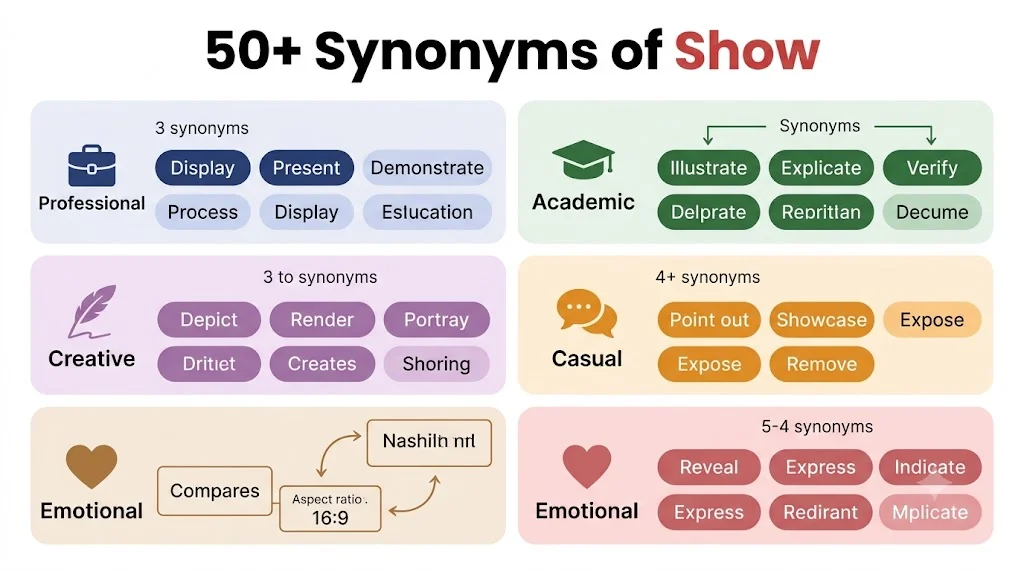
Show means to display, demonstrate, or make something visible. The best synonyms depend on the context. For professional writing, use demonstrate or illustrate. Casual conversation, use display or present. For creative writing, use portray or depict. The right choice improves clarity and impact.
Meaning, Tone, and Context
Understanding the word show is the first step to using it effectively.
Simple Definition:
Show means to cause something to be seen, to explain something clearly, or to prove that something exists or is true. It can refer to displaying an object, demonstrating a process, revealing information, or presenting evidence.
Part of Speech:
Verb and Noun
Overall Tone:
Neutral. Show works in almost any context, from casual conversations to formal business reports.
Formality Level:
Neutral. The word is widely accepted in both formal and informal settings.
Common Uses:
Native English speakers commonly use show to describe displaying objects, demonstrating skills, explaining ideas, presenting information, revealing emotions, and performing on stage.
Word Forms:
- Verb: show (to display or demonstrate)
- Noun: show (a performance or display)
- Adjective: showy (flashy or ostentatious)
- Adverb: showily (in a flashy manner)
- Related Verb: showcase (to display prominently)
- Related Noun: showing (a presentation or display)
Opposite Form:
Hide or conceal
When and How to Use “Show”
The word show fits almost any situation where you want to make something visible, explain something clearly, or present information. It is versatile, clear, and widely understood. However, it can feel generic when overused.
Professional Context:
The data shows a clear trend toward higher engagement.
Academic Context:
The experiment shows that temperature affects the outcome.
Workplace Context:
Please show your team how to use the new software.
Personal Context:
He showed his appreciation by sending a thoughtful gift.
Email Context:
Can you show me the revised proposal before the meeting?
Resume Context:
Showcased my ability to lead cross-functional teams.
Social Media Context:
Show your support by liking and sharing this post.
Best Synonyms of “Show”
No single synonym works perfectly in every situation. The best choice depends on your audience, the context, and the specific meaning you want to convey.
For Professional Writing:
Use demonstrate or illustrate. These words sound more authoritative and precise than show.
For Academic Writing:
Use indicate or evidence. These words fit research and analytical writing perfectly.
For Business Communication:
Use present or display. These words sound polished and professional.
For Casual Conversation:
Use show itself or let someone see. These expressions feel natural and friendly.
For Emotional Writing:
Use reveal or betray. These words add depth and vulnerability.
For Creative Writing:
Use portray or depict. These words create vivid imagery.
For Resume Writing:
Use demonstrated, showcased, or exhibited. These words highlight skills and achievements.
For Workplace Communication:
Use explain, guide, or walk through. These words emphasize teaching and collaboration.
For Stronger Meaning:
Use prove or establish. These words suggest certainty and authority.
For Softer Meaning:
Use suggest or hint at. These words are subtle and indirect.
When Not to Use “Show”
Even though show is a useful word, there are times when it is not the best choice.
When the Word Sounds Too General:
Show is vague in some situations. It does not specify how something is being displayed or demonstrated.
Original:
The report shows the results.
Better Recommendation:
Use demonstrates or illustrates to add clarity and authority.
Rewritten Sentence:
The report demonstrates the effectiveness of the new strategy.
When the Word Sounds Too Informal:
In formal writing, show can feel too casual.
Original:
The study shows that exercise improves health.
Better Recommendation:
Use indicates or suggests.
Rewritten Sentence:
The study indicates that exercise improves health.
When the Word Sounds Too Weak:
Sometimes show does not capture the full impact of what you are describing.
Original:
The evidence shows the defendant’s guilt.
Better Recommendation:
Use proves or establishes.
Rewritten Sentence:
The evidence proves the defendant’s guilt.
When the Word Sounds Too Strong:
For subtle or indirect communication, show can feel too direct.
Original:
His expression showed his disappointment.
Better Recommendation:
Use hinted at or betrayed.
Rewritten Sentence:
His expression betrayed his disappointment.
Words Commonly Confused With “Show”
Several words are often confused with show. Understanding their differences helps you choose the most accurate word.
- Show vs. Demonstrate
- Difference: Demonstrate implies providing evidence or proof. Show is more general and can mean simply making something visible.
- When to Use It: Use demonstrate when you want to emphasize proof or teaching.
- Example: The scientist demonstrated the experiment to the class.
- Show vs. Display
- Difference: Display emphasizes arranging something for people to see. Show is broader and can include explaining or revealing.
- When to Use It: Use display when describing exhibitions, merchandise, or presentations.
- Example: The museum displayed ancient artifacts.
- Show vs. Reveal
- Difference: Reveal implies uncovering something previously hidden. Show is more neutral.
- When to Use It: Use reveal when discussing secrets, emotions, or discoveries.
- Example: The investigation revealed the truth.
- Show vs. Portray
- Difference: Portray involves representing or describing someone or something in a particular way. Show is more straightforward.
- When to Use It: Use portray in artistic or descriptive contexts.
- Example: The novel portrays life in the 19th century.
- Show vs. Indicate
- Difference: Indicate suggests pointing to something or serving as evidence. Show is more general.
- When to Use It: Use indicate in academic or analytical contexts.
- Example: The results indicate a positive trend.
- Show vs. Present
- Difference: Present involves formally offering or showing something to an audience. Show is simpler.
- When to Use It: Use present in professional or formal settings.
- Example: She presented her findings at the conference.
Best Synonyms of “Show” by Context
| Context | Best Synonym | Why It Works | Example |
|---|---|---|---|
| Formal Writing | Demonstrate | Sounds authoritative and precise | The study demonstrates the effectiveness of the new policy. |
| Academic Writing | Indicate | Fits research and analytical writing | The data indicates a clear correlation. |
| Professional Communication | Present | Polished and business appropriate | We will present our findings to the board. |
| Business Emails | Illustrate | Helps clarify complex ideas | The chart illustrates our quarterly growth. |
| Resume Writing | Showcased | Highlights achievements | Showcased my leadership skills during the merger. |
| Workplace Communication | Guide | Emphasizes teaching and collaboration | She guided the team through the new process. |
| Casual Conversation | Let someone see | Natural and friendly | Let me see that new phone of yours. |
| Everyday Speaking | Show | Simple and widely understood | Can you show me how to do that? |
| Creative Writing | Portray | Creates vivid imagery | The author portrays the protagonist as a tragic hero. |
| Storytelling | Depict | Adds depth to descriptions | The painting depicts a dramatic historical scene. |
| Emotional Writing | Reveal | Adds vulnerability and depth | She finally revealed her true feelings. |
| Strong Emphasis | Prove | Suggests certainty and authority | The evidence proves the theory is correct. |
| Mild Tone | Suggest | Subtle and indirect | The report suggests room for improvement. |
| Social Media Captions | Showcase | Modern and engaging | Showcasing my latest creative project. |
| American English | Show | Standard and widely accepted | Let me show you what I mean. |
How to Choose the Best Synonym of “Show”
Choosing the right synonym depends on several factors. Use this practical guide to make the best decision.
Meaning:
What exactly are you trying to communicate? Are you displaying, explaining, proving, or revealing something? Choose a synonym that reflects the specific action.
Tone:
Do you want to sound formal, casual, emotional, or neutral? Formal words like demonstrate fit professional writing. Casual words like show fit conversation. Emotional words like reveal fit personal writing.
Audience:
Who is reading your writing? Business executives expect professional language. Friends expect casual language. Academic readers expect precise vocabulary.
Emotional Strength:
How strong is the action? Use prove or establish for certainty. Use suggest or hint at for subtlety.
Writing Purpose:
Are you writing a resume, an email, a story, or a social media post? Match your synonym to the purpose of the message.
Level of Formality:
Consider the formality of your situation. Reports, essays, and official documents require formal synonyms. Texting and social media allow informal language.
Natural Sounding Usage:
Always read your sentence aloud. If the synonym sounds forced or awkward, choose a different word.
Real Life Examples of “Show”
School Context:
The teacher showed the students how to solve the problem.
Stronger Version:
The teacher demonstrated the solution step by step.
College Context:
My research shows a connection between sleep and academic performance.
Stronger Version:
My research indicates a strong connection between sleep and academic performance.
Workplace Context:
Please show the new employee how to use the system.
Stronger Version:
Please guide the new employee through the system.
Business Context:
The quarterly report shows our revenue growth.
Stronger Version:
The quarterly report illustrates our revenue growth.
Email Context:
Can you show me the updated proposal before the meeting?
Stronger Version:
Can you share the updated proposal before the meeting?
Resume Context:
Showed my ability to manage complex projects.
Stronger Version:
Demonstrated the ability to manage complex projects successfully.
Conversation Context:
Show me your new phone!
Stronger Version:
Let me see your new phone!
Storytelling Context:
The author shows the character’s inner conflict.
Stronger Version:
The author portrays the character’s inner conflict powerfully.
Blogging Context:
This post shows you how to improve your writing skills.
Stronger Version:
This post demonstrates proven techniques for improving your writing skills.
Social Media Context:
Show your support by sharing this post.
Stronger Version:
Share this post to show your support.
25 Best Synonyms of “Show”
| Synonym | Simple Meaning | Best Used For | Example Sentence |
|---|---|---|---|
| Demonstrate | To prove or explain by example | Professional writing | The trainer demonstrated the new technique. |
| Display | To show publicly or prominently | Exhibitions, merchandise | The gallery displayed her artwork. |
| Present | To show or introduce formally | Business, presentations | She presented her findings to the board. |
| Reveal | To make known or visible | Secrets, emotions, discoveries | The investigation revealed the truth. |
| Exhibit | To show in public | Museums, galleries, resumes | The museum exhibits ancient artifacts. |
| Illustrate | To explain with examples | Academic, teaching | The diagram illustrates the process. |
| Indicate | To point out or show | Academic, analytical writing | The data indicates a positive trend. |
| Portray | To represent or describe | Creative writing, art | The novel portrays life in the 19th century. |
| Depict | To show in a picture or description | Art, storytelling | The painting depicts a dramatic scene. |
| Unveil | To reveal for the first time | Launches, announcements | The company unveiled its new product. |
| Expose | To reveal something hidden | Investigations, journalism | The article exposed the corruption. |
| Disclose | To make known formally | Legal, official contexts | He disclosed his financial interests. |
| Evidence | To show or prove clearly | Academic, legal writing | The results evidence the effectiveness. |
| Prove | To demonstrate the truth | Arguments, research | The experiment proved the hypothesis. |
| Establish | To show as fact or proven | Formal writing | The study establishes a clear link. |
| Clarify | To make clear or understandable | Teaching, explanations | She clarified the complex topic. |
| Explain | To describe in detail | Teaching, communication | He explained the process carefully. |
| Point out | To draw attention to | Conversations, instructions | She pointed out the error. |
| Express | To communicate clearly | Emotions, opinions | He expressed his gratitude. |
| Convey | To communicate or make known | Writing, speaking | The message conveys the importance. |
| Manifest | To show clearly or visibly | Formal, literary writing | His talent manifested early. |
| Betray | To reveal unintentionally | Emotional, psychological | His expression betrayed his fear. |
| Unveil | To remove a cover from | Launches, ceremonies | They unveiled the statue. |
| Showcase | To display prominently | Resumes, portfolios | The presentation showcased his skills. |
| Highlight | To emphasize or draw attention | Writing, presentations | The report highlights the key issues. |
Synonyms of “Show” by Usage
Professional vs Personal Synonyms
Professional Synonyms:
Demonstrate, present, illustrate, exhibit, showcase, highlight, prove, establish.
These words sound serious and results oriented. They fit resumes, business reports, and professional emails perfectly.
Personal Synonyms:
Show, let someone see, share, express, convey, reveal.
These words feel natural in conversation, personal reflection, and social media. They focus on connection and communication.
Formal vs Conversational Synonyms
Formal Synonyms:
Demonstrate, illustrate, indicate, evidence, prove, establish, manifest, unveil.
These words fit essays, research papers, official reports, and formal speeches. They sound authoritative and precise.
Conversational Synonyms:
Show, let someone see, point out, explain, share, express.
These words feel natural in texting, everyday speech, and casual writing.
Academic Synonyms
Recommended Words:
Demonstrate, illustrate, indicate, evidence, establish, prove, clarify.
These words sound authoritative and precise. They show that you understand the complexity of the subject.
Why They Work:
Demonstrate suggests proof through evidence. Indicate suggests pointing to a conclusion. Evidence suggests supporting findings.
Professional and Business Synonyms
Recommended Words:
Present, demonstrate, showcase, illustrate, highlight, exhibit.
Why They Fit:
Present suggests a formal introduction. Showcase suggests prominent display. Highlight suggests emphasizing key points.
Use in Resumes:
“Showcased my ability to lead cross-functional teams.”
Use in Interviews:
“I demonstrated my problem-solving skills during the project.”
Creative and Literary Synonyms
Recommended Words:
Portray, depict, reveal, manifest, betray, convey.
Why They Fit:
These words add drama, emotion, and imagery to storytelling, poetry, and descriptive writing. They create vivid mental pictures and evoke strong feelings.
Example:
“The author portrays the protagonist as a tragic hero.”
Modern English Synonyms
Recommended Words:
Showcase, highlight, demonstrate, present, share.
These words are widely used in modern American English. They are clear, direct, and easy to understand.
Slang or Modern Synonyms
Flex:
Meaning: To show off or display something proudly.
Where It Is Acceptable:
Casual conversation, social media, friendly contexts.
Where It Should Be Avoided:
Formal reports, academic papers, professional emails.
Example:
“She posted a photo to flex her new car.”
Whip out:
Meaning: To show something quickly.
Where It Is Acceptable:
Casual conversation.
Where It Should Be Avoided:
Formal writing.
Example:
“He whipped out his phone to show the video.”
Strongest to Mildest Synonyms
Mild (Subtle Indication):
Suggest, hint at, imply, indicate.
Moderate (General Display):
Show, display, present, demonstrate, illustrate.
Strong (Clear Proof):
Prove, establish, evidence, confirm.
Very Strong (Absolute Certainty):
Prove, establish, demonstrate conclusively, confirm beyond doubt.
Emotional vs Neutral Synonyms
Emotional Synonyms:
Reveal, betray, convey, express, manifest.
When to Use Emotional Synonyms:
Use them in storytelling, personal writing, emotional expression, and situations where you want to inspire or connect emotionally.
Neutral Synonyms:
Show, demonstrate, display, present, illustrate.
When to Use Neutral Synonyms:
Use them in professional writing, business communication, academic papers, and situations where facts matter more than feelings.
Antonyms of “Show”
| Antonym | Meaning | Example Sentence |
|---|---|---|
| Hide | To keep from being seen | He tried to hide his disappointment. |
| Conceal | To keep secret or hidden | She concealed the evidence. |
| Cover | To place something over | The blanket covered the table. |
| Obscure | To make unclear or hidden | The fog obscured the view. |
| Mask | To hide or disguise | He masked his true feelings. |
| Cloak | To hide or cover | The darkness cloaked their movements. |
| Veil | To cover or conceal | A veil of secrecy covered the project. |
| Suppress | To keep from being known | They suppressed the information. |
| Withhold | To refuse to give | The company withheld the report. |
| Deny | To refuse to acknowledge | He denied any involvement. |
| Disclaim | To deny responsibility | She disclaimed any knowledge. |
| Refute | To prove false | The evidence refuted the claim. |
| Contradict | To deny the truth of | His testimony contradicted the facts. |
| Disprove | To show to be false | The experiment disproved the theory. |
| Invalidate | To make invalid | The new evidence invalidated their argument. |
Comparison: “Show” vs Similar Words
Show vs Demonstrate
Main Difference:
Demonstrate implies providing evidence or teaching through example. Show is more general.
Which Is Stronger?
Demonstrate is stronger because it implies proof.
Which Is More Formal?
Demonstrate is more formal.
When to Use Each:
Use demonstrate when you want to prove or teach. Use show when you want to display or reveal.
Examples:
Show: Let me show you my new painting.
Demonstrate: The teacher demonstrated the experiment.
Show vs Display
Main Difference:
Display emphasizes arranging something for people to see. Show is broader.
Which Is Stronger?
Display is more specific but not necessarily stronger.
Which Is More Formal?
Display is neutral.
When to Use Each:
Use display when describing exhibitions or merchandise. Use show when describing any type of visual presentation.
Examples:
Show: She showed me her new car.
Display: The store displayed its new products.
Show vs Reveal
Main Difference:
Reveal implies uncovering something hidden. Show is more neutral.
Which Is Stronger?
Reveal is stronger and more dramatic.
Which Is More Formal?
Reveal is neutral.
When to Use Each:
Use reveal when discussing secrets, emotions, or discoveries. Use show when simply making something visible.
Examples:
Show: The photo shows the accident scene.
Reveal: The report reveals the truth.
Show vs Portray
Main Difference:
Portray involves representing or describing in a particular way. Show is more straightforward.
Which Is Stronger?
Portray is more specific and artistic.
Which Is More Formal?
Portray is formal and literary.
When to Use Each:
Use portray in artistic or descriptive contexts. Use show in everyday situations.
Examples:
Show: The documentary shows the effects of climate change.
Portray: The novel portrays the struggles of immigrants.
Show vs Indicate
Main Difference:
Indicate suggests pointing to something or serving as evidence. Show is more general.
Which Is Stronger?
Indicate is more precise and academic.
Which Is More Formal?
Indicate is more formal.
When to Use Each:
Use indicate in academic or analytical contexts. Use show in general communication.
Examples:
Show: The survey shows a preference for online shopping.
Indicate: The survey indicates a growing trend.
Show vs Present
Main Difference:
Present involves formally offering or showing to an audience. Show is simpler.
Which Is Stronger?
Present is more formal and polished.
Which Is More Formal?
Present is more formal.
When to Use Each:
Use present in professional or formal settings. Use show in everyday situations.
Examples:
Show: Let me show you the details.
Present: She presented her findings at the conference.
Common Phrases and Expressions with “Show”
| Phrase | Meaning | Example Sentence |
|---|---|---|
| Show off | To display proudly or boastfully | He loves to show off his new car. |
| Show up | To arrive or appear | She showed up late for the meeting. |
| Show around | To guide someone through a place | Let me show you around the office. |
| Show business | The entertainment industry | She worked in show business for years. |
| Showtime | The time when a show begins | Showtime is at seven o’clock. |
| Show of hands | A vote by raising hands | Let’s have a show of hands. |
| Showmanship | Skill in entertaining or presenting | His showmanship impressed the audience. |
Common Mistakes to Avoid
Choosing a Vague Synonym Instead of a Precise One
Incorrect:
The data shows a positive trend.
Better:
The data demonstrates a positive trend.
Why:
Demonstrates is more authoritative and precise than shows.
Confusing “Show” With “Tell”
Incorrect:
Show me what you told me.
Better:
Show me what you described.
Why:
Show and tell are often confused. Show emphasizes visual presentation. Tell emphasizes verbal communication.
Using an Informal Synonym in Formal Writing
Incorrect:
The report gives a showing of the results.
Better:
The report presents the results clearly.
Why:
Showing is too casual for a professional report. Present is more appropriate.
Selecting an Overly Dramatic Synonym
Incorrect:
The small detail revealed the entire truth about the situation.
Better:
The small detail indicated the truth about the situation.
Why:
Revealed is too dramatic for a minor detail. Indicated is more balanced.
Repeating the Same Word Too Often
Incorrect:
The results show improvement. The data shows growth. The trends show progress.
Better:
The results show improvement. The data indicates growth. The trends demonstrate progress.
Why:
Repeating show sounds repetitive. Using synonyms improves flow.
Choosing a Word With the Wrong Emotional Tone
Incorrect:
His face showed his love for her.
Better:
His face betrayed his love for her.
Why:
Betrayed adds depth and vulnerability. Showed is too neutral for emotional moments.
Frequently Asked Questions
What are the best synonyms of “show”?
The best synonyms of show are demonstrate, display, present, reveal, illustrate, and indicate. The right choice depends on the context. For professional writing, use demonstrate or illustrate. For creative writing, use portray or depict.
What are the best formal synonyms of “show”?
The best formal synonyms of show are demonstrate, illustrate, indicate, present, and evidence. These words fit academic papers, business reports, legal documents, and official speeches. They sound authoritative and precise.
What are common informal synonyms of “show”?
Common informal synonyms of show include let someone see, point out, share, and show itself. These words are used in casual conversations, texting, social media, and friendly emails. They are simple, friendly, and natural.
What is another word for “show” in professional writing?
In professional writing, use demonstrate, present, or illustrate. These words are specific, measurable, and results oriented. They fit resumes, performance reviews, business reports, and client emails perfectly.
What is the difference between “show” and “display”?
Show is a general word that means to make something visible. Display specifically means to arrange something for people to see. Display often implies a public or formal presentation. Show is more versatile.
What is the opposite of “show”?
The opposite of show is hide. Other antonyms include conceal, cover, obscure, mask, cloak, veil, suppress, withhold, deny, and refute. Choose the most accurate opposite based on the context of your sentence.
Conclusion
Show is a versatile and useful word, but using the same word repeatedly weakens your writing. The best synonyms of show help you communicate clearly, match the right tone, and express yourself with precision. You write a business report, a college essay, a personal reflection, or a social media post, there is a perfect synonym for every situation.
The more you practice choosing the right synonym, the more natural and confident your writing will become. A strong vocabulary helps you connect with readers, express your ideas clearly, and make a lasting impression.
Definitions, meanings, and usage recommendations should be verified with trusted language references before publication. Recommended sources include Cambridge Dictionary, Oxford English Dictionary, Merriam Webster, Collins Dictionary, and Britannica.
Read More Related Articles:
Synonyms for Empty | Meaning, Examples, and Better Word …
Synonyms for Thus | Meaning, Examples, and Better Word …