When writing an email, essay, caption, resume, or blog post, using the word reveal repeatedly can make your sentences feel predictable. Finding the right synonym of reveal can make your writing more precise by showing whether something is being discovered, disclosed, exposed, demonstrated, or made known.
The best alternative depends on what you mean and how much emphasis you want to add. A business report may need disclose, an academic paper may prefer demonstrate, a news story may use uncover, and a personal story may sound more natural with share. Understanding these differences helps you communicate the exact idea instead of simply replacing one word with another.
What Are the Best Synonyms of “Reveal”?
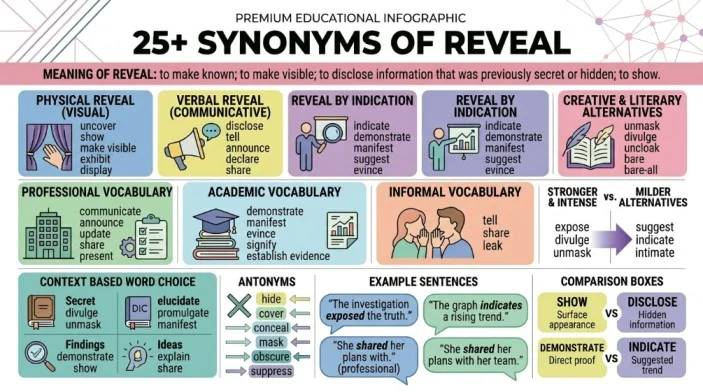
A reveal means to make something previously hidden, unknown, or secret known or visible. The best alternatives include disclose for formal information, uncover for discovering hidden facts, expose for bringing something concealed to light, demonstrate for showing evidence, and share for personal information.
Meaning, Tone, and Context
Simple Definition
Reveal means to make information, facts, feelings, objects, or details known or visible when they were previously hidden, secret, or unknown.
For example:
“The investigation revealed several problems.”
The sentence means that the investigation brought previously unknown problems to light.
The word can describe both physical and abstract situations.
“She revealed the painting.”
Here, something physically hidden becomes visible.
“He revealed his feelings.”
Here, something previously private becomes known.
Part of Speech
Reveal is primarily a verb.
It can describe an intentional action, such as someone revealing a secret, or a discovery produced by evidence, research, or investigation.
Overall Tone
Reveal is generally neutral. Its tone can become positive, negative, dramatic, or emotional depending on the information being revealed.
For example:
“The report revealed strong growth.”
This sounds positive.
“The investigation revealed serious misconduct.”
This sounds negative.
“She finally revealed her secret.”
This can sound dramatic or emotional.
Formality Level
Reveal is a neutral word that works in both formal and informal English.
It is appropriate for:
- Academic writing
- Business communication
- News writing
- Everyday conversation
- Creative writing
- Personal communication
- Social media
More formal alternatives include disclose, demonstrate, and indicate.
More conversational alternatives include show, tell, and share.
Common Uses
Native English speakers commonly use reveal when discussing:
- Secrets
- Information
- Research findings
- Emotions
- Plans
- Results
- Identities
- Evidence
- Problems
- Mistakes
- Personal feelings
- New products
- Hidden objects
- Unexpected facts
Word Forms
| Word Form | Example |
|---|---|
| Verb | reveal |
| Noun | revelation |
| Adjective | revealing |
| Adjective | revealed |
Examples:
“The interview was surprisingly revealing.”
“The discovery was an important revelation.”
When and How to Use “Reveal”
Use reveal when something that was hidden, private, unknown, or unclear becomes known or visible.
The word is especially useful when the act of making something known is the central idea.
Professional
“The audit revealed several areas where the company could reduce costs.”
Academic
“The research revealed a strong relationship between sleep and memory.”
Workplace
“The meeting revealed several concerns about the new schedule.”
Personal
“She finally revealed how she felt about the decision.”
“The latest report reveals a noticeable increase in customer satisfaction.”
Resume
“Analyzed customer data to reveal trends that supported business decisions.”
Social Media
“Today, we are excited to reveal our new product design.”
Best Synonyms of “Reveal”
No synonym of reveal works perfectly in every sentence. Each alternative emphasizes a slightly different idea, such as making information public, discovering something hidden, showing evidence, or sharing something personal.
Professional Writing: Disclose
Disclose is one of the strongest choices for formal and professional communication.
It means to make information known, especially information that may previously have been private or confidential.
“Employees must disclose any potential conflicts of interest.”
Use disclose for legal documents, financial reports, policies, official statements, and business communication.
Academic Writing: Demonstrate
Demonstrate works well when research, evidence, or results show that something is true.
“The findings demonstrate the effectiveness of the treatment.”
Use it when the information becomes clear through evidence rather than simply being announced.
Business Communication: Indicate
Indicate is useful when evidence points toward a conclusion.
“The latest figures indicate stronger customer demand.”
It is less dramatic than reveal and often sounds appropriately objective in business writing.
Casual Conversation: Show
Show is the most natural everyday alternative in many situations.
“The results show that we need more time.”
It is simple, familiar, and rarely sounds overly formal.
Emotional Writing: Share
Share works especially well when someone voluntarily communicates personal thoughts or feelings.
“She shared her concerns with her closest friend.”
Use share when the focus is on communication rather than discovery.
Creative Writing: Uncover
Uncover creates a stronger sense of discovery.
“The detective uncovered a hidden connection between the two families.”
It works particularly well in stories, mysteries, journalism, and descriptive writing.
Resume Writing: Demonstrate
A resume often benefits from demonstrate because it connects evidence with ability.
“Demonstrated strong leadership skills while managing a five person team.”
It sounds professional and focuses on proof rather than simply exposing information.
Workplace Communication: Highlight
Highlight is useful when you want to draw attention to something important.
“The report highlights several areas for improvement.”
It does not necessarily mean the information was secret. Instead, it means the information has been brought into focus.
Stronger Meaning: Expose
Expose is stronger than reveal and often carries a negative or critical tone.
“The investigation exposed serious violations.”
Use it when something hidden is brought to public attention, especially wrongdoing, weaknesses, or unpleasant facts.
Softer Meaning: Show
Show is a softer and more neutral alternative.
“The results show steady improvement.”
It communicates information without suggesting secrecy, drama, or surprise.
When Not to Use “Reveal”
Although reveal is versatile, it is not always the most precise choice.
When the Information Was Never Hidden
If something is simply presented or explained, reveal may suggest unnecessary secrecy.
Less precise:
“The chart reveals the monthly sales figures.”
Better:
“The chart shows the monthly sales figures.”
Why:
The figures are displayed openly. They were not necessarily hidden.
When Someone Officially Releases Information
For formal announcements, disclose may be more precise.
Less precise:
“The company revealed its financial information.”
Better:
“The company disclosed its financial information.”
Why:
Disclose emphasizes the formal act of making information available.
When Evidence Proves Something
Use demonstrate when evidence supports a conclusion.
Less precise:
“The study revealed that the method works.”
Better:
“The study demonstrated that the method works.”
Why:
Demonstrate emphasizes evidence and proof.
When Something Is Discovered
Use uncover when an investigation or search brings hidden information to light.
Less precise:
“The journalist revealed the corruption.”
Better:
“The journalist uncovered the corruption.”
Why:
Uncover emphasizes the process of discovering something hidden.
When You Want to Emphasize Importance
Use highlight when your goal is to draw attention rather than expose something secret.
Less precise:
“The report revealed the need for better training.”
Better:
“The report highlighted the need for better training.”
Why:
Highlight focuses on attention and importance.
Words Commonly Confused With “Reveal”
| Word | Difference | When to Use It | Example |
|---|---|---|---|
| Disclose | Making private or confidential information known | Formal and official communication | “The company disclosed the financial results.” |
| Expose | Bringing something hidden, often negative, into public view | Wrongdoing, problems, weaknesses | “The investigation exposed serious errors.” |
| Uncover | Finding something that was hidden | Research, investigation, journalism | “The reporter uncovered new evidence.” |
| Show | Making something visible or understandable | Everyday communication | “The results show steady progress.” |
| Demonstrate | Showing something through evidence or example | Academic and professional writing | “The experiment demonstrated the theory.” |
| Indicate | Providing evidence that points toward something | Reports and analysis | “The figures indicate rising demand.” |
Best Synonyms of “Reveal” by Context
| Context | Best Synonym | Why It Works | Example |
|---|---|---|---|
| Formal writing | Disclose | Sounds official and precise | “The organization disclosed the findings.” |
| Academic writing | Demonstrate | Connects evidence with conclusions | “The study demonstrated a clear trend.” |
| Professional communication | Indicate | Sounds objective | “The figures indicate improvement.” |
| Business emails | Highlight | Draws attention to useful information | “The report highlights several concerns.” |
| Resume writing | Demonstrate | Shows evidence of ability | “Demonstrated strong leadership skills.” |
| Workplace communication | Show | Clear and natural | “The data shows a change in demand.” |
| Casual conversation | Show | Simple and conversational | “The results show what happened.” |
| Everyday speaking | Tell | Natural when communicating information | “She told me the truth.” |
| Creative writing | Uncover | Creates a sense of discovery | “The detective uncovered a hidden clue.” |
| Storytelling | Expose | Adds dramatic force | “The evidence exposed the truth.” |
| Emotional writing | Share | Focuses on personal communication | “He shared his feelings.” |
| Strong emphasis | Expose | Suggests something hidden was brought to light | “The report exposed major flaws.” |
| Mild tone | Show | Neutral and uncomplicated | “The chart shows a steady increase.” |
| Social media captions | Unveil | Creates anticipation and excitement | “We are excited to unveil our new collection.” |
| American English | Reveal | Natural across many contexts | “The company revealed its new logo.” |
| British English | Reveal | Also widely natural in British English | “The report revealed new details.” |
How to Choose the Best Synonym of “Reveal”
Choosing the right synonym becomes easier when you identify exactly what is happening.
If Something Secret Becomes Known
Choose disclose or reveal.
“The company disclosed the information.”
If Something Hidden Is Found
Choose uncover.
“Researchers uncovered new evidence.”
If Something Negative Is Brought to Light
Choose expose.
“The investigation exposed serious problems.”
If Evidence Shows a Conclusion
Choose demonstrate or indicate.
“The results demonstrate a clear relationship.”
If You Simply Want to Present Information
Choose show.
“The graph shows the annual results.”
If Someone Communicates Personal Information
Choose share or tell.
“She shared her concerns with her manager.”
If You Want to Draw Attention to a Point
Choose highlight.
“The report highlights the importance of training.”
If You Want a Dramatic Announcement
Choose unveil.
“The company unveiled its latest product.”
Consider Your Audience
Academic readers usually respond better to precise words such as demonstrate, indicate, and disclose.
Everyday readers often prefer simpler choices such as show, tell, and share.
Consider Emotional Strength
Show is generally neutral.
Reveal can suggest surprise.
Uncover suggests discovery.
Expose can suggest wrongdoing or criticism.
Unveil often suggests excitement or anticipation.
Consider Formality
For a formal report:
“The findings indicate a substantial change.”
For casual conversation:
“The results show a big change.”
Both communicate a similar basic idea, but the tone is different.
Real Life Examples of “Reveal”
School
Basic:
“The experiment revealed an unexpected result.”
Stronger:
“The experiment uncovered an unexpected result.”
College
Basic:
“The research revealed a connection between the two factors.”
Improved:
“The research demonstrated a connection between the two factors.”
Workplace
Basic:
“The survey revealed employee concerns.”
Improved:
“The survey highlighted several employee concerns.”
Business
Basic:
“The financial report revealed a decline in sales.”
Improved:
“The financial report indicated a decline in sales.”
Basic:
“The latest data reveals several problems.”
Improved:
“The latest data highlights several areas that need attention.”
Resume
Basic:
“Used data analysis to reveal customer trends.”
Improved:
“Used data analysis to identify customer trends.”
Conversation
Basic:
“She revealed her plans.”
Natural:
“She shared her plans with me.”
Storytelling
Basic:
“The investigation revealed a hidden connection.”
Improved:
“The investigation uncovered a hidden connection.”
Blogging
Basic:
“The survey revealed several interesting facts.”
Improved:
“The survey uncovered several interesting insights.”
Social Media
Basic:
“We are ready to reveal our new collection.”
Improved:
“We are excited to unveil our new collection.”
25 Best Synonyms of “Reveal”
| Synonym | Simple Meaning | Best Used For | Example Sentence |
|---|---|---|---|
| Disclose | Make private information known | Formal and professional writing | “The company disclosed the relevant financial information.” |
| Uncover | Find something hidden | Investigations and research | “The investigation uncovered new evidence.” |
| Expose | Bring something hidden into public view | Problems and wrongdoing | “The audit exposed several weaknesses.” |
| Show | Make something clear or visible | Everyday communication | “The results show steady progress.” |
| Demonstrate | Show through evidence or example | Academic and professional writing | “The experiment demonstrated the value of the approach.” |
| Indicate | Point toward a conclusion | Research and reports | “The figures indicate stronger demand.” |
| Highlight | Draw attention to something | Reports and presentations | “The report highlights several important issues.” |
| Share | Give information to others | Personal communication | “She shared her concerns with the team.” |
| Tell | Communicate information | Casual conversation | “He told us the truth.” |
| Unveil | Publicly introduce something new | Products and announcements | “The company unveiled its newest model.” |
| Announce | Make information publicly known | Official communication | “The organization announced its new policy.” |
| Present | Put information before an audience | Meetings and presentations | “The researcher presented the findings.” |
| Display | Make something visible | Objects, data, and visuals | “The screen displays the latest results.” |
| Illustrate | Make an idea clear through an example | Academic and educational writing | “The example illustrates the main principle.” |
| Express | Make thoughts or feelings known | Emotional and personal writing | “She expressed her concerns openly.” |
| Communicate | Transfer information to others | Professional communication | “The manager communicated the changes clearly.” |
| Publish | Make information available to the public | Articles and official information | “The organization published the findings.” |
| Report | Give information about something | News and business | “The newspaper reported the latest developments.” |
| Identify | Point out or establish what something is | Research and analysis | “The study identified several risk factors.” |
| Demonstrate | Make ability or evidence clear | Resumes and academic writing | “The project demonstrates strong technical skills.” |
| Bring to light | Make hidden information known | Journalism and investigations | “The investigation brought several facts to light.” |
| Make known | Cause information to become known | General formal usage | “The organization made its concerns known.” |
| Clarify | Make something easier to understand | Communication and explanations | “The new evidence clarified the situation.” |
| Expose | Make concealed facts visible | Investigative contexts | “The report exposed serious procedural failures.” |
| Elaborate | Give more information about something | Academic and professional discussion | “The speaker elaborated on the main findings.” |
Synonyms of “Reveal” by Usage
Professional vs Personal Synonyms
Professional settings usually require accuracy and controlled tone.
Use:
- Disclose
- Demonstrate
- Indicate
- Highlight
- Identify
- Communicate
For personal conversations, simpler alternatives often sound more natural.
Use:
- Share
- Tell
- Show
- Express
For example:
“The manager disclosed the policy changes.”
sounds more professional than:
“The manager told everyone about the policy changes.”
Both can be correct, but the first emphasizes formal communication.
Formal vs Conversational Synonyms
Reports
Use indicate, demonstrate, disclose, or highlight.
Essays
Use demonstrate, indicate, illustrate, or identify.
Business Writing
Use disclose, highlight, indicate, or demonstrate.
Presentations
Use show, highlight, demonstrate, or illustrate.
Emails
Use share, highlight, provide, or disclose, depending on the situation.
Casual Conversations
Use show, tell, or share.
Texting
Simple words such as show, tell, and share usually sound more natural.
Academic Synonyms
Academic writing should distinguish between information that is simply presented and information supported by evidence.
Demonstrate
Use when evidence supports a conclusion.
“The findings demonstrate the effectiveness of the new method.”
Indicate
Use when evidence points toward a possibility or conclusion without necessarily proving it.
“The results indicate that additional research may be necessary.”
Identify
Use when research establishes or recognizes a specific factor.
“The study identified three major risk factors.”
Illustrate
Use when an example helps explain an idea.
“The case illustrates the importance of early intervention.”
Uncover
Use when research discovers something previously unknown.
“The investigation uncovered previously overlooked evidence.”
These alternatives help academic writing sound more precise than repeatedly using reveal.
Professional and Business Synonyms
Resumes
Use demonstrate, identify, and highlight.
“Demonstrated advanced analytical skills through multiple projects.”
Interviews
Use demonstrate when describing abilities.
“My previous experience demonstrates my ability to manage complex projects.”
Meetings
Use highlight or present.
“The presentation highlighted three major concerns.”
Presentations
Use demonstrate, show, and illustrate.
“This chart demonstrates the growth in customer engagement.”
Performance Reviews
Use demonstrate and highlight.
“The results demonstrate consistent improvement.”
Client Communication
Use indicate, show, and highlight.
“The latest analysis indicates a reduction in operating costs.”
Business Emails
Use disclose when confidential information is being formally communicated.
“Please disclose any potential conflicts before the meeting.”
Creative and Literary Synonyms
Creative writing allows more expressive choices.
Uncover
Creates a sense of discovery.
“She uncovered a letter hidden beneath the floorboards.”
Expose
Adds tension or conflict.
“The evidence exposed the secret he had protected for years.”
Unveil
Creates anticipation.
“The final scene unveiled the truth behind the mysterious disappearance.”
Reveal
Works well for dramatic moments.
“He finally revealed the reason he had left.”
Bring to Light
Adds a literary or investigative quality.
“The old journal brought forgotten memories to light.”
Slang or Modern Synonyms
There is no single slang word that perfectly replaces reveal in all contexts.
Informal expressions such as spill, spill the details, or let someone in on can work in casual conversation, but they should not be treated as universal synonyms.
Spill
Meaning: To reveal information, especially a secret.
Acceptable in:
- Casual conversation
- Texting
- Social media
- Informal entertainment writing
Avoid in:
- Academic papers
- Legal documents
- Formal business communication
Example:
“Come on, spill. What happened?”
A professional version would be:
“Please share the relevant details.”
Strongest to Mildest Synonyms
Mild
- Show
- Indicate
- Highlight
- Share
These words generally communicate information without creating strong emotional pressure.
Moderate
- Reveal
- Disclose
- Demonstrate
- Identify
- Uncover
These alternatives suggest that information has become known, established, or discovered.
Strong
- Expose
- Unveil
- Bring to light
These can create stronger emphasis, depending on the context.
Very Strong
- Expose
- Uncover
- Bring to light
These become particularly forceful when the information concerns wrongdoing, secrets, or controversial facts.
The intensity depends heavily on context. Expose can be especially strong because it often suggests that something negative was deliberately brought into public view.
Emotional vs Neutral Synonyms
Emotional Synonyms
Use these when the act of revealing carries personal or dramatic meaning.
- Share
- Express
- Unveil
- Expose
- Bring to light
Example:
“She finally shared her deepest concerns.”
The word shared creates a personal and vulnerable feeling.
Neutral Synonyms
Use these when you simply want to communicate information.
- Show
- Indicate
- Demonstrate
- Identify
- Present
- Display
Example:
“The graph indicates a gradual increase.”
The sentence communicates information without adding emotional drama.
Antonyms of “Reveal”
| Antonym | Meaning | Example Sentence |
|---|---|---|
| Conceal | Keep something hidden | “He tried to conceal the evidence.” |
| Hide | Keep something out of sight | “She hid the letter in a drawer.” |
| Withhold | Refuse to give information | “The company withheld important details.” |
| Suppress | Prevent information from becoming known | “Officials attempted to suppress the report.” |
| Cover | Keep something from being seen | “The cloth covered the object.” |
| Obscure | Make something difficult to see or understand | “The fog obscured the road.” |
| Mask | Hide the true nature of something | “The smile masked her disappointment.” |
| Secrete | Hide something carefully | “The documents were secreted in a secure location.” |
| Protect | Keep something from exposure or harm | “The system protects private information.” |
| Keep secret | Prevent others from knowing something | “They agreed to keep the plan secret.” |
| Guard | Protect information from disclosure | “The company carefully guarded its plans.” |
| Camouflage | Hide by making something blend with its surroundings | “The pattern camouflaged the equipment.” |
| Disguise | Make something appear different to conceal it | “He disguised his identity.” |
| Blur | Make something unclear or difficult to see | “The image blurred the person’s face.” |
| Omit | Leave information out | “The report omitted several relevant details.” |
Comparison: “Reveal” vs Similar Words
Reveal vs Disclose
Main Difference
Reveal is broad and can describe making almost anything known or visible. Disclose is more formal and usually involves information that was private, confidential, or previously withheld.
Which Is Stronger?
Neither is always stronger. Disclose has a more official tone.
Which Is More Formal?
Disclose is more formal.
When to Use Each
Use reveal for general information, secrets, discoveries, or dramatic moments.
Use disclose for legal, financial, corporate, or confidential information.
Examples
Reveal:
“The author revealed the ending.”
Disclose:
“The company disclosed its financial results.”
Reveal vs Expose
Main Difference
Expose often implies that something undesirable or hidden has been brought into public view.
Which Is Stronger?
Expose is usually stronger.
Which Is More Formal?
Both can be formal, but expose is especially common in investigative writing.
When to Use Each
Use reveal for neutral information.
Use expose for wrongdoing, corruption, weaknesses, or uncomfortable truths.
Examples
Reveal:
“The interview revealed new details.”
Expose:
“The investigation exposed serious misconduct.”
Reveal vs Uncover
Main Difference
Reveal focuses on making something known. Uncover emphasizes discovering something hidden.
Which Is Stronger?
Uncover often creates a stronger sense of investigation or discovery.
Which Is More Formal?
Both work in formal writing.
When to Use Each
Use uncover when research, investigation, or searching leads to a discovery.
Examples
Reveal:
“The report revealed several concerns.”
Uncover:
“The investigation uncovered several hidden concerns.”
Reveal vs Show
Main Difference
Show is broader and more neutral. Reveal often suggests that something was previously unknown or hidden.
Which Is Stronger?
Reveal usually carries more emphasis.
Which Is More Formal?
Both are neutral, but show is more conversational.
When to Use Each
Use show for visible information or ordinary evidence.
Use reveal when something becomes known or visible for the first time.
Examples
Reveal:
“The investigation revealed new evidence.”
Show:
“The chart shows annual revenue.”
Reveal vs Demonstrate
Main Difference
Demonstrate emphasizes proof, evidence, or clear illustration.
Which Is Stronger?
Demonstrate is stronger when evidence is involved.
Which Is More Formal?
Demonstrate is particularly suitable for academic and professional writing.
When to Use Each
Use demonstrate when evidence establishes or illustrates something.
Examples
Reveal:
“The research revealed a new trend.”
Demonstrate:
“The research demonstrated the effectiveness of the treatment.”
Reveal vs Indicate
Main Difference
Indicate means to point toward or suggest something. Reveal suggests that information has become known or visible.
Which Is Stronger?
Reveal often sounds more direct.
Which Is More Formal?
Indicate is highly useful in formal and analytical writing.
When to Use Each
Use indicate when the evidence suggests a conclusion rather than directly exposing it.
Examples
Reveal:
“The investigation revealed the cause.”
Indicate:
“The evidence indicates the likely cause.”
Common Phrases and Expressions with “Reveal”
Reveal the Truth
Meaning: Make the actual facts known.
Example:
“The investigation eventually revealed the truth.”
Reveal a Secret
Meaning: Tell someone information that was previously private.
Example:
“She decided to reveal the secret to her closest friend.”
Reveal Information
Meaning: Make information known.
Example:
“The company refused to reveal additional information.”
Reveal Details
Meaning: Provide previously unknown facts.
Example:
“The spokesperson revealed new details about the project.”
Reveal the Results
Meaning: Make findings or outcomes known.
Example:
“The researchers will reveal the results next week.”
Reveal an Identity
Meaning: Make someone’s identity known.
Example:
“The organization did not reveal the identity of the winner.”
Reveal a Plan
Meaning: Tell others about a plan that was previously private.
Example:
“The CEO revealed the company’s expansion plan.”
Reveal the Cause
Meaning: Make the reason for something known.
Example:
“The investigation revealed the cause of the problem.”
Common Mistakes to Avoid
1. Treating Every Synonym as Identical
Incorrect:
“The study exposed that exercise improves health.”
Better:
“The study demonstrated that exercise improves health.”
Why:
Expose often suggests bringing something hidden or problematic into public view. Demonstrate fits evidence and research much better.
2. Using “Disclose” in Casual Conversation
Incorrect:
“I disclosed my weekend plans to my friend.”
Better:
“I shared my weekend plans with my friend.”
Why:
Disclose sounds unnecessarily formal for an ordinary personal conversation.
3. Using “Expose” When the Information Is Neutral
Incorrect:
“The chart exposed the monthly sales figures.”
Better:
“The chart shows the monthly sales figures.”
Why:
Expose can imply that something negative or hidden was brought to light. Show is more neutral.
4. Using “Reveal” When Something Is Simply Visible
Incorrect:
“The screen reveals the current temperature.”
Better:
“The screen shows the current temperature.”
Why:
The temperature is displayed openly, so show is the more natural choice.
5. Using “Uncover” Without a Discovery
Incorrect:
“The presentation uncovered the company’s quarterly results.”
Better:
“The presentation presented the company’s quarterly results.”
Why:
Nothing was necessarily hidden or discovered. The presentation simply provided information.
6. Using Dramatic Vocabulary in Professional Writing
Incorrect:
“The email exposed our new meeting schedule.”
Better:
“The email announced our new meeting schedule.”
Why:
Announced accurately describes the formal communication of new information without adding unnecessary drama.
7. Repeating “Reveal” Too Often
Incorrect:
“The report reveals the problem. The data reveals the cause, and the interview reveals the employee’s concerns.”
Better:
“The report highlights the problem. The data indicates the cause, and the interview shares the employee’s concerns.”
Why:
Using contextually accurate alternatives makes the paragraph smoother and more precise.
Frequently Asked Questions
What is another word for “reveals”?
A strong alternative is discloses, especially when something previously unknown is made known.
What is a good reveal synonym?
Uncover is a useful reveal synonym when something hidden or unknown becomes known.
What is another word for “revealing”?
Depending on context, disclosing, uncovering, exposing, or showing can replace “revealing.”
What is another word for “reveal”?
Common alternatives include disclose, uncover, expose, show, and demonstrate.
What is a formal synonym for “reveals”?
Discloses is a strong formal synonym for “reveals,” particularly in professional or academic writing.
What is a synonym for “reveals”?
Useful synonyms include discloses, uncovers, exposes, demonstrates, and shows.
What are synonyms for “revealed”?
Depending on the context, disclosed, uncovered, exposed, unveiled, and made known can work.
What is a synonym for “revealing”?
Disclosing is a precise synonym, while exposing or uncovering may fit specific contexts.
What is a synonym for “reveal”?
Disclose is a strong choice when revealing information, while uncover works well for hidden facts.
What is the correct reveal synonym?
The best reveal synonym depends on context. Disclose, uncover, expose, unveil, and show are common choices.
What are the best synonyms of “reveal”?
The best synonyms include disclose, uncover, expose, show, demonstrate, indicate, highlight, share, tell, and unveil. The ideal choice depends on whether you are discussing evidence, secrets, discoveries, personal information, or public announcements.
What are the best formal synonyms of “reveal”?
The strongest formal alternatives include disclose, demonstrate, indicate, identify, present, and uncover. These choices work particularly well in academic papers, business reports, official documents, and professional communication.
What are common informal synonyms of “reveal”?
Common informal alternatives include show, tell, share, and expressions such as spill in very casual situations. These words sound more natural in conversations, texts, and informal social media communication.
What is another word for “reveal” in professional writing?
Disclose, demonstrate, indicate, highlight, and identify are strong professional alternatives. Choose based on meaning: use disclose for private information, demonstrate for evidence, and highlight for important points.
What is the difference between “reveal” and “disclose”?
Reveal is a broad word for making something hidden or unknown known. Disclose is more formal and usually refers to intentionally providing private, confidential, financial, legal, or official information.
What is the opposite of “reveal”?
Common opposites include conceal, hide, withhold, suppress, obscure, mask, and cover. The best antonym depends on whether information is deliberately hidden, kept private, made unclear, or simply left undisclosed.
Conclusion
Reveal means to make something previously hidden, private, unknown, or unclear become known or visible. Although it is a flexible word, alternatives such as disclose, uncover, expose, demonstrate, indicate, show, share, and unveil provide more precise choices for different situations.
For academic and professional writing, demonstrate, indicate, and disclose are especially useful. For everyday communication, show, tell, and share sound more natural, while uncover, expose, and unveil can add stronger emphasis in investigative or creative contexts.
No synonym works perfectly in every sentence. The best choice depends on the audience, tone, purpose, and exact meaning you want to communicate. A useful vocabulary habit is to identify how the information became known before choosing a synonym of reveal.
Read More Related Articles:
- 25+ Synonyms of Existence | Meanings, Uses, Examples, and …
- Synonyms for Thus | Meaning, Examples, and Better Word …
- Meaning, Uses, Examples, and the Best Synonym of Complain