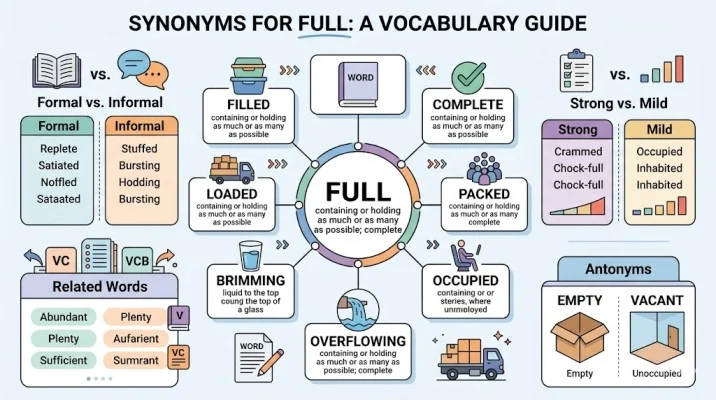
Finding the perfect word can completely change how a sentence feels. A simple word like full works in many situations, but using it again and again can make your writing sound repetitive. That is why many writers, students, professionals, and English learners search for synonyms for full to make their sentences more natural, descriptive, and engaging.
The right alternative depends on what you want to express. Sometimes you need a word that describes something completely filled, while other times you want to show completeness, satisfaction, or a busy schedule. Exploring synonyms for full helps you choose words that match the exact meaning and tone, making your communication clearer and more polished.
This guide brings together carefully selected synonyms, explains when each one works best, and includes practical examples to help you use them with confidence. By the end, you’ll have a stronger vocabulary and a better understanding of which alternative fits every context.
Best Synonyms for Full
The best synonyms for full are filled, complete, packed, occupied, loaded, brimming, overflowing, and saturated. The right choice depends on tone, context, and intensity.
- Filled – something contains as much as it can.
- Complete – nothing is missing.
- Packed – extremely full or crowded.
- Occupied – no space or time is available.
- Brimming – full to the edge.
- Overflowing – so full that contents spill over.
- Loaded – carrying or containing a large amount.
- Saturated – completely soaked or unable to absorb more.
What Does Full Mean?
The word full is an adjective that describes something containing as much as possible or reaching its maximum capacity. It can refer to physical space, emotions, time, information, or completeness.
In everyday English, full is one of the most flexible adjectives because its meaning changes slightly depending on the context.
For example:
- The glass is full of water.
- My calendar is full this week.
- After dinner, I felt full.
- The report gives a full explanation.
Although the central idea remains the same, each sentence uses full differently.
Core Meaning of Full
At its core, full expresses the idea that there is little or no room for anything more.
Depending on the situation, it may describe:
- Maximum capacity
- Completeness
- Abundance
- Satisfaction
- Crowded conditions
- Richness in detail
- Strong emotions
- A busy schedule
For example:
A bottle is full when no more liquid can fit inside.
A theater is full when every seat is occupied.
A person is full after eating enough food.
A report is full when it includes complete information.
Because the word has several meanings, no single synonym works perfectly in every sentence.
Grammar and Usage Notes
Part of Speech
The word full is most commonly used as an adjective.
Examples:
- The room is full.
- The tank is full.
- She gave a full explanation.
It may also appear in fixed expressions such as:
- full of hope
- full of energy
- full attention
- full responsibility
- full payment
- full support
- full access
- full speed
- full moon
- full capacity
- full time
Common Sentence Patterns
Full + of + noun
Examples:
- The basket is full of fruit.
- His speech was full of humor.
- The museum is full of visitors.
Full + noun
Examples:
- Full report
- Full refund
- Full access
- Full payment
- Full schedule
When “Full” Sounds Natural
Use full when you want to express:
- Maximum capacity
- Complete information
- Enough food
- A crowded place
- Rich detail
- Strong emotion
Examples:
- The parking lot is full.
- Please provide your full name.
- She felt full after lunch.
When a Synonym Works Better
Sometimes another word communicates your meaning more precisely.
Instead of:
“The bus is full.”
You could say:
“The bus is packed.”
This emphasizes heavy crowding.
Instead of:
“The document is full.”
You could write:
“The document is complete.”
This sounds clearer and more natural.
Instead of:
“The sponge is full.”
You could say:
“The sponge is saturated.”
This specifically refers to absorbing liquid.
Choosing the right synonym improves clarity and makes your writing sound more natural.
Best Synonyms for Full
| Synonym | Meaning | Tone | Best Use Case | Example Sentence |
|---|---|---|---|---|
| Filled | Contains something completely | Neutral | Containers, spaces | The bottle was filled with water. |
| Complete | Nothing is missing | Formal | Documents, projects | We submitted the complete report. |
| Packed | Very crowded or tightly filled | Informal | Places, bags, events | The train was packed this morning. |
| Occupied | Currently in use | Formal | Rooms, seats, schedules | Every seat was occupied. |
| Loaded | Carrying a large amount | Neutral | Vehicles, equipment | The truck was loaded with supplies. |
| Brimming | Filled to the top | Descriptive | Liquids, emotions | Her cup was brimming with tea. |
| Overflowing | More than full | Expressive | Containers, feelings | The sink was overflowing. |
| Saturated | Unable to absorb more | Technical | Science, liquids | The soil became saturated after the rain. |
| Stuffed | Filled tightly | Informal | Bags, food, people | I was stuffed after dinner. |
| Replete | Completely supplied | Formal | Literature, academic writing | The article was replete with examples. |
Common Synonyms for Full
These are the alternatives people use most often in everyday conversation and writing.
Filled
Meaning: Contains something inside until little or no space remains.
Best Context: Containers, rooms, boxes, tanks, bags.
Example:
The glass was filled with fresh orange juice.
Complete
Meaning: Finished with nothing missing.
Best Context: Reports, forms, assignments, collections.
Example:
Please submit the complete application before Friday.
Packed
Meaning: Extremely crowded or tightly filled.
Best Context: Buses, concerts, restaurants, stadiums.
Example:
The stadium was packed before the game started.
Occupied
Meaning: Already being used.
Best Context: Hotel rooms, seats, parking spaces, schedules.
Example:
Every meeting room was occupied throughout the afternoon.
Loaded
Meaning: Carrying or containing a large amount.
Best Context: Vehicles, shelves, trucks, websites, equipment.
Example:
The truck was loaded with construction materials.
Stuffed
Meaning: Filled completely, often beyond comfort.
Best Context: Food, bags, toys, clothing.
Example:
After Thanksgiving dinner, everyone felt stuffed.
Brimming
Meaning: Filled right to the top.
Best Context: Cups, bowls, rivers, emotions.
Example:
The bowl was brimming with fresh berries.
Overflowing
Meaning: So full that contents spill over.
Best Context: Rivers, sinks, trash bins, emotions.
Example:
The trash can was overflowing by the end of the day.
Replete
Meaning: Fully supplied or abundantly provided.
Best Context: Academic writing, literature, formal reports.
Example:
The book is replete with practical advice.
Saturated
Meaning: Completely soaked or unable to absorb more.
Best Context: Weather, chemistry, marketing, photography.
Example:
The ground was saturated after three days of heavy rain.
Formal Synonyms for Full
Formal writing often needs more precise alternatives to full. In professional, academic, or business contexts, a synonym can make your sentence clearer and more specific.
Complete
Meaning: Having all necessary parts or details.
Best Use: Reports, research, documents, instructions.
Example sentence:
The team prepared a complete analysis of the results.
Comprehensive
Meaning: Including many details and covering a wide area.
Best Use: Studies, guides, reviews, reports.
Example sentence:
The company created a comprehensive training program for employees.
Entire
Meaning: Including everything or the whole amount.
Best Use: Formal descriptions and general writing.
Example sentence:
The entire process took less than two hours.
Total
Meaning: The whole amount or complete quantity.
Best Use: Numbers, measurements, summaries.
Example sentence:
The total cost included all additional fees.
Exhaustive
Meaning: Covering every possible detail.
Best Use: Research and detailed investigations.
Example sentence:
The researchers conducted an exhaustive review of previous studies.
Replete
Meaning: Filled or richly supplied with something.
Best Use: Formal descriptions and literary writing.
Example sentence:
The report was replete with useful examples.
Abundant
Meaning: Existing in large quantities.
Best Use: Resources, opportunities, information.
Example sentence:
The region has abundant natural resources.
Informal Synonyms for Full
In casual conversations, people often choose simpler and more expressive words instead of full.
Packed
Meaning: Very crowded or filled tightly.
Best Use: People, places, bags, schedules.
Example sentence:
The café was packed after work hours.
Stuffed
Meaning: Filled completely, especially after eating.
Best Use: Food, bags, casual speech.
Example sentence:
I am stuffed after that big meal.
Jammed
Meaning: Completely filled or blocked.
Best Use: Roads, devices, spaces.
Example sentence:
The highway was jammed with traffic.
Loaded
Meaning: Carrying a lot or containing many things.
Best Use: Vehicles, devices, casual descriptions.
Example sentence:
My backpack is loaded with books today.
Crammed
Meaning: Filled with too many things or people.
Best Use: Rooms, schedules, containers.
Example sentence:
The small apartment was crammed with furniture.
Chock-full
Meaning: Completely full.
Best Use: Friendly conversation and informal writing.
Example sentence:
The website is chock-full of helpful ideas.
Strong Synonyms for Full
Some alternatives suggest a stronger level of fullness. They create a stronger image or feeling.
Overflowing
Meaning: Beyond full, with contents spilling out.
Example sentence:
The river was overflowing after the storm.
Bursting
Meaning: So full that it seems ready to break.
Example sentence:
The room was bursting with excitement.
Packed
Meaning: Extremely crowded.
Example sentence:
The concert hall was packed with fans.
Crammed
Meaning: Filled beyond comfortable limits.
Example sentence:
The schedule was crammed with meetings.
Saturated
Meaning: Completely filled or soaked.
Example sentence:
The market is saturated with similar products.
Brimming
Meaning: Filled to the edge, often with emotion or energy.
Example sentence:
She was brimming with confidence before the interview.
Mild Synonyms for Full
Milder alternatives describe fullness without sounding extreme.
Filled
Meaning: Having something inside.
Example sentence:
The drawer was filled with old photos.
Complete
Meaning: Finished or whole.
Example sentence:
The assignment is complete.
Occupied
Meaning: Being used.
Example sentence:
The chair is occupied.
Covered
Meaning: Containing or including something.
Example sentence:
The article covered all major topics.
Supplied
Meaning: Provided with what is needed.
Example sentence:
The room was supplied with basic equipment.
Synonyms for Full by Context
The best synonym depends heavily on what you are describing. A word that works for a container may sound strange when talking about emotions or schedules.
Everyday Conversation
In daily speech, simple and natural words usually work best.
Common choices include:
- Filled
- Packed
- Stuffed
- Loaded
- Complete
Examples:
Original:
My bag is full.
Natural alternatives:
- My bag is packed.
- My bag is loaded.
- My bag is stuffed.
The choice changes the feeling:
- Packed suggests organization.
- Stuffed suggests too much inside.
- Loaded suggests a large amount.
Professional Writing
Professional writing often needs accuracy and clarity.
Better choices include:
- Complete
- Comprehensive
- Occupied
- Total
- Entire
Examples:
- The complete report is attached.
- The conference room is occupied.
- The total amount has been calculated.
These words sound more precise than simply using full repeatedly.
Academic Writing
Academic writing often focuses on detail and completeness.
Useful alternatives:
Comprehensive
Used when something includes many details.
Example:
The study provides a comprehensive overview of climate patterns.
Exhaustive
Used when something covers nearly every possible area.
Example:
The paper includes an exhaustive review of available research.
Complete
Used when something has all required parts.
Example:
The experiment requires complete documentation.
Creative Writing
Creative writing often uses stronger, more visual synonyms.
Good choices include:
- Overflowing
- Brimming
- Bursting
- Filled
- Loaded
Examples:
- Her heart was brimming with happiness.
- The garden was overflowing with flowers.
- The street was bursting with energy.
These words create stronger images than the basic word full.
Marketing Copy
Marketing language often emphasizes abundance and value.
Useful options:
- Packed
- Loaded
- Rich
- Filled
- Complete
Examples:
- A course packed with useful lessons.
- A guide filled with expert tips.
- A package loaded with features.
The goal is usually to show that something offers a lot.
Emotional Expression
When describing feelings, full often means deeply experiencing something.
Better choices include:
- Filled
- Brimming
- Overflowing
- Bursting
Examples:
- She was filled with gratitude.
- He was brimming with excitement.
- They were overflowing with joy.
These synonyms add emotional strength.
Another Word for Full in a Sentence
Here are natural examples using different alternatives:
- The room was packed with guests during the celebration.
- Her notebook was filled with creative ideas.
- The report provides a complete explanation of the issue.
- The river was overflowing after heavy rainfall.
- The child’s face was brimming with happiness.
- The truck was loaded with supplies.
- The schedule was crammed with appointments.
- The bottle was filled to the top.
- The library was occupied by students preparing for exams.
- The article was replete with useful examples.
- The bag was stuffed with clothes for the trip.
- The presentation was packed with valuable information.
- The field was covered with fresh snow.
- The website is loaded with helpful resources.
- The room was bursting with excitement.
Full Synonyms Compared
| Word | Meaning Difference | Tone | Best Use |
|---|---|---|---|
| Full | Maximum amount or capacity | Neutral | General use |
| Filled | Contains something | Neutral | Containers and spaces |
| Complete | Nothing missing | Formal | Tasks and information |
| Packed | Extremely crowded | Casual | People and places |
| Occupied | Already being used | Formal | Seats and rooms |
| Overflowing | More than full | Strong | Liquids and emotions |
| Brimming | Full to the edge | Expressive | Feelings and containers |
| Loaded | Contains a lot | Neutral | Objects and features |
| Saturated | Cannot absorb more | Technical | Materials and systems |
| Replete | Richly supplied | Formal | Writing and descriptions |
Words Similar to Full
Some words are closely connected to full but are not always exact replacements. These words share a similar idea, but they may change the meaning of your sentence.
Understanding these differences helps you avoid choosing a word that sounds correct but does not fit the situation.
Complete
Why it is related:
Complete suggests that something has all required parts.
Why it may not replace full:
A thing can be complete without being physically full.
Example:
- The report is complete. ✅
- The report is full. (Possible, but less precise)
Crowded
Why it is related:
Crowded means there are many people or objects in one place.
Why it may not replace full:
Crowded focuses on limited space, not simply having the maximum amount.
Example:
The bus was crowded.
This means many people were inside, but it does not describe a container or amount.
Abundant
Why it is related:
Abundant means there is a large supply of something.
Why it may not replace full:
It focuses on quantity rather than capacity.
Example:
The area has abundant resources.
Rich
Why it is related:
Rich can mean containing a lot of something valuable.
Why it may not replace full:
It often describes quality or variety, not physical capacity.
Example:
The article is rich in information.
Busy
Why it is related:
A busy schedule can be described as full.
Why it may not replace full:
Busy focuses on activity, not amount.
Example:
My schedule is full.
My schedule is busy.
Both work, but they emphasize different ideas.
Antonyms of Full
Antonyms are words that express the opposite meaning of full. The best opposite depends on the context.
| Antonym | Meaning | Example Sentence |
|---|---|---|
| Empty | Contains nothing | The bottle is empty. |
| Vacant | Available and unused | The seat is vacant. |
| Available | Ready for use | The room is available. |
| Hollow | Having an empty space inside | The tree trunk is hollow. |
| Bare | Without something expected | The walls were bare. |
| Incomplete | Missing parts | The application is incomplete. |
| Lacking | Not having enough | The report is lacking details. |
| Scarce | Available in small amounts | Water became scarce during the drought. |
| Limited | Restricted in amount | Tickets are limited. |
How to Choose the Right Synonym for Full
Choosing the right alternative depends on more than finding a similar word. A good synonym should match the meaning, tone, and situation.
Match the Context
Think about what you are describing.
- For a container:
- filled
- overflowing
- saturated
- For a schedule:
- busy
- occupied
- packed
- For information:
- complete
- comprehensive
- detailed
Example:
“The article is full of information.”
Better options:
- The article is packed with information.
- The article is rich in information.
- The article is filled with useful details.
Match the Tone
Different words create different feelings.
Neutral:
- filled
- complete
Casual:
- stuffed
- packed
Formal:
- comprehensive
- exhaustive
Emotional:
- overflowing
- brimming
A formal report may sound strange if it says:
“The research is stuffed with examples.”
A better choice:
“The research is filled with examples.”
Check the Intensity
Some synonyms are stronger than others.
Compare:
- filled → normal
- packed → very full
- overflowing → beyond full
Example:
“The room was filled with people.”
This sounds normal.
“The room was overflowing with people.”
This creates a stronger image.
Think About the Reader
Choose words your audience will understand.
Simple words often communicate better.
Instead of:
“The document is replete with unnecessary terminology.”
You might write:
“The document is filled with unnecessary terms.”
Clear writing is usually better than complicated vocabulary.
Check Exact Meaning
Not every related word is a perfect synonym.
For example:
“Complete” and “full” overlap, but they are not identical.
A complete project has all parts finished.
A full container has no space left.
The best synonym keeps the original meaning.
Keep the Sentence Natural
A synonym should make your writing better, not awkward.
Natural:
“The room was packed with visitors.”
Less natural:
“The room was complete with visitors.”
Even though both suggest “full,” only one fits naturally.
Common Mistakes When Using Synonyms for Full
Using synonyms incorrectly can make writing confusing or unnatural.
Choosing the Wrong Tone
Some words are too casual or too formal.
Wrong:
“The scientific study was stuffed with evidence.”
Better:
“The scientific study was filled with evidence.”
Using a Word That Is Too Strong
A stronger synonym can change the meaning.
Example:
“The basket was full of apples.”
Changing it to:
“The basket was overflowing with apples.”
suggests there are more apples than the basket can hold.
Using Casual Words in Professional Writing
Words like:
- stuffed
- jammed
- crammed
work well in conversation but may sound informal in reports.
Professional:
“The schedule is fully booked.”
Casual:
“The schedule is packed.”
Using Formal Words in Simple Situations
A complicated word may make writing feel unnatural.
Example:
“The cup was replete with coffee.”
A natural sentence:
“The cup was full of coffee.”
Treating Related Words as Exact Synonyms
Words can be connected without being interchangeable.
For example:
- crowded = many people
- full = maximum capacity
They overlap but are not always equal.
Making Sentences Sound Forced
Avoid replacing every use of full with unusual vocabulary.
Good writing uses the right word, not the most impressive word.
Quick Synonym List for Full
Common Synonyms
- filled
- complete
- packed
- occupied
- loaded
- covered
Formal Synonyms
- comprehensive
- entire
- total
- exhaustive
- replete
- abundant
Informal Synonyms
- stuffed
- jammed
- crammed
- chock-full
- loaded
Strong Synonyms
- overflowing
- bursting
- packed
- saturated
- brimming
Mild Synonyms
- filled
- complete
- supplied
- occupied
- covered
Related Words
- crowded
- rich
- busy
- plentiful
- available
- abundant
FAQs
What is the best synonym for full?
The best synonym for full depends on the sentence. Common choices include filled, complete, packed, occupied, and loaded. Each word fits different situations.
What is another word for full?
Another word for full is filled. Other alternatives include complete, packed, occupied, overflowing, and loaded.
What is a formal synonym for full?
A formal synonym for full is complete or comprehensive. These words work well in professional writing, reports, and academic contexts.
What is an informal synonym for full?
Informal synonyms for full include stuffed, packed, crammed, and jammed. These are common in everyday conversation.
What is a stronger word for full?
Stronger words for full include overflowing, bursting, saturated, and brimming. They suggest an extreme level of fullness.
What is a milder word for full?
Milder alternatives include filled, occupied, supplied, and complete. They describe fullness without strong emphasis.
What words are similar to full?
Words similar to full include crowded, abundant, rich, busy, plentiful, and complete. However, some are related rather than exact synonyms.
What is the opposite of full?
The opposite of full can be empty, vacant, incomplete, lacking, or limited, depending on the context.
How do I choose the right synonym for full?
Choose a synonym based on what you are describing, the tone you want, and how strong the meaning should be. A container, schedule, emotion, and report may all need different words.
Conclusion
The word full has many useful alternatives, but the best choice depends on meaning, context, tone, and intensity. Words like filled, complete, packed, occupied, overflowing, and brimming can all work, but they do not always mean exactly the same thing.
For everyday writing, simple options like filled and complete are often the clearest. In professional or academic writing, words like comprehensive and exhaustive may be more precise. For emotional or creative writing, stronger choices like overflowing or brimming can create a stronger image.
Good word choice is not about using the fanciest synonym. It is about choosing the word that communicates your exact meaning naturally.
Read More Related Articles:
Synonyms for Realized | Meaning, Examples, and Better Word …
Synonyms for Everything | Meaning, Examples, and Better …










6 thoughts on “Best Synonyms for Full | Formal, Casual, and Creative Alternatives”