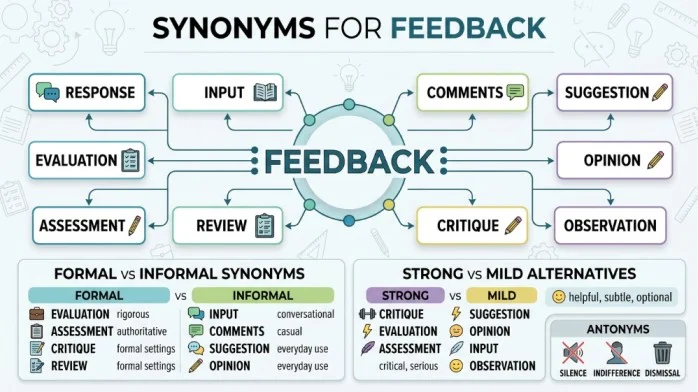
Feedback can shape better decisions, stronger communication, and real progress, but the word itself can become repetitive. Choosing the right synonyms of feedback can make your writing more precise and professional. In a workplace, classroom, review, or everyday conversation, the best alternative depends on what you actually mean.
A useful feedback synonym may be response, evaluation, comment, input, or critique, but these words are not always interchangeable. For example, input often suggests an idea or contribution, while evaluation focuses on judging performance. If you need a constructive feedback synonym, terms such as guidance, helpful critique, or developmental advice may fit better.
This guide explains another word for feedback, a feedback other term, and the most useful feedback synonyms for different situations. You’ll also find practical examples for another word for feedback in communication, along with clear distinctions that help you choose the right synonym for feedback, synonym of feedback, or other term of feedback with confidence.
Best Synonyms for Feedback
The best synonyms for feedback are response, input, comments, and evaluation. The right choice depends on tone, context, and intensity.
- Response works well when referring to someone’s reaction.
- Input emphasizes suggestions or ideas from others.
- Comments fits both spoken and written communication.
- Evaluation is ideal in formal or professional settings.
Each of these words shares part of the meaning of feedback, but they are not always interchangeable.
What Does Feedback Mean?
Feedback is information, comments, or reactions provided to someone about their work, behavior, performance, product, or ideas. Its purpose is often to help improve future results, although feedback can also express approval, criticism, or general opinions.
Simple Definition
Feedback is information given in response to something with the goal of informing, evaluating, or improving it.
Core Idea
At its heart, feedback is a two-way exchange of information. One person performs an action, creates something, or expresses an idea, and another person responds with observations, suggestions, praise, or criticism.
Unlike casual opinions, feedback usually has a practical purpose. It helps someone understand what worked well, what could improve, or how others experienced the result.
Part of Speech
Feedback is primarily a noun.
Examples:
- The manager gave helpful feedback after the presentation.
- We appreciate your feedback on our new website.
- Customer feedback helped improve the product.
In technical fields such as engineering or electronics, feedback also describes a process where part of a system’s output returns to influence its input. However, in everyday English, the word most often refers to comments, evaluations, or reactions.
Common Usage
People commonly use feedback in situations such as:
- Employee performance reviews
- Classroom assignments
- Business meetings
- Customer satisfaction surveys
- Product testing
- Creative writing workshops
- Team collaboration
- Online reviews
Example Sentences
- My teacher gave me detailed feedback that helped improve my essay.
- We collected customer feedback before launching the updated product.
Both examples show feedback as useful information intended to guide future improvements.
Core Meaning of Feedback
The central idea behind feedback is communication that helps someone understand the quality, effectiveness, or impact of something they have done.
Unlike simple praise or criticism, feedback often combines observation with guidance. It may highlight strengths, identify weaknesses, suggest improvements, or explain how others experienced a product, service, performance, or idea.
For example:
- A supervisor explains how an employee can improve future presentations.
- A customer shares their experience using a new product.
- A teacher marks an assignment and offers suggestions for stronger writing.
- A friend comments on a speech before an important event.
In each case, the goal is not merely to express an opinion but to provide information that can influence future decisions or performance.
Feedback can also vary in tone:
- Positive feedback recognizes strengths and successful performance.
- Constructive feedback balances praise with practical suggestions for improvement.
- Critical feedback focuses more heavily on identifying problems or weaknesses.
- Neutral feedback simply reports observations without strong positive or negative judgment.
Because of these different purposes, choosing the right synonym depends on what kind of communication you are describing. Sometimes response is the best fit, while in other situations evaluation, assessment, comments, or input communicates the meaning more accurately.
Grammar and Usage Notes
Understanding how feedback functions in a sentence makes it easier to choose the right synonym. Although the word is common in everyday English, it has a few usage rules that are worth remembering.
Part of Speech
Feedback is a noun.
Examples:
- Thank you for your feedback.
- Her feedback helped improve the report.
- We received valuable feedback from customers.
Unlike many nouns, feedback is generally treated as uncountable in standard English.
✔ Correct:
- We received useful feedback.
- Thank you for your feedback.
- The team welcomed constructive feedback.
✘ Less natural:
- She gave three feedbacks.
- I received many feedbacks.
If you want to count individual pieces of feedback, say:
- three comments
- several suggestions
- two observations
- a few points of feedback
- multiple responses
Common Sentence Patterns
The word feedback naturally appears in several sentence structures.
Give feedback
- The editor gave helpful feedback on my article.
Receive feedback
- Employees receive regular feedback from their managers.
Ask for feedback
- Don’t hesitate to ask for feedback before submitting your project.
Collect feedback
- The company collected customer feedback through an online survey.
Provide feedback
- Participants were invited to provide feedback after the workshop.
Respond to feedback
- Successful professionals learn how to respond to feedback with an open mind.
Common Collocations
Certain words frequently appear with feedback because they describe its quality or purpose.
Some of the most common collocations include:
- constructive feedback
- positive feedback
- negative feedback
- honest feedback
- valuable feedback
- detailed feedback
- immediate feedback
- customer feedback
- employee feedback
- user feedback
- peer feedback
- performance feedback
- written feedback
- verbal feedback
- real-time feedback
These combinations sound natural because they are widely used in professional, educational, and everyday communication.
When “Feedback” Sounds Natural
Use feedback when someone is sharing information that can improve a person, product, service, or process.
Examples:
- A teacher commenting on homework.
- A manager discussing job performance.
- Customers reviewing a new product.
- Readers responding to an article.
- Designers testing a prototype.
In these situations, feedback clearly communicates that the information has a practical purpose.
When Another Word Works Better
Sometimes another word is more precise than feedback.
| Instead of “Feedback” | Better Choice | Why It Fits Better |
|---|---|---|
| Customer reaction | Response | Focuses on how people reacted |
| Professional review | Evaluation | More formal and systematic |
| Friendly suggestions | Input | Sounds collaborative |
| Written notes | Comments | Refers to specific written observations |
| Expert analysis | Critique | Emphasizes detailed evaluation |
| Formal grading | Assessment | Often used in education and business |
Choosing the most accurate word helps your writing sound more natural and professional.
Common Phrases Using “Feedback”
You will often hear expressions like:
- appreciate your feedback
- thank you for your feedback
- based on your feedback
- welcome your feedback
- gather customer feedback
- provide honest feedback
- implement feedback
- respond to feedback
- receive constructive feedback
- act on feedback
These phrases are common in workplaces, schools, customer service, and everyday communication because they clearly describe the exchange of useful information.
Usage Tip
A good way to decide whether feedback is the right word is to ask yourself:
Is someone sharing information that can help improve something?
If the answer is yes, feedback is usually the best choice.
If the focus is simply on a reaction, opinion, review, or suggestion, a synonym such as response, comment, input, or evaluation may sound more natural depending on the context.
Informal Synonyms for Feedback
In everyday conversations, text messages, social media, and friendly emails, people often use simpler alternatives to feedback. These words sound more relaxed and conversational while still expressing opinions, reactions, or suggestions.
Input
Meaning: Ideas or suggestions offered to help improve something.
Best context: Team discussions, group projects, and casual workplace conversations.
Example:
- I’d love your input before I send the proposal.
- Everyone’s input helped make the event a success.
Thoughts
Meaning: Personal opinions or impressions.
Best context: Informal conversations and friendly discussions.
Example:
- What are your thoughts on the new design?
- I’d appreciate hearing your thoughts after you read the article.
Comments
Meaning: Written or spoken opinions about something.
Best context: Online discussions, meetings, presentations, and documents.
Example:
- Please leave your comments below the post.
- Her comments gave us several new ideas.
Opinion
Meaning: A personal belief or judgment.
Best context: Casual conversations and decision-making.
Example:
- What’s your opinion on this logo?
- I’d like your honest opinion before publishing the report.
Take
Meaning: A person’s viewpoint or interpretation.
Best context: Modern conversational English, podcasts, blogs, and social media.
Example:
- What’s your take on the latest update?
- His take on the issue was surprisingly balanced.
Reaction
Meaning: The immediate response to an event, product, or idea.
Best context: Entertainment, marketing, product launches, and news.
Example:
- The audience’s reaction was overwhelmingly positive.
- We monitored customer reactions after the announcement.
Why These Informal Alternatives Work
These words create a friendly tone without sounding overly formal. They are especially useful when asking friends, coworkers, classmates, or online communities to share what they think.
For example:
- “Can I get your feedback?” sounds professional.
- “Can I get your thoughts?” sounds warm and conversational.
- “I’d love your input.” encourages collaboration.
- “What’s your take?” feels modern and relaxed.
Strong Synonyms for Feedback
Sometimes you need a word that emphasizes careful analysis, detailed judgment, or significant evaluation. These stronger synonyms carry more authority or intensity than the general word feedback.
Critique
Meaning: A detailed evaluation that highlights both strengths and weaknesses.
Best use: Academic writing, creative work, design reviews, and professional analysis.
Example:
- The architect welcomed a detailed critique of the building plans.
Note: A critique is more comprehensive than ordinary feedback.
Evaluation
Meaning: A structured assessment based on specific standards.
Best use: Business, education, healthcare, and performance reviews.
Example:
- Every employee receives an annual evaluation.
Assessment
Meaning: A careful judgment of quality, ability, or performance.
Best use: Schools, training programs, and organizational reviews.
Example:
- The final assessment measured each student’s progress.
Appraisal
Meaning: A formal review of performance or value.
Best use: Human resources, management, and professional settings.
Example:
- Her yearly appraisal included goals for professional growth.
Analysis
Meaning: A detailed examination of information or performance.
Best use: Research, technical writing, and business reports.
Example:
- The consultant provided an in-depth analysis of the marketing campaign.
Review
Meaning: A considered examination that often includes recommendations.
Best use: Products, books, software, movies, and workplace projects.
Example:
- The editor completed a thorough review of the manuscript.
When Strong Synonyms May Be Too Strong
Words such as critique, evaluation, and assessment imply careful examination. They may sound too formal if you’re simply asking a friend what they think.
For example:
- “Can I get your feedback?” ✔ Natural
- “Can I get your critique?” ✔ Appropriate for writers, artists, or designers
- “Can I get your evaluation?” ✖ Sounds overly formal in casual conversation
Choose stronger words only when the situation calls for detailed or professional analysis.
Mild Synonyms for Feedback
Sometimes you want language that feels supportive, neutral, or less direct. Mild synonyms soften the message while still inviting useful communication.
Suggestion
Meaning: An idea for improvement rather than criticism.
Best context: Friendly advice and teamwork.
Example:
- She offered a helpful suggestion for improving the presentation.
Recommendation
Meaning: A proposed course of action.
Best context: Professional communication and planning.
Example:
- The consultant made several practical recommendations.
Observation
Meaning: Something someone notices without necessarily judging it.
Best context: Coaching, education, and professional reviews.
Example:
- The coach shared a few useful observations after practice.
Note
Meaning: A brief comment or reminder.
Best context: Editing, proofreading, and collaboration.
Example:
- I added a few notes to your draft.
Remark
Meaning: A short spoken or written comment.
Best context: Everyday conversation and informal discussions.
Example:
- His remark made everyone think more carefully about the issue.
Response
Meaning: A reply or reaction without implying criticism.
Best context: Surveys, customer service, and general communication.
Example:
- We appreciate every customer response.
Why Mild Synonyms Are Useful
Mild alternatives help keep conversations positive and approachable. They are especially valuable when encouraging participation or discussing sensitive topics.
Compare these examples:
- We’d appreciate your feedback on the proposal.
- We’d appreciate your suggestions on the proposal.
- We’d appreciate your thoughts on the proposal.
- We’d appreciate your comments on the proposal.
Each version is correct, but the tone becomes progressively softer and more conversational.
Synonyms for Feedback by Context
The best replacement for feedback depends on where and how you’re using it. A word that fits perfectly in a business report may sound awkward in a casual conversation. Choosing the right synonym helps your message sound natural and clear.
Everyday Conversation
In daily conversations, people usually prefer simple and friendly words.
Best synonyms:
- Thoughts
- Opinion
- Comments
- Input
- Take
- Response
These alternatives encourage open discussion without sounding overly formal.
Examples:
- I’d love to hear your thoughts on my new haircut.
- What’s your opinion of the movie?
- Thanks for your helpful comments.
Professional Writing
Business communication often calls for words that sound clear and professional.
Best synonyms:
- Feedback
- Evaluation
- Assessment
- Input
- Recommendations
- Review
These words work well in emails, reports, meetings, and performance discussions.
Examples:
- Your input will help improve the proposal.
- The manager completed a performance evaluation.
- We welcome customer feedback on our services.
Academic Writing
Schools, colleges, and research settings typically use more formal vocabulary.
Best synonyms:
- Assessment
- Evaluation
- Critique
- Review
- Analysis
These words emphasize careful examination and evidence-based judgment.
Examples:
- The professor provided a detailed critique of the essay.
- The final assessment measured learning outcomes.
- Peer reviews strengthened the research paper.
Creative Writing
Writers, designers, artists, and musicians often receive detailed comments on their work.
Best synonyms:
- Critique
- Comments
- Suggestions
- Review
- Input
These words highlight improvement while respecting creativity.
Examples:
- The editor’s suggestions improved the story.
- The artist appreciated the thoughtful critique.
- Early readers shared valuable comments.
Marketing and Customer Service
Businesses often collect opinions from customers to improve products and services.
Best synonyms:
- Feedback
- Response
- Review
- Customer opinion
- User input
These terms focus on customer experience and satisfaction.
Examples:
- Customer feedback shaped the new design.
- The survey received thousands of responses.
- Positive reviews increased customer confidence.
Personal Communication
Friends and family usually prefer softer, more conversational language.
Best synonyms:
- Thoughts
- Opinion
- Suggestions
- Comments
- Input
Examples:
- Can I get your thoughts before I send this message?
- Thanks for your honest opinion.
- Your suggestions really helped.
Another Word for Feedback in a Sentence
Below are natural examples showing how different synonyms can replace feedback depending on the situation.
- The teacher gave helpful comments on my essay.
- We appreciate your input during the planning meeting.
- Her evaluation highlighted both strengths and weaknesses.
- The manager shared constructive recommendations after the presentation.
- I’d like your honest opinion before making a final decision.
- The editor offered several useful suggestions for improving the article.
- Customer responses helped us identify common problems.
- The design team welcomed every review they received.
- His detailed critique helped improve the painting.
- The consultant’s analysis uncovered several opportunities for growth.
- Your thoughts are always valuable to the team.
- The coach made a few important observations after practice.
- We collected user comments through an online survey.
- The annual assessment measured employee performance.
- Everyone appreciated her balanced appraisal of the project.
These examples show that while many words are related to feedback, each one brings its own tone and level of formality.
Feedback Synonyms Compared
Several synonyms share similar meanings but differ in tone, purpose, and usage. The table below highlights those differences to help you choose the most accurate word.
| Synonym | Meaning | Tone | Formality | Best Use Case |
|---|---|---|---|---|
| Feedback | Information intended to improve something | Neutral | Medium | General communication |
| Input | Ideas or suggestions | Collaborative | Medium | Teamwork and brainstorming |
| Comments | Written or spoken observations | Friendly | Low–Medium | Documents, discussions, online posts |
| Opinion | Personal belief or judgment | Casual | Low | Everyday conversation |
| Response | A reaction or reply | Neutral | Medium | Surveys, customer service |
| Review | An examination with comments | Neutral | Medium | Products, documents, creative work |
| Evaluation | Formal judgment using criteria | Professional | High | Performance reviews and reports |
| Assessment | Careful measurement or judgment | Formal | High | Education and business |
| Critique | Detailed analytical evaluation | Serious | High | Art, writing, research |
| Suggestion | Advice for improvement | Friendly | Low–Medium | Coaching and collaboration |
Key Differences
- Feedback is the broadest and most flexible term.
- Input emphasizes participation rather than judgment.
- Comments usually refer to individual written or spoken observations.
- Opinion expresses personal preference instead of objective evaluation.
- Response focuses on someone’s reaction.
- Review combines evaluation with recommendations.
- Evaluation and assessment are structured and formal.
- Critique involves detailed analysis and often includes constructive criticism.
- Suggestion offers ideas for improvement without sounding critical.
Which Synonym Should You Choose?
- Choose feedback when you need a general word that fits almost any situation.
- Choose input when encouraging collaboration.
- Choose comments for written notes or discussions.
- Choose review, evaluation, or assessment when writing professionally.
- Choose critique when referring to an in-depth analysis, especially in creative or academic work.
- Choose suggestion when you want your message to sound supportive and encouraging rather than critical.
Words Similar to Feedback
Some words are closely related to feedback but are not exact synonyms. They belong to the same semantic field because they involve communication, evaluation, or improvement. However, they cannot replace feedback in every sentence.
| Related Word | Why It’s Related | Why It Isn’t an Exact Synonym | Example |
|---|---|---|---|
| Advice | Offers guidance | Focuses on recommending actions rather than reacting to past performance | She gave me good advice before the interview. |
| Criticism | Points out problems | Usually more negative than feedback | The criticism helped improve the design. |
| Praise | Expresses approval | Highlights strengths without suggesting improvements | The team received praise for its excellent work. |
| Coaching | Helps someone improve | Refers to an ongoing process, not a single response | Coaching improved her leadership skills. |
| Guidance | Provides direction | Broader than feedback and often proactive | The mentor offered valuable guidance. |
| Observation | Notes something noticed | May not include evaluation or recommendations | The coach shared several observations. |
| Insight | Offers deeper understanding | Focuses on understanding rather than evaluation | Her insight changed our approach. |
| Recommendation | Suggests a course of action | Emphasizes solutions instead of reactions | The report included several recommendations. |
These words are useful in similar contexts, but replacing feedback with them without checking the meaning may make a sentence less accurate.
Antonyms of Feedback
Although feedback does not have one direct opposite, several words express the absence of response or the rejection of communication.
| Antonym | Meaning | Example Sentence |
|---|---|---|
| Silence | No response or comment | After the presentation, the room fell into silence. |
| Indifference | Lack of interest or concern | Customer indifference can be difficult to interpret. |
| Disregard | Ignoring information or opinions | The company showed disregard for customer concerns. |
| Neglect | Failure to pay attention | Neglect of employee suggestions hurt morale. |
| Dismissal | Rejecting ideas without consideration | His comments were met with immediate dismissal. |
| Rejection | Refusing to accept something | The proposal received outright rejection. |
While these words contrast with the idea of feedback, they do not always function as direct opposites in every sentence.
How to Choose the Right Synonym for Feedback
Choosing the best synonym depends on more than just dictionary definitions. Consider the purpose of your writing and the audience you’re addressing.
Match the Context
Ask yourself where the word will appear.
- Use feedback for general communication.
- Use evaluation in professional reports.
- Use critique for detailed analysis.
- Use comments for written notes.
- Use thoughts in friendly conversations.
Match the Tone
Different situations require different levels of formality.
- Business email → input, evaluation
- School assignment → assessment, review
- Text message → thoughts, opinion
- Team meeting → feedback, suggestions
Consider the Intensity
Some words sound stronger than others.
- Suggestion is gentle.
- Comment is neutral.
- Feedback is balanced.
- Evaluation is formal.
- Critique is analytical and more intense.
Think About Your Audience
Choose words your readers will immediately understand.
For a general audience, simple words such as comments, input, or feedback usually work best. Highly technical or academic audiences may expect terms like assessment or evaluation.
Check Whether the Word Is an Exact Synonym
Not every related word means the same thing.
For example:
- Advice tells someone what to do.
- Feedback explains how something was received or how it can improve.
The difference is small but important.
Keep the Sentence Natural
The best synonym is the one that sounds like something a native speaker would naturally say.
Instead of choosing a complicated word simply because it sounds impressive, choose the word that communicates your meaning most clearly.
Common Mistakes When Using Synonyms for Feedback
Even experienced writers sometimes choose the wrong alternative. Avoid these common mistakes.
Choosing the Wrong Tone
Using critique in a friendly conversation may sound overly serious.
✔ I’d love your thoughts on my design.
✘ I’d love your critique on my birthday invitation.
Using a Word That’s Too Strong
Words like evaluation or assessment imply structured judgment.
If someone is simply sharing an opinion, comments or feedback is usually a better choice.
Using Formal Words in Casual Writing
Formal language can make everyday conversations feel awkward.
Instead of:
I’d appreciate your evaluation.
Try:
I’d appreciate your feedback.
or
I’d love your thoughts.
Using Casual Words in Professional Writing
The opposite mistake also happens.
Instead of writing:
We’d like your thoughts regarding employee performance.
A formal report may read better as:
We’d like your performance feedback.
or
We’d like your evaluation.
Treating Related Words as Exact Synonyms
Words like advice, guidance, criticism, and coaching are related but have different meanings.
Always check whether the replacement changes the message.
Ignoring Context
A synonym that works perfectly in one sentence may sound strange in another.
For example:
- Customer feedback ✔
- Customer evaluation ✔ (formal reports)
- Customer thoughts ✔ (casual surveys)
- Customer critique ✘ (less common)
Context always matters.
Quick Synonym List for Feedback
Common Synonyms
- Response
- Input
- Comments
- Opinion
- Review
- Suggestion
Formal Synonyms
- Evaluation
- Assessment
- Appraisal
- Analysis
- Critique
- Recommendation
Informal Synonyms
- Thoughts
- Take
- Opinion
- Comments
- Input
Strong Synonyms
- Critique
- Evaluation
- Assessment
- Analysis
- Appraisal
Mild Synonyms
- Suggestion
- Note
- Observation
- Remark
- Response
Related Words
- Advice
- Guidance
- Coaching
- Praise
- Criticism
- Insight
- Recommendation
FAQs
What is the best synonym for feedback?
Response, input, comments, and evaluation are among the best synonyms. The right choice depends on whether you’re discussing casual opinions, professional reviews, or formal assessments.
What is another word for feedback?
Common alternatives include input, comments, response, review, assessment, critique, and evaluation. Each fits different situations and levels of formality.
What is a formal synonym for feedback?
Formal alternatives include evaluation, assessment, appraisal, critique, and review. These words are widely used in business, education, and professional communication.
What is an informal synonym for feedback?
For casual conversations, try thoughts, opinion, comments, take, or input. These words sound friendly and natural.
What is a stronger word for feedback?
Critique is often the strongest alternative because it suggests detailed analysis. Evaluation and assessment also sound more formal and authoritative than feedback.
What is a milder word for feedback?
Suggestion, comment, remark, and observation are softer alternatives that sound less critical and more supportive.
What words are similar to feedback?
Related words include advice, guidance, coaching, criticism, praise, insight, and recommendation. They share similar ideas but are not exact synonyms.
What is the opposite of feedback?
There is no perfect opposite, but silence, indifference, disregard, neglect, and dismissal express the absence or rejection of meaningful response.
How do I choose the right synonym for feedback?
Start by considering the context, tone, and audience. Choose a word that matches the level of formality and accurately reflects whether you’re describing a reaction, an opinion, a suggestion, or a structured evaluation.
Conclusion
The best synonyms for feedback include response, input, comments, evaluation, review, assessment, and critique, but no single alternative works in every situation. Each word carries its own level of formality, intensity, and purpose.
When selecting a synonym, think about your audience, the tone you want to create, and the context in which the word appears. A casual conversation may call for thoughts or comments, while a business report may be better served by evaluation or assessment.
Choosing the right word makes your writing more precise, natural, and engaging. By understanding the subtle differences between these alternatives, you can communicate your ideas with greater confidence and clarity.
Read More Related Articles:
- Synonyms for Involved | Meaning, Examples, and Better Word …
- Synonyms for Thinking | Meaning, Examples, and Better Word …