When writing an email, essay, caption, resume, blog post, or school assignment, it is easy to use the same word whenever you want to describe disbelief. If that word keeps appearing as incredulous, your writing may start to feel repetitive, even when the meaning is correct.
Learning the synonyms of incredulous gives you more control over tone and meaning. Words such as skeptical, doubtful, unconvinced, and disbelieving can express similar ideas, but they are not interchangeable in every sentence. The best choice depends on whether you are describing a person’s reaction, questioning a claim, rejecting evidence, or expressing surprise.
This guide explains the meaning of incredulous, shows how its closest alternatives differ, and provides practical examples for academic, professional, personal, and creative writing.
What Are the Best Synonyms of “Incredulous”?
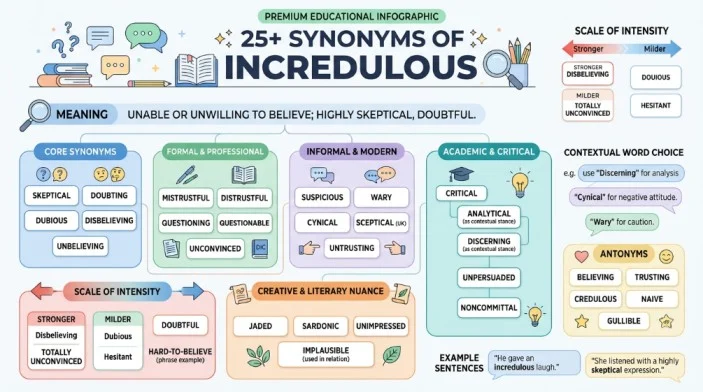
Incredulous describes someone who is unwilling or unable to believe something because it seems surprising, unlikely, or difficult to accept. The closest general alternatives are disbelieving, skeptical, doubtful, unconvinced, dubious, and unbelieving. For formal writing, skeptical or unconvinced often works well. For emotional or dramatic writing, disbelieving or astonished can be more expressive.
Best choices by context
| Context | Recommended synonym | Why it works |
|---|---|---|
| Formal writing | Skeptical | Clear and professional |
| Academic writing | Unconvinced | Suggests insufficient evidence |
| Casual conversation | Doubtful | Natural and familiar |
| Professional communication | Skeptical | Neutral and precise |
| Business emails | Unconvinced | Focuses on lack of acceptance |
| Emotional writing | Disbelieving | Emphasizes personal reaction |
| Creative writing | Astonished | Adds surprise and emotional force |
| Strong disbelief | Dubious | Signals serious doubt |
| Mild disbelief | Questioning | Sounds less forceful |
| Everyday speech | Surprised | Natural when disbelief comes from unexpected news |
Meaning, Tone, and Context
Simple Definition
Incredulous means unable or unwilling to believe something because it seems surprising, unlikely, or difficult to accept.
For example:
Maya gave an incredulous look when she heard that the tiny company had won the national award.
Her reaction shows that she found the information hard to believe.
Part of Speech
Incredulous is an adjective.
Common patterns include:
- an incredulous expression
- an incredulous look
- an incredulous response
- an incredulous voice
- an incredulous reaction
- an incredulous listener
Overall Tone
The word is generally neutral in emotional direction, but it often carries a strong sense of surprise or doubt.
It can describe simple disbelief, but context may make the reaction sound skeptical, shocked, amused, or even critical.
Formality Level
Incredulous is generally neutral to somewhat formal. It appears naturally in journalism, essays, professional writing, fiction, and polished conversation.
It is less common in casual speech than words such as surprised, doubtful, or shocked.
Common Uses
Native English speakers commonly use incredulous when describing:
- facial expressions
- reactions to surprising news
- disbelief about an unusual claim
- responses to unexpected results
- dialogue in fiction
- skeptical reactions
- emotional responses to extraordinary events
Word Forms
The main related forms are:
- Incredulous, adjective
- Incredulously, adverb
- Incredulity, noun
Examples:
She stared at him incredulously.
His face showed clear incredulity.
The word incredible is related historically and morphologically, but it does not mean exactly the same thing as incredulous. Incredible usually describes something that is difficult to believe, while incredulous describes the person or reaction that struggles to believe it.
When and How to Use “Incredulous”
Use incredulous when someone reacts to information with disbelief or finds a claim difficult to accept.
It is especially useful when you want to describe a visible or emotional reaction rather than simply state that someone disagrees.
Professional
The manager gave an incredulous response to the claim that the project had been completed ahead of schedule.
Here, incredulous describes the manager’s reaction to surprising information.
Academic
Several researchers remained incredulous after the initial results appeared to contradict established findings.
The word works because the researchers have difficulty accepting an unexpected result.
Workplace
His coworkers looked incredulous when he announced that the deadline had been moved forward.
The reaction involves surprise and disbelief.
Personal
I was incredulous when my brother told me he had sold his car without telling anyone.
The word emphasizes personal surprise.
I was initially incredulous about the offer, but the supporting documents changed my view.
This sounds polished and appropriate for a professional message.
Resume
Directly using incredulous on a resume is uncommon. Resume writing usually focuses on achievements rather than reactions.
Instead of:
The hiring manager was incredulous about my results.
Use:
The hiring manager was impressed by the results.
Social Media
I was honestly incredulous when I saw the final score.
This is understandable, although shocked or surprised would usually sound more natural in casual social media writing.
Best Synonyms of “Incredulous”
No synonym perfectly replaces incredulous in every sentence. Some alternatives emphasize doubt, while others emphasize surprise, skepticism, mistrust, or refusal to accept information.
Professional Writing
Skeptical is usually the strongest professional choice.
The committee remained skeptical of the proposed solution.
It sounds objective and avoids unnecessary emotional intensity.
Academic Writing
Unconvinced works especially well when evidence or reasoning has not persuaded someone.
The researchers remained unconvinced by the explanation.
This is precise because it focuses on the lack of persuasive evidence.
Business Communication
Doubtful is useful when you want to express uncertainty without sounding overly dramatic.
The client was doubtful that the revised schedule was realistic.
Casual Conversation
Surprised or doubtful usually sounds more natural than incredulous in everyday speech.
I was surprised when she said she had already finished.
Emotional Writing
Disbelieving highlights the personal experience of struggling to accept something.
He stood there with a disbelieving expression.
Creative Writing
Astonished can work when disbelief is closely connected with intense surprise.
She stared at the enormous painting, astonished by its size.
Resume Writing
Incredulous itself is rarely appropriate on a resume. Use achievement focused words such as impressed, convinced, or surprised, depending on the intended meaning.
Workplace Communication
Skeptical is generally safer than incredulous because it sounds measured.
The team was skeptical of the proposed timeline.
Stronger Meaning
Dubious or disbelieving can communicate substantial doubt, depending on context.
The board was dubious about the financial projections.
Softer Meaning
Questioning can express uncertainty without suggesting outright rejection.
The reviewer remained questioning about the reliability of the results.
When Not to Use “Incredulous”
Choosing a synonym is sometimes better than choosing incredulous. The issue is usually not grammatical correctness. It is precision.
When the meaning is simply “surprised”
Incredulous can imply difficulty believing something. If you only mean that something was unexpected, surprised is clearer.
Less precise:
I was incredulous when my friend arrived early.
Better:
I was surprised when my friend arrived early.
When you mean “skeptical”
If someone questions the reliability of a claim rather than reacting emotionally to surprising information, skeptical is often better.
Less precise:
The scientist was incredulous about the theory.
Better:
The scientist was skeptical about the theory.
When you mean “not persuaded”
For academic or analytical writing, unconvinced may communicate the idea more directly.
Less precise:
The reviewers were incredulous about the evidence.
Better:
The reviewers were unconvinced by the evidence.
When the word sounds too formal
In a casual conversation, incredulous can sound more polished than necessary.
Formal:
I was incredulous when I heard the news.
Natural conversation:
I couldn’t believe it when I heard the news.
When you mean strong emotional shock
If the person is overwhelmed by unexpected information, astonished, stunned, or shocked may be more accurate.
She was stunned by the announcement.
This communicates emotional impact more clearly than incredulous.
Words Commonly Confused With “Incredulous”
| Word | Difference | When to use it | Example |
|---|---|---|---|
| Skeptical | Questions whether something is true or reliable | Claims, evidence, proposals | The editor was skeptical of the statistic. |
| Incredible | Describes something extremely difficult to believe or exceptionally impressive | Events, achievements, claims | The team made an incredible comeback. |
| Credulous | Too ready to believe something | Someone who accepts claims easily | He was too credulous to question the story. |
| Doubtful | Suggests uncertainty or low confidence | Predictions, plans, claims | She was doubtful that the plan would work. |
| Astonished | Emphasizes intense surprise | Unexpected events | We were astonished by the result. |
| Unconvinced | Shows that evidence has failed to persuade someone | Arguments, research, explanations | The panel remained unconvinced by the proposal. |
Best Synonyms of “Incredulous” by Context
| Context | Best Synonym | Why It Works | Example |
|---|---|---|---|
| Formal writing | Skeptical | Professional and controlled | The committee was skeptical of the claim. |
| Academic writing | Unconvinced | Focuses on insufficient persuasion | The authors remained unconvinced by the evidence. |
| Professional communication | Skeptical | Neutral and precise | The manager was skeptical of the forecast. |
| Business emails | Doubtful | Polite way to express uncertainty | I am doubtful that the timeline is achievable. |
| Resume writing | Impressed | Better suited to achievement language | The results impressed the hiring team. |
| Workplace communication | Skeptical | Avoids unnecessary emotional language | The team was skeptical of the estimate. |
| Casual conversation | Surprised | More natural in ordinary speech | I was surprised by the announcement. |
| Everyday speaking | Doubtful | Familiar and easy to understand | I’m doubtful that he will agree. |
| Creative writing | Disbelieving | Conveys personal disbelief | She gave him a disbelieving stare. |
| Storytelling | Astonished | Adds strong surprise | He was astonished by what he saw. |
| Emotional writing | Stunned | Highlights emotional impact | She was stunned by the news. |
| Strong emphasis | Dubious | Communicates substantial doubt | The investors were dubious about the plan. |
| Mild tone | Questioning | Leaves room for uncertainty | The reviewer remained questioning. |
| Social media captions | Shocked | Natural and expressive | I was shocked when I saw the result. |
| American English | Skeptical | Standard American spelling and usage | The audience was skeptical. |
| British English | Sceptical | British spelling of the same concept | The audience was sceptical. |
How to Choose the Best Synonym of “Incredulous”
Choosing the right alternative becomes easier when you identify the exact idea you want to communicate.
1. Focus on the meaning
Ask whether you mean disbelief, uncertainty, surprise, suspicion, or refusal to accept an explanation.
If the central idea is disbelief, disbelieving is a strong choice. If the central idea is questioning reliability, skeptical is usually better.
2. Consider your audience
A professional audience generally responds better to measured vocabulary.
Use skeptical, unconvinced, or doubtful in business and academic settings instead of highly emotional alternatives such as stunned or shocked.
3. Consider emotional strength
Questioning is relatively mild. Doubtful adds more uncertainty. Skeptical emphasizes critical judgment. Disbelieving can feel more personal. Stunned and astonished emphasize emotional surprise.
4. Match the writing purpose
An academic paper usually benefits from analytical vocabulary.
The researchers were unconvinced by the available evidence.
A novel may benefit from expressive language.
She stared at him in stunned disbelief.
5. Choose natural wording
A synonym can be technically related to incredulous while still sounding unnatural in a particular sentence.
Always read the complete sentence rather than replacing a word mechanically.
Real Life Examples of “Incredulous”
School
The students were incredulous when the teacher announced that the test would be canceled.
College
The class remained skeptical of the theory because the supporting evidence was limited.
Workplace
The employees looked surprised when the company announced the unexpected bonus.
Business
The investors were doubtful that the proposed expansion could be completed within six months.
I was initially unconvinced by the explanation, but the additional documentation clarified the situation.
Resume
Instead of emphasizing disbelief:
The hiring manager was incredulous about my results.
A stronger resume focused version is:
My results impressed the hiring manager and demonstrated my ability to improve team efficiency.
Conversation
I couldn’t believe it when Sarah said she had won the competition.
Storytelling
He stared at the empty room with a disbelieving expression.
Blogging
Readers may be skeptical of the claim unless the article provides clear evidence.
Social Media
I was completely shocked when I saw the final results.
These examples demonstrate an important principle: the best replacement depends on what part of incredulous you want to preserve.
25 Best Synonyms of “Incredulous”
The following list focuses on words that can overlap with incredulous in contexts involving disbelief, doubt, skepticism, uncertainty, or surprise. Some are closer synonyms than others, so the context matters.
| Synonym | Simple Meaning | Best Used For | Example Sentence |
|---|---|---|---|
| Disbelieving | Finding something hard to believe | Personal reactions | She gave him a disbelieving look. |
| Unbelieving | Not accepting something as true | Direct disbelief | He remained unbelieving after hearing the explanation. |
| Skeptical | Doubting whether something is true | Professional and analytical writing | The reviewer was skeptical of the claim. |
| Doubtful | Feeling uncertain about something | Everyday and professional use | I am doubtful that the plan will succeed. |
| Unconvinced | Not persuaded by evidence or reasoning | Academic and formal writing | The committee remained unconvinced by the argument. |
| Dubious | Feeling serious doubt about something | Formal and analytical contexts | The investors were dubious about the forecast. |
| Questioning | Showing doubt or uncertainty | Mild disagreement | She gave the proposal a questioning look. |
| Mistrustful | Lacking confidence in someone’s honesty or reliability | People and relationships | He was mistrustful of the unfamiliar salesperson. |
| Suspicious | Believing something may be wrong or dishonest | Claims, behavior, situations | The manager became suspicious of the unusual figures. |
| Distrustful | Unwilling to trust someone or something | Relationships and institutions | The customer was distrustful of the new policy. |
| Wary | Cautious because something may be risky | Decisions and situations | She was wary of the unusually generous offer. |
| Unpersuaded | Not convinced by an argument | Academic and professional writing | The panel remained unpersuaded by the presentation. |
| Unaccepting | Unwilling to accept an idea or situation | Personal and social contexts | He was unaccepting of the unexpected explanation. |
| Astonished | Extremely surprised | Emotional and creative writing | She was astonished by the sudden announcement. |
| Amazed | Very surprised or impressed | Everyday and positive contexts | We were amazed by the unexpected result. |
| Stunned | Extremely surprised or shocked | Emotional situations | Everyone was stunned by the decision. |
| Shocked | Strongly surprised or disturbed | Everyday and emotional writing | I was shocked when I heard the news. |
| Surprised | Experiencing unexpectedness | Casual conversation | She was surprised by the sudden invitation. |
| Startled | Suddenly surprised | Immediate reactions | He looked startled by the loud announcement. |
| Taken aback | Suddenly surprised or confused | Conversation and storytelling | She was taken aback by his unexpected response. |
| Nonplussed | Confused or surprised by something unexpected | Formal or literary writing | He looked nonplussed by the unusual request. |
| Bewildered | Confused because something is difficult to understand | Complex situations | The witness appeared bewildered by the question. |
| Perplexed | Confused or uncertain about something | Formal and analytical writing | The committee was perplexed by the conflicting data. |
| Astonished | Filled with strong surprise | Literary and emotional writing | He was astonished to see the final score. |
| Uncertain | Not sure about something | Neutral and professional writing | She remained uncertain about the explanation. |
Important usage note: Astonished, amazed, stunned, shocked, startled, bewildered, and perplexed are contextual alternatives rather than perfect replacements in every sentence. They overlap with incredulous when disbelief is connected to surprise or confusion.
Synonyms of “Incredulous” by Usage
Professional vs Personal Synonyms
Professional writing usually benefits from words that describe reasoning rather than dramatic emotion.
Best professional choices include:
- skeptical
- unconvinced
- doubtful
- dubious
- questioning
Personal writing can be more expressive:
- disbelieving
- shocked
- astonished
- stunned
- amazed
Compare:
The client was skeptical of the proposal.
This sounds professional.
The client was stunned by the proposal.
This sounds more emotional and suggests a strong reaction.
Formal vs Conversational Synonyms
Formal and academic writing often favors:
- skeptical
- unconvinced
- dubious
- unpersuaded
- questioning
Conversation usually favors:
- surprised
- shocked
- doubtful
- amazed
- couldn’t believe it
For example:
Formal:
The reviewers remained unconvinced by the findings.
Conversational:
I couldn’t believe what happened.
Both communicate disbelief, but they fit different settings.
Academic Synonyms
Academic writing should distinguish between emotional disbelief and evidence based skepticism.
Skeptical
Use skeptical when evaluating a claim, method, interpretation, or source.
The researchers were skeptical of the proposed explanation.
Unconvinced
Use unconvinced when an argument or evidence fails to persuade.
The reviewers remained unconvinced by the author’s interpretation.
Dubious
Use dubious when something appears questionable or unreliable.
The study’s conclusion is dubious because the sample was extremely small.
Unpersuaded
Use unpersuaded when directly discussing whether an argument has succeeded.
The committee remained unpersuaded by the proposed solution.
These choices sound more precise in academic writing because they explain the nature of the doubt.
Professional and Business Synonyms
Professional communication should usually avoid unnecessarily dramatic language.
Skeptical
Best for evaluating proposals, claims, forecasts, and plans.
The client was skeptical of the projected savings.
Doubtful
Useful when politely expressing uncertainty.
I am doubtful that we can meet the current deadline.
Unconvinced
Useful when evidence or explanation has not resolved concerns.
The board remains unconvinced by the revised proposal.
Questioning
Useful when concerns exist but you do not want to sound strongly negative.
The team took a questioning approach to the proposed changes.
For resumes and performance reviews, it is usually better to describe measurable outcomes rather than someone else’s disbelief.
Creative and Literary Synonyms
Creative writing allows more emotional variation.
Disbelieving is useful for facial expressions and internal reactions.
She stared at the letter with a disbelieving smile.
Stunned emphasizes a powerful emotional response.
He stood stunned in the doorway.
Astonished emphasizes wonder or intense surprise.
The traveler was astonished by the view.
Bewildered focuses on confusion.
The stranger looked bewildered by the sudden accusation.
Taken aback works well in realistic dialogue and narration.
She was taken aback by his unexpected honesty.
These choices let writers show different shades of reaction instead of repeating incredulous.
Slang or Modern Synonyms
There is no single slang word that perfectly replaces incredulous in all situations.
In casual American English, expressions such as no way, seriously?, I can’t believe it, shocked, and mind blown can communicate disbelief or surprise.
These expressions are useful in:
- texting
- social media
- casual conversation
- informal captions
Avoid them in:
- academic papers
- resumes
- formal reports
- professional proposals
- official business correspondence
For example:
Casual:
No way. You actually won?
Professional:
I was surprised to learn that the proposal had been approved.
Strongest to Mildest Synonyms
Because incredulous can express either doubt or surprise, intensity depends on the specific context.
Mild
Questioning
Suggests uncertainty without strong rejection.
Mild to Moderate
Doubtful
Indicates that something seems unlikely.
Moderate
Skeptical
Shows active doubt or critical evaluation.
Moderate to Strong
Unconvinced
Shows that information has failed to persuade someone.
Strong
Dubious
Communicates substantial doubt.
Strong Emotional Reaction
Disbelieving
Emphasizes the difficulty of accepting what has happened.
Very Strong Surprise
Stunned
Communicates powerful emotional surprise, although it is not a perfect synonym for skeptical disbelief.
Emotional vs Neutral Synonyms
Emotional Synonyms
These words add a noticeable reaction:
- disbelieving
- astonished
- amazed
- stunned
- shocked
- startled
- taken aback
Use them when the person’s emotional response matters.
She was stunned by the unexpected announcement.
Neutral Synonyms
These words communicate doubt or uncertainty more objectively:
- skeptical
- doubtful
- unconvinced
- dubious
- questioning
- unpersuaded
- uncertain
Use them in reports, analysis, academic writing, and professional communication.
The committee was skeptical of the proposed solution.
Antonyms of “Incredulous”
There is no single perfect opposite in every context because incredulous can express either disbelief or surprise. The following are contextual antonyms that describe acceptance, belief, confidence, or readiness to trust.
| Antonym | Meaning | Example Sentence |
|---|---|---|
| Credulous | Too ready to believe | He was credulous enough to accept the story immediately. |
| Gullible | Easily persuaded to believe something false | The scam targeted people who were especially gullible. |
| Believing | Accepting something as true | She was believing of the explanation from the beginning. |
| Trusting | Willing to believe or rely on someone | He was trusting of his longtime adviser. |
| Convinced | Fully persuaded that something is true | The evidence left the jury convinced. |
| Persuaded | Brought to accept an idea | The explanation persuaded the skeptical reviewer. |
| Accepting | Willing to receive or acknowledge something | She was accepting of the unexpected decision. |
| Certain | Having no significant doubt | The manager was certain that the figures were correct. |
| Assured | Confident that something is true or will happen | We felt assured that the process was safe. |
| Confident | Having strong belief in a result or judgment | The team was confident in its strategy. |
| Unquestioning | Accepting without doubt or criticism | His unquestioning trust made him easy to influence. |
| Open minded | Willing to consider ideas fairly | The reviewer remained open minded about the new theory. |
| Receptive | Willing to consider or accept something | The audience was receptive to the proposal. |
| Trustful | Inclined to trust others | The child was naturally trustful of adults. |
| Convincedly | In a convinced manner | She spoke convincedly about the plan. |
The last item, convincedly, is rare and generally not recommended in modern writing. A natural sentence would normally use confidently or simply with conviction instead. For high quality publishing, it is better to prioritize natural usage over forcing a grammatical opposite.
Comparison: “Incredulous” vs Similar Words
Incredulous vs Skeptical
Main Difference: Incredulous often describes a reaction to something surprising or difficult to believe. Skeptical usually describes a reasoned doubt about whether something is true or reliable.
Which Is Stronger? Incredulous can sound more emotionally intense.
Which Is More Formal? Skeptical is generally more suitable for academic and professional analysis.
When to Use Each: Use incredulous for reactions and skeptical for evaluation.
Examples
Incredulous:
She looked incredulous when she heard the announcement.
Skeptical:
The researchers were skeptical of the claim.
Incredulous vs Doubtful
Main Difference: Doubtful emphasizes uncertainty. Incredulous often suggests that the information seems so surprising that belief is difficult.
Which Is Stronger? Incredulous can carry a stronger reaction.
Which Is More Formal? Both are standard, but doubtful is often more versatile.
When to Use Each: Use doubtful for predictions and uncertainty. Use incredulous for reactions to unexpected information.
Examples
Incredulous:
He gave an incredulous laugh.
Doubtful:
She was doubtful that the plan would work.
Incredulous vs Incredible
Main Difference: Incredulous describes a person or reaction. Incredible describes something that is difficult to believe or exceptionally impressive.
Which Is Stronger? They express different ideas, so intensity cannot be directly ranked.
Which Is More Formal? Both are common.
When to Use Each: Use incredulous for the person reacting and incredible for the thing being described.
Examples
Incredulous:
The audience looked incredulous.
Incredible:
The athlete achieved an incredible result.
Incredulous vs Astonished
Main Difference: Astonished emphasizes extreme surprise. Incredulous emphasizes difficulty believing something.
Which Is Stronger? Astonished usually carries stronger surprise.
Which Is More Formal? Both can work in polished writing.
When to Use Each: Use astonished when surprise is central. Use incredulous when disbelief is central.
Examples
Incredulous:
She was incredulous at first.
Astonished:
She was astonished by the unexpected victory.
Incredulous vs Unconvinced
Main Difference: Unconvinced means that a person has not been persuaded. Incredulous focuses more strongly on disbelief or surprise.
Which Is Stronger? Incredulous can sound more emotional.
Which Is More Formal? Unconvinced is particularly useful in academic and professional writing.
When to Use Each: Use unconvinced when discussing evidence, arguments, or explanations.
Examples
Incredulous:
He was incredulous when he heard the accusation.
Unconvinced:
The panel remained unconvinced by the evidence.
Incredulous vs Suspicious
Main Difference: Suspicious suggests that something may be wrong, dishonest, or intentionally hidden. Incredulous does not necessarily imply wrongdoing.
Which Is Stronger? Suspicious can be stronger when mistrust is involved.
Which Is More Formal? Both are standard.
When to Use Each: Use suspicious when trust or possible misconduct is involved.
Examples
Incredulous:
She was incredulous when she heard the story.
Suspicious:
She became suspicious when the details changed.
Common Phrases and Expressions with “Incredulous”
Incredulous Look
Meaning: A facial expression showing that someone finds something difficult to believe.
Example Sentence:
He gave me an incredulous look when I told him the news.
Incredulous Expression
Meaning: A visible reaction of disbelief.
Example Sentence:
Her incredulous expression made it clear that she had not expected the announcement.
Incredulous Stare
Meaning: A sustained look showing surprise or disbelief.
Example Sentence:
The audience responded with an incredulous stare.
Incredulous Smile
Meaning: A smile that reflects disbelief, surprise, or amusement.
Example Sentence:
He responded with an incredulous smile after hearing the unexpected offer.
Incredulous Voice
Meaning: A tone that communicates difficulty believing something.
Example Sentence:
“You finished already?” she asked in an incredulous voice.
Incredulous Reaction
Meaning: A response showing disbelief or surprise.
Example Sentence:
His incredulous reaction showed how unexpected the result was.
Looked Incredulous
Meaning: Appeared unable or unwilling to believe something.
Example Sentence:
The manager looked incredulous when the report arrived.
Sounded Incredulous
Meaning: Spoke in a way that communicated disbelief.
Example Sentence:
She sounded incredulous when she heard the proposed deadline.
Common Mistakes to Avoid
Mistake 1: Using “incredible” instead of “incredulous”
Incorrect:
She was incredible when she heard the news.
Better:
She was incredulous when she heard the news.
Why: Incredible normally describes a thing or event. Incredulous describes a person or reaction.
Mistake 2: Using “skeptical” when you mean surprise
Incorrect:
I was skeptical when my sister surprised me with a birthday party.
Better:
I was surprised when my sister surprised me with a birthday party.
Why: There is no necessary doubt about truth or reliability. The main idea is unexpectedness.
Mistake 3: Using an informal expression in academic writing
Incorrect:
The researchers were like, “No way,” when they saw the results.
Better:
The researchers were incredulous when they saw the results.
Why: The revised sentence is more appropriate for formal academic prose.
Mistake 4: Choosing an overly dramatic synonym
Incorrect:
The manager was stunned when the meeting started five minutes late.
Better:
The manager was surprised when the meeting started five minutes late.
Why: Stunned suggests a powerful reaction and is excessive for a minor inconvenience.
Mistake 5: Repeating “incredulous” too often
Incorrect:
She looked incredulous. Her incredulous expression showed disbelief. Everyone became incredulous.
Better:
She looked incredulous. Her disbelieving expression showed how unexpected the news was. Everyone else was equally surprised.
Why: Varying vocabulary makes the writing smoother while preserving the meaning.
Mistake 6: Confusing disbelief with suspicion
Incorrect:
I became incredulous because I thought my coworker had lied.
Better:
I became suspicious because I thought my coworker had lied.
Why: Suspicious specifically communicates mistrust or concern about possible dishonesty.
Mistake 7: Choosing a synonym with the wrong emotional tone
Incorrect:
The academic reviewer was shocked by the questionable methodology.
Better:
The academic reviewer was skeptical of the methodology.
Why: Skeptical communicates analytical doubt without adding unnecessary emotional drama.
Frequently Asked Questions
1. What are the best synonyms of “incredulous”?
The best synonyms of incredulous include skeptical, disbelieving, doubtful, unconvinced, dubious, and unbelieving. The right choice depends on whether you want to emphasize doubt, surprise, emotional disbelief, or lack of persuasion.
2. What are the best formal synonyms of “incredulous”?
The strongest formal synonyms of incredulous include skeptical, unconvinced, dubious, and unpersuaded. These choices work particularly well in academic papers, reports, professional analysis, and business communication.
3. What are common informal synonyms of “incredulous”?
Common informal alternatives include surprised, shocked, amazed, and doubtful. In casual speech, people also commonly say I couldn’t believe it instead of using the more formal word incredulous.
4. What is another word for “incredulous” in professional writing?
Skeptical is usually the best professional alternative when discussing a questionable claim, proposal, or forecast. Unconvinced works better when evidence or an explanation has failed to persuade the reader.
5. What is the difference between “incredulous” and “skeptical”?
Incredulous usually describes a reaction of disbelief, often caused by something surprising. Skeptical describes a more general or analytical doubt about whether something is true, reliable, or convincing.
6. What is the opposite of “incredulous”?
Contextual opposites of incredulous include credulous, believing, trusting, convinced, persuaded, certain, assured, confident, accepting, and receptive. The best opposite depends on whether the original sentence focuses on belief, trust, or certainty.
Conclusion
Incredulous describes a person or reaction marked by disbelief, especially when information seems surprising or difficult to accept. The best alternatives include skeptical for analytical doubt, unconvinced for insufficient evidence, doubtful for uncertainty, and disbelieving for personal disbelief.
There is no single synonym that works perfectly in every sentence. When choosing among the synonyms of incredulous, consider your audience, tone, emotional strength, and purpose. A professional report may need skeptical, while a story may benefit from disbelieving or astonished.
A useful vocabulary habit is to identify the exact feeling or idea behind a word before replacing it. That small step will help you choose more precise language instead of simply choosing a word that looks similar in a thesaurus.
Read More Related Articles:
- Synonyms for Everything | Meaning, Examples, and Better …
- Synonyms for Unexpected | Meaning, Examples, and Better …
- 50+ Synonyms of This | Meanings, Uses, Examples, and Best …