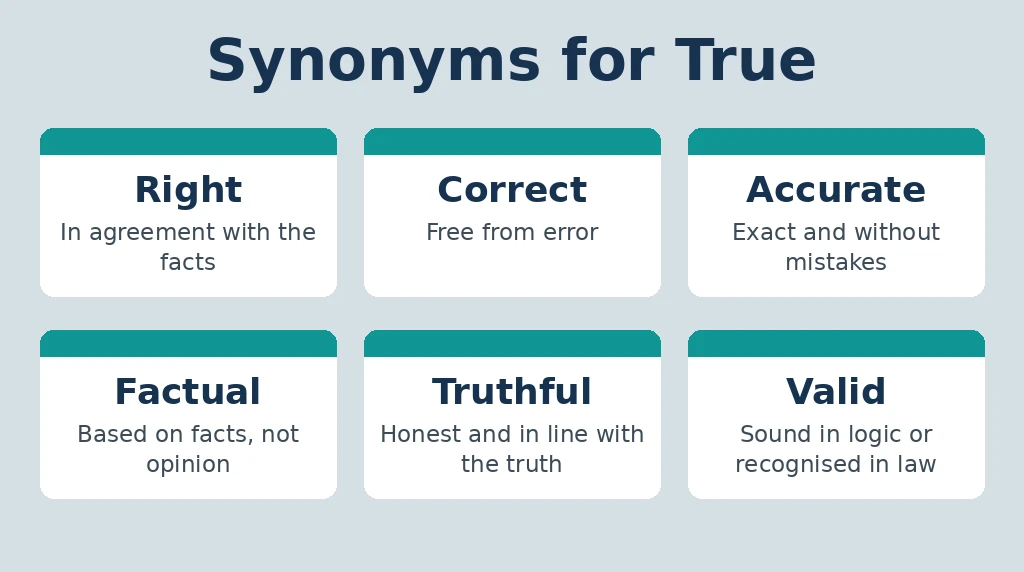
It sounds like the easiest compliment in English. Then somebody checks. A story hopes to be called true, so does a friend, so does an apology, and so does an arrow, and every one of them earns the word in a completely different way. The closest synonyms split by job: right and correct for facts, real and genuine for things, loyal and faithful for people, and exact or dead-on when something has to land precisely. This guide works through 48 synonyms for true, sorted by facts, genuineness, sincerity, loyalty, aim and rightful claims. In fact, that family of meanings is the whole subject of this guide. For example, synonyms for true split by the job they do, and the job decides the word.
Nothing here was pulled out of thin air. Every word below sits in real thesaurus entries, and each one comes with a plain meaning and a short example, because true only means something once you know which claim it is backing. Pick the right branch of this family and your sentence does not just read better. It gets more honest about honesty. In other words, the meanings are earned from real use, not invented for the page. Consequently, synonyms for true in this guide come with a meaning and an example each.
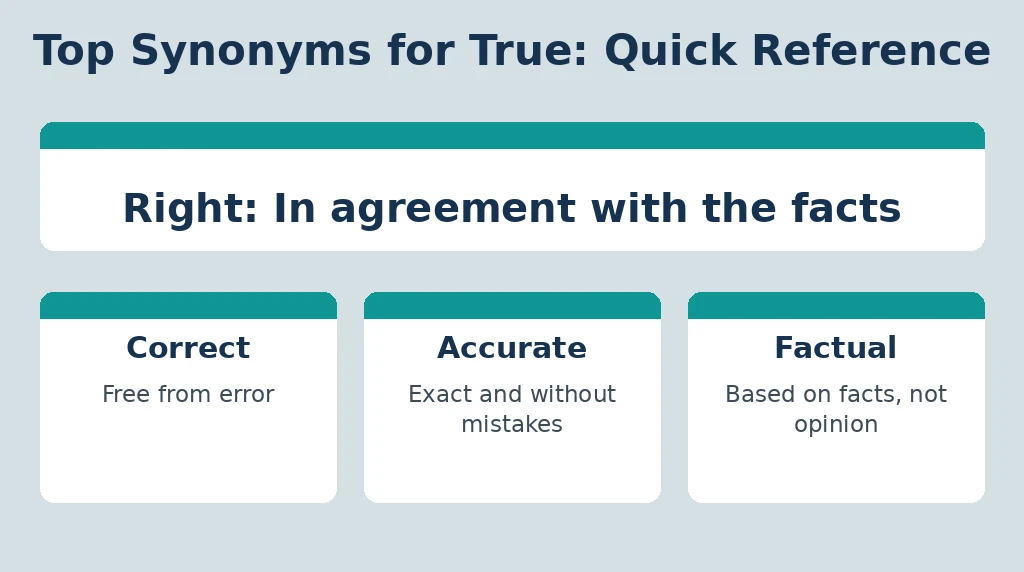
Top Synonyms for True: Quick Reference
In a rush? Start with this table. It holds the synonyms for true that writers grab most often, what each one actually means, and where it earns its place. The sections after it pull the senses apart, because the word you would use for a loyal friend is no use at all for a checked fact. In particular, the table is the shortcut, and the sections after it are the full map. For instance, a writer in a hurry can take the table and go, while a careful writer reads on.
| Word | Meaning in one line | Best for |
|---|---|---|
| Right | In agreement with the facts | Answers, claims, decisions |
| Correct | Free from error | Information, answers, formal writing |
| Accurate | Exact and without mistakes | Reports, measurements, descriptions |
| Factual | Based on facts, not opinion | Reports, documentaries, evidence |
| Truthful | Honest and in line with the truth | Accounts, witnesses, people |
| Valid | Sound in logic or recognised in law | Arguments, tickets, passports |
| Real | Actually existing, not imagined | Reasons, feelings, dangers |
| Actual | Existing in fact, the real state of things | Numbers, costs, events |
| Genuine | Truly what it claims to be | Objects, feelings, offers |
| Authentic | Of undisputed origin, not a copy | Documents, art, experiences |
| Bona fide | Genuine and offered in good faith | Offers, charities, credentials |
| Legitimate | Lawful and rightful | Governments, heirs, businesses |
| Rightful | Having a just or legal claim | Owners, heirs, rulers |
| Sincere | Truly felt, not pretended | Apologies, thanks, wishes |
| Heartfelt | Deeply and genuinely felt | Sympathy, gratitude, congratulations |
| Faithful | Loyal and constant in support | Friends, partners, followers |
| Loyal | Firm in allegiance | Friends, fans, citizens |
| Devoted | Deeply loving and loyal | Parents, partners, fans |
| Staunch | Loyal and hard to move | Supporters, defenders, allies |
| Constant | Never changing in loyalty or presence | Companions, support |
| Reliable | Able to be trusted | Friends, sources, information |
| Exact | Precise in every detail | Words, figures, copies |
| Precise | Exact and careful | Details, instructions, timing |
| Perfect | Exactly matching the original | Imitations, copies, examples |
| Dead-on | Exactly right (informal) | Estimates, guesses, impressions |
| Spot-on | Exactly right (British informal) | Analyses, predictions, data |
What Does True Mean?
At its simplest, true means matching. A statement is true if the world agrees with it. A friend is true if their loyalty matches their promises. An arrow flies true if its path matches where you aimed it. Under every sense sits that one idea: what is claimed on one side, what is actually there on the other. It is one of the oldest words in English, and it has been carrying this idea of tested, dependable matching since long before surnames existed. In short, matching is the single idea, and every sense of the word is a different match. Therefore, a writer should sort synonyms for true by what they match, not by how they sound.
The senses divide by whatever is being matched. Statements get matched against facts, so they earn right, correct and factual. Things get matched against their labels: a true diamond is one that passes the test its name promises, so it earns real, genuine and authentic. Feelings get matched against behaviour, which gives us sincere and heartfelt. People get matched against their commitments over years, and that produces the loyal family. Then there are measurements, copies and shots, matched against a target, which is where exact, precise and dead-on live. In fact, the matching test sorts the family cleanly, because each sense matches a different thing. For example, a fact matches the world, while a friend matches a promise.
Call an answer true and we usually just mean it is right. Call a story true and we mean something stronger: it happened, it rests on fact rather than invention. Writers blur these two at their own risk, because readers feel the gap even when they cannot explain it. A report can be completely sincere and completely wrong. A witness can be ice-cold factual and totally disloyal. The branches of this family are not interchangeable, however cosy they look side by side. In fact, the two uses are easy to confuse, and the confusion is costly. In short, an answer is right when it earns true, while a story is true when it earns the facts.
True also hides inside a handful of fixed phrases worth knowing cold. Dreams and predictions come true when reality finally matches them. A story rings true when it sounds believable. Being true to your word means keeping a promise, and true to size is the label every honest pair of shoes should carry. These are not decorations. They are proof of how many different kinds of matching one small word does every day. In fact, the phrases are the family at work in plain sight, and each one shows a different match. For example, synonyms for true hide in dreams, wishes and promises, waiting to be noticed.
One more sense lives in the workshop, where true is something you do with your hands. Carpenters and bike mechanics true a wheel, a frame or a blade when they coax it back into exact alignment, and a door that hangs crooked is out of true. Old manuals on printing presses are full of truing. The sense is worth knowing because it shows the family’s deepest idea wearing its oldest clothes: truth as alignment, a thing brought carefully into line with what it ought to be. In other words, the workshop sense is the oldest one, and it still shapes the word. Consequently, a writer should judge synonyms for true in craft by the tool, not the talk.
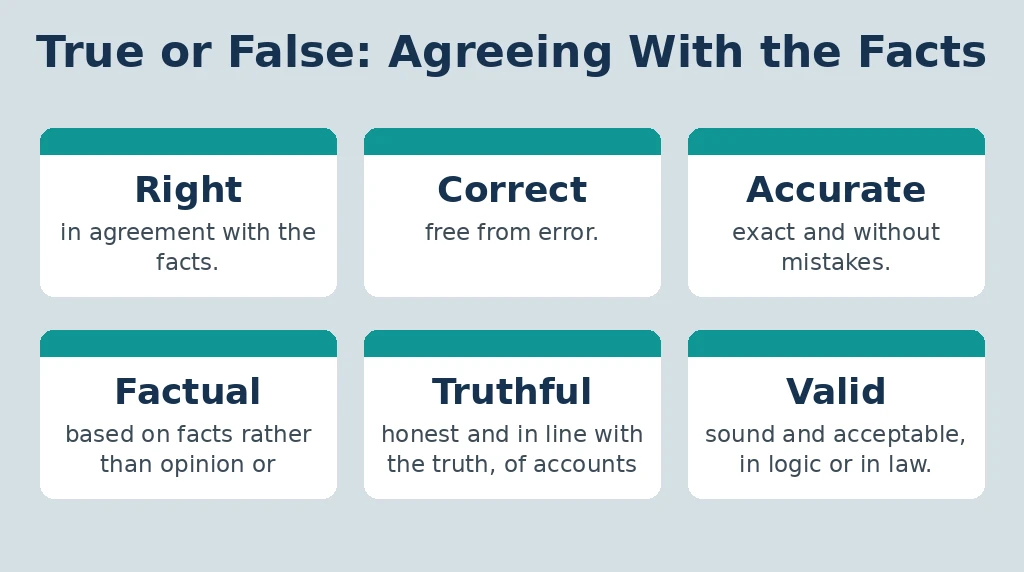
True or False: Agreeing With the Facts
This is the classroom and courtroom sense: a claim held up against the world and found to match. These are the coldest words in the family, and that is deliberate. Their whole job is to take feeling out of the judgement. A fact does not care whether we like it. Neither do the words that certify it. In particular, the courtroom cares about the match, not the music of the words. Therefore, a writer should choose synonyms for true for facts by evidence, not eloquence.
- Right: in agreement with the facts. Nadia checked the spreadsheet twice and every figure was right.
- Correct: free from error. The correct total is printed at the bottom of the invoice, not in the email.
- Accurate: exact and without mistakes. His account of the accident was more accurate than the first police report.
- Factual: based on facts rather than opinion or invention. Strip out the gossip and there is almost nothing factual left in that post.
- Truthful: honest and in line with the truth, of accounts and people. To her credit, she gave a truthful answer even though it cost her the job.
- Valid: sound and acceptable, in logic or in law. A valid ticket gets you through the barrier; an expired one gets you an argument.
- Historical: based on real events, of a story or account. The film bends a few dates, but the escape itself is historical.
The small differences decide real sentences. Right is the everyday word, the one teachers scribble in margins. Correct is its formal cousin, at home in manuals and official statements. Accurate adds care and measurement. Factual digs its heels in about the absence of opinion. Valid moves the whole question into logic and law, where a claim counts as true when the rules allow you to make it. In fact, the small differences are the whole game, and the examples show them plainly. For instance, synonyms for true in this group change with the register, not the meaning.
This little group has had a busy decade. Fact-checkers now grade public claims on scales that run from true through mostly true to pants-on-fire false. Scientists defend accurate as the honest word for results that come with margins of error. Courts still ask every witness for the truth, the whole truth and nothing but it. The vocabulary of checking is centuries old, but the workload is new, and a writer who can grade a claim precisely, factual here, valid there, is doing real civic work with adjectives. In short, the fact-checkers sharpened the group, because every claim is now graded in public. As a result, a writer should choose synonyms for true for news with the fact-check in mind.
Schools and quiz shows run a whole industry on the first two members of this group. True or false is the purest test format ever devised: it strips a claim down to the single decision this section is about. It also produced a shared classroom scar, the statement that is almost true. The facts are right, the joining of them is false, the examiner planted it like a landmine, and half the class remembers it years later. In other words, the quiz format lives on right and correct, and the rest of the family waits backstage. For example, synonyms for true in quizzes are the plain ones, because the answer must be quick.
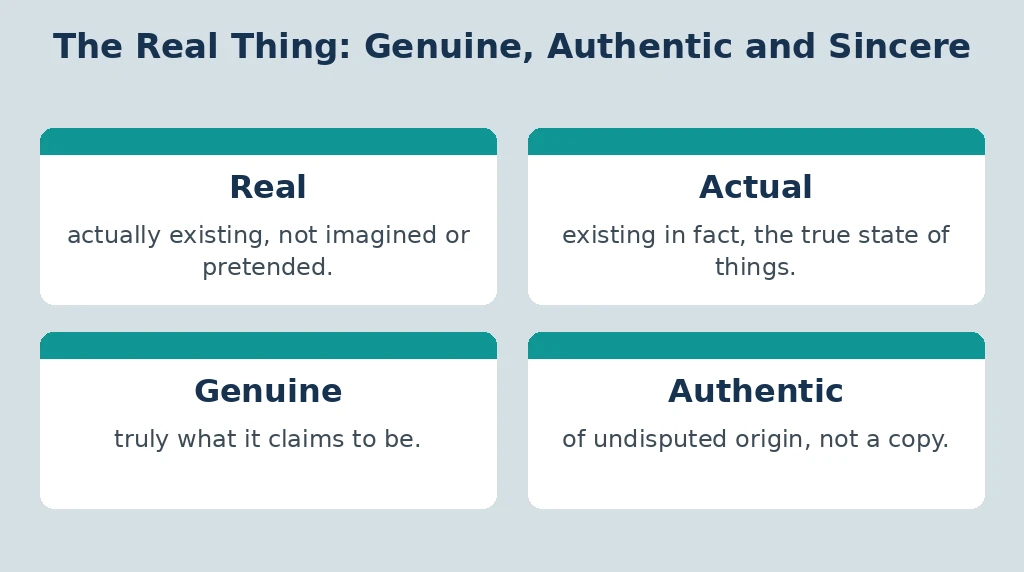
The Real Thing: Genuine, Authentic and Sincere
When true describes a thing instead of a statement, it stops meaning correct and starts meaning real. Not a copy. It is not a fake. Not a performance. A true antique, a true apology and a true diamond all pass the same test: being exactly what they present themselves to be. Feelings sit in this group too, because a sincere apology and a genuine antique pass or fail by the identical standard. In fact, the test is simple, and the examples pass it plainly. For example, synonyms for true in this group prove the thing, not the claim.
- Real: actually existing, not imagined or pretended. The real reason she rang was the rent, not the excuse about the keys.
- Actual: existing in fact, the true state of things. Six hundred people registered, but the actual turnout on the night was nearer ninety.
- Genuine: truly what it claims to be. The dealer swore the watch was genuine, box, papers and all.
- Authentic: of undisputed origin, not a copy. Two experts examined the signature and confirmed the letter was authentic.
- Natural: genuine and unaffected, not artificial. There was nothing staged about her; she was as natural with the cleaners as with the board.
- Pure: unmixed and genuine in kind. The ring was stamped pure gold, and the jeweller confirmed it.
- Proper: real and complete in the full sense, in phrases like a proper job. After years of casual shifts, he finally landed a proper job with a contract and paid holidays.
- Dinkum: genuine, in Australian and New Zealand informal speech. Ask anyone in the pub: she is a fair dinkum local who has run the shop for thirty years.
- Sincere: truly felt, not pretended. His apology sounded sincere, and this time she believed him.
- Heartfelt: deeply and genuinely felt. The card carried a heartfelt thank-you that she has kept in a drawer ever since.
- Unfeigned: not pretended, real. His unfeigned shock told the room he had known nothing about the plan.
- Unpretended: genuine and without disguise (uncommon). Her unpretended delight at the news made everyone else smile too.
Genuine and authentic divide the labour between them. Genuine is the broad everyday word, good for things and feelings alike. Authentic leans toward origin and evidence; it is the word of museums, certificates and experts with gloves on. Sincere and heartfelt handle the feelings that things cannot have. And unfeigned, the most literary of the set, is the one to save for the moment in a novel when a character’s face gives everything away. In other words, the labour divides between the everyday and the proven. Consequently, synonyms for true here split by use, not by fine shades of meaning.
Commerce runs on this group, and it always has. Genuine leather, genuine parts, genuine offers: the labels of the world are full of certificate words because buyers learned long ago to hunt for the certificate before the product. Authentic has become the premium term, now stuck onto experiences and restaurant food as happily as onto handbags. Its rise tells its own story. In a market built on copies, the most valuable adjective anything can earn is the one that swears it is itself. In particular, commerce trusts the group because the buyer’s money is at stake. Therefore, a writer should choose synonyms for true in trade for proof, not polish.
True Friends: Loyal, Faithful and Steadfast
A true friend is not a correct friend, and not exactly a genuine one either. They are something better. In this branch of the family, true means tested over time and never found wanting: the friend who stays, the supporter who does not drift off, the partner whose promises survive bad weather. It is the warmest sense of the word, and poets have used it longest, from wedding vows to football terraces. In fact, the friend test is loyalty over time, not correctness in a moment. For instance, a writer should choose synonyms for true for people by the years, not the day.
- Faithful: loyal and constant in support. A faithful old dog will wait by the door long after the car has gone.
- Loyal: firm in allegiance to a person, group or cause. Even after the firm let her go, she stayed loyal to her old team and never bad-mouthed them.
- Devoted: deeply loving and loyal. A devoted grandfather, he never missed a single school play.
- Staunch: loyal and committed, hard to move. She remained a staunch defender of the library when the council tried to close it.
- Constant: never changing in loyalty or presence. Through three house moves and one redundancy, Maya was his constant companion.
- Steady: firm and dependable under pressure. When the business nearly folded, Tom was the steady one who kept everyone calm.
- Fast: firmly fixed, in the old-fashioned phrase fast friends. They have been fast friends since their first day at school in 1974.
- Firm: unshaken in belief or support. He kept a firm belief in the cause long after the crowds drifted away.
- Reliable: able to be trusted, of people and sources alike. If Sara says the report will land by Friday, it lands by Friday; she is reliable.
- Honest: truthful and honourable in character. My grandfather was the most honest man I have known; his handshake was a contract.
- Upright: honourable and morally straight. An upright magistrate, she treated the powerful and the poor exactly the same.
- Trusty: trusted over long service (slightly old-fashioned). His trusty deputy had kept the shop’s accounts for twenty years.
- True-blue: unwaveringly loyal (informal). He is true-blue about his hometown club and his family, in that order on match days.
- Unswerving: never turning aside from a belief or loyalty. Her unswerving belief in her brother’s innocence outlasted two appeals.
Loyal is the headline word, but the shades matter. Faithful adds promise-keeping. Devoted adds love. Staunch adds stubbornness in a good cause. Constant adds sheer presence: the constant friend may say nothing wise at all, but they are always there, unfailingly, and that is its own kind of eloquence. In short, the shades are the point, and the headline word is only the start. As a result, synonyms for true for friends should match the virtue, not the volume.
Sailors gave this group its best image. A compass gets corrected until it points to true north, the fixed bearing that does not wander because of rocks or iron nearby. The phrase sailed into everyday speech as a name for whatever a person refuses to drift away from: a true north of loyalty, of craft, of family. When a eulogy calls someone a true friend, it is quietly borrowing that compass, and the compliment lands because everyone listening knows exactly what fixed means. In other words, the compass image is the family’s best, because a direction cannot lie. For example, synonyms for true for loyalty point north, whatever the weather says.
True Aim: Exact, Precise and Dead-On
Long before true described statements, it described flight: an arrow, a bullet or a thrown stone going where it was aimed. That sense is still alive every time we praise an estimate, a copy or a judgement for landing exactly on its target. These are the marksman’s words, the ones to reach for when near enough is not good enough. In fact, the flight sense is the oldest one, and the target test still holds. For example, synonyms for true for aim should hit the mark, not circle it.
- Exact: precise in every detail. She quoted his exact words back at him, which ended the argument.
- Precise: exact and careful in detail. The precise moment the photo was taken may never be known.
- Perfect: exactly matching the original. The toddler does a perfect imitation of her grandmother’s laugh.
- Unerring: never missing the mark. Clients trusted her unerring eye for a typo in a ninety-page report.
- Spot-on: exactly right (British informal). Your description of the landlord was spot-on, unfortunately for him.
- Dead-on: exactly right (informal). You guessed the repair bill to the pound. Dead-on.
- On target: hitting the intended mark. The charity’s appeal landed on target and raised the full amount by March.
- On the nose: exactly right, of amounts and times (informal). “The train gets in at six forty.” “Six forty it was, on the nose.”
- On the money: exactly right (informal). She predicted the delay to the minute, right on the money.
Exact and precise are the laboratory words: calm, repeatable, checked. Spot-on, dead-on and on the money belong to impressed conversation, the words you use when a guess lands so well it stops looking like a guess. Perfect belongs here too, but narrowly. A perfect copy or a perfect imitation earns it. A merely excellent one has to settle for being very good. In other words, the laboratory words are the calm ones, and the slang words are the lively ones. Consequently, a writer should choose synonyms for true for measurements by the instrument, not the mood.
Sport keeps this sense in daily training. Commentators praise the striker whose aim was true, the bowler whose line stayed true, the long putt that ran true all the way to the hole. In every case the word certifies a path, not a person. Archery writing is full of arrows flying true, and the old phrase straight and true hardened into a small oath of its own, which is why it still turns up in wedding readings, adventure stories and regimental mottos. In particular, sport keeps the sense alive because every kick is tested at once. Therefore, synonyms for true in sport should describe the flight, not the intention.
The True Heir: Rightful, Legal and True to Type
The last branch of the family settles arguments about ownership, office and identity. The true owner of a suitcase, the true heir to a throne, the true government of a country: all of them make the same claim. Whatever the appearances, this is the one the rules recognise. It is the sense that fills courtrooms, coronations and the final chapters of novels, where the rightful person so often walks in at last. In fact, the claim is the point here, and the word certifies it. For instance, a writer should choose synonyms for true for claims by the law, not the loudness.
- Rightful: having a just or legal claim. The painting hung in a gallery for years before it was returned to its rightful owner.
- Legitimate: lawful and rightful. Voters demanded that the legitimate government be restored after the coup.
- Lawful: allowed and recognised by law. The court ruled it was lawful for the doctors to treat her as they judged best.
- Legal: recognised by law. What he did was perfectly legal, whatever the neighbours muttered.
- Bona fide: genuine, offered or acting in good faith (from Latin). The fund only donates to bona fide charities registered with the commission.
- Typical: showing all the qualities of its kind, as in a true specimen. The fossil looks like a true, typical dinosaur of its period, small arms and all.
Typical may look like the odd one out, but it completes the pattern. A true dinosaur, a true gentleman and a true disaster are all measured against the full definition of their kind. Whenever true stands in front of a noun and means the real example of its type, typical is the synonym waiting in the wings. Spotting that sense saves learners from some very strange sentences about loyalty to dinosaurs. In short, typical completes the pattern by naming the specimen, not the exception. As a result, synonyms for true for type should match the kind, not the instance.
The law keeps one fossil of this branch in daily use. When a grand jury finds enough evidence for a trial, it endorses the charge a true bill, a phrase that has certified accusations for centuries. The detail is worth remembering because it shows the rightful sense of true was never decoration. Behind every true heir in a story stands a courtroom, a document and a queue of disappointed relatives, and the adjective does serious legal work every time it appears. In other words, the fossil is the law’s daily word, and it still earns its keep. For example, a writer should choose synonyms for true in court by the evidence, not the eloquence.
How to Choose the Right Synonym for True
Start with a simple question: what is being matched? If the subject is a statement, an answer or a report, you are in the facts group, and all that remains is register. Right for everyday speech, correct for formal writing, factual when you want to stress that opinion has been kept out. If the subject is a thing, an offer or a feeling, move to the genuine group: authentic for evidence and origin, genuine for almost everything else, sincere and heartfelt for the feelings themselves.
If the subject is a person and time is involved, think loyalty. A friend who agrees with you today is pleasant. A friend who has agreed, helped and stayed put for twenty years is faithful, devoted or staunch, and the word should show the mileage. One warning: do not let confidence dress up as truth. A witness can be perfectly sure and still be wrong, because sure measures how a person feels, while true measures how the world actually is.
For judgements, estimates and copies, go to the marksman’s shelf. Exact and precise suit instruments, instructions and anything a professional will check. Spot-on and dead-on belong in conversation and praise, and they carry a little celebration inside them that the laboratory words avoid on purpose. And when the question is not accuracy but entitlement (whose car, whose throne, whose government), leave the other groups alone and use rightful or legitimate, the words built for claims.
| Situation | Best word | Why |
|---|---|---|
| A claim in a news report | Factual | Certifies fact and excludes opinion in one word |
| A friend of twenty years | Staunch | Loyalty with mileage and stubbornness built in |
| An estimate that lands exactly | Dead-on | Informal, impressed and precise about precision |
| A handbag that is not a copy | Genuine | The everyday word for the real thing |
| The person a throne belongs to | Rightful | The claim word, built for heirs and owners |
| An apology that costs the speaker something | Heartfelt | Shows the feeling is deep, not performed |
When the deadline is doing the choosing, a quick ladder helps. Plain and everyday: right, real, loyal. Careful and professional: correct, accurate, genuine, reliable. Formal and legal: valid, legitimate, bona fide. Warm and spoken: heartfelt, staunch, dead-on, spot-on. Most sentences about truth fail not by picking a false friend, but by picking the right word at the wrong altitude: a bona fide produced in a playground, a dead-on offered in a coroner’s report.
True Synonyms for Writing and Dialogue
In fiction, true does quiet structural work. Characters reveal themselves by the branch of the family they live in: the loyal friend, the sincere apology that arrives too late, the estimate that turns out dead-on and swings the plot. Give a character a reputation for being true in one sense, then test them in another, faithful in friendship but careless with facts, and you have built a whole personality out of one adjective’s family tree.
Dialogue needs the chatty end of the list. Real people confirming each other say right, spot-on and dead-on. Nobody in a kitchen says accurate, and veracious would stop the scene dead. Friends get called loyal and faithful. Apologies get called sincere when the speaker is choosing words carefully, heartfelt when the card shop is doing the talking. Keep the formal words, valid, legitimate, bona fide, inside the mouths of lawyers, officials and head teachers, and everyone else sounds more alive by contrast.
Journalism and academic writing lean the other way, toward the verifiable end of the family: factual accounts, accurate figures, valid methods. The professional skill is remembering that a clear account is not automatically a true one. Clarity is about how easily a reader understands; truth is about whether the world agrees. Editors exist to patrol exactly that border, and the synonyms in this guide are the border guards’ vocabulary.
In every genre the same economy applies. True is claimed a hundred times a day and proved far less often, so the word a writer picks should show the proof. Name the match: against facts, against an original, against a promise, against a target. The synonym then chooses itself, and plain true stays free for the rare sentence where plainness is the whole point.
Poets have always farmed this family hardest. Shakespeare opens his most famous love sonnet by refusing to admit impediments to the marriage of true minds, and love songs have borrowed the loyal sense ever since while pretending to invent it. The craft lesson hides inside the borrowing: true love works as a phrase because readers supply the test themselves, the years, the weather, the staying. Name that test in your own writing and even the oldest phrase in this guide can feel new again.
Antonyms for True
Because true certifies a match, its opposites name the ways a match can fail: the statement that misses the facts, the object that fails its label, the friend who fails the test of time. The plain opposite, false, leads the family, and the list below gathers its main members, sorted by the same senses as the synonyms.
- False: not true, wrong or deceitful.
- Untrue: not in accordance with the facts or with loyalty.
- Fake: not genuine, made to deceive.
- Counterfeit: copied exactly in order to deceive.
- Bogus: not genuine, sham (informal).
- Fictitious: invented, existing only in stories.
- Imaginary: existing only in the mind.
- Inaccurate: containing mistakes, not exact.
- Erroneous: wrong and mistaken, in formal writing.
- Faithless: disloyal and unable to be trusted.
Notice how faithless mirrors faithful exactly, and fictitious answers factual. The language keeps the two families in matching pairs, sense by sense. Learn them together and you gain a switch as well as a word: one term flips a sentence from certificate to accusation.
Between the two armies sits a crowded grey zone with a vocabulary of its own. The half-truth conceals while it informs. The white lie offends nobody and protects everybody. The fib is a lie shrunk to child size. The tall tale is falsehood told openly, as entertainment. English grades dishonesty as carefully as honesty, and a writer who can name the exact shade, exaggeration here, evasion there, owns a finer instrument than one who can only shout false.
Common Mistakes: Words That Are Not True Synonyms for True
The trap examiners love most is truly. It looks like the natural partner of true, but truly is an adverb, not an adjective. It means very, really or sincerely, as in truly sorry or truly grateful, and it cannot do true’s job in front of a noun. A truly story is not English, however heartfelt it sounds. Yours truly at the end of a letter is a fixed fossil of the adverb, not proof that the two words swap places. Keep truly for strengthening other adjectives, and let true keep its own seat.
Next, the false friend that catches learners of English all over Europe: actual does not mean current. Actual means real, existing in fact, which is why it earns its place in this guide. The word for current is, simply, current. A shop promising the actual prices when it means today’s prices will confuse every native reader it meets. Actually causes the same trouble backwards, since it means in fact, not at the present moment.
Correct causes a subtler muddle. Correct belongs to answers, information and behaviour measured against a standard; it cannot certify genuineness. A correct diamond is not a real diamond, it is a confused one, and a correct friend sounds like a friend marked out of ten. When the claim is that something is the real thing rather than a copy, the honest words are genuine and authentic.
Finally, keep the family’s grammar straight. truth is the noun, true is the adjective, and the two do not trade places. We speak the truth, we test whether a claim is true, and we tell the truth about both. A sentence like “he said the true” fails before it begins, and no synonyms, however carefully chosen, can rescue a word asked to do the wrong grammatical job.
Three travelling phrases deserve a line before we stop. Dreams and wishes come true when events finally match them. A person who keeps every promise is true to their word. Anything behaving exactly as its record predicts is true to form. Add too good to be true, the warning label English sticks on any offer that fails the family test on sight, and you hold the handful of idioms built on this word that readers meet most often.
Frequently Asked Questions
What is the best synonym for true?
It depends on the sense, as almost everything with this word does. For facts and answers, right and correct are the everyday standards, with accurate for careful work. When things and feelings are the subject, genuine is the most useful all-rounder. For people, loyal and faithful carry it best. And for an estimate or judgement that lands exactly, dead-on and spot-on are the lively choices.
What is the difference between true and truthful?
True describes the claim or the thing itself: a true statement matches the facts. Truthful describes a person, or an account, that habitually deals in truth: a truthful witness, a truthful answer. So a statement is true, a person is truthful, and a truthful person can still occasionally say something that turns out not to be true.
What is another word for a true friend?
Loyal friend is the standard phrase, and faithful friend is its close partner. For stronger colours: a staunch friend never wavers in a crisis, a devoted friend adds love to loyalty, and a constant friend is simply always there. The old-fashioned phrase fast friends survives in literature, for bonds nothing could loosen.
What is the opposite of true?
The direct opposite is false. Around it stand untrue, which covers both facts and loyalty, and a family of sense-by-sense opposites: fake and counterfeit for things, fictitious and imaginary for stories, inaccurate and erroneous for statements, and faithless for the friend who fails the test that true friends pass.
What does it mean when something rings true?
When a story, excuse or performance rings true, it sounds believable and consistent with everything else we know, even before anyone checks it. The phrase borrows a coin or a bell: a genuine one gives a clear, honest sound when struck. Its opposite, ringing false, is what a practised liar’s story does in a good listener’s ear.
Final Thoughts
True earns its keep by being tested, and so does every word in its family: right against the facts, genuine against the copy, faithful against the years, dead-on against the target. Once you see which test your sentence is running, the synonym stops being a guess and becomes a small act of precision, which is a satisfying thing for a word about truth to be.
Want to dig deeper into this large and honourable family? The Merriam-Webster Thesaurus entry for true lists hundreds of relatives, near matches and opposites. Keep this guide close too, and the next claim, copy or companion you describe will get the exact certificate it deserves.
Discover More Post:
- Synonyms for Define | Meaning, Examples, and Better Word …
- Synonyms for Shape |25+ Meaning, Context, Examples …
- Synonyms for Sacrifice |25+ Meaning, Examples, and …

1 thought on “Synonyms for True | 48+ Words for Facts, Feelings, Loyalty and True Aim”