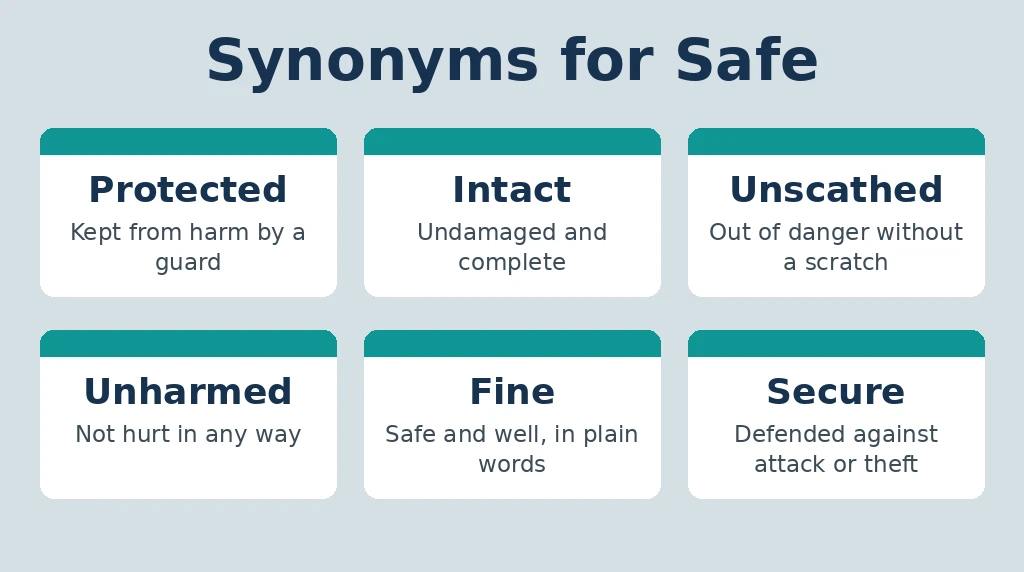
Every journey home ends with the same small sentence: got back safe. Behind that modest word stands a whole system of protection: protected and unscathed for the people who came through, secure and sound for the places and structures that held, harmless for the things that never threatened anyone, and cautious and dependable for the hands that did the protecting. In short, this guide gathers synonyms for safe for every one of those kinds of protection. For example, protected guards the people, secure guards the places, and harmless guards the things.
This guide collects 35 synonyms for safe and sorts them by whose safety is at stake: the survivor, the building, the substance, the driver, and even, in the critics’ corner, the album that risked nothing and pleased nobody. Each word was checked against real thesaurus entries and carries a plain meaning and a short example. Master the families and you’ll never again call a mushroom safe when the word you wanted was harmless. In fact, the sorting is the point, because the same word can guard a survivor, a vault and a joke. Consequently, synonyms for safe in this guide sit in groups by the thing they protect.
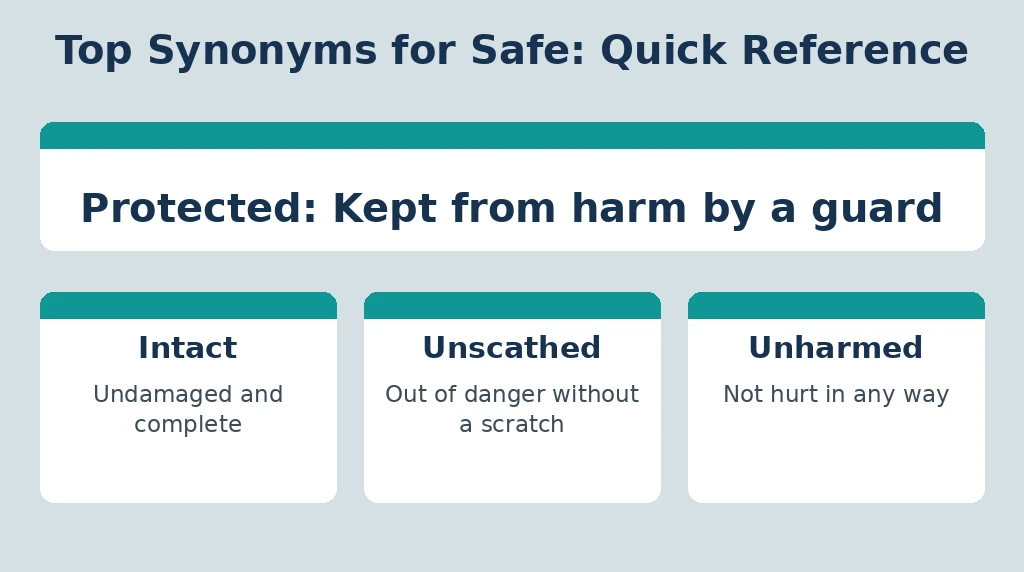
Top Synonyms for Safe: Quick Reference
Twenty words cover safe’s main territories. The grouped sections below give the full list sense by sense, including safe the noun, the strongbox hiding inside the adjective. In particular, the table gives the twenty at a glance, and the sections below give the whole story. For instance, a writer in a hurry can take the table and go, while a careful writer reads on.
| Word | Meaning in one line | Best for |
|---|---|---|
| Protected | Kept from harm by a guard | Cameras, children, cargo |
| Intact | Undamaged and complete | Cargo, ruins, reputations |
| Unscathed | Out of danger without a scratch | Survivors, escapes, scandals |
| Unharmed | Not hurt in any way | Passengers, animals, bystanders |
| Fine | Safe and well, in plain words | Messages home, reassurance |
| Secure | Defended against attack or theft | Homes, systems, borders |
| Sound | Strong and free from risk | Buildings, investments, plans |
| Risk-free | With no risk at all | Investments, guarantees, claims |
| Impregnable | Impossible to break into | Forts, vaults, defences |
| Harmless | Unable to cause harm | Animals, chemicals, jokes |
| Innocuous | Not harmful or offensive | Remarks, ingredients, looks |
| Pure | Free of anything harmful | Water, air, food |
| Cautious | Careful to avoid risk | Drivers, investors, walkers |
| Prudent | Wisely careful about the future | Savers, managers, planners |
| Reliable | Trustworthy every time | Cars, colleagues, sources |
| Dependable | Always there when needed | Friends, staff, machines |
| Discreet | Careful and quiet about it | Assistants, distances, enquiries |
| Circumspect | Watchful in all dealings | Diplomats, dealers, formal prose |
| Boring | Safe in the critic’s sense: dull | Albums, programmes, choices |
| Vault | The noun: a strong room | Banks, treasure, archives |
What Does Safe Mean?
Safe means free from danger, and free from the risk of it. The word works in both directions, which is its quiet genius and its main trap: a safe place protects the people in it, while a safe fuel endangers nobody outside it. Things are safe when they cannot be harmed and when they cannot harm. People add a third use: a safe driver, a safe pair of hands, where safe describes the protector’s reliability rather than anyone’s survival. In other words, the two directions are the whole secret, and the families follow from them. For example, synonyms for safe split by whether the danger sits inside or outside.
The phrases tell the same story of shelter. Safe and sound is the traveller’s report. Out of harm’s way is the rescuer’s goal. A safe haven and a safe house are places; a safe bet is a risk that isn’t one; playing it safe is choosing survival over glory; and better safe than sorry is the family motto, the proverb Collins prints with the word itself. Even the insult is structured: a safe choice, in a review, is one that admitted no danger of failure and therefore no chance of greatness. Dictionaries of quotations are full of the resulting tension, the ship in harbour that is safe but not built for harbour, because English has never quite decided whether safety is the goal of the voyage or the thing the voyage is for.
In fact, the phrases carry the same story, because safe and sound is the report every traveller sends. Therefore, the phrases tell the story best, because they come from real journeys home.
As a noun, safe completes its journey from condition to container: the strongbox where valuables are kept safe by being locked in. The adjective is one of the most reassuring words in English, but its synonyms are precise instruments, distinguishing the survived, the defended, the inoffensive and the merely unadventurous. That precision is what the rest of this guide is for. In short, the noun turns the condition into a container, and the strongbox is the proof of it. As a result, synonyms for safe for the noun come from banks, cellars and treasure rooms.
One use of the word deserves a note of its own. In British youth slang, safe works as a greeting, a thank-you and a mark of approval, roughly: all good between us. Dictionaries record the sense, and grandmothers across London have been greeted with it for thirty years. It isn’t a synonym in any list here, but it proves the word’s deepest meaning one more time. Safe is what we say when nothing stands between people: no danger, no debt and no grudge. In fact, the greeting shows the word at its warmest, because it promises nothing stands between friends. For example, slang keeps the word alive far from dictionaries, and the greeting is the proof.
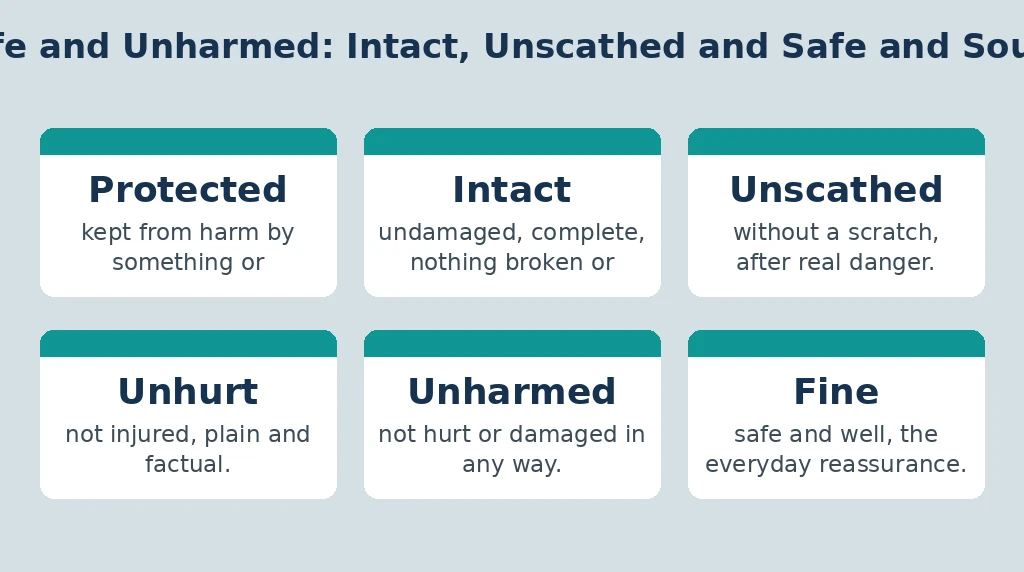
Safe and Unharmed: Intact, Unscathed and Safe and Sound
The first family reports on the endangered after the event: the passengers after the crash, the cargo after the explosion, the reputation after the scandal. These words certify outcomes, and their grammar is the grammar of relief. In particular, the report comes after the danger, and the words certify the escape. Therefore, synonyms for safe in this family should name the survivor, not the storm.
- Protected: kept from harm by something or someone. Keep your camera safe, protected from sand and spray.
- Intact: undamaged, complete, nothing broken or missing. After the explosion, most of the cargo was left intact.
- Unscathed: without a scratch, after real danger. He emerged unscathed apart from a severely bruised finger.
- Unhurt: not injured, plain and factual. The lorry driver escaped unhurt, but a pedestrian was injured.
- Unharmed: not hurt or damaged in any way. The car was a write-off, but everyone escaped unharmed.
- Fine: safe and well, the everyday reassurance. Do not worry about Sophie; she is fine.
- Okay: safe and unhurt, informal, often written O.K. Text me when you land so I know you are okay.
Grade them by the danger survived. Unhurt and unharmed report the plain medical fact, the vocabulary of police statements and insurance forms. Intact covers things and adds completeness, nothing missing as well as nothing broken. Unscathed is the dramatic summit, used when the danger was real and the escape complete, and it flatters slightly, which is why profiles love it. Fine and okay are the spoken currency, the text message home; in formal reports they’re too weak to carry the news, and protected belongs to the danger itself, crediting whatever stood between. When the relief settles, the language softens a degree further, and the traveller is not only safe but at rest, in the territory of the synonyms for calm. In other words, the grade follows the danger, and the medical fact comes first. For instance, synonyms for safe for survivors suit the hospital note better than the headline.
News writing is where this family earns its keep, and editors grade it strictly. “All passengers were unharmed” is a complete news sentence: factual, unsentimental, closed. “Everyone is fine” is a quote, not a report. Intact is reserved for cargo, buildings and, metaphorically, reputations and records: the finance minister emerged with his credibility intact. Learn the ladder and you can hear, in a single adjective on the evening bulletin, exactly how bad the afternoon was and how much of it survived. In fact, the newsroom grades every word, because the report becomes the record. Consequently, synonyms for safe in news should carry the official fact, not the drama.
The family’s crown phrase, safe and sound, deserves its fame. Sound here is the old word for whole and uninjured, the same sound as in the defended-places section, so the phrase says the same thing twice in two registers, once for the heart and once for the record. English loves such doublets in moments of relief, and travellers have ended their letters with it for centuries. When the news is best, the language reaches for redundancy, as if one word for safety were not safe enough. In short, the crown phrase earns its fame by sounding whole in every language. As a result, synonyms for safe for homecomings lean on sound, because it promises wholeness.
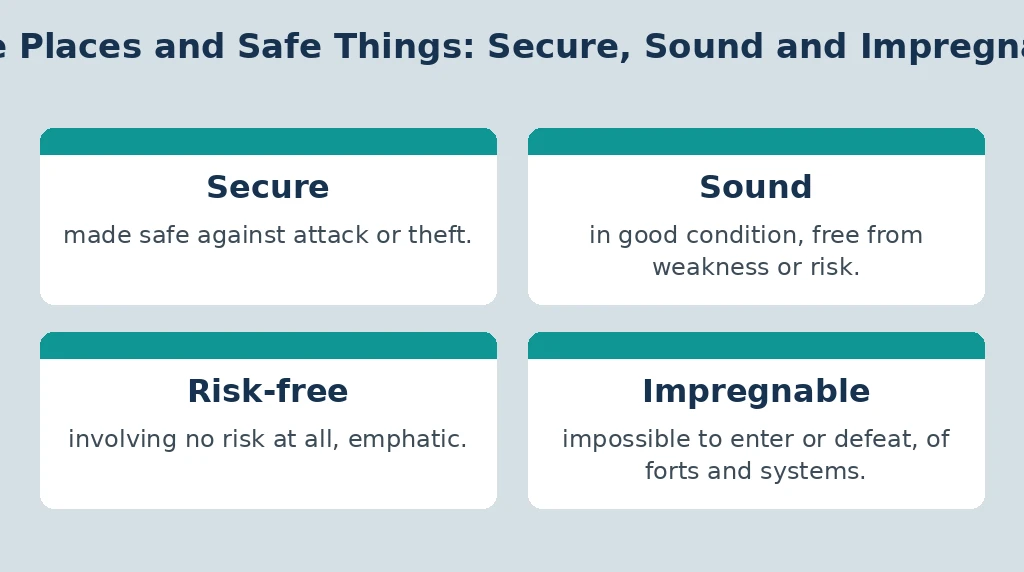
Safe Places and Safe Things: Secure, Sound and Impregnable
The second family describes the defences rather than the defended: buildings, systems, investments and plans that can be trusted to hold. Where the first family looks backward at survival, this one looks forward at risk. In fact, the defences do the work, and the words describe the locks, not the lucky. For example, synonyms for safe for places suit the architect’s plan better than the traveller’s tale.
- Secure: made safe against attack or theft. We shall make sure our home is as secure as possible.
- Sound: in good condition, free from weakness or risk. The engineers declared the building sound.
- Risk-free: involving no risk at all, emphatic. There is no such thing as a completely risk-free investment.
- Impregnable: impossible to enter or defeat, of forts and systems. The old fort, with its thick high walls, was virtually impregnable.
Secure is the professional word, the term of locks, borders and passwords, and it implies an active defence. Sound is older and quieter, the engineer’s and banker’s word for a structure with no weakness in it, and it doubles for arguments and sleep. Risk-free is the bold claim, beloved of advertisers and auditors of each other’s prose. Impregnable is the castle word, best kept for fortresses, vaults and, metaphorically, positions in argument that no opponent has ever entered. In fact, the system is the difference, because a lock without a keeper is only furniture. For example, synonyms for safe for places should name the defence, not the luck.
Computing rebuilt this family in its own image, and the results fill every phone. A secure password, a secure connection, a secure folder: the digital world borrowed the castle vocabulary wholesale, because its threats (intrusion, theft, interception) are the castle’s threats with better tools. The borrowing explains a modern confusion. Users told a site is secure ask whether they are safe, and the honest answer involves both words: secure measures produce safe people only when the measures are maintained. A defence, digital or stone, is a habit before it is a wall. In other words, the computer rewrote the family in passwords and padlocks. Consequently, synonyms for safe in computing carry the lock, not the luck.
Industry quantifies the family until the poetry nearly leaves it. Safe distances, safe speeds, safe working loads, safety margins measured in metres and multiples: the engineer’s safe is a number with a standard behind it. That quantified sense feeds back into everyday speech whenever we say safely within the limit or a safe margin of error, borrowing the laboratory’s calm for ordinary judgement. Writers in technical fields live inside this usage; writers visiting it should respect the numbers hiding inside the adjectives. In particular, the numbers do the talking here, because the margin is the meaning. Therefore, synonyms for safe in industry should come with a figure attached.
Not Dangerous: Harmless, Innocuous and Pure
Safe also faces outward. A safe fuel, a safe toy, a safe neighbourhood dog: here the word promises that the thing itself will hurt nobody. This small family is the one most often confused with the first, and the confusion matters, because direction is everything in safety. In fact, the outward turn is the one parents care about, because the promise is about others. For instance, synonyms for safe for things should promise no harm to anyone else.
- Harmless: not able or likely to cause harm. They are developing harmless substitutes for these gases.
- Innocuous: not harmful or offensive, slightly formal. Both mushrooms look innocuous, but one is in fact deadly.
- Pure: free of anything harmful, of water, air and food. The town demands pure, safe drinking water.
Harmless is the plain certificate, innocuous its formal cousin, often used of remarks and appearances, its famous trap being the innocuous-looking mushroom that is deadly after all. Pure enters from the elements, safe water and safe air, where harmlessness is measured chemically. It’s the bridge to the world of the synonyms for clean, since a substance nobody can safely drink is, in the report, simply not clean. In short, the certificate is plain, and the cousin is formal, and both keep the same promise. As a result, synonyms for safe for substances should start with harmless and climb only when the register demands it.
Playgrounds and medicines teach the family to every parent by heart. A medicine safe for children is not harmless in adult doses; a plant harmless to adults may poison a toddler; the directions columns of the world are written in these distinctions. Writers for families, schools and clinics therefore choose within this family with a lawyer’s care, and their rule is worth stealing for all prose: name who is protected, from what, and by which word’s exact promise. In other words, every parent learns the family by heart, because the stakes are their children. For example, synonyms for safe for children should be the plainest words in the book.
Consumer language runs on this family. Child-safe caps, pet-safe cleaners, food-safe plastics, skin-safe cosmetics: the compound safe is everywhere precisely because the family supplies its legal backup. When a regulator challenges a claim, harmless and innocuous are the words in the testing documents, each with thresholds and methods attached. Parents reading labels are doing applied lexicography, deciding which direction of safety a product promises, protection of the child or harmlessness in the child’s hands, and the honest label says which. In fact, the label is the promise, and the test is the proof behind it. For example, synonyms for safe for products should carry the test in the label, not the poetry.
Safe Hands: Cautious, Prudent and Dependable
The fourth family describes protectors: people whose habits make others safe. A safe driver, a safe babysitter, a safe pair of hands in goal: the compliment is about method, not luck, and it grades character the way the first family grades outcomes. In other words, the protectors prevent the harm, and the habits are the defence. Consequently, synonyms for safe for people should describe the habit, not the luck.
- Cautious: careful to avoid danger or risk. Mr King clearly has a cautious approach to change.
- Prudent: wise and careful about the future. He is taking a prudent and cautious approach to the merger.
- Reliable: able to be trusted, consistently safe. She was efficient, reliable, and calm in a crisis.
- Dependable: worthy of trust, always there when needed. He was a good friend and a dependable companion.
- Discreet: careful not to attract attention or embarrass. He followed at a discreet distance all the way home.
- Circumspect: careful and watchful in all dealings, formal. You should have been more circumspect in your dealings with him.
Cautious names the method, avoiding risk. Prudent names the wisdom behind it, thinking ahead. Reliable and dependable name the record, safety delivered every time, with dependable adding warmth, the friend rather than the machine. Discreet and circumspect guard a different frontier, reputation and information, where the harm avoided is embarrassment or exposure. Put together, the family explains the gambler’s phrase too: a safe bet is a dependable prospect, a wager that shades into a certainty, close neighbour to the world of the synonyms for sure. In fact, the method and the wisdom are the two halves, and the paragraph shows both. For instance, synonyms for safe for habits should name the method before the motive.
The safe pair of hands began, most agree, with goalkeepers and cricketers, the players whose one job is that nothing gets past. Politics adopted it for leaders who promise competence over fireworks, and the phrase now appoints finance ministers and acting heads of everything. Its compliment is double-edged, as the critics’ section will show: safe hands are trusted precisely because they attempt nothing surprising. Hiring one is a statement about the times, and describing a colleague with this family (prudent, reliable, discreet) is writing their reference in a single breath. In short, the phrase began in sport, and the changing rooms gave it its home. As a result, synonyms for safe for hands should come from keepers, not theorists.
Safe as a Criticism: Boring, Dull and Unexciting
Reviewers keep a private sense of safe that the rest of the language politely ignores: safe means unadventurous. A safe album, a safe menu, a safe third act: nothing in them can fail, and therefore nothing in them can soar. Collins illustrates the sense with commercialised rock, and every critic since has used the word as a small, disappointed sigh. In particular, the private sense is the critic’s, and the public sense is everyone else’s. Therefore, synonyms for safe for reviewers should stay in the review, not the report.
- Boring: not interesting, the blunt verdict. The channel filled its evenings with boring, safe programmes.
- Routine: ordinary and predictable, nothing new. So many days were routine and uninteresting.
- Dull: without excitement or brightness. They can both be rather dull company after nine.
- Tedious: long, slow and tiresome. It was the tedious business of checking every line by hand.
- Stale: no longer fresh or interesting. He kept repeating stale jokes to kill the time.
- Monotonous: unchanging and therefore dull. It is monotonous work, like most factory jobs.
- Humdrum: ordinary, everyday and unexciting. He felt trapped in a humdrum but well-paid job.
- Uninteresting: offering nothing to hold attention. Why did he choose these uninteresting people as friends?
- Insipid: without flavour or spirit, a critic’s word. They gave an insipid performance in a nil-nil draw.
- Unexciting: plainly not exciting, the mildest charge. It was a competent, unexciting album by a band resting.
The family is graded like a yawn. Routine and humdrum describe the predictable round of days; dull and uninteresting state the plain failure; tedious adds length to the charge; stale adds age, jokes and ideas past their season; monotonous blames the unchanging rhythm; and insipid, the critic’s stiletto, declares an absence of flavour, spirit and salt. To call a work safe in this company is to place it in the museum of good intentions, and writers should deploy the sense knowingly, because readers of reviews hear it instantly. In fact, the grade follows the yawn, and the mildest word is the dullest. For example, synonyms for safe for boredom should be the plainest words of all.
Careers hear the same accusation in politer dress. The safe candidate, the safe promotion, the safe pair of hands from the section above: in every institution, safety is simultaneously the qualification and the ceiling. Life advice splits on exactly this seam, one school preaching prudent and dependable, the other warning that a risk-free life is the one risk nobody should take. The vocabulary doesn’t settle the argument; it merely gives both sides their adjectives, which is why examiners of essays love watching candidates discover the tension. In fact, the dress is politer, and the accusation is the same. For example, synonyms for safe for careers should name the ceiling, not the comfort.
Safe as a Noun: Vaults, Coffers and Deposit Boxes
Safe the noun is the strongbox, and it brings its own small family of containers, from the bank’s vault to the traveller’s coffer. The adjective promised protection. The noun is where the protection physically lives. In other words, the noun is the container, and the family is the set of boxes. Consequently, synonyms for safe for the noun should come from banks and cellars.
- Vault: a strong room for valuables, in banks and cellars. The money was in storage in bank vaults.
- Coffer: a strong box for money and treasure, old-fashioned. Crossing to her clothes coffer, she jerked the lid up.
- Repository: a place where things are stored, literal or figurative. The church became a repository for police files.
- Deposit box: a rented safe box at a bank or hotel. She kept the deeds in a deposit box downtown.
- Safe-deposit box: the full formal name of the bank box. His will lay in a safe-deposit box for forty years.
Vault is the grand member, a room rather than a box, and it doubles as the verb for the gymnast’s leap, a confusion contexts resolve instantly. Coffer survives in treasure stories and in the metaphor of public coffers, the state’s money chest. Repository generalises the idea to anywhere things are stored (archives, churches and databases), while the deposit boxes keep the banking sense precise. Together they remind us that safety began as carpentry and ironwork before it became a feeling. In particular, the vault is the grand member, and the room is the proof of its size. Therefore, synonyms for safe for vaults should come from banks, not bedside tables.
Fiction cannot leave this noun alone. The safe behind the painting, the hotel safe with the wrong contents, the cracked safe at the story’s climax: the strongbox is literature’s promise that something in the house matters more than the house. Hotel chains now install one in every wardrobe, and travellers test the metaphor nightly, trusting a four-digit code with their passports. The word’s two lives, condition and container, meet in that small nightly ritual: we put our valuables in the safe so that we can feel safe, and English sees nothing odd in the sentence at all. In fact, fiction loves the noun, because the strongbox holds secrets as well as money. For instance, synonyms for safe for stories should hide a secret inside the box.
How to Choose the Right Synonym for Safe
Ask first about direction. Is your subject protected from harm, or incapable of causing it? Survivors and passengers take the first family: intact, unscathed, unharmed. Fuels, toys and dogs take harmless and innocuous. Then ask about time. Outcomes already known take the survivor words; defences and prospects take secure, sound and risk-free; habits take cautious, prudent and dependable. Most errors with safe are direction errors or time errors wearing a synonym’s clothes. In short, the direction is the first question, and the rest follow from it. As a result, synonyms for safe for choosing should follow the direction, not the sound.
Finally, mind the register and the wink. In official reports, fine and okay are too weak, and risk-free is a claim you must be able to defend. In reviews, safe itself may be the insult, and choosing it innocently can damn a client with faint survival. And where money is involved, sound is the sober professional’s word, prudent his compliment, and impregnable a promise no honest auditor would sign. In other words, the register is the last question, and the wink is the answer. For example, synonyms for safe for reports should mind the register before the rhyme.
| Situation | Best word | Why |
|---|---|---|
| Passengers after an emergency landing | Unharmed | The medical fact, officially stated |
| A climber down from a storm | Unscathed | Real danger, complete escape |
| A house with locks and alarms fitted | Secure | An active, maintained defence |
| A bridge passed by engineers | Sound | No weakness found in the structure |
| A dog that would never bite | Harmless | Direction outward: it endangers nobody |
| A goalkeeper who never drops a cross | Dependable: a safe pair of hands | Habit and record, not luck |
| A sequel that copies the original | Safe: boring | The critic’s sense, risk avoided |
When in doubt, safe itself is almost never wrong, which is its charm and its limitation. Reach for the specialists when the direction, the timing or the certificate matters, and the plain word will keep its strength for the sentences, like the text home, where plainness is the whole point. In fact, the doubt should send a writer to safe, because it never lies. For example, synonyms for safe in doubt should start with safe itself, not the fancy cousin.
Work one example through the whole method. A climbing centre reopens after an accident. The injured instructor is, thankfully, unhurt. The wall, inspected and re-bolted, is sound, the premises secure. The new helmets are harmless in every test that matters, which is to say they cause no harm and pass every standard. The manager, a prudent and circumspect man, calls it business as usual; the local paper, reaching for the critic’s sense, calls the reopening safe. Six families, one story, no word wasted, and every reader knows exactly what protected whom. In other words, the method works on a real case, and the example proves it. Consequently, synonyms for safe for the centre should follow the method step by step.
Synonyms for Safe in Essays, Stories and Professional Writing
Essays use safe to draw the map of risk. The safe option, the safe seat, the safe conclusion: academic and political writers grade choices with this family, and prudent, sound and circumspect do the formal work while boring and stale wait, in the opinion pages, for the policies that never dared. A writer arguing for boldness will quote the critic’s sense; a writer arguing for care will quote the proverb. Both are citing the same word, which is why definitions matter more here than synonyms. In particular, the map of risk is the essay’s work, and safe draws its borders. Therefore, synonyms for safe in essays should draw the map, not decorate it.
The safe seat shows the word doing quiet constitutional work. A constituency so loyal that its result is never in doubt makes its representative, in the survivor’s sense, unharmed by elections, and political scientists measure democracy partly by how few such seats exist. The metaphor borrows the whole family at once: the seat is secure, its holder protected, the outcome dependable to the point of dullness. Essayists who unpack that single adjective can explain landslides, complacency and reform in one move, which is why safe repays close reading far beyond its modest size. In fact, the seat shows the word at work in the constitution, not the dictionary. For instance, synonyms for safe for seats should come from politics, not poetry.
Fiction runs on the gap between safe and secure. Characters feel safe in places that aren’t secure at all, a locked room in a burning house of a plot, and the reader’s dread lives in the difference. The survivor words carry chapters: the unscathed hero begins to believe in his own luck, the intact cargo mocks the ruined ship. And the noun does quiet symbolic work, the safe in the study wall holding whatever the family cannot say aloud. In short, the gap is the story, and the feeling is the trap. As a result, synonyms for safe in fiction should mind the gap, not the feeling.
Professional writing treats safety as a claim to be audited. Safe working loads, safe systems of work, safe staffing levels: in reports, every use of the word implies a standard, a test and a signature. That’s why professionals grade so carefully, sound for structures, reliable for equipment, dependable for people, and why harmless appears in regulations with a lawyer at its elbow. The writer who borrows the family’s casual words for technical claims will meet the auditors, and the auditors bring definitions. In other words, the audit is the standard, and the claim must pass it. For example, synonyms for safe in reports should carry the audit with them.
Travel writing is the family’s holiday home. Guides promise safe neighbourhoods, safe water and safe hands at the wheel, and every promise leans on a different family: the quarter is secure, the supply is pure, the driver is dependable, and the traveller who returns unscathed writes the review. Skilled travel writers specify which safety they mean, because readers book on the difference. The vague assurance, a safe destination, convinces nobody. The graded one, its old town secure, its taxis reliable, its tap water pure, fills hotels.
Antonyms for Safe
Safe’s opposites name the danger from every side:
- Unsafe: not safe, the direct opposite, plain and official.
- Dangerous: likely to cause harm, the strong everyday word.
- Risky: full of risk, of ventures and manoeuvres.
- Hazardous: involving hazards, formal and technical.
- Harmful: causing harm, the outward opposite of harmless.
- Endangered: at risk of extinction or destruction.
- Threatened: under threat, of species, jobs and peace.
- Insecure: not firm or not confident, of structures and people.
- Damaged: harmed and no longer intact.
- Precarious: dangerously unstable, likely to fall.
The list pairs off neatly against the families: unsafe and precarious against the defended places, dangerous and hazardous against the harmless things, endangered and threatened against the survivors, and damaged against intact itself. Choosing the right opposite is the same skill as choosing the right synonym. State the direction of the danger, and the word follows.
One asymmetry is worth remembering. Safe has no single exact opposite covering all its senses, which is why the list above has to be a committee. A performance can be dull’s opposite, brilliant, and still be the safest thing on the programme; a coffer’s opposite isn’t a word at all but an open door. Writers forced to negate safe should negate the sense, not the word: not yet secure, far from harmless, anything but sound. Precision about danger is the whole art, in this family and in the world it describes.
Common Mistakes: Words That Are Not True Synonyms for Safe
Secure is safe’s closest partner and commonest confusion. As adjectives they overlap, but secure implies an active defence (locks fitted, guards posted, encryption on), while safe can describe a state nobody arranged, a safe cove, a safe childhood. A harbour is safe by geography and secure only when defended. The verbs differ entirely: to secure is to fasten or obtain, never to make safe in the survivor’s sense.
Harmless faces only one way. A harmless thing cannot hurt you, but it may itself be in great danger, as any harmless animal in a forest fire will testify. Safe faces both ways. Learners who call a rescued animal harmless when they mean it is now safe reverse the story’s ending, so check the direction before choosing.
Cautious belongs to people and their habits, not to things and outcomes. A cautious bridge is nonsense; a sound one is a compliment. Cautious drivers make roads safe, but the roads themselves are never cautious. Keep the family of habits for the actors, and the families of states for the world they act on.
Okay and fine are reassurance, not certification. In speech they’re perfect, the text that stops a parent worrying. In reports, certificates and journalism they carry no authority at all, because they record a feeling rather than a test. After an accident, the official vocabulary is unhurt, unharmed and intact. Save fine for the phone call home.
Risk-free is the family’s licensed exaggeration. In ordinary speech it means the risk is too small to mention. In finance, regulators in many countries ban or restrict the phrase outright, because no investment is free of risk and the claim itself is the danger. Learners and copywriters alike should treat it as a technical term with legal weather around it: fine for a children’s climbing frame in a catalogue of the imagination, hazardous in a brochure asking for money.
Frequently Asked Questions
What is the best synonym for safe?
Secure is the most useful all-rounder for places and systems, and unharmed for people after an incident. Harmless is the word when the direction reverses and the thing itself could cause harm. Safe has no single heir, so choose by whether you mean protected, defended, or incapable of hurting anyone.
What is the difference between safe and secure?
Safe describes a state of being free from danger; secure adds the idea of an active defence that keeps it that way. A remote cove is safe; a harbour with locks, patrols and cameras is secure. In computing the distinction is standard: systems are secured by measures so that users can be safe. A handy test is to ask who did the work. If nobody had to, safe is the word. If somebody maintains the protection daily, secure earns its place.
What do you call a person who is safe to rely on?
A safe pair of hands is the classic phrase, and the adjectives are dependable, reliable and prudent. Cautious describes such a person’s method, and circumspect their care in dealings. In sport, finance and childcare alike, dependable is the compliment that gets people hired.
What does playing it safe mean?
Playing it safe means choosing the option with the least risk, even at the cost of a bigger reward. Its neighbours are cautious and prudent, and its motto is better safe than sorry. Critics use the same idea as an insult, where a safe performance is a boring one, so context decides whether the phrase praises or sighs.
What is a safe word for children, for things that cannot hurt them?
Harmless is the word: a harmless toy, a harmless animal, a harmless joke. Innocuous is its formal cousin. Avoid calling things safe when you mean they cannot cause harm, because safe also means protected, and a harmless toy in a fire is anything but safe itself.
Final Thoughts
Safe is the word journeys end with, and its family stands guard over every part of the promise: protected for the watched-over, unscathed for the escaped, secure for the defended, sound for the tested, harmless for the innocent, dependable for the hands on the wheel, and even boring for the works that survived by never daring, plus one proverb to govern the whole estate: better safe than sorry, whenever the stakes are real. Learn the directions and the tenses of safety, and the family will always tell you, precisely, what kind of all-right you mean.
Keep this guide beside the map and the first-aid kit, and for the complete historical record of the word’s defences, the Merriam-Webster Thesaurus entry for safe is the fullest strongroom of all. Travel well, lock up kindly, and may everything you love come home safe and sound, on time, unhurried, and with its stories intact for the telling.
Discover More Post:
- Synonyms for Define | Meaning, Examples, and Better Word …
- Synonyms for Shape |25+ Meaning, Context, Examples …
- Synonyms for Sacrifice |25+ Meaning, Examples, and …
