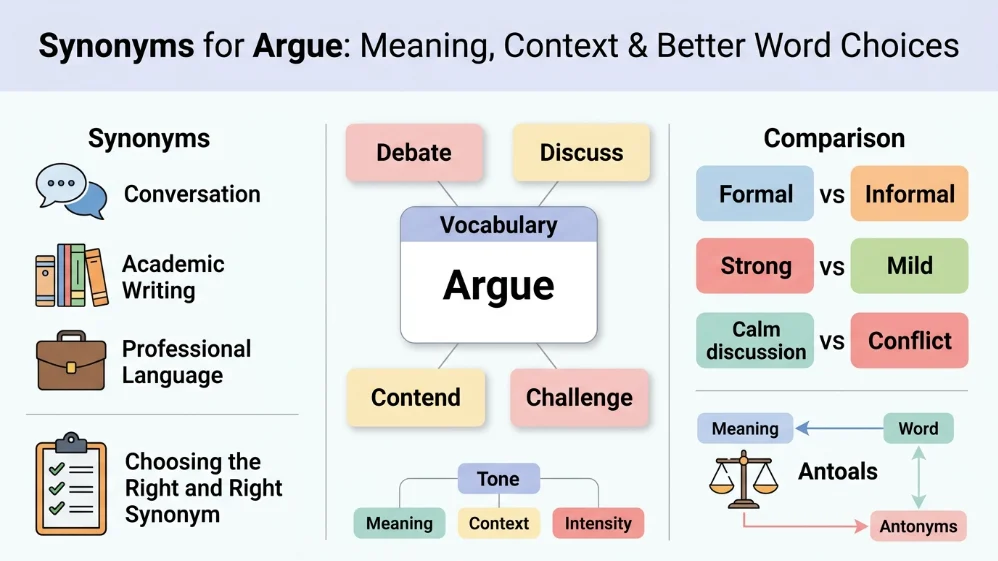
A strong argument can lose its impact when the same word appears again and again. Whether you are writing an essay, email, blog post, social media caption, or workplace message, choosing a more precise alternative can make your ideas sound clearer and more natural. That is why readers often search for an argue synonym, another word for argue, or a useful synonym for argue that better matches the situation.
Understanding argue synonyms is not simply about replacing one word with another. The right choice depends on tone, purpose, and intensity. You might debate an issue, disagree with an opinion, dispute a claim, or contend that something is true. This guide explores arguing synonym choices, argues synonym and argued synonym forms, along with practical examples of synonyms for argue, synonyms of argue, and other words for argue, so you can choose confidently.
Best Synonyms for Argue
The best synonyms for argue are dispute, debate, quarrel, contend, disagree, and reason. The right choice depends on the tone, context, and intensity. For emotional conflicts, quarrel or wrangle often fits best. In formal discussions, debate or contend may be more accurate. For legal contexts, dispute or reason are stronger choices.
What Does Argue Mean?
Argue means expressing opposing views or attempting to persuade someone through reasoning.
It usually involves presenting reasons for or against something. Arguing can be emotional, logical, aggressive, or constructive.
Part of Speech: Verb
Common Uses:
As a verb expressing disagreement:
The couple argued about money all the time.
They argued for hours without reaching a conclusion.
As a verb expressing reasoning:
The lawyer argued that the evidence was insufficient.
She argued in favor of the new policy.
In everyday English, the word frequently appears in personal, professional, academic, and legal contexts. It is often used when discussing disagreements, debates, negotiations, or legal reasoning.
Core Meaning of Argue
At its heart, argue represents expressing opposing views or attempting to persuade someone through reasoning.
Sometimes the argument is heated and emotional, like a quarrel between friends. In other situations, it may be calm and logical, such as a debate between scholars. It can be constructive, like negotiating a solution, or destructive, like a bitter conflict.
The word usually carries a neutral to slightly negative meaning because it suggests disagreement. However, depending on the context, it can describe healthy debate or persuasive reasoning. That is why selecting the correct synonym matters. Some alternatives emphasize emotional conflict, while others highlight logical reasoning or formal debate.
Grammar and Usage Notes
Part of Speech: Verb
Common Sentence Patterns:
- argue with someone
- argue about something
- argue for something
- argue against something
- argue that (clause)
Common Collocations:
- argue passionately
- argue vehemently
- argue convincingly
- argue strongly
- argue endlessly
- argue bitterly
- argue logically
- argue constantly
When “Argue” Sounds Natural:
Use argue when describing disagreement or reasoning. Examples include:
- Personal conflicts
- Professional debates
- Academic discussions
- Legal reasoning
- Political discourse
- Family disagreements
- Philosophical debates
When Another Word Works Better:
Sometimes a synonym sounds more precise.
- Debate works best for formal, structured discussions.
- Quarrel fits emotional, personal conflicts.
- Dispute works for legal or professional disagreements.
- Contend is ideal for reasoned, persuasive arguments.
- Reason emphasizes logical thinking over conflict.
Matching the synonym to the situation makes your writing clearer and more natural.
Best Synonyms for Argue
| Synonym | Meaning | Tone | Best Use Case | Example Sentence |
|---|---|---|---|---|
| Debate | A formal discussion on a topic | Neutral to formal | Academic, political, professional | The candidates debated the issues thoroughly. |
| Dispute | A disagreement or argument | Neutral to formal | Legal, professional, personal | They disputed the terms of the contract. |
| Quarrel | A heated argument or conflict | Emotional | Personal conflicts, relationships | The couple quarreled over money. |
| Contend | Assert or argue a point | Formal | Legal, academic, professional | The lawyer contended that the evidence was insufficient. |
| Disagree | Have a different opinion | Neutral | Everyday situations, conversations | I disagree with your assessment. |
| Reason | Think, argue, or persuade logically | Formal | Philosophy, law, logic | She reasoned that the plan was flawed. |
| Wrangle | A noisy or heated argument | Emotional | Personal conflicts, debates | They wrangled over the details for hours. |
| Clash | A conflict or disagreement | Strong | Politics, personalities, ideas | Their views clashed on every issue. |
| Squabble | A minor, petty argument | Casual | Children, minor disagreements | The siblings squabbled over the remote control. |
| Bicker | Argue about trivial matters | Casual | Annoying, repeated arguments | They bickered constantly about household chores. |
Common Synonyms for Argue
These are the alternatives most people use in everyday English. While they all relate to disagreement, each has a slightly different meaning.
Disagree
Meaning: Have a different opinion from someone.
Best Context: Everyday conversations, polite disagreement.
Example:
I disagree with your conclusion.
Debate
Meaning: Discuss a topic formally with opposing views.
Best Context: Academic, political, professional settings.
Example:
The students debated the issue in class.
Dispute
Meaning: Argue about a claim, fact, or right.
Best Context: Legal, professional, formal contexts.
Example:
The two parties disputed the ownership of the property.
Quarrel
Meaning: Have a heated argument, often personal.
Best Context: Personal relationships, conflicts.
Example:
They quarreled about the children’s education.
Contend
Meaning: Assert something as true in an argument.
Best Context: Formal writing, academic, legal.
Example:
The researcher contended that the data supported her hypothesis.
Reason
Meaning: Use logical thinking to argue or persuade.
Best Context: Philosophy, logic, formal discussions.
Example:
He reasoned that the project was too costly to continue.
Formal Synonyms for Argue
Formal alternatives are useful in academic papers, business communication, legal documents, reports, speeches, and professional writing. These words often sound more precise than argue and fit serious contexts.
Contend
Best for: Legal, academic, and professional contexts
Contend means to assert something as true in an argument or debate. It suggests a reasoned, formal position.
Example:
The defense contended that the evidence was insufficient.
The researcher contended that the findings were significant.
Debate
Best for: Academic, political, professional contexts
Debate means to discuss a topic formally with opposing views. It suggests a structured, often public exchange of arguments.
Example:
The scholars debated the theory for hours.
The issue was debated in Parliament.
Dispute
Best for: Legal, professional, and contractual contexts
Dispute means to argue about a claim, fact, or right. It is often used in legal and professional settings.
Example:
The company disputed the employee’s claim for overtime pay.
They disputed the terms of the contract.
Reason
Best for: Philosophy, logic, formal writing
Reason means to think, argue, or persuade logically. It emphasizes rational thinking.
Example:
She reasoned that the policy would harm the economy.
The philosopher reasoned that happiness was the ultimate goal.
Assert
Best for: Formal arguments, legal contexts
Assert means to state something confidently and forcefully as true.
Example:
The lawyer asserted that his client was innocent.
The CEO asserted that the company was financially sound.
Argue (formal use)
Best for: Legal, academic writing
In formal contexts, argue is perfectly acceptable and widely used.
Example:
The professor argued that the theory was outdated.
Informal Synonyms for Argue
Casual writing and everyday conversation often call for simpler words. These alternatives sound natural without being overly formal.
Disagree
Tone: Neutral and polite
Disagree is the most common everyday replacement for argue.
Example:
I disagree with what you’re saying.
Quarrel
Tone: Strong but common
Quarrel is widely used in personal contexts.
Example:
They always quarrel about silly things.
Bicker
Tone: Casual and slightly negative
Bicker suggests annoying, repeated arguments over trivial matters.
Example:
Stop bickering over the remote control!
Squabble
Tone: Casual and mild
Squabble suggests a minor, petty argument.
Example:
The children squabbled over who got the bigger piece.
Wrangle
Tone: Strong and casual
Wrangle suggests a noisy, prolonged argument.
Example:
They wrangled over the bill for hours.
Clash
Tone: Strong and dramatic
Clash suggests a conflict of ideas or personalities.
Example:
Their opinions clashed on every topic.
Fall out
Tone: Casual and personal
Fall out means to argue and stop being friendly.
Example:
They fell out over a misunderstanding.
Strong Synonyms for Argue
Some alternatives express greater intensity, emotion, or conflict. These words should be used carefully because they create a stronger impact.
Quarrel
Best Use: Heated personal arguments, conflicts
Quarrel suggests a bitter, emotional argument.
Example:
They quarreled bitterly over the inheritance.
Wrangle
Best Use: Prolonged, noisy arguments
Wrangle suggests a lengthy, often angry dispute.
Example:
They wrangled for hours without resolving anything.
Clash
Best Use: Conflicts of ideas, personalities
Clash suggests a sharp, often dramatic disagreement.
Example:
Their strong personalities clashed immediately.
Feud
Best Use: Long-term, bitter conflicts
Feud suggests a prolonged, often family or group conflict.
Example:
The two families feuded for generations.
Spar
Best Use: Light but competitive arguing
Spar suggests playful or competitive arguing.
Example:
The debaters sparred over the issue.
Battle
Best Use: Intense arguments, legal cases
Battle suggests a determined, often aggressive argument.
Example:
They battled in court for years.
Confront
Best Use: Direct, often hostile arguments
Confront suggests facing someone directly in conflict.
Example:
She confronted him about his behavior.
When Strong Synonyms May Be Too Much:
Words like feud, battle, and confront can make ordinary disagreements sound overly dramatic.
Example:
❌ They feuded over which movie to watch.
✔ They argued over which movie to watch.
Choose stronger alternatives only when the situation truly involves significant conflict or intensity.
Mild Synonyms for Argue
Sometimes softer wording makes your writing sound more balanced. Mild alternatives reduce intensity while keeping the original meaning clear.
Disagree
Tone: Neutral and polite
Disagree suggests a difference of opinion without conflict.
Example:
I respectfully disagree with your point.
Discuss
Tone: Constructive and positive
Discuss suggests a calm exchange of ideas.
Example:
We discussed the issue without getting angry.
Reason
Tone: Logical and calm
Reason suggests thoughtful, logical persuasion.
Example:
He reasoned with her calmly.
Explain
Tone: Helpful and neutral
Explain suggests clarifying rather than arguing.
Example:
She explained her perspective clearly.
Clarify
Tone: Helpful and neutral
Clarify suggests making things clear.
Example:
I’d like to clarify my position on this issue.
Question
Tone: Curious and neutral
Question suggests inquiry rather than conflict.
Example:
I question the logic behind that decision.
Challenge
Tone: Constructive to competitive
Challenge suggests questioning rather than fighting.
Example:
I challenge that assumption.
Why Mild Synonyms Matter:
Not every disagreement needs to be a conflict. If the situation is a calm difference of opinion, a softer synonym often sounds more natural.
Compare these examples:
❌ They quarreled about the best route.
✔ They debated the best route.
Synonyms for Argue by Context
Different situations call for different word choices. The best synonym depends on what kind of argument you are describing.
Everyday Conversation
For casual speech, choose words that sound simple and familiar.
Recommended synonyms:
- Disagree
- Quarrel
- Bicker
- Squabble
Example:
We disagreed about where to go for dinner.
Professional Writing
Business communication benefits from precise and neutral language.
Recommended synonyms:
- Dispute
- Contend
- Debate
- Reason
Example:
The union disputed the company’s interpretation of the contract.
Academic Writing
Academic writing values clarity and precision.
Recommended synonyms:
- Contend
- Debate
- Assert
- Reason
Example:
The historian contended that the events were misinterpreted.
Legal Writing
Legal writing requires precise and formal language.
Recommended synonyms:
- Dispute
- Contend
- Assert
- Argue
Example:
The defense contended that the evidence was inadmissible.
Political Context
Political writing often benefits from strong vocabulary.
Recommended synonyms:
- Debate
- Clash
- Contend
- Dispute
Example:
The candidates clashed on healthcare policy.
Personal Relationships
Personal contexts often require emotional vocabulary.
Recommended synonyms:
- Quarrel
- Disagree
- Bicker
- Squabble
Example:
They quarreled about how to raise their children.
Academic Debate
Academic debate requires formal, thoughtful language.
Recommended synonyms:
- Debate
- Contend
- Reason
- Argue
Example:
The scholars debated the philosophical implications of the theory.
Another Word for Argue in a Sentence
These examples show how different synonyms fit naturally into real writing.
- The scholars debated the theory for hours.
- They disputed the terms of the contract.
- The couple quarreled about money constantly.
- The lawyer contended that the evidence was insufficient.
- I disagree with your assessment of the situation.
- She reasoned that the policy would be ineffective.
- They wrangled over the details for days.
- The politicians clashed on healthcare reform.
- The siblings squabbled over the remote control.
- They bickered constantly about household chores.
- The defense asserted that his client was innocent.
- We need to discuss this issue calmly.
- She challenged his assumptions about the economy.
- The two parties fell out over a misunderstanding.
- The sparring between the debaters was entertaining.
Argue Synonyms Compared
| Synonym | Meaning | Tone | Intensity | Best Use |
|---|---|---|---|---|
| Debate | Formal discussion | Neutral | Medium | Academic, political |
| Dispute | Disagreement over rights | Formal | Medium | Legal, professional |
| Quarrel | Heated argument | Emotional | High | Personal conflicts |
| Contend | Assert a point | Formal | Medium | Legal, academic |
| Disagree | Different opinion | Neutral | Low | Everyday situations |
| Reason | Logical persuasion | Formal | Low | Philosophy, logic |
| Wrangle | Noisy argument | Emotional | High | Prolonged conflicts |
| Clash | Conflict of ideas | Strong | High | Politics, personalities |
| Squabble | Petty argument | Casual | Low | Minor disagreements |
| Bicker | Trivial repeated argument | Casual | Low | Annoying conflicts |
Words Similar to Argue
Some words belong to the same semantic field as argue, but they are not exact synonyms. They share related ideas such as disagreement, discussion, or conflict, yet they cannot replace argue in every sentence.
| Related Word | Why It’s Related | Why It’s Not an Exact Synonym |
|---|---|---|
| Debate | Formal discussion | More structured than argue |
| Dispute | Disagreement over rights | Often legal or formal |
| Quarrel | Emotional conflict | More personal and heated |
| Contend | Assert a point | More formal than argue |
| Disagree | Different opinion | Not always an argument |
| Reason | Logical thinking | Emphasizes logic over conflict |
| Wrangle | Noisy argument | Often prolonged |
| Clash | Conflict of ideas | More dramatic than argue |
| Discuss | Talk about something | Usually less conflictual |
| Challenge | Question something | Often positive or constructive |
These words enrich your vocabulary, but always check whether they preserve the original meaning of your sentence before replacing argue.
Antonyms of Argue
Antonyms describe ideas that oppose arguing or disagreeing.
| Antonym | Meaning | Example Sentence |
|---|---|---|
| Agree | Have the same opinion | We all agreed on the plan. |
| Concur | Be of the same opinion | I concur with your analysis. |
| Accept | Receive or agree to | She accepted the proposal. |
| Comply | Act in accordance with | He complied with the request. |
| Consent | Give permission or agreement | They consented to the terms. |
| Harmonize | Be in agreement | Their views harmonized perfectly. |
| Reconcile | Restore friendly relations | They reconciled after the argument. |
Understanding antonyms can also improve your writing because they help you choose words that clearly express the opposite idea when needed.
How to Choose the Right Synonym for Argue
Not every synonym fits every situation. The best choice depends on what you’re trying to communicate.
Match the Context
Think about where the sentence will appear.
- Academic writing often works better with debate, contend, or reason.
- Everyday conversation usually sounds more natural with disagree or quarrel.
- Legal writing often benefits from dispute or contend.
- Personal writing often requires quarrel or bicker.
Match the Tone
Choose a word that matches the emotional style of your writing.
For example:
- Debate sounds formal and structured.
- Quarrel sounds emotional and personal.
- Disagree sounds neutral and polite.
- Contend sounds reasoned and formal.
- Bicker sounds petty and annoying.
Check the Intensity
Ask yourself how significant or intense the disagreement really is.
- A simple difference of opinion needs milder words like disagree or discuss.
- A formal discussion needs words like debate or contend.
- A heated personal conflict needs words like quarrel or wrangle.
Think About the Reader
- Academic readers expect precise vocabulary like contend or debate.
- Legal readers expect formal vocabulary like dispute or assert.
- General readers often respond better to simple, familiar vocabulary.
Make Sure the Meaning Matches
Some related words describe specific types of argument, not general ones.
For example:
- “The scholars debated the theory.” ✔
- “The scholars quarreled about the theory.” ✘
Although both words suggest disagreement, they express different ideas.
Keep the Sentence Natural
Always read the sentence aloud.
If the replacement sounds forced or overly dramatic, choose a simpler synonym.
Common Mistakes When Using Synonyms for Argue
Even experienced writers sometimes choose the wrong alternative. Avoid these common errors.
Using a Word That Is Too Emotional
Not every disagreement is a quarrel.
❌ We quarreled about which restaurant to choose.
✔ We debated which restaurant to choose.
Using Formal Language in Casual Writing
Formal words can make simple sentences sound unnatural.
❌ I contend that the pizza is better than the pasta.
✔ I think the pizza is better than the pasta.
Using Casual Language in Formal Writing
Academic documents usually require more precise vocabulary.
❌ The researchers bickered about the methodology.
✔ The researchers debated the methodology.
Treating Related Words as Exact Synonyms
Words such as discuss, challenge, and reason are related to argue but cannot replace it in every sentence.
Always consider the exact meaning before making a substitution.
Ignoring Context
A synonym that works in one sentence may sound awkward in another.
Compare these examples:
✔ The lawyers disputed the claim.
✔ The children squabbled over the toy.
Although both involve argument, the meanings are different.
Forgetting the Purpose of Arguing
Arguing can be constructive or destructive. Replacing it with a word that suggests only conflict may remove the possibility of reasoning.
Quick Synonym List for Argue
Common Synonyms
- Disagree
- Quarrel
- Debate
- Dispute
- Bicker
Formal Synonyms
- Contend
- Debate
- Dispute
- Assert
- Reason
Informal Synonyms
- Bicker
- Squabble
- Quarrel
- Wrangle
- Fall out
Strong Synonyms
- Quarrel
- Wrangle
- Clash
- Feud
- Confront
Mild Synonyms
- Disagree
- Discuss
- Reason
- Explain
- Clarify
Related Words
- Debate
- Dispute
- Quarrel
- Contend
- Disagree
- Reason
- Wrangle
- Clash
FAQs
What is a good synonym for argue?
A good synonym for argue depends on the context. Common choices include debate, dispute, disagree, contend, maintain, and quarrel. For formal writing, debate or contend may be more suitable, while quarrel often suggests a personal conflict.
What is another word for argue?
Another word for argue can be debate, dispute, contend, disagree, discuss, or quarrel. The best choice depends on whether you mean presenting opposing ideas, expressing disagreement, or having an angry verbal conflict.
What are the most common argue synonyms?
Common argue synonyms include debate, dispute, disagree, contend, reason, maintain, quarrel, and wrangle. These words are related but can differ in tone, formality, and the type of disagreement they describe.
What is a synonym for argue in formal writing?
For formal writing, useful alternatives to argue include contend, assert, maintain, debate, and reason. For example, “The researchers argue that the results are significant” can become “The researchers contend that the results are significant.”
What is a good arguing synonym?
A suitable arguing synonym depends on the situation. Debating works for a reasoned exchange of ideas, disputing suggests disagreement, and quarreling usually describes a more emotional or personal argument.
What is a synonym for argues?
A synonym for argues may be contends, maintains, asserts, debates, or disputes. The correct alternative depends on whether the subject is presenting an opinion, defending a position, or disagreeing with another person.
What is a synonym for argued?
A synonym for argued can be contended, maintained, asserted, debated, or disputed. In academic or professional writing, contended and maintained can be useful when describing a position someone presented in the past.
What are other words for argue?
Other words for argue include debate, dispute, disagree, contend, assert, reason, quarrel, and wrangle. Some are neutral or formal, while others suggest a heated or personal disagreement.
What is the best synonym for argue?
The best synonym depends on context. Debate, dispute, contend, disagree, and quarrel are among the most accurate choices for different situations.
What is another word for argue in a formal document?
Contend, debate, dispute, assert, and reason are excellent formal alternatives commonly used in academic, legal, and professional writing.
What is an informal synonym for argue?
Bicker, squabble, quarrel, wrangle, and fall out are all casual alternatives.
What is a stronger word for argue?
Quarrel, wrangle, clash, feud, and confront express greater intensity and should be reserved for serious situations.
What is a milder word for argue?
Disagree, discuss, reason, explain, and clarify provide softer alternatives that work well when the disagreement is gentle.
What words are similar to argue but not exact synonyms?
Related words include debate, dispute, quarrel, contend, disagree, reason, wrangle, and clash. These words are connected in meaning but are not always direct replacements.
What is the opposite of argue?
Common antonyms include agree, concur, accept, comply, consent, harmonize, and reconcile.
Conclusion
Learning the best synonyms for argue helps you write with greater clarity and precision. While words like debate, dispute, quarrel, contend, and disagree all relate to argue, each carries its own tone, level of formality, and emotional weight.
Before replacing argue, think about your audience, the context, and the intensity of the situation. A carefully chosen synonym can make your writing sound more natural, persuasive, and accurate. Whether you’re writing an essay, a business report, a legal brief, or everyday messages, selecting the right word will help your ideas connect more effectively with readers.
Read More Related Articles:
- Synonyms for Empty | Meaning, Examples, and Better Word …
- Synonyms for Regret | Meaning, Examples, and Better Word …