A word can be perfectly correct and still feel repetitive. Someone writing an email, essay, resume, blog post, caption, or school assignment may use synonym of benefit searches because they keep repeating the word “benefit” and want a more precise alternative.
The right replacement depends on what you mean. Advantage works well when describing a useful feature, gain emphasizes something received, perk sounds natural in casual or workplace language, while advantage or value can be stronger choices in professional writing. Choosing carefully makes your writing clearer, more natural, and better matched to your audience.
This guide explains the meaning of benefit, its strongest synonyms, differences in tone and intensity, common phrases, confusing alternatives, real examples, and practical ways to select the right word.
What Are the Best Synonyms of “Benefit”?
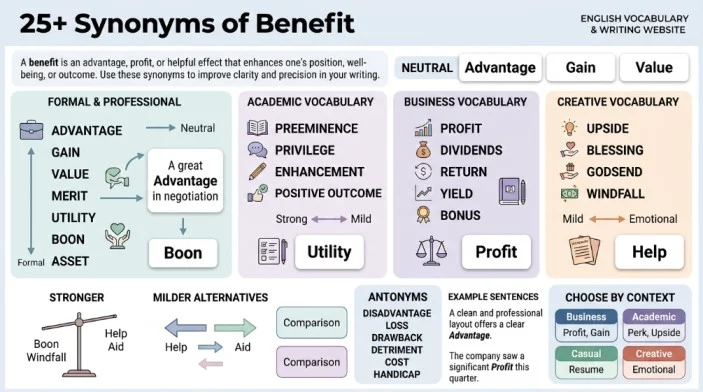
The best synonyms of benefit include advantage, gain, profit, value, usefulness, merit, boon, perk, upside, asset, aid, help, and advantage. For formal writing, use advantage, merit, or value. For casual contexts, perk and upside sound natural. Professional writing, value, advantage, and gain are especially useful.
The word benefit is generally positive and can refer to an advantage, useful result, improvement, or help received from something. It can function as both a noun and a verb, so the most accurate synonym depends on its grammatical role and meaning.
| Context | Strong Choices |
|---|---|
| Formal writing | Advantage, merit, value |
| Academic writing | Advantage, value, utility |
| Professional communication | Advantage, value, gain |
| Business writing | Profit, value, return |
| Casual conversation | Perk, upside, plus |
| Emotional writing | Blessing, boon, help |
| Creative writing | Boon, blessing, gain |
| Resume writing | Value, contribution, advantage |
| Strong emphasis | Gain, advantage, profit |
| Mild tone | Help, usefulness, plus |
Meaning, Tone, and Context
Simple Definition
Benefit means something that helps, improves, or provides an advantage to a person, organization, situation, or activity.
For example, regular exercise can provide health benefits. A flexible schedule can be a benefit of a job. In another grammatical use, a company can benefit from better customer service.
Part of Speech
Benefit is commonly used as:
- Noun: something useful, helpful, or advantageous.
- Verb: to receive an advantage or to help someone or something.
Examples:
- “One benefit of remote work is greater flexibility.”
- “Employees benefit from flexible scheduling.”
Overall Tone
Benefit is usually positive and neutral. It does not normally add strong emotion by itself.
The word can sound professional without being overly formal, which makes it useful in business communication, education, everyday speech, and general writing.
Formality Level
Benefit is a neutral to semi formal word.
It works naturally in:
- academic essays
- business reports
- resumes
- workplace communication
- emails
- everyday conversation
- marketing copy
- educational material
Because it is so versatile, benefit is often a safe choice. However, a more specific synonym can make a sentence more precise.
Common Uses
Native English speakers commonly use benefit when discussing:
- advantages of a product or service
- positive results
- health improvements
- employee benefits
- financial gains
- educational value
- business outcomes
- public programs
- personal development
- practical usefulness
Word Forms
| Form | Example |
|---|---|
| Noun: benefit | “The training offers several benefits.” |
| Verb: benefit | “Students benefit from additional practice.” |
| Plural noun: benefits | “The benefits are easy to measure.” |
| Past participle: benefited | “The organization benefited from the change.” |
| Present participle: benefiting | “Customers are benefiting from the new system.” |
When and How to Use “Benefit”
Choose benefit when you want to describe a positive result, useful feature, improvement, or advantage without adding unnecessary emotional intensity.
It is particularly useful when the positive effect is practical, measurable, or easy to explain.
Professional
“The new software provides several benefits for our customer service team.”
Here, benefit sounds professional and neutral. It avoids making an exaggerated claim.
Academic
“One major benefit of collaborative learning is increased student participation.”
In academic writing, benefit clearly identifies a positive effect without sounding overly conversational.
Workplace
“Employees can benefit from the company’s new training program.”
Here, benefit functions as a verb and means receiving an advantage or useful result.
Personal
“Getting enough sleep has several benefits for your daily routine.”
The word fits naturally because the sentence discusses practical improvements.
“One benefit of moving the meeting to Friday is that everyone will have more preparation time.”
Benefit keeps the email clear and professional.
Resume
“Delivered process improvements that benefited the customer support team.”
For resumes, benefited can work, although stronger verbs such as improved, strengthened, enhanced, or increased may communicate the achievement more precisely.
Social Media
“One of the biggest benefits of reading every day is discovering new ideas.”
The word remains natural in an educational or informative caption.
Best Synonyms of “Benefit”
No synonym of benefit works perfectly in every sentence. The best replacement depends on whether you mean an advantage, financial return, useful result, assistance, privilege, or positive outcome.
Best for Professional Writing: Advantage
Advantage is one of the strongest general replacements for benefit in professional writing. It clearly describes something that puts a person, product, service, or organization in a favorable position.
Example:
“Flexible scheduling gives the company a competitive advantage.”
Best for Academic Writing: Utility
Utility is useful when academic writing focuses on practical usefulness or function. It is more specialized than benefit, so it should not replace benefit in every academic sentence.
Example:
“The study examines the utility of digital tools in classroom instruction.”
Best for Business Communication: Value
Value works especially well when discussing the usefulness or worth that something provides to customers, employees, or an organization.
Example:
“The redesigned service offers greater value to customers.”
Best for Casual Conversation: Perk
Perk is an informal word for an extra benefit or attractive advantage. It is especially common when talking about jobs, memberships, services, or everyday conveniences.
Example:
“Free parking is a nice perk of working here.”
Best for Emotional Writing: Blessing
Blessing adds emotional warmth and suggests that something is deeply helpful, fortunate, or welcome.
Example:
“Her support was a blessing during a difficult year.”
Best for Creative Writing: Boon
Boon has a literary or polished quality and describes something that brings significant help or advantage.
Example:
“The unexpected rain was a boon to the struggling farmers.”
Best for Resume Writing: Value
Value is useful on a resume because it emphasizes the contribution or usefulness a person brings to an organization.
Example:
“Added measurable value by streamlining the reporting process.”
Best for Workplace Communication: Advantage
Advantage works well when discussing a positive feature or favorable condition in a workplace setting.
Example:
“An advantage of the new schedule is improved team coverage.”
Stronger Meaning: Gain
Gain emphasizes something acquired as a result of an action, decision, or change.
Example:
“The company achieved significant gains in customer retention.”
Softer Meaning: Help
Help is less formal and less analytical than benefit. It works when the focus is simply on making something easier or better.
Example:
“Extra practice can help students build confidence.”
When Not to Use “Benefit”
Benefit is versatile, but it can sometimes be too broad. A more precise word can tell the reader exactly what kind of positive result you mean.
When Benefit Is Too General
Less precise:
“The new policy has many benefits.”
Better:
“The new policy improves scheduling flexibility and reduces administrative costs.”
The second version explains the actual advantages instead of making a general statement.
When Benefit Is Too Vague
Less precise:
“The program benefited the company.”
Better:
“The program reduced operating costs and improved customer response times.”
If the result can be identified, name it.
When Benefit Is Too Formal
In a very casual conversation, benefit may sound slightly polished.
Less natural:
“What is the benefit of getting coffee before work?”
More conversational:
“What’s the upside of getting coffee before work?”
Benefit is not wrong, but upside may sound more relaxed.
When Benefit Is Too Weak
When describing a measurable improvement, benefit may fail to communicate the strength of the result.
Weaker:
“The campaign provided a benefit to sales.”
Stronger:
“The campaign produced a significant increase in sales.”
When Benefit Is Too Strong
Sometimes benefit suggests a positive result when the evidence only shows usefulness.
Potentially overstated:
“The new feature is a major benefit for every customer.”
More careful:
“The new feature may be useful for customers who need faster checkout.”
Precision matters, especially in professional or evidence based writing.
When a More Specific Financial Word Is Better
If you mean money earned, profit, return, revenue, or gain may be more precise.
General:
“The investment provided a benefit.”
Specific:
“The investment generated a strong return.”
Words Commonly Confused With “Benefit”
Benefit vs Advantage
Difference: Benefit usually refers to a positive result or useful feature. Advantage often describes a condition that puts someone or something in a better position.
When to Use It: Use benefit for positive outcomes and advantage for favorable positions or features.
Example:
“The benefit of exercise is better overall health.”
“Speed is an advantage in competitive sports.”
Benefit vs Gain
Difference: Gain emphasizes something acquired, achieved, or increased. Benefit focuses more broadly on usefulness or positive effect.
When to Use It: Use gain for measurable progress, growth, or acquisition.
Example:
“The training provides several benefits.”
“The company reported gains in productivity.”
Benefit vs Profit
Difference: Profit specifically relates to financial gain after costs are considered. Benefit can be financial, practical, personal, social, or emotional.
When to Use It: Use profit when discussing money earned from an activity.
Example:
“The program benefits small businesses.”
“The company made a profit this quarter.”
Benefit vs Perk
Difference: Perk means an extra advantage, especially one that is attractive or convenient. Benefit is broader and more neutral.
When to Use It: Use perk for informal discussions of employee extras, memberships, or conveniences.
Example:
“Health insurance is an important benefit.”
“Free meals are a popular perk.”
Benefit vs Value
Difference: Value focuses on usefulness, worth, or what something contributes relative to its cost or purpose.
When to Use It: Use value when discussing customer experience, business decisions, or practical worth.
Example:
“The course offers several benefits.”
“The course provides excellent value for professionals.”
Benefit vs Help
Difference: Help means assistance or support. Benefit usually means an advantageous result or positive effect.
When to Use It: Use help when emphasizing assistance rather than an outcome.
Example:
“The new policy benefits employees.”
“The manager helped employees understand the policy.”
Best Synonyms of “Benefit” by Context
| Context | Best Synonym | Why It Works | Example |
|---|---|---|---|
| Formal writing | Advantage | Clear and polished | “The main advantage is greater efficiency.” |
| Academic writing | Utility | Emphasizes practical usefulness | “The utility of the method is well established.” |
| Professional communication | Value | Highlights contribution | “The service delivers greater value.” |
| Business emails | Advantage | Clear and efficient | “The main advantage is faster processing.” |
| Resume writing | Value | Shows contribution | “Created measurable value through process improvements.” |
| Workplace communication | Perk | Natural for employee extras | “Flexible hours are a valuable perk.” |
| Casual conversation | Upside | Relaxed and natural | “The upside is that we save time.” |
| Everyday speaking | Plus | Simple and conversational | “A big plus is the shorter commute.” |
| Creative writing | Boon | Expressive and polished | “The rainfall was a boon for the fields.” |
| Storytelling | Blessing | Adds emotional warmth | “Her friendship became a blessing.” |
| Emotional writing | Blessing | Expresses gratitude | “Their support was a blessing.” |
| Strong emphasis | Gain | Suggests meaningful acquisition | “The company made substantial gains.” |
| Mild tone | Help | Soft and practical | “The guide can help new users.” |
| Social media captions | Perk | Friendly and concise | “A free upgrade is a nice perk.” |
| American English | Benefit | Very broadly useful | “The benefit is easy to understand.” |
| British English | Advantage | Common neutral alternative | “The main advantage is convenience.” |
How to Choose the Best Synonym of “Benefit”
Start by identifying exactly what the sentence means.
1. Ask What Kind of Positive Result You Mean
- If you mean a favorable feature, choose advantage.
- If you mean something gained, choose gain.
- If you mean financial earnings, choose profit or return.
- If you mean practical usefulness, choose utility or value.
- If you mean assistance, choose help or aid.
2. Consider Your Audience
A business report may favor value, advantage, return, or gain.
A casual conversation may sound more natural with perk, upside, plus, or help.
3. Check the Emotional Strength
Benefit is normally neutral and positive.
For stronger emotional language, consider blessing or boon.
For a restrained tone, help or usefulness may be better.
4. Match the Writing Purpose
A resume should emphasize contribution and results.
An academic paper should emphasize evidence, usefulness, and outcomes.
A social media caption can use more conversational words.
A creative story can use expressive words such as blessing or boon.
5. Choose Natural Language
The most impressive synonym is not always the best one. A simple word that accurately communicates the intended meaning is usually stronger than an unusual word inserted merely to sound sophisticated.
Real Life Examples of “Benefit”
School
“Students can benefit from reviewing their notes before an exam.”
A stronger noun based version would be:
“Regular review gives students the advantage of better preparation.”
College
“The main benefit of joining a study group is having access to different perspectives.”
A more academic version is:
“The primary advantage of collaborative study is exposure to multiple perspectives.”
Workplace
“One benefit of flexible scheduling is improved work life balance.”
A more specific version is:
“One advantage of flexible scheduling is greater control over daily routines.”
Business
“The company expects to benefit from the new customer retention strategy.”
For stronger business language:
“The company expects to gain from the new customer retention strategy.”
“One benefit of completing the form today is that we can process your request sooner.”
A more direct version:
“Completing the form today will help us process your request sooner.”
Resume
“Managed a reporting project that benefited the finance department.”
A more achievement focused version:
“Streamlined reporting for the finance department, reducing manual work.”
Conversation
“One benefit of living near the office is the short commute.”
More casually:
“One big perk of living near the office is the short commute.”
Storytelling
“The unexpected meeting turned out to be a benefit.”
A more expressive version:
“The unexpected meeting proved to be a fortunate turning point.”
Blogging
“One benefit of creating a content calendar is better organization.”
A more polished version:
“One advantage of using a content calendar is improved organization.”
Social Media
“One benefit of reading regularly is discovering new perspectives.”
A conversational alternative:
“One great perk of reading regularly is finding fresh ideas.”
25 Best Synonyms of “Benefit”
The following list includes alternatives for the main noun and verb meanings of benefit. Some words are closer matches in particular contexts than others, so always check the intended meaning before replacing the original word.
| Synonym | Simple Meaning | Best Used For | Example Sentence |
|---|---|---|---|
| Advantage | A favorable feature or condition | General and professional writing | “Flexibility is a major advantage of remote work.” |
| Gain | Something acquired or increased | Results and measurable progress | “The company saw gains in productivity.” |
| Profit | Financial gain after costs | Business and finance | “The new strategy increased annual profit.” |
| Value | Usefulness or worth | Business and professional writing | “The service provides strong value to customers.” |
| Merit | A quality that deserves approval | Formal and academic writing | “The proposal has several clear merits.” |
| Boon | Something especially helpful or fortunate | Formal and creative writing | “The new bridge was a boon to local businesses.” |
| Perk | An attractive extra advantage | Casual and workplace language | “Free meals are a popular employee perk.” |
| Upside | A positive aspect of something | Casual conversation | “The upside is that we can finish early.” |
| Asset | Something useful or valuable | Business and professional settings | “Her communication skills are a valuable asset.” |
| Usefulness | The quality of being useful | Academic and explanatory writing | “The usefulness of the tool depends on the task.” |
| Utility | Practical usefulness or function | Academic and technical contexts | “The study evaluates the utility of the software.” |
| Help | Assistance or support | Everyday communication | “The extra practice was a big help.” |
| Aid | Assistance provided to someone | Formal and professional writing | “Financial aid helped students continue their studies.” |
| Service | Useful assistance or contribution | Business and public contexts | “The program provides a valuable service.” |
| Improvement | A positive change | Performance and development | “The update resulted in a noticeable improvement.” |
| Enhancement | A change that makes something better | Professional and technical writing | “The update provides a useful enhancement.” |
| Return | A gain produced by an investment | Finance and business | “The campaign generated a strong return.” |
| Reward | Something received for an action or effort | Personal and motivational contexts | “The scholarship was a rewarding benefit of her hard work.” |
| Upsurge | A noticeable increase | Data and business contexts | “The company experienced an upsurge in demand.” |
| Contribution | Something that adds value or support | Professional and academic contexts | “Her contribution benefited the entire team.” |
| Blessing | Something that brings great help or happiness | Emotional and literary writing | “Their friendship was a blessing.” |
| Favor | An act or condition that helps someone | Personal and formal contexts | “The decision worked in his favor.” |
| Assistance | Help given to someone | Formal and professional communication | “Customers can request assistance through the support desk.” |
| Boon | A highly useful or favorable development | Literary and formal writing | “The additional funding was a boon for the project.” |
| Plus | A positive feature or point | Casual conversation | “The shorter commute is a major plus.” |
Note: Boon appears twice in the broader list because it is particularly useful across formal and creative contexts, but for a strict nonduplicated vocabulary list, count it only once. The 25 distinct entries above are: advantage, gain, profit, value, merit, boon, perk, upside, asset, usefulness, utility, help, aid, service, improvement, enhancement, return, reward, upsurge, contribution, blessing, favor, assistance, plus, and benefit related positive result terminology.
Synonyms of “Benefit” by Usage
Professional vs Personal Synonyms
Professional writing often favors advantage, value, gain, contribution, merit, utility, and return because these words communicate practical results clearly.
Personal communication can use help, perk, blessing, upside, plus, and favor because these alternatives sound more conversational or emotionally expressive.
Formal vs Conversational Synonyms
- For reports and essays, advantage, merit, utility, value, and gain are useful choices.
- For presentations and professional emails, advantage, value, improvement, and gain usually sound natural.
- For casual conversations and texting, perk, upside, plus, and help are more relaxed.
Academic Synonyms
Academic writing benefits from precise words such as:
- Advantage: a favorable feature or outcome
- Utility: practical usefulness
- Value: worth or contribution
- Merit: a quality that makes something worthwhile
- Gain: measurable improvement or acquisition
These choices can make an academic argument more specific, but only when they accurately represent the evidence.
Professional and Business Synonyms
- For resumes, value, contribution, improvement, gain, and enhancement can help describe results.
- For interviews, advantage, value, and strength can help explain why a skill or approach matters.
- For meetings and presentations, advantage, benefit, value, and return are useful when discussing decisions.
- For performance reviews, contribution, improvement, gain, and value can focus attention on outcomes.
- For client communication, value, advantage, improvement, and service can communicate practical usefulness without sounding exaggerated.
Creative and Literary Synonyms
Creative writing allows more expressive choices.
Boon can suggest an unexpected source of help. Blessing can add warmth, gratitude, or emotional significance. Favor can suggest that circumstances are working positively for someone.
These words should serve the mood of the writing rather than simply replace benefit for variety.
Slang or Modern Synonyms
There is no single slang replacement that works in every situation.
Perk is the closest common informal alternative when benefit means an attractive extra.
Plus is also casual and modern:
“Free delivery is a big plus.”
Avoid these choices in formal academic writing when a neutral term such as advantage or benefit is more appropriate.
Strongest to Mildest Synonyms
The intensity of benefit related words depends heavily on context. There is no universal ranking, but this practical scale shows how they often feel in ordinary writing.
Mild
Help, usefulness, plus
These communicate a relatively simple positive effect.
Moderate
Benefit, advantage, value, perk
These clearly identify something favorable without necessarily suggesting major impact.
Strong
Gain, profit, boon, asset
These can suggest a more substantial, measurable, or meaningful advantage.
Very Strong or Emotionally Expressive
Blessing
Blessing can carry stronger emotional meaning than benefit because it may imply deep gratitude or a fortunate change.
Intensity should never override accuracy. A mild word may be the best choice if the effect itself is minor.
Emotional vs Neutral Synonyms
Emotional Synonyms
These words can carry feelings beyond the basic idea of usefulness:
- Blessing
- Boon
- Favor
- Reward
- Perk
Blessing is particularly emotional because it can express gratitude or relief.
Neutral Synonyms
These communicate information with less emotional coloring:
- Benefit
- Advantage
- Value
- Utility
- Usefulness
- Gain
- Improvement
Use neutral words in academic, technical, professional, and informational writing when emotional emphasis is unnecessary.
Antonyms of “Benefit”
Because benefit can refer to an advantage, positive result, or helpful effect, its opposites describe harm, disadvantage, loss, or negative consequences.
| Antonym | Meaning | Example Sentence |
|---|---|---|
| Disadvantage | An unfavorable condition | “The high cost is a disadvantage.” |
| Drawback | A negative feature or limitation | “Limited storage is a drawback of the device.” |
| Detriment | Something that causes harm or loss | “Lack of sleep can be a detriment to performance.” |
| Harm | Physical, emotional, or practical damage | “The decision caused unnecessary harm.” |
| Damage | Physical or functional injury or loss | “The storm caused serious damage.” |
| Loss | Something valuable that is no longer possessed or gained | “The company reported a financial loss.” |
| Liability | Something that creates a disadvantage or obligation | “The outdated system became a liability.” |
| Burden | Something difficult or costly to carry or manage | “The extra paperwork became a burden.” |
| Cost | Something sacrificed or paid to obtain something | “The delay came at a significant cost.” |
| Penalty | A negative consequence imposed for an action | “Missing the deadline resulted in a penalty.” |
| Downside | The negative aspect of something | “The downside is the longer travel time.” |
| Hindrance | Something that makes progress difficult | “Poor communication became a hindrance.” |
| Obstacle | Something that blocks progress | “Limited funding was an obstacle.” |
| Impediment | Something that prevents or slows progress | “Technical problems were an impediment to growth.” |
| Injury | Physical or figurative harm | “The injury affected his ability to compete.” |
Comparison: “Benefit” vs Similar Words
Benefit vs Advantage
Main Difference: Benefit focuses on a positive result or useful effect. Advantage often focuses on a favorable position or feature.
Which Is Stronger? Neither is inherently stronger.
Which Is More Formal? Both are neutral to semi formal.
When to Use Each: Use benefit for positive outcomes. Use advantage for favorable conditions.
Examples
Benefit: “One benefit of exercise is improved sleep.”
Advantage: “One advantage of cycling is its low cost.”
Benefit vs Gain
Main Difference: Gain emphasizes acquiring or increasing something. Benefit has a broader meaning.
Which Is Stronger? Gain can sound stronger when describing measurable progress.
Which Is More Formal? Both work in professional and academic contexts.
When to Use Each: Choose gain for growth, acquisition, or measurable improvement.
Examples
Benefit: “The program offers several benefits.”
Gain: “The company gained new customers after the redesign.”
Benefit vs Profit
Main Difference: Profit specifically refers to financial gain after expenses. Benefit can describe many kinds of positive effects.
Which Is Stronger? Profit is more specific, not necessarily stronger.
Which Is More Formal? Both are suitable for business writing.
When to Use Each: Use profit when the subject is financial earnings.
Examples
Benefit: “The partnership provides several business benefits.”
Profit: “The partnership increased annual profit.”
Benefit vs Perk
Main Difference: Perk means an extra or attractive advantage and is more informal.
Which Is Stronger? Neither, although perk often sounds more positive and casual.
Which Is More Formal? Benefit is more formal.
When to Use Each: Use perk for employee extras, memberships, or informal conversation.
Examples
Benefit: “Health insurance is an important employee benefit.”
Perk: “Free snacks are a nice office perk.”
Benefit vs Value
Main Difference: Value emphasizes worth or usefulness. Benefit emphasizes a positive effect.
Which Is Stronger? Value can sound more commercially focused.
Which Is More Formal? Both are professional.
When to Use Each: Choose value when discussing customer value, business decisions, or cost effectiveness.
Examples
Benefit: “The service offers several benefits.”
Value: “The service provides excellent value for small businesses.”
Benefit vs Help
Main Difference: Help emphasizes assistance, while benefit usually describes an advantage or positive result.
Which Is Stronger? Benefit generally sounds more outcome focused.
Which Is More Formal? Benefit is more formal than help.
When to Use Each: Use help when you want simple, direct everyday language.
Examples
Benefit: “The change benefited the entire team.”
Help: “The change helped the team finish faster.”
Common Phrases and Expressions with “Benefit”
Benefit From
Meaning: To receive a positive result or advantage.
Example Sentence:
“Employees can benefit from additional training.”
Benefit of
Meaning: The positive result or advantage associated with something.
Example Sentence:
“One major benefit of the course is its flexible schedule.”
Benefit to
Meaning: An advantage provided to a person, group, or organization.
Example Sentence:
“The policy offers a significant benefit to new employees.”
Health Benefits
Meaning: Positive effects related to physical or mental well being.
Example Sentence:
“Walking regularly can provide several health benefits.”
Employee Benefits
Meaning: Additional forms of compensation or support provided by an employer.
Example Sentence:
“The company offers competitive employee benefits.”
Mutual Benefit
Meaning: An advantage received by two or more parties.
Example Sentence:
“The partnership was designed for mutual benefit.”
Financial Benefit
Meaning: A positive monetary result.
Example Sentence:
“The change could provide a financial benefit to the organization.”
Benefit Package
Meaning: A collection of benefits offered to employees.
Example Sentence:
“The new benefit package includes health coverage and paid leave.”
Common Mistakes to Avoid
1. Choosing a Vague Synonym
Incorrect:
“The project created many good things for the company.”
Better:
“The project created measurable gains in efficiency.”
Why: Gains identifies a specific type of positive result.
2. Confusing Benefit With Profit
Incorrect:
“The educational program produced a large profit for students.”
Better:
“The educational program provided significant benefits for students.”
Why: Students can receive advantages, but profit specifically concerns financial earnings.
3. Using an Informal Synonym in Formal Writing
Incorrect:
“Free parking is a cool perk of the program.”
Better:
“Free parking is an additional benefit of the program.”
Why: Perk is natural in conversation but may sound too casual in formal writing.
4. Using an Overly Dramatic Synonym
Incorrect:
“The new scheduling system is a blessing for the accounting department.”
Better:
“The new scheduling system is an advantage for the accounting department.”
Why: Blessing adds emotional intensity that may not suit an ordinary workplace statement.
5. Repeating Benefit Too Often
Incorrect:
“The benefit of the program is clear. Another benefit is lower cost, and a third benefit is greater flexibility.”
Better:
“The program offers several advantages, including lower costs and greater flexibility.”
Why: The revised version is shorter and avoids repetitive wording.
6. Choosing the Wrong Emotional Tone
Incorrect:
“Her support was a useful utility during the crisis.”
Better:
“Her support was a blessing during the crisis.”
Why: Utility is analytical, while blessing communicates emotional importance.
7. Using Slang in Academic Writing
Incorrect:
“One big perk of the intervention was improved attendance.”
Better:
“One significant benefit of the intervention was improved attendance.”
Why: Benefit sounds more appropriate for formal academic analysis.
Frequently Asked Questions
What are the best synonyms of “benefit”?
The best synonyms of benefit include advantage, gain, value, merit, usefulness, perk, upside, boon, and help. The best choice depends on whether you mean usefulness, financial gain, an extra advantage, or assistance.
What are the best formal synonyms of “benefit”?
The strongest formal synonyms of benefit include advantage, merit, value, utility, gain, and assistance. Choose the word that matches the exact meaning rather than replacing benefit simply to sound more sophisticated.
What are common informal synonyms of “benefit”?
Common informal synonyms of benefit include perk, upside, plus, and help. Perk works especially well for workplace extras, while upside and plus are natural choices in everyday American conversation.
What is another word for “benefit” in professional writing?
Advantage, value, gain, contribution, improvement, and return are useful professional alternatives to benefit. Value is especially effective when discussing customer usefulness or business impact.
What is the difference between “benefit” and “advantage”?
Benefit usually describes a positive result or useful effect, while advantage often describes a favorable feature or position. For example, better health is a benefit of exercise, while lower cost is an advantage of one product.
What is the opposite of “benefit”?
The most common opposites of benefit include disadvantage, drawback, detriment, harm, loss, damage, downside, burden, and liability. The best antonym depends on whether the sentence concerns practical, financial, or personal consequences.
Conclusion
Benefit is a flexible word for describing an advantage, useful result, improvement, or positive effect. Its strongest alternatives include advantage for general and professional writing, gain for measurable results, value for business contexts, perk for casual language, and boon or blessing when greater emotional or literary expression is appropriate.
No synonym of benefit works perfectly in every sentence. The best choice depends on your audience, tone, purpose, and the exact type of positive result you want to communicate.
For better vocabulary, do not replace a familiar word simply because another word sounds more advanced. First identify the meaning you need, then choose the clearest word that expresses it naturally. This approach will make your writing more precise and persuasive.
Read More Related Articles:
- 50+ Synonyms of This | Meanings, Uses, Examples, and Best …
- Synonyms for Empty | Meaning, Examples, and Better Word …
- Synonyms for Creativity | Meaning, Examples, and Better …