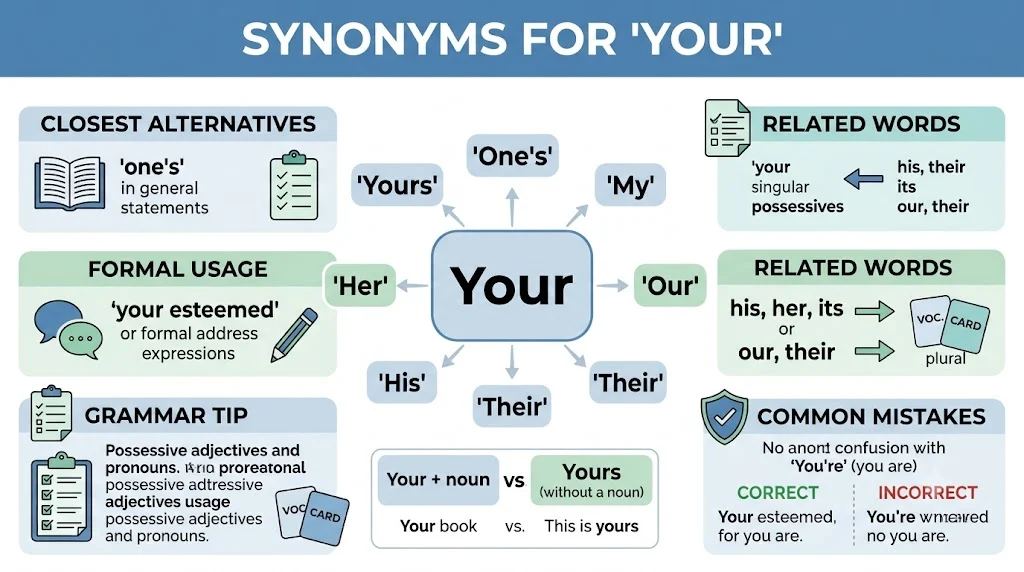
The word “your” looks simple, but choosing a better alternative can make a sentence sound more natural, precise, or professional. In everyday English, “your” shows possession or a connection to the person being addressed. Yet writers often need different expressions when the context is formal, conversational, persuasive, or creative. Understanding the synonyms of your helps you avoid repetitive phrasing while keeping your meaning clear and grammatically correct.
From emails and academic writing to business communication and creative content, the right alternative depends on what you actually mean. Words and phrases such as belonging to you, yours, personal, and owned by you can work in specific contexts, but they are not always interchangeable. This guide explains these alternatives with clear meanings, examples, tone differences, and practical usage so you can choose the most accurate expression with confidence.
Best Alternatives for Your
The best alternatives for your depend on the context and subject of your sentence. The most common replacements are one’s, his, her, its, our, and their. The right choice depends on whether you are writing formally or informally, whether the subject is singular or plural, and whether you need to specify gender. Formal writing, one’s works for general statements. For plural subjects, use their. Masculine singular, use his. For feminine singular, use her.
What Does Your Mean?
Your means belonging to or associated with the person or people being spoken to. It is the possessive form of the pronoun “you.”
Part of Speech: Possessive adjective (also called possessive determiner)
Common Uses:
As a possessive adjective indicating ownership:
Your book is on the table.
Is this your phone?
Indicating association or relationship:
Your kindness is appreciated.
Your support means a lot to us.
Used in general statements (informal):
You should always check your sources.
In everyday English, your is one of the most frequently used words. It appears in conversation, writing, instructions, marketing, advertising, and personal communication. However, in formal writing, your is often avoided to create a more impersonal or professional tone.
Core Meaning of Your
At its heart, your indicates possession, association, or relationship to the person being addressed.
Sometimes it refers to physical possession, like your book or your car. In other situations, it may refer to abstract association, like your opinion or your happiness. It can also refer to parts of a person, like your hand or your mind.
The word is essential for second-person communication. However, in some contexts, writers may want to avoid using your to make their writing more formal, more inclusive, or less direct.
Grammar and Usage Notes
Part of Speech: Possessive adjective
Common Sentence Patterns:
- your + noun: Your idea is excellent.
- your + noun + verb: Your support helps us.
- verb + your + noun: I appreciate your honesty.
Common Collocations:
- your opinion
- your help
- your support
- your time
- your feedback
- your thoughts
- your experience
- your needs
- your goals
- your success
- your health
- your family
- your future
When “Your” Sounds Natural:
Use your when directly addressing someone. Examples include:
- Personal communication
- Customer service interactions
- Marketing and advertising
- Instructions and guides
- Everyday conversation
- Informal business writing
When Another Word Works Better:
Sometimes an alternative sounds more precise, formal, or inclusive.
- One’s works for formal, general statements.
- His or her works for specific gendered subjects.
- Their works for plural or gender-neutral singular subjects.
- Our works for inclusive, first-person plural statements.
Best Alternatives for Your
| Alternative | Meaning | Tone | Best Use Case | Example Sentence |
|---|---|---|---|---|
| One’s | Belonging to a general person | Formal | Academic, philosophical | One’s health is important. |
| His | Belonging to a male | Neutral | Masculine subjects | He shared his opinion. |
| Her | Belonging to a female | Neutral | Feminine subjects | She shared her opinion. |
| Its | Belonging to a thing | Neutral | Objects, animals | The company increased its profits. |
| Our | Belonging to us | Inclusive | Group statements | Our team worked hard. |
| Their | Belonging to them | Neutral | Plural, gender-neutral | Everyone shared their ideas. |
| Thy | Belonging to you (archaic) | Old-fashioned | Historical, poetic | Thy will be done. |
| Yours | Possessive pronoun | Neutral | Replacing “your + noun” | The decision is yours. |
Common Alternatives for Your
These are the most frequently used alternatives in everyday English. While they all relate to possession or association, each has a slightly different meaning and usage.
One’s
Meaning: Belonging to a general or unspecified person.
Best Context: Formal writing, academic papers, philosophical statements.
Example:
One’s reputation is built over time.
It is important to consider one’s options carefully.
His
Meaning: Belonging to a male person or animal.
Best Context: Referring to a specific male subject.
Example:
He shared his opinion with the group.
The manager submitted his report.
Her
Meaning: Belonging to a female person or animal.
Best Context: Referring to a specific female subject.
Example:
She presented her findings to the board.
The doctor shared her expertise.
Its
Meaning: Belonging to a thing, animal, or concept.
Best Context: Referring to objects, animals, or abstract entities.
Example:
The company announced its new strategy.
The tree shed its leaves in autumn.
Our
Meaning: Belonging to or associated with the speaker and others.
Best Context: Inclusive statements, group communication.
Example:
Our team worked hard on this project.
We value our customers.
Their
Meaning: Belonging to them (plural) or a gender-neutral singular person.
Best Context: Plural subjects, modern gender-neutral usage.
Example:
The students submitted their assignments.
Everyone should bring their own lunch.
Formal Alternatives for Your
Formal alternatives are useful in academic papers, business communication, legal documents, reports, speeches, and professional writing. These alternatives help create an impersonal, authoritative tone.
One’s
Best for: Academic, philosophical, and formal statements
One’s means belonging to a general person. It is used to make statements impersonal and formal, avoiding direct address to the reader.
Example:
One’s success depends on one’s efforts and dedication.
It is essential to consider one’s long-term goals.
Usage note: One’s is often used with the pronoun one as the subject.
Example:
One should always consider one’s options before making a decision.
His or Her
Best for: Traditional formal writing
His or her is used when the subject could be male or female, and the writer wants to be explicitly inclusive.
Example:
Everyone should bring his or her own materials to the workshop.
Each employee must submit his or her timesheet by Friday.
Usage note: While grammatically correct, his or her can sound awkward or overly formal in modern writing.
Their (Formal Use)
Best for: Modern formal writing
Their is now widely accepted as a singular, gender-neutral pronoun in formal writing. It is less cumbersome than his or her.
Example:
Everyone should bring their own materials to the workshop.
Each employee must submit their timesheet by Friday.
Our (Formal Use)
Best for: Inclusive formal writing
Our includes the speaker or writer in the group being addressed.
Example:
We must consider our responsibilities to future generations.
Our commitment to quality is unwavering.
Informal Alternatives for Your
In casual writing and everyday conversation, your is almost always the best choice. However, sometimes alternatives like one’s or their can be used for stylistic variation.
One’s (in casual contexts)
Tone: Slightly formal but can be used casually for humorous effect.
Example:
One’s got to do what one’s got to do.
Their (casual contexts)
Tone: Casual and modern, widely used in everyday speech.
Example:
Someone left their phone on the table.
Everyone has their own opinion.
Our (casual contexts)
Tone: Inclusive and friendly.
Example:
We should all do our best.
Our family is planning a trip.
Strong Alternatives for Your
Some alternatives carry greater formality or authority. These words should be used carefully because they create a stronger impact.
One’s
Best Use: Formal, authoritative statements
One’s creates a formal, impersonal tone that suggests universal truth.
Example: One’s integrity is one’s most valuable asset.
Our
Best Use: Inclusive, communal statements
Our suggests shared responsibility or belonging.
Example: Our collective future depends on our actions today.
Their
Best Use: Group statements, formal recommendations
Their creates distance while remaining neutral.
Example: Employees should submit their reports by Friday.
Mild Alternatives for Your
Sometimes softer wording makes your writing sound more balanced. Mild alternatives reduce the directness of addressing the reader.
One’s
Tone: Neutral to formal
One’s is mild and avoids direct address.
Example: One’s choice matters.
Our
Tone: Inclusive and friendly
Our softens statements by including the writer.
Example: Our goal is to help everyone succeed.
Their
Tone: Neutral
Their is mild and avoids direct address.
Example: Everyone has their own perspective.
When to Use Alternatives to Your
Formal Writing
In formal academic or professional writing, one’s is often used to make general statements sound more formal and impersonal.
Example:
✔ One’s health should always be a priority.
✘ Your health should always be a priority. (if addressing a general audience)
Other formal alternatives:
His or her (traditional formal):
Everyone should do his or her best.
Their (modern formal):
Everyone should do their best.
Avoiding Direct Address
Sometimes writers avoid using your to sound more inclusive or less personal.
Example:
❌ You should always check your sources.
✔ One should always check one’s sources.
Singular They
In modern English, their is commonly used as a singular, gender-neutral pronoun.
Example:
✔ Everyone should bring their own lunch.
Plural Subjects
When the subject is plural, use their instead of your.
Example:
❌ The students should submit your assignments.
✔ The students should submit their assignments.
Inclusive Language
When speaking for a group, use our to include yourself.
Example:
✔ We value our customers.
Another Word for Your in a Sentence
These examples show how different alternatives fit naturally into real writing.
- One’s reputation is built on trust and honesty.
- He presented his findings to the committee.
- She shared her expertise with the team.
- The organization announced its new policy.
- Our commitment to quality is unwavering.
- Everyone should bring their own materials.
- Thy will be done. (archaic/poetic)
- The decision is yours to make.
- Each employee must submit his or her timesheet.
- We value our customers above all else.
- One must consider one’s long-term goals.
- The students completed their assignments on time.
- She took her responsibility seriously.
- The company increased its profits by 20%.
- Our team worked tirelessly on this project.
Your Alternatives Compared
| Alternative | Meaning | Tone | Formality | Best Use |
|---|---|---|---|---|
| Your | Belonging to you | Neutral | Low-Medium | Direct address |
| One’s | Belonging to a general person | Formal | High | Academic, philosophical |
| His | Belonging to a male | Neutral | Medium | Masculine subjects |
| Her | Belonging to a female | Neutral | Medium | Feminine subjects |
| Its | Belonging to a thing | Neutral | Medium | Objects, animals |
| Our | Belonging to us | Inclusive | Low-Medium | Group statements |
| Their | Belonging to them | Neutral | Medium | Plural, gender-neutral |
| Thy | Belonging to you | Archaic | Very High | Historical, poetic |
| Yours | Possessive pronoun | Neutral | Medium | Replacing “your + noun” |
Words Similar to Your
These words belong to the same grammatical category as your but are used differently.
| Related Word | Why It’s Related | Why It’s Not an Exact Synonym |
|---|---|---|
| Your | Second-person possessive | The base word itself |
| One’s | General possessive | Impersonal, not second-person |
| His | Masculine possessive | Specific to male subjects |
| Her | Feminine possessive | Specific to female subjects |
| Its | Neuter possessive | For objects and animals |
| Our | First-person plural possessive | Includes the speaker |
| Their | Third-person plural possessive | Refers to others, not the listener |
| Thy | Archaic second-person possessive | Old-fashioned, poetic |
| Yours | Possessive pronoun | Replaces “your + noun” |
Common Mistakes When Using Alternatives for Your
Even experienced writers sometimes choose the wrong alternative. Avoid these common errors.
Using “Your” with an Impersonal Subject
When the subject is not “you,” using your creates confusion.
❌ The employee should submit your report.
✔ The employee should submit their report.
Using “One’s” Too Formally in Casual Writing
One’s can sound overly formal or pretentious in everyday conversation.
❌ One’s dinner was delicious.
✔ Your dinner was delicious. (if addressing someone)
Misusing “His” or “Her” with Gender-Neutral Subjects
Traditional usage of “his” alone is now considered outdated and potentially offensive.
❌ Everyone should bring his own lunch.
✔ Everyone should bring their own lunch.
Confusing “Your” and “Yours”
Your is a possessive adjective (before a noun). Yours is a possessive pronoun (stands alone).
❌ This is your.
✔ This is yours.
Overusing Formal Alternatives
Not every formal document needs to avoid your. In business writing, especially when addressing customers, your is often more effective.
❌ One’s account has been updated.
✔ Your account has been updated.
How to Choose the Right Alternative for Your
Not every alternative fits every situation. The best choice depends on what you’re trying to communicate.
Match the Subject
Think about who or what the sentence refers to.
- First person: Use our.
- Second person: Use your.
- Third person singular masculine: Use his.
- Third person singular feminine: Use her.
- Third person singular neuter: Use its.
- Third person plural or gender-neutral: Use their.
- General/impersonal: Use one’s.
Match the Tone
Choose a word that matches the style of your writing.
For example:
- Your sounds direct and personal.
- One’s sounds formal and impersonal.
- Their sounds modern and inclusive.
- Our sounds inclusive and collaborative.
Consider the Audience
- Academic readers expect formal vocabulary like one’s.
- Business readers may expect a mix of personal and formal language.
- General readers often respond better to direct language like your.
Make Sure the Meaning Matches
Some alternatives are specific to gender or number.
For example:
- “The CEO shared his vision.” ✔ (if male)
- “The CEO shared their vision.” ✔ (if gender-neutral or plural)
Keep the Sentence Natural
Always read the sentence aloud.
If the replacement sounds forced or overly formal, choose a simpler alternative.
Quick Alternative List for Your
Common Alternatives
- Your
- One’s
- His
- Her
- Its
- Our
- Their
- Yours
Formal Alternatives
- One’s
- His or her
- Their
- Our
Informal Alternatives
- Your
- Their
- Our
Gender-Specific Alternatives
- His (masculine)
- Her (feminine)
- One’s (neutral but formal)
- Their (gender-neutral)
Inclusive Alternatives
- Our
- Their
FAQs
What Are the Synonyms of “Your”?
“Your” is a possessive determiner, so it usually does not have a direct synonym. Context-based alternatives may include phrases such as “belonging to you.”
What Is Another Word for “Your” in an Essay?
In formal writing, you can sometimes replace “your” with “the,” “one’s,” or a specific noun phrase, depending on the sentence.
What Are Formal Synonyms for “Your”?
Formal alternatives include “one’s” or a specific possessive phrase. The best choice depends on the sentence and intended meaning.
What Is the Meaning of “Your”?
“Your” shows that something belongs to or is associated with the person or people being addressed.
What Is Another Word for “You”?
Depending on context, “you” may be replaced with “one,” “the reader,” “the individual,” or a specific person or group.
What is the formal alternative for your?
The formal alternative for your is one’s in general statements. For specific subjects, use his, her, or their as appropriate.
What is the plural alternative for your?
The plural alternative for your is your itself (since your can be singular or plural) or their when referring to a third-person plural subject.
Can I use “their” instead of “your”?
Yes, if the subject is third-person plural or singular gender-neutral.
Example: “Everyone should bring their own supplies” instead of “You should bring your own supplies.”
What is the inclusive alternative for your?
The inclusive alternative is our, which includes the speaker in the group.
Is “one’s” still used?
Yes, especially in formal academic and philosophical writing, though it is less common in everyday conversation.
What is the difference between “your” and “yours”?
Your is a possessive adjective used before a noun (your book). Yours is a possessive pronoun used alone (the book is yours).
Can I use “his” as a gender-neutral pronoun?
In traditional English, yes, but modern usage prefers their for gender-neutral singular references.
Conclusion
While your is a fundamental and often irreplaceable word, understanding alternatives like one’s, his, her, its, our, and their helps you write with greater precision and formality. The right choice depends on your subject, tone, and audience.
Before replacing your, think about who or what you are referring to. A carefully chosen alternative can make your writing sound more formal, inclusive, or precise. Whether you’re writing an essay, a business report, or everyday messages, selecting the right word will help your ideas connect more effectively with readers.
Read More Related Articles:
- Synonyms for Mature| Smart, Professional, and Everyday …
- Synonyms for Critique |Better Words for Reviews, Analysis …