Finding the right synonym for finish can make your writing clearer, more precise, and less repetitive. The word “finish” can describe completing a task, bringing an activity to an end, using something completely, or adding the final detail to a piece of work. That is why the best finishing synonym depends on the context and tone. A strong synonym of finish may work well in professional writing, while a simpler finish synonym can sound more natural in everyday conversation.
This guide explores the most useful finished synonym choices, including formal, casual, strong, and context-specific alternatives. If you need another word for finish, want to understand the synonyms of finish, or are looking for a to finish synonym, you will find practical options here. We also cover finishes synonym variations and common synonyms for finish with clear examples, helping you choose the word that fits your sentence naturally.
What Are the Best Synonyms of “Finish”?
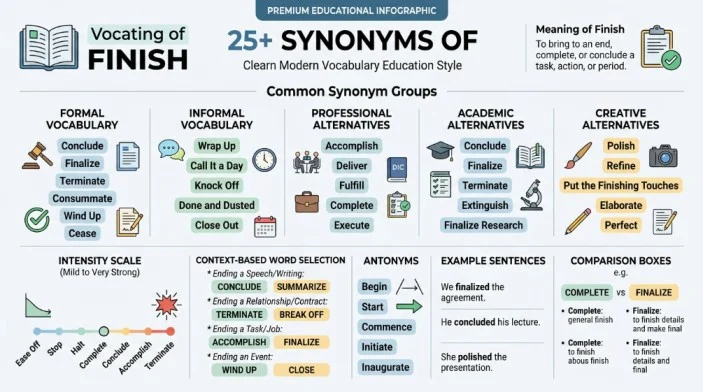
The best synonym for finish depends on its meaning. Use complete for a task, conclude for a discussion or event, finalize for documents or plans, end for general situations, and wrap up in casual speech. For formal writing, conclude and complete work well, while polish is useful when describing final improvements.
Meaning, Tone, and Context
Simple Definition
Finish generally means to bring something to an end or complete something that has been started. It can describe completing an activity, reaching the end of an event, consuming the last part of something, or adding final improvements to an object or piece of work.
The exact meaning depends on the context.
For example:
“I need to finish my report.”
Here, finish means complete the report.
“The movie finishes at 10 p.m.”
- Here, finish means come to an end.
“She finished her coffee.”
- Here, finish means consume what remains.
“The designer finished the surface with a protective coating.”
- Here, finish refers to completing or improving the final surface.
Part of Speech
Finish can function as both a verb and a noun.
As a verb:
“I need to finish the assignment.”
As a noun:
“The table has a smooth finish.”
Overall Tone
The word finish is generally neutral.
It does not normally express positive or negative emotion by itself. Its tone depends on the surrounding sentence.
For example:
“We finally finished the project.”
This can express relief or satisfaction.
“The match finished early.”
This is simply factual.
Formality Level
Finish is a neutral English word that works naturally in:
- Academic writing
- Business communication
- Workplace conversations
- Emails
- Everyday speech
- Social media
- Creative writing
- Personal communication
Because it is so versatile, it is often better to keep finish rather than replace it unnecessarily.
Common Uses
Native English speakers commonly use finish when talking about:
- Finishing a task
- Finishing a project
- Finishing an assignment
- Finishing a book
- Finishing a meal
- Finishing a conversation
- Finishing a meeting
- Finishing a speech
- Finishing a race
- Finishing a job
- Finishing a course
- Finishing a product
- Finishing a surface
- Finishing a sentence
Word Forms
| Form | Example |
|---|---|
| Verb | finish |
| Noun | finish |
| Past tense | finished |
| Present participle | finishing |
| Third person | finishes |
| Related noun | completion |
| Related adjective | finished |
| Opposite concept | unfinished |
When and How to Use “Finish”
Use finish when you want to communicate that an activity, task, event, or process has reached its end. It is especially useful when the exact context already makes the meaning clear.
Professional
“The team expects to finish the project by Friday.”
Here, finish means complete the project.
Academic
“Students must finish the assignment before the deadline.”
The word refers to completing required academic work.
Workplace
“I will finish the report before the afternoon meeting.”
This is a natural workplace use because the meaning is clear and direct.
Personal
“I finished reading the book last night.”
Here, finish means reach the end of the book.
“I will finish the document and send the final version this afternoon.”
The word works naturally in professional email communication.
Resume
“Finished monthly reports and maintained accurate client records.”
For a resume, a more specific action verb such as completed may sound stronger:
“Completed monthly reports and maintained accurate client records.”
Social Media
“Finally finished my first marathon.”
This casual use sounds natural because finish can describe reaching the end of a race or major activity.
Best Synonyms of “Finish”
No single synonym replaces finish in every situation. The best choice depends on what you mean by finish.
Professional Writing: Complete
Complete is one of the strongest general alternatives when you mean successfully bringing a task or project to its end.
“The team completed the project ahead of schedule.”
It sounds clear and professional without adding unnecessary emotion.
Academic Writing: Complete
Complete works especially well for assignments, courses, research tasks, and academic requirements.
“Students must complete all required readings before the seminar.”
It clearly communicates that all required work has been done.
Business Communication: Finalize
Finalize is useful when the work is nearly finished and the remaining step involves making the final decisions or changes.
“We need to finalize the contract before Friday.”
It is more specific than simply saying finish.
Casual Conversation: Wrap Up
Wrap up is a natural informal expression for bringing an activity or conversation to an end.
“Let’s wrap up the meeting.”
It sounds conversational and friendly.
Emotional Writing: End
End can carry more emotional weight when describing relationships, experiences, periods of life, or difficult situations.
“She knew the long journey had finally come to an end.”
Creative Writing: Conclude
Conclude can give writing a polished and formal tone, particularly when describing how a story, speech, argument, or event reaches its final point.
“The novel concludes with a quiet scene of reconciliation.”
Resume Writing: Complete
For resumes, complete is often more useful than finish because it sounds direct and accomplishment focused.
“Completed a six month training program in digital marketing.”
Workplace Communication: Finalize
Use finalize when the main work has been done and the final approval, decision, edit, or arrangement remains.
“Please finalize the presentation before the client call.”
Stronger Meaning: Conclude
Conclude can sound more deliberate than finish when discussing formal events, arguments, reports, or discussions.
“The committee concluded its investigation.”
Softer Meaning: Wrap Up
Wrap up is less formal and often sounds relaxed rather than forceful.
“I’ll wrap up this task before lunch.”
When Not to Use “Finish”
Although finish is highly versatile, sometimes another word communicates the intended meaning more precisely.
When Finish Sounds Too General
If you want to emphasize that a task was successfully completed, complete can be more precise.
Less precise:
“I finished the training.”
More precise:
“I completed the required training.”
The second sentence makes the accomplishment sound clearer in professional contexts.
When Finish Sounds Too Vague
If you mean that a document is ready for approval, finalize gives more information.
Less precise:
“We need to finish the contract.”
Better:
“We need to finalize the contract.”
When Finish Is Too Informal
In formal discussions, conclude may be preferable when talking about an argument, speech, meeting, or formal event.
Less formal:
“The speaker finished with a summary.”
More formal:
“The speaker concluded with a summary.”
When Finish Sounds Too Weak
If something requires immediate completion, complete, finalize, or conclude may communicate the purpose more clearly.
Less direct:
“Please finish the application today.”
Better:
“Please complete the application today.”
When Finish Sounds Too Strong
This issue usually appears when finish is used to describe an activity that has not literally reached its end.
For example, saying:
“Finish discussing the problem.”
can sound like a command to stop.
A softer alternative is:
“Let’s wrap up our discussion.”
When a More Specific Word Is Better
Sometimes the intended meaning is not simply “finish.”
Compare:
“She finished the report.”
with:
“She finalized the report.”
The first says the report was completed. The second suggests the final version was prepared and made ready for use or submission.
Words Commonly Confused With “Finish”
Complete
Difference: Complete emphasizes that all required parts of something have been done.
When to use it: Use it for assignments, projects, applications, courses, and tasks.
Example:
“Please complete the application before submitting it.”
End
Difference: End focuses on something stopping or reaching its final point.
When to use it: Use it for meetings, events, relationships, periods, stories, and situations.
Example:
“The meeting ended at noon.”
Conclude
Difference: Conclude often describes a formal or deliberate ending.
When to use it: Use it for speeches, discussions, reports, arguments, investigations, and events.
Example:
“The report concludes with several recommendations.”
Finalize
Difference: Finalize means making something final and ready for approval, delivery, or use.
When to use it: Use it for plans, contracts, documents, schedules, and decisions.
Example:
“The manager finalized the new schedule.”
Stop
Difference: Stop means cease an activity, while finish usually means bring it to completion.
When to use it: Use stop when the activity ends without necessarily being completed.
Example:
“He stopped writing before completing the report.”
Best Synonyms of “Finish” by Context
| Context | Best Synonym | Why It Works | Example |
|---|---|---|---|
| Formal writing | Conclude | Gives a polished sense of finality | “The report concludes with three recommendations.” |
| Academic writing | Complete | Clearly indicates all required work is done | “Students must complete the assignment.” |
| Professional communication | Complete | Direct and accomplishment focused | “She completed the training program.” |
| Business emails | Finalize | Suggests the last decisions or edits | “Please finalize the proposal today.” |
| Resume writing | Complete | Clearly communicates an achievement | “Completed a professional certification.” |
| Workplace communication | Wrap up | Natural for meetings and routine tasks | “Let’s wrap up the meeting.” |
| Casual conversation | Finish | Simple and natural | “I’ll finish this later.” |
| Everyday speaking | End | Useful for events or activities | “When does the movie end?” |
| Creative writing | Conclude | Creates a polished ending | “The story concludes with a surprising reunion.” |
| Storytelling | End | Natural when describing the final point | “The story ends with the family reunited.” |
| Emotional writing | Come to an end | Emphasizes emotional closure | “Their journey finally came to an end.” |
| Strong emphasis | Complete | Stresses that nothing remains | “The team completed every required task.” |
| Mild tone | Wrap up | Sounds relaxed and less forceful | “We can wrap up the discussion soon.” |
| Social media captions | Finish | Short and conversational | “Finished my first marathon!” |
| American English | Finish | Extremely common and natural | “I need to finish this before dinner.” |
| British English | Finish | Also standard and widely used | “I’ll finish the report this afternoon.” |
How to Choose the Best Synonym of “Finish”
The easiest way to select the right alternative is to identify what kind of ending you mean.
If You Mean Completing a Task
Choose complete.
“I completed the assignment.”
If You Mean Bringing Something to an End
Choose end.
“The concert ended at midnight.”
If You Mean Reaching a Formal Conclusion
Choose conclude.
“The report concludes with a recommendation.”
If You Mean Making Something Final
Choose finalize.
“The team finalized the agreement.”
If You Mean Ending Something Casually
Choose wrap up.
“Let’s wrap up the meeting.”
If You Mean Improving the Final Version
Choose polish.
“She polished the article before publication.”
If You Mean Completing Something Perfectly
Choose perfect only when the context supports improvement toward a very high standard.
“He spent another hour perfecting the presentation.”
Consider Your Audience
- For a professor, use complete or conclude.
- For a manager, use complete or finalize.
- For a friend, use finish or wrap up.
- For a creative audience, use conclude, end, or polish, depending on the meaning.
Consider the Level of Formality
| Level | Recommended Words |
|---|---|
| Formal | Conclude, finalize, complete |
| Neutral | Finish, complete, end |
| Informal | Wrap up |
| Creative | Conclude, end, polish |
| Professional | Complete, finalize |
The best vocabulary is not necessarily the most complicated vocabulary. The strongest choice is the word that communicates your intended meaning naturally.
Real Life Examples of “Finish”
School
Original:
“I finished my homework.”
More polished:
“I completed my homework before dinner.”
College
Original:
“She finished her research paper.”
More academic:
“She completed her research paper before the submission deadline.”
Workplace
Original:
“We finished the project.”
More professional:
“We completed the project ahead of schedule.”
Business
Original:
“The company finished the negotiations.”
More formal:
“The company concluded the negotiations.”
Original:
“I will finish the document tomorrow.”
More precise:
“I will finalize the document tomorrow.”
Resume
Original:
“Finished employee training.”
Stronger:
“Completed employee training and prepared performance materials.”
Conversation
“I’ll finish my coffee and meet you outside.”
Here, finish sounds more natural than a formal alternative.
Storytelling
“The story ended with the main character returning home.”
The word ended naturally describes the final part of a narrative.
Blogging
“Finish your article with a clear call to action.”
Here, finish is simple and appropriate because the instruction is direct.
Social Media
“Finally finished the race after months of training.”
The conversational tone makes finished a natural choice.
25 Best Synonyms of “Finish”
The following list includes words and expressions that genuinely overlap with finish, but their meanings are not identical in every context.
| Synonym | Simple Meaning | Best Used For | Example Sentence |
|---|---|---|---|
| Complete | Do all required parts | Tasks and projects | “She completed the report before lunch.” |
| End | Bring something to its final point | Events and situations | “The meeting ended at four.” |
| Conclude | Bring something to a formal close | Reports and discussions | “The speaker concluded with a brief summary.” |
| Finalize | Make something final | Plans and documents | “We finalized the contract yesterday.” |
| Terminate | Officially bring something to an end | Formal agreements or services | “The company terminated the contract.” |
| Accomplish | Successfully achieve a task or goal | Goals and achievements | “She accomplished everything on her list.” |
| Fulfill | Complete a requirement or obligation | Duties and promises | “He fulfilled all of the course requirements.” |
| Achieve | Successfully reach a goal | Objectives and results | “The team achieved its annual target.” |
| Wrap up | Bring something to a close informally | Meetings and activities | “Let’s wrap up the discussion.” |
| Wind up | Gradually bring something to an end | Meetings and activities | “We wound up the meeting after an hour.” |
| Close | Bring something to an end or completion | Businesses, accounts, events | “The ceremony closed with a final speech.” |
| Settle | Resolve a matter so no further action is needed | Disputes and questions | “The two sides settled the dispute.” |
| Resolve | Successfully deal with and finish an issue | Problems and conflicts | “The team resolved the technical issue.” |
| Consummate | Bring something to completion | Very formal contexts | “The agreement consummated years of negotiations.” |
| Round off | Complete something neatly | Speeches, events, tasks | “She rounded off the presentation with a summary.” |
| Polish | Improve something in its final stage | Writing and creative work | “He polished the article before publication.” |
| Perfect | Refine something toward an excellent standard | Skills and creative work | “She perfected the final presentation.” |
| Top off | Add a final part that completes something | Food, events, designs | “A short speech topped off the celebration.” |
| Bring to an end | Cause something to stop or conclude | Formal and general writing | “The agreement brought the dispute to an end.” |
| Bring to a close | Complete or conclude something | Formal communication | “The chair brought the meeting to a close.” |
| Cease | Stop completely | Formal writing | “The company ordered the activity to cease.” |
| Exhaust | Use all of something until none remains | Supplies and resources | “The team exhausted its remaining supplies.” |
| Use up | Consume all of something | Everyday speech | “We used up the last of the milk.” |
| Eat up | Consume all remaining food | Meals and food | “The children ate up their dinner.” |
| Stop | Bring an activity to an end | General situations | “The workers stopped the machine.” |
Synonyms of “Finish” by Usage
Professional vs Personal Synonyms
In professional writing, complete, finalize, conclude, and resolve are often more precise than finish.
“The team completed the annual report.”
In personal conversation, finish and wrap up often sound more natural.
“I’ll finish this and call you.”
The best choice depends on whether you want to emphasize completion, closure, resolution, or simply stopping.
Formal vs Conversational Synonyms
- For reports and essays, consider complete, conclude, or finalize.
- For presentations, conclude works particularly well:
“I would like to conclude with three recommendations.”
- For business emails, finalize is useful:
“Please finalize the document before the meeting.”
- For casual conversations and texting, finish and wrap up are usually more natural:
“I’ll finish it tonight.”
“Let’s wrap up and head home.”
Academic Synonyms
Academic writing often benefits from precise vocabulary.
Complete
Use it for assignments, courses, experiments, and research tasks.
“The students completed the required readings.”
Conclude
Use it for research papers, arguments, reports, and discussions.
“The study concludes that additional research is needed.”
Finalize
Use it when preparing the final version of academic work.
“The researchers finalized the manuscript before submission.”
Fulfill
Use it for requirements, conditions, and obligations.
“The study fulfilled all institutional requirements.”
Resolve
Use it for questions, problems, or issues.
“The researchers resolved several methodological concerns.”
These choices make academic writing more specific because they explain what kind of completion has occurred.
Professional and Business Synonyms
Resumes
Use completed, achieved, or accomplished when describing finished responsibilities or goals.
“Completed a comprehensive customer service training program.”
Interviews
Use completed when explaining a task and achieved when emphasizing a result.
“I completed the implementation ahead of schedule.”
Meetings
Use conclude or wrap up depending on formality.
“We concluded the meeting at 3 p.m.”
“Let’s wrap up the meeting.”
Presentations
Use conclude for the final section.
“I’d like to conclude by highlighting our three priorities.”
Performance Reviews
Use completed, achieved, and accomplished to describe measurable results.
“Completed all quarterly objectives ahead of schedule.”
Client Communication
Use finalize when discussing documents, plans, contracts, or approvals.
“We are ready to finalize the project agreement.”
Business Emails
Use complete when requesting work and finalize when requesting final approval.
“Please complete the form by Thursday.”
“Please finalize the proposal by Thursday.”
Creative and Literary Synonyms
Creative writing gives you more freedom to choose words based on mood.
End
Best for a straightforward narrative ending.
“The story ended with a quiet reunion.”
Conclude
Useful for polished, formal storytelling.
“The novel concludes with the hero returning home.”
Round Off
Useful when a character or narrator completes an experience.
“She rounded off the evening with a final toast.”
Polish
Best when describing the final improvement of writing.
“The editor polished the final chapter.”
Perfect
Useful when a character spends time refining a skill or creation.
“He spent years perfecting his craft.”
These alternatives should be chosen for meaning rather than simply to avoid repeating finish.
Slang or Modern Synonyms
There is no single modern slang word that universally replaces finish.
However, informal expressions are common.
Wrap Up
Meaning: Finish an activity or discussion.
Acceptable in: Conversations, texts, informal workplace speech.
Avoid in: Highly formal reports.
“Let’s wrap up and go home.”
Call It a Day
Meaning: Stop working for the day, whether or not every task is complete.
Acceptable in: Casual workplace conversations and everyday speech.
Avoid in: Formal academic writing.
“We’ve done enough for today, so let’s call it a day.”
This expression is important because it does not necessarily mean that the entire task has been completed.
Strongest to Mildest Synonyms
Because finish has several meanings, intensity depends on the type of completion being discussed.
| Level | Words | Typical Meaning |
|---|---|---|
| Mild | Wrap up, round off | Bring something toward a natural close |
| Moderate | Finish, end, complete | Reach the end or complete a task |
| Strong | Conclude, finalize, accomplish | Deliberately bring something to completion |
| Very Strong | Terminate, consummate | Bring something to a definitive or formal end |
Terminate should not be used casually because it can suggest an official, forceful, or permanent ending.
Conclude is strong in formal writing but does not necessarily suggest conflict or force.
Emotional vs Neutral Synonyms
Emotional Synonyms
Some alternatives can carry more emotional meaning because they emphasize closure or achievement.
Come to an end can suggest emotional closure.
“Their long journey finally came to an end.”
Accomplish can emphasize personal achievement.
“She accomplished a goal she had worked toward for years.”
Perfect can suggest dedication and pride.
“He spent months perfecting his technique.”
Neutral Synonyms
For straightforward information, use:
- Finish
- Complete
- End
- Conclude
- Finalize
These words communicate the action without adding much emotional meaning.
Antonyms of “Finish”
Because finish has several meanings, its opposites vary by context. The table below focuses on words that directly oppose the idea of completion, closure, or bringing something to an end.
| Antonym | Meaning | Example Sentence |
|---|---|---|
| Begin | Start something | “We will begin the project tomorrow.” |
| Start | Begin an activity | “She started the assignment after lunch.” |
| Commence | Begin formally | “The ceremony will commence at noon.” |
| Initiate | Cause something to begin | “The manager initiated the review process.” |
| Launch | Start a new project or activity | “The company launched its new program.” |
| Open | Begin an event or activity | “The speaker opened the conference.” |
| Originate | Begin or come into existence | “The idea originated during a team meeting.” |
| Embark | Begin a significant activity or journey | “They embarked on a new research project.” |
| Continue | Keep something going | “The team continued working after the break.” |
| Proceed | Continue or move forward | “Please proceed with the next step.” |
| Resume | Begin again after stopping | “The meeting resumed after lunch.” |
| Prolong | Make something last longer | “The negotiations were prolonged by several disagreements.” |
| Extend | Make something continue for a longer period | “The company extended the deadline.” |
| Remain | Continue to exist or stay unfinished | “Several questions remain unanswered.” |
| Leave unfinished | Not bring something to completion | “He left the assignment unfinished.” |
Comparison: “Finish” vs Similar Words
Finish vs Complete
Main Difference
Finish can mean reaching an end, while complete strongly emphasizes that all necessary parts have been done.
Which Is Stronger?
Complete is stronger when emphasizing full task accomplishment.
Which Is More Formal?
Complete is slightly more suitable for professional and academic writing.
When to Use Each
Use finish for general conversation. Use complete when describing requirements or achievements.
Examples
Finish:
“I finished the book.”
Complete:
“I completed the training program.”
Finish vs End
Main Difference
Finish often focuses on completion, while end focuses on something stopping or reaching its final point.
Which Is Stronger?
Neither is automatically stronger.
Which Is More Formal?
Both are neutral.
When to Use Each
Use end for events, periods, and situations. Use finish for tasks and activities.
Examples
Finish:
“I finished my homework.”
End:
“The class ended at three.”
Finish vs Conclude
Main Difference
Conclude usually suggests a deliberate or formal ending.
Which Is Stronger?
Conclude can sound more deliberate and formal.
Which Is More Formal?
Conclude is clearly more formal.
When to Use Each
Use conclude for speeches, reports, discussions, and arguments.
Examples
Finish:
“She finished the presentation.”
Conclude:
“She concluded the presentation with a summary.”
Finish vs Finalize
Main Difference
Finalize means make something final, usually after decisions or revisions.
Which Is Stronger?
Neither is stronger, but finalize is more specific.
Which Is More Formal?
Finalize is more common in professional communication.
When to Use Each
Use finalize for plans, documents, contracts, and schedules.
Examples
Finish:
“We finished the report.”
Finalize:
“We finalized the report for publication.”
Finish vs Stop
Main Difference
Finish normally implies completion. Stop simply means cease an activity.
Which Is Stronger?
Stop can be stronger when an activity is being interrupted.
Which Is More Formal?
Both are neutral.
When to Use Each
Use finish when the intended result has been reached. Use stop when the activity ends without completion.
Examples
Finish:
“She finished the assignment.”
Stop:
“She stopped working on the assignment.”
Finish vs Accomplish
Main Difference
Finish focuses on completion, while accomplish emphasizes successfully achieving something.
Which Is Stronger?
Accomplish often sounds stronger because it highlights achievement.
Which Is More Formal?
Accomplish works especially well in professional and achievement focused writing.
When to Use Each
Use accomplish for goals, objectives, and significant achievements.
Examples
Finish:
“He finished the project.”
Accomplish:
“He accomplished the project’s main objectives.”
Common Phrases and Expressions with “Finish”
Finish the Job
Meaning: Complete the work that needs to be done.
Example:
“We need to finish the job before sunset.”
Finish Up
Meaning: Complete the remaining part of something.
Example:
“I’ll finish up the report before lunch.”
Finish Off
Meaning: Complete the last part of something, or consume the remaining amount.
Example:
“She finished off the last piece of cake.”
Finish First
Meaning: Complete a race or competition in first place.
Example:
“The runner finished first in the final race.”
Finish Strong
Meaning: End an activity with strong performance or effort.
Example:
“The team needs to finish strong this quarter.”
Finish With
Meaning: End an activity with a particular final element.
Example:
“The speaker finished with a short thank you.”
Finish Something Off
Meaning: Complete the final part of something.
Example:
“I just need another hour to finish the report off.”
Finish on Time
Meaning: Complete something by the expected time.
Example:
“The construction team finished on time.”
Common Mistakes to Avoid
1. Using Finish When You Mean Stop
Incorrect:
“I finished working on the project because I ran out of time.”
Better:
“I stopped working on the project because I ran out of time.”
Why:
The first sentence can suggest that the project itself was completed. Stopped clearly shows that the activity ended before completion.
2. Confusing Finish With Complete
Incorrect:
“Please finish all required fields on the application.”
This is understandable, but complete is more precise.
Better:
“Please complete all required fields on the application.”
Why:
Complete naturally refers to filling in every required part.
3. Using Finalize for Every Type of Ending
Incorrect:
“The movie finalized at 10 p.m.”
Better:
“The movie ended at 10 p.m.”
Why:
Finalize is used for making something final, not normally for events simply reaching their ending.
4. Using Conclude in Casual Situations
Incorrect:
“I concluded my homework.”
Better:
“I finished my homework.”
Why:
Conclude sounds unnatural for ordinary homework. Finish or complete is much more natural.
5. Choosing an Overly Formal Synonym
Incorrect:
“Let’s consummate our lunch.”
Better:
“Let’s finish lunch.”
Why:
Consummate is highly formal and has specialized uses. It is not a natural substitute for finish in everyday situations.
6. Assuming Finish Always Means Completion
Incorrect:
“He stopped the report.”
Better:
“He stopped working on the report.”
Why:
A report itself is not normally something a person “stops.” The person stops the activity of working on it.
7. Using Strong Words Without Considering Meaning
Incorrect:
“The manager terminated the meeting.”
Better:
“The manager concluded the meeting.”
Why:
Terminate can sound unusually forceful or official. Conclude is more natural for a normal meeting.
Frequently Asked Questions
What is a good synonym for finish?
A good synonym depends on context. Complete, conclude, end, finalize, and terminate are common options.
What is a synonym of finish?
Common synonyms of finish include complete, end, conclude, finalize, accomplish, and terminate.
What is another word for finish?
Another word for finish can be complete, end, conclude, wrap up, or finalize, depending on the sentence.
What is a finishing synonym?
A finishing synonym can be completing, concluding, finalizing, ending, or wrapping up.
What is a finished synonym?
Common synonyms for finished include completed, concluded, done, finalized, and ended.
What is a synonym for “to finish”?
Useful synonyms for to finish include to complete, conclude, finalize, end, accomplish, and wrap up.
What is a synonym for finishes?
Depending on the meaning, finishes can mean completes, ends, concludes, finalizes, or coatings.
What are the common synonyms for finish?
Common synonyms for finish include complete, end, conclude, finalize, accomplish, terminate, and wrap up.
What is the best synonym of “finish”?
The best synonym depends on context. Complete is ideal for tasks, end for events, conclude for formal discussions, finalize for documents and plans, and wrap up for casual conversations.
What are the best formal synonyms of “finish”?
The strongest formal alternatives include complete, conclude, finalize, and terminate. Choose based on meaning. Conclude suits discussions, finalize suits documents, and complete suits tasks and requirements.
What are common informal synonyms of “finish”?
Common informal alternatives include wrap up, finish up, and finish off. These expressions are natural in everyday conversations, although some are less suitable for formal academic or business writing.
What is another word for “finish” in professional writing?
Complete is usually the safest professional alternative. Finalize works for documents and plans, while conclude is better for meetings, presentations, reports, and formal discussions.
What is the difference between “finish” and “complete”?
Finish can mean reaching the end of an activity, while complete emphasizes that all required parts have been successfully done. For tasks and professional achievements, complete is often more precise.
What is the opposite of “finish”?
The most direct opposites are begin and start. Depending on context, other contrasting words include commence, initiate, continue, resume, and leave unfinished.
Conclusion
The word finish is a flexible English verb that can describe completing a task, reaching the end of an event, consuming the last part of something, or adding final improvements. Its neutral tone makes it useful in almost every type of communication.
The best synonym of finish depends on what you want to communicate. Choose complete for tasks, conclude for formal endings, finalize for documents and plans, end for events, accomplish for achievements, and wrap up for casual situations.
No synonym works perfectly in every sentence. Before replacing finish, consider the exact meaning, your audience, the level of formality, and the effect you want the word to create. A useful vocabulary habit is to identify the specific type of completion you mean first, then choose the word that expresses that meaning most precisely.
Read More Related Articles:
- Synonyms for Creativity | Meaning, Examples, and Better …
- Synonyms for Pros and Cons | Meaning, Examples, and Better …