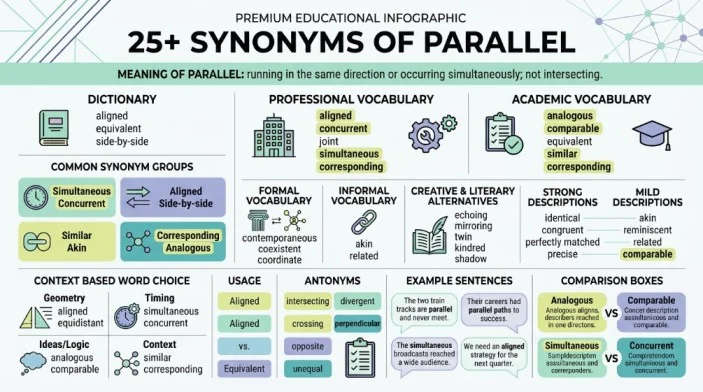
Finding the right alternative to a common word can make your writing clearer, sharper, and more natural. Synonyms of Parallel are especially useful because “parallel” can describe lines, ideas, situations, processes, relationships, or things happening at the same time. Depending on the context, words such as similar, corresponding, equivalent, concurrent, aligned, or comparable may fit better. However, these alternatives are not always interchangeable. Each one can carry a slightly different meaning, tone, or level of formality.
This guide explains the most useful Synonyms of Parallel with simple meanings, practical examples, and context-based guidance. You will learn which alternatives work best in academic writing, professional communication, everyday conversation, technical descriptions, and creative writing. Instead of choosing a synonym only because it looks similar, you can select the word that expresses your exact idea with greater precision and confidence.
What Is the Best Synonym of “Parallel”?
The best synonym of parallel depends on its meaning. For ideas or situations, use similar, analogous, or comparable. For events happening at the same time, use concurrent or simultaneous. In geometry, equidirectional can describe lines with the same direction, while corresponding works when things match in position or relationship.
Meaning, Tone, and Context
Simple Definition
Parallel describes things that are side by side, follow the same direction, happen alongside each other, or closely correspond without necessarily becoming identical.
The word has several important uses. It can describe geometric lines, simultaneous activities, similar developments, matching structures, or situations that resemble one another.
Part of Speech
Parallel can function as:
- An adjective
- A noun
- A verb
Overall Tone
The word parallel is generally neutral. It does not naturally express positive or negative emotion.
Its meaning comes from the context. eGometry, it describes direction and position. In writing, it can describe similarity or correspondence. In business or technology, it can describe activities occurring alongside one another.
Formality Level
Parallel is a neutral to formal word.
It works naturally in:
- Academic writing
- Business communication
- Technical writing
- Mathematics
- Science
- Everyday conversation
- Journalism
- Creative writing
It is not restricted to formal English, although some of its technical meanings are more common in specialized subjects.
Common Uses
Native English speakers commonly use parallel in expressions such as:
- Parallel lines
- Parallel processes
- Parallel development
- Parallel systems
- Parallel structure
- Parallel careers
- Parallel paths
- Parallel events
- Parallel ideas
- Run parallel to
- In parallel
- Parallel to something
Word Forms
| Form | Example |
|---|---|
| Adjective | The two roads are parallel. |
| Noun | The author draws a parallel between the two events. |
| Verb | The two stories parallel each other. |
| Related noun | Parallelism |
| Related adjective | Parallel |
The noun parallelism is especially common in grammar, rhetoric, literature, and comparative analysis.
When and How to Use “Parallel”
Use parallel when two or more things move, develop, operate, or exist alongside one another in a comparable or matching relationship.
The exact meaning changes according to the context.
Professional
“The two departments are developing parallel strategies for improving customer service.”
Here, parallel means the strategies are being developed alongside one another.
Academic
“The researchers identified parallel patterns in the two studies.”
In this sentence, parallel indicates that the patterns correspond or resemble one another.
Workplace
“Our teams are working on parallel projects.”
This suggests that the projects are being handled alongside each other.
Personal
“My sister and I followed parallel career paths for several years.”
Here, parallel describes careers that developed in similar ways.
“We can move the two approval processes forward in parallel.”
This means both processes can progress at the same time.
Resume
“Managed parallel projects while maintaining strict quality standards.”
The phrase shows the ability to handle multiple projects simultaneously.
Social Media
“Two cities, two cultures, and parallel stories of transformation.”
Here, parallel creates a literary sense of similarities between different experiences.
Best Synonyms of “Parallel”
There is no single synonym that replaces parallel in every sentence. The word has several meanings, so the best alternative changes depending on whether you mean similarity, simultaneous activity, correspondence, geometry, or a comparable situation.
Professional Writing: Corresponding
Corresponding works well when two things match or relate to each other in position, function, or structure.
Example:
“The corresponding departments reviewed the proposed changes.”
It is useful when you want to emphasize a relationship between matching parts.
Academic Writing: Analogous
Analogous is a strong choice when two things are similar in important ways but are not identical.
Example:
“The researchers found an analogous pattern in the second experiment.”
It is especially useful for comparisons, theories, systems, and research findings.
Business Communication: Concurrent
Concurrent works best when separate activities occur during the same period.
Example:
“The company launched concurrent marketing campaigns in three regions.”
It emphasizes timing rather than similarity.
Casual Conversation: Similar
Similar is usually clearer than parallel when you simply mean that two things are alike.
Example:
“Our experiences were surprisingly similar.”
Emotional Writing: Comparable
Comparable can describe two experiences, situations, or achievements that can reasonably be considered alongside one another.
Example:
“Few moments in her life were comparable to that achievement.”
Creative Writing: Analogous
Analogous can create a thoughtful comparison between two different experiences or ideas.
Example:
“The changing seasons were analogous to the stages of his life.”
Resume Writing: Concurrent
When describing multiple responsibilities handled at the same time, concurrent can be precise.
Example:
“Managed concurrent client projects while meeting all reporting deadlines.”
Workplace Communication: Simultaneous
Use simultaneous when two or more actions happen at exactly or nearly the same time.
Example:
“The system supports simultaneous access by multiple users.”
Stronger Meaning: Closely Corresponding
When you want to emphasize a strong relationship between two things, closely corresponding can be clearer than simply saying parallel.
Example:
“The two reports contain closely corresponding findings.”
Softer Meaning: Similar
If you only want to indicate resemblance without suggesting a structured relationship, similar is the safest choice.
Example:
“The two proposals have similar goals.”
When Not to Use “Parallel”
Although parallel is flexible, it should not automatically replace every word associated with similarity or simultaneous activity. Its specific meaning can make it inaccurate in some situations.
When “Parallel” Is Too General
If you simply mean that two things are alike, similar may be clearer.
Less Effective:
“The two products are parallel.”
Better:
“The two products are similar in design.”
Why:
Parallel suggests a particular relationship, while similar directly communicates resemblance.
When “Parallel” Is Too Vague
When timing is the main point, use a word that directly expresses simultaneous activity.
Less Effective:
“The teams worked in a parallel manner.”
Better:
“The teams worked simultaneously.”
Why:
Simultaneously tells the reader exactly what happened with regard to timing.
When a Technical Meaning Is Unnecessary
In simple everyday writing, parallel can sound more technical than needed.
Less Effective:
“Their lives developed in parallel.”
Better:
“Their lives developed in similar ways.”
Why:
The second version is easier for a general audience to understand.
When You Mean Exact Equality
Parallel does not normally mean that two things are equal in value or quantity.
Less Effective:
“The two salaries are parallel.”
Better:
“The two salaries are equal.”
Why:
Equal directly communicates the relationship between the amounts.
When You Mean Exact Similarity
If two things are almost identical, parallel may not communicate enough.
Less Effective:
“The two designs are parallel.”
Better:
“The two designs are nearly identical.”
Why:
The replacement gives the reader a more precise description.
When You Mean Physical Intersection
In geometry, parallel lines do not meet. If two lines cross, use intersecting rather than parallel.
Incorrect:
“The two intersecting roads are parallel.”
Better:
“The two roads are intersecting.”
Why:
The words describe opposite geometric relationships.
Words Commonly Confused With “Parallel”
Similar
Difference:
Similar means alike in one or more qualities. It does not necessarily imply that two things develop alongside each other.
When to Use It:
Use it for general resemblance.
Example:
“The two proposals are similar in several ways.”
Analogous
Difference:
Analogous describes things that are comparable because they have a similar relationship, function, or structure.
When to Use It:
Use it in academic, technical, and analytical writing.
Example:
“The human brain is sometimes described as analogous to a computer in certain discussions.”
Concurrent
Difference:
Concurrent focuses on things occurring during the same period.
When to Use It:
Use it for projects, activities, events, or processes happening at the same time.
Example:
“The company is managing several concurrent projects.”
Simultaneous
Difference:
Simultaneous emphasizes actions occurring at exactly or nearly the same time.
When to Use It:
Use it when timing is the main idea.
Example:
“The system can process simultaneous requests.”
Corresponding
Difference:
Corresponding emphasizes matching or related parts.
When to Use It:
Use it when one item relates directly to another.
Example:
“Each student received feedback on the corresponding assignment.”
Comparable
Difference:
Comparable means similar enough to be compared meaningfully.
When to Use It:
Use it for products, achievements, results, experiences, and measurable qualities.
Example:
“The two companies have comparable revenue figures.”
Best Synonyms of “Parallel” by Context
| Context | Best Synonym | Why It Works | Example |
|---|---|---|---|
| Formal writing | Analogous | Clearly expresses meaningful similarity. | The two systems are analogous in structure. |
| Academic writing | Analogous | Fits analytical comparisons. | The results show an analogous pattern. |
| Professional communication | Corresponding | Emphasizes related roles or parts. | The corresponding teams reviewed the data. |
| Business emails | Concurrent | Clearly describes activities occurring together. | We can handle the requests concurrently. |
| Resume writing | Concurrent | Shows ability to manage multiple activities. | Managed concurrent projects for major clients. |
| Workplace communication | Simultaneous | Makes timing clear. | The teams completed simultaneous reviews. |
| Casual conversation | Similar | Sounds natural and simple. | Our ideas are pretty similar. |
| Everyday speaking | Similar | Avoids unnecessary technical language. | Their situations are similar. |
| Creative writing | Analogous | Supports thoughtful comparisons. | Their journeys were analogous in unexpected ways. |
| Storytelling | Corresponding | Helps connect characters or events. | Each event had a corresponding consequence. |
| Emotional writing | Comparable | Highlights the relationship between experiences. | Nothing was comparable to that moment. |
| Strong emphasis | Closely corresponding | Shows a strong relationship. | The findings were closely corresponding. |
| Mild tone | Similar | Expresses resemblance without overstatement. | The two plans are similar. |
| Social media captions | Similar | Short and accessible. | Two different journeys, but surprisingly similar. |
| American English | Parallel | Common across general and technical contexts. | The roads run parallel to each other. |
| British English | Parallel | The same standard word is commonly used. | The two trends developed in parallel. |
How to Choose the Best Synonym of “Parallel”
Choosing a synonym becomes easier when you identify the exact relationship you want to describe.
If You Mean “Alike”
Choose similar.
Example:
“The two designs are similar.”
If You Mean “Similar in Structure or Function”
Choose analogous.
Example:
“The two systems are analogous.”
If You Mean “Happening at the Same Time”
Choose simultaneous or concurrent.
Example:
“The company conducted simultaneous interviews.”
If You Mean “Related or Matching”
Choose corresponding.
Example:
“Check the corresponding section of the report.”
If You Mean “Able to Be Compared”
Choose comparable.
Example:
“The results are comparable across both groups.”
If You Mean “Side by Side in the Same Direction”
Keep parallel.
Example:
“The two lines remain parallel.”
The original word is often the best choice when the exact concept is geometric or involves activities proceeding alongside each other.
Real Life Examples of “Parallel”
School
Original:
“The two arguments are parallel.”
Improved:
“The two arguments are similar because they rely on the same basic idea.”
College
“The researchers developed parallel explanations for the observed results.”
Workplace
“Our departments are running parallel training programs.”
Business
“The company launched two concurrent campaigns for different customer groups.”
“We can review both documents simultaneously to save time.”
Resume
“Managed multiple concurrent projects while maintaining strict deadlines.”
Conversation
“Your experience sounds similar to mine.”
Storytelling
“Their lives followed parallel paths until they finally met.”
Blogging
“These two trends developed in parallel, creating similar changes across the industry.”
Social Media
“Different journeys, parallel ambitions.”
25 Best Synonyms of “Parallel”
Because parallel has several meanings, the following list includes alternatives that match specific senses of the word. Some describe similarity, some describe simultaneous activity, and others describe correspondence or comparable relationships.
| Synonym | Simple Meaning | Best Used For | Example Sentence |
|---|---|---|---|
| Similar | Alike in some ways | Everyday writing | The two plans are similar in several important ways. |
| Analogous | Similar in structure or function | Academic writing | The two systems are analogous in design. |
| Comparable | Similar enough to compare | Reports and analysis | The results are comparable across both groups. |
| Corresponding | Matching or related | Formal writing | The corresponding departments handled the issue. |
| Concurrent | Happening during the same period | Business and workplace | The company managed several concurrent projects. |
| Simultaneous | Happening at the same time | Technical writing | The platform supports simultaneous connections. |
| Equivalent | Equal in value, purpose, or effect | Technical and academic writing | The two methods produced equivalent results. |
| Coexisting | Existing together | General and academic writing | Several cultures were coexisting in the region. |
| Aligned | Positioned or arranged in agreement | Business and technical writing | The teams are aligned with the same goals. |
| Matching | Corresponding closely | Everyday and professional use | The two records contain matching information. |
| Related | Connected in some way | General writing | The two issues are closely related. |
| Comparable | Able to be meaningfully compared | Analytical writing | The companies have comparable operating costs. |
| Equidirectional | Moving in the same direction | Technical or geometric contexts | The vectors are equidirectional under the stated conditions. |
| Side by side | Existing alongside another | Everyday descriptions | The two buildings stand side by side. |
| Coextensive | Covering the same area or range | Technical writing | The two boundaries are nearly coextensive. |
| Simultaneous | Occurring together in time | Processes and events | The system records simultaneous events. |
| Co-occurring | Happening together | Research and analysis | The symptoms were co-occurring during the study. |
| Synchronized | Happening or operating in coordination | Technology and performance | The devices remained synchronized throughout the test. |
| Coordinated | Organized to work together | Workplace communication | The teams used a coordinated approach. |
| Interrelated | Connected through mutual relationships | Academic writing | The factors are closely interrelated. |
| Concomitant | Existing or occurring alongside something else | Formal writing | The treatment produced several concomitant effects. |
| Associated | Connected or linked | General and professional writing | The condition has several associated factors. |
| Consistent | Showing the same pattern or relationship | Research and analysis | The findings were consistent across the groups. |
| Proximate | Close in position or relationship | Formal or technical contexts | The two structures are proximate to one another. |
| Twin | Closely matching or corresponding | Creative and descriptive writing | The novel presents twin narratives of loss and recovery. |
Important usage note: Not all 25 alternatives are interchangeable with parallel. Words such as concurrent, simultaneous, and co-occurring are strongest when the meaning involves time. Analogous, similar, and comparable work better for resemblance. Corresponding, aligned, and synchronized emphasize relationships or coordination.
Synonyms of “Parallel” by Usage
Professional vs Personal Synonyms
Professional writing benefits from precise words that explain the relationship between two things.
Use:
- Concurrent for projects happening during the same period
- Corresponding for matching departments or sections
- Analogous for similar structures
- Aligned for shared goals
- Synchronized for coordinated activities
In personal communication, simpler words are usually more natural.
Use:
- Similar
- Related
- Matching
- Side by side
- Comparable
Professional:
“The teams are pursuing concurrent initiatives.”
Personal:
“Our experiences were surprisingly similar.”
Formal vs Conversational Synonyms
For reports, essays, and business writing, choose words such as analogous, corresponding, concurrent, and comparable.
For casual conversations and texting, similar, matching, and related are generally easier to understand.
Formal:
“The findings are analogous across both studies.”
Conversational:
“The two situations are pretty similar.”
Academic Synonyms
Academic writing often requires a precise distinction between resemblance and simultaneous activity.
Analogous
Use analogous when two concepts share an important structural or functional similarity.
Comparable
Use comparable when two results, groups, or situations can reasonably be evaluated against each other.
Corresponding
Use corresponding when two parts have a direct relationship.
Concurrent
Use concurrent when studies, processes, or events occur during the same period.
Interrelated
Use interrelated when multiple factors influence or connect with one another.
Example:
“The study identified several interrelated factors that contributed to the outcome.”
These alternatives make academic writing more precise because they explain how two things relate.
Professional and Business Synonyms
Resumes
Use concurrent, coordinated, or key when describing multiple responsibilities.
Example:
“Managed concurrent projects across three regional offices.”
Interviews
Use comparable or similar when discussing previous experiences.
Example:
“I handled a comparable project in my previous role.”
Meetings
Use parallel or concurrent when describing separate activities.
Example:
“The teams will conduct concurrent planning sessions.”
Presentations
Use corresponding when connecting slides, data points, or departments.
Example:
“The corresponding figures appear on the next slide.”
Performance Reviews
Use aligned when discussing goals and organizational priorities.
Example:
“My objectives remain aligned with the company’s strategic priorities.”
Client Communication
Use comparable when discussing products, services, or previous cases.
Example:
“We can provide a comparable solution based on your requirements.”
Business Emails
Use concurrent or simultaneously when timing matters.
Example:
“We can review both proposals concurrently.”
Creative and Literary Synonyms
Creative writing gives parallel a particularly useful figurative meaning. It can connect characters, experiences, events, or themes that develop in similar ways.
Analogous
Useful for deeper comparisons between ideas.
Example:
“His fading confidence was analogous to the crumbling walls around him.”
Similar
Useful when the comparison should remain simple.
Example:
“Their dreams were similar, even though their lives were worlds apart.”
Corresponding
Useful when events or experiences mirror one another.
Example:
“Each victory had a corresponding sacrifice.”
Twin
Useful as a literary description of closely connected narratives.
Example:
“The novel follows twin stories of ambition and regret.”
Parallel
Sometimes the original word remains the strongest creative choice.
Example:
“Two parallel lives unfolded beneath the same restless sky.”
Slang or Modern Synonyms
There is no widely accepted slang word that directly replaces parallel in all of its meanings.
In casual English, speakers may use expressions such as similar, the same kind of thing, or along the same lines, depending on context.
Along the Same Lines
Meaning: Similar in idea or approach.
Acceptable In: Casual conversations, informal writing, social media.
Avoid In: Formal academic or technical writing when precision is important.
Example:
“Her idea is along the same lines as mine.”
For professional or academic writing, similar, analogous, or comparable is usually clearer.
Strongest to Mildest Synonyms
The idea of strength depends on the meaning of parallel. Unlike emotional adjectives, these words do not form one universal intensity scale.
A useful contextual scale is:
Mild similarity: Similar, related
Moderate similarity: Comparable, corresponding
Strong structural similarity: Analogous, closely corresponding
Strong simultaneous relationship: Concurrent, simultaneous, synchronized
The stronger word is not necessarily better. Choose the alternative that describes the exact relationship rather than selecting the most sophisticated sounding word.
Emotional vs Neutral Synonyms
Emotional Synonyms
Parallel itself is usually neutral, but creative alternatives can add emotional or literary meaning.
- Twin
- Similar
- Matching
- Comparable
Example:
“Their parallel journeys eventually brought them together.”
The word parallel can create a reflective or poetic feeling without becoming strongly emotional.
Neutral Synonyms
These are better when the goal is objective communication:
- Corresponding
- Concurrent
- Simultaneous
- Analogous
- Comparable
- Related
- Aligned
- Synchronized
Use neutral vocabulary in reports, research papers, instructions, and professional communication.
Antonyms of “Parallel”
The opposite of parallel depends on which meaning is intended. In geometry, the clearest contrast involves lines that intersect rather than remain separate. In figurative or process related contexts, the opposite may involve difference, divergence, or sequential activity.
| Antonym | Meaning | Example Sentence |
|---|---|---|
| Perpendicular | Meeting at a right angle | The two lines are perpendicular. |
| Intersecting | Crossing at a point | The two roads are intersecting near the bridge. |
| Converging | Moving toward the same point | The two paths are converging ahead. |
| Diverging | Moving away from each other | The roads begin diverging after the town. |
| Nonparallel | Not parallel | The diagram contains two nonparallel lines. |
| Crossing | Passing through or over another | The two paths are crossing near the entrance. |
| Different | Not alike | The two approaches are fundamentally different. |
| Dissimilar | Not similar | The studies examined dissimilar populations. |
| Unrelated | Having no meaningful connection | The two topics are unrelated to the main issue. |
| Unequal | Not equal in amount or value | The two quantities are unequal. |
| Mismatched | Failing to correspond | The records contain mismatched information. |
| Sequential | Happening one after another rather than alongside | The steps must occur sequentially. |
| Divergent | Developing in different directions | The researchers reached divergent conclusions. |
| Conflicting | In opposition or disagreement | The two reports contain conflicting findings. |
| Inconsistent | Failing to correspond or agree | The results were inconsistent across the trials. |
Comparison: “Parallel” vs Similar Words
Parallel vs Similar
Main Difference
Parallel can describe similarity, but it often suggests that two things develop alongside each other or have a corresponding structure. Similar simply means alike.
Which Is Stronger?
Parallel can suggest a more specific relationship.
Which Is More Formal?
Both are neutral, but parallel can sound more analytical.
When to Use Each
Use similar for general resemblance. Use parallel when you want to show matching development, structure, or direction.
Examples
Parallel:
“The two companies followed parallel growth strategies.”
Similar:
“The two companies have similar products.”
Parallel vs Analogous
Main Difference
Analogous emphasizes similarity in function, structure, or relationship. Parallel can describe this, but also has geometric and simultaneous meanings.
Which Is Stronger?
Analogous is more specific when discussing conceptual similarity.
Which Is More Formal?
Analogous is more common in academic and technical writing.
When to Use Each
Use analogous for theories, systems, concepts, and structures. Use parallel for broader relationships or simultaneous development.
Examples
Parallel:
“The two stories follow parallel paths.”
Analogous:
“The two systems are analogous in function.”
Parallel vs Concurrent
Main Difference
Parallel can mean activities occurring alongside each other. Concurrent specifically emphasizes that activities occur during the same period.
Which Is Stronger?
Neither is inherently stronger.
Which Is More Formal?
Concurrent is particularly common in technical and professional writing.
When to Use Each
Use concurrent when timing is central. Use parallel when both timing and independent development matter.
Examples
Parallel:
“The teams worked on parallel projects.”
Concurrent:
“The company managed concurrent projects.”
Parallel vs Simultaneous
Main Difference
Simultaneous specifically means occurring at the same time. Parallel can describe simultaneous activity but can also refer to direction or similarity.
Which Is Stronger?
Simultaneous is more precise about timing.
Which Is More Formal?
Both are suitable for formal writing.
When to Use Each
Use simultaneous when timing must be unmistakable.
Examples
Parallel:
“The researchers conducted parallel investigations.”
Simultaneous:
“The researchers conducted simultaneous tests.”
Parallel vs Corresponding
Main Difference
Corresponding means matching or directly related. Parallel can indicate a similar relationship but does not always imply exact correspondence.
Which Is Stronger?
Corresponding is more precise when matching parts are involved.
Which Is More Formal?
Corresponding is common in formal and academic writing.
When to Use Each
Use corresponding for matching sections, positions, roles, or items.
Examples
Parallel:
“The two departments developed parallel plans.”
Corresponding:
“Each department submitted its corresponding plan.”
Parallel vs Comparable
Main Difference
Comparable means similar enough to be compared. Parallel can describe a closer structural or developmental relationship.
Which Is Stronger?
Parallel can imply a more direct relationship, depending on context.
Which Is More Formal?
Comparable is especially common in analytical and academic writing.
When to Use Each
Use comparable for measurable results, products, experiences, or achievements.
Examples
Parallel:
“The two companies pursued parallel strategies.”
Comparable:
“The two companies achieved comparable results.”
Common Phrases and Expressions with “Parallel”
Parallel Lines
Meaning: Lines in the same plane that remain the same distance apart and do not intersect.
Example:
“The geometry lesson focused on parallel lines.”
Parallel to
Meaning: Following the same direction as something else or developing alongside it.
Example:
“The highway runs parallel to the river.”
Run Parallel
Meaning: To continue alongside something in the same or a similar direction.
Example:
“The two roads run parallel for several miles.”
In Parallel
Meaning: Happening alongside another activity.
Example:
“The teams worked in parallel to finish the project on time.”
Parallel Process
Meaning: A process in which multiple tasks or activities are handled alongside one another.
Example:
“The software allows the system to use a parallel process.”
Parallel Structure
Meaning: A writing or grammatical technique in which related elements use matching structures.
Example:
“The sentence needs better parallel structure.”
Parallel Circuit
Meaning: An electrical circuit in which components are connected along separate branches.
Example:
“The students built a simple parallel circuit.”
Parallel Universe
Meaning: A hypothetical universe existing alongside our own, often used in science fiction.
Example:
“The movie explores the possibility of a parallel universe.”
Common Mistakes to Avoid
1. Treating Every Synonym as Interchangeable
Incorrect:
“The two products are concurrent.”
Better:
“The two products are similar.”
Why:
Concurrent describes timing, not general resemblance.
2. Using “Parallel” When You Mean “Equal”
Incorrect:
“The two salaries are parallel.”
Better:
“The two salaries are equal.”
Why:
Parallel does not normally describe equal amounts.
3. Confusing “Parallel” With “Perpendicular”
Incorrect:
“The lines are parallel because they meet at a right angle.”
Better:
“The lines are perpendicular because they meet at a right angle.”
Why:
Parallel lines do not intersect, while perpendicular lines intersect at a right angle.
4. Using “Concurrent” for Similarity
Incorrect:
“The two theories are concurrent.”
Better:
“The two theories are analogous.”
Why:
Concurrent concerns timing, while analogous concerns similarity.
5. Using “Similar” When Timing Is the Main Point
Incorrect:
“The teams completed the tests in similar.”
Better:
“The teams completed the tests simultaneously.”
Why:
Simultaneously clearly communicates that the tests happened at the same time.
6. Using Technical Vocabulary When Simple English Is Better
Incorrect:
“The two situations are analogous.”
Better:
“The two situations are similar.”
Why:
If the audience needs only a simple statement of resemblance, similar is clearer.
7. Assuming “Parallel” Always Means “Similar”
Incorrect:
“The two figures are parallel because they look alike.”
Better:
“The two figures are similar because they share several characteristics.”
Why:
Parallel has a narrower meaning in geometry and specific figurative contexts. Visual resemblance alone does not make two objects parallel.
Frequently Asked Questions
What is another word for parallel?
Common alternatives include concurrent, simultaneous, corresponding, side-by-side, equivalent, and similar, depending on the context.
What is a synonym for parallel?
A useful synonym for parallel is concurrent when describing things happening at the same time. Corresponding or similar can work when comparing related things.
What are the most common parallel synonyms?
Common parallel synonyms include concurrent, simultaneous, corresponding, equivalent, aligned, side-by-side, and similar.
What are the synonyms of parallel in English?
The synonyms of parallel vary by meaning. For lines or directions, equidistant or side-by-side may fit. For events, simultaneous or concurrent is often better.
What is a synonym for parallels?
Depending on the context, parallels can mean similarities, counterparts, correspondences, equivalents, or comparisons.
What is another word for “in parallel”?
Simultaneously, concurrently, at the same time, alongside, and side by side can replace in parallel, depending on the sentence.
What is the best synonym of “parallel”?
The best synonym of parallel depends on context. Use similar for general resemblance, analogous for structural similarity, concurrent for activities occurring during the same period, and corresponding for matching parts.
What are the best formal synonyms of “parallel”?
The strongest formal alternatives include analogous, corresponding, concurrent, comparable, interrelated, and coextensive. The best choice depends on whether you mean similarity, timing, correspondence, or shared scope.
What are common informal synonyms of “parallel”?
For casual communication, similar, related, matching, and along the same lines can replace parallel when the intended meaning involves resemblance or similar ideas. Simple wording is usually more natural in conversation.
What is another word for “parallel” in professional writing?
In professional writing, useful alternatives include concurrent, corresponding, aligned, coordinated, and analogous. Choose the word according to whether you are describing timing, matching responsibilities, shared goals, or structural similarity.
What is the difference between “parallel” and “similar”?
Parallel can describe things that develop alongside each other or share a corresponding relationship. Similar has a broader meaning and simply indicates that two things have qualities in common.
What is the opposite of “parallel”?
The opposite depends on the context. In geometry, perpendicular, intersecting, or nonparallel may provide the clearest contrast. For figurative relationships, different, divergent, unrelated, or dissimilar may be appropriate.
Conclusion
Parallel is a versatile word that can describe lines moving in the same direction, activities progressing alongside each other, or ideas and experiences that show a meaningful relationship. The most accurate alternative depends on the sense you intend.
For general similarity, choose similar. For structural comparison, analogous is often better. Simultaneous activities, use concurrent or simultaneous. Matching parts, choose corresponding, while comparable works well when two things can be meaningfully evaluated together.
No synonym of parallel works perfectly in every situation. Before replacing the word, identify the relationship you are trying to express, then consider your audience, tone, and purpose. A useful vocabulary habit is to ask whether you mean similarity, timing, direction, correspondence, or comparison before choosing an alternative.
Read More Related Articles:
- 25+ Synonyms of Existence | Meanings, Uses, Examples, and …
- Synonyms for Thus | Meaning, Examples, and Better Word …
- Meaning, Uses, Examples, and the Best Synonym of Complain