When writing an essay, email, resume, blog post, or social media caption, the word worth can sometimes feel too general. You may want to explain financial value, personal importance, usefulness, quality, or the value of an experience without repeating the same word.
Finding the right synonym of worth depends on what you actually mean. Value works well for general importance or financial value, while merit emphasizes quality, significance highlights importance, and usefulness focuses on practical benefit. Choosing a precise alternative makes your writing clearer and helps readers understand exactly why someone or something matters.
What Are the Best Synonyms of “Worth”?
The best synonym of worth depends on its meaning. Value is the closest general alternative, while merit suits quality, importance and significance express meaning, and utility emphasizes usefulness. For money, use price, cost, or market value. For personal value, esteem, regard, or worthiness may fit better.
Meaning, Tone, and Context
Simple Definition
Worth describes the value, usefulness, importance, quality, or monetary amount associated with a person, object, activity, or idea.
For example, in the sentence “The painting is worth $5,000,” worth refers to monetary value. In “The book is worth reading,” it means the book is valuable or deserving of the time and effort involved.
Because worth has several related meanings, the best synonym changes according to context.
Part of Speech
Worth can function mainly as a noun, an adjective, and a preposition in common English structures.
As a noun:
“Her advice has great worth.”
As an adjective:
“The painting is worth a fortune.”
As a preposition:
“The book is worth reading.”
Overall Tone
Worth is generally neutral. It does not automatically sound positive or negative.
Its tone comes from the context:
“The idea has little worth.”
This expresses low value.
“Her contribution has enormous worth.”
This expresses high value.
Formality Level
Worth is a neutral word that works naturally in formal, professional, academic, and everyday English.
It is especially useful because it can describe both practical and abstract value without sounding overly technical.
Common Uses
Native English speakers commonly use worth when discussing:
- Financial value
- Personal value
- Importance
- Usefulness
- Quality
- Merit
- Benefits
- Time and effort
- Property
- Investments
- Skills
- Experiences
- Achievements
- Ideas
- Relationships
Common expressions include:
- Worth the money
- Worth the effort
- Worth the time
- Worth considering
- Worth mentioning
- Worth noting
- Worth doing
- Worth having
- Worth the risk
- Worth a fortune
Word Forms
| Form | Example |
|---|---|
| Noun | The painting has considerable worth. |
| Adjective | The property is worth $300,000. |
| Prepositional use | The course is worth taking. |
| Related noun | Worthiness describes the quality of deserving approval or respect. |
| Related adjective | Worthy means deserving attention, respect, or consideration. |
When and How to Use “Worth”
Use worth when you want to describe how valuable, useful, meaningful, or beneficial something is. The word is especially flexible because it can refer to money, effort, time, quality, or personal significance.
Professional
“The consultant’s experience was worth the investment.”
Here, worth connects the cost of professional services with the value received.
Academic
“The evidence is worth examining before reaching a conclusion.”
In this context, worth means deserving the time and attention required for examination.
Workplace
“The new training program was worth the additional time.”
The word describes whether the benefit justified the effort.
Personal
“Our conversation was worth having.”
Here, worth suggests that the conversation had meaningful personal value.
“Your feedback is worth considering before we finalize the proposal.”
This politely indicates that the feedback deserves attention.
Resume
“The project demonstrated the worth of a more efficient workflow.”
In a resume, a more specific word such as value or impact may often sound stronger.
Social Media
“Some experiences are worth more than money.”
This use gives worth an emotional or philosophical meaning.
Best Synonyms of “Worth”
No single synonym works perfectly in every sentence because worth covers several meanings. The best replacement depends on whether you mean money, usefulness, importance, quality, personal significance, or deservingness.
Professional Writing: Value
Value is usually the safest professional alternative to worth. It can describe financial, practical, strategic, or personal benefit.
Example:
“The project delivered significant value to the organization.”
Academic Writing: Significance
Significance is especially useful when discussing the importance or meaning of research, findings, events, or ideas.
Example:
“The study highlights the significance of early intervention.”
Business Communication: Benefit
Benefit works well when you want to emphasize the positive result someone receives from a product, service, decision, or strategy.
Example:
“The main benefit of the new system is faster processing.”
Casual Conversation: Value
Value remains natural in everyday speech when discussing usefulness or importance.
Example:
“I really value your advice.”
Emotional Writing: Meaning
When worth describes emotional importance, meaning can provide a warmer alternative.
Example:
“The experience gave new meaning to her work.”
Creative Writing: Significance
Significance can add depth when discussing an event, object, memory, or decision in a story.
Example:
“The old photograph held unexpected significance for him.”
Resume Writing: Value
For resumes, value is usually stronger than worth because it connects an achievement with a measurable contribution.
Example:
“Created processes that added measurable value to the organization.”
Workplace Communication: Benefit
When explaining why a change is useful, benefit provides a direct and practical alternative.
Example:
“The primary benefit of the updated system is improved accuracy.”
Stronger Meaning: Merit
Merit emphasizes the quality or strengths that make something deserving of approval, consideration, or recognition.
Example:
“The proposal has considerable merit.”
Softer Meaning: Usefulness
Usefulness is appropriate when you simply want to describe practical value without making a strong claim about importance.
Example:
“The usefulness of the tool depends on the user’s needs.”
When Not to Use “Worth”
Although worth is highly versatile, it is not always the most precise word. Replacing it with a more specific alternative can make the meaning clearer.
When “Worth” Is Too General
Sentence:
“The program has worth.”
Better:
“The program provides significant value to small businesses.”
Why:
Value explains the idea more directly and sounds more natural in professional communication.
When “Worth” Is Too Vague
Sentence:
“The research has worth.”
Better:
“The research has considerable significance for public policy.”
Why:
Significance tells readers that the research matters because of its implications.
When Financial Value Is the Main Point
Sentence:
“I want to know the worth of this property.”
Better:
“I want to know the market value of this property.”
Why:
Market value is more precise when discussing what an asset is likely to sell for.
When Practical Use Is the Main Point
Sentence:
“The worth of this software depends on how often you use it.”
Better:
“The usefulness of this software depends on how often you use it.”
Why:
Usefulness focuses directly on practical function.
When Quality Is the Main Point
Sentence:
“The worth of the proposal is clear.”
Better:
“The merit of the proposal is clear.”
Why:
Merit emphasizes the proposal’s strengths and qualities.
When Emotional Importance Is Intended
Sentence:
“The worth of the memory was difficult to explain.”
Better:
“The meaning of the memory was difficult to explain.”
Why:
Meaning sounds more natural when discussing personal or emotional significance.
When “Worth” Sounds Too Informal
In some highly technical or formal contexts, worth may be less precise than a specialized term.
Sentence:
“The worth of the company increased.”
Better:
“The company’s market value increased.”
Why:
Market value identifies the financial concept more specifically.
Words Commonly Confused With “Worth”
Value
Difference: Value is the closest broad alternative to worth. It can refer to monetary, practical, personal, or strategic importance.
When to Use It: Use value when discussing what something contributes or how much it is considered to be worth.
Example: “The training provides considerable value to new employees.”
Price
Difference: Price refers to the amount charged or paid for something. Worth can describe value even when no purchase price exists.
When to Use It: Use price when discussing buying or selling.
Example: “The price of the laptop is $900.”
Merit
Difference: Merit refers to the qualities that make something worthy of approval, attention, or consideration.
When to Use It: Use merit when evaluating an idea, argument, plan, or proposal.
Example: “The proposal has several important merits.”
Importance
Difference: Importance focuses specifically on how much something matters, while worth can also refer to money or usefulness.
When to Use It: Use importance for ideas, events, responsibilities, or issues.
Example: “The importance of accurate communication cannot be overstated.”
Usefulness
Difference: Usefulness describes how practical or helpful something is.
When to Use It: Use it when discussing tools, information, methods, or resources.
Example: “The usefulness of the guide depends on its accuracy.”
Significance
Difference: Significance emphasizes meaning, impact, or importance.
When to Use It: Use it in academic, historical, professional, or analytical writing.
Example: “The discovery has considerable scientific significance.”
Best Synonyms of “Worth” by Context
| Context | Best Synonym | Why It Works | Example |
|---|---|---|---|
| Formal writing | Value | Broad and professional | “The policy offers considerable value.” |
| Academic writing | Significance | Emphasizes meaning or impact | “The findings have academic significance.” |
| Professional communication | Value | Highlights contribution | “The employee brings substantial value.” |
| Business emails | Benefit | Focuses on practical results | “The main benefit is faster processing.” |
| Resume writing | Value | Connects skills with contribution | “Added measurable value through process improvements.” |
| Workplace communication | Benefit | Explains practical advantages | “The benefit is improved efficiency.” |
| Casual conversation | Value | Sounds natural and flexible | “I really value your opinion.” |
| Everyday speaking | Usefulness | Focuses on practical help | “I can see the usefulness of this tool.” |
| Creative writing | Significance | Adds depth to ideas and events | “The object had deep significance.” |
| Storytelling | Meaning | Adds emotional depth | “The journey gained new meaning.” |
| Emotional writing | Meaning | Highlights personal importance | “The gift had special meaning.” |
| Strong emphasis | Merit | Highlights quality and deservingness | “The argument has considerable merit.” |
| Mild tone | Usefulness | Makes a modest claim | “The guide has some usefulness.” |
| Social media captions | Value | Short and accessible | “True value is not always measured in money.” |
| American English | Value | Common across contexts | “The experience was worth it because of its value.” |
| British English | Value | Also natural and widely understood | “The property has considerable value.” |
How to Choose the Best Synonym of “Worth”
Choosing the right alternative becomes easier when you identify the exact type of value you are describing.
If You Mean Money
Choose price, market value, monetary value, or financial value.
Example:
“The house has a market value of $450,000.”
If You Mean Importance
Choose importance or significance.
Example:
“The historical significance of the building is considerable.”
If You Mean Quality
Choose merit or excellence.
Example:
“The proposal has real merit.”
If You Mean Practical Benefit
Choose usefulness, benefit, or utility.
Example:
“The utility of the application makes it useful for small businesses.”
If You Mean Personal Value
Choose meaning, esteem, or regard, depending on the sentence.
Example:
“She holds the experience in high regard.”
If You Mean Deserving Attention
Choose worthiness or merit when the grammatical structure allows it.
Example:
“The proposal deserves consideration because of its merit.”
Consider Your Audience
Academic readers generally respond better to precise terms such as significance and merit. Business audiences may prefer value, benefit, and financial value.
For everyday communication, simpler terms usually sound more natural.
Consider Emotional Strength
Usefulness is relatively neutral.
Value can be neutral or positive.
Significance can sound more serious.
Meaning often carries emotional depth.
Merit emphasizes positive qualities.
Consider Formality
For formal writing, choose value, significance, merit, or financial value.
For casual communication, value, benefit, and meaning are usually easier and more natural.
Real Life Examples of “Worth”
School
Original:
“The assignment has worth.”
Improved:
“The assignment has educational value because it develops critical thinking.”
College
Original:
“This research is worth studying.”
Improved:
“This research is significant because it addresses an overlooked issue.”
Workplace
Original:
“The new system is worth the investment.”
Improved:
“The new system provides enough value to justify the investment.”
Business
Original:
“The product’s worth depends on demand.”
Improved:
“The product’s market value depends on consumer demand.”
Original:
“Your suggestion is worth considering.”
Improved:
“Your suggestion has considerable merit and deserves further consideration.”
Resume
Original:
“My experience is worth a lot to the company.”
Improved:
“My experience can provide measurable value to the organization.”
Conversation
Original:
“Your advice is worth a lot to me.”
Improved:
“I really value your advice.”
Storytelling
Original:
“The old house had great worth to the family.”
Improved:
“The old house held deep meaning for the family.”
Blogging
Original:
“The article has worth for new writers.”
Improved:
“The article offers practical value to new writers.”
Social Media
Original:
“Some moments are worth more than money.”
Improved:
“Some moments have a value that money cannot measure.”
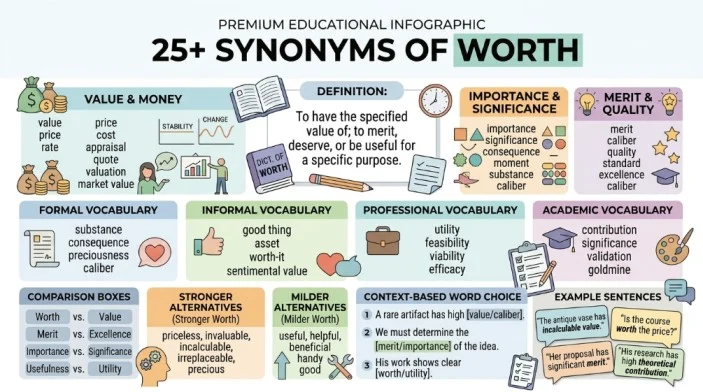
25 Best Synonyms of “Worth”
The word worth has multiple senses, so these alternatives are grouped according to the meaning they can accurately express. They should not be treated as interchangeable in every sentence.
| Synonym | Simple Meaning | Best Used For | Example Sentence |
|---|---|---|---|
| Value | The amount or importance something has | General, financial, professional | “The experience added great value to her career.” |
| Merit | Quality that deserves approval | Ideas, proposals, arguments | “The proposal has considerable merit.” |
| Importance | The degree to which something matters | General importance | “The importance of preparation is clear.” |
| Significance | Meaning or impact | Academic and formal writing | “The discovery has major significance.” |
| Utility | Practical usefulness | Tools, systems, methods | “The utility of the software is easy to see.” |
| Usefulness | Ability to provide practical help | Everyday and professional contexts | “The usefulness of the guide depends on accurate information.” |
| Benefit | A helpful result or advantage | Business and personal decisions | “The main benefit is improved efficiency.” |
| Advantage | A favorable condition or gain | Comparisons and decisions | “The lower cost is a major advantage.” |
| Gain | Something beneficial that is obtained | Business, finance, personal growth | “The training produced a significant gain in productivity.” |
| Price | Amount paid for something | Buying and selling | “The price of the equipment has increased.” |
| Cost | Amount required to obtain or produce something | Financial contexts | “The cost of repairs was higher than expected.” |
| Market value | Likely financial value in a market | Property and assets | “The home’s market value has increased.” |
| Monetary value | Value measured in money | Financial writing | “The artwork has considerable monetary value.” |
| Financial value | Economic benefit or worth | Business and investment | “The acquisition could create substantial financial value.” |
| Net value | Value remaining after relevant deductions | Finance and accounting | “The company’s net value changed after the acquisition.” |
| Quality | Degree of excellence | Products, work, services | “The quality of the workmanship is impressive.” |
| Excellence | Exceptional quality | Performance and achievement | “The award recognizes her excellence in teaching.” |
| Desirability | Degree to which something is wanted | Products, property, features | “Location increases the property’s desirability.” |
| Esteem | Respect or admiration | People and achievements | “She is held in high esteem by her colleagues.” |
| Regard | Respect or positive opinion | People and relationships | “He has great regard for his former teacher.” |
| Standing | Position or reputation within a group | Professional and social contexts | “Her professional standing grew over the years.” |
| Substance | Real value or meaningful content | Ideas, arguments, writing | “The proposal has considerable substance.” |
| Validity | Soundness or logical strength | Arguments and research | “The evidence supports the validity of the conclusion.” |
| Soundness | Quality of being reliable or well founded | Decisions and reasoning | “The committee questioned the soundness of the plan.” |
| Worthiness | Quality of deserving approval or respect | Recognition and moral contexts | “The committee considered the candidate’s worthiness for the award.” |
Synonyms of “Worth” by Usage
Professional vs Personal Synonyms
Professional writing usually benefits from precise terms such as value, benefit, merit, significance, and financial value.
For personal communication, meaning, value, regard, and esteem can sound more natural depending on the context.
Compare:
Professional:
“The proposal offers significant value to the organization.”
Personal:
“Her friendship has tremendous meaning in my life.”
Formal vs Conversational Synonyms
Formal writing often favors terms such as significance, merit, utility, and monetary value.
Conversational English usually sounds more natural with value, benefit, meaning, and usefulness.
For example:
Formal:
“The findings possess considerable significance for future research.”
Conversational:
“The findings have real value for future research.”
Academic Synonyms
Academic writing often requires precision rather than simply stronger vocabulary.
Useful choices include:
- Significance
- Merit
- Validity
- Utility
- Importance
- Substance
Significance is especially useful when explaining why research matters.
Merit works when evaluating the quality of an argument or proposal.
Validity is appropriate when discussing whether evidence, reasoning, or conclusions are sound.
Professional and Business Synonyms
For resumes, interviews, meetings, presentations, performance reviews, client communication, and business emails, the strongest practical choices include value, benefit, advantage, financial value, and strategic value.
Resume:
“Delivered measurable value through process improvements.”
Interview:
“I believe my experience can add significant value to the team.”
Meeting:
“The main benefit of this approach is improved efficiency.”
Client communication:
“The solution provides long term value without increasing complexity.”
Creative and Literary Synonyms
Creative writing often needs words that communicate more than financial or practical value.
Useful alternatives include:
- Meaning
- Significance
- Merit
- Excellence
- Esteem
- Worthiness
Example:
“The necklace had little monetary value, but its meaning to her was immeasurable.”
This distinction is especially useful in storytelling because something can have low financial value while having enormous emotional significance.
Slang or Modern Synonyms
There is no single widely accepted slang synonym for worth that can replace the word naturally in all situations.
Expressions such as a big deal can communicate importance in casual speech, but they are not direct synonyms for every meaning of worth.
Casual:
“That opportunity is a big deal for her.”
This means the opportunity is highly important.
For professional or academic writing, use value, significance, importance, or another context specific term instead.
Strongest to Mildest Synonyms
Because worth has several meanings, intensity depends on the sense being expressed.
Mild
Usefulness, benefit, and value can make relatively moderate claims.
Example:
“The tool has some usefulness for beginners.”
Moderate
Importance, merit, significance, and advantage communicate stronger value.
Example:
“The research has considerable significance.”
Strong
Excellence, substance, and esteem can express substantial quality or respect when the context supports them.
Example:
“Her work earned widespread esteem.”
Very Strong
Words such as paramount importance or exceptional value may express extremely high significance, but these are phrases rather than direct one word synonyms.
Example:
“Safety has paramount importance in this environment.”
The key point is that stronger vocabulary should be used only when the meaning genuinely supports it.
Emotional vs Neutral Synonyms
Emotional Synonyms
- Emotional alternatives focus on personal or human significance.
Meaning can express personal importance.
Esteem can express respect.
Regard can express admiration or respect.
Worthiness can suggest deserving respect or recognition.
Example:
“Her words had deep meaning for him.”
Neutral Synonyms
Neutral alternatives communicate value without adding strong emotion.
Value, utility, usefulness, benefit, importance, and significance are generally more objective.
Example:
“The study has practical value for educators.”
Use neutral terms for reports and analytical writing. Choose emotional terms when the purpose is to communicate personal significance or feeling.
Antonyms of “Worth”
The opposite of worth depends on the sense being discussed. These terms express low, absent, or reduced value in different contexts.
| Antonym | Meaning | Example Sentence |
|---|---|---|
| Worthlessness | Complete lack of value | The damaged item was considered worthlessness in practical terms. |
| Valuelessness | Absence of value | The document’s valuelessness became clear after the information was outdated. |
| Uselessness | Lack of practical usefulness | The uselessness of the broken tool was obvious. |
| Insignificance | Lack of importance | The issue’s insignificance became clear after further review. |
| Triviality | Lack of seriousness or importance | The triviality of the disagreement surprised everyone. |
| Irrelevance | Lack of connection or usefulness to the matter | The irrelevance of the detail became apparent. |
| Futility | Lack of useful result | They recognized the futility of continuing the argument. |
| Inferiority | Lower quality or status | The test revealed the product’s inferiority to its competitor. |
| Unimportance | Lack of importance | The manager explained the unimportance of the minor detail. |
| Pointlessness | Lack of purpose or useful result | The pointlessness of the exercise frustrated the students. |
| Meaninglessness | Lack of meaning | The repetition eventually gave the task a sense of meaninglessness. |
| Deficiency | Lack of an expected quality or amount | The product showed a serious deficiency in durability. |
| Disadvantage | An unfavorable condition | The higher price was a major disadvantage. |
| Loss | Reduction or absence of something valuable | The company experienced a financial loss. |
| Devaluation | Reduction in financial or perceived value | The currency suffered significant devaluation. |
Comparison: “Worth” vs Similar Words
Worth vs Value
Main Difference
Worth can describe value, but value is often more flexible and easier to use in professional contexts.
Which Is Stronger?
Neither is inherently stronger. The choice depends on the sentence.
Which Is More Formal?
Value often sounds slightly more professional when discussing business contribution or strategic benefit.
When to Use Each
Use worth for general value, especially in structures such as “worth doing.” Use value when describing contribution, benefit, or financial assessment.
Examples
Worth:
“The course was worth taking.”
Value:
“The course provided significant value to participants.”
Worth vs Price
Main Difference
Price is the amount someone pays or charges. Worth can describe perceived or actual value beyond the purchase price.
Which Is Stronger?
Neither.
Which Is More Formal?
Both are neutral.
When to Use Each
Use price for transactions. Use worth for value or benefit.
Examples
Worth:
“The painting is worth $10,000.”
Price:
“The asking price is $10,000.”
Worth vs Merit
Main Difference
Merit focuses on qualities that make something deserving of approval or consideration.
Which Is Stronger?
Merit can sound stronger when evaluating quality.
Which Is More Formal?
Merit is more formal and common in evaluative writing.
When to Use Each
Use worth broadly. Use merit when judging an argument, plan, proposal, or idea.
Examples
Worth:
“The idea is worth considering.”
Merit:
“The idea has considerable merit.”
Worth vs Importance
Main Difference
Importance specifically concerns how much something matters. Worth can also concern financial value, usefulness, or quality.
Which Is Stronger?
Neither is automatically stronger.
Which Is More Formal?
Both can work in formal writing.
When to Use Each
Use importance for issues, ideas, responsibilities, and events. Use worth when value has a broader meaning.
Examples
Worth:
“The experience was worth the effort.”
Importance:
“The importance of the experience became clear later.”
Worth vs Significance
Main Difference
Significance emphasizes meaning, influence, or importance. Worth is broader.
Which Is Stronger?
Significance can sound more substantial in academic or historical contexts.
Which Is More Formal?
Significance is more formal.
When to Use Each
Use significance when discussing impact or meaning.
Examples
Worth:
“The project was worth completing.”
Significance:
“The project has long term significance.”
Worth vs Usefulness
Main Difference
Usefulness specifically describes practical benefit. Worth can describe practical benefit but also money, quality, or importance.
Which Is Stronger?
Neither.
Which Is More Formal?
Both are neutral, although usefulness is more specific.
When to Use Each
Use usefulness for tools, information, methods, and resources.
Examples
Worth:
“The guide is worth reading.”
Usefulness:
“The usefulness of the guide depends on the reader’s goals.”
Common Phrases and Expressions with “Worth”
Worth the Money
Meaning: Something provides enough value to justify its price.
Example Sentence:
“The premium version is worth the money because it includes several useful features.”
Worth the Effort
Meaning: The result justifies the work required.
Example Sentence:
“Learning these skills takes time, but the effort is worth it.”
Worth the Time
Meaning: Something deserves the time needed to complete or experience it.
Example Sentence:
“The documentary is worth the time if you enjoy historical stories.”
Worth Considering
Meaning: Something deserves careful thought.
Example Sentence:
“Your proposal is definitely worth considering.”
Worth Mentioning
Meaning: Something deserves to be included in a discussion.
Example Sentence:
“It is worth mentioning that the deadline has changed.”
Worth Noting
Meaning: A detail deserves attention.
Example Sentence:
“It is worth noting that the results varied by age group.”
Worth Doing
Meaning: An activity is valuable enough to justify the effort.
Example Sentence:
“Taking the extra course is worth doing if you want to develop new skills.”
Worth a Fortune
Meaning: Something has extremely high monetary value.
Example Sentence:
“The antique watch may be worth a fortune.”
Common Mistakes to Avoid
Mistake 1: Treating Every Synonym as Interchangeable
Incorrect
“The price of the research is significant.”
Better
“The cost of the research is significant.”
Why
Price and cost concern money, while significance concerns importance or meaning.
Mistake 2: Confusing Worth With Price
Incorrect
“The house’s worth is the amount the seller is asking.”
Better
“The house’s asking price is the amount the seller is requesting.”
Why
An asking price is a specific selling figure. Worth can refer to broader financial or perceived value.
Mistake 3: Using Informal Language in Formal Writing
Incorrect
“The study is a big deal.”
Better
“The study has considerable significance.”
Why
The revised sentence is more appropriate for academic communication.
Mistake 4: Choosing an Overly Dramatic Synonym
Incorrect
“The usefulness of a pencil is paramount.”
Better
“The usefulness of a pencil is practical and straightforward.”
Why
Paramount expresses an extremely high priority and would be unnecessarily dramatic here.
Mistake 5: Repeating “Worth” Too Often
Incorrect
“The course is worth taking because the material is worth studying and the certificate is worth having.”
Better
“The course is worth taking because the material is valuable and the certificate can strengthen your professional profile.”
Why
Varying vocabulary improves flow and avoids repetitive writing.
Mistake 6: Using a Financial Synonym for Emotional Value
Incorrect
“The memory had great monetary value to her.”
Better
“The memory had great meaning to her.”
Why
Monetary value refers to money, while meaning expresses emotional or personal significance.
Mistake 7: Using Slang in Academic Writing
Incorrect
“The discovery was a big deal.”
Better
“The discovery was significant.”
Why
Significant communicates the idea objectively and fits academic writing better.
Frequently Asked Questions
1. What are the best synonyms of “worth”?
The best synonym of worth is usually value, but the correct choice depends on context. Merit, significance, importance, benefit, usefulness, and market value each express different types of value.
2. What are the best formal synonyms of “worth”?
Formal alternatives include value, merit, significance, utility, importance, financial value, and monetary value. The best option depends on whether you are discussing quality, importance, usefulness, or money.
3. What are common informal synonyms of “worth”?
In everyday English, value, benefit, meaning, and usefulness can replace worth in appropriate contexts. Casual expressions such as a big deal can express importance but are not universal synonyms.
4. What is another word for “worth” in professional writing?
Value is usually the most versatile professional alternative to worth. Depending on context, benefit, merit, significance, utility, or financial value may communicate the intended meaning more precisely.
5. What is the difference between “worth” and “value”?
Worth and value are closely related, but value is often broader and more flexible. Worth commonly describes what something is worth, while value can emphasize usefulness, contribution, importance, or financial significance.
6. What is the opposite of “worth”?
There is no single antonym for every sense of worth. Depending on context, useful opposites include worthlessness, uselessness, insignificance, irrelevance, pointlessness, and devaluation.
Conclusion
Worth is a flexible English word that can describe financial value, practical usefulness, quality, importance, personal meaning, or deservingness. Because its meaning changes with context, the best replacement is not always the same.
For general and professional writing, value is usually the strongest alternative. Significance works well for academic and formal contexts, merit suits evaluations, benefit emphasizes practical advantages, usefulness describes function, and meaning is often better for emotional writing.
No synonym works perfectly in every situation. Before replacing worth, identify what you actually mean, then choose the word that communicates that idea most precisely. A useful vocabulary habit is to learn synonyms in context rather than memorizing isolated word lists. This makes it easier to choose the right synonym of worth naturally.
Read More Related Articles:
Meaning, Uses, Examples, and the Best Synonym of Complain
25+ Synonyms of Frequency | Meanings, Uses, Examples …
50+ Synonyms of This | Meanings, Uses, Examples, and Best …