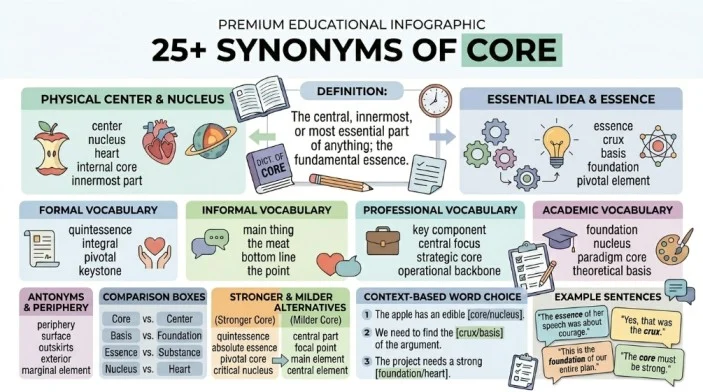
Writers often use core repeatedly when describing the main part of an idea, organization, problem, or object. In an essay, business report, email, blog post, or presentation, replacing the same word with a more precise alternative can make the writing clearer and more natural.
The best synonym of core depends on what you mean. Center works well for a physical or conceptual middle, essence emphasizes the fundamental nature of something, crux identifies the most important point, and nucleus often describes a central group or part. Understanding these differences helps you choose vocabulary that fits your exact context rather than simply swapping one word for another.
What Are the Best Synonyms of “Core”?
The best synonym of core depends on its meaning. Use center for the middle of something, essence for its fundamental nature, crux for the most important point, nucleus for a central group or part, and heart for emotional or central importance. In professional and academic writing, central element, foundation, and basis are also useful.
Meaning, Tone, and Context
Simple Definition
Core refers to the central, most important, or essential part of something. It can describe a physical center, the main idea of an argument, the essential qualities of a subject, or a group that forms the center of an organization or activity.
For example, in the sentence, “Trust is at the core of the relationship,” core means the fundamental or most important part.
Part of Speech
Core is most commonly used as a noun.
It can also function as an adjective when it describes something central or essential.
Examples:
- “The apple’s core was removed.”
- “These are our core values.”
- “She is part of the core team.”
Overall Tone
Core is generally neutral. It does not automatically express a positive or negative attitude.
Its meaning comes mainly from context. A writer can discuss the core of a problem, the core of a successful strategy, or the core of an argument.
Formality Level
Core is a neutral, versatile word.
It works naturally in:
- Academic writing
- Business communication
- Professional reports
- Everyday conversation
- Technical writing
- Journalism
- Creative writing
- Educational content
Some alternatives, such as crux, quintessence, and pith, can sound more formal or literary.
Common Uses
Native English speakers commonly use core in several ways.
Physical center:
“The peach has a hard core.”
Central idea:
“The core of her argument is easy to understand.”
Essential quality:
“Honesty is at the core of his leadership style.”
Main group:
“A small core of volunteers organized the event.”
Business or professional context:
“Customer service is a core part of the company’s strategy.”
Technical context:
“The processor has multiple cores.”
Word Forms
| Form | Example |
|---|---|
| Noun | “The core of the issue is trust.” |
| Adjective | “These are our core services.” |
| Related noun | “The core remains intact.” |
There is no commonly used verb form of core in ordinary American English that functions as a direct equivalent of its main noun meaning.
When and How to Use “Core”
Use core when you want to identify something as central, fundamental, or especially important within a larger whole. It is particularly useful when the relationship between the central part and the surrounding parts matters.
Professional
“Communication is at the core of effective leadership.”
Here, core identifies communication as a fundamental element of leadership.
Academic
“The core of the theory is based on human behavior.”
This use identifies the central concept within an academic idea.
Workplace
“Our core team meets every Monday to discuss project priorities.”
Here, core describes the main or central group.
Personal
“Family remains at the core of her values.”
This use emphasizes deep personal importance.
“The core issue is the delay in receiving the required documents.”
This makes the central problem clear without sounding overly dramatic.
Resume
“Developed strategies around the company’s core business objectives.”
The word works well in professional documents because it is concise and widely understood.
Social Media
“Kindness is at the core of everything we do.”
This gives a simple statement a sense of purpose and central value.
Best Synonyms of “Core”
No synonym of core works perfectly in every context. The word can describe a physical center, an essential idea, a central group, or the fundamental nature of something, so the best alternative depends on the intended meaning.
Professional Writing: Central Element
Central element is useful when describing the most important component of a system, plan, strategy, or process.
Example:
“Trust is a central element of successful client relationships.”
It sounds precise without being unnecessarily formal.
Academic Writing: Essence
Essence works well when discussing the fundamental nature or defining quality of a concept.
Example:
“The essence of the argument is that education should remain accessible.”
It is especially useful when the writer is explaining what something fundamentally means.
Business Communication: Key Component
Key component clearly identifies an essential part of a process, strategy, or system.
Example:
“Employee training is a key component of the new development program.”
Casual Conversation: Heart
Heart is natural when talking about the central or most meaningful part of an idea, relationship, or situation.
Example:
“At the heart of the problem is a lack of communication.”
Emotional Writing: Heart
For emotional writing, heart can be more expressive than core.
Example:
“At the heart of her story is a desire to belong.”
It adds warmth and emotional depth.
Creative Writing: Essence
Essence can work well in literary and descriptive writing when you want to emphasize a person’s or thing’s defining nature.
Example:
“The quiet village captured the essence of life by the sea.”
Resume Writing: Key
Key is concise and highly useful in resumes.
Example:
“Led key initiatives that improved customer retention.”
It avoids repetition while keeping the language direct.
Workplace Communication: Central
Central works naturally when describing something that occupies an important position in a process or discussion.
Example:
“Data security is central to our technology strategy.”
Stronger Meaning: Crux
Crux identifies the most decisive or difficult point of an issue.
Example:
“The crux of the problem is insufficient funding.”
It is stronger and more specific than simply saying core.
Softer Meaning: Main Part
Main part is a straightforward alternative when you want simple, accessible language without adding extra emphasis.
Example:
“The main part of the presentation focuses on customer needs.”
When Not to Use “Core”
Although core is flexible, another word may communicate your meaning more precisely.
When “Core” Is Too General
If you want to identify the exact central point of an argument, crux may be better.
Less precise:
“The core of the disagreement was unclear.”
Better:
“The crux of the disagreement was the proposed budget.”
Why:
Crux specifically points to the decisive issue.
When “Core” Is Too Vague
When discussing a defining characteristic, essence can provide a clearer meaning.
Less precise:
“The core of the tradition has changed.”
Better:
“The essence of the tradition has changed.”
Why:
Essence focuses on the fundamental nature of something.
When “Core” Sounds Too Technical
For general readers, main part or heart may sound more approachable.
Less natural for a casual audience:
“The core of the story was friendship.”
More conversational:
“The heart of the story was friendship.”
When “Core” Is Too Weak
If you mean that something determines the outcome, foundation or cornerstone may provide stronger emphasis.
Less forceful:
“Trust is at the core of the partnership.”
Stronger:
“Trust is the foundation of the partnership.”
When “Core” Is Too Strong
If you only mean the middle or central location, center is often more accurate.
Less precise:
“The core of the room was crowded.”
Better:
“The center of the room was crowded.”
When “Core” Is Not the Most Natural Physical Term
For a physical object, the correct synonym depends heavily on the object itself.
Example:
“The center of the circle.”
Here, center is more natural than core.
Words Commonly Confused With “Core”
| Word | Difference | When to Use It | Example |
|---|---|---|---|
| Center | Refers primarily to the middle position or point. | Physical or conceptual middle. | “The table stood in the center of the room.” |
| Essence | Focuses on fundamental nature or defining qualities. | Ideas, identities, experiences, and concepts. | “Freedom is the essence of the movement.” |
| Crux | Identifies the decisive or most difficult point. | Problems, arguments, and debates. | “The crux of the issue is cost.” |
| Nucleus | Describes a central part or central group around which other elements develop. | Science, organizations, and groups. | “A small nucleus of volunteers led the project.” |
| Foundation | Refers to the underlying basis that supports something. | Systems, relationships, businesses, and ideas. | “Trust provides the foundation for the partnership.” |
| Heart | Suggests the central or most meaningful part, often with emotional force. | Stories, relationships, values, and problems. | “At the heart of the story is a family conflict.” |
Best Synonyms of “Core” by Context
| Context | Best Synonym | Why It Works | Example |
|---|---|---|---|
| Formal writing | Essence | Expresses fundamental nature precisely. | “The essence of the proposal is efficiency.” |
| Academic writing | Central element | Clearly identifies a major component. | “Culture is a central element of the theory.” |
| Professional communication | Key component | Direct and practical. | “Training is a key component of the program.” |
| Business emails | Main issue | Makes the central concern immediately clear. | “The main issue is the missing invoice.” |
| Resume writing | Key | Concise and professional. | “Managed key customer accounts.” |
| Workplace communication | Central | Highlights an important position or role. | “Safety is central to our operations.” |
| Casual conversation | Heart | Natural and expressive. | “That’s the heart of the problem.” |
| Everyday speaking | Center | Simple and familiar. | “The center of the discussion was cost.” |
| Creative writing | Essence | Adds descriptive depth. | “The poem captures the essence of solitude.” |
| Storytelling | Heart | Emphasizes emotional meaning. | “Friendship is the heart of the story.” |
| Emotional writing | Heart | Adds warmth and feeling. | “Love was at the heart of their relationship.” |
| Strong emphasis | Crux | Identifies the decisive issue. | “The crux is whether the plan is affordable.” |
| Mild tone | Main part | Simple and understated. | “The main part of the lesson covers grammar.” |
| Social media captions | Heart | Short, warm, and relatable. | “Family is the heart of everything.” |
| American English | Center | Standard American spelling and usage. | “The center of the town is busy.” |
| British English | Centre | Standard British spelling for the middle or focal location. | “The town centre was crowded.” |
How to Choose the Best Synonym of “Core”
Choosing the right alternative starts with identifying exactly what core means in your sentence.
If You Mean the Middle
Choose center.
“Place the box in the center of the table.”
If You Mean the Fundamental Nature
Choose essence.
“The essence of the philosophy is simplicity.”
If You Mean the Most Important Issue
Choose crux.
“The crux of the debate is funding.”
If You Mean an Essential Supporting Basis
Choose foundation.
“Trust is the foundation of a healthy relationship.”
If You Mean a Central Group
Choose nucleus.
“A small nucleus of researchers continued the project.”
If You Want Emotional Meaning
Choose heart.
“At the heart of the novel is a story about forgiveness.”
If You Need Professional Concision
Choose key or central.
“She handled several key responsibilities.”
The best word is the one that communicates your intended meaning most clearly without making the sentence sound forced.
Real Life Examples of “Core”
School
Original:
“Reading is at the core of language education.”
Alternative:
“Reading is a fundamental part of language education.”
The alternative emphasizes that reading provides a basic foundation for learning.
College
Original:
“The core of the research examines student motivation.”
Alternative:
“The central focus of the research is student motivation.”
This version is particularly clear in an academic setting.
Workplace
Original:
“Communication is at the core of effective teamwork.”
Alternative:
“Communication is a key component of effective teamwork.”
The second version sounds practical and professional.
Business
Original:
“Customer satisfaction is at the core of our strategy.”
Alternative:
“Customer satisfaction is central to our strategy.”
This is concise and natural in business writing.
Original:
“The core issue is the delayed shipment.”
Alternative:
“The main issue is the delayed shipment.”
The second version is simple and direct for everyday professional communication.
Resume
Original:
“Managed core business operations.”
Alternative:
“Managed key business operations.”
The alternative sounds concise and achievement focused.
Conversation
Original:
“The core of the problem is poor communication.”
Alternative:
“The heart of the problem is poor communication.”
Heart sounds more conversational and expressive.
Storytelling
Original:
“The core of the story is about forgiveness.”
Alternative:
“At the heart of the story is a powerful lesson about forgiveness.”
The alternative creates more emotional depth.
Blogging
Original:
“The core idea of this article is simple.”
Alternative:
“The central idea of this article is simple.”
Central idea is particularly natural in explanatory writing.
Social Media
Original:
“Family is at the core of everything I do.”
Alternative:
“Family is at the heart of everything I do.”
The second version feels warmer and more personal.
25 Best Synonyms of “Core”
| Synonym | Simple Meaning | Best Used For | Example Sentence |
|---|---|---|---|
| Center | The middle or central point | Physical and conceptual locations | “The fountain stands at the center of the plaza.” |
| Heart | The central or most meaningful part | Emotional and general writing | “Trust is at the heart of their partnership.” |
| Nucleus | A central part or group | Groups, science, organizations | “The original team formed the nucleus of the company.” |
| Essence | The fundamental nature of something | Ideas and concepts | “The essence of the message is compassion.” |
| Crux | The decisive central point | Problems and arguments | “The crux of the debate is affordability.” |
| Kernel | The essential or central part | Ideas and technical contexts | “The kernel of the idea was surprisingly simple.” |
| Gist | The main meaning or point | Conversation and summaries | “She understood the gist of his explanation.” |
| Pith | The essential or central substance | Formal and literary writing | “The pith of the argument concerns public access.” |
| Marrow | The deepest or most essential part | Literary or formal writing | “The marrow of the discussion was personal responsibility.” |
| Substance | The essential content or meaning | Formal and academic writing | “The substance of the proposal deserves attention.” |
| Foundation | The underlying basis | Systems, relationships, ideas | “Respect is the foundation of effective teamwork.” |
| Basis | The fundamental support or reason | Academic and professional writing | “Evidence provides the basis for the conclusion.” |
| Cornerstone | A fundamental supporting element | Business, society, ideas | “Education is a cornerstone of economic development.” |
| Backbone | The main supporting structure | Organizations and systems | “Small businesses form the backbone of the local economy.” |
| Mainstay | A dependable central support | Organizations and activities | “Volunteers are a mainstay of the community program.” |
| Central element | A major part of a whole | Academic and professional writing | “Trust is a central element of effective leadership.” |
| Central point | The main point or location | Arguments and discussions | “The central point of the article is easy to identify.” |
| Central part | The middle or essential section | General writing | “The central part of the plan addresses staffing.” |
| Focal point | The main point receiving attention | Discussions and visual descriptions | “The new library became the focal point of the campus.” |
| Key component | An essential part of a system | Business and technical writing | “Testing is a key component of the process.” |
| Main part | The most significant section | Simple everyday English | “The main part of the meeting covered the budget.” |
| Central feature | A major defining characteristic | Descriptive and professional writing | “Flexibility is a central feature of the program.” |
| Mainstay | A major source of support | Formal and general writing | “Tourism remains a mainstay of the local economy.” |
| Quintessence | The purest or most typical example | Literary and highly formal writing | “The building represents the quintessence of modern design.” |
| Innermost part | The deepest internal section | Physical descriptions | “The seed develops within the innermost part of the fruit.” |
Synonyms of “Core” by Usage
Professional vs Personal Synonyms
Professional writing benefits from direct and precise alternatives.
Use key, central, essential, central element, and key component in workplace documents.
Personal writing can use more expressive choices such as heart, essence, and meaningful center when the emotional dimension matters.
Professional:
“Customer satisfaction is a key component of our strategy.”
Personal:
“Family is at the heart of my life.”
The first sentence is objective and business focused. The second emphasizes emotional importance.
Formal vs Conversational Synonyms
Reports
Use essence, central element, substance, or basis.
Essays
Use central idea, essence, foundation, or crux, depending on the meaning.
Business Writing
Use key component, central, essential, or foundation.
Presentations
Use central point, key element, or focal point.
Emails
Use main issue, central concern, or key point.
Casual Conversations
Use heart, center, main part, or gist.
Texting
Simple terms such as main point, center, or heart are usually more natural than highly formal words such as quintessence.
Academic Synonyms
Academic writing benefits from distinguishing between the main idea, the fundamental nature of an argument, and the basis supporting a conclusion.
Essence
Use essence when discussing the fundamental nature of an idea.
“The essence of the theory lies in its treatment of social behavior.”
Central Idea
Use central idea when identifying the main concept in a text.
“The central idea of the article concerns unequal access to education.”
Crux
Use crux when identifying the decisive point in an argument.
“The crux of the debate involves the reliability of the available evidence.”
Foundation
Use foundation when discussing underlying principles.
“Empirical evidence provides the foundation for the study.”
Basis
Use basis when explaining what supports a conclusion.
“The findings provide a strong basis for further research.”
These alternatives can make academic writing more precise because they distinguish different relationships rather than treating every central idea as simply core.
Professional and Business Synonyms
Resumes
Use key, central, and essential.
“Managed key operational processes.”
Interviews
Use foundation, central, or essential when explaining skills or values.
“Clear communication is a foundation of my management approach.”
Meetings
Use central point, main issue, or key point.
“The key point is that the project needs additional resources.”
Presentations
Use focal point or central theme.
“Customer experience is the central theme of this presentation.”
Performance Reviews
Use key contribution, central responsibility, or essential role.
“She made a key contribution to the team’s success.”
Client Communication
Use main concern, central issue, or key requirement.
“The main concern is meeting the client’s delivery date.”
Business Emails
Use key point, main issue, or essential information.
“The key point is that the contract requires another review.”
Creative and Literary Synonyms
Creative writing allows more expressive alternatives.
Heart
Heart gives a story emotional depth.
“At the heart of the novel is a complicated family relationship.”
Essence
Essence can describe the defining quality of a person, place, or experience.
“The painting captures the essence of summer.”
Marrow
Marrow is more literary and can suggest the deepest substance of an idea.
“The marrow of his argument was difficult to ignore.”
Quintessence
Quintessence is highly formal and literary. It means the purest or most characteristic example of something.
“Her performance was the quintessence of elegance.”
Because it is uncommon in ordinary conversation, it should be used selectively.
Focal Point
Focal point works especially well when describing visual attention.
“The red doorway became the focal point of the painting.”
Slang or Modern Synonyms
There is no single slang word that consistently means core in every context.
In casual American English, expressions such as heart, main thing, main point, and center can replace core depending on the sentence.
For example:
“What’s the main point?”
This is much more natural in casual conversation than:
“What is the quintessence?”
Highly formal alternatives should generally be avoided in texting and relaxed conversation unless the unusual wording is intentional.
Strongest to Mildest Synonyms
The intensity of a synonym for core depends on whether the word emphasizes central position, necessity, or fundamental meaning.
| Level | Useful Alternatives | Typical Effect |
|---|---|---|
| Mild | Main part, center, central part | Simply identifies a central section. |
| Moderate | Key component, central element, focal point | Indicates greater relevance. |
| Strong | Foundation, cornerstone, backbone, crux | Suggests essential support or decisive importance. |
| Very Strong | Essence, quintessence | Emphasizes fundamental or defining nature. |
These levels are not absolute. A word’s strength changes according to context.
For example, center is not necessarily weaker than essence. They describe different aspects of centrality.
Emotional vs Neutral Synonyms
Emotional Synonyms
Use these when the central part has personal or emotional significance.
- Heart
- Essence
- Marrow
- Precious center, in highly personal descriptive writing
Example:
“At the heart of the story is a family’s struggle to stay together.”
Neutral Synonyms
Use these when you want to communicate information objectively.
- Center
- Central element
- Central point
- Key component
- Main part
- Foundation
- Basis
- Nucleus
Example:
“The central element of the experiment was the control group.”
Neutral alternatives are generally better for technical, academic, and professional writing.
Antonyms of “Core”
Because core can mean either a physical center or an essential part, it does not have one universal antonym. The following words are contextual opposites that describe outer, noncentral, secondary, or less essential positions.
| Antonym | Meaning | Example Sentence |
|---|---|---|
| Periphery | The outer edge of something | “The villages lie on the periphery of the city.” |
| Edge | The outer boundary | “The chair was placed near the edge of the room.” |
| Exterior | The outside part | “The exterior of the building was recently renovated.” |
| Surface | The outermost layer | “The scratch only affected the surface.” |
| Outside | The part away from the center | “The decorations were placed on the outside.” |
| Outskirts | Areas beyond the central part of a city or place | “They moved to the outskirts of town.” |
| Margin | The outer or less central area | “The notes were written in the margin.” |
| Fringe | The outer edge or less central position | “The group operates on the fringe of the movement.” |
| Exteriority | The condition of being outside | “The design emphasizes the building’s exteriority.” |
| Secondary part | A less central component | “The decorative feature is only a secondary part of the design.” |
| Peripheral element | A component outside the main focus | “The issue is a peripheral element of the discussion.” |
| Outer layer | The part surrounding the center | “The fruit has a thin outer layer.” |
| Outer portion | A section away from the center | “The outer portion of the structure was damaged.” |
| Minor aspect | A less important feature | “That detail is only a minor aspect of the proposal.” |
| Peripheral area | A region away from the central area | “The development reached the peripheral area of the city.” |
Comparison: “Core” vs Similar Words
Core vs Center
Main Difference
Core often suggests an essential or fundamental part, while center primarily describes the middle position.
Which Is Stronger?
Core can carry more conceptual importance. Center is more spatial.
Which Is More Formal?
Both are neutral and suitable for formal writing.
When to Use Each
Use center for physical locations and core for essential concepts.
Examples
Core:
“Trust is at the core of the relationship.”
Center:
“The statue stands in the center of the square.”
Core vs Essence
Main Difference
Core can refer to a central part, while essence focuses on fundamental nature.
Which Is Stronger?
Neither is universally stronger. Essence is more abstract.
Which Is More Formal?
Essence can sound more formal or literary.
When to Use Each
Use essence when explaining what fundamentally defines something.
Examples
Core:
“The core of the strategy is customer retention.”
Essence:
“The essence of the strategy is customer trust.”
Core vs Crux
Main Difference
Crux specifically refers to the decisive point of an issue, argument, or problem.
Which Is Stronger?
Crux is more pointed because it identifies the decisive issue.
Which Is More Formal?
Crux is somewhat more formal than everyday core.
When to Use Each
Use crux for debates, disagreements, and complex problems.
Examples
Core:
“The core of the problem involves poor communication.”
Crux:
“The crux of the problem is the lack of funding.”
Core vs Nucleus
Main Difference
Nucleus often describes a central group or structure around which other elements form.
Which Is Stronger?
Neither is inherently stronger.
Which Is More Formal?
Nucleus can sound more technical or formal.
When to Use Each
Use nucleus for scientific contexts or central groups.
Examples
Core:
“The core team handled the project.”
Nucleus:
“A small nucleus of researchers continued the work.”
Core vs Foundation
Main Difference
Foundation describes what supports or provides a basis for something. Core identifies what is central or essential.
Which Is Stronger?
Foundation can imply deeper structural importance.
Which Is More Formal?
Both are widely accepted in professional and academic writing.
When to Use Each
Use foundation when one element supports the development of another.
Examples
Core:
“Communication is at the core of leadership.”
Foundation:
“Communication provides the foundation for effective leadership.”
Core vs Heart
Main Difference
Both can mean the central or most meaningful part, but heart often carries more emotional warmth.
Which Is Stronger?
Heart can feel more emotionally expressive.
Which Is More Formal?
Core is generally more neutral. Heart is more conversational or literary when used figuratively.
When to Use Each
Use heart for stories, relationships, emotions, and personal values.
Examples
Core:
“Honesty is at the core of her philosophy.”
Heart:
“Honesty is at the heart of her philosophy.”
Common Phrases and Expressions with “Core”
Core Values
Meaning
The principles or beliefs that strongly guide a person or organization.
Example Sentence
“Integrity and respect are among our company’s core values.”
Core Team
Meaning
The main group responsible for an activity or project.
Example Sentence
“The core team will review the proposal tomorrow.”
Core Issue
Meaning
The main or central problem that needs attention.
Example Sentence
“The core issue is the lack of reliable data.”
Core Competencies
Meaning
The abilities or areas of expertise that are central to an individual or organization.
Example Sentence
“Communication and problem solving are two of her core competencies.”
Core Business
Meaning
The primary business activity that an organization focuses on.
Example Sentence
“The company plans to invest more heavily in its core business.”
Core Principle
Meaning
A fundamental rule or belief that guides behavior or decisions.
Example Sentence
“Fairness is a core principle of the organization.”
Core Function
Meaning
A primary activity that something is designed to perform.
Example Sentence
“Processing customer orders is a core function of the system.”
At the Core of
Meaning
Used to show that something is fundamental to a larger idea, system, or situation.
Example Sentence
“Trust is at the core of every successful partnership.”
Common Mistakes to Avoid
1. Treating Every Synonym as Identical
Incorrect
“The crux of the apple was removed.”
Better
“The core of the apple was removed.”
Why
Crux refers to a decisive point in an issue or argument. It does not normally describe the physical center of an apple.
2. Using “Center” When You Mean “Essential Part”
Incorrect
“Honesty is at the center of her values.”
Better
“Honesty is at the core of her values.”
Why
Both can work figuratively, but core more directly communicates fundamental importance.
3. Using a Highly Formal Word in Casual Conversation
Incorrect
“The quintessence of our disagreement is your schedule.”
Better
“The main issue is your schedule.”
Why
Quintessence is unusually formal and can sound unnatural in ordinary conversation.
4. Using “Core” When You Simply Mean “Middle”
Incorrect
“The core of the room has a large table.”
Better
“The center of the room has a large table.”
Why
Center is the natural word for a physical middle point.
5. Confusing “Essence” With “Core”
Incorrect
“The essence of the circle is exactly five feet from the wall.”
Better
“The center of the circle is exactly five feet from the wall.”
Why
Essence concerns fundamental nature, not physical location.
6. Choosing a Synonym That Is Too Dramatic
Incorrect
“The core of my lunch was a sandwich.”
Better
“The main part of my lunch was a sandwich.”
Why
Not every central element needs a powerful or abstract synonym.
7. Using Unnatural Vocabulary to Avoid Repetition
Incorrect
“The quintessence of the meeting was a discussion about parking.”
Better
“The main topic of the meeting was parking.”
Why
Clear, familiar vocabulary is usually better than an unusual synonym chosen only to avoid repetition.
Frequently Asked Questions
1. What are the best synonyms of “core”?
The best synonyms of core include center, heart, essence, nucleus, crux, foundation, basis, key component, and central element. The best choice depends on whether you mean location, importance, meaning, or structure.
2. What are the best formal synonyms of “core”?
Formal alternatives include essence, crux, nucleus, foundation, basis, central element, and substance. For academic writing, choose the word that most precisely describes the relationship between the central idea and the rest of the subject.
3. What are common informal synonyms of “core”?
Common conversational alternatives include center, heart, main part, and main point. These are usually easier and more natural than highly formal choices such as quintessence or pith.
4. What is another word for “core” in professional writing?
In professional writing, useful alternatives include key, central, essential, key component, central element, and foundation. Choose based on whether you mean importance, position, support, or a major component of a system.
5. What is the difference between “core” and “center”?
Core often means the essential or fundamental part of something, while center usually means the middle location or central point. For example, a building has a center, while trust can be at the core of a relationship.
6. What is the opposite of “core”?
There is no single universal opposite of core. Depending on context, possible opposites include periphery, edge, exterior, surface, margin, fringe, and outskirts, especially when describing physical or conceptual outer areas.
Conclusion
The word core can describe a physical center, an essential idea, a central group, or the fundamental nature of something. Because these meanings are not identical, the best synonym of core depends on what you want your sentence to communicate.
Use center for a middle position, essence for fundamental nature, crux for a decisive issue, nucleus for a central group, foundation for underlying support, and heart when emotional or personal meaning is important. In professional writing, key, central, and key component are often clear and effective choices.
The best vocabulary improvement habit is to identify the exact meaning you intend before replacing a word. Instead of searching for any synonym, choose the alternative that matches your meaning, audience, tone, and purpose most naturally.
Read More Related Articles:
25+ Synonyms, Meanings, Uses, Examples, and Best …
Meaning, Uses, Examples, and the Best Synonym of Complain
25+ Synonyms of Frequency | Meanings, Uses, Examples …