When the word certain appears repeatedly in an essay, email, caption, resume, or blog post, the writing can quickly start to sound repetitive. Finding the right synonym of certain lets you express confidence, certainty, a specific but unnamed thing, or an unavoidable result with much greater precision.
The best alternative depends on what you mean. Words such as sure, definite, specific, particular, certainly, and inevitable are related to certain, but they do not work in exactly the same situations.
What Are the Best Synonyms of “Certain”?
Certain can mean sure or confident about something, or it can refer to a particular but unspecified person or thing. The best synonyms include sure for everyday speech, definite for clear certainty, specific for precise reference, particular for an individual item, and inevitable when an outcome cannot be avoided.
Meaning, Tone, and Context
Simple Definition
Certain has two closely related uses.
First, it can mean sure, confident, or without doubt.
“I am certain that she will arrive on time.”
Here, certain describes confidence in the truth of something.
Second, certain can mean a particular person, thing, or group that is identified without being named directly.
“Certain students prefer to study in the morning.”
Here, certain means particular or specific students, but the exact students are not identified.
This second meaning is especially common in formal and written English.
Part of Speech
Certain is primarily an adjective.
It can describe:
- Confidence or lack of doubt.
- A particular person, thing, or group.
- An outcome that is unavoidable.
Overall Tone
The tone of certain is generally neutral.
It does not inherently express a positive or negative feeling. Its effect depends on the context.
For example:
“I am certain about my decision.”
This expresses confidence.
“Certain rules must be followed.”
This refers to particular rules.
Formality Level
Certain is a neutral to slightly formal word. It is natural in everyday conversations, but it is also common in academic, professional, legal, and business writing.
Examples include:
“I am certain that this is the correct address.”
“Certain conditions must be met before approval.”
Common Uses
Native English speakers commonly use certain in expressions involving:
- Confidence
- Decisions
- Predictions
- Rules
- Conditions
- Particular people
- Particular things
- Unavoidable outcomes
- Formal qualifications
- General statements
Common patterns include:
be certain that
“She is certain that the plan will work.”
be certain about
“Are you certain about your choice?”
make certain
“Please make certain that all documents are complete.”
for certain
“We do not know for certain what happened.”
certain people
“Certain people prefer working independently.”
certain conditions
“The offer is available under certain conditions.”
Word Forms
| Word | Type | Example |
|---|---|---|
| Certain | Adjective | “I am certain about the result.” |
| Certainly | Adverb | “She will certainly notice the difference.” |
| Certainty | Noun | “There is no certainty about the outcome.” |
| Uncertain | Adjective | “The future remains uncertain.” |
| Uncertainty | Noun | “The uncertainty affected their decision.” |
When and How to Use “Certain”
Choose certain when you want to communicate confidence, identify something particular without naming it directly, or describe an outcome as unavoidable.
Professional
“We are certain that the revised process will improve efficiency.”
In professional writing, certain communicates confidence without sounding excessively emotional.
Academic
“Certain factors may influence the reliability of the results.”
Here, certain refers to particular factors without specifying every one.
Workplace
“Please make certain that the equipment is turned off before leaving.”
This use emphasizes responsibility and completeness.
Personal
“I am certain that you made the right decision.”
The word communicates strong personal confidence.
“Please be certain that all required documents are attached before submitting the application.”
This sounds clear and professional.
Resume
“Developed processes to make certain that customer records remained accurate.”
In a resume, however, ensure may often sound more direct:
“Developed processes to ensure customer records remained accurate.”
Social Media
“One thing is certain: hard work eventually teaches you something valuable.”
This conversational structure works well when making a confident statement.
Best Synonyms of “Certain”
No single synonym can replace certain in every sentence because certain has several meanings. The best alternative depends on whether you mean confidence, a particular item, or an unavoidable result.
Professional Writing: Definite
Definite works well when something is clear, settled, or not doubtful.
“We need a definite answer before moving forward.”
It is especially useful when discussing plans, decisions, dates, or conclusions.
Academic Writing: Specific
Specific is often the better choice when certain means a particular item, factor, or example.
“Specific variables were excluded from the analysis.”
It gives the reader more precision than the broader word certain.
Business Communication: Sure
Sure expresses confidence clearly, although it is less formal than some alternatives.
“We are sure that the new approach will improve customer service.”
For highly formal documents, confident or certain may be preferable.
Casual Conversation: Sure
In everyday American English, sure is often more natural than certain when expressing confidence.
“I’m sure she’ll call later.”
This sounds relaxed and conversational.
Emotional Writing: Confident
Confident emphasizes a person’s strong belief in their own judgment or ability.
“She felt confident about her decision.”
It is more personal than definite.
Creative Writing: Inevitable
Inevitable is effective when describing an outcome that cannot be avoided.
“The changing seasons made the coming winter inevitable.”
It adds a stronger sense of consequence.
Resume Writing: Definite
When describing clear results or established outcomes, definite can sometimes replace certain, although more specific action language is often better.
“Established definite procedures for handling customer complaints.”
In many resumes, ensured or established clear procedures would sound more natural.
Workplace Communication: Clear
Clear is useful when the intended meaning is that something is settled, understandable, or not ambiguous.
“We need clear expectations before the project begins.”
Stronger Meaning: Absolute
Absolute can express an extremely high level of certainty.
“She has absolute confidence in the team’s ability.”
It should not be used when ordinary confidence is enough.
Softer Meaning: Likely
Likely is not a direct synonym for certain, because it expresses probability rather than certainty. It is useful when you want to soften a statement that might otherwise sound too definite.
“The changes are likely to improve performance.”
When Not to Use “Certain”
Although certain is versatile, using it without considering its precise meaning can make a sentence vague or unnatural.
When It Is Too General
Less precise:
“Certain information was missing.”
Better:
“Specific information was missing from the report.”
Why:
If you know what type of information is missing, specific gives the reader a clearer idea.
When It Is Too Vague
Less precise:
“Certain issues affected the project.”
Better:
“Several scheduling issues affected the project.”
Why:
Certain can hide useful information when the writer could identify the actual category.
When You Need Stronger Certainty
Less effective:
“The outcome is certain.”
Stronger:
“The outcome is inevitable.”
Why:
Inevitable suggests that the outcome cannot be prevented.
When You Need a Softer Statement
Too strong:
“The new strategy will certainly increase sales.”
Better:
“The new strategy will likely increase sales.”
Why:
Likely communicates probability without claiming absolute confidence.
When You Mean a Particular Item
Less precise:
“Certain employees attended the meeting.”
Better:
“Specific employees were invited to the meeting.”
Why:
Specific is clearer when you are referring to identifiable individuals.
When You Mean Personal Confidence
Less natural:
“I am certain in my abilities.”
Better:
“I am confident in my abilities.”
Why:
Confident naturally describes a person’s belief in their own abilities.
When a More Natural Everyday Word Works Better
Formal:
“I am certain that he will come.”
Conversational:
“I’m sure he’ll come.”
Why:
Both sentences communicate confidence, but sure is more natural in casual conversation.
Words Commonly Confused With “Certain”
Sure
Difference:
Sure usually expresses confidence or lack of doubt. It is often more conversational than certain.
When to Use It:
Use it in everyday speech, informal writing, and friendly communication.
Example:
“I’m sure she’ll understand.”
Definite
Difference:
Definite emphasizes something that is clear, fixed, or settled.
When to Use It:
Use it for plans, decisions, answers, dates, and conclusions.
Example:
“We need a definite date for the meeting.”
Specific
Difference:
Specific means clearly identified or limited to a particular item, person, or detail.
When to Use It:
Use it when discussing exact information or particular examples.
Example:
“Please provide a specific reason for the change.”
Particular
Difference:
Particular often identifies one specific person or thing from a larger group.
When to Use It:
Use it when distinguishing one item or group from others.
Example:
“She had a particular reason for declining the invitation.”
Confident
Difference:
Confident describes a person’s belief that something is true or that they can succeed.
When to Use It:
Use it when discussing personal belief, ability, judgment, or expectations.
Example:
“He is confident about his presentation.”
Inevitable
Difference:
Inevitable means something cannot be avoided or prevented. It is much stronger than the general sense of certain.
When to Use It:
Use it for outcomes that are unavoidable.
Example:
“Some degree of change is inevitable.”
Best Synonyms of “Certain” by Context
| Context | Best Synonym | Why It Works | Example |
|---|---|---|---|
| Formal writing | Definite | Clearly communicates settled information. | “A definite answer is required.” |
| Academic writing | Specific | Identifies precise factors or details. | “Specific variables were examined.” |
| Professional communication | Confident | Expresses informed belief naturally. | “We are confident in the results.” |
| Business emails | Sure | Sounds natural while remaining clear. | “I am sure we can resolve this issue.” |
| Resume writing | Definite | Works when describing established procedures or outcomes. | “Established definite quality standards.” |
| Workplace communication | Clear | Emphasizes understandable expectations or decisions. | “We need clear guidelines.” |
| Casual conversation | Sure | Most natural for everyday confidence. | “I’m sure he’ll be there.” |
| Everyday speaking | Sure | Sounds relaxed and familiar. | “Are you sure about that?” |
| Creative writing | Inevitable | Creates a strong sense of unavoidable outcome. | “The storm’s arrival seemed inevitable.” |
| Storytelling | Unavoidable | Highlights something that cannot be prevented. | “Their confrontation was unavoidable.” |
| Emotional writing | Confident | Focuses on personal belief. | “She felt confident in her choice.” |
| Strong emphasis | Absolute | Communicates extremely strong certainty. | “He had absolute faith in the plan.” |
| Mild tone | Likely | Softens certainty into probability. | “Rain is likely this afternoon.” |
| Social media captions | Sure | Short and conversational. | “One thing I’m sure of: progress takes patience.” |
| American English | Sure | Very common in everyday speech. | “I’m sure you’re right.” |
| British English | Certain | Also natural in formal and general usage. | “I am certain this is the correct route.” |
How to Choose the Best Synonym of “Certain”
The most accurate alternative depends on the meaning you want to communicate.
If You Mean “Without Doubt”
Choose:
Sure, confident, or definite
“I am sure this is correct.”
“I am confident this is correct.”
“The answer is definite.”
The first two describe belief, while definite is more naturally used for an answer, decision, or fact.
If You Mean “Particular”
Choose:
Specific, particular, or individual
“Certain details were discussed.”
“Specific details were discussed.”
Here, specific is usually clearer because it identifies the details as particular ones.
If You Mean “Unavoidable”
Choose:
Inevitable, unavoidable, or inescapable
“Change is certain.”
“Change is inevitable.”
The second version gives a stronger sense that change cannot be prevented.
Consider Your Audience
For everyday readers, sure is usually easy and natural.
- For academic readers, specific, definite, and confident can provide greater precision.
For professional audiences, choose the word that explains exactly what you mean rather than simply choosing the most formal sounding alternative.
Consider Emotional Strength
- If you want moderate confidence, use likely when appropriate.
If you want strong confidence, use confident or sure.
If you want an unavoidable result, use inevitable.
Consider Formality
| Situation | Recommended Word |
|---|---|
| Text message | Sure |
| Conversation | Sure |
| Professional email | Certain, confident |
| Academic paper | Specific, definite |
| Business report | Definite, confident |
| Resume | Confident, specific |
| Creative writing | Inevitable, definite |
Check the Grammar
Not every synonym fits the same grammatical structure.
“I am certain that he knows.”
Natural.
“I am sure that he knows.”
Also natural.
But:
“I am specific that he knows.”
Incorrect.
Specific describes identifiable things, not personal certainty.
Real Life Examples of “Certain”
School
Original:
“Certain students performed better after the new program.”
More precise:
“Specific students showed stronger results after the new program.”
Use specific when you mean identifiable students rather than students in general.
College
“The professor was certain that the research needed more evidence.”
A more formal alternative is:
“The professor was confident that the research needed more evidence.”
Workplace
“Please make certain that the files are saved before closing the program.”
Here, make certain means to ensure that something happens.
Business
“The company is certain that the new service will attract more customers.”
A more measured version is:
“The company is confident that the new service will attract more customers.”
“Please be certain that you have included all required attachments.”
This is clear and appropriately formal.
Resume
Instead of:
“Made certain that all customer requests were handled promptly.”
A stronger resume style is:
“Ensured that customer requests were handled promptly.”
The second version is more direct and action-oriented.
Conversation
“Are you certain you left your keys at home?”
A more natural casual version is:
“Are you sure you left your keys at home?”
Storytelling
“She was certain that someone had followed her.”
For a more dramatic effect:
“She became convinced that someone had followed her.”
This changes the emphasis from certainty to the process of forming a belief.
Blogging
“Certain habits can make writing more effective.”
A more reader-friendly version is:
“Specific habits can make writing more effective.”
Social Media
“One thing is certain: consistency matters.”
This is a concise and natural way to introduce a strong conclusion.
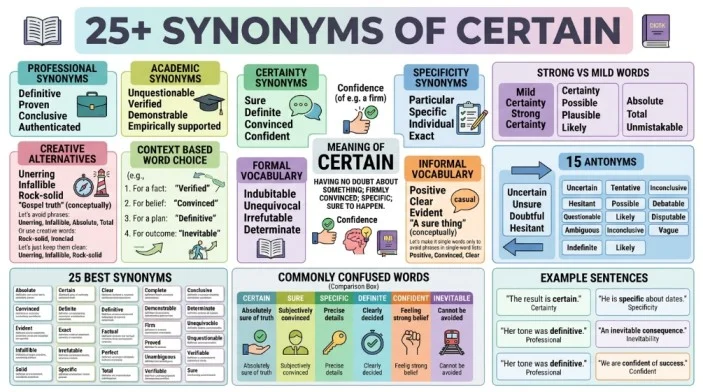
25 Best Synonyms of “Certain”
Because certain has more than one meaning, the list below includes alternatives that correspond to its different senses. Some describe certainty, while others describe particularity or unavoidable outcomes.
| Synonym | Simple Meaning | Best Used For | Example Sentence |
|---|---|---|---|
| Sure | Confident that something is true | Everyday conversation | “I’m sure she will understand.” |
| Definite | Clear or settled | Decisions and plans | “We need a definite answer today.” |
| Specific | Clearly identified | Details and information | “Please provide a specific example.” |
| Particular | One specific person or thing | Formal and general writing | “A particular issue caused the delay.” |
| Confident | Strongly believing something | Personal belief | “She is confident about the outcome.” |
| Inevitable | Impossible to avoid | Future outcomes | “Some changes are inevitable.” |
| Unavoidable | Cannot be prevented | Difficult outcomes | “The delay was unavoidable.” |
| Absolute | Complete and without qualification | Strong certainty | “He has absolute confidence in his team.” |
| Definitive | Final and authoritative | Conclusions and decisions | “The report provides a definitive answer.” |
| Fixed | Established and unlikely to change | Dates and arrangements | “The meeting date is fixed.” |
| Settled | Decided or resolved | Questions and disputes | “The matter is now settled.” |
| Clear | Easy to understand or determine | Instructions and conclusions | “The evidence provides a clear explanation.” |
| Established | Accepted or firmly known | Facts and principles | “The method is well established.” |
| Determined | Firmly decided | Decisions and intentions | “She was determined to finish the project.” |
| Convinced | Strongly persuaded that something is true | Personal belief | “He was convinced that the plan would work.” |
| Positive | Completely confident | Informal and professional speech | “I am positive that we sent the email.” |
| Assured | Confident or certain | Formal reassurance | “She sounded assured during the presentation.” |
| Undoubted | Not reasonably questioned | Formal writing | “Her talent is undoubted.” |
| Unquestionable | Impossible to reasonably dispute | Strong formal claims | “His commitment is unquestionable.” |
| Incontrovertible | Impossible to successfully dispute | Very formal writing | “The evidence was incontrovertible.” |
| Unmistakable | Impossible to confuse or misinterpret | Signs and evidence | “There was an unmistakable change in his attitude.” |
| Inescapable | Impossible to avoid | Consequences and realities | “The consequences became inescapable.” |
| Predictable | Likely to happen in an expected way | Outcomes and behavior | “The result was fairly predictable.” |
| Determinate | Clearly defined or fixed | Technical and formal contexts | “The process has a determinate endpoint.” |
| Unambiguous | Having only one clear meaning | Instructions and language | “The contract contains an unambiguous requirement.” |
Synonyms of “Certain” by Usage
Professional vs Personal Synonyms
Professional communication often benefits from confident, definite, specific, and clear because these words communicate precise information.
Personal conversations usually favor sure, positive, and confident.
Professional:
“We are confident that the proposal meets the client’s requirements.”
Personal:
“I’m sure everything will work out.”
The second sentence sounds more natural in conversation because sure is less formal.
Formal vs Conversational Synonyms
For reports, essays, and formal correspondence, consider:
- Definite
- Specific
- Definitive
- Unambiguous
- Certain
- Established
For conversations and texting, consider:
- Sure
- Positive
- Confident
The most important factor is not simply formality. The synonym must also express the correct meaning.
Academic Synonyms
Academic writing benefits from precision. Good alternatives include:
Specific
“The researchers examined specific variables.”
Definite
“The study reached a definite conclusion.”
Established
“The researchers followed an established procedure.”
Unambiguous
“The findings provide an unambiguous pattern.”
Avoid replacing every use of certain with a more complicated word. Academic writing should be precise, not unnecessarily difficult.
Professional and Business Synonyms
Resumes
Use specific, confident, and established where they accurately describe your experience.
Instead of:
“Certain processes were improved.”
Write:
“Improved specific processes to reduce processing time.”
Better still, name the actual process and measurable result when available.
Interviews
Confident is particularly useful when describing your abilities.
“I am confident that my project management experience would benefit the team.”
Meetings
Definite works well when discussing decisions.
“We need a definite timeline before assigning resources.”
Presentations
Clear can be more useful than certain when discussing conclusions.
“The results provide a clear indication of customer preferences.”
Performance Reviews
Confident can describe expectations or abilities.
“I am confident in my ability to lead the next phase of the project.”
Client Communication
Certain and confident can both work, depending on how strongly you can support the claim.
“We are confident that the revised schedule will meet your requirements.”
Business Emails
Sure is acceptable in friendly workplace emails, while certain or confident may fit more formal communication.
Creative and Literary Synonyms
Creative writing gives you more freedom to choose expressive alternatives.
Inevitable can suggest fate or unavoidable change.
“Their final meeting felt inevitable.”
Inescapable can create tension.
“The truth became inescapable.”
Unmistakable can strengthen sensory or emotional description.
“There was an unmistakable sadness in her voice.”
Unavoidable can describe conflict or consequences.
“The confrontation was unavoidable.”
These words add meaning beyond simple certainty.
Slang or Modern Synonyms
There is no need to force slang into an article about certain because common standard English already provides natural conversational alternatives.
Sure is the most useful casual alternative.
“Are you sure?”
Positive can also appear in informal American English.
“I’m positive I left it here.”
These expressions are acceptable in everyday communication but may be less appropriate in highly formal academic writing.
Strongest to Mildest Synonyms
The intensity depends heavily on the meaning of certain. A useful scale for expressions of confidence is:
Mild probability:
Likely
Moderate confidence:
Confident, sure
Strong confidence:
Certain, definite, positive
Very strong certainty:
Absolute, definitive, unquestionable, incontrovertible
For unavoidable outcomes, a different scale is more useful:
Strong:
Unavoidable
Very strong:
Inevitable, inescapable
Do not treat these words as interchangeable simply because they appear at different points on an intensity scale. Their meanings differ.
Emotional vs Neutral Synonyms
Emotional Synonyms
These alternatives can add personal feeling, emphasis, or dramatic force:
- Confident
- Positive
- Assured
- Inevitable
- Inescapable
- Unquestionable
Example:
“She was absolutely confident that everything would work out.”
This communicates personal conviction.
Neutral Synonyms
These words usually communicate information without adding much emotional force:
- Specific
- Particular
- Definite
- Clear
- Established
- Fixed
- Unambiguous
Example:
“The researchers selected specific participants.”
This is factual and precise rather than emotional.
Antonyms of “Certain”
Because certain has multiple meanings, its opposites also depend on context. The following words represent genuine opposites across its main senses.
| Antonym | Meaning | Example Sentence |
|---|---|---|
| Uncertain | Not known or decided | “The final outcome remains uncertain.” |
| Unsure | Not confident about something | “She was unsure about the answer.” |
| Doubtful | Not convinced or unlikely | “He was doubtful that the plan would succeed.” |
| Unclear | Difficult to understand or determine | “The instructions were unclear.” |
| Indefinite | Not fixed or clearly defined | “The project has an indefinite deadline.” |
| Unlikely | Not expected to happen | “A complete recovery seems unlikely.” |
| Possible | Able to happen but not guaranteed | “Several outcomes are possible.” |
| Ambiguous | Open to more than one interpretation | “The wording was ambiguous.” |
| Vague | Lacking clear detail | “Her explanation was vague.” |
| Questionable | Open to doubt | “The accuracy of the claim is questionable.” |
| Debatable | Reasonably open to disagreement | “The conclusion is debatable.” |
| Unresolved | Not yet settled | “The issue remains unresolved.” |
| Changeable | Likely to change | “The weather is highly changeable.” |
| Avoidable | Able to be prevented | “The mistake was avoidable.” |
| Preventable | Capable of being stopped | “The accident was preventable.” |
Comparison: “Certain” vs Similar Words
Certain vs Sure
Main Difference
Both can express confidence, but sure is more conversational, while certain can sound more formal or emphatic.
Which Is Stronger?
They can express similar levels of confidence. Context determines the strength.
Which Is More Formal?
Certain is generally more formal.
When to Use Each
Use sure in everyday conversation. Use certain when you want a more formal or deliberate tone.
Examples
Certain:
“I am certain that the information is accurate.”
Sure:
“I’m sure the information is accurate.”
Certain vs Specific
Main Difference
Certain can mean particular, but specific more directly means clearly identified or precisely defined.
Which Is Stronger?
Neither is stronger. They communicate different ideas.
Which Is More Formal?
Both work in formal writing.
When to Use Each
Use specific when precision is the main point.
Examples
Certain:
“Certain conditions must be met.”
Specific:
“Specific conditions must be met.”
Certain vs Definite
Main Difference
Definite emphasizes something settled, clear, or fixed.
Which Is Stronger?
Definite can sound stronger when discussing a decision or answer.
Which Is More Formal?
Both are suitable for formal communication.
When to Use Each
Use definite for plans, dates, answers, and decisions.
Examples
Certain:
“I am certain about the result.”
Definite:
“We need a definite answer.”
Certain vs Particular
Main Difference
Both can refer to something specific, but particular is especially useful when distinguishing one person or thing from others.
Which Is Stronger?
Neither is inherently stronger.
Which Is More Formal?
Both are neutral to moderately formal.
When to Use Each
Use particular when selecting one item from a group.
Examples
Certain:
“Certain students received additional support.”
Particular:
“One particular student requested additional support.”
Certain vs Confident
Main Difference
Certain can describe the truth of a situation or a person’s confidence. Confident specifically focuses on a person’s belief, judgment, ability, or expectation.
Which Is Stronger?
Neither is always stronger.
Which Is More Formal?
Both work well in professional settings.
When to Use Each
Use confident when discussing a person’s belief or ability.
Examples
Certain:
“She is certain that the plan will succeed.”
Confident:
“She is confident that the plan will succeed.”
Certain vs Inevitable
Main Difference
Certain can mean something is known or expected with complete confidence. Inevitable means the event cannot be avoided.
Which Is Stronger?
Inevitable is stronger when discussing unavoidable outcomes.
Which Is More Formal?
Both are suitable for formal writing.
When to Use Each
Use inevitable when prevention is impossible.
Examples
Certain:
“Change is certain.”
Inevitable:
“Change is inevitable.”
Common Phrases and Expressions with “Certain”
Be Certain
Meaning:
To be confident that something is true or correct.
Example:
“I am certain that we made the right choice.”
Make Certain
Meaning:
To ensure that something happens.
Example:
“Please make certain that all windows are closed.”
For Certain
Meaning:
With complete confidence or knowledge.
Example:
“We cannot say for certain what caused the problem.”
Certain That
Meaning:
Used before a statement that someone believes to be true.
Example:
“She is certain that the package has arrived.”
Certain About
Meaning:
To have no doubt about a person, thing, or decision.
Example:
“Are you certain about your choice?”
Certain People
Meaning:
Particular people who are not specifically named.
Example:
“Certain people prefer working early in the morning.”
Certain Conditions
Meaning:
Particular requirements or circumstances.
Example:
“The discount is available under certain conditions.”
For Certain Purposes
Meaning:
For particular reasons or intended uses.
Example:
“This tool was designed for certain purposes.”
Common Mistakes to Avoid
1. Treating “Certain” and “Specific” as Perfect Synonyms
Incorrect:
“I am specific that she will arrive.”
Better:
“I am certain that she will arrive.”
Why:
Specific describes identifiable details, while certain can describe confidence.
2. Using “Certain” When You Mean “Sure” in Casual Speech
Less Natural:
“Are you certain you want pizza?”
Better:
“Are you sure you want pizza?”
Why:
The first sentence is grammatical, but sure sounds more natural in casual American conversation.
3. Using “Inevitable” for Ordinary Possibilities
Incorrect:
“A promotion is inevitable if you work hard.”
Better:
“A promotion is likely if you consistently perform well.”
Why:
Hard work may increase the chance of promotion, but it does not guarantee that promotion is unavoidable.
4. Using “Definite” for Personal Confidence
Less Natural:
“I am definite that she will come.”
Better:
“I am certain that she will come.”
Why:
Definite usually describes an answer, decision, fact, plan, or arrangement rather than a person’s state of confidence.
5. Using Strong Certainty Without Evidence
Less Effective:
“The new campaign will certainly double sales.”
Better:
“The new campaign is expected to increase sales.”
Why:
Strong certainty should match the available evidence.
6. Confusing “Certain” With “Certainly”
Incorrect:
“She is certainly about the answer.”
Better:
“She is certain about the answer.”
Why:
Certain is an adjective. Certainly is an adverb.
7. Replacing Every Use With a More Formal Word
Less Natural:
“I am definitive that he will arrive.”
Better:
“I am certain that he will arrive.”
Why:
More complicated vocabulary does not automatically make writing better. The replacement must fit the grammar and meaning.
Frequently Asked Questions
1. What are the best synonyms of “certain”?
The best synonym of certain depends on the intended meaning. Sure works well for everyday confidence, definite for settled information, specific for particular details, and inevitable for unavoidable outcomes.
2. What are the best formal synonyms of “certain”?
Useful formal alternatives include definite, confident, specific, definitive, unambiguous, and established. The correct choice depends on whether you mean confidence, precision, a settled decision, or an identifiable detail.
3. What are common informal synonyms of “certain”?
Sure is the most common informal alternative when certain means confident. Positive can also work in casual American English, as in “I’m positive that’s where I left it.”
4. What is another word for “certain” in professional writing?
Confident, definite, specific, and clear are useful professional alternatives. Choose confident for belief, definite for settled decisions, and specific when referring to particular details.
5. What is the difference between “certain” and “sure”?
Certain and sure can both express confidence, but sure is generally more conversational. Certain can sound more formal or deliberate, making it useful in professional and academic contexts.
6. What is the opposite of “certain”?
The most common opposite is uncertain. Depending on context, related opposites include unsure, doubtful, unclear, indefinite, unlikely, and ambiguous.
Conclusion
Certain can describe complete confidence, a particular but unnamed person or thing, or an outcome viewed as unavoidable. The best alternative depends on the exact meaning you want to communicate.
Use sure for natural everyday conversation, confident for personal belief, definite for settled information, specific for precise details, and inevitable when an outcome cannot be avoided. Choosing among these words carefully makes your writing more accurate and prevents subtle meaning errors.
When searching for a synonym of certain, do not simply choose the most sophisticated sounding word. First identify the intended meaning, then consider your audience, tone, and purpose. A useful vocabulary habit is to learn synonyms in context rather than memorizing them as interchangeable lists.
Read More Related Articles:
25+ Synonyms, Meanings, Uses, Examples, and Best …
Meaning, Uses, Examples, and the Best Synonym of Complain
25+ Synonyms of Frequency | Meanings, Uses, Examples …