When the same word appears repeatedly in an essay, business report, email, or blog post, the writing can quickly feel flat. If you keep using scarcity to describe limited resources, supplies, opportunities, or availability, choosing a more precise alternative can make your message clearer. Knowing the right synonym of scarcity also helps you match your vocabulary to the situation.
Words such as shortage, lack, dearth, paucity, and deficiency can all express limited availability, but they do not always carry exactly the same meaning or tone. Some are natural in everyday English, while others work better in academic, economic, professional, or formal writing. Understanding those differences helps you communicate limited supply accurately without making your writing sound repetitive or unnatural.
What Are the Best Synonyms of “Scarcity”?
The best synonym of scarcity depends on context. Shortage and lack are natural everyday choices, dearth and paucity suit formal or academic writing, and deficiency works well when something is below the required level. In business and economics, shortfall, deficit, and undersupply can provide greater precision.
Meaning, Tone, and Context
Simple Definition
Scarcity means a situation in which something is available in a limited amount, especially when the supply is not enough to meet demand, need, or expected availability.
Scarcity can describe physical resources such as water, food, land, fuel, and raw materials. It can also describe less tangible things, including time, skilled workers, opportunities, attention, and affordable housing.
For example:
“Water scarcity is a serious concern in many dry regions.”
The sentence means that the available water supply is limited compared with what people need.
Part of Speech
Scarcity is a noun.
It names a condition or situation rather than describing an object directly.
Overall Tone
Scarcity is generally neutral in tone. It can appear in ordinary conversation, but it is especially common in economics, environmental discussions, business writing, journalism, academic work, and public policy.
The word does not automatically express emotion. Its tone depends largely on the subject being discussed.
Formality Level
Scarcity is a neutral to formal word.
It sounds natural in:
- Academic papers
- Economic discussions
- Business reports
- Environmental articles
- Government reports
- News writing
- Professional presentations
- Everyday conversations
In casual speech, however, lack or shortage may sound more natural.
Common Uses
Native English speakers commonly use scarcity when discussing:
- Scarcity of water
- Scarcity of food
- Scarcity of resources
- Scarcity of workers
- Scarcity of housing
- Scarcity of jobs
- Scarcity of time
- Scarcity of opportunities
- Scarcity of information
- Resource scarcity
- Labor scarcity
- Food scarcity
- Economic scarcity
- Natural resource scarcity
Word Forms
| Form | Word |
|---|---|
| Noun | scarcity |
| Related noun | scarcity |
| Related adjective | scarce |
| Related adverb | scarcely |
| Common opposite | abundance |
The adjective scarce describes something that is available only in a limited amount.
Example:
“Fresh water is scarce in the region.”
The noun scarcity describes the condition itself.
Example:
“The region is experiencing water scarcity.”
When and How to Use “Scarcity”
Use scarcity when you want to emphasize that something is limited or insufficient in relation to demand, need, or normal availability. It is especially useful when discussing resources, economics, environmental problems, markets, or situations where limited supply affects people or decisions.
Professional
“Labor scarcity has made it difficult for the company to fill specialized positions.”
Here, scarcity works well because the sentence describes a limited supply of workers.
Academic
“Resource scarcity can influence how communities distribute essential goods.”
The word fits academic writing because it describes a broader economic or social condition.
Workplace
“Time scarcity often forces employees to prioritize urgent tasks.”
This use emphasizes that workers have limited time available.
Personal
“The scarcity of free time made it difficult for her to maintain a regular exercise routine.”
The word is somewhat formal, but it remains understandable in personal writing.
“Due to the scarcity of available meeting rooms, please reserve your preferred time as early as possible.”
This is suitable for a professional email because the situation involves limited availability.
Resume
“Developed purchasing strategies to reduce the impact of raw material scarcity.”
Here, scarcity describes a business challenge in a concise and professional way.
Social Media
“The scarcity of affordable housing continues to affect young families.”
This works well in an informative social media post because the word communicates a broader social issue.
Best Synonyms of “Scarcity”
No synonym is identical to scarcity in every context. The best alternative depends on whether you want to emphasize a limited supply, an absence, an inadequate amount, a serious shortage, or an unusually small quantity.
Professional Writing: Shortfall
Shortfall works particularly well when the available amount is below what was expected, planned, or required.
Example:
“The company experienced a shortfall in skilled labor during the final quarter.”
It is useful in business reports because it emphasizes the gap between what was needed and what was available.
Academic Writing: Paucity
Paucity refers to a very small amount of something and is particularly common in formal or academic writing.
Example:
“The paucity of reliable data limited the scope of the study.”
It is more formal than shortage and works well when discussing limited evidence, research, or information.
Business Communication: Shortage
Shortage is a clear and widely understood alternative when supply does not meet demand.
Example:
“The company is facing a shortage of qualified technicians.”
It is direct, professional, and easier to understand than some more formal alternatives.
Casual Conversation: Lack
Lack is one of the most natural alternatives in everyday English.
Example:
“We had to cancel the trip because of a lack of time.”
It sounds simple and conversational without losing the basic meaning.
Emotional Writing: Deprivation
Deprivation can work when scarcity affects people’s quality of life or prevents them from accessing something necessary.
Example:
“Long periods of food deprivation can have serious consequences.”
This word is stronger and more serious than ordinary scarcity, so it should be used when people are being denied something they need.
Creative Writing: Dearth
Dearth gives writing a formal or literary quality and emphasizes a notable lack.
Example:
“A dearth of opportunities forced many young artists to leave the town.”
It can make descriptive writing more distinctive, although it is less conversational than lack or shortage.
Resume Writing: Shortfall
Shortfall is useful on resumes when describing a gap between available resources and organizational needs.
Example:
“Implemented inventory controls that reduced supply shortfalls.”
This is concise and focuses on a measurable business problem.
Workplace Communication: Deficiency
Deficiency works when the limited amount represents a problem or failure to meet an expected standard.
Example:
“The audit identified a deficiency in available safety equipment.”
It is more specific than scarcity when the amount is inadequate for a particular requirement.
Stronger Meaning: Paucity
Paucity can suggest an especially small amount, particularly in formal contexts.
Example:
“The paucity of qualified applicants delayed the hiring process.”
It emphasizes how limited the supply is.
Softer Meaning: Limited Availability
Limited availability is a useful neutral phrase when you want to describe restricted access without making the situation sound severe.
Example:
“Due to limited availability, appointments are offered on a first come, first served basis.”
This expression is especially useful in customer service and professional communication.
When Not to Use “Scarcity”
Although scarcity is accurate in many situations, it is not always the clearest word. Sometimes it sounds too formal, too broad, or too indirect.
When It Sounds Too General
Less effective:
“There is scarcity of information about the event.”
Better:
“There is a lack of information about the event.”
Why:
Lack is simpler and more natural when referring to missing information in ordinary communication.
When It Sounds Too Formal
Less effective:
“There is a scarcity of parking spaces.”
Better:
“There is a shortage of parking spaces.”
Why:
Shortage is more direct and conversational in this context.
When You Mean a Specific Gap
Less effective:
“The project suffered from scarcity of funding.”
Better:
“The project suffered from a funding shortfall.”
Why:
Shortfall clearly indicates that the funding available was below the required or expected amount.
When Something Is Missing Completely
Less effective:
“There was scarcity of evidence.”
Better:
“There was an absence of evidence.”
Why:
Scarcity suggests a limited amount. Absence suggests that something is not present at all.
When You Mean Poor Quality Rather Than Limited Quantity
Less effective:
“The product has a scarcity of quality.”
Better:
“The product has a quality deficiency.”
Why:
Scarcity concerns limited quantity or availability. A deficiency can describe something that falls below an expected standard.
When You Need a Simple Everyday Expression
Less effective:
“Scarcity of time prevented me from attending.”
Better:
“A lack of time prevented me from attending.”
Why:
Lack of time is much more natural in everyday American English.
Words Commonly Confused With “Scarcity”
Shortage
Difference: A shortage occurs when there is not enough of something to meet demand or need.
When to Use It: Use shortage for practical supply problems involving goods, workers, housing, food, or equipment.
Example:
“The city is experiencing a shortage of affordable apartments.”
Lack
Difference: Lack is broader and can describe having too little of something or not having it at all.
When to Use It: Use it in everyday English and when you want a simple, flexible expression.
Example:
“The team struggled because of a lack of experience.”
Dearth
Difference: Dearth means a scarcity or very small supply and has a more formal or literary tone.
When to Use It: Use it in formal, academic, journalistic, or literary writing.
Example:
“There is a dearth of reliable information on the subject.”
Paucity
Difference: Paucity emphasizes a very small amount, especially when discussing information, evidence, resources, or options.
When to Use It: Use it mainly in formal or academic writing.
Example:
“The paucity of evidence made the conclusion difficult to support.”
Deficiency
Difference: Deficiency usually means that something is below an expected, necessary, or adequate level.
When to Use It: Use it for resources, skills, nutrients, equipment, or other things that fail to meet a requirement.
Example:
“The inspection revealed a deficiency in emergency supplies.”
Deficit
Difference: Deficit usually describes an amount that is below what is needed, expected, or balanced. It is especially common in economics and finance.
When to Use It: Use it when discussing budgets, trade, resources, production, or numerical gaps.
Example:
“The organization faced a budget deficit at the end of the year.”
Best Synonyms of “Scarcity” by Context
| Context | Best Synonym | Why It Works | Example |
|---|---|---|---|
| Formal writing | Dearth | Formal and precise | The region faces a dearth of reliable water supplies. |
| Academic writing | Paucity | Common for limited evidence or data | The paucity of research limits the conclusion. |
| Professional communication | Shortage | Clear and widely understood | The company is facing a shortage of skilled workers. |
| Business emails | Limited availability | Polite and neutral | Due to limited availability, appointments are restricted. |
| Resume writing | Shortfall | Concise and business focused | Reduced inventory shortfalls through better forecasting. |
| Workplace communication | Deficiency | Highlights an inadequate amount | The audit found a deficiency in safety supplies. |
| Casual conversation | Lack | Natural and simple | We have a lack of time today. |
| Everyday speaking | Shortage | Easy to understand | There is a shortage of parking nearby. |
| Creative writing | Dearth | Adds a literary quality | A dearth of opportunities changed her plans. |
| Storytelling | Lack | Natural in narrative prose | His lack of money shaped his choices. |
| Emotional writing | Deprivation | Emphasizes being denied something needed | Years of deprivation affected the family deeply. |
| Strong emphasis | Paucity | Highlights an unusually small amount | The paucity of evidence was striking. |
| Mild tone | Limited availability | Avoids overly negative wording | Seats are subject to limited availability. |
| Social media captions | Shortage | Clear and accessible | The city is facing a housing shortage. |
| American English | Shortage | Very common and natural | The area has a shortage of affordable homes. |
| British English | Shortage | Also widely understood and used | The country faces a shortage of nurses. |
How to Choose the Best Synonym of “Scarcity”
The easiest way to select the right synonym is to identify what you want the reader to notice.
If You Mean Not Enough Supply
Choose shortage.
“The region is experiencing a shortage of fuel.”
This is the most straightforward choice for supply problems.
If You Mean Simply Not Having Enough
Choose lack.
“The project failed because of a lack of funding.”
This is flexible and natural in almost any type of writing.
If You Mean a Very Small Amount
Choose paucity.
“The paucity of reliable sources made the research difficult.”
This is particularly suitable for academic writing.
If You Mean a Formal or Serious Lack
Choose dearth.
“The industry faces a dearth of experienced professionals.”
It works well in formal prose but may sound too sophisticated for casual conversation.
If You Mean an Amount Below a Requirement
Choose deficiency.
“The inspection revealed a deficiency in medical supplies.”
This word emphasizes inadequacy.
If You Mean a Numerical or Financial Gap
Choose deficit.
“The organization recorded a budget deficit.”
This is especially appropriate for economics, finance, and accounting.
If You Want a Neutral Customer Friendly Expression
Choose limited availability.
“Tickets are currently subject to limited availability.”
This sounds less severe than scarcity or shortage.
A Simple Decision Guide
| What You Want to Express | Best Choice |
|---|---|
| Not enough supply | Shortage |
| Not enough in general | Lack |
| Very small amount | Paucity |
| Formal lack | Dearth |
| Below required level | Deficiency |
| Financial or numerical gap | Deficit |
| Expected amount was not reached | Shortfall |
| Supply is below demand | Undersupply |
| Restricted access | Limited availability |
| Severe lack of necessities | Deprivation |
Real Life Examples of “Scarcity”
School
Basic:
“The scarcity of school supplies affected the students.”
Stronger:
“The shortage of school supplies affected the students.”
Why it works:
Shortage sounds more natural when discussing physical products that are difficult to obtain.
College
Basic:
“The scarcity of research data made the project difficult.”
Stronger:
“The paucity of research data made the project difficult.”
Why it works:
Paucity is appropriate for academic discussions about limited evidence or information.
Workplace
Basic:
“The company is dealing with a scarcity of trained employees.”
Stronger:
“The company is dealing with a shortage of trained employees.”
Why it works:
Shortage is a common business term for insufficient workers.
Business
Basic:
“Scarcity of raw materials increased production costs.”
Stronger:
“A shortage of raw materials increased production costs.”
Why it works:
Shortage clearly describes a supply problem.
Basic:
“Because of the scarcity of available rooms, your meeting has been moved.”
Stronger:
“Because of the limited availability of meeting rooms, your meeting has been moved.”
Why it works:
The alternative sounds more polite and customer friendly.
Resume
Basic:
“Helped the company respond to employee scarcity.”
Stronger:
“Helped the company address a shortage of skilled employees.”
Why it works:
The improved version sounds more specific and professional.
Conversation
Basic:
“There is a scarcity of time before the deadline.”
Natural:
“We don’t have much time before the deadline.”
Why it works:
Everyday conversation usually favors simple language over formal nouns such as scarcity.
Storytelling
Basic:
“The scarcity of food changed the family’s plans.”
More expressive:
“The dearth of food forced the family to leave the village.”
Why it works:
Dearth gives the sentence a more formal narrative tone.
Blogging
“Water scarcity is becoming an increasingly important topic in discussions about sustainable development.”
This use works because scarcity is widely understood in environmental and economic writing.
Social Media
“A shortage of affordable housing can make it difficult for young families to remain in their communities.”
Shortage is generally more accessible to a broad social media audience than highly formal alternatives.
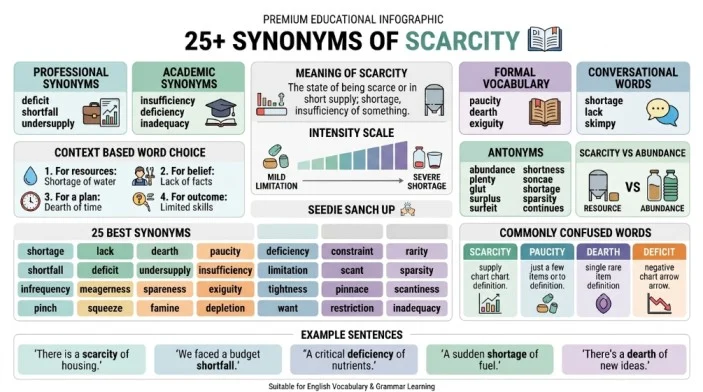
25 Best Synonyms of “Scarcity”
Some alternatives below are direct synonyms, while others are context specific expressions that can replace scarcity when the intended meaning is limited supply, inadequate quantity, or restricted availability. Context matters because no substitute works equally well in every sentence.
| Synonym | Simple Meaning | Best Used For | Example Sentence |
|---|---|---|---|
| Shortage | Not enough supply to meet need | Goods, workers, housing, supplies | The hospital is facing a shortage of nurses. |
| Lack | Not having enough of something | Everyday and general writing | A lack of funding delayed the project. |
| Dearth | A very small supply | Formal and literary writing | The industry suffers from a dearth of skilled workers. |
| Paucity | A very small amount | Academic and formal writing | The paucity of evidence weakened the argument. |
| Deficiency | An amount below what is required | Resources, skills, nutrients | The report identified a deficiency in safety equipment. |
| Insufficiency | Not enough to meet a need | Formal and technical writing | The insufficiency of funds forced the program to close. |
| Shortfall | An amount below what was expected | Business and finance | The company faced a shortfall in annual revenue. |
| Deficit | A shortage or negative balance | Economics and finance | The budget showed a significant deficit. |
| Undersupply | Supply below demand | Economics and markets | An undersupply of homes pushed prices higher. |
| Meagerness | A very small or inadequate amount | Descriptive and formal writing | The meagerness of the available resources was concerning. |
| Scantness | The condition of being scarce or limited | Formal descriptive writing | The scantness of the evidence raised concerns. |
| Scantiness | A small or inadequate quantity | Formal and descriptive contexts | The scantiness of the harvest affected local families. |
| Sparseness | A state of being thinly distributed | Population, information, resources | The sparseness of medical facilities created problems for rural residents. |
| Sparsity | Low density or limited occurrence | Data, population, networks | The sparsity of reliable data made analysis difficult. |
| Scarceness | The condition of being scarce | Direct descriptive usage | The scarceness of clean water remains a concern. |
| Rarity | Uncommon availability or occurrence | Objects, opportunities, conditions | The rarity of affordable homes makes them highly desirable. |
| Inadequacy | Failure to provide enough | Resources, funding, capacity | The inadequacy of the budget prevented expansion. |
| Privation | Lack of basic necessities | Serious hardship and formal writing | Years of privation affected the community. |
| Want | Lack or absence of something | Formal, literary, or traditional usage | The region suffered from want of adequate medical care. |
| Unavailability | The state of not being available | Products, services, appointments | The unavailability of parts delayed repairs. |
| Limited availability | Restricted access or supply | Business and customer communication | The product is offered with limited availability. |
| Limited supply | A restricted amount available | Commerce and resources | The item is sold while supplies remain limited. |
| Inadequate supply | Supply that is not sufficient | Technical and professional writing | The clinic had an inadequate supply of medicine. |
| Famine | Extreme scarcity of food | Food crises and humanitarian contexts | The famine left thousands without reliable food supplies. |
| Resource shortage | Insufficient available resources | Business, economics, and policy | The project was delayed by a resource shortage. |
Synonyms of “Scarcity” by Usage
Professional vs Personal Synonyms
Professional writing often benefits from precise terms such as shortage, shortfall, deficiency, deficit, and undersupply.
For personal communication, lack and shortage usually sound more natural.
Professional:
“The company is experiencing a shortage of qualified applicants.”
Personal:
“I have a lack of time this week.”
The choice should reflect both the audience and the seriousness of the situation.
Formal vs Conversational Synonyms
Formal writing can use dearth, paucity, insufficiency, and deficiency when those words accurately express the intended meaning.
Conversational English usually favors lack and shortage.
Formal:
“The paucity of reliable evidence presents a challenge.”
Conversational:
“There’s a lack of information about the event.”
For texting, even simpler language may sound better:
“We don’t have enough information yet.”
Academic Synonyms
Academic writing benefits from vocabulary that identifies exactly what is limited.
Paucity is especially useful for a small amount of evidence, research, or data.
“The paucity of longitudinal studies limits our understanding of the issue.”
Deficiency works when something falls below a required standard.
“A deficiency in available data affected the analysis.”
Insufficiency emphasizes that the available amount does not meet a need.
“The insufficiency of the sample size reduced the reliability of the findings.”
Dearth is also possible, especially in formal prose.
“A dearth of research remains in this area.”
Professional and Business Synonyms
Resumes
Use shortfall, shortage, deficiency, or resource shortage when describing business problems.
“Reduced supply shortfalls through improved inventory forecasting.”
Interviews
Use clear words such as shortage or lack rather than unnecessarily complex vocabulary.
“The industry is experiencing a shortage of qualified workers.”
Meetings
Shortage, deficit, and shortfall work well when discussing measurable business conditions.
“We need to address the projected budget shortfall.”
Presentations
Scarcity, shortage, and undersupply can all work depending on the subject.
“Housing scarcity continues to influence regional prices.”
Performance Reviews
Resource shortage and staffing shortage are useful when explaining workplace constraints.
“Successfully managed projects during a period of staffing shortage.”
Client Communication
Limited availability is often preferable because it sounds clear and professional without being unnecessarily negative.
“Due to limited availability, delivery may take an additional two days.”
Business Emails
Shortage is appropriate for supply problems.
“We are currently experiencing a shortage of the requested material.”
Creative and Literary Synonyms
Creative writing gives you more freedom to choose words based on atmosphere.
Dearth can create a serious or formal mood.
“A dearth of hope settled over the village.”
Privation can emphasize hardship.
“Years of privation had changed the way he viewed comfort.”
Meagerness can describe a small quantity in a vivid way.
“The meagerness of the harvest worried the farmers.”
For most modern fiction, however, lack and shortage are often more natural and less conspicuous.
Slang or Modern Synonyms
There is no widely accepted slang word that functions as a direct synonym for scarcity.
In casual American English, people are more likely to say:
- “There isn’t enough.”
- “We’re running low.”
- “It’s hard to find.”
- “There’s a shortage.”
- “There’s not much available.”
These expressions are natural in conversation but should generally be avoided in formal academic writing.
Strongest to Mildest Synonyms
The intensity of a scarcity related word depends heavily on context. A useful general scale is:
Mild
Limited availability, lack, rarity
These terms can describe restricted access without necessarily suggesting a serious crisis.
Moderate
Shortage, shortfall, deficiency, insufficiency
These words usually indicate that the available amount does not fully meet a need.
Strong
Paucity, dearth, undersupply, privation
These can emphasize a very small amount or serious lack, depending on context.
Very Strong
Famine
This word should be reserved for severe food scarcity and humanitarian situations. It is not an interchangeable synonym for ordinary shortages.
A strong vocabulary choice should reflect the actual severity of the situation. Using famine for a minor grocery shortage, for example, would be inaccurate and exaggerated.
Emotional vs Neutral Synonyms
Emotional Synonyms
Some alternatives carry stronger associations with hardship or human suffering.
Privation can suggest prolonged hardship.
Famine carries extremely serious humanitarian implications.
Deprivation emphasizes being denied something necessary or beneficial.
Example:
“The community experienced years of deprivation.”
These words should be used carefully because they can make a sentence considerably more serious.
Neutral Synonyms
For straightforward communication, use:
- Scarcity
- Shortage
- Lack
- Deficiency
- Shortfall
- Limited availability
- Limited supply
- Undersupply
Example:
“The shortage of qualified workers affected production.”
This communicates the problem without adding unnecessary emotional force.
Antonyms of “Scarcity”
| Antonym | Meaning | Example Sentence |
|---|---|---|
| Abundance | A very large supply | The region has an abundance of fresh water. |
| Plenty | More than enough | There was plenty of food for everyone. |
| Surplus | More than is needed or used | The farm produced a surplus of wheat. |
| Profusion | A large or generous amount | The garden contained a profusion of flowers. |
| Ample supply | More than enough available | The warehouse has an ample supply of materials. |
| Adequacy | Enough to meet a need | The adequacy of the funding was reviewed. |
| Sufficiency | Enough for a particular purpose | The team confirmed the sufficiency of its resources. |
| Availability | The state of being obtainable | The availability of affordable housing remains high in the area. |
| Copiousness | A very large quantity | The copiousness of the rainfall surprised residents. |
| Bounty | A generous supply or amount | The harvest provided a bounty of fresh produce. |
| Wealth | A large amount or rich supply | The region has a wealth of natural resources. |
| Overflow | An amount beyond normal capacity | The reservoir reached overflow after heavy rainfall. |
| Excess | More than necessary | The company had an excess of inventory. |
| Abundance of resources | A plentiful supply of resources | The area benefits from an abundance of resources. |
| Plentifulness | The state of being plentiful | The plentifulness of local crops supported the community. |
Comparison: “Scarcity” vs Similar Words
Scarcity vs Shortage
Main Difference
Scarcity describes a general condition in which something is limited. Shortage usually describes a specific situation in which available supply does not meet demand or need.
Which Is Stronger?
Neither is always stronger. Shortage often sounds more immediate and practical.
Which Is More Formal?
Scarcity can sound more formal, especially in economics and academic writing.
When to Use Each
Use scarcity for broad conditions and economic concepts.
Use shortage for specific supply problems.
Examples
Scarcity:
“Water scarcity affects agricultural communities.”
Shortage:
“The city is experiencing a shortage of drinking water.”
Scarcity vs Lack
Main Difference
Lack is broader and more common in everyday English. Scarcity usually suggests that something is limited rather than completely absent.
Which Is Stronger?
Scarcity can suggest a more systematic or widespread limitation.
Which Is More Formal?
Scarcity is generally more formal.
When to Use Each
Use lack for simple statements about not having enough.
Use scarcity for resources, markets, economics, and broader conditions.
Examples
Scarcity:
“Resource scarcity can affect economic decisions.”
Lack:
“A lack of resources delayed the project.”
Scarcity vs Dearth
Main Difference
Both describe a limited supply, but dearth has a more formal and literary tone.
Which Is Stronger?
Dearth can suggest a notably small supply.
Which Is More Formal?
Dearth is more formal and less common in everyday speech.
When to Use Each
Use scarcity for general and technical writing.
Use dearth when you want a formal or literary alternative.
Examples
Scarcity:
“The scarcity of affordable housing is a major concern.”
Dearth:
“A dearth of affordable housing has changed the local market.”
Scarcity vs Paucity
Main Difference
Paucity emphasizes a very small amount, especially of information, evidence, choices, or resources.
Which Is Stronger?
Paucity can sound stronger when the available quantity is extremely small.
Which Is More Formal?
Paucity is more formal and particularly common in academic writing.
When to Use Each
Use scarcity for broad resource conditions.
Use paucity for unusually small quantities.
Examples
Scarcity:
“The scarcity of data affected the analysis.”
Paucity:
“The paucity of reliable data affected the analysis.”
Scarcity vs Deficit
Main Difference
A deficit is a specific shortfall, often expressed in numerical, financial, or measurable terms. Scarcity describes a broader condition of limited availability.
Which Is Stronger?
Neither is inherently stronger.
Which Is More Formal?
Both can be formal, but deficit is especially common in economics and finance.
When to Use Each
Use deficit for budgets, trade balances, production, and measurable gaps.
Use scarcity for general resource limitations.
Examples
Scarcity:
“Labor scarcity has affected the industry.”
Deficit:
“The company reported a labor deficit in several departments.”
Scarcity vs Rarity
Main Difference
Scarcity focuses on limited supply or availability. Rarity focuses on something being uncommon or unusual.
Which Is Stronger?
Neither is inherently stronger.
Which Is More Formal?
Both can be used in formal writing.
When to Use Each
Use scarcity when supply is the main concern.
Use rarity when unusual occurrence or uniqueness is the focus.
Examples
Scarcity:
“The scarcity of affordable homes has increased competition.”
Rarity:
“The rarity of the painting increased its value.”
Common Phrases and Expressions with “Scarcity”
Scarcity of Resources
Meaning: A limited supply of resources needed for a particular purpose.
Example:
“Scarcity of resources forced the organization to change its priorities.”
Water Scarcity
Meaning: A condition in which available water is insufficient for demand.
Example:
“Water scarcity is a growing concern in dry regions.”
Food Scarcity
Meaning: Limited access to an adequate food supply.
Example:
“Food scarcity can have serious effects on vulnerable communities.”
Scarcity of Time
Meaning: Having too little time available.
Example:
“Because of the scarcity of time, the team focused on the highest priority tasks.”
In everyday English, lack of time is usually more natural.
Scarcity of Affordable Housing
Meaning: A limited supply of homes that people can reasonably afford.
Example:
“The scarcity of affordable housing has affected many working families.”
Resource Scarcity
Meaning: A limited supply of natural, financial, human, or other resources.
Example:
“Resource scarcity can influence business decisions.”
Scarcity Value
Meaning: The increased appeal or perceived value of something because it is difficult to obtain or available in limited quantities.
Example:
“The limited edition gained scarcity value among collectors.”
Artificial Scarcity
Meaning: A limited supply created or maintained intentionally rather than occurring naturally.
Example:
“The company used limited production to create artificial scarcity around the product.”
Common Mistakes to Avoid
1. Treating “Scarcity” and “Shortage” as Completely Identical
Incorrect:
“The city has scarcity of gasoline.”
Better:
“The city has a shortage of gasoline.”
Why:
Shortage is more natural when describing a specific supply problem. Scarcity works better for a broader condition.
2. Using “Scarcity” When Something Is Completely Absent
Incorrect:
“There is scarcity of evidence because no evidence exists.”
Better:
“There is an absence of evidence.”
Why:
Scarcity suggests limited availability. Absence indicates that something is not present.
3. Using a Very Formal Synonym in Casual Conversation
Incorrect:
“We are experiencing a paucity of time.”
Better:
“We don’t have much time.”
Why:
Paucity is unnecessarily formal for an ordinary conversation.
4. Using “Paucity” for Every Type of Shortage
Incorrect:
“There is a paucity of gasoline at the station.”
Better:
“There is a shortage of gasoline at the station.”
Why:
Although paucity means a small amount, shortage is much more natural for a practical supply problem.
5. Using “Famine” for a Minor Food Shortage
Incorrect:
“The supermarket experienced a famine of bread.”
Better:
“The supermarket experienced a shortage of bread.”
Why:
Famine refers to an extreme food crisis, not an ordinary temporary shortage in a store.
6. Confusing Scarcity With Rarity
Incorrect:
“The scarcity of this unique painting makes it unusual.”
Better:
“The rarity of this unique painting makes it unusual.”
Why:
Rarity is the better choice when the focus is on something being uncommon rather than insufficiently supplied.
7. Using Scarcity When You Mean Poor Quality
Incorrect:
“The company has a scarcity of customer service.”
Better:
“The company has a deficiency in customer service.”
Why:
The problem concerns the quality or adequacy of service, not necessarily its quantity.
Frequently Asked Questions
1. What are the best synonyms of “scarcity”?
The best synonyms of scarcity include shortage, lack, dearth, paucity, deficiency, shortfall, and undersupply. The best choice depends on whether you mean limited supply, inadequate quantity, or a very small amount.
2. What are the best formal synonyms of “scarcity”?
The strongest formal alternatives include dearth, paucity, insufficiency, deficiency, and shortfall. Dearth and paucity are particularly useful when discussing limited evidence, resources, information, or opportunities.
3. What are common informal synonyms of “scarcity”?
Common informal alternatives include lack, shortage, and expressions such as not enough or running low. These choices are easier to understand in everyday conversations than formal terms such as paucity or dearth.
4. What is another word for “scarcity” in professional writing?
In professional writing, shortage, shortfall, deficiency, deficit, and limited availability are useful alternatives. Choose based on the situation, with shortfall especially useful for measurable gaps and shortage for supply problems.
5. What is the difference between “scarcity” and “shortage”?
Scarcity describes a general condition of limited availability, while a shortage usually refers to a specific situation where supply fails to meet demand or need. Shortage is often more natural for practical supply problems.
6. What is the opposite of “scarcity”?
The most common opposite of scarcity is abundance. Other alternatives include plenty, surplus, profusion, ample supply, and sufficiency, depending on whether you mean a large supply or simply enough resources.
Conclusion
Scarcity describes a condition in which something is available in a limited amount, especially when supply does not adequately meet demand or need. The best alternative depends on what you want to emphasize.
Use shortage for practical supply problems, lack for simple everyday statements, paucity for very small amounts in formal writing, dearth for a formal or literary tone, deficiency for an inadequate level, and shortfall for a gap between what is available and what was expected.
There is no single perfect replacement in every sentence. When choosing a synonym of scarcity, consider the meaning, audience, formality, emotional strength, and purpose of your writing. A useful vocabulary habit is to identify exactly what is limited before selecting an alternative, because precision almost always produces stronger communication
Read More Related Articles:
25+ Synonyms, Meanings, Uses, Examples, and Best …
Meaning, Uses, Examples, and the Best Synonym of Complain
25+ Synonyms of Frequency | Meanings, Uses, Examples …