You have probably used the word foreboding in an essay, story, email, caption, or conversation, then noticed that you keep reaching for it whenever something feels wrong. That repetition can make otherwise strong writing sound predictable. Learning the synonyms of foreboding gives you more precise ways to express fear, unease, expectation, warning, or a sense that something unpleasant may happen.
The best alternative depends on what you actually mean. Dread creates stronger emotional fear, unease suggests a milder discomfort, apprehension works well in formal writing, while premonition emphasizes a feeling that something specific may happen. Choosing carefully makes your writing clearer, more natural, and better suited to its audience.
What Are the Best Synonyms of “Foreboding”?
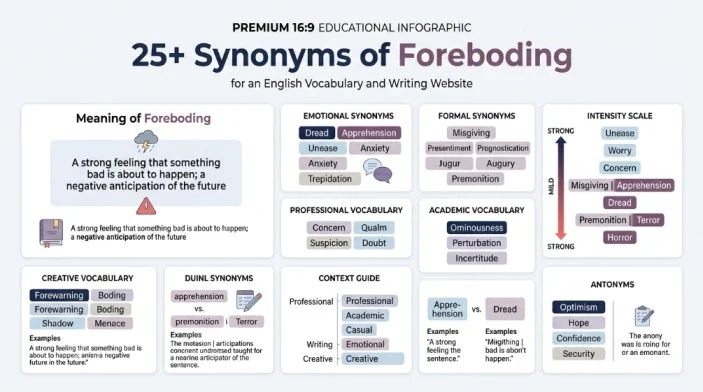
Foreboding means a strong feeling that something unpleasant or threatening may happen. Its best synonyms include dread, apprehension, unease, misgiving, trepidation, anxiety, premonition, presentiment, and ominousness. Use apprehension in formal writing, unease for mild concern, dread for stronger fear, and premonition when the feeling seems predictive.
For formal writing, apprehension, trepidation, and misgiving are strong choices. For casual conversation, unease, worry, and fear sound more natural.
In academic writing, apprehension, anxiety, or concern may be appropriate depending on the subject. In professional communication, concern, apprehension, or misgiving usually sounds more measured than foreboding.
For emotional writing, dread and trepidation add intensity. For creative writing, ominousness, premonition, presentiment, and portent can create a darker or more atmospheric effect.
Meaning, Tone, and Context
Simple Definition
Foreboding describes a feeling or sign that suggests something unpleasant, dangerous, or troubling may happen.
For example:
She felt a strange sense of foreboding before entering the abandoned house.
Here, foreboding does not simply mean fear. It suggests an uneasy expectation that something bad may be coming.
The word can also refer to an indication or sign of what is likely to happen. This second use is less common in everyday conversation but appears in literary and descriptive writing.
Part of Speech
Foreboding is primarily used as a noun when it refers to an uneasy feeling or expectation.
Example:
A sense of foreboding filled the room.
It can also function as an adjective in phrases such as:
The dark clouds had a foreboding appearance.
Overall Tone
Foreboding is generally negative and often carries a serious, mysterious, or ominous tone.
It usually communicates more than ordinary concern. The speaker senses that something unpleasant is approaching, even when there is no clear evidence yet.
Formality Level
Foreboding is neutral to formal. It is perfectly acceptable in general writing, but it appears especially often in literature, journalism, essays, descriptive writing, and serious discussion.
For everyday speech, words such as worry, fear, or unease may sound more natural.
Common Uses
Native English speakers commonly use foreboding when discussing:
- an uneasy feeling about the future
- a possible danger
- an ominous situation
- suspense in fiction
- disturbing signs or events
- uncertain outcomes
- emotional reactions to threatening circumstances
Word Forms
The most useful related forms include:
- foreboding, noun: an uneasy feeling about what may happen
- foreboding, adjective: suggesting something bad may happen
- forebode, verb: to suggest or predict something unpleasant
Example:
The sudden silence foreboded trouble.
When and How to Use “Foreboding”
Use foreboding when you want to communicate anticipation of something unpleasant, especially when the outcome has not happened yet.
It is particularly effective when the feeling is vague or difficult to explain.
Professional
The team entered the final phase of the project with a sense of foreboding about the unresolved technical issues.
Academic
The novel uses repeated images of darkness to create a sense of foreboding.
Workplace
The unexpected resignation created a feeling of foreboding among several employees.
Personal
I had a strange sense of foreboding before the trip.
The latest figures give us some reason for foreboding about the upcoming quarter.
In a professional email, however, concern or apprehension may sound more measured.
Resume
Foreboding is rarely appropriate on a resume. Resume language should focus on measurable skills, responsibilities, and achievements rather than personal feelings.
Instead of:
Managed projects despite a sense of foreboding.
Use:
Managed high risk projects while maintaining delivery timelines.
Social Media
That empty hallway gave me an instant sense of foreboding.
This works because social media writing often allows more emotional and descriptive language.
Best Synonyms of “Foreboding”
No synonym works perfectly in every sentence. The closest alternative depends on whether you want to emphasize fear, uncertainty, anxiety, prediction, warning, or atmosphere.
| Context | Best Synonym | Why It Works |
|---|---|---|
| Professional writing | Apprehension | Measured and appropriately serious |
| Academic writing | Apprehension | Precise and formal |
| Business communication | Concern | Professional without sounding dramatic |
| Casual conversation | Unease | Natural and conversational |
| Emotional writing | Dread | Strong emotional fear |
| Creative writing | Ominousness | Creates a dark atmosphere |
| Resume writing | Concern | More professional than emotional wording |
| Workplace communication | Misgiving | Expresses reservations clearly |
| Stronger meaning | Dread | More emotionally intense |
| Softer meaning | Unease | Suggests mild discomfort |
Professional Writing: Apprehension
Apprehension is a strong professional substitute because it communicates concern about what may happen without sounding overly dramatic.
Academic Writing: Apprehension
In academic discussions, apprehension can describe anxiety or concern about a future event, especially when discussing behavior, psychology, literature, or social reactions.
Business Communication: Concern
Concern is usually safer in business writing because it focuses on an identifiable issue rather than creating an ominous emotional impression.
Casual Conversation: Unease
Unease sounds natural when someone feels uncomfortable or senses that something is not right.
Emotional Writing: Dread
Dread is more powerful than foreboding. It emphasizes intense fear about an expected negative event.
Creative Writing: Ominousness
Ominousness works particularly well when describing an atmosphere, setting, sound, object, or event that seems threatening.
When Not to Use “Foreboding”
When the Meaning Is Simply “Concern”
If you are discussing a specific business problem, foreboding may sound too dramatic.
Less effective:
I have a sense of foreboding about the delayed shipment.
Better:
I have some concern about the delayed shipment.
Concern keeps the statement professional and focused.
When You Mean Strong Fear
Foreboding suggests anticipation, while terror describes extreme fear.
Less precise:
He experienced foreboding when he saw the attacker.
Better:
He felt terror when he saw the attacker.
When You Mean Mild Discomfort
If the feeling is only slightly uncomfortable, foreboding can sound too intense.
Less natural:
I felt foreboding when everyone became quiet.
Better:
I felt uneasy when everyone became quiet.
When You Mean a Specific Prediction
If someone believes they know that an event will happen, premonition may be more precise.
Less precise:
She had a feeling of foreboding that her brother would call.
Better:
She had a premonition that her brother would call.
When Writing a Resume
Emotional vocabulary such as foreboding, dread, or trepidation usually does not strengthen professional credentials.
Instead, describe the situation, action, and result.
Words Commonly Confused With “Foreboding”
| Word | Difference | When to Use It | Example |
|---|---|---|---|
| Apprehension | Concern or anxiety about a future event | Formal and professional contexts | She felt apprehension about the upcoming decision. |
| Dread | Strong fear about something expected | Emotional situations | He felt dread before opening the letter. |
| Unease | Mild discomfort or uncertainty | Everyday situations | The strange noise caused some unease. |
| Premonition | A feeling that a particular event may happen | Predictive or mysterious contexts | She had a premonition that something was wrong. |
| Misgiving | Doubt or concern about a decision or situation | Decisions and judgment | He had misgivings about signing the contract. |
| Ominousness | A threatening quality or atmosphere | Descriptive and creative writing | The ominousness of the storm changed the mood. |
Best Synonyms of “Foreboding” by Context
| Context | Best Synonym | Why It Works | Example |
|---|---|---|---|
| Formal writing | Apprehension | Serious and controlled | She expressed apprehension about the outcome. |
| Academic writing | Apprehension | Precise for future anxiety | The findings generated apprehension among participants. |
| Professional communication | Concern | Clear and measured | The manager raised concerns about the deadline. |
| Business emails | Concern | Direct without unnecessary drama | We have concerns about the revised schedule. |
| Resume writing | Concern | Professional and objective | Identified concerns before project launch. |
| Workplace communication | Misgiving | Shows thoughtful reservation | Several employees had misgivings about the change. |
| Casual conversation | Unease | Natural in speech | I felt uneasy about the situation. |
| Everyday speaking | Worry | Simple and familiar | I was worried about what might happen. |
| Creative writing | Ominousness | Builds atmosphere | The ominousness of the silence was unsettling. |
| Storytelling | Dread | Creates emotional tension | A feeling of dread followed him upstairs. |
| Emotional writing | Trepidation | Expresses nervous anticipation | She approached the stage with trepidation. |
| Strong emphasis | Dread | Strong emotional intensity | He felt dread as the door opened. |
| Mild tone | Unease | Less intense | The conversation left her with some unease. |
| Social media captions | Unease | Short and natural | This place gives me serious unease. |
| American English | Apprehension | Common and natural | He expressed apprehension about the decision. |
| British English | Apprehension | Also standard and natural | She felt apprehension before the meeting. |
How to Choose the Best Synonym of “Foreboding”
Start by asking what you want the reader to understand.
- If you mean general concern, choose concern.
- If you mean mild discomfort, choose unease.
- If you mean serious uncertainty about what will happen, choose apprehension.
- If you mean strong fear, choose dread.
- If you mean nervous anticipation, choose trepidation.
- If you mean doubt about a choice, choose misgiving.
- If you mean a feeling that a specific event may happen, choose premonition or presentiment.
- If you mean a threatening atmosphere, choose ominousness.
The audience also matters. A business email generally benefits from concern, while a suspense novel may become more effective with dread, premonition, or ominousness.
Real Life Examples of “Foreboding”
School
The author creates a sense of foreboding by describing the empty street before the character enters the house.
College
The study examines how uncertainty can produce apprehension about future events.
Workplace
The sudden departure of two senior employees created some unease among the staff.
Business
Management expressed concern about the declining sales figures.
I have some apprehension about moving forward without additional testing.
Resume
Instead of using an emotional word such as foreboding, write:
Identified potential risks before implementation and recommended corrective action.
Conversation
I don’t know why, but I had a strange feeling that something was going to happen.
Storytelling
A heavy silence settled over the house, filling everyone with dread.
Blogging
The empty streets created an eerie sense of foreboding as the storm approached.
Social Media
The sky looks beautiful, but there is something seriously ominous about it.
25 Best Synonyms of “Foreboding”
Because foreboding has two related senses, some alternatives describe the feeling of anticipated trouble, while others describe a sign or indication of what may happen. The table keeps those distinctions clear.
| Synonym | Simple Meaning | Best Used For | Example Sentence |
|---|---|---|---|
| Apprehension | Uneasy concern about what may happen | Formal writing | She felt apprehension before the announcement. |
| Dread | Strong fear about an expected event | Emotional writing | He was filled with dread before the test results arrived. |
| Unease | Mild discomfort or uncertainty | Everyday use | The strange silence caused unease. |
| Anxiety | Worry about an uncertain future | Academic and professional contexts | The delay increased anxiety among customers. |
| Fear | Emotional reaction to perceived danger | General communication | Fear spread through the crowd. |
| Misgiving | Doubt or concern about something | Decisions and workplace writing | She had misgivings about the proposed agreement. |
| Trepidation | Nervous fear about what is coming | Formal and emotional writing | He entered the room with trepidation. |
| Disquiet | A troubled or unsettled feeling | Formal and literary writing | The announcement caused widespread disquiet. |
| Alarm | Sudden or serious concern about danger | News and professional contexts | The discovery raised alarm among officials. |
| Concern | Worry about a particular issue | Business and professional writing | The report raised concerns about safety. |
| Worry | Uneasy thoughts about possible problems | Casual conversation | Her worry grew as the storm approached. |
| Premonition | A feeling that something may happen | Mysterious or predictive contexts | He had a premonition that the journey would end badly. |
| Presentiment | An intuitive feeling about a future event | Literary and formal writing | She experienced a presentiment of disaster. |
| Portent | A sign suggesting what will happen | Literary and descriptive writing | The unusual silence seemed like a portent of trouble. |
| Ominousness | A threatening or troubling quality | Creative writing | The ominousness of the sky made everyone uneasy. |
| Boding | A sense or indication of what is coming | Literary and formal writing | The silence had an unsettling boding quality. |
| Presage | A sign or indication of a future event | Formal and literary writing | The sudden drop in temperature seemed to presage a storm. |
| Omen | A sign believed to indicate a future event | Stories and cultural contexts | The broken mirror was treated as a bad omen. |
| Augury | A sign or prediction about the future | Literary and specialized contexts | The unusual event was interpreted as an augury of change. |
| Forewarning | An advance indication of possible danger | Warnings and informational writing | The notice provided a forewarning of severe weather. |
| Harbinger | A person or thing that signals what is coming | Descriptive writing | The first cold morning was a harbinger of winter. |
| Presumption | An expectation based on available information | Analytical contexts | The decision rested on the presumption that demand would fall. |
| Anticipation | Expectation of something that may happen | Neutral contexts | Anticipation grew as the results approached. |
| Expectation | A belief about what is likely to happen | General and academic writing | The expectation of further delays caused frustration. |
| Inquietude | A state of mental uneasiness | Formal and literary writing | The uncertainty produced a sense of inquietude. |
Important usage note: Words such as omen, portent, presage, augury, and harbinger are closest to the sign or indication sense of foreboding. They should not automatically replace foreboding when you mean a person’s internal feeling.
Synonyms of “Foreboding” by Usage
Professional vs Personal Synonyms
Professional writing generally favors controlled words such as concern, apprehension, and misgiving. These communicate risk without making the writer sound overly emotional.
Personal writing has more freedom. Unease, worry, dread, and fear can communicate an individual’s emotional reaction naturally.
Formal vs Conversational Synonyms
- For reports and essays, consider apprehension, trepidation, disquiet, or misgiving.
- For business emails, concern is usually the most practical choice.
- For presentations, apprehension can work when discussing audience reactions or future uncertainty.
- For casual conversation, worry, unease, and fear are generally easier and more natural.
- For texting, simple expressions such as I have a bad feeling about this may sound more authentic than I have a sense of foreboding.
Academic Synonyms
Academic writing benefits from precision rather than dramatic vocabulary.
Useful options include:
- apprehension
- anxiety
- concern
- trepidation
- disquiet
- misgiving
The best choice depends on the subject. In psychology, anxiety may be more precise. In literary analysis, foreboding, ominousness, and premonition may better describe a narrative effect.
Professional and Business Synonyms
For resumes, use objective vocabulary rather than emotional language. Concern, risk, uncertainty, and apprehension can be useful when describing professional situations, but measurable outcomes are usually stronger.
- For interviews, concern is safer than foreboding.
- For meetings, misgiving can communicate reservations about a proposal.
- For client communication, concern keeps the tone calm and constructive.
- For performance reviews, describe observable behavior or risk instead of saying that you felt foreboding.
Creative and Literary Synonyms
Creative writing gives you more room to choose words based on atmosphere.
Dread makes a character’s fear feel intense. Ominousness focuses on the environment. Premonition suggests a mysterious expectation, while portent or omen can make an event seem symbolically important.
Slang or Modern Synonyms
There is no single slang word that functions as a reliable synonym for foreboding in every context.
In casual American English, phrases such as a bad feeling, something feels off, or this doesn’t feel right can communicate a similar idea.
Avoid these expressions in formal academic, legal, or professional writing unless you are intentionally quoting conversational language.
Strongest to Mildest Synonyms
A useful intensity scale looks like this:
Mild: concern, unease, worry
Moderate: apprehension, anxiety, misgiving, disquiet
Strong: trepidation, fear, dread
Very strong or highly dramatic: dread in an extreme context, especially when paired with words such as overwhelming or terrifying
Intensity depends on context. Fear can be mild or extreme, while dread usually creates a stronger emotional response than unease.
Emotional vs Neutral Synonyms
Emotional Synonyms
These words add noticeable feeling:
- dread
- fear
- trepidation
- anxiety
- unease
- presentiment
Use them when the emotional state matters.
Neutral Synonyms
These are more controlled:
- concern
- apprehension
- misgiving
- expectation
- warning
They are useful when you want to communicate an issue without creating unnecessary drama.
Antonyms of “Foreboding”
Because foreboding describes anticipated trouble or an ominous expectation, its opposites generally express confidence, safety, optimism, reassurance, or positive expectation.
| Antonym | Meaning | Example Sentence |
|---|---|---|
| Reassurance | A feeling that things are safe or acceptable | Her explanation gave everyone reassurance. |
| Confidence | Belief that something will succeed | He approached the challenge with confidence. |
| Hope | Positive expectation for the future | They continued with hope despite the uncertainty. |
| Optimism | Expectation that good things will happen | Her optimism encouraged the entire team. |
| Assurance | A strong statement or feeling of certainty | The manager gave us assurance that the issue was resolved. |
| Security | A sense of safety or protection | The new system provided greater security. |
| Calm | A peaceful state without fear or agitation | His calm helped everyone focus. |
| Comfort | A feeling of relief or emotional ease | Her words brought comfort to the family. |
| Certainty | Firm belief that something is true or will happen | He spoke with certainty about the outcome. |
| Trust | Confidence in a person or situation | The team had complete trust in its leader. |
| Expectancy | A strong anticipation of something expected | The children waited in happy expectancy. |
| Excitement | Energetic enthusiasm about what is coming | There was excitement before the concert. |
| Anticipation | Expectation of an upcoming event | The audience waited in anticipation. |
| Safety | Freedom from danger or significant risk | Everyone was moved to safety. |
| Peace | A state without conflict, fear, or disturbance | The quiet evening brought a sense of peace. |
Comparison: “Foreboding” vs Similar Words
Foreboding vs Apprehension
Main Difference: Foreboding often suggests that something bad may happen, while apprehension more generally means anxiety or concern about a future event.
Which Is Stronger? Foreboding often feels more ominous. Apprehension is usually more neutral.
Which Is More Formal? Apprehension.
When to Use Each: Use foreboding for atmosphere or anticipated trouble. Use apprehension for formal discussions of concern.
Examples
Foreboding:
A sense of foreboding settled over the village.
Apprehension:
Employees expressed apprehension about the organizational changes.
Foreboding vs Dread
Main Difference: Dread emphasizes intense fear, while foreboding emphasizes an uneasy expectation that something bad may happen.
Which Is Stronger? Dread.
Which Is More Formal? Both can be formal, but foreboding is particularly common in literary description.
When to Use Each: Choose dread when emotion is central. Choose foreboding when anticipation and atmosphere matter.
Examples
Foreboding:
The dark clouds created a sense of foreboding.
Dread:
She felt dread as she waited for the verdict.
Foreboding vs Unease
Main Difference: Unease is broader and usually milder. Foreboding specifically suggests that something unpleasant may happen.
Which Is Stronger? Foreboding.
Which Is More Formal? Foreboding can sound more literary, while both are acceptable in formal writing.
When to Use Each: Use unease for general discomfort. Use foreboding when the discomfort involves an expectation of trouble.
Examples
Foreboding:
He could not shake the sense of foreboding.
Unease:
The unfamiliar surroundings caused some unease.
Foreboding vs Premonition
Main Difference: A premonition is a feeling that a particular future event may occur. Foreboding can be more vague.
Which Is Stronger? Neither is automatically stronger. They emphasize different ideas.
Which Is More Formal? Both can appear in formal or literary writing.
When to Use Each: Choose premonition when the anticipated event is more specific.
Examples
Foreboding:
She felt a growing sense of foreboding.
Premonition:
He had a premonition that the meeting would go badly.
Foreboding vs Omen
Main Difference: Foreboding is commonly an internal feeling. An omen is a sign believed to indicate a future event.
Which Is Stronger? Neither. They describe different things.
Which Is More Formal? Both are suitable for literary and formal contexts.
When to Use Each: Use omen when an external sign carries meaning.
Examples
Foreboding:
She experienced a strange feeling of foreboding.
Omen:
They regarded the unusual weather as a bad omen.
Foreboding vs Concern
Main Difference: Concern is a broad and neutral expression of worry. Foreboding adds a sense that something unpleasant may be approaching.
Which Is Stronger? Foreboding usually sounds more emotionally charged.
Which Is More Formal? Concern is often better for professional writing.
When to Use Each: Choose concern for business communication and specific problems. Choose foreboding for emotional or descriptive contexts.
Examples
Foreboding:
The silence created an atmosphere of foreboding.
Concern:
The delay raised concerns among investors.
Common Phrases and Expressions with “Foreboding”
A Sense of Foreboding
Meaning: A feeling that something unpleasant may happen.
Example Sentence:
A sense of foreboding followed her as she walked toward the empty building.
A Feeling of Foreboding
Meaning: An uneasy emotional reaction to an uncertain future.
Example Sentence:
He could not explain the feeling of foreboding that came over him.
A Growing Sense of Foreboding
Meaning: An increasingly strong feeling that something bad may happen.
Example Sentence:
As the storm became stronger, a growing sense of foreboding filled the town.
An Atmosphere of Foreboding
Meaning: A setting that feels threatening or suggests approaching trouble.
Example Sentence:
The director uses silence and shadows to create an atmosphere of foreboding.
A Sense of Impending Trouble
Meaning: A feeling that difficulty or danger is close.
Example Sentence:
The sudden power outage gave everyone a sense of impending trouble.
Create a Sense of Foreboding
Meaning: To make a reader or viewer expect something unpleasant.
Example Sentence:
The writer uses short sentences to create a sense of foreboding.
Common Mistakes to Avoid
Mistake 1: Using “Dread” When You Mean Mild Concern
Incorrect:
I felt dread about the slightly delayed meeting.
Better:
I felt some concern about the slightly delayed meeting.
Why: Dread can make a routine professional issue sound unnecessarily serious.
Mistake 2: Using “Foreboding” for a Specific External Sign
Incorrect:
The warning sign was a foreboding.
Better:
The warning sign was an omen.
Why: Omen refers to a sign that suggests what may happen. Foreboding more commonly describes the feeling itself.
Mistake 3: Using Informal Language in Academic Writing
Incorrect:
The experiment made participants feel like something bad was going to happen.
Better:
The experiment produced apprehension among participants.
Why: The second sentence is more concise and appropriate for formal analysis.
Mistake 4: Choosing an Overly Dramatic Synonym
Incorrect:
The minor scheduling change filled the team with dread.
Better:
The scheduling change caused some concern among the team.
Why: The revised sentence matches the emotional intensity of the situation.
Mistake 5: Repeating “Foreboding” Too Often
Incorrect:
The scene has foreboding music, a foreboding setting, and a foreboding atmosphere.
Better:
The scene combines ominous music with a threatening atmosphere and a growing sense of dread.
Why: Varied vocabulary makes descriptive writing more precise and engaging.
Mistake 6: Confusing “Foreboding” With “Premonition”
Incorrect:
Her foreboding specifically predicted the accident.
Better:
She had a premonition that an accident would occur.
Why: Premonition better communicates a feeling that points toward a particular future event.
Mistake 7: Using Literary Vocabulary in a Routine Business Email
Incorrect:
I have a deep sense of foreboding regarding the revised invoice.
Better:
I have some concerns about the revised invoice.
Why: Concern sounds professional, direct, and proportionate.
Frequently Asked Questions
1. What are the best synonyms of “foreboding”?
The best synonyms of foreboding include apprehension, dread, unease, anxiety, misgiving, trepidation, premonition, presentiment, and disquiet. The right choice depends on whether you mean fear, concern, prediction, or atmosphere.
2. What are the best formal synonyms of “foreboding”?
The strongest formal synonyms of foreboding include apprehension, trepidation, disquiet, misgiving, presentiment, and presage. Choose based on whether you mean an internal feeling or an external sign of future trouble.
3. What are common informal synonyms of “foreboding”?
Common informal alternatives include worry, unease, fear, and a bad feeling. These choices sound more natural in everyday conversation than highly literary terms such as presentiment or augury.
4. What is another word for “foreboding” in professional writing?
Concern is usually the best professional alternative when discussing a specific risk or problem. Apprehension works when the focus is anxiety about a future outcome rather than a concrete business issue.
5. What is the difference between “foreboding” and “apprehension”?
Foreboding suggests an uneasy expectation that something unpleasant may happen, while apprehension means anxiety or concern about a future event. Foreboding often sounds more ominous, while apprehension is more neutral and formal.
6. What is the opposite of “foreboding”?
There is no single perfect opposite in every context, but reassurance, confidence, hope, optimism, security, calm, and assurance can express ideas opposite to foreboding, depending on the intended meaning.
Conclusion
Foreboding describes an uneasy expectation that something unpleasant or threatening may happen. The best alternative depends on your purpose. Use unease for mild discomfort, apprehension for formal concern, dread for stronger fear, premonition for a predictive feeling, and concern for professional communication.
No synonym works perfectly in every sentence. The most effective choice considers the meaning, audience, emotional strength, formality, and purpose of your writing.
When choosing among the synonyms of foreboding, read the complete sentence and ask one simple question: am I describing a feeling, a fear, a prediction, or a warning sign? That small distinction can turn an ordinary sentence into a much more precise one.
Read More Related Articles:
- Synonyms for Everything | Meaning, Examples, and Better …
- Synonyms for Unexpected | Meaning, Examples, and Better …
- 50+ Synonyms of This | Meanings, Uses, Examples, and Best …