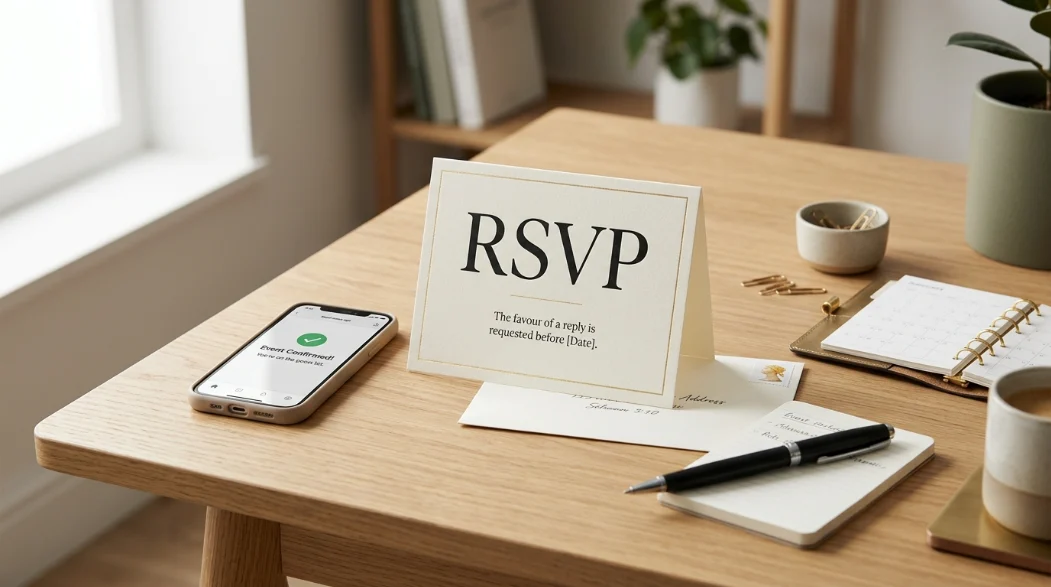
RSVP meaning is a request for an invited guest to confirm whether they will attend an event. You will commonly see RSVP on wedding invitations, birthday parties, business events, dinners, conferences, and other occasions where the host needs an accurate guest count.
RSVP comes from the French phrase “Répondez s’il vous plaît,” which translates roughly to “Please respond.” Despite its French origin, RSVP is widely used in English invitations.
When an invitation says “Please RSVP by June 15,” the host is asking you to tell them by that date if you plan to attend. A simple yes or no helps the host organize food, seating, venue space, schedules, and other details.
What Does RSVP Mean?
RSVP means “Please respond.” It comes from the French phrase “Répondez s’il vous plaît.” On an invitation, RSVP asks the guest to confirm attendance.
For example, “RSVP by May 10” means you should tell the host by May 10 if you are attending. You may usually respond by email, phone, text, an online form, or another method provided by the host.
What Does RSVP Stand For?
RSVP stands for “Répondez s’il vous plaît.”
Here is the breakdown:
| Part | Meaning |
|---|---|
| Répondez | Respond |
| s’il | if it |
| vous | you |
| plaît | pleases |
| Full phrase | Please respond |
The phrase is French, but RSVP has become a familiar abbreviation in English. Many English speakers use it without thinking about the original French wording.
Is RSVP an English Word?
RSVP originated from French, but it is now commonly used in English.
You can find it on formal invitations, casual party invitations, wedding stationery, professional event announcements, and online event pages.
It is often treated as an English abbreviation in everyday communication, even though its source phrase is French.
RSVP Meaning on an Invitation
When you see RSVP on an invitation, the host wants a response from you.
For example:
Dinner Party
Saturday, July 18
7:00 PM
RSVP by July 10
This means the guest should confirm attendance by July 10.
The host may need this information to determine:
- How much food to prepare
- How many seats are needed
- How much space is required
- How many invitations to finalize
- Transportation arrangements
- Hotel or accommodation needs
- Event materials or name badges
- Catering costs
So, an RSVP is more than a polite formality. It gives the host information needed to plan the event.
What Does “RSVP By” Mean?
“RSVP by” means you should send your response no later than the stated date.
For example:
RSVP by August 5
You should confirm your attendance by August 5.
If you already know that you cannot attend, it is still considerate to respond rather than simply ignoring the invitation.
What Does “RSVP Requested” Mean?
“RSVP requested” means the host wants invited guests to provide a response.
The invitation may provide specific instructions, such as:
RSVP requested by email.
Please RSVP using the online form.
Kindly RSVP to Sarah at the number provided.
Follow the method listed on the invitation whenever possible.
How to RSVP
The easiest way to RSVP is to follow the instructions provided by the host.
1. Check the invitation
Look for:
- RSVP deadline
- Email address
- Phone number
- Website or response form
- Guest instructions
- Meal selection
- Plus-one information
2. Decide if you can attend
Give a clear answer. Avoid vague replies such as “I might come” when the host needs a final guest count.
3. Respond using the requested method
If the invitation provides an online form, use it. If it asks for an email response, send an email.
4. Include the requested information
For example, a wedding RSVP may ask for:
- Your name
- Attendance confirmation
- Number of guests
- Meal choice
- Dietary requirements
5. Respond before the deadline
Late responses can create planning problems, particularly for events involving catering and reserved seating.
RSVP Examples
Here are realistic examples of RSVP responses.
Accepting an Invitation
Thank you for the invitation. I’m happy to confirm that I’ll attend.
Declining an Invitation
Thank you for inviting me. Unfortunately, I won’t be able to attend, but I appreciate the invitation.
Accepting a Wedding Invitation
Thank you for inviting us. We’re delighted to attend and look forward to celebrating with you.
Declining a Wedding Invitation
Thank you for thinking of us. Sadly, we won’t be able to attend, but we wish you both a wonderful celebration.
RSVP by Text
Hi Sarah, thanks for the invitation. I’d be happy to attend the dinner on Saturday. See you then!
Professional Event RSVP
Thank you for the invitation. I’m pleased to confirm my attendance at the event on September 12.
How to Reply to an RSVP Request
An RSVP request does not necessarily require a long message.
A clear response is usually enough.
| Situation | Suitable response |
|---|---|
| You can attend | “I’d be happy to attend. Thank you for inviting me.” |
| You cannot attend | “Thank you for the invitation. Unfortunately, I can’t attend.” |
| You need clarification | “Thank you for the invitation. Could you please confirm the event start time?” |
| You are bringing an approved guest | “I’m pleased to confirm my attendance, along with John.” |
| You need to decline after accepting | “I’m sorry, but an unexpected commitment means I can no longer attend.” |
The tone can change depending on the relationship and event. A wedding invitation usually deserves a warmer response than a casual gathering.
RSVP Etiquette
Good RSVP etiquette is mainly about being clear, timely, and considerate.
Respond on time
Respect the deadline. The host may need your response before ordering food or finalizing arrangements.
Give a definite answer
If you know you can attend, confirm it. If you cannot attend, politely decline.
Do not assume you can bring someone
A guest or plus-one should not be added unless the invitation allows it.
For example, if the invitation says “Sarah and James”, that does not automatically mean Sarah can bring another person.
Tell the host about important dietary needs
If the invitation asks for meal preferences or dietary information, provide accurate details when you respond.
Avoid unnecessary last-minute changes
Plans can change, but repeatedly changing your response can make event planning more difficult.
RSVP for Weddings
Wedding invitations commonly include an RSVP because the couple and venue need an accurate guest count.
A wedding RSVP may ask you to confirm:
- Attendance
- Number of guests
- Meal preference
- Dietary requirements
- Names of attendees
For example:
Will you attend?
☐ Accepts with pleasure
☐ Declines with regret
The exact wording varies, but the purpose remains the same: the hosts need a clear response.
What If You Cannot Attend a Wedding?
Respond politely and as soon as possible.
You do not need to give a detailed personal explanation. A simple expression of appreciation and a sincere decline is usually appropriate.
RSVP for Parties
Party invitations can use RSVP in both formal and casual settings.
For a casual birthday party, a text message may be enough:
Thanks for inviting me! I’ll be there.
For a larger celebration, the host may use an online RSVP form to track the guest list.
The more organized the event, the more important an accurate response can become.
RSVP for Business and Professional Events
RSVP is also common in professional settings.
Examples include:
- Conferences
- Networking events
- Corporate dinners
- Workshops
- Seminars
- Award ceremonies
- Client events
- Company celebrations
A professional RSVP should usually be brief and polite.
Example:
Thank you for the invitation. I’m pleased to confirm my attendance.
If you cannot attend:
Thank you for the invitation. Unfortunately, I’m unable to attend, but I appreciate the opportunity.
RSVP Meaning in Text Messages
In text messages, RSVP generally has the same meaning as it does on an invitation.
Someone might text:
“Can you RSVP for Friday’s dinner?”
They are asking you to confirm if you will attend.
You might reply:
“Yes, I’ll be there.”
Or:
“Thanks, but I won’t be able to make it.”
The abbreviation does not have a special texting meaning. The context remains connected to confirming attendance.
Common RSVP Mistakes
1. Ignoring the invitation
Not responding can leave the host unsure about your plans.
2. Responding after the deadline
A late response may affect catering, seating, or event arrangements.
3. Bringing an uninvited guest
Do not assume that an invitation includes a plus-one.
4. Giving an unclear answer
“I’ll try” is not useful when the host needs a confirmed number.
5. Saying yes and not showing up
If your plans change, let the host know as soon as possible.
6. Saying no without checking the details
Sometimes guests decline because they misunderstand the date, location, or event type. Check the invitation carefully before responding.
RSVP vs. Registration
RSVP and registration are related, but they are not always identical.
| RSVP | Registration |
|---|---|
| Usually confirms attendance | Usually enrolls someone for an event or activity |
| Common on invitations | Common for conferences, classes, websites, and events |
| Often asks for a simple response | May collect detailed participant information |
| Can be informal or formal | Often more structured |
| Focuses on attendance confirmation | Can involve enrollment, payment, or participant details |
For example, a dinner invitation may ask you to RSVP, while a professional conference may require you to register.
An event can also use both. You might register online and then receive an RSVP request for a separate dinner.
Accepting vs. Declining an RSVP
An RSVP does not mean that you must accept the invitation.
The important thing is to give the host a clear answer.
Accept
Use a positive, direct response:
I’m pleased to confirm that I’ll attend.
Decline
Use a polite, direct response:
Thank you for inviting me. Unfortunately, I won’t be able to attend.
You do not need to invent an excuse. A brief and respectful response is generally enough.
Is It Correct to Say “Please RSVP”?
The phrase “Please RSVP” is extremely common in modern English.
From a strict literal perspective, RSVP already comes from a phrase meaning “Please respond,” so adding “please” can be seen as redundant.
However, “Please RSVP” is widely understood and commonly used, especially in invitations and event announcements. It is not likely to confuse readers.
Other common wording includes:
- RSVP by June 20
- Please respond by June 20
- Kindly RSVP
- RSVP requested
- Please confirm your attendance
- Respond by June 20
What Does “RSVP Yes or No” Mean?
“RSVP yes or no” means the host wants a definite answer about attendance.
Choose yes if you plan to attend.
Choose no if you cannot attend.
This wording is especially useful for online invitations because it makes the expected response immediately clear.
What Happens If You Do Not RSVP?
The result depends on the event and the host.
For a casual gathering, the host may simply assume you are not attending.
For a wedding, formal dinner, or professional event, failing to respond can create practical problems. The host may have to contact you directly or make an assumption about your attendance.
If you missed the deadline, it is better to contact the host than to remain silent.
Frequently Asked Questions
What does RSVP mean?
RSVP means “Please respond.” It comes from the French phrase “Répondez s’il vous plaît.” On an invitation, it asks guests to confirm whether they will attend.
What does RSVP stand for?
RSVP stands for “Répondez s’il vous plaît,” a French phrase meaning “Please respond.”
What does RSVP mean on an invitation?
It means the host wants you to confirm your attendance. The invitation may also provide a deadline and a specific method for replying.
How do you RSVP to an invitation?
Follow the instructions on the invitation. You may need to reply by text, email, phone, website, or response card. Clearly state if you will attend.
What does RSVP by a date mean?
It means you should provide your attendance response by that date. For example, “RSVP by July 10” means the host wants your response no later than July 10.
Can you RSVP no?
Yes. RSVP means responding, not necessarily accepting. You can politely decline an invitation if you cannot attend.
What does RSVP mean in a text?
In a text message, RSVP normally means confirming attendance for an event. For example, someone asking you to RSVP for dinner wants to know if you plan to attend.
Is RSVP only used for weddings?
No. RSVP is used for weddings, parties, dinners, business events, conferences, meetings, celebrations, and many other occasions.
Final Takeaway
The simplest RSVP meaning is “Please respond.” It is used when a host needs guests to confirm their attendance at an event.
When you receive an RSVP request, check the deadline, follow the stated response method, and give a clear answer. A quick response can help the host manage everything from seating and catering to the final guest list.
Read More Related Articles:
- JW Meaning in Text | The Hidden Meaning Behind This Short …
- LWK Meaning in Text | What It Really Means, How to Use It …
- HM Meaning in Text | What It Really Means in Modern Chats …