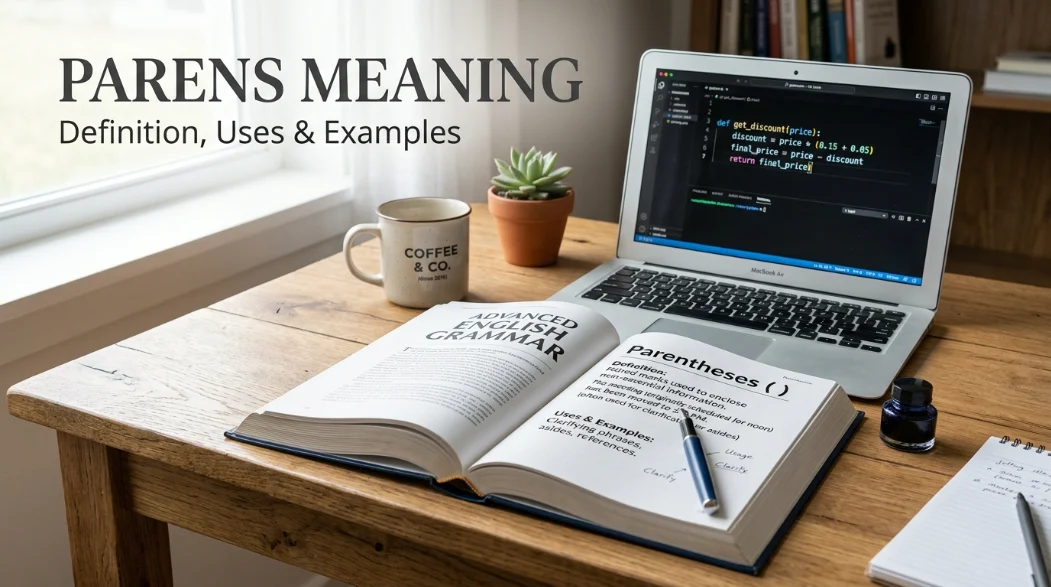
The parens meaning is simple: “parens” is a shortened form of “parentheses,” the curved punctuation marks ( ) used to add extra information, clarification, examples, or side comments to a sentence. You may see this term in grammar discussions, editing, academic writing, programming, and everyday communication.
Although “parens” and “parentheses” refer to the same punctuation, they are not equally formal in every situation. Knowing the difference between parens meaning, parenthesis, parentheses, and brackets can help you write more clearly and choose the right term for your audience. This guide explains the definition, common uses, practical examples, related punctuation terms, and frequent mistakes in simple English.
What Does Parens Mean?
Parens is a common abbreviation of parentheses. The term usually refers to the two curved marks:
( )
The word can appear in casual writing, editing discussions, grammar explanations, programming, and technical communication.
For example:
- Please put the extra information in parens.
- The editor asked me to remove the parens from the sentence.
- Add the function arguments inside the parens.
- The number is shown in parens for clarity.
In formal writing, parentheses is generally the safer and more traditional term. Parens is shorter and conversational.
Parens Definition in English
The basic definition of parens is:
Parens are parentheses, the curved punctuation marks used to enclose additional or explanatory information.
A single curved mark is called a parenthesis.
The two marks together are called parentheses.
| Term | Meaning |
|---|---|
| Parenthesis | One curved punctuation mark |
| Parentheses | The pair of curved marks |
| Paren | Informal singular form |
| Parens | Informal plural form |
| ( ) | The punctuation marks themselves |
For example:
The meeting starts at 9:00 (please arrive early).
The entire pair is parentheses, while each individual curved mark is a parenthesis.
What Are Parens Used For?
Parentheses have several important uses in writing. Their main purpose is to add information that supports the main sentence without interrupting its central message too strongly.
1. Adding Extra Information
Parentheses can provide additional details.
James visited Boston (his favorite city) during the summer.
The phrase inside the parentheses gives the reader extra information about Boston.
2. Adding an Explanation
They can clarify something mentioned in a sentence.
The company opened a new branch in Austin (the state capital of Texas).
The parenthetical phrase gives additional context.
3. Including Examples
Parentheses can introduce examples.
Several fruits are rich in vitamin C (such as oranges and strawberries).
The example supports the main statement without becoming the main point.
4. Giving Dates
Parentheses are often used around dates or other identifying information.
William Shakespeare (1564–1616) remains one of the most studied writers in English literature.
5. Showing Optional Information
Sometimes information inside parentheses can be omitted without changing the basic meaning.
Please bring your identification (if available).
The main instruction remains understandable without the parenthetical phrase.
6. Adding Acronyms
Parentheses can introduce an abbreviation after the full term.
Search engine optimization (SEO) is commonly discussed in digital marketing.
The full phrase comes first, followed by its abbreviation.
7. Showing Alternative Words
Parentheses can sometimes indicate an optional word or ending.
Please enter your name(s) below.
This construction tells readers that the singular or plural form may apply.
Parens Meaning in Writing
In writing, parens generally means parentheses used to separate supplementary information from the main sentence.
Consider this example:
Maria submitted the report (three days before the deadline).
The main statement is:
Maria submitted the report.
The information inside the parentheses gives additional context.
This is one reason parentheses are useful. They allow writers to add information without creating another complete sentence.
However, parentheses should not become a place to put every detail. Too many parenthetical phrases can make writing feel crowded and harder to follow.
Parens Meaning in Grammar
From a grammar and punctuation perspective, parentheses are used to enclose material that is supplementary to the surrounding sentence.
For example:
The new policy will begin next month (assuming the final approval is received).
The parenthetical material is related to the sentence but is not essential to its basic structure.
A useful test is to temporarily remove the words inside the parentheses. If the main sentence remains clear, the parenthetical information is probably functioning as supplementary material.
Parens Meaning in Text and Messaging
In casual digital communication, parens can simply refer to parentheses.
For example:
Put the date in parens.
This means:
Put the date inside parentheses.
People may also use parentheses directly in messages:
I finally finished the assignment (after three cups of coffee).
The information in parentheses can add a side comment, clarification, or personal reaction.
The term parens meaning in text therefore depends slightly on context. In most ordinary messages, it simply means the curved punctuation marks ( ).
Parens vs. Parentheses
Parens and parentheses refer to the same punctuation marks, but they differ in style.
| Feature | Parens | Parentheses |
|---|---|---|
| Meaning | Parentheses | Parentheses |
| Style | Informal/shortened | Standard/full term |
| Common in conversation | Yes | Yes |
| Common in formal writing | Less common | More common |
| Common in editing | Yes | Yes |
| Common in programming | Very common | Common |
| Punctuation | ( ) | ( ) |
For a formal article, report, academic paper, or professional document, parentheses is usually the clearer choice.
In a casual conversation with an editor, writer, or programmer, parens is perfectly understandable.
Is Parens Short for Parentheses?
Yes. Parens is a shortened form of parentheses.
It is especially common in informal discussions about writing, editing, coding, and punctuation.
For example:
Remove the parens around that phrase.
This means:
Remove the parentheses around that phrase.
The shortened form does not describe a different punctuation mark. It is simply a more concise term.
Parens and Parenthesis: What Is the Difference?
The singular and plural forms can sometimes cause confusion.
Parenthesis refers to one of the marks.
Parentheses refers to the pair.
For example:
Add a parenthesis at the end.
Put the phrase inside parentheses.
In informal usage, paren can refer to one mark, while parens can refer to the pair.
Simple way to remember
- One: parenthesis
- Two: parentheses
- Informal singular: paren
- Informal plural: parens
Parentheses vs. Brackets
Another common source of confusion is the difference between parentheses and brackets.
Parentheses look like this:
( )
Square brackets look like this:
[ ]
They have different names and can serve different purposes.
| Mark | Common name | Example |
|---|---|---|
| ( ) | Parentheses | The answer is correct (according to the teacher). |
| [ ] | Square brackets | The editor added [sic] to the quotation. |
| { } | Braces/curly brackets | Used in mathematics and programming. |
| < > | Angle brackets | Used in some technical contexts. |
Regional usage can also cause confusion. In American English, brackets commonly refers to square brackets, while parentheses refers to round marks.
In British English, brackets can sometimes refer to round parentheses, so context matters.
How to Use Parens in a Sentence
Using parentheses correctly is mainly about deciding what information is secondary.
Example 1: Additional detail
The conference will take place in Denver (Colorado).
Example 2: Personal aside
I completed the project (finally!) before the deadline.
Example 3: Abbreviation
The World Health Organization (WHO) publishes health information.
Example 4: Date
George Orwell (1903–1950) wrote several influential works.
Example 5: Clarification
The store closes at 8 p.m. (7 p.m. on Sundays).
Example 6: Optional information
Customers can contact the support team (if they need assistance).
Parens in Academic Writing
Parentheses are common in academic writing, but their use should be purposeful.
They can contain citations, abbreviations, dates, explanations, and supplementary details.
For example:
The study included 150 participants (75 men and 75 women).
Academic writers also use parentheses when introducing an abbreviation:
Artificial intelligence (AI) has become an important research topic.
The exact citation style can determine how parentheses should be formatted, so students should follow the requirements of their institution or chosen style guide.
Parens in Professional and Business Writing
Parentheses can be useful in professional communication when they make information easier to understand.
For example:
The revised policy will take effect on July 1 (subject to final approval).
They can also help explain abbreviations:
The Human Resources department (HR) will distribute the updated policy.
Still, professional writing usually benefits from clear sentence structure. If a parenthetical phrase contains a major point, it may be better to write it as a separate sentence.
Parens in Programming
The word parens is especially common in programming conversations.
Programmers often use parentheses to group expressions, pass function arguments, control mathematical operations, or structure code.
For example:
print("Hello")
The parentheses after print contain the function’s argument.
Another example is:
total = (price + tax)
Here, the parentheses group part of the expression.
In programming discussions, someone might say:
Check the closing paren.
This means:
Check the closing parenthesis.
The term is common because programmers frequently work with parentheses and need a short way to discuss them.
Common Phrases With Parens
You may encounter several expressions involving the word parens.
“Put it in parens”
This means to place something inside parentheses.
Put the date in parens.
“Remove the parens”
This means to delete the parentheses.
Remove the parens around the title.
“Open paren”
This refers to the opening parenthesis:
(
“Close paren”
This refers to the closing parenthesis:
)
“Nested parens”
This refers to parentheses placed inside other parentheses or several levels of grouping.
Nested punctuation can become difficult to read, so writers often restructure the sentence when possible.
Common Mistakes With Parens
Mistake 1: Confusing parens with brackets
Incorrect idea: All forms of brackets are parentheses.
Better: Parentheses are ( ), while square brackets are [ ].
Mistake 2: Using too many parentheses
A sentence packed with parenthetical information can become difficult to read.
Instead of adding several side comments, consider breaking the information into separate sentences.
Mistake 3: Using “parenthesis” for the pair
Parenthesis is singular.
Parentheses is plural.
Mistake 4: Treating parens as a formal replacement everywhere
Parens is widely understood, but parentheses is often more appropriate in formal writing.
Mistake 5: Putting essential information inside parentheses
If information is necessary for understanding the main sentence, parentheses may weaken its importance.
For example, instead of:
The company changed its policy (employees must submit the form by Friday).
A clearer version is:
The company changed its policy. Employees must submit the form by Friday.
When Should You Use Parens?
Use parentheses when information is useful but secondary.
They work especially well for:
- Clarifications
- Brief explanations
- Examples
- Dates
- Acronyms
- Optional details
- Side comments
- Technical notation
- Function arguments in programming
- Mathematical grouping
Avoid relying on them when the information deserves direct emphasis.
A simple writing principle is:
Main idea outside the parentheses, supporting detail inside.
Parens Meaning: Quick Comparison
| Term | Meaning | Best context |
|---|---|---|
| Parens | Informal term for parentheses | Casual and technical discussions |
| Parentheses | Curved punctuation marks | General and formal writing |
| Parenthesis | One curved mark | Grammar and punctuation explanations |
| Paren | Informal singular form | Programming and casual discussion |
| Brackets | Can mean square brackets or, regionally, parentheses | Context dependent |
| Square brackets | [ ] | Editing, quotations, technical writing |
| Braces | { } | Mathematics and programming |
Frequently Asked Questions
What does parens mean?
Parens is an informal shortened term for parentheses, the curved punctuation marks ( ). It is commonly used in conversations about writing, editing, grammar, and programming.
Is parens short for parentheses?
Yes. Parens is a shortened form of parentheses. It refers to the same curved punctuation marks and does not represent a different type of punctuation.
What is the singular of parens?
The informal singular form is paren. The standard singular term is parenthesis.
Are parens and parentheses the same thing?
Yes. They refer to the same punctuation marks. Parens is simply a shorter, more informal term for parentheses.
What is the difference between parens and brackets?
Parens usually refers to parentheses, ( ). In American English, brackets commonly refers to square brackets, [ ]. Usage can vary by region and context.
What does parens mean in programming?
In programming, parens is an informal term for parentheses. Programmers commonly use it when discussing function calls, arguments, expressions, conditions, and other parts of code.
What are parens used for in writing?
Parens are used to add supplementary information, explanations, examples, dates, abbreviations, and side comments without making that information the main focus of the sentence.
Should I use parens in formal writing?
You can use the term when appropriate, but parentheses is generally the clearer choice in formal writing. Parens is more common in casual, editing, and technical conversations.
Final Takeaway
The simple parens meaning is parentheses, the curved punctuation marks ( ). The term is an informal abbreviation that appears frequently in writing discussions, editing, programming, and everyday communication.
Use parens when a short, casual term fits the context. Use parentheses when you want the standard term, especially in formal or educational writing.
The most important distinction is simple: parenthesis means one mark, parentheses means the pair, and parens is the common shortened form for the pair.
Read More Related Articles:
- JW Meaning in Text | The Hidden Meaning Behind This Short …
- LWK Meaning in Text | What It Really Means, How to Use It …
- HM Meaning in Text | What It Really Means in Modern Chats …