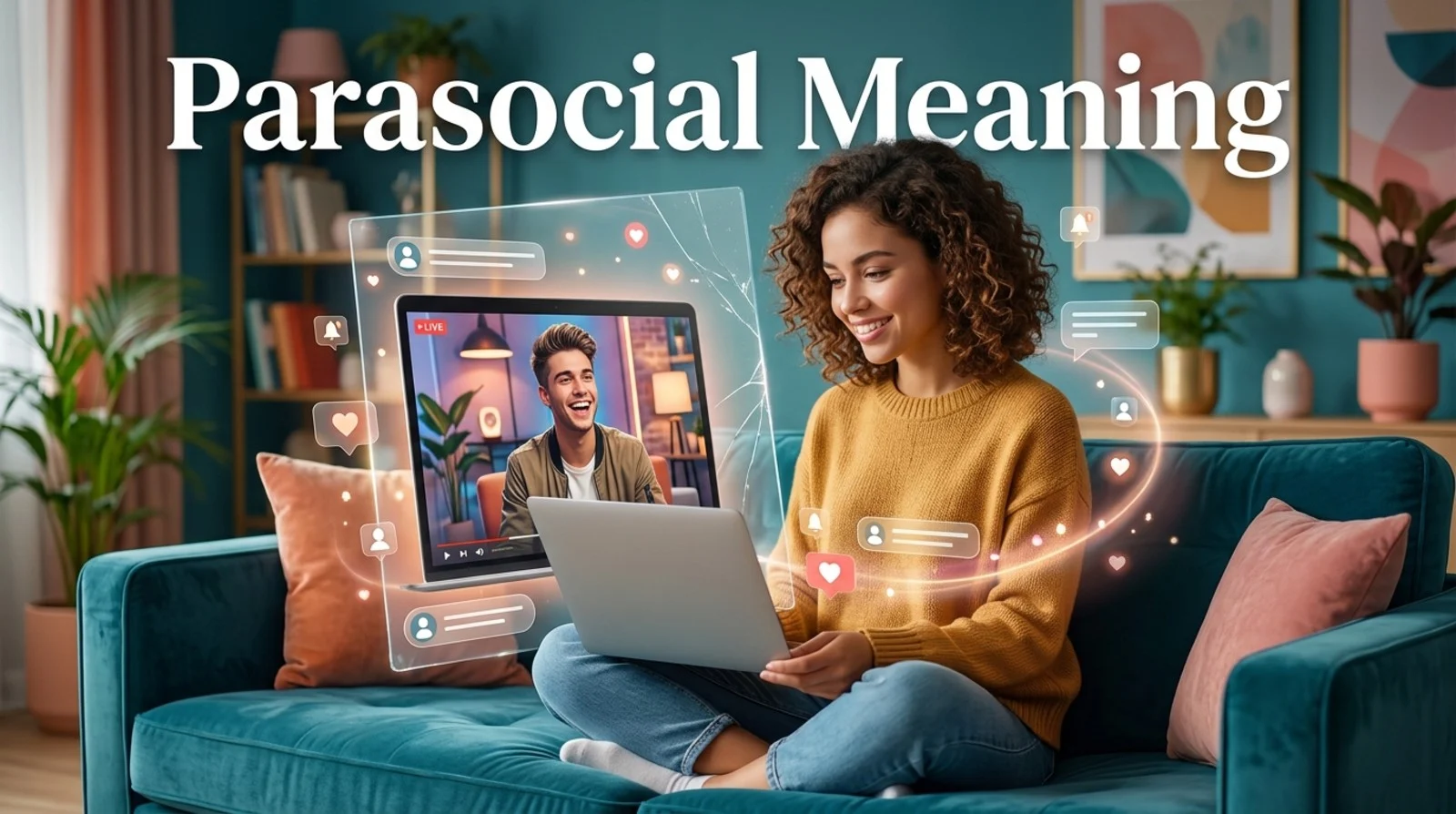
You can follow a creator for years, know their favorite foods, hear their stories every week, and feel like you understand their personality. Yet they may have no idea who you are. That one-sided sense of connection is at the heart of the parasocial meaning.
A parasocial relationship is a one-sided relationship in which a person develops a sense of familiarity, emotional connection, or attachment to a public figure, media personality, influencer, fictional character, or other person they mainly encounter through media. The connection can feel surprisingly personal even though the other person does not know the individual personally.
Parasocial connections are not automatically unhealthy or strange. They can be a normal part of being a fan or regularly consuming media. The important issue is the difference between enjoying a connection and believing that a genuine two-way relationship exists when it does not.
What Does Parasocial Mean?
Parasocial describes a one-sided emotional or social connection that a person develops with someone they encounter through media, such as a celebrity, influencer, streamer, fictional character, athlete, or media personality.
For example, someone may watch the same YouTuber every day and start feeling that the creator is like a friend. The viewer knows a lot about the creator, but the creator does not personally know the viewer. This is a parasocial relationship.
The word is commonly associated with media psychology and the way audiences form perceived relationships with people they repeatedly see through television, films, podcasts, livestreams, and social media.
Parasocial Definition in Simple English
In simple terms, parasocial means a relationship that feels personal to one person but is not a mutual relationship.
The word is especially useful for describing connections between audiences and people they regularly watch or follow.
A simple example:
You watch a streamer every evening. You know their jokes, opinions, routines, and personality. You feel comfortable talking about them as if they are someone you know. The streamer, however, does not know you personally.
That is a parasocial connection.
The relationship exists in the viewer’s experience, but it does not have the same mutual interaction found in an ordinary friendship.
What Is a Parasocial Relationship?
A parasocial relationship is a perceived relationship between an audience member and a media figure or fictional character.
The audience member may experience:
- Familiarity
- Affection
- Admiration
- Trust
- Emotional attachment
- A sense of friendship
- Concern for the person’s wellbeing
- A feeling of knowing their personality
The other side of the relationship does not need to participate personally for these feelings to develop.
This is one reason the concept is particularly relevant to modern social media. Platforms can make creators appear unusually accessible. Followers may see daily videos, personal updates, livestreams, behind-the-scenes content, and direct replies.
That repeated exposure can create a strong feeling of familiarity.
Parasocial Relationship vs Real Friendship
| Feature | Parasocial Relationship | Mutual Friendship |
|---|---|---|
| Personal connection | Mainly experienced by one person | Experienced by both people |
| Knowledge | One person may know a lot about the other | Both people generally know each other |
| Communication | Usually media-based or limited | Two-way communication |
| Personal access | Usually limited | Usually reciprocal |
| Emotional attachment | Can be strong | Can be strong |
| Mutual awareness | Often absent | Present |
| Example | Fan and influencer | Two people who regularly interact |
The key distinction is reciprocity. A person can genuinely feel something without the relationship becoming a two-way friendship.
How Parasocial Relationships Develop
Parasocial connections rarely appear from one single video or post. They often develop gradually through repeated exposure.
1. Repeated Exposure
Seeing the same person frequently can make them feel familiar.
A creator who posts every morning may become part of someone’s daily routine. After months or years, the creator can feel almost like a familiar presence.
2. Personal Storytelling
Creators often share experiences, opinions, struggles, celebrations, and everyday details.
This information gives audiences a richer picture of the person’s personality. The viewer may begin to feel that they understand the creator beyond their public content.
3. Direct-Style Communication
A creator may speak directly into the camera and use phrases such as “you guys” or “I wanted to tell you something.”
Although thousands or millions of people may be watching, the format can create a feeling of personal conversation.
4. Shared Interests
People often follow personalities who reflect their interests, humor, values, hobbies, or experiences.
A viewer might think:
“They get me.”
That feeling of similarity can strengthen emotional attachment.
5. Routine and Habit
A podcast during breakfast, a favorite streamer after work, or a creator’s weekly video can become part of someone’s routine.
The repeated presence becomes meaningful because it is connected to familiar moments in everyday life.
Parasocial Interaction vs Parasocial Relationship
These terms are related, but they are not exactly the same.
Parasocial interaction generally refers to the experience of interacting with or responding to a media personality during media exposure. It can happen while watching a video, television program, livestream, or other content.
For example, you might laugh when a creator makes a joke or mentally respond to something they say.
A parasocial relationship is broader. It refers to a longer-lasting perceived relationship that can develop over repeated exposure.
Think of it this way:
Interaction = a moment of perceived interaction
Relationship = a continuing sense of connection
A person can experience parasocial interactions without developing a strong long-term attachment.
Parasocial Meaning in Social Media
Social media has changed the way audiences experience public figures.
Traditional media often presented celebrities at a distance. Social platforms can make creators appear much more accessible.
Followers may see:
- Morning routines
- Family stories
- Personal opinions
- Livestreams
- Private-looking moments
- Travel updates
- Behind-the-scenes content
- Q&A sessions
- Comments and replies
- Everyday frustrations and celebrations
This creates an unusual combination: large-scale communication with an intimate style.
An influencer might speak to hundreds of thousands of followers using a conversational tone. A viewer receives that message individually on their phone, even though the creator is communicating with a large audience.
That can make the social experience feel more personal than the actual relationship is.
Parasocial Relationship Examples
Parasocial relationships can happen in many settings, not only celebrity culture.
Example 1: YouTube Creator
A person watches one creator every night. Over time, they know the creator’s humor, opinions, favorite topics, and recurring stories.
The viewer starts thinking of the creator as a friend.
That can be a parasocial relationship.
Example 2: Celebrity
Someone has followed an actor for many years. They feel genuinely sad when the actor goes through a difficult public event.
Feeling sympathy is not automatically a problem. The parasocial element appears when the fan develops a strong sense of personal connection despite having no personal relationship with the actor.
Example 3: Podcast Host
A listener hears the same podcast every week for several years.
The host discusses personal experiences and speaks casually to listeners. The listener begins to feel that they know the host personally.
The repeated exposure can create a parasocial bond.
Example 4: Livestreamer
A streamer regularly reads viewer comments and sometimes responds to individual people.
A viewer may feel especially connected after receiving a reply. If that feeling grows into a belief that they have a close friendship with the streamer, the situation can become more strongly parasocial.
Example 5: Fictional Character
Parasocial attachment is not limited to real people.
Someone can become emotionally attached to a fictional character and feel deeply affected by the character’s experiences.
The person knows the character is fictional, so the emotional response itself does not mean they believe the character is real.
Is a Parasocial Relationship Normal?
Having a parasocial relationship can be a normal part of media use and fandom.
People naturally form emotional responses to stories, characters, performers, and personalities. Enjoying a creator’s content, caring about a fictional character, or feeling inspired by a public figure does not automatically indicate a problem.
The more useful question is how the connection affects everyday life.
A parasocial connection can remain relatively harmless when someone:
- Understands that the relationship is one-sided
- Enjoys content without feeling entitled to access
- Maintains real-world relationships
- Respects the creator’s privacy
- Can take breaks from the content
- Keeps reasonable boundaries
Concerns can arise when the attachment begins to interfere substantially with daily responsibilities, relationships, finances, privacy, or emotional wellbeing.
When Can Parasocial Attachment Become Unhealthy?
The term itself does not mean something harmful.
The potential problem comes from loss of boundaries.
For example, a viewer may move from:
“I really enjoy this creator.”
to:
“This creator owes me personal attention because I support them.”
That second belief changes the nature of the behavior.
Warning signs can include:
- Feeling personally betrayed by ordinary choices a creator makes
- Believing you are entitled to private information
- Spending money you cannot afford to maintain a sense of closeness
- Becoming extremely distressed when content stops
- Ignoring friends or family because of online attachment
- Attempting to control a creator’s personal life
- Treating imagined closeness as proof of an actual friendship
- Becoming hostile toward people who criticize the public figure
These signs do not diagnose a mental health condition. They simply describe situations where stronger personal boundaries may be useful.
Why Do People Develop Parasocial Relationships?
There is no single reason.
Human beings are social creatures, and media can provide repeated social cues. Familiar voices, faces, stories, humor, shared interests, and perceived similarities can all contribute to feelings of connection.
A creator can also become associated with a particular period of someone’s life.
For example, someone might listen to the same podcast while studying for exams, starting a new job, moving to another city, or going through a difficult transition. Years later, that person’s voice may bring back strong memories.
The emotional meaning can therefore come from both the creator and the viewer’s own experiences.
This is an important distinction. A parasocial connection is not necessarily based on believing that a celebrity is secretly your friend. Sometimes it simply reflects the personal meaning attached to repeated media experiences.
Parasocial Relationships and Loneliness
Parasocial relationships are sometimes discussed alongside loneliness because media can provide a sense of social presence.
However, it is too simplistic to say that lonely people always develop parasocial relationships or that parasocial relationships automatically cause loneliness.
A person can have strong friendships and still enjoy a deep attachment to a favorite creator.
Likewise, someone experiencing loneliness might find comfort in podcasts, videos, television characters, or online communities.
The important point is that a media connection and a mutual human relationship are not identical. A parasocial connection may provide entertainment, comfort, or familiarity, but it does not replace the reciprocity of an actual relationship.
Parasocial Relationships With Influencers
Influencers can create particularly strong parasocial connections because their content often mixes public performance with personal details.
A celebrity might appear in a movie for two hours. An influencer might appear on a follower’s screen every day.
That frequency changes the experience.
Influencers may also respond to comments, share personal routines, mention followers, or livestream from their homes. These practices can make the audience feel closer to the creator.
At the same time, the creator may be managing a professional brand.
This means viewers should remember that social media content can be both personal and professionally produced. Seeing someone’s daily posts does not necessarily mean knowing their private life.
Parasocial Relationships With Fictional Characters
People can form powerful emotional attachments to fictional characters.
A reader may become attached to a character in a novel. A television viewer may feel devastated when a character dies. A gamer may spend hundreds of hours with a particular character.
These experiences can feel emotionally real even though the character is fictional.
The emotional response is part of the audience’s experience with the story. It does not require the character to be a real person.
This is one reason parasocial attachment is broader than simple celebrity fandom.
Parasocial vs One-Sided Relationship
A parasocial relationship is a particular type of one-sided relationship.
The phrase one-sided relationship can describe many situations. A person might have unreturned romantic feelings for someone they know personally, for example.
A parasocial relationship usually involves a person encountered through media or public communication.
| Term | Basic Meaning |
|---|---|
| One-sided relationship | A connection where emotional investment is not equally shared |
| Parasocial relationship | A perceived connection with a media figure or fictional character |
| Parasocial interaction | A moment of perceived interaction with a media figure |
| Fandom | A community or culture built around interest in a person, work, or subject |
| Celebrity admiration | Positive feelings toward a famous person without necessarily feeling personally connected |
The terms can overlap, but they should not be treated as exact synonyms.
Common Misunderstandings About Parasocial Relationships
“Every fan has an unhealthy parasocial relationship.”
Not true.
Being a fan and having a parasocial connection can be ordinary parts of entertainment and media consumption.
“Parasocial means fake feelings.”
Not exactly.
The relationship may be one-sided, but the viewer’s emotions can still be genuine.
“Following an influencer means you have a parasocial relationship.”
Not necessarily.
Following someone online does not automatically mean developing emotional attachment or a perceived personal relationship.
“Parasocial relationships only involve celebrities.”
No.
They can involve influencers, streamers, podcasters, fictional characters, athletes, musicians, television personalities, and other media figures.
“Parasocial relationships are always harmful.”
No.
The concept describes a type of relationship experience. Its effects depend on the person’s behavior, expectations, boundaries, and circumstances.
How to Maintain Healthy Boundaries
Enjoying someone’s content does not require eliminating emotional attachment. It means keeping the connection in perspective.
A few practical habits can help:
Keep the Relationship in Context
Remind yourself that seeing someone’s content regularly does not mean you know every part of their life.
Maintain Offline Connections
Make room for family, friends, colleagues, classmates, and other real-world relationships.
Respect Privacy
Public content does not give an audience unlimited access to someone’s private life.
Watch Your Spending
Memberships, merchandise, donations, subscriptions, and paid content can be enjoyable. Problems can arise when spending is driven by pressure or a desire to obtain personal attention.
Take Occasional Breaks
If a creator’s content starts controlling your mood or schedule, stepping away for a while can help restore balance.
Separate Appreciation From Entitlement
You can admire someone’s work without expecting personal access, loyalty, replies, or agreement from them.
That distinction is one of the healthiest ways to understand parasocial connections.
How to Use “Parasocial” in a Sentence
Here are natural examples:
- She developed a parasocial relationship with her favorite podcast host.
- The documentary explored parasocial relationships between fans and celebrities.
- Social media can make parasocial connections feel more personal.
- His attachment to the fictional character became strongly parasocial.
- The creator discussed healthy boundaries with parasocial fans.
- Parasocial interaction can occur while someone watches a livestream.
- The fan recognized that the connection was parasocial rather than a real friendship.
- Influencer marketing can benefit from strong parasocial connections with audiences.
- Her interest in the singer was based on admiration rather than a close parasocial attachment.
- The podcast created a feeling of familiarity that some listeners described as parasocial.
Synonyms and Related Words for Parasocial
There is no perfect everyday synonym for parasocial because it describes a specific concept.
Depending on context, related expressions include:
- One-sided relationship
- Perceived relationship
- One-sided connection
- Emotional attachment
- Audience connection
- Celebrity attachment
- Fan attachment
- Media-based relationship
- Perceived friendship
- Emotional connection
These terms are related, but they are not interchangeable in every sentence.
For example, emotional attachment is much broader than parasocial relationship. Someone can have emotional attachment to a family member, pet, place, object, or fictional character. Parasocial describes a more specific kind of social or relational connection.
Parasocial Meaning in Text and Online Conversations
When someone uses parasocial in a text, comment, or social media discussion, they are usually pointing out that a person’s attachment to a public figure appears unusually personal or one-sided.
For example:
“You’re getting too parasocial about this celebrity.”
Here, the speaker is suggesting that the person’s emotional investment has moved beyond ordinary fandom.
The word can also be used neutrally:
“Fans can develop parasocial relationships with podcast hosts.”
The meaning depends heavily on context.
In online conversations, parasocial is sometimes used loosely as an insult. That can make discussions confusing because ordinary admiration and genuinely boundary-crossing behavior are not the same thing.
FAQs
What is the simple meaning of parasocial?
Parasocial describes a one-sided connection in which someone feels emotionally or socially connected to a media figure, celebrity, influencer, streamer, or fictional character who does not personally know them.
What does parasocial mean on social media?
On social media, parasocial usually describes a perceived personal connection between a follower and a creator or public figure. Frequent posts, livestreams, personal stories, and direct-style communication can strengthen that feeling.
Is a parasocial relationship a real relationship?
It is a real emotional experience for the audience member, but it is not a mutual relationship in the same way as a friendship or romantic relationship. The key difference is reciprocity.
Are parasocial relationships bad?
Not automatically. Enjoying a strong connection with a creator or fictional character can be a normal part of media use. Problems may arise when boundaries disappear or the attachment seriously interferes with everyday life.
Can you have a parasocial relationship with a fictional character?
Yes. People can develop strong emotional attachments to fictional characters. The character does not need to be a real person for the audience’s emotional response to be meaningful.
What is the difference between parasocial interaction and parasocial relationship?
Parasocial interaction usually describes a perceived interaction during media exposure. A parasocial relationship refers to a more continuing sense of connection that develops over time.
Why do people get parasocial attachments?
Repeated exposure, perceived similarity, personal storytelling, routine, entertainment, emotional experiences, and feelings of familiarity can all contribute to parasocial attachment.
Can a parasocial relationship become unhealthy?
It can become problematic when someone develops unrealistic expectations, feels entitled to a public figure’s attention or private life, neglects important responsibilities, or allows the attachment to seriously disrupt other relationships.
Final Takeaway
The simplest way to understand parasocial meaning is to think of a connection that feels personal but is not mutually experienced.
A viewer can genuinely admire a creator, feel comforted by a podcast host, care about a fictional character, or feel familiar with a celebrity. Those emotions can be meaningful without becoming a two-way friendship.
The useful distinction is connection versus reciprocity. Enjoying someone’s work is one thing. Expecting personal access, attention, or control is something different.
Understanding that boundary makes the term easier to use accurately and makes conversations about fandom, influencers, celebrities, and social media much clearer.
Discover More Post:
- ENO Meaning in Text | Definition, Uses, Context & What It …
- 111 Meaning | Spiritual Significance, Symbolism, Love & the …
- Abut Meaning | Definition, Examples, Usage & How to Use It …











11 thoughts on “Parasocial Meaning | Definition, Examples, Psychology & the Modern Connection Behind One-Sided Bonds 2026”