When writing an essay, reviewing a news story, preparing a report, or describing someone’s opinion, repeating the word bias can make your language feel limited. Finding the right synonym of bias can help you explain unfair judgment, personal preference, one sided thinking, or a tendency toward a particular viewpoint with greater precision.
The best alternative depends on what you mean by bias. Prejudice emphasizes an unfair opinion, partiality suggests favoritism, subjectivity points to personal judgment, and slant describes a presentation that favors one side. Choosing the right word improves clarity, tone, and accuracy, especially in academic, professional, and analytical writing.
What Are the Best Synonyms of “Bias”?
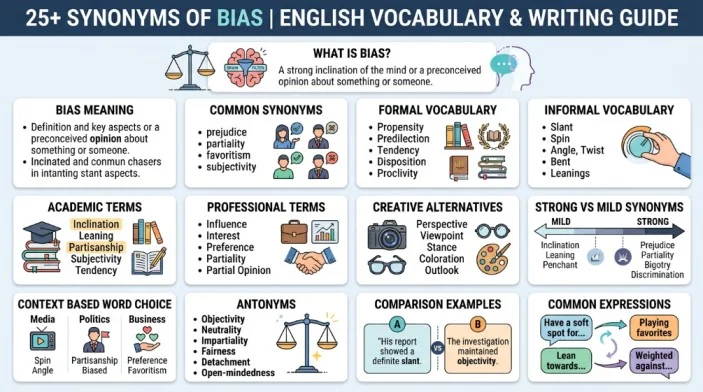
Bias means a tendency to favor or oppose a person, group, idea, or viewpoint rather than judging fairly and objectively. The best synonyms include prejudice, partiality, favoritism, subjectivity, predisposition, inclination, slant, one sidedness, and partisanship. Formal writing often favors partiality or subjectivity, while casual contexts may use leaning or preference.
Meaning, Tone, and Context
Simple Definition
Bias is a tendency to favor one person, group, idea, or position over another, often in a way that affects fair judgment. It can come from personal beliefs, experiences, preferences, social influences, or assumptions.
For example:
“The article showed a clear bias against the proposed policy.”
Here, bias means the article presented the issue in a way that unfairly favored one side.
Bias can also describe a systematic tendency or distortion in research, statistics, testing, algorithms, or decision making. In this sense, it does not always mean intentional unfairness.
For example:
“The survey contained a sampling bias.”
This means the way participants were selected created a systematic distortion in the results.
Part of Speech
Bias can function as both a noun and a verb.
As a noun:
“The report contains political bias.”
As a verb:
“Personal opinions can bias a person’s judgment.”
Overall Tone
The tone of bias is usually negative or critical when it refers to unfair judgment or favoritism.
However, the word can be neutral in technical contexts. Researchers may discuss selection bias, measurement bias, or sampling bias without suggesting that someone deliberately acted unfairly.
Formality Level
Bias is a neutral and widely accepted word. It works naturally in:
- Academic writing
- Journalism
- Research
- Business communication
- Workplace discussions
- Everyday conversations
- Social media
- Political analysis
- Scientific writing
Some synonyms, such as partisanship, partiality, and predisposition, sound more formal. Others, such as leaning and preference, are more conversational.
Common Uses
Native English speakers commonly use bias when discussing:
- Political opinions
- News coverage
- Hiring decisions
- Research studies
- Media reporting
- Personal judgments
- Consumer choices
- Workplace decisions
- Social attitudes
- Artificial intelligence
- Statistical analysis
- Historical accounts
Word Forms
| Form | Example |
|---|---|
| Noun | “The study showed bias.” |
| Verb | “The wording may bias the results.” |
| Adjective | “The report appears biased.” |
| Adverb | “The issue was presented in a biased way.” |
| Related noun | “The researcher examined potential bias.” |
When and How to Use “Bias”
Use bias when you want to describe a tendency that affects judgment, representation, evaluation, or decision making. The word is particularly useful when the issue involves fairness, objectivity, or unequal treatment.
Professional
“Managers should recognize unconscious bias when evaluating candidates.”
This is appropriate in workplace discussions about hiring and decision making.
Academic
“The researchers controlled for possible sampling bias.”
Here, bias refers to a methodological problem rather than personal prejudice.
Workplace
“Personal bias can affect how employees interpret feedback.”
The word works well when discussing professional judgment.
Personal
“I realized that my bias toward familiar brands influenced my purchase.”
This sentence shows that bias can exist in everyday choices.
“We should review the data carefully to make sure there is no unintended bias.”
This sounds professional and measured.
Resume
“Evaluated applications using consistent criteria to reduce hiring bias.”
This wording emphasizes fairness and objective decision making.
Social Media
“The post seems to show a strong bias toward one side of the debate.”
This is natural when discussing opinions or online commentary.
Best Synonyms of “Bias”
No single synonym perfectly replaces bias in every sentence. The best choice depends on whether you mean unfair treatment, personal preference, a natural tendency, a one sided presentation, or a technical distortion.
Professional Writing: Partiality
Partiality is a strong formal alternative when bias means unfair preference for one person or side.
“The committee was criticized for partiality during the selection process.”
It works especially well in formal reports and discussions about fairness.
Academic Writing: Subjectivity
Subjectivity works when personal opinions, experiences, or interpretations influence judgment.
“The study acknowledges the potential effects of researcher subjectivity.”
It is especially useful when contrasting personal judgment with objective analysis.
Business Communication: Favoritism
Favoritism is appropriate when someone gives unfair advantages to a particular person or group.
“Employees raised concerns about favoritism in promotions.”
It is more specific than bias because it focuses on preferential treatment.
Casual Conversation: Leaning
Leaning is a natural conversational alternative when someone tends to support one side.
“He has a strong leaning toward traditional approaches.”
It sounds less accusatory than bias.
Emotional Writing: Prejudice
Prejudice is stronger when the bias involves an unfair negative opinion, especially toward a social group.
“The novel explores the prejudice faced by immigrants.”
It carries more emotional and social weight than many neutral alternatives.
Creative Writing: Slant
Slant works well when describing a particular angle or one sided presentation.
“The journalist’s article had a noticeable political slant.”
It can be useful in media analysis and descriptive writing.
Resume Writing: Subjectivity
When discussing decision making, subjectivity can be useful when explaining the need for consistent evaluation.
“Developed standardized criteria to reduce subjectivity in candidate assessments.”
Workplace Communication: Partiality
Partiality works well when discussing fairness between employees, teams, clients, or candidates.
“The review process was designed to prevent partiality.”
Stronger Meaning: Prejudice
Use prejudice when the bias involves an unfair preconceived judgment, particularly toward a person or group.
Softer Meaning: Inclination
Inclination is a softer alternative because it can describe a natural tendency without suggesting unfairness.
“She has an inclination toward practical solutions.”
When Not to Use “Bias”
Although bias is highly useful, it is not always the most precise word.
When the Meaning Is Too General
If you specifically mean unfair treatment toward a particular person, favoritism may be clearer.
Less precise:
“The manager showed bias.”
Better:
“The manager showed favoritism toward one employee.”
When You Mean a Strongly Negative Attitude
If the issue involves an unfair negative belief about a group, prejudice is more specific.
Less precise:
“The character demonstrates bias against immigrants.”
Better:
“The character demonstrates prejudice against immigrants.”
When You Mean Personal Judgment
If the issue is simply influenced by personal perspective, subjectivity may be more accurate.
Less precise:
“The review contains bias.”
Better:
“The review reflects considerable subjectivity.”
When You Mean Support for One Side
If someone consistently favors one political or ideological position, partisanship may communicate the idea more directly.
Less precise:
“The commentator has political bias.”
Better:
“The commentator shows strong political partisanship.”
When You Mean a Natural Preference
Not every preference is unfair.
Less precise:
“She has a bias toward working independently.”
Better:
“She has a preference for working independently.”
When You Need a Technical Term
In research, simply saying bias may not identify the specific problem.
General:
“The study has bias.”
More precise:
“The study may contain selection bias.”
The more specific term gives readers useful information about the source of the problem.
Words Commonly Confused With “Bias”
Prejudice
Difference: Prejudice usually refers to a preconceived and unfair opinion, especially toward people or social groups. Bias is broader and can be positive, negative, personal, or technical.
When to Use It: Use prejudice when discussing discriminatory attitudes or unfair assumptions.
Example:
“The campaign addressed prejudice against minority communities.”
Preference
Difference: Preference simply means liking one option more than another. It does not necessarily involve unfairness.
When to Use It: Use preference for ordinary choices.
Example:
“She has a preference for working in the morning.”
Partiality
Difference: Partiality means unfair favoritism or a lack of neutrality.
When to Use It: Use it in formal discussions about fairness.
Example:
“The judge was accused of partiality.”
Subjectivity
Difference: Subjectivity means judgment is influenced by personal opinions, feelings, or perspectives. It does not automatically imply unfairness.
When to Use It: Use it in academic, artistic, and analytical contexts.
Example:
“Art criticism often contains some degree of subjectivity.”
Favoritism
Difference: Favoritism specifically involves giving unfair preference or advantages to someone.
When to Use It: Use it for workplace, family, school, or organizational situations.
Example:
“The employee complained about favoritism in the department.”
Tendency
Difference: A tendency is simply a pattern or inclination. It does not necessarily involve unfairness or poor judgment.
When to Use It: Use it when you want a neutral description.
Example:
“The company has a tendency to favor long term suppliers.”
Best Synonyms of “Bias” by Context
| Context | Best Synonym | Why It Works | Example |
|---|---|---|---|
| Formal writing | Partiality | Clearly suggests lack of neutrality | “The report was criticized for partiality.” |
| Academic writing | Subjectivity | Focuses on personal judgment | “Subjectivity can affect interpretation.” |
| Professional communication | Partiality | Emphasizes fair treatment | “The process reduces partiality.” |
| Business emails | Favoritism | Specific when unequal treatment is involved | “The policy helps prevent favoritism.” |
| Resume writing | Subjectivity | Appropriate for evaluation processes | “Reduced subjectivity through standardized criteria.” |
| Workplace communication | Favoritism | Useful for unequal treatment | “Employees reported concerns about favoritism.” |
| Casual conversation | Leaning | Sounds natural and less severe | “He has a leaning toward conservative ideas.” |
| Everyday speaking | Preference | Neutral and easy to understand | “I have a preference for local products.” |
| Creative writing | Slant | Describes a particular angle | “The story has a humorous slant.” |
| Storytelling | Perspective | Highlights viewpoint rather than unfairness | “The story is told from a child’s perspective.” |
| Emotional writing | Prejudice | Conveys stronger social judgment | “The character struggles with prejudice.” |
| Strong emphasis | Partisanship | Strongly suggests commitment to one side | “The debate was marked by intense partisanship.” |
| Mild tone | Inclination | Describes a tendency without accusation | “She has an inclination toward practical solutions.” |
| Social media captions | Leaning | Casual and concise | “My personal leaning is toward simple designs.” |
| American English | Bias | Standard and widely understood | “The survey may contain bias.” |
| British English | Partiality | A formal alternative commonly understood in British English | “The decision was questioned because of perceived partiality.” |
How to Choose the Best Synonym of “Bias”
Choosing an alternative becomes easier when you first identify what kind of bias you mean.
Step 1: Identify the Meaning
Ask whether you mean:
- Unfair judgment
- Personal preference
- Favoritism
- A preconceived belief
- A tendency
- A one sided presentation
- Personal interpretation
- A technical distortion
For example, prejudice is better for unfair social attitudes, while preference is better for ordinary personal choices.
Step 2: Consider the Tone
If you want a neutral tone, use inclination, tendency, or preference.
If you want stronger criticism, consider prejudice, partiality, or favoritism.
Step 3: Consider Your Audience
Academic readers may respond better to subjectivity, partiality, or a specific technical term.
Everyday readers may find leaning, preference, or one sidedness easier to understand.
Step 4: Match the Writing Purpose
- For a research paper, precision matters more than emotional force.
- For a social media post, conversational language may be more effective.
- For a workplace report, choose a word that describes the issue without making an unsupported accusation.
Step 5: Check the Emotional Strength
Compare these sentences:
“The reviewer has a preference for traditional designs.”
“The reviewer has a strong leaning toward traditional designs.”
“The reviewer shows partiality toward traditional designs.”
“The reviewer demonstrates prejudice against modern designs.”
The meaning becomes increasingly critical and specific.
Step 6: Choose Natural English
Do not replace bias simply to make your writing sound more advanced. A synonym is useful only when it communicates the intended meaning more accurately.
Real Life Examples of “Bias”
School
Basic:
“The teacher should avoid bias when grading students.”
Improved:
“The teacher should avoid partiality when grading students.”
Why: Partiality specifically emphasizes fairness between students.
College
“Researchers must recognize potential bias when interpreting survey results.”
A more technical version could identify the exact type of bias involved.
Workplace
“The company introduced standardized interviews to reduce unconscious bias.”
This is a natural professional use because hiring decisions can be influenced by unconscious assumptions.
Business
“The analyst’s report appeared to show a strong bias toward the company’s preferred strategy.”
A more specific alternative could be slant if the concern is how information was presented.
“Please review the proposal objectively so that personal preferences do not influence the final decision.”
Here, replacing bias with personal preferences creates a softer tone.
Resume
“Created structured evaluation criteria to reduce subjectivity during candidate screening.”
This sounds more precise than simply saying “reduced bias.”
Conversation
“I may have a slight bias toward locally owned restaurants.”
In casual speech, bias can describe a personal preference without necessarily implying serious unfairness.
Storytelling
“The narrator’s perspective gives the story a clear emotional slant.”
Slant works particularly well when describing the way a narrator presents events.
Blogging
“A good product review should disclose any potential bias.”
This is useful when discussing transparency and credibility.
Social Media
“The discussion quickly became one sided, with users showing strong support for only one viewpoint.”
This avoids accusing people of bias when the writer simply wants to describe an unbalanced discussion.
25 Best Synonyms of “Bias”
| Synonym | Simple Meaning | Best Used For | Example Sentence |
|---|---|---|---|
| Prejudice | Unfair preconceived judgment | Social attitudes | “The organization works to reduce prejudice.” |
| Partiality | Unfair preference for one side | Formal writing | “The decision was questioned because of partiality.” |
| Favoritism | Unfair preference for someone | Workplace situations | “Favoritism can damage employee morale.” |
| Subjectivity | Influence of personal views | Academic writing | “Subjectivity may affect the interpretation of the results.” |
| Predisposition | Existing tendency toward a view | Psychology and analysis | “His predisposition toward risk influenced the decision.” |
| Inclination | A tendency or leaning | Neutral and formal writing | “She has an inclination toward practical solutions.” |
| Leaning | A tendency to support one side | Conversation | “He has a strong leaning toward environmental policies.” |
| Slant | A one sided angle or presentation | Media analysis | “The article has a noticeable political slant.” |
| One sidedness | Lack of balance | General analysis | “The review was criticized for its one sidedness.” |
| Partisanship | Strong support for one side | Politics and public debate | “Partisanship made cooperation difficult.” |
| Preference | Greater liking for one option | Everyday choices | “His preference for familiar brands affected his decision.” |
| Tendency | A recurring pattern or direction | Neutral contexts | “The system has a tendency to favor larger samples.” |
| Propensity | A natural tendency toward something | Formal and academic writing | “The model showed a propensity toward certain outcomes.” |
| Predilection | A strong personal preference | Formal writing | “She has a predilection for traditional literature.” |
| Disposition | A person’s usual tendency or attitude | Formal descriptions | “His cautious disposition shaped the decision.” |
| Incline | A tendency toward a particular opinion | Formal or literary contexts | “The evidence may incline readers toward one interpretation.” |
| Favor | Support or preference for one option | General communication | “The policy appears to favor larger businesses.” |
| Preference bias | A systematic preference affecting judgment | Research and analysis | “The study examined possible preference bias.” |
| Preconception | An opinion formed before full knowledge | Academic and social discussion | “Researchers should question their preconceptions.” |
| Presumption | An assumption accepted without enough evidence | Analytical writing | “The argument relies on a questionable presumption.” |
| Disposition toward | An established tendency | Formal writing | “The group showed a disposition toward cautious decisions.” |
| Ideological leaning | Preference for a particular ideology | Politics and analysis | “The publication has a clear ideological leaning.” |
| Political slant | Presentation favoring a political side | Journalism | “Readers noticed the article’s political slant.” |
| Unfair preference | Favoring one side without fair reason | General explanation | “The selection process appeared to involve unfair preference.” |
| Lack of neutrality | Failure to remain impartial | Formal analysis | “The report was criticized for its lack of neutrality.” |
Synonyms of “Bias” by Usage
Professional vs Personal Synonyms
Professional writing benefits from precise words that describe the source and nature of the problem.
Use partiality when discussing fairness, subjectivity when discussing personal judgment, and favoritism when someone receives unfair advantages.
In personal conversations, preference, leaning, and inclination are often better because they do not automatically accuse someone of unfair behavior.
Formal vs Conversational Synonyms
- For reports, essays, and formal documents, consider:
- Partiality
- Subjectivity
- Predisposition
- Partisanship
- Prejudice
- For casual conversations and texting, consider:
- Preference
- Leaning
- Tendency
- Slant
- Favor
- For example:
Formal:
“The analysis may reflect a degree of subjectivity.”
Conversational:
“I have a slight leaning toward the other option.”
Academic Synonyms
Academic writing requires careful distinctions.
Subjectivity is useful when personal interpretation affects an analysis.
Predisposition describes an existing tendency that may influence judgment.
Preconception refers to an idea held before someone has complete information.
Partiality works when an evaluation lacks fairness or neutrality.
Partisanship is especially useful in political or ideological analysis.
These terms help academic writers identify the mechanism behind the bias rather than simply labeling something as biased.
Professional and Business Synonyms
Resumes
Use subjectivity when describing standardized evaluation systems.
“Implemented structured interviews to reduce subjectivity in hiring.”
Interviews
Use partiality or favoritism when discussing fair candidate treatment.
Meetings
Use leaning when describing someone’s position without making a strong accusation.
Presentations
Use slant when analyzing how information has been presented.
Performance Reviews
Use partiality when discussing unequal treatment between employees.
Client Communication
Use objectivity when emphasizing a neutral evaluation.
Business Emails
Use bias when the issue is general, but identify the specific source when possible.
“We should review the data for potential selection bias.”
Creative and Literary Synonyms
Creative writing often benefits from words that describe viewpoint rather than simply labeling a character as biased.
Slant can describe how a story presents events.
Perspective explains whose viewpoint shapes the narrative.
Prejudice creates stronger emotional and social tension.
Predilection can describe a character’s strong preference in a literary context.
Leaning provides a softer way to show a character’s tendency.
For example:
“The narrator’s political slant becomes increasingly obvious as the story unfolds.”
Slang or Modern Synonyms
There is no single widely accepted slang replacement for bias that works across contexts.
Casual expressions such as leaning, favorite, or playing favorites may be used in informal conversation.
Playing favorites is especially natural when someone gives preferential treatment.
“The coach is playing favorites.”
This expression should generally be avoided in academic or formal professional writing.
Strongest to Mildest Synonyms
The intensity of a synonym depends heavily on context, but a useful general scale is:
| Level | Words | Typical Effect |
|---|---|---|
| Mild | Preference, inclination, tendency | Neutral description |
| Moderate | Leaning, predisposition, subjectivity | Suggests influence |
| Strong | Partiality, favoritism, partisanship | Suggests unfair or one sided judgment |
| Very Strong | Prejudice, discriminatory attitude | Carries serious social or ethical implications |
A preference does not necessarily indicate a problem. Prejudice, by contrast, usually carries a much stronger negative meaning.
Emotional vs Neutral Synonyms
Emotional Synonyms
These words can create stronger reactions:
- Prejudice
- Favoritism
- Partisanship
- One sidedness
- Unfair preference
Use them when the unfairness or social impact is central to the message.
Neutral Synonyms
These alternatives are more restrained:
- Preference
- Inclination
- Tendency
- Subjectivity
- Predisposition
- Leaning
They are useful when discussing someone’s judgment without making an unnecessarily strong accusation.
Antonyms of “Bias”
| Antonym | Meaning | Example Sentence |
|---|---|---|
| Impartiality | Fair treatment without favoring a side | “The panel was praised for its impartiality.” |
| Objectivity | Judging based on evidence rather than personal feelings | “The report aims to maintain objectivity.” |
| Neutrality | Not supporting either side | “The organization maintained neutrality during the dispute.” |
| Fairness | Treating people or situations reasonably and equally | “Fairness should guide every hiring decision.” |
| Evenhandedness | Giving equal consideration to different sides | “The journalist was known for her evenhandedness.” |
| Balance | Giving appropriate attention to opposing views | “The article provides balance by presenting both arguments.” |
| Open mindedness | Willingness to consider different ideas | “Open mindedness helps people reconsider assumptions.” |
| Detachment | Freedom from personal emotional involvement | “Professional detachment helped him evaluate the case.” |
| Equitability | Fair treatment according to reasonable standards | “The policy was designed to improve equitability.” |
| Disinterestedness | Lack of personal interest in influencing an outcome | “The mediator’s disinterestedness increased trust.” |
| Nonpartisanship | Lack of support for a political or competing side | “The committee operates with nonpartisanship.” |
| Objectiveness | Quality of being objective | “The review process requires objectiveness.” |
| Impartial judgment | Fair evaluation without favoritism | “The court requires impartial judgment.” |
| Unbiasedness | Absence of personal or unfair preference | “The goal is to improve unbiasedness in evaluations.” |
| Equality | Equal treatment or status | “Equality should guide access to opportunities.” |
Comparison: “Bias” vs Similar Words
Bias vs Prejudice
Main Difference
Bias is a broad term for a tendency that influences judgment. Prejudice usually involves an unfair preconceived opinion, particularly about people or groups.
Which Is Stronger?
Prejudice is generally stronger and more negative.
Which Is More Formal?
Both are appropriate in formal writing. Prejudice is more specific when discussing social discrimination.
When to Use Each
Use bias for general judgment problems or technical research issues.
Use prejudice for unfair social attitudes.
Examples
Bias:
“The survey may contain selection bias.”
Prejudice:
“The campaign addressed prejudice in the workplace.”
Bias vs Preference
Main Difference
A preference is simply liking one option more than another. Bias can imply that the preference affects fair judgment.
Which Is Stronger?
Bias is usually stronger.
Which Is More Formal?
Both are neutral, but preference is especially common in everyday communication.
When to Use Each
Use preference for ordinary choices.
Use bias when the preference creates distortion or unfairness.
Examples
Bias:
“The reviewer showed bias toward one supplier.”
Preference:
“The reviewer has a preference for local suppliers.”
Bias vs Partiality
Main Difference
Partiality specifically suggests a lack of fairness or neutrality.
Which Is Stronger?
Partiality can sound stronger in formal discussions because it directly raises concerns about fairness.
Which Is More Formal?
Partiality is more formal.
When to Use Each
Use partiality for formal discussions about impartial decisions.
Examples
Bias:
“The committee may have shown bias.”
Partiality:
“The committee was criticized for partiality.”
Bias vs Subjectivity
Main Difference
Subjectivity means personal views or feelings influence judgment. Bias suggests a tendency that may distort judgment or favor one side.
Which Is Stronger?
Bias is generally more critical.
Which Is More Formal?
Subjectivity is especially common in academic and analytical writing.
When to Use Each
Use subjectivity when discussing personal interpretation.
Examples
Bias:
“The article contains political bias.”
Subjectivity:
“The review reflects the writer’s subjectivity.”
Bias vs Favoritism
Main Difference
Favoritism means giving special treatment or advantages to someone. Bias is broader.
Which Is Stronger?
Favoritism can be stronger when unfair treatment is obvious.
Which Is More Formal?
Bias is more broadly useful in formal and technical contexts.
When to Use Each
Use favoritism for workplace, school, family, or organizational decisions.
Examples
Bias:
“The hiring process may contain unconscious bias.”
Favoritism:
“Employees complained about favoritism.”
Bias vs Tendency
Main Difference
A tendency is simply a recurring direction or pattern. It does not necessarily imply unfairness.
Which Is Stronger?
Bias generally carries more critical meaning.
Which Is More Formal?
Both are neutral, but tendency is useful when you want to avoid implying wrongdoing.
When to Use Each
Use tendency for neutral observations.
Examples
Bias:
“The algorithm showed bias toward certain results.”
Tendency:
“The algorithm has a tendency to favor shorter responses.”
Common Phrases and Expressions with “Bias”
Bias against someone or something
Meaning: A tendency to unfairly oppose or judge someone or something.
Example:
“The organization is working to reduce bias against older workers.”
Bias toward someone or something
Meaning: A tendency to favor a particular person, group, or option.
Example:
“The review shows a clear bias toward premium products.”
Unconscious bias
Meaning: An automatic assumption or preference that a person may not recognize.
Example:
“Training can help employees recognize unconscious bias.”
Confirmation bias
Meaning: The tendency to favor information that supports existing beliefs.
Example:
“Confirmation bias can make people ignore evidence that challenges their opinions.”
Political bias
Meaning: A tendency to favor a political viewpoint or side.
Example:
“Readers debated whether the article showed political bias.”
Gender bias
Meaning: Unfair assumptions or treatment related to gender.
Example:
“The company reviewed its hiring process for possible gender bias.”
Racial bias
Meaning: Bias connected to racial identity or assumptions about race.
Example:
“The study examined possible racial bias in the evaluation process.”
Bias in favor of
Meaning: A tendency to support or prefer a particular option.
Example:
“The policy creates a bias in favor of larger companies.”
Common Mistakes to Avoid
1. Treating Every Preference as Bias
Incorrect:
“I prefer tea to coffee, so I have a bias against coffee.”
Better:
“I have a preference for tea over coffee.”
Why:
A personal preference does not automatically involve unfair judgment.
2. Confusing Bias With Prejudice
Incorrect:
“Every statistical bias is prejudice.”
Better:
“Statistical bias can distort research results.”
Why:
Prejudice usually concerns unfair preconceived attitudes, while bias has broader technical and social uses.
3. Using Informal Language in Academic Writing
Incorrect:
“The researcher was playing favorites.”
Better:
“The evaluation process may have involved partiality.”
Why:
The formal alternative is more appropriate for academic analysis.
4. Using “Prejudice” When the Evidence Shows Only Preference
Incorrect:
“She has prejudice toward classical music.”
Better:
“She has a strong preference for classical music.”
Why:
Prejudice is too strong when there is no unfair or preconceived judgment involved.
5. Using “Bias” Without Identifying the Problem
Incorrect:
“The study has bias.”
Better:
“The study may contain sampling bias because the participants were not randomly selected.”
Why:
Identifying the specific type of bias gives readers useful information.
6. Making an Accusation Without Evidence
Incorrect:
“The manager is biased.”
Better:
“The evaluation process may have favored certain candidates.”
Why:
The second sentence describes an observable concern without making an unsupported personal accusation.
7. Repeating “Bias” Too Often
Incorrect:
“The article has bias, the writer shows bias, and the argument contains bias.”
Better:
“The article shows a clear slant, the writer favors one position, and the argument lacks balance.”
Why:
Using precise alternatives improves readability while preserving the intended meaning.
Frequently Asked Questions
1. What are the best synonyms of “bias”?
The best synonyms of bias include prejudice, partiality, favoritism, subjectivity, predisposition, inclination, leaning, slant, and partisanship. The best choice depends on whether you mean unfairness, preference, personal judgment, or one sided presentation.
2. What are the best formal synonyms of “bias”?
The strongest formal alternatives include partiality, subjectivity, predisposition, partisanship, and prejudice. In academic or professional writing, choose the word that precisely describes why judgment may lack neutrality.
3. What are common informal synonyms of “bias”?
Common informal alternatives include leaning, preference, tendency, and slant. These words can sound more conversational, although preference is usually the safest choice when you simply mean that someone likes one option more.
4. What is another word for “bias” in professional writing?
Partiality, subjectivity, favoritism, and predisposition can work well in professional writing. The most accurate choice depends on the situation, such as unfair treatment, personal judgment, or an existing tendency.
5. What is the difference between “bias” and “prejudice”?
Bias is a broad tendency that can influence judgment, while prejudice usually describes an unfair preconceived opinion, particularly toward a person or social group. Prejudice therefore carries a stronger negative and social meaning.
6. What is the opposite of “bias”?
Common opposites of bias include impartiality, objectivity, neutrality, fairness, evenhandedness, balance, and open mindedness. These terms describe fair evaluation without allowing personal preferences to improperly influence judgment.
Conclusion
Bias describes a tendency that can influence judgment, presentation, or decision making, often by favoring one side or perspective. The best alternative depends on the exact meaning. Prejudice is stronger and often social, partiality emphasizes unfairness, subjectivity highlights personal judgment, favoritism describes unequal treatment, and inclination provides a softer, more neutral option.
The most effective synonym is not necessarily the most sophisticated word. Consider your audience, purpose, tone, and the precise kind of bias you are describing before making a substitution. When you identify the underlying meaning first, your vocabulary becomes more accurate and your writing becomes easier to understand.
A useful vocabulary habit is to replace bias only when another word explains the situation more precisely. That approach will help you choose the right synonym of bias without changing the meaning of your sentence.
Read More Related Articles:
50+ Synonyms of Autonomy | Meanings, Uses, Examples, and …
Synonyms for Pros and Cons | Meaning, Examples, and Better …
25+ Synonyms, Meanings, Uses, and Best Alternatives