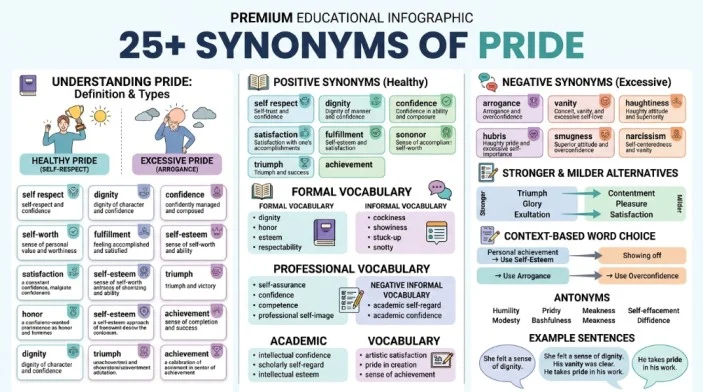
When writing an essay, email, resume, caption, or personal message, using the word pride repeatedly can make your language feel predictable. Finding the right synonym of pride can help you express self respect, satisfaction, confidence, achievement, or even arrogance with much greater precision.
The challenge is that pride has both positive and negative meanings. A person can feel pride after achieving a goal, take pride in excellent work, or display too much pride and become arrogant. Words such as self respect, dignity, confidence, satisfaction, honor, arrogance, conceit, and vanity do not all carry the same meaning, so the best choice depends on context, tone, and emotional strength.
What Are the Best Synonyms of “Pride”?
The best synonym of pride depends on its meaning. For positive pride, use self respect, dignity, confidence, satisfaction, honor, fulfillment, or pleasure. For excessive or negative pride, use arrogance, conceit, vanity, egotism, haughtiness, or hubris. Formal writing often favors dignity or self respect, while emotional and casual writing may use satisfaction, confidence, or pleasure.
Meaning, Tone, and Context
Simple Definition
Pride is a feeling of pleasure, satisfaction, or self respect that comes from your own achievements, qualities, identity, or association with someone or something you value. It can also describe an excessive sense of superiority over others.
This gives pride two major meanings:
- Positive pride: A healthy feeling of satisfaction, self respect, or achievement.
- Negative pride: An excessive belief in your own importance or superiority.
The surrounding context usually makes the intended meaning clear.
Part of Speech
Pride is primarily a noun.
Examples:
- “She felt great pride after completing the project.”
- “His pride prevented him from admitting the mistake.”
Overall Tone
The tone of pride can be positive, neutral, or negative.
Positive pride often communicates accomplishment, dignity, self respect, or satisfaction.
Negative pride can suggest arrogance, stubbornness, vanity, or an exaggerated sense of superiority.
Formality Level
Pride is a neutral English word that works naturally in formal, professional, academic, and casual communication.
It is common in:
- Essays
- Business writing
- Personal conversations
- Speeches
- Social media posts
- Resumes
- Workplace communication
- Storytelling
- Motivational writing
Common Uses
Native English speakers commonly use pride when discussing:
- Personal achievements
- Family accomplishments
- Cultural identity
- Professional work
- Academic success
- Personal values
- Self respect
- Confidence
- National identity
- Community achievements
- Excessive self importance
Word Forms
| Word | Part of Speech | Example |
|---|---|---|
| Pride | Noun | “She felt pride in her achievement.” |
| Proud | Adjective | “He was proud of his work.” |
| Proudly | Adverb | “She proudly accepted the award.” |
The opposite concept depends on the meaning. Humility can oppose excessive pride, while shame or humiliation can contrast with pride based on achievement or status.
When and How to Use “Pride”
Use pride when you want to communicate a feeling of satisfaction, self respect, dignity, or pleasure in an achievement}
Professional
“She takes great pride in delivering high quality work to every client.”
Here, pride expresses professional dedication and satisfaction.
Academic
“The student felt a strong sense of pride after receiving the scholarship.”
The word communicates satisfaction connected to an academic achievement.
Workplace
“Our team takes pride in providing reliable customer service.”
This usage suggests commitment and satisfaction in the quality of work.
Personal
“His parents felt enormous pride when he graduated from college.”
Here, pride describes happiness and satisfaction connected to someone else’s success.
“We are proud to announce this achievement and share it with our customers.”
This is a natural professional expression when communicating a successful result.
Resume
“I take pride in building strong relationships with clients and colleagues.”
This communicates a positive professional attitude, although a more specific achievement may be stronger on a resume.
Social Media
“Feeling incredibly proud of everything our team accomplished this year.”
This sounds natural for a celebratory social media post.
Best Synonyms of “Pride”
No single synonym works in every situation because pride has several related meanings. A word that expresses healthy self respect may be completely inappropriate when the intended meaning is arrogance.
Professional Writing: Dignity
Dignity is an excellent choice when pride refers to self respect, personal worth, or honorable behavior.
Example:
“She handled the difficult situation with dignity.”
Why it works:
Dignity sounds professional and focuses on respectful conduct rather than personal superiority.
Academic Writing: Self Respect
Self respect works well when discussing a person’s belief in their own worth.
Example:
“Healthy self respect can influence how individuals respond to criticism.”
Why it works:
It is precise and clearly communicates a positive form of pride.
Business Communication: Confidence
Confidence is often better than pride when discussing professional ability or belief in one’s skills.
Example:
“The presentation demonstrated the team’s confidence in its strategy.”
Why it works:
Confidence sounds constructive and avoids the potentially negative meaning associated with excessive pride.
Casual Conversation: Satisfaction
Satisfaction is natural when pride comes from completing something successfully.
Example:
“I felt a lot of satisfaction after finishing the project.”
Why it works:
It emphasizes the pleasure of accomplishment without suggesting superiority.
Emotional Writing: Fulfillment
Fulfillment works when pride comes from achieving something personally meaningful.
Example:
“Helping her community gave her a deep sense of fulfillment.”
Why it works:
It expresses emotional reward and personal meaning.
Creative Writing: Glory
Glory can work in dramatic or literary writing when pride is connected with achievement, honor, or triumph.
Example:
“He returned home seeking the glory of victory.”
Why it works:
It creates a stronger, more dramatic tone than ordinary pride.
Resume Writing: Confidence
Confidence is usually more appropriate than pride when describing professional strengths.
Example:
“Approaches complex client challenges with confidence and professionalism.”
Why it works:
It communicates ability without sounding self important.
Workplace Communication: Ownership
Ownership can be useful when pride refers to taking responsibility for the quality of one’s work.
Example:
“She demonstrates strong ownership of every project she manages.”
Why it works:
It emphasizes responsibility and commitment rather than personal superiority.
Stronger Meaning: Arrogance
Arrogance is appropriate when pride has become excessive and causes someone to believe they are better than others.
Example:
“His arrogance made it difficult for him to accept feedback.”
Why it works:
It clearly communicates the negative side of pride.
Softer Meaning: Satisfaction
Satisfaction is a softer alternative when you want to describe positive pride without strong emotion.
Example:
“She felt satisfaction after completing the difficult assignment.”
Why it works:
It focuses on personal contentment rather than status or self importance.
When Not to Use “Pride”
Although pride is versatile, it is not always the most precise choice.
When “Pride” Is Too General
If you specifically mean confidence in someone’s ability, confidence may be clearer.
Less Precise:
“She has pride in her leadership skills.”
Better:
“She has confidence in her leadership skills.”
Why:
Confidence directly communicates belief in one’s abilities.
When “Pride” Is Too Vague
If you mean satisfaction after completing something, satisfaction can be more precise.
Less Precise:
“He felt pride after finishing the assignment.”
Better:
“He felt satisfaction after finishing the assignment.”
Why:
The revised sentence clearly focuses on the rewarding feeling of completion.
When “Pride” Sounds Too Positive
If someone behaves as though they are better than everyone else, arrogance communicates the negative meaning more accurately.
Less Precise:
“His pride annoyed his coworkers.”
Better:
“His arrogance annoyed his coworkers.”
Why:
Arrogance clearly signals excessive self importance.
When “Pride” Sounds Too Formal
In casual conversation, pride can sometimes sound less direct than confidence or satisfaction.
Less Natural:
“I have pride in my cooking.”
More Natural:
“I’m proud of my cooking.”
Why:
The adjective proud is often more conversational than the noun pride.
When “Pride” Is Too Weak
When describing extreme superiority, pride may not communicate enough intensity.
Less Effective:
“His pride caused problems.”
Stronger:
“His arrogance caused serious problems.”
Why:
Arrogance makes the negative behavior explicit.
When “Pride” Is Too Strong
When you simply mean happiness about an outcome, pleasure or satisfaction may sound more appropriate.
Less Strong:
“She felt immense pride when the meal turned out well.”
Softer:
“She felt great satisfaction when the meal turned out well.”
Why:
Satisfaction expresses enjoyment without adding a strong sense of personal achievement.
When a More Specific Word Is Available
Avoid replacing every use of pride with another synonym just for variety. The goal is precision, not repetition of different words.
For example:
“She showed pride in her heritage.”
This may be perfectly appropriate. Replacing pride with confidence would change the meaning.
Words Commonly Confused With “Pride”
Confidence
Difference: Confidence means belief in your abilities or judgment. Pride can include confidence but may also involve satisfaction or superiority.
When to Use It: Use confidence when discussing ability, performance, or self belief.
Example:
“Her confidence helped her lead the presentation effectively.”
Self Esteem
Difference: Self esteem refers to how someone generally evaluates their own worth. Pride is often connected to achievements, identity, or specific qualities.
When to Use It: Use self esteem in discussions of personal worth and psychological well being.
Example:
“Positive feedback helped improve his self esteem.”
Arrogance
Difference: Arrogance is excessive self importance and a belief that you are better than others. It represents the negative side of pride.
When to Use It: Use arrogance when someone’s attitude is disrespectfully superior.
Example:
“Her arrogance made collaboration difficult.”
Vanity
Difference: Vanity involves excessive concern about one’s appearance, abilities, or achievements. Pride is broader.
When to Use It: Use vanity when someone is overly focused on admiration or appearance.
Example:
“His vanity was obvious from the constant attention he paid to his appearance.”
Dignity
Difference: Dignity refers to a sense of worth, respect, and honorable behavior. It is usually more positive and controlled than pride.
When to Use It: Use dignity when emphasizing self respect and respectful conduct.
Example:
“She maintained her dignity throughout the difficult conversation.”
Best Synonyms of “Pride” by Context
| Context | Best Synonym | Why It Works | Example |
|---|---|---|---|
| Formal writing | Dignity | Emphasizes self respect and worth. | “He defended his dignity.” |
| Academic writing | Self respect | Clearly identifies a positive psychological quality. | “Self respect influences personal decisions.” |
| Professional communication | Confidence | Highlights belief in ability without arrogance. | “Her confidence improved the presentation.” |
| Business emails | Satisfaction | Communicates positive achievement professionally. | “We take satisfaction in serving our clients.” |
| Resume writing | Confidence | Presents ability positively. | “Demonstrates confidence in client communication.” |
| Workplace communication | Ownership | Connects pride with responsibility. | “She takes ownership of project outcomes.” |
| Casual conversation | Satisfaction | Sounds natural when discussing achievements. | “I felt real satisfaction after finishing it.” |
| Everyday speaking | Proud | More conversational than the noun pride. | “I’m proud of what we achieved.” |
| Creative writing | Glory | Adds dramatic emphasis to achievement. | “He dreamed of glory.” |
| Storytelling | Triumph | Emphasizes successful victory or achievement. | “The victory brought a feeling of triumph.” |
| Emotional writing | Fulfillment | Highlights deep personal meaning. | “The work gave her fulfillment.” |
| Strong emphasis | Arrogance | Clearly expresses excessive pride. | “His arrogance hurt the team.” |
| Mild tone | Satisfaction | Expresses positive feeling without exaggeration. | “She felt satisfaction after completing the task.” |
| Social media captions | Proud | Sounds natural and personal. | “Proud of this incredible team.” |
| American English | Pride | Common and natural across formal and casual settings. | “We take pride in our work.” |
How to Choose the Best Synonym of “Pride”
Choosing the right word begins with identifying exactly what pride means in your sentence.
If You Mean Self Respect
Choose dignity, self respect, or self esteem.
Example:
“She maintained her dignity during the disagreement.”
If You Mean Belief in Your Abilities
Choose confidence.
Example:
“His confidence helped him perform well under pressure.”
If You Mean Pleasure in an Achievement
Choose satisfaction, pleasure, or fulfillment.
Example:
“Completing the project gave her a strong sense of satisfaction.”
If You Mean Honor
Choose honor or dignity.
Example:
“He accepted the award with a deep sense of honor.”
If You Mean Excessive Pride
Choose arrogance, conceit, vanity, egotism, or haughtiness.
Example:
“His arrogance prevented him from listening to others.”
If You Mean Dramatic Achievement
Choose triumph, glory, or honor, depending on the sentence.
Example:
“The victory was a moment of triumph for the entire team.”
Consider Your Audience
A business report usually benefits from words such as confidence, dignity, or achievement.
A personal message may sound more natural with pride, joy, or satisfaction.
Creative writing can use stronger expressive terms such as triumph, glory, or fulfillment.
Consider Emotional Strength
Use mild words when the feeling is understated.
Use stronger words when the sentence describes an intense emotional experience or negative attitude.
Consider Natural Usage
Do not replace pride simply because another word looks similar in a thesaurus. A synonym should preserve the original meaning and sound natural in the sentence.
Real Life Examples of “Pride”
School
Original:
“She felt pride after receiving the highest grade in the class.”
More Specific:
“She felt satisfaction after receiving the highest grade in the class.”
The second version focuses on the rewarding feeling of achievement.
College
“Graduating from college gave him a deep sense of pride.”
A stronger emotional alternative is:
“Graduating from college gave him a deep sense of fulfillment.”
Workplace
“Our employees take pride in delivering reliable service.”
Here, pride works naturally because it communicates commitment and satisfaction in work.
Business
“The company takes pride in its long history of customer service.”
This is a natural professional use of the word.
“We are proud to share the results of this year’s project.”
The adjective proud sounds more natural in this type of announcement than forcing a noun synonym.
Resume
Less Effective:
“Take pride in completing projects on time.”
Better:
“Demonstrate strong ownership of projects and consistently meet deadlines.”
The revised version describes a professional behavior rather than simply stating an emotion.
Conversation
“I’m really proud of everything you’ve accomplished.”
This is warmer and more natural than using a formal noun such as dignity or self esteem.
Storytelling
“After years of struggle, the victory filled him with a sense of triumph.”
Triumph creates more dramatic energy than ordinary pride.
Blogging
“Small improvements can give you a real sense of satisfaction.”
This sounds natural when discussing personal development.
Social Media
“Feeling incredibly proud of our team today.”
For a social media caption, proud is usually more natural than a formal synonym.
25 Best Synonyms of “Pride”
Because pride has both positive and negative meanings, the following words are grouped by the sense they can express. They should not be treated as interchangeable in every sentence.
| Synonym | Simple Meaning | Best Used For | Example Sentence |
|---|---|---|---|
| Self respect | A healthy sense of personal worth | Personal development | “Self respect helped her set clear boundaries.” |
| Dignity | A sense of worth and honorable behavior | Formal and professional writing | “He handled the criticism with dignity.” |
| Confidence | Belief in your own abilities | Workplace and personal writing | “Her confidence grew after the successful presentation.” |
| Self esteem | A person’s sense of their own value | Educational and personal topics | “Positive feedback can strengthen self esteem.” |
| Satisfaction | Pleasure from achieving or completing something | Everyday and professional use | “Finishing the project brought great satisfaction.” |
| Fulfillment | A deep sense of personal achievement or meaning | Emotional writing | “Teaching gave him a strong sense of fulfillment.” |
| Pleasure | A feeling of enjoyment or happiness | General writing | “She took pleasure in seeing her students succeed.” |
| Honor | Respect or recognition connected with achievement | Formal and ceremonial writing | “Receiving the award was a great honor.” |
| Delight | Strong pleasure or happiness | Emotional and creative writing | “She felt delight when her family arrived.” |
| Joy | A strong feeling of happiness | Personal and emotional writing | “The achievement brought him immense joy.” |
| Triumph | A feeling connected with major success or victory | Storytelling and speeches | “The victory was a moment of triumph.” |
| Glory | Great honor or admiration connected with achievement | Literary writing | “The warrior dreamed of glory.” |
| Arrogance | Excessive belief in one’s superiority | Negative descriptions | “His arrogance damaged his relationships.” |
| Conceit | Excessive pride in oneself or one’s abilities | Formal and literary writing | “Her conceit made her dismiss useful advice.” |
| Vanity | Excessive concern with appearance or admiration | Personal and literary writing | “His vanity often influenced his decisions.” |
| Egotism | Excessive focus on oneself | Critical writing | “His egotism made every conversation about him.” |
| Haughtiness | An attitude of superiority | Formal and descriptive writing | “Her haughtiness discouraged honest discussion.” |
| Self importance | An exaggerated belief in one’s importance | Critical writing | “His sense of self importance frustrated his coworkers.” |
| Smugness | Excessive satisfaction with oneself | Informal and critical writing | “His smugness was obvious after the argument.” |
| Hubris | Excessive confidence that can lead to failure | Literary and formal writing | “His hubris ultimately caused his downfall.” |
| Superiority | A belief that one is better than others | Analytical writing | “He expressed a strong sense of superiority.” |
| Ego | A person’s sense of self, often excessive in context | Informal discussion | “His ego made it difficult to accept criticism.” |
| Boastfulness | A tendency to speak proudly about oneself | Critical writing | “Her boastfulness irritated the other players.” |
| Pretension | An attempt to appear more important or impressive | Critical and literary writing | “His pretension was obvious to everyone.” |
| Self satisfaction | Excessive or comfortable satisfaction with oneself | Critical writing | “His self satisfaction prevented him from improving.” |
Synonyms of “Pride” by Usage
Professional vs Personal Synonyms
In professional settings, positive pride is usually better expressed through confidence, ownership, dignity, achievement, or commitment.
For example:
“She takes pride in her work.”
A more professional version could be:
“She demonstrates strong ownership of her work.”
In personal communication, pride, joy, satisfaction, and fulfillment often sound more natural.
Formal vs Conversational Synonyms
Formal writing may use:
- Dignity
- Self respect
- Self esteem
- Honor
- Fulfillment
- Conceit
- Arrogance
- Hubris
Conversational English often prefers:
- Pride
- Proud
- Confidence
- Satisfaction
- Joy
- Big accomplishment
- Arrogance
For texting or casual conversation, the adjective proud is usually more natural than forcing a formal noun synonym.
Academic Synonyms
Academic writing requires precise distinctions.
Self esteem works when discussing a person’s perception of their own worth.
Self respect works when discussing healthy regard for oneself.
Confidence is appropriate when discussing belief in one’s abilities.
Arrogance describes excessive superiority.
Hubris works when discussing excessive confidence that contributes to failure, especially in literary, historical, or analytical contexts.
Example:
“Excessive confidence can sometimes develop into arrogance when individuals dismiss opposing viewpoints.”
This is more precise than simply writing:
“Too much pride can cause problems.”
Professional and Business Synonyms
Resumes
Use confidence, ownership, achievement, or specific performance language.
Instead of:
“I take pride in my work.”
Consider:
“Consistently deliver high quality results and take ownership of complex projects.”
Interviews
Confidence is generally more useful than pride.
Example:
“I am confident in my ability to manage multiple priorities.”
Meetings
Use confidence when discussing expertise and ownership when discussing responsibility.
Presentations
Words such as confidence, achievement, and success communicate professional value clearly.
Performance Reviews
Use concrete terms such as achievement, commitment, and ownership instead of relying only on emotional language.
Client Communication
Pride can work naturally:
“We take pride in providing dependable service.”
This expression communicates quality and commitment without sounding boastful.
Business Emails
Professional alternatives include confidence, satisfaction, achievement, and honor, depending on the context.
Creative and Literary Synonyms
Creative writing allows more expressive alternatives.
Triumph
Useful for victories and turning points.
“The final victory felt like a personal triumph.”
Glory
Creates a dramatic sense of honor or achievement.
“He chased glory long after others had given up.”
Fulfillment
Adds emotional depth.
“She found fulfillment in helping people who needed support.”
Hubris
Useful for characters whose excessive pride leads to consequences.
“His hubris blinded him to the warning signs.”
Dignity
Works well in emotional scenes involving hardship or self respect.
“She walked away with her dignity intact.”
Slang or Modern Synonyms
There is no single slang word that perfectly replaces pride across its different meanings. However, casual English uses several expressions that can communicate related ideas.
A Big Deal
This means something is very important or significant.
Acceptable:
“Winning the competition was a big deal for her.”
Avoid in:
Academic papers, formal reports, and professional documents.
Feeling Myself
This informal expression can describe feeling confident or pleased with oneself.
Acceptable:
“After that performance, I was really feeling myself.”
Avoid in:
Resumes, academic writing, formal emails, and business reports.
These expressions are related to pride but are not universal synonyms.
Strongest to Mildest Synonyms
Pride does not have one fixed intensity scale because positive pride and negative pride behave differently.
Positive Pride
| Intensity | Word | Meaning |
|---|---|---|
| Mild | Satisfaction | Quiet pleasure from an outcome |
| Moderate | Pleasure | Enjoyment connected with success |
| Strong | Pride | Strong satisfaction or self respect |
| Very Strong | Fulfillment | Deep personal satisfaction and meaning |
Negative Pride
| Intensity | Word | Meaning |
|---|---|---|
| Mild | Self satisfaction | Excessive comfort with oneself |
| Moderate | Vanity | Excessive concern with admiration |
| Strong | Arrogance | Belief in one’s superiority |
| Very Strong | Hubris | Excessive confidence with potentially serious consequences |
Intensity should always be judged from context rather than from the word alone.
Emotional vs Neutral Synonyms
Emotional Synonyms
These words add stronger feelings:
- Joy
- Delight
- Fulfillment
- Triumph
- Glory
- Pride
- Shame, when used as a contrasting emotional state
Use them in personal writing, speeches, stories, captions, and emotional messages.
Neutral Synonyms
These words communicate the idea more objectively:
- Confidence
- Dignity
- Self respect
- Satisfaction
- Self esteem
- Honor
These are often better for academic, professional, and explanatory writing.
Antonyms of “Pride”
Because pride can mean either healthy self respect or excessive superiority, its opposites also depend on context.
| Antonym | Meaning | Example Sentence |
|---|---|---|
| Humility | A modest view of one’s importance | “She accepted the award with humility.” |
| Modesty | Avoiding excessive self praise | “His modesty made him easy to work with.” |
| Meekness | A gentle and nonassertive attitude | “Her meekness contrasted with his aggressive behavior.” |
| Self doubt | Lack of confidence in oneself | “Self doubt made him hesitate before speaking.” |
| Shame | Painful awareness of wrongdoing or failure | “He felt shame after breaking his promise.” |
| Humiliation | A painful loss of dignity or status | “The public criticism caused deep humiliation.” |
| Disgrace | Loss of respect or honor | “The scandal brought disgrace to the organization.” |
| Dishonor | Loss or absence of honor | “The betrayal was viewed as an act of dishonor.” |
| Embarrassment | Discomfort caused by an awkward situation | “She felt embarrassment after forgetting the speaker’s name.” |
| Insignificance | A state of having little importance | “He struggled with feelings of insignificance.” |
| Inferiority | A feeling of being less capable or valuable | “Constant comparison created feelings of inferiority.” |
| Submissiveness | Willingness to yield to others | “His submissiveness prevented him from expressing his opinion.” |
| Self effacement | Deliberately minimizing oneself | “Her self effacement sometimes hid her real achievements.” |
| Unimportance | A state of lacking significance | “The detail was treated as a matter of unimportance.” |
| Humbleness | A modest attitude toward oneself | “His humbleness made his success even more admirable.” |
Comparison: “Pride” vs Similar Words
Pride vs Confidence
Main Difference
Pride can describe satisfaction in achievement or an elevated opinion of oneself. Confidence specifically describes belief in one’s abilities, judgment, or capacity to succeed.
Which Is Stronger?
Neither is automatically stronger. Pride can become more emotionally intense, while confidence is generally more neutral.
Which Is More Formal?
Both work in formal writing. Confidence is often preferable in professional contexts.
When to Use Each
Use pride for achievement and satisfaction. Use confidence for ability and self belief.
Examples
Pride:
“She felt pride after completing the challenging project.”
Confidence:
“She had confidence in her ability to complete the project.”
Pride vs Arrogance
Main Difference
Pride can be healthy or unhealthy. Arrogance is specifically negative and suggests excessive superiority.
Which Is Stronger?
Arrogance is stronger when expressing negative self importance.
Which Is More Formal?
Both can appear in formal writing, although arrogance is more explicitly critical.
When to Use Each
Use pride when the attitude may be positive. Use arrogance when superiority is clearly negative.
Examples
Pride:
“He takes pride in his work.”
Arrogance:
“His arrogance made him ignore valuable advice.”
Pride vs Self Esteem
Main Difference
Self esteem concerns a person’s general sense of personal worth. Pride often arises from a specific achievement, identity, or quality.
Which Is Stronger?
Neither is inherently stronger.
Which Is More Formal?
Self esteem is especially useful in academic and educational discussions.
When to Use Each
Use self esteem for general self evaluation. Use pride for achievement or identity.
Examples
Pride:
“She felt pride in her accomplishment.”
Self Esteem:
“Her success improved her self esteem.”
Pride vs Vanity
Main Difference
Vanity involves excessive concern with appearance, admiration, or personal qualities. Pride has a much broader range of meanings.
Which Is Stronger?
Vanity is more specifically negative.
Which Is More Formal?
Both are appropriate in formal writing.
When to Use Each
Use vanity when admiration or appearance is central to the meaning.
Examples
Pride:
“He felt pride in his team’s success.”
Vanity:
“Her vanity made her constantly seek compliments.”
Pride vs Dignity
Main Difference
Dignity emphasizes worth, respect, and honorable conduct. Pride can include those ideas but also refers to satisfaction and achievement.
Which Is Stronger?
Neither is inherently stronger.
Which Is More Formal?
Dignity often sounds more formal.
When to Use Each
Use dignity when discussing respectful behavior or personal worth.
Examples
Pride:
“She felt pride after receiving the award.”
Dignity:
“She accepted the award with dignity.”
Pride vs Self Respect
Main Difference
Self respect means recognizing your own value and maintaining healthy personal boundaries. Pride can refer to this, but it also covers achievement and satisfaction.
Which Is Stronger?
Neither is inherently stronger.
Which Is More Formal?
Both are suitable for formal and educational writing.
When to Use Each
Use self respect when personal worth or boundaries are the central idea.
Examples
Pride:
“He felt pride in his accomplishments.”
Self Respect:
“She refused the offer because it conflicted with her self respect.”
Common Phrases and Expressions with “Pride”
Take Pride In
Meaning: To feel satisfaction or pleasure because of the quality of something you do or possess.
Example:
“She takes pride in helping new employees succeed.”
Feel Proud
Meaning: To experience satisfaction or happiness about an achievement.
Example:
“You should feel proud of the progress you’ve made.”
A Source of Pride
Meaning: A person, achievement, or thing that creates a strong feeling of satisfaction.
Example:
“The new community center became a source of pride for the neighborhood.”
Swallow Your Pride
Meaning: To accept something difficult or admit that you were wrong despite feeling embarrassed or stubborn.
Example:
“He had to swallow his pride and ask for help.”
Pride and Joy
Meaning: Someone or something that gives a person great happiness and satisfaction.
Example:
“Her children are her pride and joy.”
Put Your Pride Aside
Meaning: To stop allowing personal ego or stubbornness to interfere with a situation.
Example:
“They put their pride aside and worked together.”
Burst With Pride
Meaning: To feel extremely proud.
Example:
“Her parents were bursting with pride when she graduated.”
A Matter of Pride
Meaning: Something considered important to one’s dignity or self respect.
Example:
“Completing the project on time became a matter of pride for the team.”
Common Mistakes to Avoid
1. Treating Every Synonym as Identical
Incorrect:
“She has arrogance in her academic achievement.”
Better:
“She feels pride in her academic achievement.”
Why:
Arrogance is negative and implies superiority. Pride can express healthy satisfaction.
2. Confusing Pride With Confidence
Incorrect:
“His pride in his abilities helped him speak clearly.”
Better:
“His confidence in his abilities helped him speak clearly.”
Why:
Confidence directly describes belief in one’s abilities.
3. Using Arrogance for Positive Achievement
Incorrect:
“She showed arrogance after winning the scholarship.”
Better:
“She showed pride after winning the scholarship.”
Why:
Winning an award does not automatically imply superiority.
4. Using Formal Vocabulary in Casual Conversation
Incorrect:
“I experienced considerable self esteem after cooking dinner.”
Better:
“I felt really proud after cooking dinner.”
Why:
The adjective proud sounds much more natural in everyday speech.
5. Choosing an Overly Dramatic Synonym
Incorrect:
“Finishing my homework was a moment of glory.”
Better:
“Finishing my homework gave me a sense of satisfaction.”
Why:
Glory is too dramatic for an ordinary achievement.
6. Repeating “Pride” Too Often
Incorrect:
“She felt pride in her work, pride in her team, and pride in the results.”
Better:
“She felt pride in her work, confidence in her team, and satisfaction with the results.”
Why:
The revised sentence uses more precise vocabulary without changing the basic message.
7. Using Negative Synonyms Without Checking Meaning
Incorrect:
“His vanity in his team’s success made his parents happy.”
Better:
“His pride in his team’s success made his parents happy.”
Why:
Vanity usually suggests excessive self concern, while pride can describe healthy satisfaction.
Frequently Asked Questions
What are the best synonyms of “pride”?
The best synonyms of pride include self respect, dignity, confidence, satisfaction, fulfillment, honor, arrogance, conceit, vanity, and hubris. The appropriate choice depends on whether pride has a positive, neutral, or negative meaning.
What are the best formal synonyms of “pride”?
Formal synonyms of pride include dignity, self respect, self esteem, honor, fulfillment, arrogance, conceit, and hubris. Choose the word according to whether you mean healthy self worth, achievement, or excessive superiority.
What are common informal synonyms of “pride”?
Common informal alternatives include proud, confidence, satisfaction, joy, and a big deal, depending on context. These expressions are especially natural in everyday conversations, personal messages, and social media.
What is another word for “pride” in professional writing?
In professional writing, useful alternatives include confidence, ownership, dignity, achievement, satisfaction, and commitment. These choices can communicate professional pride more precisely without suggesting arrogance or excessive self importance.
What is the difference between “pride” and “confidence”?
Pride often describes satisfaction with an achievement, quality, or identity, while confidence means belief in your abilities or judgment. A person can have confidence without feeling pride about a particular accomplishment.
What is the opposite of “pride”?
The opposite depends on the meaning. Humility and modesty can oppose excessive pride, while shame, humiliation, or disgrace can contrast with pride connected to achievement, honor, or status.
Conclusion
Pride can describe healthy satisfaction, self respect, dignity, confidence, and pleasure in an achievement. It can also describe excessive self importance when it becomes arrogance, conceit, vanity, or hubris.
The best synonym of pride depends on the exact meaning you want to communicate. Choose confidence for belief in ability, dignity for honorable self respect, satisfaction for pleasure after achievement, fulfillment for deep personal meaning, and arrogance when the pride is clearly excessive.
No synonym works perfectly in every sentence. Before replacing pride, consider your audience, purpose, emotional tone, and the specific idea you want the reader to understand. A useful vocabulary habit is to identify the exact feeling or quality behind a word before choosing its replacement.
Read More Related Articles:
50+ Synonyms of Change | Meanings, Uses, Examples, and …
50+ Synonyms of Infinitive | Meanings, Uses, Examples, and …











2 thoughts on “25+ Synonyms of Pride | Meanings, Uses, Examples, and Best Alternatives”