Worry can sound simple, but the right alternative can completely change the tone of your writing. Synonyms of Worry range from everyday words such as concern and unease to stronger expressions such as anxiety, apprehension, and distress. Each word carries a slightly different meaning, emotional intensity, or context. Choosing carefully helps you describe feelings more accurately instead of repeating the same word.
Understanding Synonyms of Worry is especially useful for students, English learners, writers, professionals, and anyone who wants more natural American English. A suitable synonym can make a sentence sound calm, formal, emotional, or conversational depending on the situation. This guide explains the meanings, differences, tones, and practical uses of accurate alternatives so you can choose the word that fits your message naturally in 2026.
What Are the Best Synonyms of “Worry”?
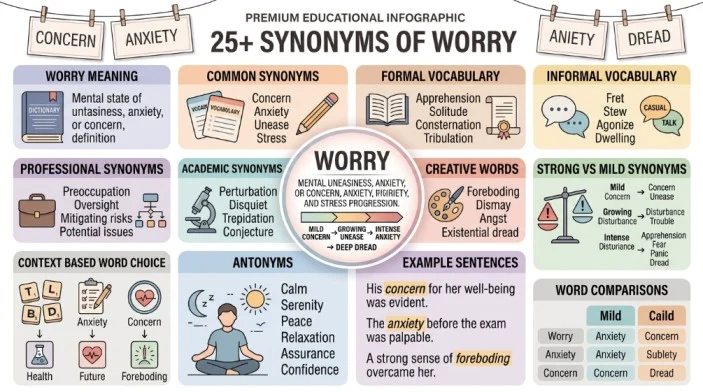
A synonym of worry can describe concern, anxiety, fear, uneasiness, or persistent mental distress. The best choices include concern for neutral writing, anxiety for stronger uneasiness, apprehension for anticipated fear, unease for mild discomfort, and dread for intense fear.
For formal and academic writing, concern, anxiety, and apprehension are useful. In casual conversation, stress, fret, and be anxious sound natural. Emotional or creative writing may benefit from dread, anguish, trepidation, or disquiet, depending on the intensity intended.
Meaning, Tone, and Context
Simple Definition
Worry refers to a feeling of concern, uneasiness, or mental distress about a problem, possible problem, uncertainty, or unpleasant outcome. As a verb, worry means to think about something with concern or to cause someone to feel concerned.
For example:
“She began to worry about the upcoming exam.”
Here, worry describes an ongoing feeling of concern about something that has not happened yet.
Part of Speech
Worry can function as both a noun and a verb.
As a noun:
“His biggest worry was finding a new job.”
As a verb:
“She worries about her children’s safety.”
Overall Tone
The word worry usually has a negative emotional tone because it describes mental concern, nervousness, or uneasiness.
However, its intensity can vary considerably. A person can have a small worry about being late, while another person may experience intense worry about a serious problem.
Formality Level
Worry is a neutral English word. It works naturally in formal, semi formal, and informal communication.
It is suitable for:
- Academic writing
- Professional communication
- Business emails
- Everyday conversation
- Personal writing
- Social media
- Storytelling
More formal alternatives include apprehension, concern, disquiet, and solicitude, while conversational choices can include fret, stress, or be anxious.
Common Uses
Native English speakers commonly use worry when discussing:
- Health
- Money
- Work
- School
- Relationships
- Family
- Future events
- Uncertainty
- Safety
- Deadlines
- Mistakes
- Difficult decisions
Examples include:
“I worry about my finances.”
“She has been worrying about the interview.”
“The delay is starting to worry the team.”
“Don’t worry about the small details.”
Word Forms
| Form | Example |
|---|---|
| Noun | “His main worry was the deadline.” |
| Verb | “She began to worry about the results.” |
| Third person verb | “He worries about his family.” |
| Present participle | “They are worrying about the cost.” |
| Past tense | “She worried about the outcome.” |
| Related adjective | “He felt worried about the situation.” |
| Related adjective | “The situation was worrisome.” |
The noun usually identifies the concern itself, while the verb describes the act or experience of feeling concerned.
When and How to Use “Worry”
Use worry when you want to communicate concern about a current problem, possible future event, uncertainty, or unwanted outcome. It is especially useful when you want a natural word that does not automatically make the situation sound extremely serious.
Professional
“Managers should not worry about the revised schedule because the team has already adjusted the timeline.”
Here, worry sounds approachable and appropriate for workplace communication.
Academic
“Students may worry about examinations when they feel unprepared.”
This is natural in educational writing when discussing emotional responses.
Workplace
“Several employees worry that the new system will take time to learn.”
The word clearly communicates concern without exaggerating the situation.
Personal
“I worry about my parents when they travel alone.”
This use emphasizes personal concern and affection.
“Please do not worry about the missing document. I will send it this afternoon.”
The word creates a reassuring and friendly tone.
Resume
A resume usually should not rely heavily on worry because it focuses on achievements and professional strengths. Instead of writing, “I worry about meeting deadlines,” a stronger resume would say, “I consistently meet demanding deadlines.”
Social Media
“I used to worry about making mistakes, but now I see them as part of learning.”
This conversational use feels natural and relatable.
Best Synonyms of “Worry”
No single synonym perfectly replaces worry in every sentence. The right choice depends on whether you mean ordinary concern, persistent anxiety, fear about the future, emotional distress, or repeated overthinking.
Professional Writing: Concern
Concern is one of the safest choices for professional communication because it sounds calm, objective, and respectful.
Example:
“We have some concerns about the proposed timeline.”
Academic Writing: Anxiety
Anxiety is useful when discussing a stronger emotional state, particularly in educational, psychological, or social contexts.
Example:
“Academic anxiety can affect a student’s concentration.”
Business Communication: Concern
Business writing often benefits from concern because it communicates a problem without sounding overly emotional.
Example:
“The company expressed concern about the rising production costs.”
Casual Conversation: Stress
Stress is common in everyday speech when someone feels pressure caused by responsibilities, uncertainty, or difficult circumstances.
Example:
“I’ve been stressed about the presentation all week.”
Emotional Writing: Anxiety
Anxiety conveys a deeper emotional state than ordinary worry.
Example:
“Her anxiety grew as the silence continued.”
Creative Writing: Dread
Dread is effective when the character strongly fears something unpleasant that is expected to happen.
Example:
“He felt a growing sense of dread as he approached the abandoned house.”
Resume Writing: Concern
Instead of saying that you worry about a problem, a resume should usually describe how you identify and solve problems.
Weak:
“I worry about customer complaints.”
Stronger:
“I proactively address customer concerns.”
Workplace Communication: Concern
Concern allows you to raise an issue professionally without sounding unnecessarily emotional.
Example:
“I’d like to discuss a concern regarding the project’s current timeline.”
Stronger Meaning: Anxiety or Dread
Use anxiety when the concern is persistent or emotionally intense. Use dread when fear of an anticipated event is especially strong.
Softer Meaning: Concern or Unease
Concern can sound measured and reasonable. Unease describes a mild feeling that something may not be right.
When Not to Use “Worry”
Although worry is highly versatile, there are situations where another word gives readers a more accurate impression.
When “Worry” Is Too General
The sentence “I have a worry about the project” is understandable, but concern often sounds more natural in professional English.
Better:
“I have a concern about the project’s timeline.”
When “Worry” Is Too Vague
If you want to show that someone is experiencing a stronger emotional condition, worry may not communicate enough intensity.
Less precise:
“She felt a lot of worry before the event.”
Better:
“She experienced intense anxiety before the event.”
When “Worry” Is Too Informal for the Context
In a formal business report, “The company is worried about declining sales” is possible, but concerned often sounds more objective.
Better:
“The company is concerned about declining sales.”
When “Worry” Is Too Weak
If a character feels intense fear about something unavoidable, worry may understate the emotion.
Less intense:
“He worried about the approaching storm.”
Stronger:
“He felt a deep sense of dread as the storm approached.”
When “Worry” Is Too Strong
Sometimes the situation involves only mild uncertainty. In that case, worry may make the emotion sound stronger than intended.
Better:
“I have some concerns about the plan.”
This sounds measured rather than alarmed.
When a More Specific Word Is Better
If you mean pressure caused by workload, stress may be more accurate.
Instead of:
“She worries about her workload.”
Consider:
“She feels stressed by her workload.”
The difference matters because stress often describes pressure caused by demands, while worry focuses more directly on concern or anticipated problems.
When a Formal Word Is Needed
In highly formal writing, disquiet, apprehension, or concern may be preferable depending on meaning.
Example:
“Investors expressed apprehension about the uncertain market conditions.”
Words Commonly Confused With “Worry”
| Word | Difference | When to Use It | Example |
|---|---|---|---|
| Concern | A measured feeling that something may be wrong or problematic. | Professional communication and neutral writing. | “The manager expressed concern about the delay.” |
| Anxiety | A stronger or more persistent state of nervousness and uneasiness. | Emotional, academic, and psychological contexts. | “She felt anxiety before the interview.” |
| Fear | A response to danger or a perceived threat. | Situations involving danger or serious risk. | “He felt fear when he heard the noise.” |
| Stress | Mental or physical pressure caused by demands or difficult circumstances. | Work, school, health, and daily life. | “Too much work can cause stress.” |
| Apprehension | Uneasy anticipation that something unpleasant may happen. | Formal writing and future events. | “She approached the meeting with apprehension.” |
| Dread | Strong fear or anxiety about something expected or approaching. | Emotional and creative writing. | “He felt dread before opening the letter.” |
Best Synonyms of “Worry” by Context
| Context | Best Synonym | Why It Works | Example |
|---|---|---|---|
| Formal writing | Concern | Calm and professional | “The report raises concern about costs.” |
| Academic writing | Anxiety | Precise for stronger emotional unease | “Test anxiety can affect performance.” |
| Professional communication | Concern | Objective and diplomatic | “We have concerns about the schedule.” |
| Business emails | Concern | Raises an issue without excessive emotion | “I would like to address a concern.” |
| Resume writing | Concern | Works better when discussing problem solving | “Resolved customer concerns efficiently.” |
| Workplace communication | Concern | Professional and measured | “The team has concerns about the deadline.” |
| Casual conversation | Stress | Common in everyday speech | “I’ve been stressed about work.” |
| Everyday speaking | Worry | Natural and broadly understood | “Don’t worry about it.” |
| Creative writing | Dread | Creates stronger emotional tension | “Dread filled the room.” |
| Storytelling | Apprehension | Shows nervous anticipation | “She entered the room with apprehension.” |
| Emotional writing | Anxiety | Conveys deeper emotional unease | “His anxiety became difficult to hide.” |
| Strong emphasis | Dread | Expresses intense anticipation of something bad | “She felt dread before the announcement.” |
| Mild tone | Unease | Communicates slight discomfort | “He felt a sense of unease.” |
| Social media captions | Stress | Casual and relatable | “Trying not to stress over the little things.” |
| American English | Worry | Common, natural, and versatile | “I wouldn’t worry about it.” |
British English uses the same core vocabulary for worry, concern, anxiety, apprehension, and dread. There is no major British English replacement that is necessary simply because the audience is British.
How to Choose the Best Synonym of “Worry”
Choosing an alternative becomes easier when you identify the exact feeling before replacing the word.
If you mean reasonable concern, choose “concern.”
Example:
“We have concerns about the project’s cost.”
This sounds calm and professional.
If you mean persistent nervousness, choose “anxiety.”
Example:
“She experienced anxiety while waiting for the results.”
This suggests a deeper emotional state.
If you mean pressure from demands, choose “stress.”
Example:
“Long working hours have caused considerable stress.”
If you mean fear about something that may happen, choose “apprehension.”
Example:
“He approached the interview with apprehension.”
If you mean intense fear about an expected event, choose “dread.”
Example:
“She felt dread as the deadline approached.”
If you mean mild discomfort or suspicion, choose “unease.”
Example:
“The unusual silence created a feeling of unease.”
If you mean repeated thinking about a problem, choose “fret,” “brood,” or “ruminate,” depending on context.
Example:
“There’s no point in fretting over something you cannot change.”
The best synonym is therefore the one that preserves both the meaning and emotional intensity of the original sentence.
Real Life Examples of “Worry”
School
Original:
“Students often worry about their grades.”
Improved:
“Students often experience anxiety about their grades.”
The second version is more appropriate when discussing a stronger emotional response.
College
Original:
“Many students worry about choosing the right major.”
Improved:
“Many students have concerns about choosing the right major.”
Concerns works well when the sentence focuses on practical uncertainty.
Workplace
Original:
“Employees worry about changes to the company.”
Improved:
“Employees may feel apprehensive about major changes to the company.”
The improved version emphasizes uncertainty about what may happen.
Business
Original:
“Investors worry about falling profits.”
Improved:
“Investors have expressed concern about falling profits.”
The revised sentence sounds more appropriate for business reporting.
Original:
“Don’t worry about the delayed response.”
Improved:
“Please don’t be concerned about the delayed response.”
The original is warmer and more conversational, while the alternative is slightly more formal.
Resume
Original:
“I worry about customer problems.”
Improved:
“I proactively address customer concerns and resolve issues efficiently.”
The improved version focuses on professional ability instead of personal anxiety.
Conversation
Original:
“I worry about tomorrow.”
Improved:
“I’ve been stressing about tomorrow.”
The alternative sounds natural in casual American conversation when the person feels pressure.
Storytelling
Original:
“She worried about what was waiting behind the door.”
Improved:
“She felt a growing sense of dread about what waited behind the door.”
The stronger word creates suspense.
Blogging
Original:
“Many new writers worry about making mistakes.”
Improved:
“Many new writers feel anxious about making mistakes.”
The second sentence makes the emotional experience more specific.
Social Media
Original:
“I used to worry about what everyone thought.”
Improved:
“I used to stress about what everyone thought.”
The revised version has a more casual, conversational feel.
25 Best Synonyms of “Worry”
The word worry covers several related meanings, so the following list includes alternatives for different senses. Some describe the emotional state itself, while others describe the act of repeatedly thinking about a problem.
| Synonym | Simple Meaning | Best Used For | Example Sentence |
|---|---|---|---|
| Concern | A feeling that something may be wrong | Professional and neutral writing | “The manager expressed concern about the delay.” |
| Anxiety | Strong or persistent nervous uneasiness | Emotional and academic contexts | “Her anxiety increased before the exam.” |
| Apprehension | Uneasy expectation about the future | Formal writing | “He entered the meeting with apprehension.” |
| Unease | A mild feeling that something is wrong | Subtle emotional writing | “The strange silence caused unease.” |
| Nervousness | A worried or tense feeling | Everyday situations | “Her nervousness disappeared after the presentation began.” |
| Stress | Mental pressure caused by difficult demands | Work and daily life | “Financial problems can create significant stress.” |
| Fear | Strong concern about danger or harm | Threatening situations | “The possibility of failure filled him with fear.” |
| Dread | Intense fear about something expected | Emotional and creative writing | “He felt dread as the storm approached.” |
| Disquiet | A feeling of uneasiness or disturbance | Formal and literary writing | “The announcement created public disquiet.” |
| Misgiving | A doubt that something may go wrong | Decisions and uncertain situations | “She had misgivings about accepting the offer.” |
| Trepidation | Nervous fear about what lies ahead | Formal and literary contexts | “He opened the results with trepidation.” |
| Distress | Severe emotional suffering | Serious emotional situations | “The news caused considerable distress.” |
| Anguish | Extreme emotional pain | Deeply emotional writing | “She felt anguish after losing her longtime friend.” |
| Preoccupation | Being deeply occupied by a troubling thought | Repeated mental focus | “His preoccupation with the problem affected his work.” |
| Solicitude | Deep concern for another person’s welfare | Formal writing | “Her actions showed genuine solicitude for the children.” |
| Fret | To worry repeatedly about something | Casual conversation | “Try not to fret about the small details.” |
| Brood | To think repeatedly and unhappily about something | Personal and literary writing | “He continued to brood over the argument.” |
| Agonize | To worry intensely while making or facing a difficult choice | Difficult decisions | “She agonized over whether to accept the job.” |
| Stew | To remain upset while thinking about a problem | Informal conversation | “He spent the evening stewing over the criticism.” |
| Dwell | To keep thinking about something, often negatively | Advice and personal writing | “Don’t dwell on mistakes you cannot change.” |
| Ruminate | To think deeply and repeatedly about something | Formal or reflective writing | “He continued to ruminate on the decision.” |
| Be anxious | To feel nervous concern | Everyday and formal contexts | “Parents may be anxious about their children’s safety.” |
| Be concerned | To feel that something may be wrong | Professional communication | “We are concerned about the unexpected delay.” |
| Be troubled | To feel disturbed or distressed | Formal and emotional writing | “She was troubled by what she had heard.” |
| Obsess | To think about something excessively | Strong repeated mental focus | “He began to obsess over every small mistake.” |
Synonyms of “Worry” by Usage
Professional vs Personal Synonyms
Professional writing usually favors words that sound objective and controlled.
The strongest choices include concern, apprehension, anxiety, and misgiving.
For example:
“We have concerns about the proposed budget.”
This sounds more professional than:
“We are worried about the proposed budget.”
The second sentence is not incorrect, but concerns makes the statement sound more measured.
Personal communication can use warmer or more conversational choices such as worry, stress, fret, or be anxious.
For example:
“Don’t stress about the party.”
That sentence feels natural between friends.
Formal vs Conversational Synonyms
For reports, essays, and business documents, prefer:
- Concern
- Anxiety
- Apprehension
- Disquiet
- Misgiving
- Trepidation
For casual conversations and texting, prefer:
- Worry
- Stress
- Fret
- Be anxious
- Stew
The choice should reflect the audience rather than simply trying to sound more sophisticated.
Academic Synonyms
Academic writing often requires precision. Anxiety is useful when discussing a recognized emotional state, while concern works well for practical or social issues.
Example:
“Students may experience test anxiety.”
For a research or policy discussion:
“Researchers have raised concerns about the reliability of the data.”
Professional and Business Synonyms
For resumes, interviews, meetings, performance reviews, client communication, and business emails, concern is generally one of the safest alternatives.
Examples:
“Addressed customer concerns promptly.”
“Identified concerns regarding project efficiency.”
“Raised concerns about potential scheduling conflicts.”
For higher emotional intensity, apprehension may be appropriate:
“Employees expressed apprehension about the upcoming restructuring.”
Creative and Literary Synonyms
Creative writing can benefit from more expressive words.
Dread creates suspense.
Trepidation creates nervous anticipation.
Anguish expresses deep emotional pain.
Disquiet creates an atmosphere of subtle disturbance.
Brood shows a character repeatedly thinking about something unpleasant.
Example:
“An uneasy dread settled over the village before sunset.”
Slang or Modern Synonyms
There is no single slang word that perfectly replaces worry. However, casual American English commonly uses stress as a verb.
Example:
“Don’t stress about it.”
Another informal expression is:
“Don’t sweat it.”
This means not to worry about something, but it is an idiomatic expression rather than a direct synonym of worry.
These expressions are suitable for conversations, texting, and informal social media. They should generally be avoided in academic papers, formal reports, and professional documents.
Strongest to Mildest Synonyms
The intensity of worry can range from a small concern to severe emotional distress.
Mild
Unease
Concern
These words can describe relatively controlled or moderate concern.
Moderate
Nervousness
Apprehension
Misgiving
These suggest more noticeable emotional uncertainty.
Strong
Anxiety
Stress
Fear
These can communicate significant emotional discomfort, although their exact meanings differ.
Very Strong
Dread
Distress
Anguish
These words communicate much stronger emotional experiences.
It is important not to treat this scale as absolute. Stress, for example, can be mild or severe depending on the context. The situation and surrounding language determine the actual intensity.
Emotional vs Neutral Synonyms
Emotional Synonyms
Words such as anxiety, dread, anguish, trepidation, and fear add emotional force.
Use them when the feeling itself is important to the message.
Example:
“She felt intense dread before entering the room.”
The sentence communicates much more than simple concern.
Neutral Synonyms
Words such as concern, unease, misgiving, and apprehension can communicate uncertainty or concern without necessarily creating dramatic emotional language.
Example:
“The committee expressed concern about the proposed changes.”
This sounds measured and appropriate for professional communication.
Antonyms of “Worry”
Because worry describes concern, uneasiness, or distress, its opposites generally express calmness, confidence, reassurance, or freedom from concern.
| Antonym | Meaning | Example Sentence |
|---|---|---|
| Reassurance | Something that reduces concern | “Her explanation provided reassurance.” |
| Calm | A peaceful emotional state | “He remained calm during the discussion.” |
| Peace | Freedom from mental disturbance | “She finally felt at peace.” |
| Confidence | Belief that something will succeed | “His preparation gave him confidence.” |
| Certainty | Freedom from doubt | “The evidence gave us certainty about the result.” |
| Assurance | A statement or feeling that provides confidence | “The manager gave the team assurance.” |
| Composure | Calm self control | “She maintained her composure under pressure.” |
| Tranquility | A state of peacefulness | “The quiet surroundings brought tranquility.” |
| Serenity | Deep calmness | “Meditation helped him find serenity.” |
| Contentment | A feeling of satisfaction | “She felt contentment after completing the project.” |
| Relief | Freedom from a previous concern or difficulty | “He felt relief when the results arrived.” |
| Optimism | A positive expectation about the future | “Her optimism helped the team stay motivated.” |
| Hope | A positive expectation or desire for a good outcome | “They still had hope for a successful result.” |
| Security | A sense of safety or freedom from threat | “The new system gave employees greater security.” |
| Fearlessness | Lack of fear or apprehension | “Her fearlessness impressed everyone.” |
Comparison: “Worry” vs Similar Words
Worry vs Concern
Main Difference
Worry often describes personal emotional concern, while concern can sound more objective and can also refer to an issue that deserves attention.
Which Is Stronger?
Usually, worry sounds more emotionally personal, while concern is more measured.
Which Is More Formal?
Concern is generally more suitable for professional and formal writing.
When to Use Each
Use worry for personal feelings and everyday communication. Use concern when discussing problems, risks, or professional issues.
Examples
Worry:
“I worry about my family’s safety.”
Concern:
“We have concerns about the project’s cost.”
Worry vs Anxiety
Main Difference
Worry can describe ordinary concern about a particular problem. Anxiety often suggests a stronger or more persistent emotional state.
Which Is Stronger?
Anxiety usually conveys greater emotional intensity.
Which Is More Formal?
Both are appropriate in formal writing, but anxiety is especially useful in academic and psychological discussions.
When to Use Each
Use worry for everyday concerns. Use anxiety when describing a deeper or ongoing emotional condition.
Examples
Worry:
“She worries about her exam.”
Anxiety:
“She experiences anxiety before important exams.”
Worry vs Fear
Main Difference
Worry usually involves concern about something that might happen. Fear more directly involves perceived danger, threat, or harm.
Which Is Stronger?
Fear is generally stronger and more immediate.
Which Is More Formal?
Both are neutral and widely appropriate.
When to Use Each
Use worry for uncertainty and possible problems. Use fear when danger or threat is central.
Examples
Worry:
“I worry that we may miss the train.”
Fear:
“I fear that someone may be hurt.”
Worry vs Stress
Main Difference
Worry focuses on concern or uneasy thoughts. Stress focuses on pressure resulting from demands or difficult circumstances.
Which Is Stronger?
Neither is always stronger. They describe different experiences.
Which Is More Formal?
Both work in professional and academic contexts.
When to Use Each
Use worry when concern is the main idea. Use stress when pressure and demands are the focus.
Examples
Worry:
“I worry about the upcoming deadline.”
Stress:
“The upcoming deadline is causing me stress.”
Worry vs Apprehension
Main Difference
Apprehension usually describes uneasy anticipation of something that may happen.
Which Is Stronger?
Apprehension can sound more formal and slightly more intense than ordinary worry.
Which Is More Formal?
Apprehension is more formal.
When to Use Each
Use worry in everyday communication. Use apprehension when describing formal, literary, or carefully expressed concern about the future.
Examples
Worry:
“She worried about the interview.”
Apprehension:
“She approached the interview with apprehension.”
Worry vs Dread
Main Difference
Dread indicates intense fear or anxiety about something expected or approaching.
Which Is Stronger?
Dread is substantially stronger than ordinary worry.
Which Is More Formal?
Both can be used in formal writing, but dread is particularly effective in emotional and creative contexts.
When to Use Each
Use worry for ordinary concern. Use dread when the anticipated event causes intense fear.
Examples
Worry:
“He worried about the difficult conversation.”
Dread:
“He felt dread as the difficult conversation approached.”
Common Phrases and Expressions with “Worry”
Don’t Worry About It
Meaning
A common expression used to reassure someone that something is not a problem.
Example Sentence
“Don’t worry about it. I can take care of everything.”
Worry About Something
Meaning
To feel concerned about a particular issue or possible outcome.
Example Sentence
“She tends to worry about things she cannot control.”
Worry Too Much
Meaning
To spend more time or emotional energy worrying than is helpful.
Example Sentence
“You worry too much about what other people think.”
Nothing to Worry About
Meaning
There is no serious reason for concern.
Example Sentence
“The doctor said there was nothing to worry about.”
Worry Yourself Sick
Meaning
To become extremely distressed because of excessive worry.
Example Sentence
“Don’t worry yourself sick over a problem that has already been resolved.”
Worry About the Little Things
Meaning
To focus concern on small details or minor problems.
Example Sentence
“She tries not to worry about the little things.”
A Constant Worry
Meaning
A problem or thought that repeatedly causes concern.
Example Sentence
“Paying the bills had become a constant worry for him.”
Worry Away
Meaning
To gradually reduce a concern through reassurance or resolution.
Example Sentence
“The good news helped worry away some of her fears.”
Common Mistakes to Avoid
Choosing a Vague Synonym Instead of a Precise One
Incorrect
“The company is worried about the issue.”
Better
“The company has concerns about the issue.”
Why
Concern sounds more objective and professional when discussing a business problem.
Confusing Worry With Fear
Incorrect
“She felt worry when she saw the dangerous animal approaching.”
Better
“She felt fear when she saw the dangerous animal approaching.”
Why
The situation involves an immediate threat, so fear communicates the emotional response more accurately.
Using an Informal Synonym in Formal Writing
Incorrect
“Employees are stressing about the new policy.”
Better
“Employees have expressed concern about the new policy.”
Why
Stress is common in everyday speech, while concern sounds more appropriate for a formal workplace statement.
Selecting an Overly Dramatic Synonym
Incorrect
“I felt tremendous dread because my package arrived ten minutes late.”
Better
“I was concerned because my package arrived late.”
Why
Dread is far too intense for a minor inconvenience.
Repeating “Worry” Too Often
Incorrect
“She worried about the test, worried about her grade, and worried about disappointing her parents.”
Better
“She felt anxious about the test, feared receiving a poor grade, and worried about disappointing her parents.”
Why
Careful variation prevents repetitive writing while preserving the different shades of meaning.
Choosing the Wrong Emotional Tone
Incorrect
“The manager felt dread about the minor scheduling change.”
Better
“The manager had some concerns about the scheduling change.”
Why
The issue does not appear serious enough to justify the intense emotional force of dread.
Using Slang in Academic or Professional Writing
Incorrect
“Students shouldn’t sweat their grades too much.”
Better
“Students should not become overly anxious about their grades.”
Why
Sweat can mean worry in casual American English, but it is not appropriate for most academic writing.
Frequently Asked Questions
What are the best synonyms of “worry”?
The best alternatives depend on context. Concern works well for neutral and professional writing, anxiety for stronger uneasiness, apprehension for future uncertainty, and dread for intense anticipated fear.
What are the best formal synonyms of “worry”?
The strongest formal choices include concern, apprehension, disquiet, misgiving, anxiety, and trepidation. The best option depends on whether you mean practical concern, nervous anticipation, or deeper emotional unease.
What are common informal synonyms of “worry”?
Common informal alternatives include stress, fret, stew, and expressions such as don’t sweat it. These choices work best in casual conversations, texting, and social media rather than formal or academic writing.
What is another word for “worry” in professional writing?
Concern is usually the safest professional alternative. Other useful choices include apprehension, anxiety, and misgiving, depending on the situation. For business communication, concern sounds measured and avoids unnecessary emotional intensity.
What is the difference between “worry” and “concern”?
Worry often emphasizes personal emotional uneasiness, while concern can describe either a feeling or an issue that deserves attention. Concern is generally more neutral and professional, making it common in business communication.
What is the opposite of “worry”?
Common opposites include calm, peace, confidence, reassurance, certainty, relief, serenity, and composure. The best antonym depends on whether you want to express emotional calm, confidence, safety, or freedom from concern.
Conclusion
The word worry describes concern, uneasiness, nervousness, or distress about a problem, uncertainty, or possible outcome. It is a natural and versatile word, but choosing a more precise alternative can make your writing clearer and more expressive.
For professional communication, concern is often the best choice. Anxiety works well for stronger or persistent uneasiness, apprehension suits uncertain future situations, stress fits pressure caused by demands, and dread communicates intense anticipated fear.
No synonym of worry works perfectly in every situation. Before replacing the word, consider your audience, purpose, emotional intensity, and level of formality. A useful vocabulary habit is to identify exactly what the feeling means first, then choose the word that communicates that specific meaning most naturally.
Read More Related Articles:
- Synonyms for Empty | Meaning, Examples, and Better Word …
- Synonyms for Creativity | Meaning, Examples, and Better …
- 25+ Synonyms of Perseverance | Meanings, Uses, Examples …