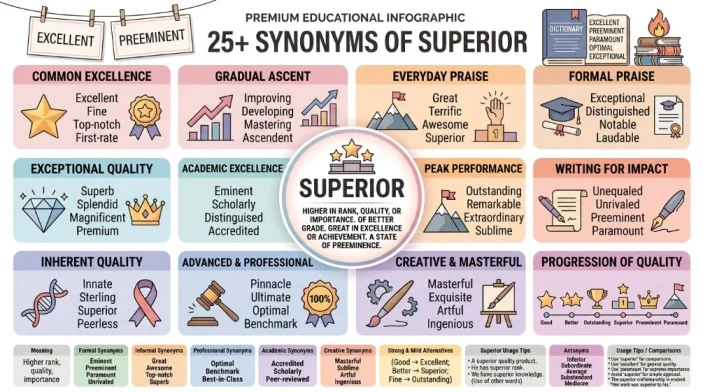
A writer may use superior several times in an essay, product review, business email, or professional description and then realize the wording feels repetitive. Finding the right synonym of superior can make the message more precise because superior can describe higher quality, greater ability, higher status, or a better position.
The best alternative depends on what you actually mean. Words such as excellent, outstanding, and exceptional emphasize quality, while dominant, advanced, and preeminent can highlight ability, position, or influence. Choosing the right word helps your writing sound natural instead of simply replacing one word with another.
What Are the Best Synonyms of “Superior”?
The best synonyms of superior depend on meaning and context. Excellent, outstanding, and exceptional work well when describing quality. Advanced suits skills or development, dominant emphasizes power, and preeminent fits highly formal writing. In casual English, better is often the most natural choice.
Meaning, Tone, and Context
Simple Definition
Superior generally means better than another person or thing in quality, ability, performance, status, or position. It can also describe someone who has a higher rank or authority within an organization.
The exact meaning depends heavily on context. For example, “a superior product” usually means a product of higher quality, while “her superior at work” means the person who has a higher position in the organizational hierarchy.
Part of Speech
Superior is mainly used as an adjective and a noun.
As an adjective:
“The new system offers superior performance.”
As a noun:
“She discussed the issue with her superior.”
Overall Tone
As an adjective, superior is usually positive when it describes quality, ability, or performance.
However, it can sound negative when it describes someone’s attitude. Saying that someone has a “superior attitude” may suggest that the person behaves as though they are better than others.
Formality Level
Superior is a neutral to formal word. It is common in professional, academic, technical, business, and everyday contexts.
The noun use, especially in workplace language, is also relatively formal:
“Please speak with your immediate superior.”
In ordinary conversation, people often say manager, boss, or supervisor instead.
Common Uses
Native English speakers commonly use superior when discussing:
- Product quality
- Performance
- Skills
- Technology
- Materials
- Results
- Professional ability
- Military or organizational rank
- Social or institutional position
- Comparative advantages
Examples include:
“This material provides superior durability.”
“The updated software delivers superior performance.”
“He reported the matter to his superior.”
Word Forms
| Form | Word | Example |
|---|---|---|
| Adjective | Superior | This model offers superior performance. |
| Noun | Superior | She reported directly to her superior. |
| Adverbial expression | Superiorly | Rare and generally unnatural in modern everyday English. |
| Related noun | Superiority | The company claims superiority in battery life. |
For most writing situations, superior, superiority, or a more specific synonym is preferable to trying to use superior in an unusual grammatical form.
When and How to Use “Superior”
Use superior when you need to communicate that one person, product, method, result, or position is higher than another in a meaningful way.
It works especially well when a comparison is implied or clearly established.
Professional
“The company introduced a superior customer service model.”
Here, superior suggests that the new model performs better than competing or previous approaches.
Academic
“The researchers found that the revised method produced superior results.”
In academic writing, the word works best when the comparison is supported by evidence.
Workplace
“Employees should report serious safety concerns to their immediate superior.”
Here, superior refers to someone with a higher organizational position.
Personal
“She believes the new design is superior to the original.”
This use expresses a personal judgment about quality.
“Our updated system provides superior data security.”
This sounds professional, although improved or enhanced may be more precise if the writer wants to avoid making a broad quality claim.
Resume
“Delivered superior customer service across high volume accounts.”
For a resume, a measurable result is usually stronger:
“Delivered superior customer service while maintaining a 95 percent customer satisfaction rating.”
Social Media
“The new version offers a superior experience for creators.”
For a casual post, better may sound more natural:
“The new version offers a much better experience for creators.”
Best Synonyms of “Superior”
No single synonym perfectly replaces superior in every sentence. The word can refer to quality, performance, ability, status, rank, or comparative advantage, so the best alternative should match the intended meaning.
Professional Writing: Excellent
Excellent is a strong choice when superior refers to high quality or performance.
“The company provides excellent customer support.”
It sounds positive and professional without necessarily suggesting that everyone else is inferior.
Academic Writing: Advanced
Advanced works well when describing methods, technology, knowledge, or development.
“The researchers used an advanced analytical technique.”
It is more specific than superior when the idea is sophistication or development.
Business Communication: Outstanding
Outstanding emphasizes unusually high quality or performance.
“The team delivered outstanding results this quarter.”
It works particularly well in performance reviews, presentations, and professional praise.
Casual Conversation: Better
Better is often the most natural alternative in everyday American English.
“This version is better than the old one.”
It is simple, direct, and easy to understand.
Emotional Writing: Exceptional
Exceptional suggests that something stands clearly above the usual standard.
“Her exceptional kindness made a lasting impression.”
It adds stronger admiration than ordinary important or good language.
Creative Writing: Remarkable
Remarkable highlights something unusual, impressive, or worthy of attention.
“The explorer survived a remarkable journey through the mountains.”
It adds descriptive energy without sounding overly technical.
Resume Writing: Outstanding
Outstanding can work well when describing achievements, performance, or results.
“Received an award for outstanding client service.”
For resumes, however, specific achievements are usually more persuasive than general praise.
Workplace Communication: Excellent
Excellent is useful for describing work quality, service, performance, or results.
“The department delivered excellent results during the transition.”
Stronger Meaning: Exceptional
Exceptional is stronger than ordinary positive alternatives because it suggests performance far above the expected level.
“She demonstrated exceptional leadership during the crisis.”
Softer Meaning: Better
Better provides a simple comparison without making the dramatic claim that something is outstanding or exceptional.
“The updated process is better for small teams.”
When Not to Use “Superior”
When the Word Sounds Too General
Superior can be vague when the reader needs to know exactly what improved.
Less precise:
“This software is superior.”
Better:
“This software offers faster processing and stronger data protection.”
The second sentence explains the basis for the comparison.
When You Need a Neutral Comparison
Sometimes superior sounds like a strong judgment.
Less neutral:
“Our product is superior to every competitor.”
Better:
“Our product performs better in independent speed tests.”
A specific comparison is usually more convincing than an unsupported claim.
When You Mean “More Advanced”
If the real meaning is technological or developmental progress, advanced may be more accurate.
Less precise:
“The company uses superior technology.”
Better:
“The company uses advanced automation technology.”
When You Mean “Higher Quality”
If quality is the central idea, high quality, excellent, or premium may communicate the point more naturally.
Less precise:
“The store sells superior materials.”
Better:
“The store sells premium materials designed for long term use.”
When You Mean Higher Rank
Do not replace the noun superior with a quality adjective when you are talking about workplace hierarchy.
“She asked her superior for approval.”
Here, manager, supervisor, or boss may be more natural depending on the organization.
When the Word Sounds Too Strong
If the comparison is only slight, better, improved, or enhanced may be more accurate.
Too strong:
“The revised design is superior.”
More measured:
“The revised design is improved.”
When the Word Sounds Too Formal
In casual conversation, superior can sound stiff.
Formal:
“This restaurant offers superior food.”
Natural:
“This restaurant has better food.”
When It Creates an Unwanted Attitude
When describing people, superior can imply arrogance or social superiority.
Instead of:
“He thinks he is superior to everyone.”
A neutral description could be:
“He often acts as though he is better than everyone else.”
Words Commonly Confused With “Superior”
Better
Difference: Better is the broadest and most natural everyday comparison. Superior sounds more formal and often suggests a clear advantage.
When to use it: Everyday speech, simple comparisons, and conversational writing.
Example:
“This phone is better than my old one.”
Excellent
Difference: Excellent means extremely good, but it does not necessarily establish a comparison with another thing.
When to use it: Praise, professional writing, reviews, and performance descriptions.
Example:
“The restaurant provides excellent service.”
Outstanding
Difference: Outstanding suggests performance that is unusually impressive.
When to use it: Awards, achievements, evaluations, and professional praise.
Example:
“She received an award for outstanding leadership.”
Advanced
Difference: Advanced focuses on development, sophistication, or technical progress rather than general superiority.
When to use it: Technology, education, methods, skills, and systems.
Example:
“The laboratory uses advanced imaging equipment.”
Dominant
Difference: Dominant emphasizes power, control, influence, or being the strongest competitor.
When to use it: Sports, markets, politics, competition, and social influence.
Example:
“The company remains dominant in the regional market.”
Preeminent
Difference: Preeminent describes someone or something regarded as especially important, distinguished, or leading within a particular field.
When to use it: Highly formal academic, professional, or literary writing.
Example:
“She is a preeminent scholar in the field.”
Best Synonyms of “Superior” by Context
| Context | Best Synonym | Why It Works | Example |
|---|---|---|---|
| Formal writing | Preeminent | Strong and formal | He is a preeminent researcher. |
| Academic writing | Advanced | Highlights development and sophistication | The study uses an advanced model. |
| Professional communication | Excellent | Positive and natural | The team provided excellent service. |
| Business emails | Better | Clear and direct | The revised process is better for clients. |
| Resume writing | Outstanding | Highlights exceptional performance | Received an award for outstanding performance. |
| Workplace communication | Excellent | Professional without sounding excessive | She delivered excellent results. |
| Casual conversation | Better | Most natural for everyday comparisons | This option is better. |
| Everyday speaking | Great | Simple positive description | She did a great job. |
| Creative writing | Remarkable | Adds descriptive impact | It was a remarkable achievement. |
| Storytelling | Extraordinary | Creates stronger emphasis | He faced an extraordinary challenge. |
| Emotional writing | Exceptional | Expresses admiration | Her exceptional courage inspired everyone. |
| Strong emphasis | Exceptional | Signals unusually high quality | The athlete showed exceptional ability. |
| Mild tone | Better | Makes a straightforward comparison | The new version is better. |
| Social media captions | Amazing | Casual and expressive | An amazing performance tonight. |
| American English | Better | Common in ordinary comparisons | This option is better for beginners. |
| British English | Better | Also natural and widely understood | This approach is better suited to the task. |
How to Choose the Best Synonym of “Superior”
1. Identify What Is Better
First determine what superior is describing.
- If you mean quality, consider excellent, outstanding, or exceptional.
- If you mean technology or development, choose advanced.
If you mean competitive power, consider dominant.
- If you mean professional rank, use manager, supervisor, or higher ranking official, depending on context.
2. Consider the Tone
- Use better for casual and straightforward communication.
- Use excellent or outstanding for professional praise.
Use preeminent for highly formal writing.
- Use remarkable or extraordinary when you want stronger expressive language.
3. Consider Your Audience
A school essay may benefit from significantly better, advanced, or exceptional.
A business report may prefer superior, outstanding, or more effective.
A conversation with a friend will usually sound more natural with better.
4. Consider Emotional Strength
Not every situation needs a powerful synonym.
Compare:
“The new model is better.”
“The new model is significantly better.”
“The new model is exceptional.”
The first is neutral. The second emphasizes the difference. The third expresses strong approval.
5. Consider Your Writing Purpose
- For a resume, focus on measurable achievements.
- For academic writing, use precise comparative language.
- For marketing, avoid unsupported claims such as “superior in every way.”
For creative writing, choose words that add emotion or imagery.
6. Choose Natural English
The best synonym is not always the most sophisticated word.
“This one is better.”
is often more natural than:
“This one is preeminent.”
Good vocabulary means choosing the right word, not simply choosing the most advanced word.
Real Life Examples of “Superior”
School
Original:
“This study method is superior.”
Improved:
“This study method is more effective for students who need visual examples.”
The improved version explains why the method is better.
College
“The revised research method produced superior results.”
A more precise academic version is:
“The revised research method produced more reliable results.”
Workplace
“Our new workflow is superior to the old system.”
A clearer version is:
“Our new workflow reduces processing time and improves accuracy.”
Business
“We offer superior products.”
A stronger business statement is:
“Our products use durable materials and undergo additional quality testing.”
“The new platform provides superior performance.”
A more specific email could say:
“The new platform loads reports faster and reduces processing delays.”
Resume
Weak:
“Provided superior customer service.”
Stronger:
“Delivered outstanding customer service while resolving complex client issues efficiently.”
Conversation
“I think this restaurant is superior.”
More natural:
“I think this restaurant is better.”
Storytelling
“The warrior possessed superior strength.”
More expressive:
“The warrior possessed extraordinary strength that few opponents could match.”
Blogging
“This tool is superior to other options.”
More useful:
“This tool offers faster setup and a simpler interface than many competing options.”
Social Media
“Our team delivered superior results.”
More natural:
“Our team delivered an incredible result today.”
25 Best Synonyms of “Superior”
| Synonym | Simple Meaning | Best Used For | Example Sentence |
|---|---|---|---|
| Better | Higher in quality or performance | Everyday comparisons | This model is better for small businesses. |
| Excellent | Extremely good | General praise | The team provided excellent service. |
| Outstanding | Exceptionally good | Achievements and performance | She delivered outstanding results. |
| Exceptional | Far above normal | Strong praise | His exceptional skills impressed the panel. |
| Excellent quality | Very high quality | Products and services | The company is known for excellent quality. |
| Advanced | Highly developed | Technology and methods | The lab uses advanced equipment. |
| Superior quality | Higher standard | Product descriptions | The material offers superior quality. |
| Remarkable | Unusually impressive | Creative and general writing | She made remarkable progress. |
| Exceptional | Unusually strong or good | Performance and ability | The athlete showed exceptional discipline. |
| Extraordinary | Far beyond ordinary | Creative and emotional writing | The team achieved extraordinary success. |
| Outstanding | Clearly above the expected standard | Professional settings | He received an outstanding performance review. |
| Preeminent | Leading or highly distinguished | Formal writing | She is a preeminent expert in the field. |
| Premier | Among the best or most important | Business and services | The city is home to a premier research center. |
| First rate | Of excellent quality | Informal and professional praise | They provide first rate customer support. |
| Top quality | Very high quality | Everyday and commercial language | The store sells top quality tools. |
| High quality | Good standard | Product descriptions | The manufacturer uses high quality materials. |
| Leading | At the front of a field | Business and industry | The company is a leading provider of software. |
| Dominant | Strongest or most powerful | Competition and markets | The team became dominant in the league. |
| Prevalent | Common or widespread | Formal descriptions | This practice is prevalent in the industry. |
| Prominent | Important or well known | People and organizations | She is a prominent figure in education. |
| First class | Excellent standard | Service and experiences | The hotel offers first class service. |
| Elite | Among the highest level | Skills, groups, performance | The program trains elite athletes. |
| Superior | Better than another in quality or position | Direct comparisons | The new material has superior durability. |
| More effective | Producing better results | Academic and professional writing | The revised strategy is more effective. |
| More capable | Having greater ability | People, systems, and teams | The new system is more capable of handling large files. |
Note: Some entries above overlap in meaning rather than functioning as perfect substitutes in every sentence. In particular, prevalent, prominent, and elite describe different aspects of distinction and should only replace superior when the surrounding meaning supports that interpretation.
Synonyms of “Superior” by Usage
Professional vs Personal Synonyms
Professional writing often needs precise and measured language.
Use excellent, outstanding, advanced, leading, or more effective when describing professional performance.
Personal communication usually favors simpler words such as better, great, amazing, or remarkable.
Compare:
Professional:
“The revised system provides more effective data management.”
Personal:
“The new system is much better.”
The second version is simpler and more conversational.
Formal vs Conversational Synonyms
Reports
Use superior, advanced, significant, or more effective when the evidence supports the comparison.
Essays
Use advanced, exceptional, more effective, or superior when the meaning is clear.
Business Writing
Use leading, outstanding, excellent, or more effective depending on the claim.
Presentations
Use key, leading, excellent, or outstanding for accessible professional language.
Emails
Prefer better, improved, more effective, or excellent when appropriate.
Casual Conversations
Use better, great, amazing, or really good.
Texting
Simple expressions usually sound most natural:
“This one is better.”
“That version is way better.”
Academic Synonyms
Academic writing benefits from precise comparisons rather than unsupported claims of superiority.
Advanced
Use this when a method, technology, or concept is more developed.
“The researchers adopted an advanced statistical model.”
More Effective
Use this when evidence shows that one approach produces better results.
“The intervention was more effective than the previous treatment.”
Significant
Use this when describing meaningful results or differences.
“The study found a significant difference between the two groups.”
Superior
Use it when the comparison is justified and the intended meaning is clearly “better in quality or performance.”
“The revised method demonstrated superior accuracy.”
Academic writing should generally explain how something is superior rather than simply making the claim.
Professional and Business Synonyms
Resumes
Use outstanding, leading, advanced, or specific achievement language.
Instead of:
“Had superior leadership skills.”
Write:
“Led a cross functional team that exceeded quarterly performance targets.”
Interviews
Excellent, strong, and advanced are usually easier to use naturally.
“I have strong analytical skills and advanced experience with data systems.”
Meetings
Key, critical, and important can identify priorities.
“The key issue is customer retention.”
Presentations
Use leading, effective, and outstanding when appropriate.
“Our revised strategy produced outstanding results.”
Performance Reviews
Excellent, outstanding, and exceptional are useful for positive evaluation.
“She demonstrated exceptional problem solving skills.”
Client Communication
Avoid unsupported superiority claims.
Instead of:
“Our service is superior.”
Use:
“Our service includes faster response times and dedicated account support.”
Business Emails
Use direct, measurable language.
“The revised process is more efficient and easier for clients to use.”
Creative and Literary Synonyms
Creative writing allows stronger descriptive vocabulary.
Remarkable
Adds a sense of wonder or admiration.
“She made a remarkable recovery.”
Extraordinary
Suggests something far beyond normal expectations.
“An extraordinary silence filled the valley.”
Exceptional
Highlights unusual ability or quality.
“His exceptional courage changed the course of the battle.”
Dominant
Creates a sense of power or control.
“The mountain remained dominant above the surrounding landscape.”
Preeminent
Provides a formal, elevated tone.
“The scholar was regarded as preeminent among her generation.”
These choices should serve the story rather than simply make the vocabulary sound more sophisticated.
Slang or Modern Synonyms
There is no single slang word that directly replaces superior in every context.
In casual American English, people may use expressions such as better, way better, the best, or top tier.
Better
“This version is way better.”
Acceptable in conversations, texts, and social media. It should generally be avoided in formal academic writing.
Top Tier
Top tier is an informal modern expression meaning extremely high quality or among the best.
“That restaurant is top tier.”
It works well in casual conversations and social media but is not appropriate for most formal reports or academic papers.
Strongest to Mildest Synonyms
The strength of a synonym depends on context, but this general scale can help.
Mild
Better, improved, good
These make relatively simple positive comparisons.
Moderate
Excellent, advanced, outstanding
These communicate stronger approval or quality.
Strong
Exceptional, remarkable, extraordinary
These suggest performance or quality well above normal expectations.
Very Strong
Preeminent, dominant, unrivaled
These expressions should be used carefully because they make stronger claims.
The most natural choice is not always the strongest word. A measured word can sound more credible when the evidence for the comparison is limited.
Emotional vs Neutral Synonyms
Emotional Synonyms
These words add admiration, enthusiasm, or expressive force:
- Exceptional
- Remarkable
- Extraordinary
- Amazing
- Outstanding
Use them for personal writing, praise, storytelling, social media, and celebratory messages.
Neutral Synonyms
These communicate comparison without adding much emotional emphasis:
- Better
- Advanced
- More effective
- Superior
- Improved
Use them in academic writing, reports, professional communication, and technical explanations.
Antonyms of “Superior”
Because superior has several meanings, its opposite changes according to context. The following words represent genuine or contextually appropriate opposites when superior means higher in quality, ability, rank, or position.
| Antonym | Meaning | Example Sentence |
|---|---|---|
| Inferior | Lower in quality or ability | The older material was inferior to the new version. |
| Subordinate | Lower in rank or authority | The officer spoke with a subordinate. |
| Lower | Below another level or position | The lower ranking employee handled the routine task. |
| Lesser | Lower in importance, size, or degree | The project addressed several lesser concerns. |
| Junior | Lower in rank or experience | A junior employee assisted the department manager. |
| Secondary | Less central or important | The secondary issue received less attention. |
| Lowly | Low in rank or social position | The character began in a lowly position. |
| Mediocre | Only average in quality | The service was mediocre rather than exceptional. |
| Substandard | Below the expected standard | The inspector rejected the substandard materials. |
| Deficient | Lacking something necessary or desirable | The report was deficient in supporting evidence. |
| Inadequate | Not good or sufficient enough | The original system was inadequate for the workload. |
| Weak | Lacking strength or ability | The proposal had a weak financial foundation. |
| Modest | Limited rather than exceptional | The company achieved modest growth. |
| Ordinary | Not unusual or exceptional | The product offers ordinary performance at a low price. |
| Common | Not distinctive or superior in status | The material is common and widely available. |
Comparison: “Superior” vs Similar Words
Superior vs Better
Main Difference
Superior is more formal and can suggest a clearly higher standard. Better is broader and more natural in everyday comparisons.
Which Is Stronger?
Superior generally sounds stronger and more categorical.
Which Is More Formal?
Superior is more formal.
When to Use Each
Use better for ordinary conversation. Use superior when the comparison is formal, technical, or clearly supported.
Examples
Superior:
“The new material offers superior durability.”
Better:
“The new material is better for outdoor use.”
Superior vs Excellent
Main Difference
Superior normally implies comparison. Excellent describes very high quality without requiring a direct comparison.
Which Is Stronger?
They are not directly ranked, because they emphasize different ideas.
Which Is More Formal?
Both can work in professional writing.
When to Use Each
Use superior when comparing. Use excellent when praising quality.
Examples
Superior:
“The new model has superior battery life.”
Excellent:
“The new model has excellent battery life.”
Superior vs Outstanding
Main Difference
Outstanding means unusually impressive or excellent. Superior usually indicates that something is better than another standard or option.
Which Is Stronger?
Outstanding can sound more enthusiastic.
Which Is More Formal?
Both work well professionally.
When to Use Each
Use outstanding for achievements and praise. Use superior for comparisons.
Examples
Superior:
“The new system provides superior processing speed.”
Outstanding:
“The team achieved outstanding processing results.”
Superior vs Advanced
Main Difference
Advanced means highly developed or sophisticated. Superior means better in quality, ability, or position.
Which Is Stronger?
Neither is inherently stronger.
Which Is More Formal?
Both are suitable for academic and professional writing.
When to Use Each
Use advanced for technology, methods, knowledge, and development.
Examples
Superior:
“The new system provides superior accuracy.”
Advanced:
“The new system uses advanced imaging technology.”
Superior vs Dominant
Main Difference
Dominant describes power, control, or a leading position. Superior focuses more broadly on quality, ability, or rank.
Which Is Stronger?
Dominant can imply greater competitive power.
Which Is More Formal?
Both are appropriate in formal writing when accurately used.
When to Use Each
Use dominant for markets, sports, competition, and influence.
Examples
Superior:
“The team had superior technical skills.”
Dominant:
“The team was dominant throughout the tournament.”
Superior vs Preeminent
Main Difference
Preeminent describes someone or something regarded as leading or highly distinguished within a particular field. Superior is broader.
Which Is Stronger?
Preeminent can sound stronger when describing status or reputation.
Which Is More Formal?
Preeminent is considerably more formal.
When to Use Each
Use preeminent in formal academic, professional, and literary contexts.
Examples
Superior:
“The company developed a superior production method.”
Preeminent:
“She is a preeminent authority on constitutional law.”
Common Phrases and Expressions with “Superior”
Superior Quality
Meaning: A level of quality that is claimed to be higher than alternatives.
Example:
“The manufacturer promotes the product for its superior quality.”
Superior Performance
Meaning: Better performance compared with another product, system, or standard.
Example:
“The updated processor delivers superior performance.”
Superior Service
Meaning: Service presented as better than competing or previous service.
Example:
“The hotel is known for its superior service.”
Superior Results
Meaning: Results that are better than another method or standard.
Example:
“The revised strategy produced superior results.”
Superior Technology
Meaning: Technology claimed to be more advanced or effective.
Example:
“The company invested in superior technology.”
Superior Position
Meaning: A higher position in rank, authority, or status.
Example:
“The officer held a superior position within the organization.”
Superior Ability
Meaning: Greater skill or capability compared with another person or group.
Example:
“Her superior ability helped the team complete the project.”
Immediate Superior
Meaning: A person who directly supervises another employee.
Example:
“Employees should discuss scheduling concerns with their immediate superior.”
Common Mistakes to Avoid
1. Treating Every Synonym as Identical
Incorrect:
“The advanced product is superior because it is better.”
Better:
“The advanced product uses newer technology and delivers better performance.”
Why:
Advanced describes development, while better describes the result of a comparison.
2. Using “Superior” Without Explaining the Comparison
Incorrect:
“Our service is superior.”
Better:
“Our service offers faster response times and extended customer support.”
Why:
The revised version gives readers a concrete reason for the claim.
3. Using “Top Tier” in Formal Writing
Incorrect:
“Our research method is top tier.”
Better:
“Our research method demonstrated excellent reliability.”
Why:
Top tier is informal and conversational.
4. Using “Superior” When You Mean “Advanced”
Incorrect:
“The laboratory installed superior imaging technology.”
Better:
“The laboratory installed advanced imaging technology.”
Why:
The main idea is technological development, not necessarily superiority over another system.
5. Using an Overly Dramatic Synonym
Incorrect:
“This minor improvement created an extraordinary result.”
Better:
“This minor improvement produced a modest increase in performance.”
Why:
Strong adjectives should match the actual size and importance of the result.
6. Confusing “Superior” With “Subordinate”
Incorrect:
“The department’s superior employee completed the task.”
Better:
“The department’s senior employee completed the task.”
Why:
Superior can refer to a higher ranking person, but it does not naturally mean “more experienced” in every sentence. Senior is often the better choice.
7. Repeating “Superior” in Marketing Copy
Incorrect:
“Our superior product offers superior quality and superior performance.”
Better:
“Our product combines durable materials with reliable performance.”
Why:
Specific evidence sounds more credible and avoids repetitive promotional language.
Frequently Asked Questions
1. What are the best synonyms of “superior”?
The best synonyms of superior include better, excellent, outstanding, exceptional, advanced, remarkable, preeminent, and dominant. The best choice depends on whether you mean quality, ability, status, or performance.
2. What are the best formal synonyms of “superior”?
Formal alternatives include preeminent, exceptional, outstanding, advanced, leading, and more effective. For academic or professional writing, choose the word that accurately identifies the specific type of advantage.
3. What are common informal synonyms of “superior”?
Better, great, amazing, and top tier can work in informal American English. Better is usually the safest everyday alternative because it sounds natural and clearly expresses comparison.
4. What is another word for “superior” in professional writing?
In professional writing, useful alternatives include excellent, outstanding, advanced, leading, more effective, and exceptional. Choose based on whether you are describing quality, performance, technology, or professional achievement.
5. What is the difference between “superior” and “better”?
Superior is more formal and often makes a stronger claim about one thing being higher in quality or ability. Better is simpler, more flexible, and more natural in everyday American English.
6. What is the opposite of “superior”?
The most direct opposite of superior is inferior, meaning lower in quality, ability, or value. Depending on context, subordinate can be the opposite when discussing rank or authority.
Conclusion
Superior can describe something that is better in quality, ability, performance, status, or position. The best alternative depends on the intended meaning. Better is usually the most natural conversational choice, while excellent, outstanding, exceptional, advanced, and preeminent provide more specific or formal alternatives.
When choosing a synonym of superior, avoid replacing the word automatically. First identify what makes the person, product, method, or result superior, then choose vocabulary that communicates that exact idea. A useful vocabulary habit is to replace general comparisons with specific descriptions whenever possible, because precise language usually makes writing clearer and more convincing.
Read More Related Articles:
- Synonyms for Empty | Meaning, Examples, and Better Word …
- Synonyms for Creativity | Meaning, Examples, and Better …
- 25+ Synonyms of Perseverance | Meanings, Uses, Examples …