A writer may use the word destruction several times in an essay, news report, story, or professional document and quickly notice that the wording feels repetitive. Finding the right synonym of destruction can make the difference between a basic sentence and one that clearly communicates the scale, cause, and effect of damage.
The best alternative depends on what has been destroyed and how it happened. Devastation emphasizes severe damage, demolition usually describes the deliberate tearing down of a structure, while annihilation suggests complete destruction. Understanding these differences helps you choose vocabulary that sounds accurate, natural, and appropriate for academic, professional, creative, and everyday communication.
What Are the Best Synonyms of “Destruction”?
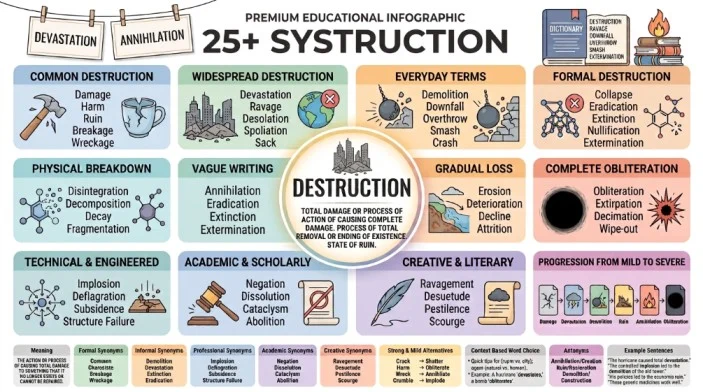
The best synonyms of destruction include devastation, ruin, demolition, annihilation, obliteration, devastation, disintegration, and eradication. Formal writing, use devastation or destruction. For buildings, demolition is more precise complete destruction, annihilation or obliteration creates stronger emphasis. Creative writing may favor ruin or desolation.
Meaning, Tone, and Context
Simple Definition
Destruction means the act or process of damaging, breaking, ruining, or completely eliminating something. It can describe physical damage to buildings, cities, objects, or natural environments, as well as the loss or collapse of systems, relationships, hopes, or institutions.
The exact meaning depends heavily on context. A sentence about a demolished building has a different meaning from one describing the destruction of a forest or the destruction of someone’s confidence.
Part of Speech
Destruction is primarily a noun.
It refers to the act, process, or result of destroying something.
Overall Tone
The word destruction generally has a negative tone because it describes serious damage, loss, ruin, or elimination.
The emotional intensity can vary. In a factual report, it may sound neutral and descriptive. In a novel or personal account, it can carry strong emotional weight.
Formality Level
Destruction is a neutral to formal word.
It works naturally in:
- Academic writing
- News reports
- Business communication
- Environmental discussions
- Historical writing
- Everyday conversation
- Fiction
- Technical descriptions
Common Uses
Native English speakers commonly use destruction when discussing:
- Buildings
- Homes
- Cities
- Forests
- Natural habitats
- Property
- Infrastructure
- Evidence
- Relationships
- Organizations
- Communities
- Confidence
- Hope
- Plans
- Systems
- Environments
Examples include:
- “The storm caused widespread destruction.”
- “The fire left a trail of destruction.”
- “The war resulted in the destruction of several historic buildings.”
- “The policy contributed to the destruction of natural habitats.”
Word Forms
| Word | Part of Speech | Example |
|---|---|---|
| Destruction | Noun | “The destruction was extensive.” |
| Destroy | Verb | “The fire destroyed several buildings.” |
| Destroyed | Adjective or past participle | “The destroyed building was unsafe.” |
| Destructive | Adjective | “The storm was highly destructive.” |
| Destructively | Adverb | “The force acted destructively on the structure.” |
The most useful related forms are destroy, destroyed, and destructive.
When and How to Use “Destruction”
Use destruction when you need a broad noun that describes severe damage, ruin, or the complete removal of something. It is especially useful when the exact mechanism of damage is less important than the resulting loss.
Professional
“The company developed a recovery plan after the destruction of several facilities.”
Here, destruction works because the sentence focuses on the damage rather than the exact process that caused it.
Academic
“The study examines the long term effects of habitat destruction.”
In academic writing, the word works well because it clearly describes the loss or severe damage of a natural environment.
Workplace
“The accident caused significant destruction to the warehouse.”
This usage is straightforward and suitable for workplace reports.
Personal
“Seeing the destruction of my childhood home was deeply upsetting.”
The word communicates physical loss while allowing the emotional context to provide additional meaning.
“Please document any property damage caused by the storm and report major destruction to management.”
This sounds appropriate for a formal workplace message.
Resume
“Assisted with emergency response following widespread storm destruction.”
The word can work on a resume when describing disaster response or restoration related experience.
Social Media
“The destruction caused by the wildfire is heartbreaking.”
In social media writing, destruction can communicate both factual damage and emotional reaction.
Best Synonyms of “Destruction”
No single alternative works perfectly in every sentence. The best word depends on whether you want to emphasize severe damage, complete elimination, deliberate demolition, gradual breakdown, or emotional ruin.
Professional Writing: Devastation
Devastation is a strong choice when describing extensive damage caused by disasters, conflict, or other destructive events.
Example:
“The report documents the devastation caused by the hurricane.”
It sounds serious and appropriate for formal reports.
Academic Writing: Destruction
Sometimes the original word is actually the most precise choice. Academic writing frequently uses destruction when discussing habitat loss, environmental damage, historical events, or physical deterioration.
Example:
“The destruction of wetlands has affected several local species.”
Business Communication: Demolition
Use demolition when destruction involves deliberately taking down a building or structure.
Example:
“The old warehouse is scheduled for demolition next month.”
It is more precise than simply saying the building will be destroyed.
Casual Conversation: Ruin
Ruin is a natural alternative when discussing something that has been badly damaged or spoiled.
Example:
“The flood ruined the basement.”
For a noun:
“The storm left the neighborhood in ruin.”
Emotional Writing: Devastation
Devastation is especially effective when destruction produces deep emotional or human consequences.
Example:
“The family struggled to recover from the devastation caused by the fire.”
Creative Writing: Desolation
Desolation can create a vivid image of a place left empty, damaged, lonely, or ruined.
Example:
“The battlefield was a scene of silence and desolation.”
Resume Writing: Demolition
When describing construction or site preparation, demolition is more specific and professional.
Example:
“Supervised demolition activities across multiple commercial sites.”
Workplace Communication: Elimination
Elimination works when something is deliberately removed rather than physically smashed.
Example:
“The new process aims to eliminate unnecessary steps.”
Stronger Meaning: Annihilation
Annihilation suggests complete destruction or total elimination.
Example:
“The fictional weapon threatened the annihilation of the entire city.”
Because it is extremely strong, it should not be used for ordinary damage.
Softer Meaning: Damage
Damage is usually milder than destruction.
Example:
“The storm caused minor damage to the roof.”
Use it when something has been harmed but not necessarily ruined.
When Not to Use “Destruction”
The word destruction is useful, but it can sometimes be too broad, too strong, or simply less precise than another word.
When the Damage Is Minor
Destruction can sound excessive when something has only suffered small amounts of damage.
Less Effective:
“The accident caused destruction to the table.”
Better:
“The accident caused damage to the table.”
Why:
Damage accurately communicates harm without suggesting that the table was completely ruined.
When a Building Is Deliberately Torn Down
Destruction is possible, but demolition is more precise.
Less Precise:
“The destruction of the old building began Monday.”
Better:
“The demolition of the old building began Monday.”
Why:
Demolition specifically describes the planned tearing down of a structure.
When Something Is Removed Rather Than Physically Destroyed
Elimination may be more appropriate.
Less Precise:
“The destruction of unnecessary expenses improved the budget.”
Better:
“The elimination of unnecessary expenses improved the budget.”
Why:
Expenses are normally reduced or eliminated rather than physically destroyed.
When the Focus Is on Emotional Loss
Destruction can sound too physical.
Less Effective:
“The breakup caused the destruction of her confidence.”
Better:
“The breakup caused a serious loss of confidence.”
Why:
The revised version communicates emotional impact more naturally.
When Complete Destruction Is Intended
Sometimes destruction is actually too weak.
Less Strong:
“The weapon caused the destruction of the fictional city.”
Stronger:
“The weapon caused the annihilation of the fictional city.”
Why:
Annihilation makes the idea of complete elimination unmistakable.
When Something Gradually Breaks Apart
Disintegration can be more accurate.
Less Precise:
“The old organization experienced destruction over several decades.”
Better:
“The old organization experienced gradual disintegration over several decades.”
Why:
Disintegration suggests a process of breaking apart rather than one sudden destructive event.
Words Commonly Confused With “Destruction”
| Word | Difference | When to Use It | Example |
|---|---|---|---|
| Damage | Means harm that does not necessarily result in complete ruin. | Minor or moderate physical harm. | “The storm caused serious damage to the roof.” |
| Demolition | Means deliberately taking down a building or structure. | Construction and property work. | “The demolition of the bridge begins next week.” |
| Devastation | Suggests widespread and severe damage. | Disasters, war, and major loss. | “The hurricane caused widespread devastation.” |
| Ruin | Describes severe damage, collapse, or a spoiled condition. | Buildings, places, plans, and situations. | “The flood left the old house in ruin.” |
| Annihilation | Means complete destruction or elimination. | Extremely severe or total destruction. | “The story describes the annihilation of an entire civilization.” |
| Deterioration | Means gradual worsening rather than sudden destruction. | Conditions, structures, health, and systems. | “Years of neglect caused deterioration of the building.” |
Best Synonyms of “Destruction” by Context
| Context | Best Synonym | Why It Works | Example |
|---|---|---|---|
| Formal writing | Devastation | Conveys severe damage clearly. | “The report describes the devastation caused by the storm.” |
| Academic writing | Destruction | Broad and precise for research contexts. | “Habitat destruction threatens biodiversity.” |
| Professional communication | Damage | Useful when the degree of loss is not complete. | “The inspection identified structural damage.” |
| Business emails | Demolition | Precise for planned building removal. | “The demolition schedule has been approved.” |
| Resume writing | Demolition | Clearly describes specialized construction work. | “Managed commercial demolition projects.” |
| Workplace communication | Damage | Practical and objective. | “The equipment sustained significant damage.” |
| Casual conversation | Ruin | Natural and familiar. | “The storm ruined the backyard.” |
| Everyday speaking | Damage | Common for ordinary physical harm. | “The accident caused some damage.” |
| Creative writing | Desolation | Adds atmosphere and emotional imagery. | “The abandoned town stood in desolation.” |
| Storytelling | Devastation | Creates a strong sense of widespread loss. | “The kingdom faced devastation after the battle.” |
| Emotional writing | Devastation | Communicates serious personal or collective loss. | “The news brought devastation to the community.” |
| Strong emphasis | Annihilation | Suggests complete elimination. | “The invasion threatened the annihilation of the city.” |
| Mild tone | Damage | Avoids unnecessary dramatic language. | “The storm caused minor damage.” |
| Social media captions | Devastation | Expressive while still widely understood. | “The devastation after the wildfire is heartbreaking.” |
| American English | Destruction | Standard and widely understood. | “The storm caused extensive destruction.” |
| British English | Destruction | Also standard and natural. | “The fire caused extensive destruction.” |
How to Choose the Best Synonym of “Destruction”
Choosing the right synonym becomes easier when you identify exactly what you want to communicate.
Consider the Meaning
First determine whether you mean:
- General destruction
- Physical damage
- Complete destruction
- Deliberate demolition
- Gradual breakdown
- Emotional ruin
- Environmental loss
- Removal or elimination
- For general use, destruction remains the safest choice.
- For severe widespread damage, choose devastation.
- For complete destruction, consider annihilation or obliteration.
- For buildings, use demolition.
- For gradual breakdown, use disintegration or deterioration.
Consider the Tone
A news report may require devastation.
A construction report may require demolition.
A casual conversation may sound more natural with damage or ruin.
A literary passage may benefit from desolation.
Consider Your Audience
Academic readers usually respond better to precise and objective vocabulary.
Business readers generally prefer practical terms such as damage, demolition, elimination, or devastation, depending on the subject.
General readers can understand destruction, damage, and ruin easily.
Consider Emotional Strength
Do not use an extremely strong synonym simply because it sounds impressive.
- For moderate harm, use damage.
- For severe destruction, use devastation.
- For complete destruction, use annihilation or obliteration.
The strongest word is not always the best word. Accuracy matters more than intensity.
Consider the Writing Purpose
- For an academic essay, choose precise terms.
For a business report, choose objective vocabulary.
- For a resume, use specific industry language.
- For fiction, choose words that create atmosphere.
- For social media, prioritize natural and emotionally appropriate language.
Real Life Examples of “Destruction”
School
Basic:
“The destruction of forests affects animals.”
Improved:
“The destruction of forests can threaten natural habitats and wildlife.”
The original word works well because the sentence describes environmental loss.
College
Basic:
“The war caused destruction.”
Improved:
“The conflict caused widespread devastation across the region.”
Devastation provides a stronger sense of scale.
Workplace
Basic:
“The accident caused destruction.”
Improved:
“The accident caused significant damage to the production equipment.”
Damage is more practical when discussing workplace property.
Business
Basic:
“The company planned the destruction of the old facility.”
Improved:
“The company planned the demolition of the old facility.”
Demolition is the more precise business and construction term.
Basic:
“Please report any destruction caused by the storm.”
Improved:
“Please report any significant damage caused by the storm.”
The revised version sounds more practical for routine workplace communication.
Resume
Basic:
“Worked on destruction projects.”
Improved:
“Supervised commercial demolition projects while maintaining site safety standards.”
The second version gives a clearer description of professional work.
Conversation
Basic:
“The storm caused destruction.”
Natural:
“The storm caused a lot of damage.”
The second version is more conversational.
Storytelling
Basic:
“The city suffered destruction after the battle.”
Creative:
“The city was reduced to ruin, its streets silent beneath the smoke.”
Ruin creates a stronger visual effect in storytelling.
Blogging
Basic:
“The destruction of forests is a serious issue.”
Improved:
“Forest destruction remains a serious environmental concern.”
The original noun is appropriate for an informational article.
Social Media
Basic:
“The wildfire caused destruction.”
Improved:
“The wildfire left behind heartbreaking devastation.”
The stronger word better matches the emotional tone of a social media caption.
25 Best Synonyms of “Destruction”
| Synonym | Simple Meaning | Best Used For | Example Sentence |
|---|---|---|---|
| Devastation | Severe and widespread damage | Natural disasters and war | “The hurricane left widespread devastation behind.” |
| Demolition | Deliberate tearing down | Buildings and structures | “The demolition of the old stadium begins tomorrow.” |
| Ruin | A badly damaged or destroyed condition | Buildings, places, plans | “The abandoned factory fell into ruin.” |
| Annihilation | Complete destruction | Total elimination | “The novel depicts the annihilation of an ancient civilization.” |
| Obliteration | Complete removal or destruction | Extreme destruction | “The blast resulted in the obliteration of the structure.” |
| Devastating damage | Extremely severe harm | Disasters and property loss | “The flood caused devastating damage to local homes.” |
| Disintegration | Breaking into smaller parts | Structures, systems, organizations | “Years of conflict led to the disintegration of the alliance.” |
| Dissolution | Ending or breaking apart | Organizations and relationships | “The dissolution of the partnership ended years of cooperation.” |
| Eradication | Complete removal | Problems, diseases, threats | “The program focused on the eradication of the disease.” |
| Elimination | Complete removal | Problems, risks, unnecessary elements | “The redesign led to the elimination of several errors.” |
| Extermination | Complete killing or removal | Pests and living populations | “The treatment was designed for pest extermination.” |
| Extinction | Complete disappearance of a species or group | Biology and environmental writing | “Habitat loss can contribute to species extinction.” |
| Desolation | A state of emptiness and severe ruin | Creative and emotional writing | “The landscape was marked by desolation.” |
| Wrecking | Destroying or badly damaging something | Buildings and informal contexts | “The wrecking of the old structure took several days.” |
| Dismantling | Taking something apart | Machines, systems, structures | “The dismantling of the old equipment began immediately.” |
| Collapse | Falling down or failing completely | Buildings, systems, institutions | “The collapse of the bridge caused major disruption.” |
| Breakdown | Failure or loss of functioning | Systems and relationships | “The breakdown of the system caused delays.” |
| Decimation | Severe reduction or destruction | Populations and groups | “The disease caused the decimation of the local population.” |
| Ravaging | Causing extensive damage | War, storms, disease | “The region was ravaged by severe flooding.” |
| Devouring | Consuming or destroying completely | Fire, nature, figurative writing | “The flames seemed to be devouring the entire building.” |
| Consumption | Complete use or destruction by consuming | Fire and resources | “The fire resulted in the consumption of the wooden structure.” |
| Destruction of property | Severe physical loss to possessions | Legal and insurance contexts | “The policy covers accidental destruction of property.” |
| Decomposition | Breaking down into simpler parts | Organic matter and scientific contexts | “Natural decomposition gradually breaks down dead material.” |
| Depredation | Destructive damage or plundering | Formal and historical writing | “The region suffered years of depredation during the conflict.” |
| Ruination | The process or state of being ruined | Literary and descriptive writing | “The town’s ruination became a symbol of the failed project.” |
Some words in this table are context specific rather than interchangeable with destruction in every sentence. For example, demolition is best for structures, extinction is best for species or groups, and eradication is most natural for problems, diseases, or unwanted conditions. Precision is more useful than simply choosing the strongest sounding word.
Synonyms of “Destruction” by Usage
Professional vs Personal Synonyms
Professional writing generally favors precise, objective terms.
Use damage when discussing property or equipment.
- Use demolition when discussing structures.
Use elimination when discussing unnecessary processes or risks.
- Use devastation when describing widespread damage.
Personal writing can use more expressive terms such as ruin, devastation, or desolation, depending on the emotional context.
Formal vs Conversational Synonyms
For reports and essays, destruction, devastation, demolition, disintegration, and eradication can be useful when their meanings fit.
For casual conversations, damage, ruin, and mess are often more natural, although mess is not a direct synonym in every context.
Example:
Formal:
“The storm caused extensive destruction.”
Conversational:
“The storm caused a lot of damage.”
Academic Synonyms
Academic writing requires precision.
Useful alternatives include:
- Destruction
- Devastation
- Disintegration
- Eradication
- Extinction
- Deterioration
- Dissolution
- Elimination
For example:
“Habitat destruction contributes to biodiversity loss.”
Here, replacing destruction with an unrelated stronger word could make the scientific meaning less precise.
Professional and Business Synonyms
For resumes, interviews, meetings, presentations, and business emails, select a word that accurately identifies the process.
Resumes: demolition, dismantling, elimination
Interviews: damage, restoration, demolition
Meetings: damage, destruction, disruption
Presentations: devastation, destruction, elimination
Performance reviews: elimination, reduction, dismantling
Client communication: damage, destruction, restoration
Business emails: damage, demolition, elimination
The key principle is specificity. If you demolished a building, say demolition rather than using the broader word destruction.
Creative and Literary Synonyms
Creative writing gives you more freedom to choose emotionally powerful vocabulary.
Ruin can make a setting feel abandoned.
Desolation can create loneliness and emptiness.
Devastation can communicate overwhelming loss.
Obliteration can suggest that almost nothing remains.
Annihilation can create an extreme sense of finality.
Ravaging can make destructive action feel active and violent.
Choose the word that supports the mood rather than simply selecting the most dramatic option.
Slang or Modern Synonyms
There is no widely accepted slang word that serves as a direct replacement for destruction in every context.
Informal expressions such as wreck, mess, or wipeout may appear in casual speech, sports, gaming, or online communities, but their meanings vary significantly.
For formal writing, academic work, resumes, and professional communication, avoid relying on these expressions.
Strongest to Mildest Synonyms
The intensity of destruction varies considerably among related words.
Mild
Damage
Indicates harm without necessarily suggesting complete ruin.
Mild to Moderate
Deterioration
Suggests gradual worsening.
Moderate
Ruin
Suggests serious damage or a state of being spoiled.
Strong
Devastation
Indicates extensive and severe destruction.
Very Strong
Obliteration
Suggests that something has been completely removed or destroyed.
Extremely Strong
Annihilation
Suggests total destruction or elimination.
The intensity should match the actual situation. Calling a small scratch “annihilation” would be exaggerated and unnatural.
Emotional vs Neutral Synonyms
Emotional Synonyms
These words can create stronger emotional reactions:
- Devastation
- Ruin
- Desolation
- Annihilation
- Obliteration
- Ravaging
They are useful in storytelling, emotional writing, speeches, journalism, and descriptions of major disasters.
Neutral Synonyms
These words can communicate information more objectively:
- Destruction
- Damage
- Demolition
- Dismantling
- Elimination
- Disintegration
They work especially well in academic, technical, workplace, and professional contexts.
Antonyms of “Destruction”
| Antonym | Meaning | Example Sentence |
|---|---|---|
| Construction | The process of building something | “Construction of the new school begins next month.” |
| Creation | The act of bringing something into existence | “The project encouraged the creation of new jobs.” |
| Building | The process of making or developing something | “The building of the bridge took two years.” |
| Preservation | Protecting something from damage or loss | “The program focuses on the preservation of historic sites.” |
| Protection | Keeping something safe from harm | “The barrier provides protection from flooding.” |
| Restoration | Returning something to an earlier condition | “The museum completed the restoration of the painting.” |
| Repair | Fixing something that has been damaged | “The team completed the repair quickly.” |
| Maintenance | Keeping something in good condition | “Regular maintenance prevents major problems.” |
| Conservation | Protecting natural or cultural resources | “Forest conservation helps protect wildlife.” |
| Reconstruction | Building something again after damage | “The city began reconstruction after the earthquake.” |
| Development | Growth or creation over time | “The development of the area created new opportunities.” |
| Renewal | Making something fresh or useful again | “The neighborhood is undergoing renewal.” |
| Improvement | Making something better | “The changes led to significant improvement.” |
| Growth | Increase or positive development | “The company experienced steady growth.” |
| Rebuilding | Constructing again after loss or damage | “The community worked together on rebuilding homes.” |
Comparison: “Destruction” vs Similar Words
Destruction vs Damage
Main Difference
Destruction can imply severe or complete ruin, while damage simply means harm or impairment.
Which Is Stronger?
Destruction is generally stronger.
Which Is More Formal?
Both are suitable for formal writing.
When to Use Each
Use damage when something is harmed but remains usable or recoverable. Use destruction when the damage is much more severe.
Examples
Destruction:
“The fire caused widespread destruction.”
Damage:
“The fire caused minor damage to the roof.”
Destruction vs Demolition
Main Difference
Demolition specifically describes the deliberate tearing down of a structure.
Which Is Stronger?
Neither is always stronger. They describe different situations.
Which Is More Formal?
Both are professional terms, but demolition is more technical.
When to Use Each
Use demolition for buildings and structures being intentionally taken down.
Examples
Destruction:
“The storm caused the destruction of the building.”
Demolition:
“The demolition crew removed the unsafe building.”
Destruction vs Devastation
Main Difference
Devastation emphasizes the scale and severity of damage.
Which Is Stronger?
Devastation often sounds more emotionally intense.
Which Is More Formal?
Both work in formal writing.
When to Use Each
Use devastation when widespread damage or human suffering is central to the message.
Examples
Destruction:
“The storm caused extensive destruction.”
Devastation:
“The storm caused widespread devastation throughout the region.”
Destruction vs Ruin
Main Difference
Ruin can describe either the process of becoming ruined or the damaged state that remains.
Which Is Stronger?
They can overlap, but ruin often has a more descriptive or literary quality.
Which Is More Formal?
Destruction is more neutral and broadly suitable.
When to Use Each
Use ruin for places, buildings, plans, reputations, or situations.
Examples
Destruction:
“The earthquake caused major destruction.”
Ruin:
“The earthquake left the old village in ruin.”
Destruction vs Annihilation
Main Difference
Annihilation suggests total destruction, often leaving nothing remaining.
Which Is Stronger?
Annihilation is considerably stronger.
Which Is More Formal?
Both can appear in formal writing, but annihilation is more extreme.
When to Use Each
Use annihilation only when complete elimination is genuinely intended.
Examples
Destruction:
“The attack caused widespread destruction.”
Annihilation:
“The fictional weapon threatened the annihilation of the entire population.”
Destruction vs Deterioration
Main Difference
Deterioration describes gradual worsening, while destruction usually suggests more severe damage or a destructive event.
Which Is Stronger?
Destruction is generally stronger.
Which Is More Formal?
Both are appropriate in formal writing.
When to Use Each
Use deterioration when something becomes worse slowly over time.
Examples
Destruction:
“The fire caused the destruction of the structure.”
Deterioration:
“Years of neglect caused the deterioration of the structure.”
Common Phrases and Expressions with “Destruction”
Destruction of Property
Meaning: Severe damage or loss involving someone’s belongings or physical property.
Example Sentence:
“The insurance policy covers accidental destruction of property.”
Widespread Destruction
Meaning: Severe damage affecting a large area or many things.
Example Sentence:
“The hurricane caused widespread destruction across the coastal region.”
Complete Destruction
Meaning: Destruction that leaves little or nothing remaining.
Example Sentence:
“The fire resulted in the complete destruction of the building.”
Destruction of Habitat
Meaning: Damage or removal of a natural environment where plants and animals live.
Example Sentence:
“Habitat destruction is a major concern for conservationists.”
Cause Destruction
Meaning: To produce severe damage or ruin.
Example Sentence:
“Strong winds can cause destruction when they reach populated areas.”
Trail of Destruction
Meaning: A path or area showing extensive damage left behind by a destructive event.
Example Sentence:
“The tornado left a trail of destruction through the town.”
Destruction and Loss
Meaning: A phrase used to emphasize both physical damage and what people have lost.
Example Sentence:
“The community is recovering from years of destruction and loss.”
Destruction of Evidence
Meaning: The act of damaging or removing evidence so it can no longer be used.
Example Sentence:
“Investigators examined whether the destruction of evidence was intentional.”
Common Mistakes to Avoid
1. Using “Destruction” for Minor Damage
Incorrect:
“The child caused destruction to the chair by scratching it.”
Better:
“The child caused damage to the chair by scratching it.”
Why:
A scratch is normally described as damage rather than destruction.
2. Confusing Destruction With Demolition
Incorrect:
“The company hired workers for the destruction of the old office building.”
Better:
“The company hired workers for the demolition of the old office building.”
Why:
Demolition specifically describes planned structural removal.
3. Using “Annihilation” Too Casually
Incorrect:
“The spilled coffee caused the annihilation of my notes.”
Better:
“The spilled coffee ruined my notes.”
Why:
Annihilation is far too extreme for an ordinary accident.
4. Choosing an Emotional Word for a Technical Report
Incorrect:
“The equipment suffered devastating destruction.”
Better:
“The equipment sustained significant damage.”
Why:
Technical reports usually benefit from objective and measurable wording.
5. Using “Destruction” When “Elimination” Is More Accurate
Incorrect:
“The company focused on the destruction of unnecessary steps.”
Better:
“The company focused on the elimination of unnecessary steps.”
Why:
Processes and unnecessary steps are normally eliminated rather than physically destroyed.
6. Confusing Destruction With Deterioration
Incorrect:
“The building suffered destruction over several decades because of neglect.”
Better:
“The building experienced gradual deterioration over several decades.”
Why:
Deterioration describes a gradual decline rather than a single destructive event.
7. Repeating the Same Word
Incorrect:
“The destruction caused more destruction, leaving further destruction throughout the area.”
Better:
“The disaster caused widespread devastation, leaving extensive damage throughout the area.”
Why:
Carefully chosen alternatives improve flow while preserving the intended meaning.
Frequently Asked Questions
1. What are the best synonyms of “destruction”?
The best synonyms of destruction include devastation, demolition, ruin, annihilation, obliteration, disintegration, desolation, and eradication. The best choice depends on whether you mean severe damage, complete elimination, structural removal, or gradual breakdown.
2. What are the best formal synonyms of “destruction”?
Formal alternatives include devastation, demolition, disintegration, obliteration, eradication, annihilation, and elimination. However, the correct word depends on context. For example, demolition is best for structures, while eradication works better for problems or diseases.
3. What are common informal synonyms of “destruction”?
Common informal alternatives include damage, ruin, and, in some contexts, wrecking. Casual speakers often say something was “ruined” or “wrecked” rather than using highly formal words such as obliteration or annihilation.
4. What is another word for “destruction” in professional writing?
Damage, demolition, devastation, and elimination are useful professional alternatives, depending on context. Use damage for physical harm, demolition for structures, devastation for widespread loss, and elimination for removing problems or unnecessary elements.
5. What is the difference between “destruction” and “damage”?
Destruction generally suggests more severe ruin or loss, while damage means harm that may be partial or repairable. For example, a storm may cause minor damage to a roof, while a fire may cause its complete destruction.
6. What is the opposite of “destruction”?
Common opposites include construction, creation, preservation, protection, restoration, repair, conservation, reconstruction, rebuilding, and maintenance. The best opposite depends on the situation, because building, repairing, protecting, and restoring are different ways of countering destruction.
Conclusion
Destruction describes the act, process, or result of severely damaging, ruining, or eliminating something. It is a broad and useful noun, but more precise alternatives can communicate the exact type and intensity of loss.
Use damage for general or partial harm, demolition for deliberately removing structures, devastation for widespread severe damage, ruin for a damaged condition, and annihilation or obliteration when complete destruction is intended. Academic and professional writing usually benefits from precision, while creative writing can make greater use of expressive words such as desolation and ruin.
There is no single perfect replacement in every sentence. When choosing a synonym of destruction, consider the meaning, audience, tone, intensity, and purpose first. A simple vocabulary habit is to identify exactly what kind of destruction you mean before selecting an alternative.Read More Related Articles:
Discover More Post:
- Synonyms of But | Meanings, Uses, Examples, and Best ..
- Synonyms of Perseverance | Meanings, Uses, Examples …
- Synonyms of Proficiency | Meanings, Uses, Examples …