When writing a resume, essay, email, or professional profile, repeating the word proficiency can make your language feel limited. Finding the right synonym of proficiency can help you describe skill, knowledge, competence, or mastery with greater precision and make your writing sound more natural.
The best alternative depends on what you actually mean. Expertise emphasizes advanced knowledge, competence suggests reliable ability, mastery indicates a very high level of skill, while fluency works especially well for languages and communication. Choosing the right word helps readers understand not only that someone can perform a task, but also how capable and experienced they are.
What Are the Best Synonyms of “Proficiency”?
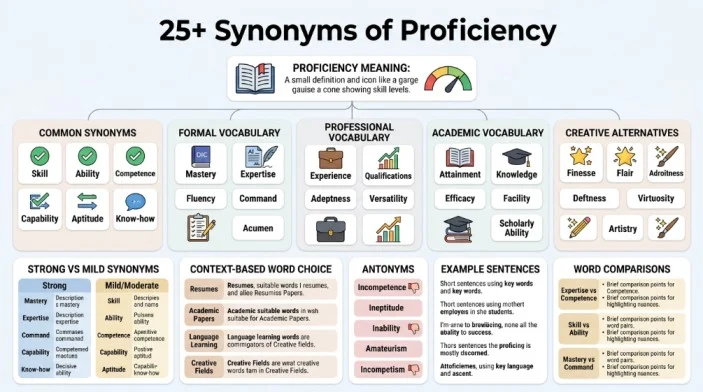
A synonym of proficiency is a word that describes a person’s ability, skill, knowledge, or competence in a particular area. The best choices include expertise for advanced knowledge, competence for reliable ability, mastery for exceptional skill, skill for general use, and fluency for languages.
Meaning, Tone, and Context
Simple Definition
Proficiency means a good or advanced level of skill or ability in a particular activity, subject, or field. It suggests that someone can perform a task effectively because they have developed the necessary knowledge and practical ability.
For example:
“She demonstrated proficiency in data analysis.”
This means she has enough skill and knowledge to use data analysis effectively.
Part of Speech
Proficiency is a noun.
It normally refers to the level of skill someone has in a particular area.
Overall Tone
The word proficiency has a generally positive and neutral tone. It describes ability objectively without automatically suggesting exceptional talent.
Formality Level
Proficiency is a formal to neutral word. It is especially common in:
- Resumes
- Job descriptions
- Academic writing
- Training documents
- Performance reviews
- Professional profiles
- Educational assessments
- Business communication
In casual conversation, simpler words such as skill, ability, or experience may sound more natural.
Common Uses
Native English speakers commonly use proficiency when discussing a person’s ability in a specific area.
Common expressions include:
- Proficiency in English
- Proficiency in Spanish
- Proficiency in Microsoft Excel
- Proficiency in programming
- Proficiency in communication
- Proficiency in mathematics
- Proficiency in technical skills
- Proficiency with software
- Language proficiency
- Professional proficiency
- Technical proficiency
Word Forms
| Form | Word | Example |
|---|---|---|
| Noun | Proficiency | Her proficiency in French is impressive. |
| Adjective | Proficient | He is proficient in Excel. |
| Related noun | Proficient user | She is a proficient user of the software. |
The most common related adjective is proficient, which describes someone who has developed a good level of skill.
When and How to Use “Proficiency”
Use proficiency when you want to describe a developed level of ability rather than simply saying someone has tried or experienced something.
It is particularly useful when the skill can be evaluated, demonstrated, or measured.
Professional
“The position requires proficiency in Microsoft Excel.”
This sounds appropriate in a job description because it describes a specific workplace skill.
Academic
“Students must demonstrate proficiency in written communication.”
Here, proficiency refers to an ability that can be assessed.
Workplace
“Her proficiency with the new software helped the team complete the project efficiently.”
The word works well when discussing practical workplace performance.
Personal
“His proficiency in photography developed through years of practice.”
This describes a personal skill without making the stronger claim that he is an expert.
“Please confirm your level of proficiency with the reporting software.”
This is suitable for a professional email because the wording is clear and formal.
Resume
“Demonstrated proficiency in spreadsheet analysis and financial reporting.”
On a resume, proficiency clearly communicates an established skill level.
Social Media
“I’ve spent years improving my proficiency in graphic design.”
This is grammatically correct, although a more conversational post might simply say, “I’ve spent years improving my graphic design skills.”
Best Synonyms of “Proficiency”
No single synonym works perfectly in every sentence. The best choice depends on whether you want to emphasize general skill, advanced knowledge, reliable performance, practical experience, or exceptional mastery.
Professional Writing: Expertise
Expertise is one of the strongest professional alternatives to proficiency. It suggests substantial knowledge and developed ability in a particular field.
“Her expertise in digital marketing helped the company improve its online strategy.”
Use expertise when the person has more than basic or moderate ability.
Academic Writing: Competence
Competence is useful when discussing whether someone has the knowledge and ability required to perform effectively.
“The assessment measured students’ competence in written communication.”
It sounds objective and works particularly well in educational contexts.
Business Communication: Capability
Capability focuses on what a person, team, or organization is able to do.
“The company has strong technical capabilities.”
It is especially useful when discussing practical capacity rather than individual skill alone.
Casual Conversation: Skill
Skill is the simplest and most natural alternative in everyday English.
“She has excellent writing skills.”
It is less formal than proficiency and works in almost any casual situation.
Emotional Writing: Talent
Talent can express natural ability and often carries a positive or admiring tone.
“Her talent for storytelling was obvious from an early age.”
Unlike proficiency, talent can suggest natural ability rather than skill developed primarily through training.
Creative Writing: Mastery
Mastery suggests an exceptionally high level of control, knowledge, or skill.
“His mastery of the piano was evident throughout the performance.”
It is powerful and should not be used for ordinary or developing ability.
Resume Writing: Expertise
Expertise can make a resume sound more precise when the candidate genuinely has advanced knowledge.
“Expertise in customer relationship management and sales strategy.”
However, it should be used honestly. Someone with beginner or intermediate skills should not describe themselves as having expertise.
Workplace Communication: Competence
Competence works well in performance reviews, training discussions, and professional assessments.
“The employee demonstrated strong competence in project coordination.”
Stronger Meaning: Mastery
Use mastery when you want to communicate a very high level of skill.
“Her mastery of the subject allowed her to explain complex ideas clearly.”
Softer Meaning: Ability
Ability is broader and less specific than proficiency. It can describe someone’s capacity to do something without suggesting a particular level of expertise.
“He has the ability to communicate effectively with clients.”
When Not to Use “Proficiency”
Although proficiency is useful, it is not always the most natural choice.
When the Word Sounds Too Formal
In everyday conversation, proficiency can sound more formal than necessary.
Less Natural:
“What is your proficiency in cooking?”
More Natural:
“How good are you at cooking?”
Why:
The second version sounds more conversational.
When You Mean Advanced Knowledge
If someone has exceptional knowledge, proficiency may not communicate enough strength.
Less Precise:
“She has proficiency in cybersecurity.”
Stronger:
“She has expertise in cybersecurity.”
Why:
Expertise more clearly communicates advanced knowledge.
When You Mean Natural Talent
Proficiency usually describes developed ability. It does not necessarily suggest that someone has an unusual natural gift.
Less Precise:
“His proficiency for music was obvious.”
Better:
“His talent for music was obvious.”
Why:
Talent naturally refers to an ability that may be partly natural.
When You Mean Years of Practical Experience
If your main point is hands on experience, experience may be more accurate.
Less Precise:
“She has proficiency in managing large teams.”
Better:
“She has extensive experience managing large teams.”
Why:
The second sentence emphasizes practical exposure and history rather than simply skill level.
When You Mean Language Ability Specifically
Proficiency works for languages, but fluency can be more specific when the focus is comfortable communication.
General:
“He has proficiency in French.”
More Specific:
“He is fluent in French.”
Why:
Fluent directly highlights smooth language use.
When You Mean Basic Ability
Using proficiency may make a beginner sound more advanced than intended.
Less Accurate:
“She has proficiency in basic coding.”
Better:
“She has basic coding skills.”
Why:
Skills allows you to describe an early stage of development more naturally.
Words Commonly Confused With “Proficiency”
Expertise
Difference: Expertise suggests advanced and specialized knowledge or skill.
When to Use It: Use it when someone has substantial knowledge and can perform at an advanced level.
Example:
“The consultant has expertise in financial planning.”
Competence
Difference: Competence means having enough knowledge and ability to perform effectively.
When to Use It: Use it for assessment, education, workplace performance, and professional standards.
Example:
“The course evaluates competence in professional communication.”
Fluency
Difference: Fluency usually describes smooth and effective use of a language, although it can occasionally describe other forms of expression.
When to Use It: Use it primarily for languages and communication.
Example:
“She speaks Spanish with impressive fluency.”
Aptitude
Difference: Aptitude refers to a natural ability or potential to learn something.
When to Use It: Use it when discussing potential rather than an already developed skill.
Example:
“He has a strong aptitude for mathematics.”
Experience
Difference: Experience refers to knowledge or skill gained through participation or practice over time.
When to Use It: Use it when the history of performing a task matters.
Example:
“She has extensive experience in project management.”
Ability
Difference: Ability is a broad term for the capacity to do something.
When to Use It: Use it when you do not need to specify a particular level of skill.
Example:
“His ability to solve complex problems impressed the team.”
Best Synonyms of “Proficiency” by Context
| Context | Best Synonym | Why It Works | Example |
|---|---|---|---|
| Formal writing | Competence | Sounds objective and precise. | The program evaluates professional competence. |
| Academic writing | Expertise | Emphasizes advanced knowledge. | Her expertise strengthened the research project. |
| Professional communication | Expertise | Communicates developed professional knowledge. | His expertise in finance is valuable to the team. |
| Business emails | Capability | Focuses on practical ability. | The team has the capability to manage the account. |
| Resume writing | Expertise | Highlights advanced professional knowledge. | Expertise in customer service strategy. |
| Workplace communication | Competence | Fits performance discussions. | She demonstrated competence in project planning. |
| Casual conversation | Skill | Simple and natural. | He has strong writing skills. |
| Everyday speaking | Ability | Broad and familiar. | She has a real ability to explain things clearly. |
| Creative writing | Mastery | Suggests exceptional control. | His mastery of language shaped the novel. |
| Storytelling | Talent | Highlights natural creative ability. | Her talent for storytelling captivated the audience. |
| Emotional writing | Gift | Can express special natural ability. | He has a gift for making people feel welcome. |
| Strong emphasis | Mastery | Indicates an exceptionally high level. | Her mastery of the subject is remarkable. |
| Mild tone | Skill | Does not exaggerate ability. | He has basic computer skills. |
| Social media captions | Skill | Sounds natural and accessible. | Finally improving my photography skills. |
| American English | Skill | Common and versatile in everyday use. | She has excellent communication skills. |
| British English | Competence | Common in formal and professional contexts. | The course develops workplace competence. |
How to Choose the Best Synonym of “Proficiency”
The best synonym depends on the message you want to communicate.
If You Mean General Skill
Choose skill.
“She has excellent communication skills.”
This is the safest choice for general writing.
If You Mean Advanced Knowledge
Choose expertise.
“He has expertise in software development.”
This suggests substantial knowledge and experience.
If You Mean Reliable Ability
Choose competence.
“The training program develops professional competence.”
This is especially useful when ability is being evaluated.
If You Mean Natural Potential
Choose aptitude.
“She has an aptitude for mathematics.”
Do not use aptitude when you mean someone has already mastered a skill.
If You Mean Language Ability
Choose fluency when smooth communication is the focus.
“His fluency in Spanish allows him to communicate confidently with clients.”
If You Mean Exceptional Skill
Choose mastery.
“The artist demonstrated mastery of color and composition.”
This is a strong word, so use it when the level of ability truly supports it.
If You Mean Practical History
Choose experience.
“She has ten years of experience in project management.”
This communicates professional background rather than skill level alone.
If You Mean General Capacity
Choose ability or capability.
“The team’s ability to adapt quickly was valuable.”
Use capability when discussing a person, team, system, or organization in a more formal setting.
Real Life Examples of “Proficiency”
School
Basic:
“Students need proficiency in reading before moving to advanced literature.”
Alternative:
“Students need strong reading skills before moving to advanced literature.”
The second version is slightly more natural for general school communication.
College
“The course develops students’ proficiency in academic writing.”
A more formal alternative is:
“The course develops students’ competence in academic writing.”
Workplace
“The manager demonstrated proficiency in conflict resolution.”
A stronger professional version is:
“The manager demonstrated expertise in conflict resolution.”
Business
“Our team has proficiency in digital marketing.”
A more natural business version is:
“Our team has expertise in digital marketing.”
“Please indicate your proficiency with Microsoft Excel.”
This is appropriate when asking applicants to identify their skill level.
Resume
“Proficiency in Microsoft Excel, Google Sheets, and data analysis.”
For advanced ability, a stronger alternative may be:
“Expertise in Microsoft Excel, Google Sheets, and data analysis.”
Conversation
“I’m working on my proficiency in Spanish.”
A more conversational alternative is:
“I’m working on my Spanish skills.”
Storytelling
“Her proficiency in painting improved over several years.”
A more expressive version is:
“Her mastery of painting developed through years of dedicated practice.”
Blogging
Strong proficiency in content writing can improve the quality of online communication.
A simpler version is:
“Strong writing skills can improve the quality of online communication.”
Social Media
“I’ve been improving my proficiency in photography.”
A more natural social media version is:
“I’ve been improving my photography skills.”
25 Best Synonyms of “Proficiency”
| Synonym | Simple Meaning | Best Used For | Example Sentence |
|---|---|---|---|
| Expertise | Advanced knowledge or skill | Professional writing | Her expertise in accounting helped solve the problem. |
| Competence | Ability to perform effectively | Academic and workplace contexts | The course measures competence in technical writing. |
| Skill | Developed ability | Everyday and professional writing | He has strong communication skills. |
| Mastery | Exceptional command of a subject or skill | Advanced achievement | Her mastery of the subject impressed the committee. |
| Ability | Capacity to do something | General communication | She has the ability to explain complex ideas clearly. |
| Capability | Practical capacity or power to perform | Business and workplace writing | The company has the capability to handle large projects. |
| Fluency | Smooth and effective language use | Language learning | His fluency in French improved through regular practice. |
| Aptitude | Natural ability or potential | Education and career guidance | She has an aptitude for computer science. |
| Experience | Knowledge gained through practice | Resumes and careers | He has extensive experience in sales. |
| Know how | Practical knowledge of how to do something | Informal and professional communication | Her technical know how helped the team fix the issue. |
| Command | Strong control or knowledge | Language and academic contexts | He has an excellent command of English. |
| Facility | Ease or natural skill in performing something | Formal and literary writing | She has a facility for explaining difficult concepts. |
| Adeptness | High skill in a particular activity | Formal writing | His adeptness at problem solving made him a valuable employee. |
| Competency | A specific ability or standard of performance | Training and professional contexts | The program evaluates each competency separately. |
| Dexterity | Skill and coordination, especially physical | Manual or technical activities | The job requires considerable manual dexterity. |
| Proficiency | Developed skill or ability | Formal and general contexts | Her proficiency in design software is impressive. |
| Aptness | Suitability or appropriateness in a particular skill or action | Formal writing | His aptness for strategic thinking became clear during the exercise. |
| Talent | Natural or notable ability | Creative and personal contexts | Her talent for music was obvious from childhood. |
| Gift | Exceptional natural ability | Emotional and creative writing | He has a gift for making complicated topics easy to understand. |
| Facility with | Ease and skill in using something | Formal writing | She has a facility with several programming languages. |
| Accomplishment | Skill demonstrated through achievement | Resumes and professional profiles | The certification is a significant professional accomplishment. |
| Competency level | Degree of demonstrated ability | Training and assessment | The test measures each student’s competency level. |
| Skillfulness | Quality of performing something well | Descriptive writing | The skillfulness of the repair was impressive. |
| Expertise level | Degree of advanced knowledge | Professional assessment | The interview helped determine the candidate’s expertise level. |
| Command of | Strong knowledge or control | Languages and subjects | She has an impressive command of technical vocabulary. |
Note: Some entries above are context based alternatives rather than perfect replacements in every sentence. For example, aptitude focuses on potential, experience focuses on practice over time, and talent can emphasize natural ability. Precision matters when choosing a synonym.
Synonyms of “Proficiency” by Usage
Professional vs Personal Synonyms
Professional writing often needs precise words that indicate a clear level of ability.
Best professional choices:
- Expertise
- Competence
- Capability
- Competency
- Command
- Mastery
For personal conversations, simpler terms usually sound more natural.
Best personal choices:
- Skill
- Ability
- Talent
- Experience
- Gift
Compare:
“She has proficiency in graphic design.”
Professional:
“She has expertise in graphic design.”
Personal:
“She’s really good at graphic design.”
The third sentence is much more conversational.
Formal vs Conversational Synonyms
Reports
Use competence, expertise, or capability.
Essays
Use competence, mastery, expertise, or skill, depending on meaning.
Business Writing
Use expertise, competence, capability, or command.
Presentations
Use expertise, mastery, or experience.
Emails
Use proficiency, skill, or experience depending on the audience.
Casual Conversations
Use skill, ability, experience, or expressions such as “good at.”
Texting
Use simple conversational language.
“She’s really good at coding.”
This is usually more natural in a text message than:
“She possesses considerable proficiency in coding.”
Academic Synonyms
Academic writing often requires language that distinguishes between basic ability, developed competence, and advanced expertise.
Competence
Use competence when discussing whether students meet an expected standard.
“The assessment measured students’ competence in critical reading.”
Expertise
Use expertise when referring to advanced knowledge.
“The professor’s expertise in linguistics informed the study.”
Mastery
Use mastery when a very high level of control has been achieved.
“The course encourages mastery of advanced statistical methods.”
Fluency
Use fluency when discussing language or smooth communication.
“The study examined students’ fluency in academic English.”
Command
Use command of when describing strong knowledge or control of a subject.
“The researcher demonstrated a strong command of the relevant literature.”
Professional and Business Synonyms
Resumes
For resumes, expertise, skill, competence, and experience are often more informative than simply saying proficiency.
Instead of:
“Proficiency in customer service.”
Consider:
“Expertise in customer relationship management.”
Or:
“Five years of experience in customer service.”
The best option depends on whether you want to emphasize skill level or professional history.
Interviews
Use experience and expertise when explaining what you can actually do.
“I have extensive experience managing cross functional teams.”
Meetings
Use expertise or knowledge when discussing professional strengths.
“Our engineering team has considerable expertise in renewable energy systems.”
Presentations
Use mastery carefully when the context genuinely supports a very high level.
“The presentation demonstrated her mastery of the subject.”
Performance Reviews
Competence is particularly useful for objective assessments.
“He consistently demonstrates competence in project planning.”
Client Communication
Expertise sounds confident and professional.
“Our team brings extensive expertise in cybersecurity.”
Business Emails
Proficiency is appropriate when discussing a specific technical skill.
“Please confirm your proficiency with the software before the training session.”
Creative and Literary Synonyms
Creative writing often benefits from more expressive alternatives.
Mastery
Shows exceptional control.
“The author’s mastery of dialogue made every conversation feel natural.”
Talent
Highlights natural creative ability.
“Her talent for painting transformed ordinary scenes into vivid images.”
Gift
Adds warmth and admiration.
“He had a gift for finding beauty in ordinary moments.”
Facility
Can describe ease and skill with language.
“The writer displayed a remarkable facility with words.”
Command
Works when describing strong control of language or artistic technique.
“The poet had a powerful command of rhythm.”
Slang or Modern Synonyms
There is no single slang word that perfectly replaces proficiency.
In casual modern American English, people commonly use expressions such as:
- Good at
- Really good at
- Great with
- Knows how to
- Has the skills to
For example:
Formal:
“She has proficiency in video editing.”
Casual:
“She’s really good at video editing.”
These expressions are natural in conversations and social media, but they should generally be avoided in formal resumes, academic papers, and professional reports.
Strongest to Mildest Synonyms
Because the alternatives emphasize different qualities, there is no universal intensity ranking. A useful approximate scale is:
| Level | Synonyms | Main Idea |
|---|---|---|
| Mild | Ability, Skill | General capacity or developed ability |
| Moderate | Competence, Capability, Experience | Reliable or established ability |
| Strong | Proficiency, Expertise, Command | Clearly developed skill or knowledge |
| Very Strong | Mastery | Exceptional control or achievement |
Aptitude does not fit neatly on this scale because it describes potential rather than current proficiency.
Similarly, talent describes natural ability rather than simply measuring someone’s current skill level.
Emotional vs Neutral Synonyms
Emotional Synonyms
These words can communicate admiration or personal appreciation.
- Talent
- Gift
- Mastery
- Remarkable skill
Example:
“Her remarkable talent for music inspired everyone around her.”
These alternatives are useful in storytelling, speeches, personal profiles, and creative writing.
Neutral Synonyms
These words communicate ability without adding strong emotion.
- Skill
- Competence
- Proficiency
- Ability
- Capability
- Experience
- Expertise
Example:
“The applicant demonstrated competence in project management.”
Neutral vocabulary is usually better for resumes, reports, academic writing, and formal assessments.
Antonyms of “Proficiency”
| Antonym | Meaning | Example Sentence |
|---|---|---|
| Incompetence | Lack of ability to perform effectively | His incompetence with the system caused repeated errors. |
| Inability | Lack of capacity to do something | Her inability to use the software slowed the process. |
| Ineptness | Lack of skill or effectiveness | His ineptness became clear during the practical test. |
| Ineptitude | Lack of ability or competence | The report revealed serious managerial ineptitude. |
| Inexperience | Lack of practical experience | Her inexperience was understandable because she was new to the field. |
| Ignorance | Lack of knowledge or awareness | His ignorance of the safety rules created unnecessary risk. |
| Unfamiliarity | Lack of knowledge gained through experience | Her unfamiliarity with the software made the first session difficult. |
| Unskillfulness | Lack of developed skill | The unskillfulness of the repair was easy to notice. |
| Incapacity | Lack of ability or power to perform | His physical incapacity prevented him from completing the task. |
| Inadequacy | Insufficient ability or quality | The training exposed gaps in his technical inadequacy. |
| Deficiency | A lack or weakness in an ability or quality | The assessment identified a deficiency in writing skills. |
| Weakness | An area where ability is limited | Public speaking remains her main professional weakness. |
| Amateurism | Lack of professional skill or experience | The presentation showed signs of amateurism. |
| Clumsiness | Lack of physical skill or coordination | His clumsiness with the equipment caused a minor delay. |
| Awkwardness | Lack of ease or skill in performing or expressing something | His awkwardness with the new software improved after training. |
Comparison: “Proficiency” vs Similar Words
Proficiency vs Expertise
Main Difference
Proficiency indicates a developed level of skill. Expertise generally suggests advanced knowledge and experience.
Which Is Stronger?
Expertise usually communicates a higher level of ability.
Which Is More Formal?
Both are formal and professional, but expertise is especially common when describing advanced professional knowledge.
When to Use Each
Use proficiency when describing an established skill level. Use expertise when the person has specialized or advanced knowledge.
Examples
Proficiency:
“She has proficiency in graphic design.”
Expertise:
“She has expertise in user experience design.”
Proficiency vs Competence
Main Difference
Proficiency emphasizes developed skill. Competence emphasizes the ability to perform effectively to an expected standard.
Which Is Stronger?
Neither is automatically stronger. The context determines the difference.
Which Is More Formal?
Both are formal, although competence is especially useful in assessment and education.
When to Use Each
Use competence when evaluating performance. Use proficiency when describing a level of skill.
Examples
Proficiency:
“His proficiency in English is advanced.”
Competence:
“The test evaluates his competence in professional English.”
Proficiency vs Fluency
Main Difference
Proficiency can describe many types of skills. Fluency most commonly describes smooth and effective language use.
Which Is Stronger?
Neither is universally stronger.
Which Is More Formal?
Both can be formal.
When to Use Each
Use fluency for languages and communication. Use proficiency for languages, technical skills, and other areas.
Examples
Proficiency:
“She demonstrated proficiency in Spanish.”
Fluency:
“She speaks Spanish with complete fluency.”
Proficiency vs Aptitude
Main Difference
Proficiency describes developed ability. Aptitude describes natural ability or potential to learn.
Which Is Stronger?
They measure different things rather than different strengths.
Which Is More Formal?
Both can appear in formal writing.
When to Use Each
Use aptitude when discussing potential. Use proficiency when discussing current skill.
Examples
Proficiency:
“He has developed proficiency in programming.”
Aptitude:
“He has a strong aptitude for programming.”
Proficiency vs Experience
Main Difference
Proficiency focuses on skill level. Experience focuses on what someone has learned through actual participation or practice.
Which Is Stronger?
Neither is inherently stronger.
Which Is More Formal?
Both work in professional writing.
When to Use Each
Use experience when duration and practical exposure matter. Use proficiency when skill level matters.
Examples
Proficiency:
“She has proficiency in financial analysis.”
Experience:
“She has eight years of experience in financial analysis.”
Proficiency vs Ability
Main Difference
Ability is broad and simply indicates capacity. Proficiency suggests a developed and effective level of skill.
Which Is Stronger?
Proficiency usually gives more information about skill level.
Which Is More Formal?
Proficiency is more formal.
When to Use Each
Use ability for general communication. Use proficiency when you want to emphasize developed skill.
Examples
Proficiency:
“His proficiency in coding is impressive.”
Ability:
“His ability to solve problems is impressive.”
Common Phrases and Expressions with “Proficiency”
Proficiency in
Meaning: A developed level of skill in a particular area.
Example:
“The position requires proficiency in Microsoft Excel.”
Language proficiency
Meaning: A person’s ability to understand and use a language.
Example:
“The university requires proof of English language proficiency.”
Proficiency level
Meaning: The degree of skill someone has.
Example:
“Applicants must state their proficiency level in each language.”
Demonstrate proficiency
Meaning: Show that you have a particular level of skill.
Example:
“Students must demonstrate proficiency before advancing to the next course.”
Develop proficiency
Meaning: Build or improve a skill through learning and practice.
Example:
“Regular practice helps learners develop proficiency in writing.”
Assess proficiency
Meaning: Evaluate someone’s level of skill.
Example:
“The test is designed to assess proficiency in reading comprehension.”
Achieve proficiency
Meaning: Reach a useful or established level of ability.
Example:
“Students can achieve proficiency through consistent practice.”
Proficiency test
Meaning: An assessment designed to measure someone’s skill level.
Example:
“She took a proficiency test before enrolling in the advanced course.”
Common Mistakes to Avoid
1. Treating Every Synonym as Identical
Incorrect:
“She has an aptitude in advanced accounting.”
Better:
“She has proficiency in advanced accounting.”
Why:
Aptitude describes potential or natural ability, while proficiency describes developed skill.
2. Using Expertise Without Enough Evidence
Incorrect:
“I have expertise in Python.”
For someone who has only recently started learning Python, this can overstate their ability.
Better:
“I have developing skills in Python.”
Why:
Professional vocabulary should accurately represent actual ability.
3. Using Formal Language in Casual Conversation
Incorrect:
“What is your proficiency in cooking?”
Better:
“How good are you at cooking?”
Why:
The second version sounds more natural in ordinary conversation.
4. Confusing Experience With Skill
Incorrect:
“I have five years of proficiency in sales.”
Better:
“I have five years of experience in sales.”
Why:
Years describe duration of experience, not a measured level of proficiency.
5. Using Fluency for Every Type of Skill
Incorrect:
“She has fluency in graphic design.”
Better:
“She has proficiency in graphic design.”
Why:
Fluency is primarily associated with languages and smooth communication.
6. Using Mastery Too Freely
Incorrect:
“I achieved mastery of Excel after taking one class.”
Better:
“I developed proficiency in Excel after completing the course.”
Why:
Mastery suggests exceptional control and should be reserved for genuinely advanced ability.
7. Choosing a Vague Alternative
Incorrect:
“He has good ability.”
Better:
“He has strong analytical skills.”
Why:
The second sentence identifies the specific ability instead of using a broad expression.
Frequently Asked Questions
1. What is the best synonym of “proficiency”?
The best synonym depends on context. Expertise works for advanced professional knowledge, competence for reliable ability, skill for general use, mastery for exceptional ability, and fluency for language skills.
2. What are the best formal synonyms of “proficiency”?
The strongest formal alternatives include expertise, competence, mastery, capability, command, and competency. The best choice depends on whether you mean advanced knowledge, reliable performance, or exceptional skill.
3. What are common informal synonyms of “proficiency”?
Common informal alternatives include skill, ability, experience, and phrases such as being good at something. These choices sound more natural in everyday conversation than the formal word proficiency.
4. What is another word for “proficiency” in professional writing?
Expertise is often the strongest professional alternative when advanced knowledge is intended. Competence, capability, skill, and experience may be more accurate when the context calls for a different emphasis.
5. What is the difference between “proficiency” and “expertise”?
Proficiency means having a developed level of skill, while expertise generally suggests advanced and specialized knowledge. A person can be proficient at a task without necessarily being considered an expert.
6. What is the opposite of “proficiency”?
Common opposites include incompetence, inability, ineptness, inexperience, ignorance, and unskillfulness. The best antonym depends on whether the problem involves lack of knowledge, skill, experience, or capacity.
Conclusion
Proficiency describes a developed level of skill or ability in a particular area. Depending on your meaning, useful alternatives include skill, competence, expertise, mastery, ability, capability, fluency, and experience.
The strongest synonym of proficiency depends on context. Use skill for simple everyday communication, competence for reliable performance, expertise for advanced professional knowledge, mastery for exceptional ability, and fluency when discussing language.
No synonym works perfectly in every sentence. Before replacing a word, consider your audience, purpose, tone, and the exact kind of ability you want to describe. A useful vocabulary habit is to ask whether you mean skill, knowledge, experience, potential, or mastery, then choose the word that communicates that idea most precisely.
Read More Related Articles:
- Synonyms for Thus | Meaning, Examples, and Better Word …
- 25+ Synonyms of Generic: Meanings, Uses, Examples, and …
- Synonyms for Empty | Meaning, Examples, and Better Word …