Writers often repeat the word hue when describing colors in essays, product descriptions, captions, artwork, or creative writing. Finding the right synonym of hue can make those descriptions more precise, especially when you need to explain a specific shade, a subtle color variation, or the overall appearance of something.
Words such as color, shade, tint, tone, and tinge are related to hue, but they are not interchangeable in every situation. The best choice depends on what you mean, how specific you want to be, and whether you are writing casually, professionally, academically, or creatively.
What Are the Best Synonyms of “Hue”?
A hue is a particular color or color family, such as red, blue, green, or yellow. The best synonym depends on context: color is the broadest everyday alternative, shade describes a variation of a color, tint suggests a lighter version, tone often refers to a modified color, and tinge describes a small amount of color.
Meaning, Tone, and Context
Simple Definition
Hue refers to a particular color or a variation within a color family. In everyday language, it can often be replaced by color, but hue is more precise when discussing visual color characteristics.
For example, red, blue, and green are different hues. Within one hue, there can be many variations created by changing lightness, darkness, saturation, or the amount of another color.
Part of Speech
Hue is primarily a noun.
Example:
The painting uses a warm orange hue.
It can also appear in established descriptive expressions such as hues of blue or a golden hue.
Overall Tone
The word hue is generally neutral. It does not inherently express positive or negative emotion.
Its tone comes from the context and the color being described.
For example:
The room had a soft blue hue.
This sounds neutral and descriptive.
The sunset filled the sky with fiery red hues.
Here, the surrounding language creates a more emotional and artistic effect.
Formality Level
Hue is neutral to slightly formal.
It is common in:
- Art writing
- Photography
- Interior design
- Fashion
- Graphic design
- Scientific and technical discussions of color
- Product descriptions
- Creative writing
In casual conversation, people usually say color instead of hue.
For example:
“I like the color of your shirt.”
sounds more natural in everyday conversation than:
“I like the hue of your shirt.”
Common Uses
Native English speakers commonly use hue when describing:
- Paint colors
- Clothing
- Artwork
- Skin or complexion in certain contexts
- Nature
- Photography
- Digital graphics
- Interior design
- Lighting
- Landscapes
- Decorative objects
- Color combinations
Common expressions include:
- A blue hue
- A warm hue
- A cool hue
- A golden hue
- A reddish hue
- A greenish hue
- Different hues of blue
- Rich hues
- Soft hues
- Vibrant hues
Word Forms
Hue is mainly used as a noun.
Related forms and expressions include:
- Hue, noun
- Hues, plural noun
- Hued, adjective, as in “blue hued,” although this form is less common in everyday writing
- Color, a closely related general term
- Coloration, a related noun referring more broadly to coloring
When and How to Use “Hue”
Use hue when you want to identify or describe a particular color quality. It is especially useful when a simple word such as color feels too general or when you want your writing to sound more descriptive.
Professional
The designer selected a warm neutral hue for the company’s new office.
Here, hue works well because the sentence concerns visual design.
Academic
The researchers measured how changes in lighting affected the perceived hue of the object.
The word is appropriate because the context involves precise discussion of color.
Workplace
We should choose a consistent blue hue for the presentation graphics.
The word gives the design discussion a specific visual focus.
Personal
I love the soft green hue of the walls in your living room.
This sounds natural when discussing decoration or appearance.
The attached samples show the proposed hue for the packaging.
In a professional design email, hue sounds appropriate and precise.
Resume
Created branded graphics using carefully selected color hues and visual combinations.
In a resume, hue can work when describing graphic design or visual communication skills.
Social Media
The sunset painted the sky in beautiful orange and pink hues.
Here, hues gives the caption a more descriptive and artistic quality than simply saying colors.
Best Synonyms of “Hue”
No single synonym perfectly replaces hue in every sentence. Some alternatives are broader, while others describe a specific type of color variation.
Professional Writing: Coloration
Coloration is useful when discussing the overall coloring or visual appearance of an object.
The product’s distinctive coloration makes it easy to recognize.
It works especially well in design, biology, photography, and descriptive technical writing.
Academic Writing: Color
Color is usually the clearest general term in academic writing when technical precision about hue itself is not required.
The study examined how color influenced participants’ visual preferences.
When discussing a specific color property, however, hue may be more precise.
Business Communication: Color
Color is usually more accessible than hue in general business communication.
Please confirm the color selected for the new packaging.
If the audience consists of designers or visual specialists, hue may be more appropriate.
Casual Conversation: Color
Color is by far the most natural everyday alternative.
I really like the color of this jacket.
Using hue in casual speech is possible, but it can sound more descriptive or specialized.
Emotional Writing: Hue
Sometimes hue itself is the better choice because it creates a softer visual effect.
A golden hue spread across the room as the sun came through the window.
Creative Writing: Tint
Tint can be effective when you want to describe a subtle or lighter variation of a color.
A pale pink tint appeared across the clouds.
Resume Writing: Coloration
For design related resumes, coloration can describe the deliberate use of color.
Developed visual concepts using balanced coloration and typography.
Workplace Communication: Shade
Shade is often more useful than hue when discussing which variation of a color should be selected.
Let’s use a darker shade of blue for the headline.
Stronger Meaning: Vibrant Color
When the goal is to emphasize intensity, vibrant color is more expressive than hue.
The artist used vibrant colors to create a dramatic effect.
Softer Meaning: Tinge
When only a small amount of color is visible, tinge is more accurate.
The clouds had a slight pink tinge.
When Not to Use “Hue”
Although hue is accurate in many color related contexts, it is not always the most natural word.
When “Hue” Sounds Too General
If you need to identify the exact variation of a color, hue may not tell the reader enough.
Less precise:
Choose a blue hue.
More specific:
Choose a pale navy shade.
Why: Shade can communicate a particular variation more clearly.
When “Hue” Sounds Too Technical
In a casual conversation, color is usually more natural.
Less natural:
What hue is your new car?
More natural:
What color is your new car?
Why: Color is the standard everyday term.
When You Mean a Lighter Version
If the color has been lightened, tint may be more precise.
Less precise:
The design uses a soft red hue.
More precise:
The design uses a pale red tint.
When You Mean a Darker Variation
Shade is often better when discussing a darker variation.
Less precise:
Try another hue of blue.
Better:
Try a darker shade of blue.
When You Mean a Small Amount of Color
Use tinge when the color appears only slightly.
Less precise:
The walls have a yellow hue.
More precise:
The walls have a slight yellow tinge.
When You Mean Overall Coloring
Coloration may be better when describing the complete coloring of an object rather than one particular hue.
The bird’s unusual coloration helps it stand out.
Words Commonly Confused With “Hue”
Color
Difference: Color is the broad everyday term. Hue usually refers more specifically to a particular color family or color quality.
When to Use It: Use color in general communication and hue when greater visual precision is useful.
Example:
The color of the wall is blue.
Shade
Difference: A shade is a variation of a color, commonly understood as a darker variation created by adding black.
When to Use It: Use shade when comparing different versions of a color.
Example:
This shade of green looks better with the furniture.
Tint
Difference: A tint traditionally refers to a lighter variation of a color, often created by adding white.
When to Use It: Use tint when describing a pale or lightened color.
Example:
The designer added a soft pink tint to the background.
Tone
Difference: Tone has several meanings, but in color terminology it can refer to a color modified with gray or to a subdued color quality.
When to Use It: Use tone when discussing muted or modified colors.
Example:
The room uses warm earth tones.
Tinge
Difference: A tinge is a small amount or slight trace of a particular color.
When to Use It: Use it when the color is subtle rather than dominant.
Example:
The white fabric had a slight blue tinge.
Cast
Difference: A cast describes a noticeable color influence over something that may otherwise have a different primary color.
When to Use It: It is particularly useful in photography, lighting, and visual description.
Example:
The photograph has a warm yellow cast.
Best Synonyms of “Hue” by Context
| Context | Best Synonym | Why It Works | Example |
|---|---|---|---|
| Formal writing | Coloration | Describes overall coloring precisely | The sculpture has unusual coloration. |
| Academic writing | Color | Clear and widely understood | The experiment examined color perception. |
| Professional communication | Color | Direct and accessible | Please confirm the color for the packaging. |
| Business emails | Shade | Useful for choosing a specific variation | Please select a darker shade of blue. |
| Resume writing | Coloration | Suitable for design related work | Created graphics with balanced coloration. |
| Workplace communication | Shade | Makes color selection specific | Use a lighter shade for the background. |
| Casual conversation | Color | Most natural everyday term | I love the color of your shirt. |
| Everyday speaking | Color | Simple and familiar | What color is that? |
| Creative writing | Hue | Adds visual elegance | Golden hues filled the sky. |
| Storytelling | Tint | Works well for subtle visual changes | A pink tint covered the horizon. |
| Emotional writing | Hue | Creates a soft descriptive effect | The room took on a warm golden hue. |
| Strong emphasis | Vibrant color | Emphasizes intensity | The mural uses vibrant colors. |
| Mild tone | Tinge | Shows a slight amount of color | There was a blue tinge in the light. |
| Social media captions | Color | Easy and conversational | Loving these autumn colors. |
| American English | Color | Standard everyday usage | I prefer this color. |
| British English | Colour | British spelling of the general term | I like this colour. |
How to Choose the Best Synonym of “Hue”
Choosing a good alternative starts with identifying exactly what you mean.
If You Mean Any Color
Choose color.
“The color of the fabric is beautiful.”
This is the safest choice for everyday English.
If You Mean a Specific Variation
Choose shade.
“This shade of green works well in the room.”
If You Mean a Light Variation
Choose tint.
“The designer added a blue tint to the image.”
If You Mean a Muted or Modified Color
Choose tone.
“The artist used earthy tones throughout the painting.”
If You Mean a Small Amount of Color
Choose tinge.
“There was a slight red tinge in the sky.”
If You Mean an Overall Coloring Pattern
Choose coloration.
“The butterfly’s bright coloration attracts attention.”
If You Mean a Color Influence in an Image
Choose cast.
“The photograph has a noticeable green cast.”
If You Want Artistic Language
Keep hue or use expressive phrases such as golden hues, warm colors, or cool tones.
The best choice should match the meaning, audience, emotional strength, writing purpose, formality, and natural usage of the sentence.
Real Life Examples of “Hue”
School
Original:
The artist used a blue hue in the painting.
Alternative:
The artist used a deep blue shade throughout the painting.
College
Original:
The researchers analyzed the hue of the displayed images.
Alternative:
The researchers analyzed the color characteristics of the displayed images.
Workplace
Original:
We need a different hue for the presentation.
Better:
We need a different shade for the presentation.
Business
Original:
The product has a distinctive hue.
Alternative:
The product has a distinctive coloration.
Original:
Please review the proposed hue for the website.
Alternative:
Please review the proposed color for the website.
Resume
Original:
Selected appropriate hues for marketing materials.
Alternative:
Selected appropriate colors for marketing materials and digital campaigns.
Conversation
Original:
I like the blue hue of your car.
More natural:
I like the blue color of your car.
Storytelling
Original:
The sky developed a red hue.
More expressive:
The sky took on a deep crimson hue as the sun disappeared.
Blogging
Original:
Warm hues can make a room feel comfortable.
Alternative:
Warm colors can make a room feel more inviting.
Social Media
Original:
The sunset was filled with beautiful hues.
Alternative:
The sunset was glowing with beautiful orange and pink colors.
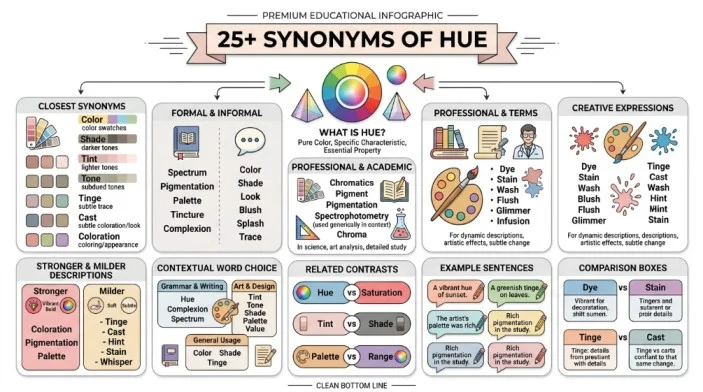
25 Best Synonyms of “Hue”
Some entries below are close contextual alternatives rather than perfect one word replacements. This distinction matters because hue is a specific color concept, while words such as tint, shade, and tinge describe particular relationships to color.
| Synonym | Simple Meaning | Best Used For | Example Sentence |
|---|---|---|---|
| Color | A visible color quality | Everyday English | The color of the wall is calming. |
| Shade | A particular variation of a color | Design and decoration | She chose a darker shade of green. |
| Tint | A lighter variation of a color | Art and design | The image has a soft pink tint. |
| Tone | A modified or subdued color quality | Interior design and art | Warm earth tones fill the room. |
| Tinge | A slight amount of color | Subtle descriptions | The clouds had a golden tinge. |
| Cast | A noticeable color influence | Photography and lighting | The photo has a blue cast. |
| Coloration | The overall coloring of something | Technical and descriptive writing | The animal’s coloration is distinctive. |
| Coloring | The way something is colored | General description | The bird has unusual coloring. |
| Colorfulness | The quality of having strong or varied color | Art and visual description | The painting’s colorfulness attracts attention. |
| Pigmentation | Coloring produced by pigment | Biology and skin or material descriptions | The pigmentation varies among individuals. |
| Complexion | The color and appearance of skin | Personal appearance | She has a warm complexion. |
| Chromatic quality | A color related characteristic | Technical writing | The image has a distinctive chromatic quality. |
| Chromatic character | The identifiable color nature of something | Art and design analysis | The painting has a cool chromatic character. |
| Color quality | A particular characteristic of a color | Design and technical writing | The color quality changes under different lighting. |
| Color character | The overall visual character created by color | Art criticism | The warm color character creates a welcoming atmosphere. |
| Color variation | A difference within a color | Design and photography | The fabric shows subtle color variation. |
| Color appearance | How a color looks visually | Lighting and displays | Screen settings can affect color appearance. |
| Color impression | The visual effect created by color | Creative and visual writing | The painting leaves a strong color impression. |
| Color aspect | A particular visual color feature | Analytical writing | The color aspect of the design deserves attention. |
| Color expression | The way color communicates visually | Art and creative work | The artist uses color expression to create emotion. |
| Color characterisation | Description of color qualities | Detailed visual analysis | The report includes color characterisation of the samples. |
| Color treatment | The deliberate use or modification of color | Photography and design | The designer applied a warm color treatment. |
| Color scheme | An organized group of related colors | Design and branding | The website uses a cool color scheme. |
| Color palette | A selected collection of colors | Art, design, and branding | The designer created a natural color palette. |
| Color cast | A color influence over an image or object | Photography | The image has a noticeable green color cast. |
Important usage note: Not all 25 alternatives are interchangeable with hue. Words such as color, shade, tint, tone, tinge, and cast are the closest practical substitutes. More specialized expressions describe particular aspects of color rather than serving as exact replacements.
Synonyms of “Hue” by Usage
Professional vs Personal Synonyms
Professional settings often benefit from precise terminology, while personal communication usually favors simpler language.
For professional design work, hue, shade, tone, coloration, and color palette can all be useful.
For everyday conversations, color is normally the best choice.
Compare:
Please select the preferred color for the logo.
with:
Please select the preferred hue for the logo.
Both are correct, but the second sounds more specialized.
Formal vs Conversational Synonyms
Use hue, coloration, or chromatic quality when technical or artistic precision is useful.
Use color in ordinary conversation.
For example:
Formal or specialized:
The artist carefully controlled the hue and saturation of each element.
Conversational:
I like the color of that painting.
Academic Synonyms
Academic writing should prioritize precision.
Useful terms include:
- Hue
- Color
- Coloration
- Shade
- Tint
- Tone
- Pigmentation
- Chromatic quality
The best term depends on the subject. In a psychology paper about color perception, hue may be more precise. In a biology paper discussing an animal’s overall appearance, coloration or pigmentation may be more appropriate.
Professional and Business Synonyms
- For resumes:
Selected color palettes for digital marketing campaigns.
- For interviews:
“I pay close attention to color relationships when developing visual designs.”
- For meetings:
“The current shade is too dark for the background.”
- For presentations:
“We should use a consistent color scheme throughout the deck.”
- For client communication:
“I’ve attached three color options for your review.”
- For business emails:
“Please confirm which shade you prefer.”
Creative and Literary Synonyms
Creative writing gives hue a particularly useful role because it can create visual atmosphere without sounding overly technical.
Examples include:
A golden hue covered the quiet street.
Blue hues reflected across the surface of the lake.
The room glowed with warm amber tones.
A faint pink tinge appeared along the horizon.
These choices help distinguish between dominant color, subtle color, and overall atmosphere.
Slang or Modern Synonyms
There is no widely accepted slang synonym for hue that should routinely replace it.
Expressions such as color, shade, and look may appear in informal speech, but they are ordinary vocabulary rather than true slang equivalents.
For example:
“I like the color.”
is natural.
“I like the hue.”
is also grammatically correct, but sounds more descriptive or specialized.
Strongest to Mildest Synonyms
Unlike words describing emotion, color terms do not have a simple strength scale. Their differences are mainly about amount, intensity, lightness, darkness, or visual prominence.
Mild
Tinge
The wall has a slight blue tinge.
This suggests only a small amount of color.
Mild to Moderate
Tint
The photograph has a pale green tint.
This suggests a lighter color variation.
Moderate
Shade
The designer selected a dark shade of red.
This identifies a particular variation of a color.
Moderate to Strong
Color
The bright color immediately attracted attention.
This can be neutral or vivid depending on the description.
Strong Visual Effect
Vibrant color
The artist used vibrant colors throughout the mural.
This explicitly emphasizes intensity and visual energy.
Emotional vs Neutral Synonyms
Emotional Synonyms and Expressions
These expressions can create stronger visual or emotional associations:
- Golden hue
- Fiery hue
- Vibrant color
- Rich color
- Warm tone
- Soft tint
- Deep shade
- Luminous color
Example:
The garden glowed beneath a warm golden hue.
The emotional effect comes from both the color term and the descriptive adjective.
Neutral Synonyms
These are better when you simply need to communicate information:
- Color
- Hue
- Shade
- Tint
- Tone
- Coloration
- Pigmentation
Example:
The sample showed a slight change in hue.
Neutral vocabulary is especially useful in reports, instructions, research, and professional communication.
Antonyms of “Hue”
There is an important vocabulary point here: hue does not have 15 direct antonyms in standard English. A hue is a color property, so English does not provide a natural set of 15 exact opposites.
To avoid inventing false antonyms, the table below uses genuine contextual contrasts related to the absence or reduction of color. These are not all dictionary opposites of hue.
| Antonym or Contrast | Meaning | Example Sentence |
|---|---|---|
| Colorlessness | Absence of noticeable color | The image has a sense of colorlessness. |
| Achromatic | Without a specific chromatic hue | The design uses an achromatic palette. |
| Colorless | Lacking visible color | The liquid appeared colorless. |
| Neutral | Not strongly associated with a particular color | The designer chose a neutral background. |
| Monochrome | Using one color or color family | The poster uses a monochrome design. |
| Black | A very dark achromatic color | The background was black. |
| White | A light achromatic color | The page has a white background. |
| Gray | An achromatic color between black and white | The walls were painted gray. |
| Grayscale | A range of grays without chromatic color | The photograph was converted to grayscale. |
| Paleness | Very weak or low-intensity appearance | The paleness of the image reduced its visual impact. |
| Fading | Loss of color intensity | The fabric showed signs of fading. |
| Dullness | Lack of vivid color | The dullness of the print was noticeable. |
| Desaturation | Reduction of color intensity | Desaturation gave the photograph a muted appearance. |
| Achromatism | Absence of chromatic color | The design uses achromatism for a minimalist effect. |
| Neutrality | Lack of strong color character | The neutrality of the palette creates a calm appearance. |
Comparison: “Hue” vs Similar Words
Hue vs Color
Main Difference
Color is the broad everyday term. Hue is more specific and often refers to a particular color family or color quality.
Which Is Stronger?
Neither is inherently stronger. Hue is more specific in technical and artistic contexts.
Which Is More Formal?
Hue usually sounds more specialized.
When to Use Each
Use color for general communication. Use hue when discussing color characteristics more precisely.
Examples
Hue:
The image has a warm orange hue.
Color:
The image uses a warm orange color.
Hue vs Shade
Main Difference
A hue identifies a color family, while a shade usually identifies a particular variation of that color.
Which Is Stronger?
Neither.
Which Is More Formal?
Both can work in design and art contexts.
When to Use Each
Use shade when comparing variations such as light and dark versions.
Examples
Hue:
Blue is the dominant hue.
Shade:
This darker shade of blue works better.
Hue vs Tint
Main Difference
A tint is generally a lighter version of a color.
Which Is Stronger?
Neither. They describe different color relationships.
Which Is More Formal?
Both are common in art and design vocabulary.
When to Use Each
Use tint when you specifically mean a lightened color.
Examples
Hue:
The painting contains several blue hues.
Tint:
A pale blue tint was added to the background.
Hue vs Tone
Main Difference
Tone has several meanings. In color terminology, it often refers to a modified or muted color.
Which Is Stronger?
Neither.
Which Is More Formal?
Both are suitable for design and artistic discussions.
When to Use Each
Use tone when describing subdued or modified colors.
Examples
Hue:
The dominant hue is green.
Tone:
The designer selected muted green tones.
Hue vs Tinge
Main Difference
A tinge means a small amount or slight trace of color.
Which Is Stronger?
Hue can describe a dominant color, while tinge suggests a very subtle amount.
Which Is More Formal?
Hue is more specialized. Tinge is common in both ordinary and descriptive English.
When to Use Each
Use tinge when the color is barely noticeable.
Examples
Hue:
The walls have a blue hue.
Tinge:
The walls have a slight blue tinge.
Hue vs Coloration
Main Difference
Hue refers to a particular color quality. Coloration can describe the overall coloring of an object.
Which Is Stronger?
Neither.
Which Is More Formal?
Coloration can sound more technical.
When to Use Each
Use coloration when discussing an object’s overall color pattern or appearance.
Examples
Hue:
The bird has a bright blue hue on its wings.
Coloration:
The bird’s unusual coloration helps identify the species.
Common Phrases and Expressions with “Hue”
Hues of Blue
Meaning: Different variations or appearances of blue.
Example:
The artist used several hues of blue to create depth.
A Golden Hue
Meaning: A warm yellow or gold-like color appearance.
Example:
The sunset gave the clouds a golden hue.
A Warm Hue
Meaning: A color with a visually warm quality, often involving reds, oranges, or yellows.
Example:
The designer selected a warm hue for the living room.
A Cool Hue
Meaning: A color with a cool visual quality, commonly associated with blues and greens.
Example:
The bedroom uses cool hues to create a calm atmosphere.
A Reddish Hue
Meaning: A color appearance that contains or resembles red.
Example:
The leaves developed a reddish hue in early autumn.
Different Hues
Meaning: Different colors or variations within a color range.
Example:
The painting combines different hues to create contrast.
Rich Hues
Meaning: Deep, vivid, or visually strong colors.
Example:
The fabric was available in several rich hues.
Soft Hues
Meaning: Gentle, pale, or subdued colors.
Example:
The nursery was decorated with soft hues.
Common Mistakes to Avoid
1. Treating “Hue” and “Shade” as Exact Synonyms
Incorrect
Choose any hue if you want a darker version of blue.
Better
Choose a darker shade of blue if you want a deeper variation.
Why: Shade is more specific when discussing a variation in darkness.
2. Using “Tinge” for a Dominant Color
Incorrect
The entire wall had a strong red tinge.
Better
The entire wall had a strong red hue.
Why: Tinge usually suggests a small or slight amount of color.
3. Using “Hue” in Every Casual Conversation
Incorrect
What hue is your new car?
Better
What color is your new car?
Why: Color is more natural in ordinary conversation.
4. Confusing “Tint” With Any Color
Incorrect
The dark red tint covered the entire wall.
Better
The dark red shade covered the entire wall.
Why: Tint generally refers to a lighter variation of a color.
5. Confusing “Hue” With “Saturation”
Incorrect
The designer changed the hue to make the color less intense.
Better
The designer reduced the saturation to make the color less intense.
Why: Hue identifies the color family, while saturation concerns color intensity or purity.
6. Using Technical Color Vocabulary Without Context
Incorrect
Please adjust the chromatic quality of the logo.
Better
Please adjust the color of the logo.
Why: Specialized vocabulary can make simple communication unnecessarily difficult.
7. Treating All Color Words as Interchangeable
Incorrect
The photograph has a slight green shade.
Better
The photograph has a slight green tinge.
Why: A tinge is appropriate when only a small trace of green is visible.
Frequently Asked Questions
1. What is the best synonym of “hue”?
The best general synonym of hue is color. Depending on context, shade, tint, tone, tinge, and coloration can be better choices when describing specific variations or qualities of color.
2. What are the best formal synonyms of “hue”?
Formal or specialized alternatives include coloration, color quality, chromatic quality, and tone, although their meanings differ slightly. In technical color discussions, hue itself is often the most precise term.
3. What are common informal synonyms of “hue”?
The most natural informal synonym is color. Depending on context, people may also say shade or tone, especially when talking about clothing, paint, makeup, photography, or interior design.
4. What is another word for “hue” in professional writing?
Color is usually the clearest professional alternative, while shade, tone, or coloration may be more precise in design, photography, branding, or technical contexts.
5. What is the difference between “hue” and “shade”?
A hue identifies a particular color family or color quality, while a shade usually describes a variation of that color, especially a darker version. They are related but are not exact synonyms.
6. What is the opposite of “hue”?
There is no single exact opposite of hue. Contextual contrasts include colorlessness, colorless, achromatic, grayscale, and desaturation, all of which relate to reduced or absent chromatic color.
Conclusion
Hue refers to a particular color or color quality, and it is especially useful in art, design, photography, creative writing, and technical discussions. The most useful alternatives depend on exactly what you want to communicate.
Use color for everyday language, shade for a particular color variation, tint for a lighter variation, tone for a modified or muted color, tinge for a slight trace of color, and coloration for overall coloring. In creative writing, hue itself can add a polished visual quality to descriptions.
The most effective vocabulary choice is not always the most sophisticated word. Consider the audience, context, tone, and exact meaning before replacing a word. A practical vocabulary habit is to learn synonyms in groups by meaning rather than memorizing them as interchangeable lists.
Understanding the difference between hue synonyms and antonyms makes your writing more accurate and helps you describe color with greater control.
Read More Related Articles:
- Synonyms for Thus | Meaning, Examples, and Better Word …
- 25+ Synonyms of Generic: Meanings, Uses, Examples, and …
- Synonyms for Empty | Meaning, Examples, and Better Word …