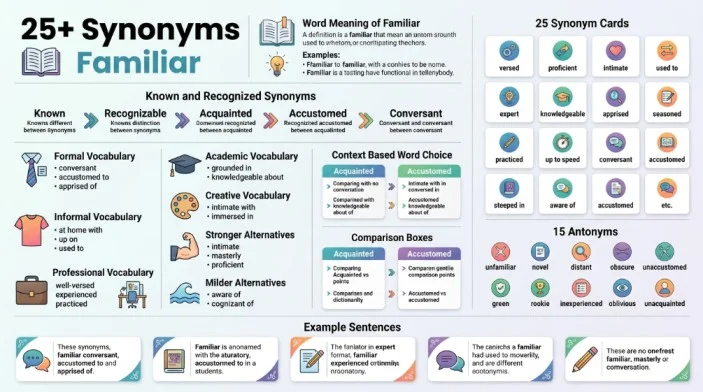
Finding the right familiar synonym can make your writing sound more natural, precise, and polished. The word familiar can describe something well-known, recognized, or understood through experience. But the best replacement depends on context. In everyday writing, words such as known, recognized, and common may work well. In professional or academic writing, alternatives like well-acquainted or knowledgeable can offer greater precision.
This guide explores useful familiar synonyms and explains when each one fits. If you need a synonym for familiar, want a familiar with synonym, or are searching for another word for familiar, you’ll find practical choices here. We also cover synonyms for familiar, familiar thesaurus options, and the subtle differences among synonyms of familiar. Whether you need a synonym of familiar or another word for familiar with something, these examples will help you choose the right word confidently.
What Is the Best Synonym of “Familiar”?
A synonym of familiar can describe something known, recognized, customary, or something a person has experience with. The best choices include known for general use, acquainted for people, accustomed for routines, conversant for knowledge, and recognizable for things that are easy to identify.
For formal writing, well-known, recognized, and conversant are useful. Casual English often favors known, usual, or common, while emotional or personal writing may benefit from comfortable, close, or well-acquainted when the context supports them.
Meaning, Tone, and Context
Simple Definition
Familiar generally means known, recognized, experienced, or easily remembered because someone has encountered something before.
The exact meaning changes slightly depending on the sentence. Someone can be familiar with a subject, a face can look familiar, a place can feel familiar, or a routine can be familiar because it happens regularly.
Part of Speech
Familiar is an adjective.
It commonly appears in the structure:
familiar with + noun
Examples:
- “She is familiar with the software.”
- “Are you familiar with this process?”
- “I’m familiar with his work.”
It can also describe something recognizable:
- “That name sounds familiar.”
- “The building looked familiar.”
Overall Tone
Familiar is usually neutral.
It does not automatically express a positive or negative feeling. The surrounding context determines the emotional effect.
For example:
- “The familiar sound of rain was relaxing.” This is positive.
- “He became familiar with the difficult procedure.” This is neutral.
- “The problem was becoming all too familiar.” This can suggest frustration.
Formality Level
Familiar is a neutral word that works comfortably in:
- Academic writing
- Professional communication
- Business emails
- Everyday conversations
- Personal writing
- Social media
- Creative writing
Some alternatives, such as conversant, accustomed, and well-acquainted, may sound more formal or specific.
Common Uses
Native English speakers commonly use familiar when talking about:
- People
- Faces
- Names
- Places
- Topics
- Subjects
- Languages
- Software
- Procedures
- Habits
- Sounds
- Ideas
- Experiences
- Routines
- Concepts
Word Forms
The main related forms are:
- Familiar, adjective
- Familiarity, noun
- Familiarly, adverb
Examples:
“Her familiarity with the industry helped the team.”
“He spoke familiarly about the subject.”
Opposite Forms
Common opposites include:
- Unfamiliar
- Unknown
- Strange
- Unrecognized
- Unaccustomed
The best antonym depends on the meaning being expressed.
When and How to Use “Familiar”
Use familiar when you want to show that someone recognizes something, knows something through experience, or has encountered something before.
The word is especially useful when you do not want to claim complete expertise.
Professional
“Are you familiar with the company’s new reporting system?”
Here, familiar means the person has some knowledge or experience with the system.
Academic
“Students should become familiar with the basic principles of research design.”
The word suggests that students should gain enough knowledge to recognize and understand the principles.
Workplace
“Our staff is already familiar with the updated safety procedures.”
This indicates previous exposure or experience.
Personal
“The neighborhood feels familiar because I grew up nearby.”
Here, familiar describes recognition and a sense of comfort.
“If you are familiar with the previous version, the new process will be easy to follow.”
The word politely assumes some prior knowledge.
Resume
“Familiar with customer relationship management platforms and digital reporting tools.”
On a resume, familiar with should be used carefully. It usually suggests basic or moderate knowledge rather than advanced expertise.
Social Media
“There’s something familiar about this little coffee shop.”
In this context, familiar creates a feeling of recognition or comfort.
Best Synonyms of “Familiar”
No single synonym works in every sentence because familiar has several related meanings. The best replacement depends on whether you mean known, recognized, experienced, customary, or closely acquainted.
Professional Writing: Known
Known is simple, direct, and widely understood.
Example:
“The researcher is known for her work in environmental science.”
Use it when the idea is general recognition rather than direct personal experience.
Academic Writing: Conversant
Conversant can describe someone who has a good working knowledge of a subject.
Example:
“Researchers must be conversant with current ethical standards.”
It is more formal than familiar with, so it should be used when the stronger sense of knowledge is intended.
Business Communication: Well-Known
Well-known works when something or someone is recognized by many people.
Example:
“The company is well-known for its customer service.”
It is especially useful for brands, organizations, public figures, and established ideas.
Casual Conversation: Known
Known is usually the easiest alternative in everyday speech.
Example:
“That restaurant is known around here for its breakfast.”
It sounds natural without adding unnecessary formality.
Emotional Writing: Comforting
When familiar describes something that creates a feeling of comfort, comforting can sometimes communicate the emotional meaning more directly.
Example:
“The familiar music was comforting after a difficult day.”
If the emphasis is emotional rather than recognition, comforting can be stronger.
Creative Writing: Recognizable
Recognizable works when a character, sound, object, or place can be identified because it has been encountered before.
Example:
“Her voice was instantly recognizable.”
This creates a more specific visual or sensory effect than the broad word familiar.
Resume Writing: Acquainted With
Acquainted with can work for basic knowledge, although resumes often benefit from naming the actual skill instead.
Example:
“Acquainted with standard inventory management procedures.”
However, if you have strong expertise, use a more precise phrase such as “proficient in” rather than understating your ability.
Workplace Communication: Accustomed
Use accustomed when familiarity comes from repeated experience or habit.
Example:
“Employees are accustomed to working with flexible schedules.”
This means the situation has become normal through experience.
Stronger Meaning: Conversant
Conversant with suggests a stronger level of knowledge than basic familiarity.
Example:
“She is fully conversant with federal compliance requirements.”
Softer Meaning: Aware Of
Aware of can be appropriate when someone knows that something exists but does not necessarily have detailed knowledge of it.
Example:
“I am aware of the new policy, but I have not reviewed the details.”
This is weaker than familiar with.
When Not to Use “Familiar”
Although familiar is versatile, there are situations where another word communicates your intended meaning more precisely.
When You Mean Expert Knowledge
Familiar can sound too weak when you actually mean advanced knowledge.
Less precise:
“She is familiar with advanced accounting practices.”
Better:
“She is proficient in advanced accounting practices.”
The second sentence communicates stronger ability.
When You Mean Something Is Widely Known
If you mean that many people recognize something, well-known is more precise.
Less precise:
“The author is familiar throughout the country.”
Better:
“The author is well-known throughout the country.”
When You Mean Someone Is Used to Something
Use accustomed when familiarity comes from repeated experience.
Less precise:
“She is familiar with working remotely.”
Better:
“She is accustomed to working remotely.”
When You Mean Recognition
Use recognizable when something can easily be identified.
Less precise:
“His face was familiar.”
Better:
“His face was recognizable from the television interviews.”
When You Mean Strong Subject Knowledge
Use conversant with when someone has substantial working knowledge.
Less precise:
“The manager is familiar with industry regulations.”
Stronger:
“The manager is conversant with industry regulations.”
When You Mean Personal Knowledge of Someone
Use acquainted with when you mean that you know a person, usually without suggesting a close relationship.
Less precise:
“I am familiar with Dr. Harris.”
Better:
“I am acquainted with Dr. Harris.”
When You Mean Something Is Common or Ordinary
If familiar means something happens regularly or seems ordinary, usual, customary, or commonplace may work better.
Less precise:
“The same familiar routine continued.”
Alternative:
“The same usual routine continued.”
Words Commonly Confused With “Familiar”
Known
Difference: Known means recognized, understood, or generally recognized as true or established. It does not always imply personal experience.
When to Use It: Use known when something is recognized by a person or group.
Example:
“The author is known for her historical novels.”
Acquainted
Difference: Acquainted usually means having some knowledge of a person or subject. It often suggests less closeness than knowing someone well.
When to Use It: Use it for relationships or basic knowledge.
Example:
“I am acquainted with several members of the committee.”
Accustomed
Difference: Accustomed means used to something because of repeated exposure or experience.
When to Use It: Use it for habits, conditions, routines, or situations.
Example:
“After several months, she became accustomed to the new schedule.”
Recognizable
Difference: Recognizable means easy to identify or recognize.
When to Use It: Use it for faces, voices, objects, places, signs, sounds, and visual features.
Example:
“His distinctive voice is instantly recognizable.”
Conversant
Difference: Conversant means having good knowledge of a particular subject.
When to Use It: Use it primarily in formal or professional contexts.
Example:
“All managers should be conversant with the updated regulations.”
Usual
Difference: Usual means something normally happens or is expected. It does not necessarily mean personally known.
When to Use It: Use it for routines, habits, common behavior, and regular situations.
Example:
“She arrived at her usual time.”
Best Synonyms of “Familiar” by Context
| Context | Best Synonym | Why It Works | Example |
|---|---|---|---|
| Formal writing | Well-known | Clearly expresses broad recognition. | The theory is well-known among researchers. |
| Academic writing | Conversant | Indicates working knowledge of a subject. | Students should be conversant with research methods. |
| Professional communication | Acquainted | Useful for basic knowledge of people or subjects. | The team is acquainted with the procedure. |
| Business emails | Aware of | Polite when referring to knowledge of an issue. | I am aware of the updated requirements. |
| Resume writing | Proficient in | Better when actual ability is being claimed. | Proficient in CRM software and data analysis. |
| Workplace communication | Accustomed to | Shows experience with a routine or condition. | Staff are accustomed to flexible schedules. |
| Casual conversation | Known | Simple and natural. | He’s known around town. |
| Everyday speaking | Usual | Fits regular or repeated situations. | We took our usual route home. |
| Creative writing | Recognizable | Creates a clear sense of identification. | A recognizable voice called from the hallway. |
| Storytelling | Well-known | Useful for people, places, and ideas recognized by many. | They entered a well-known village. |
| Emotional writing | Comforting | Emphasizes emotional familiarity. | The familiar song was comforting. |
| Strong emphasis | Conversant | Suggests substantial knowledge. | She is conversant with international law. |
| Mild tone | Aware of | Indicates limited knowledge. | He was aware of the issue. |
| Social media captions | Recognizable | Works well for places, images, and trends. | A recognizable view from my hometown. |
| American English | Familiar | Natural and widely used across contexts. | Are you familiar with this app? |
| British English | Familiar | The same standard form is commonly used. | Are you familiar with this process? |
How to Choose the Best Synonym of “Familiar”
The easiest way to select the right alternative is to identify what familiar means in your specific sentence.
If You Mean “Known”
Choose known or well-known.
Example:
“She is a familiar name in the industry.”
Better:
“She is a well-known name in the industry.”
If You Mean “Used To”
Choose accustomed.
Example:
“He is familiar with the long commute.”
Better:
“He is accustomed to the long commute.”
If You Mean “Recognizable”
Choose recognizable.
Example:
“The building looked familiar.”
Possible alternative:
“The building looked recognizable from the old photographs.”
If You Mean “Having Knowledge”
Choose conversant with, acquainted with, or aware of, depending on the level of knowledge.
If You Mean “Normal or Regular”
Choose usual, customary, or routine.
If You Mean “Comfortably Known”
Keep familiar, or consider comforting if emotional comfort is the main idea.
Consider Your Audience
For students, known, recognized, and familiar are easy choices.
For professionals, conversant, acquainted, accustomed, and more precise skill terms may be appropriate.
Consider Your Tone
Formal writing may favor conversant, recognized, or well-known.
Casual writing generally sounds better with known, usual, or simply familiar.
Consider Your Level of Knowledge
Do not use familiar when you mean expert-level knowledge.
For example:
- “I am familiar with Python” suggests some knowledge.
- “I am proficient in Python” suggests practical ability.
- “I am highly experienced in Python development” communicates even stronger professional experience.
Real Life Examples of “Familiar”
School
Original:
“Students should be familiar with the basic rules.”
More precise:
“Students should be acquainted with the basic rules before starting the activity.”
College
Original:
“College students should be familiar with academic citation.”
Improved:
“College students should be familiar with standard academic citation practices before submitting research papers.”
Workplace
Original:
“New employees should become familiar with the system.”
Improved:
“New employees should become accustomed to the system during their first few weeks.”
Business
Original:
“Customers are familiar with the brand.”
Improved:
“The brand is well-known among customers in the region.”
Original:
“If you are familiar with the old system, the update should be easy.”
Alternative:
“If you are acquainted with the old system, the update should be easy to understand.”
Resume
Original:
“Familiar with Microsoft Excel.”
Better when basic knowledge is intended:
“Familiar with Microsoft Excel, including spreadsheets and basic formulas.”
Better when stronger ability exists:
“Proficient in Microsoft Excel, including formulas, data analysis, and reporting.”
Conversation
Original:
“That name sounds familiar.”
This is already the most natural choice in everyday speech.
Storytelling
Original:
“The sound was familiar.”
More descriptive:
“The sound was recognizable, although she could not remember where she had heard it.”
Blogging
Original:
“Most readers are familiar with this concept.”
Alternative:
“Most readers are already acquainted with this concept.”
Social Media
Original:
“This place feels familiar.”
More emotional:
“This place feels strangely comforting, even though I’ve never been here before.”
25 Best Synonyms of “Familiar”
| Synonym | Simple Meaning | Best Used For | Example Sentence |
|---|---|---|---|
| Known | Recognized or understood | General writing | The author is known for her research. |
| Recognizable | Easy to identify | Faces, sounds, objects | His voice was instantly recognizable. |
| Acquainted | Having some knowledge of someone or something | People and subjects | She is acquainted with the local business community. |
| Conversant | Having good knowledge of a subject | Formal and professional writing | The lawyer is conversant with tax regulations. |
| Accustomed | Used to something through experience | Routines and conditions | He became accustomed to working nights. |
| Well-known | Recognized by many people | People, brands, ideas | The restaurant is well-known for its seafood. |
| Usual | Normal or regularly occurring | Routines | She took her usual seat. |
| Common | Frequently encountered | General situations | This is a common problem among beginners. |
| Commonplace | Very ordinary or frequently seen | Formal and descriptive writing | Smartphones are now commonplace in daily life. |
| Customary | Traditionally or normally done | Formal writing | It is customary to greet guests before dinner. |
| Routine | Regular and repeated | Work and daily activities | The inspection became a routine procedure. |
| Ordinary | Normal rather than unusual | General description | It looked like an ordinary neighborhood. |
| Typical | Characteristic of a particular person or situation | General and academic writing | That reaction is typical of new users. |
| Established | Accepted or well known over time | Professional and academic writing | The company follows an established process. |
| Recognized | Accepted or identified as known | Academic and professional writing | She is a recognized expert in the field. |
| Aware | Knowing about something | General and professional communication | I am aware of the current policy. |
| Experienced | Having gained knowledge through practice | Work and skills | The team is experienced in project management. |
| Proficient | Skilled through knowledge and practice | Resumes and professional writing | She is proficient in data analysis. |
| Well-acquainted | Having considerable knowledge of something | Formal writing | He is well-acquainted with the local regulations. |
| Intimate | Very closely familiar with something | Specialized or literary contexts | The author had an intimate knowledge of rural life. |
| Close | Personally familiar or strongly connected | Relationships and personal writing | She has a close relationship with her mentor. |
| Comfortable | At ease because something is known | Personal and workplace contexts | She is comfortable with the new software. |
| At home with | Very comfortable or skilled with something | Conversational English | He is at home with complex technical problems. |
| Seasoned | Experienced through repeated involvement | Professional contexts | The seasoned manager knew how to handle the crisis. |
| Habitual | Done regularly as a habit | Formal and descriptive writing | His habitual route took him through the park. |
Synonyms of “Familiar” by Usage
Professional vs Personal Synonyms
Professional writing often needs precision. Personal writing can allow more emotional or conversational vocabulary.
- For professional communication, consider:
- Conversant
- Acquainted
- Experienced
- Proficient
- Accustomed
- Recognized
- Established
- For personal communication, consider:
- Known
- Comfortable
- Close
- Familiar
- Recognizable
- Usual
- Meaningful, when emotional context is intended
- For example:
Professional:
“She is proficient in the software.”
Personal:
“She feels comfortable with the new software.”
These sentences are not identical because the first describes skill, while the second describes ease.
Formal vs Conversational Synonyms
Reports
Use recognized, established, significant, or conversant, depending on the intended meaning.
Essays
Use known, recognized, established, or conversant with where appropriate.
Business Writing
Choose well-known, established, experienced, or accustomed, depending on context.
Presentations
Recognized, known, and established are useful when discussing people, organizations, methods, or ideas.
Emails
Simple vocabulary is usually better. Familiar, aware of, and acquainted with can all work depending on the meaning.
Casual Conversations
Use familiar, known, usual, common, or comfortable.
Texting
Keep the wording natural:
“That place looks familiar.”
“His name sounds familiar.”
“She’s a familiar face around here.”
Academic Synonyms
Academic writing requires careful distinctions because familiar can describe different levels of knowledge.
Recognized
Use recognized when something has received acceptance or acknowledgment.
“She is a recognized authority in the field.”
Established
Use established for accepted methods, principles, practices, or facts.
“The researchers followed an established procedure.”
Conversant
Use conversant with when discussing substantial knowledge.
“Students should be conversant with basic statistical concepts.”
Acquainted
Use acquainted with for introductory or moderate knowledge.
“Participants were first acquainted with the experimental procedure.”
Commonplace
Use commonplace when something is widespread or ordinary.
“Digital communication has become commonplace in higher education.”
Professional and Business Synonyms
Resumes
On a resume, avoid using familiar with for a skill when you can describe the actual level of ability.
Weak:
“Familiar with Excel.”
Stronger:
“Proficient in Excel, including data analysis and reporting.”
Use familiar with when you genuinely mean introductory knowledge.
Interviews
During an interview, familiar with is useful when describing exposure to a system or process.
“I am familiar with your company’s project management platform.”
If you have extensive experience, be more specific:
“I have several years of experience using project management platforms.”
Meetings
Acquainted with, aware of, and familiar with can work naturally.
Example:
“Everyone here should be familiar with the agenda.”
Presentations
Use well-known, recognized, or established when describing people, concepts, or methods.
Example:
“This is an established approach to customer retention.”
Performance Reviews
Experienced, proficient, and accustomed are often more informative than familiar.
Example:
“She is highly experienced in managing cross-functional teams.”
Client Communication
Use simple, respectful wording.
Example:
“I believe you are already familiar with the process, but I have included a brief overview below.”
Business Emails
Avoid unnecessarily formal alternatives.
Natural:
“Please let me know if you are familiar with the updated system.”
More formal:
“Please let me know whether you are conversant with the updated system.”
The first sentence is generally more natural for ordinary business communication.
Creative and Literary Synonyms
Creative writing often benefits from selecting the synonym that creates the exact emotional or sensory effect.
Recognizable
Useful for voices, faces, objects, and sounds.
“Through the fog came a recognizable whistle.”
Comforting
Useful when familiarity creates emotional security.
“The old song was strangely comforting.”
Usual
Useful for repeated routines.
“He walked down his usual street.”
Intimate
Useful when describing deep knowledge or close familiarity.
“She had an intimate understanding of the village.”
Close
Useful for relationships.
“He remained close to his childhood friend.”
The key is not to replace familiar mechanically. Choose the word that creates the specific image or emotion you want.
Slang or Modern Synonyms
There is no single slang word that consistently replaces familiar in standard American English.
However, conversational expressions can communicate similar ideas.
“Know”
“Yeah, I know that place.”
This is extremely natural in casual speech but does not work as a direct grammatical replacement in every sentence.
“Used to”
“I’m used to this routine.”
This is a conversational alternative when familiar means accustomed through experience.
“Know the ropes”
This expression means having enough experience to understand how something works.
Example:
“After a few months, she knew the ropes.”
It is informal and should generally be avoided in academic papers and formal business documents.
Strongest to Mildest Synonyms
The synonyms of familiar do not form one perfect intensity scale because the word has several meanings. A useful scale depends on whether you mean knowledge, experience, or recognition.
Mild
- Aware
- Acquainted
- Known
These can indicate limited or general knowledge.
Moderate
- Familiar
- Recognizable
- Experienced
- Accustomed
These suggest meaningful exposure or experience.
Strong
- Well-acquainted
- Conversant
- Proficient
- Seasoned
These can suggest deeper knowledge or experience, although their exact meanings differ.
Very Strong
- Intimate
- Highly experienced
- Expert, when expertise is actually intended
Do not treat expert as a direct synonym of familiar. It expresses a much stronger level of knowledge.
Emotional vs Neutral Synonyms
Emotional Synonyms
Some alternatives add feelings of comfort, closeness, or personal connection.
- Comfortable
- Close
- Intimate
- Comforting
- Recognizable
Example:
“The familiar smell of fresh bread was comforting.”
The emotional meaning comes from the combination of familiarity and comfort.
Neutral Synonyms
These communicate knowledge or recognition without strong emotion.
- Known
- Recognized
- Acquainted
- Aware
- Conversant
- Accustomed
- Established
- Usual
Neutral vocabulary is generally safer for academic, professional, and informational writing.
Antonyms of “Familiar”
Because familiar has several meanings, its opposites vary by context. The following are accurate alternatives when the intended sense is lack of knowledge, recognition, experience, or customary use.
| Antonym | Meaning | Example Sentence |
|---|---|---|
| Unfamiliar | Not previously known or experienced | The software was unfamiliar to the new employees. |
| Unknown | Not known or recognized | The source of the noise remains unknown. |
| Strange | Unusual or not known | The city felt strange at first. |
| Unrecognized | Not identified or known | Her face went unrecognized in the crowd. |
| Unaccustomed | Not used to something | He was unaccustomed to such long working hours. |
| Novel | New or different from what is known | The researchers tested a novel approach. |
| New | Not previously encountered | The process was completely new to me. |
| Foreign | Unfamiliar or belonging to another place | The customs were foreign to the visitors. |
| Unusual | Not common or ordinary | The weather was unusual for that month. |
| Rare | Not frequently encountered | Such an opportunity is rare. |
| Uncommon | Not often seen or experienced | The bird is uncommon in this region. |
| Different | Not the same as what is known | The new system is very different from the old one. |
| Remote | Distant and not personally known | The village was remote and unfamiliar to travelers. |
| Inexperienced | Lacking previous experience | The inexperienced employee needed additional training. |
| Unusual | Outside normal experience | The team faced an unusual challenge. |
Comparison: “Familiar” vs Similar Words
Familiar vs Known
Main Difference
Familiar often suggests previous exposure or experience. Known is broader and can simply mean recognized or understood.
Which Is Stronger?
Neither is always stronger. Familiar often suggests more personal exposure, while known can describe general recognition.
Which Is More Formal?
Both are neutral.
When to Use Each
Use familiar for personal experience and known for general recognition.
Examples
Familiar:
“I am familiar with the software.”
Known:
“The software is known for its reliability.”
Familiar vs Acquainted
Main Difference
Acquainted often describes having some knowledge of a person or subject. Familiar is broader and can describe people, things, places, ideas, and experiences.
Which Is Stronger?
Neither is automatically stronger.
Which Is More Formal?
Acquainted can sound slightly more formal.
When to Use Each
Use acquainted with when emphasizing basic knowledge or a relationship.
Examples
Familiar:
“I am familiar with the neighborhood.”
Acquainted:
“I am acquainted with several residents.”
Familiar vs Accustomed
Main Difference
Familiar means known through exposure. Accustomed means used to something because of repeated experience.
Which Is Stronger?
Accustomed is more specific about repeated experience.
Which Is More Formal?
Both are suitable for formal writing.
When to Use Each
Use accustomed for routines, conditions, habits, and repeated situations.
Examples
Familiar:
“She is familiar with the process.”
Accustomed:
“She is accustomed to the process.”
Familiar vs Recognizable
Main Difference
Familiar means known or experienced before. Recognizable means capable of being identified.
Which Is Stronger?
Neither is stronger. They describe different ideas.
Which Is More Formal?
Both are neutral.
When to Use Each
Use recognizable for visual or sensory identification.
Examples
Familiar:
“His face looked familiar.”
Recognizable:
“His face was immediately recognizable.”
Familiar vs Conversant
Main Difference
Conversant with suggests good knowledge of a subject. Familiar with can indicate basic or moderate knowledge.
Which Is Stronger?
Conversant generally suggests deeper knowledge.
Which Is More Formal?
Conversant is more formal.
When to Use Each
Use conversant in professional or academic contexts when a solid working knowledge is intended.
Examples
Familiar:
“She is familiar with the regulations.”
Conversant:
“She is conversant with the regulations.”
Familiar vs Usual
Main Difference
Familiar means known through previous exposure. Usual means normal or regularly occurring.
Which Is Stronger?
Neither is stronger.
Which Is More Formal?
Both are neutral.
When to Use Each
Use usual for routines and repeated events.
Examples
Familiar:
“The street looked familiar.”
Usual:
“She took her usual route.”
Common Phrases and Expressions with “Familiar”
Familiar With
Meaning: Having knowledge or experience of something.
Example Sentence:
Are you familiar with the company’s privacy policy?”
Familiar Face
Meaning: A person who is recognized because you have seen them before.
Example Sentence:
“She was a familiar face at the local bookstore.”
Familiar Name
Meaning: A name that is recognized because it has been encountered before.
Example Sentence:
“The author is a familiar name to anyone who follows modern fiction.”
Familiar Sound
Meaning: A sound that has been heard before and can be recognized.
Example Sentence:
“The familiar sound of the train woke me before sunrise.”
Familiar Place
Meaning: A location that someone knows through previous experience.
Example Sentence:
“The park felt like a familiar place after years of visiting it.”
Familiar Pattern
Meaning: A pattern that has been seen or experienced before.
Example Sentence:
“The researchers noticed a familiar pattern in the data.”
All Too Familiar
Meaning: Something that has happened so often that it is easily recognized, often with a negative feeling.
Example Sentence:
“The team faced the all too familiar problem of missed deadlines.”
Familiar Territory
Meaning: A subject, situation, or place that someone knows well.
Example Sentence:
“Marketing is familiar territory for the experienced consultant.”
Common Mistakes to Avoid
Mistake 1: Treating Every Synonym as Identical
Incorrect
“She is accustomed with the software.”
Better
“She is familiar with the software.”
Why
Accustomed is normally followed by to, not with. It describes being used to something through repeated experience.
Mistake 2: Using “Familiar” When You Mean Expert
Incorrect
“He is familiar with advanced cybersecurity.”
Better
“He is proficient in advanced cybersecurity.”
Why
Familiar can suggest only basic or moderate knowledge. Proficient communicates practical skill.
Mistake 3: Using “Familiar” When You Mean Famous
Incorrect
“She is familiar throughout the country.”
Better
“She is well-known throughout the country.”
Why
Well-known clearly expresses broad public recognition.
Mistake 4: Confusing “Familiar” With “Accustomed”
Incorrect
“She is familiar to working late.”
Better
“She is accustomed to working late.”
Why
The standard structure is accustomed to, followed by a noun or gerund.
Mistake 5: Using Informal Language in Academic Writing
Incorrect
“The topic is something everyone knows really well.”
Better
“The topic is well-established in the academic literature.”
Why
The second version is more precise and appropriate for formal academic communication.
Mistake 6: Choosing an Overly Formal Synonym
Incorrect
“Are you conversant with the meeting agenda?”
Better
“Are you familiar with the meeting agenda?”
Why
Conversant can sound unnecessarily formal for a simple workplace question.
Mistake 7: Using “Familiar” When “Recognizable” Is More Precise
Incorrect
“The logo was familiar because it was easy to identify.”
Better
“The logo was recognizable because of its distinctive design.”
Why
Recognizable directly communicates ease of identification.
Frequently Asked Questions
What is a synonym for familiar?
Common synonyms for familiar include well-known, recognized, acquainted, known, and common. The best choice depends on the context.
What are the most common familiar synonyms?
Popular familiar synonyms include known, recognizable, accustomed, commonplace, and conversant.
What is another word for familiar?
Another word for familiar is known, recognizable, ordinary, or acquainted, depending on the intended meaning.
What is a synonym for familiar with?
Synonyms for familiar with include knowledgeable about, acquainted with, experienced in, and well-versed in.
What are some synonyms for familiar in different contexts?
Use recognizable for something you can identify, accustomed for something you are used to, and well-versed for a subject you understand well.
What is the best familiar thesaurus alternative?
Useful thesaurus alternatives for familiar include known, common, recognizable, acquainted, and conversant. Choose one that fits your sentence.
What is the synonym of familiar in English?
The synonym of familiar depends on the meaning. Known means recognized, while acquainted describes knowing a person or subject.
What is the Hindi synonym of familiar (परिचित का पर्यायवाची)?
परिचित के पर्यायवाची शब्द हैं ज्ञात, जाना-पहचाना, वाकिफ़ और परिचय वाला। सही शब्द वाक्य के संदर्भ पर निर्भर करता है।
What are the synonyms of familiar for formal writing?
For formal writing, use knowledgeable, acquainted, well-versed, or conversant, especially when describing someone’s understanding of a topic.
What are the best synonyms of “familiar”?
The best alternatives depend on context. Known, recognizable, acquainted, accustomed, well-known, and conversant are useful choices, but each expresses a slightly different type or level of familiarity.
What are the best formal synonyms of “familiar”?
Formal alternatives include conversant, well-acquainted, recognized, established, and accustomed, depending on the intended meaning. Conversant with is especially useful when describing strong knowledge of a subject.
What are common informal synonyms of “familiar”?
In casual English, known, used to, usual, common, and comfortable with can replace familiar in certain contexts. The best choice depends on whether you mean recognition, habit, or ease.
What is another word for “familiar” in professional writing?
Professional alternatives include conversant, acquainted, experienced, proficient, accustomed, and recognized. Choose based on whether you mean knowledge, practical ability, repeated experience, or public recognition.
What is the difference between “familiar” and “known”?
Familiar usually suggests previous exposure or personal experience, while known has a broader meaning and can refer to something generally recognized or understood. For example, you can be familiar with software, while a brand can be well-known.
What is the opposite of “familiar”?
The most direct opposite is unfamiliar. Other alternatives include unknown, strange, unrecognized, unaccustomed, new, and unusual, depending on whether the original meaning involves knowledge, recognition, experience, or normality.
Conclusion
Familiar is a flexible adjective used to describe something known, recognized, experienced, or customary. Because it covers several related meanings, the best alternative depends on exactly what you want to communicate.
For general recognition, choose known or well-known. For personal knowledge, acquainted works well. Repeated experience, use accustomed. Subject knowledge, conversant is more precise, while recognizable is a better choice when something can easily be identified.
The most useful synonym of familiar is therefore not always the most sophisticated word. Before replacing familiar, identify the meaning you want, then match your choice to the audience, tone, and purpose. A simple vocabulary habit is to ask, “Do I mean known, recognized, experienced, or accustomed?” That one distinction can make your writing much more precise.
Read More Related Articles:
- Synonyms for Thus | Meaning, Examples, and Better Word …
- 25+ Synonyms of Generic: Meanings, Uses, Examples, and …
- Synonyms for Empty | Meaning, Examples, and Better Word …











3 thoughts on “Synonym of Familiar |25+ Meaning, Smart Alternatives & Words That Sound More Natural in 2026”