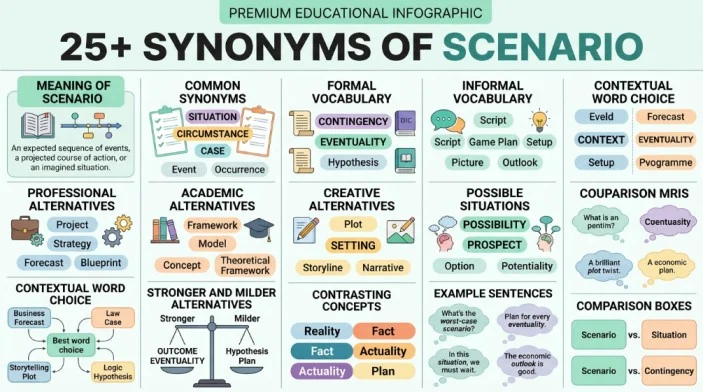
Choosing the right word can make an ordinary sentence sound clearer, more natural, and more precise. Synonyms of Scenario are useful when you want to describe a situation, possible outcome, setting, or set of circumstances without repeating the same word. However, not every synonym fits every context. Words such as situation, circumstance, possibility, setting, case, and outlook can carry different meanings, tones, and levels of formality. Understanding these differences helps you communicate your exact idea instead of simply replacing one word with another.
A strong vocabulary is not about using the most complicated word. It is about choosing the word that matches your purpose, audience, and context. This guide explores practical alternatives to scenario, explains where each word works best, and provides clear examples for academic writing, business communication, everyday conversation, storytelling, and professional content. By understanding the subtle differences, you can make your writing more accurate, polished, and engaging.
What Is the Best Synonym of “Scenario”?
A scenario is a description of a possible situation, set of circumstances, or sequence of events. The best synonym depends on context: situation for everyday use, circumstance for formal writing, possibility for potential outcomes, setting for stories, and case for professional or analytical writing.
Meaning, Tone, and Context
Simple Definition
Scenario generally refers to a possible situation or a description of how events might develop. It can describe something that is happening now, something that could happen in the future, or an imagined sequence of events.
For example:
“We prepared for several possible scenarios before launching the product.”
Here, scenarios means different situations that could occur.
The word can also describe the setting and sequence of events in a story, movie, or imagined situation.
Part of Speech
Scenario is a noun.
Its plural form is scenarios.
Examples:
“The team discussed several possible scenarios.”
“The movie presents a fascinating scenario.”
Overall Tone
The word scenario is generally neutral.
It does not automatically express positive or negative emotion. The tone comes from the situation being described.
For example:
“The best case scenario would allow us to finish early.”
“The worst case scenario could delay the project.”
The same word works in both positive and negative contexts.
Formality Level
Scenario is a neutral to semi formal word.
It is common in:
- Business communication
- Academic writing
- Technical discussions
- Risk analysis
- Planning
- News writing
- Everyday conversations
- Storytelling
- Creative writing
It is not unusually formal, but alternatives such as circumstance, eventuality, or contingency may sound more specialized.
Common Uses
Native English speakers commonly use scenario when discussing:
- Possible future events
- Business planning
- Risk management
- Emergency preparation
- Hypothetical situations
- Story settings
- Movie or television plots
- Economic forecasts
- Political developments
- Workplace problems
- Decision making
- What could happen next
Common Word Combinations
Some natural expressions include:
- Possible scenario
- Likely scenario
- Worst case scenario
- Best case scenario
- Realistic scenario
- Hypothetical scenario
- Future scenario
- Alternative scenario
- Potential scenario
- Different scenarios
- Most likely scenario
- Unlikely scenario
Word Forms
Noun: scenario
Plural noun: scenarios
There is no commonly used everyday verb or adjective directly formed from scenario. When you need related descriptions, words such as hypothetical, possible, situational, or contextual may be appropriate depending on the sentence.
When and How to Use “Scenario”
Use scenario when you want to describe a possible situation, imagined set of events, or version of how something might unfold. It is especially useful when discussing possibilities rather than a single confirmed fact.
Professional Context
“The management team reviewed several scenarios before approving the expansion.”
Here, scenarios refers to different possible business situations.
Academic Context
“The researchers examined how the model would perform under several scenarios.”
The word works well because the researchers are considering different possible conditions.
Workplace Context
“We should have a backup plan for this scenario.”
This sentence refers to a particular situation that may require preparation.
Personal Context
“I never expected to find myself in that scenario.”
Here, scenario describes an unexpected situation.
Email Context
“In this scenario, we recommend postponing the meeting.”
The word sounds clear and professional in workplace correspondence.
Resume Context
“Developed response plans for multiple emergency scenarios.”
Here, scenarios efficiently communicates preparation for different possible situations.
Social Media Context
“The worst case scenario would be missing the entire event.”
This casual use sounds natural, especially when discussing possibilities.
Best Synonyms of “Scenario”
No single alternative works in every sentence because scenario has several related meanings. Sometimes it means a real situation, sometimes a possible outcome, and sometimes an imagined sequence of events.
Professional Writing: Situation
Situation is one of the safest alternatives when scenario means the circumstances surrounding an event.
“The company is evaluating the current situation before making a decision.”
It sounds natural and professional without being overly technical.
Academic Writing: Case
Case works well when discussing a particular example, condition, or instance for analysis.
“In this case, the results differed from the original prediction.”
It is especially useful in research, analysis, and academic discussions.
Business Communication: Circumstance
Circumstance emphasizes the conditions surrounding an event.
“Under these circumstances, delaying the launch may be necessary.”
It is more formal than situation and useful when the surrounding conditions matter.
Casual Conversation: Situation
For everyday speech, situation is usually more natural than scenario.
“That’s a difficult situation.”
Saying “That’s a difficult scenario” is possible, but situation is more conversational.
Emotional Writing: Situation
When describing a person’s lived experience, situation usually sounds warmer and more natural.
“She handled a difficult situation with remarkable patience.”
Creative Writing: Setting
Setting is appropriate when scenario refers to the environment, location, time, or circumstances in which a story takes place.
“The coastal village provides a dramatic setting for the novel.”
Resume Writing: Situation or Case
For resumes, situation or case may work depending on the meaning.
“Resolved complex customer situations while maintaining high service standards.”
For a specific example of problem solving, case may be more appropriate.
Workplace Communication: Situation
“Let’s review the situation before deciding what to do.”
This sounds direct and natural in workplace conversations.
Stronger Meaning: Circumstance or Contingency
When you need to emphasize the conditions surrounding an event, circumstance works well. When you mean a possible future event that requires preparation, contingency may be more precise.
Softer Meaning: Possibility
When you simply want to mention something that might happen, possibility can be less technical than scenario.
“We should consider the possibility of delays.”
When Not to Use “Scenario”
Although scenario is versatile, it is not always the most natural choice.
When You Mean an Everyday Situation
Less Natural:
“I had a strange scenario at the grocery store.”
Better:
“I had a strange situation at the grocery store.”
Why:
Situation is more natural for ordinary events that actually happened.
When You Mean Surrounding Conditions
Less Precise:
“Under this scenario, the policy may fail.”
Better:
“Under these circumstances, the policy may fail.”
Why:
Circumstances focuses on the conditions affecting an event.
When You Mean a Simple Possibility
Less Natural:
“There is a scenario that the flight could be delayed.”
Better:
“There is a possibility that the flight could be delayed.”
Why:
Possibility directly communicates uncertainty.
When You Mean a Story Location
Less Precise:
“The scenario of the novel is a small coastal town.”
Better:
“The setting of the novel is a small coastal town.”
Why:
Setting specifically describes where and when a story occurs.
When You Mean a Particular Example
Less Precise:
“This scenario shows why the rule matters.”
Better:
“This case shows why the rule matters.”
Why:
Case works well when referring to a particular example being analyzed.
When You Need a Specialized Planning Term
Less Precise:
“We need a plan for a possible scenario.”
Better:
“We need a contingency plan.”
Why:
A contingency refers to a possible future event or condition that requires preparation.
Words Commonly Confused With “Scenario”
Situation
Difference: A situation is the circumstances or state of affairs existing at a particular time.
When to Use It: Use it for real life events and everyday conditions.
Example:
“The team is trying to understand the situation.”
Circumstance
Difference: A circumstance is a condition or fact surrounding an event.
When to Use It: Use it when the surrounding conditions are especially relevant.
Example:
“Under the circumstances, postponing the event was sensible.”
Possibility
Difference: A possibility is something that may happen or be true.
When to Use It: Use it when your main idea is uncertainty or potential.
Example:
“There is a possibility that prices will increase.”
Setting
Difference: A setting describes the time, place, and environment of an event or story.
When to Use It: Use it for fiction, films, plays, and descriptions of environments.
Example:
“The desert provides an unusual setting for the story.”
Case
Difference: A case can refer to a particular example, instance, or situation considered for analysis.
When to Use It: Use it in research, law, business, education, and analytical writing.
Example:
“This case demonstrates the importance of careful planning.”
Contingency
Difference: A contingency is a possible future event or condition that may require preparation.
When to Use It: Use it in planning, risk management, business, and emergency preparation.
Example:
“The company developed a contingency plan for supply disruptions.”
Best Synonyms of “Scenario” by Context
| Context | Best Synonym | Why It Works | Example |
|---|---|---|---|
| Formal writing | Circumstance | Highlights surrounding conditions | “Under these circumstances, further review is necessary.” |
| Academic writing | Case | Works well for analysis and examples | “This case provides useful evidence.” |
| Professional communication | Situation | Clear and broadly understood | “We need to address the situation quickly.” |
| Business emails | Situation | Sounds direct and natural | “We will update you as the situation develops.” |
| Resume writing | Case | Useful for describing specific examples | “Handled complex customer cases efficiently.” |
| Workplace communication | Situation | Natural in spoken and written English | “Let’s discuss the situation first.” |
| Casual conversation | Situation | More conversational than scenario | “That’s a strange situation.” |
| Everyday speaking | Situation | Simple and familiar | “I don’t know how to handle this situation.” |
| Creative writing | Setting | Describes story environment | “The setting creates a mysterious atmosphere.” |
| Storytelling | Situation | Describes circumstances characters face | “The character finds herself in a difficult situation.” |
| Emotional writing | Circumstance | Can emphasize difficult conditions | “Despite her circumstances, she remained hopeful.” |
| Strong emphasis | Contingency | Suggests preparation for a possible event | “We need a contingency for unexpected delays.” |
| Mild tone | Possibility | Focuses on what might happen | “We should consider the possibility of rain.” |
| Social media captions | Situation | Sounds casual and accessible | “A situation I definitely did not expect.” |
| American English | Situation | Highly natural in everyday use | “This situation needs attention.” |
| Technical analysis | Case | Supports structured evaluation | “The model was tested in each case.” |
How to Choose the Best Synonym of “Scenario”
The easiest way to select an alternative is to identify the exact idea behind scenario.
If You Mean a Real Event
Choose situation.
“We need to understand the situation.”
If You Mean Surrounding Conditions
Choose circumstance.
“The circumstances made the decision difficult.”
If You Mean Something That Might Happen
Choose possibility.
“A delay is a possibility.”
If You Mean a Specific Example
Choose case.
“This case illustrates the problem.”
If You Mean a Story Environment
Choose setting.
“The setting is a remote island.”
If You Mean Preparation for a Possible Problem
Choose contingency.
“The company created a contingency plan.”
If You Mean a Sequence of Imagined Events
Keep scenario or use sequence of events, depending on the sentence.
“The simulation presents a realistic scenario.”
The most important rule is to choose based on meaning, not simply on variety. Replacing scenario with a random synonym can change the sentence’s meaning.
Real Life Examples of “Scenario”
School
Original:
“The teacher gave us a difficult scenario to analyze.”
More precise:
“The teacher gave us a difficult case to analyze.”
Case works especially well when students are expected to examine a specific example.
College
“The students discussed several possible scenarios during the seminar.”
This works because the students are considering different possible outcomes.
Workplace
“The manager asked the team to prepare for several possible scenarios.”
Here, scenario naturally describes different situations that might occur.
Business
“The company modeled several scenarios before entering the new market.”
The word is appropriate because business planning often considers multiple possible outcomes.
“If this scenario occurs, please contact the operations team immediately.”
This is clear and professional.
Resume
Less precise:
“Managed different customer scenarios.”
More natural:
“Resolved complex customer situations while maintaining high service standards.”
The revised version sounds more concrete and natural for a resume.
Conversation
“I never imagined I would end up in that situation.”
Situation is more natural than scenario in ordinary conversation.
Storytelling
“The story begins in a quiet village, creating a peaceful setting before the conflict begins.”
Here, setting is more specific than scenario because the focus is the story’s environment.
Blogging
“Consider this scenario: a customer visits your website but cannot find the information they need.”
This is a natural use because the writer is presenting an imagined situation.
Social Media
“Worst case scenario, we arrive late and miss the opening.”
This common expression works naturally in informal writing.
25 Best Synonyms of “Scenario”
The following alternatives cover the major meanings associated with scenario. They are not interchangeable in every sentence. Some are closer synonyms, while others are context specific alternatives.
| Synonym | Simple Meaning | Best Used For | Example Sentence |
|---|---|---|---|
| Situation | A set of conditions or circumstances | Everyday and professional use | “We need to understand the situation before responding.” |
| Circumstance | A condition surrounding an event | Formal writing | “Under these circumstances, the plan must change.” |
| Case | A particular example or instance | Academic and analytical writing | “This case shows why preparation matters.” |
| Possibility | Something that may happen | Future events | “A delay is a real possibility.” |
| Setting | The place and conditions of an event or story | Creative writing | “The setting gives the novel its distinctive atmosphere.” |
| Contingency | A possible future event requiring preparation | Business and planning | “We created a contingency for supply problems.” |
| Context | The surrounding information or conditions | Academic and analytical writing | “The statement makes more sense in its original context.” |
| State of affairs | The current condition of things | Formal writing | “The report describes the current state of affairs.” |
| Event | Something that happens | General descriptions | “The unexpected event changed their plans.” |
| Instance | A particular occurrence or example | Formal and academic writing | “This instance illustrates the problem clearly.” |
| Example | Something used to demonstrate an idea | Teaching and explanation | “Consider this example before making a decision.” |
| Prospect | A possible future development or outcome | Business and formal writing | “The prospect of higher costs concerns investors.” |
| Eventuality | A possible future event, especially an undesirable one | Formal planning | “The team prepared for every reasonable eventuality.” |
| Outcome | The result of an event or process | Analysis and planning | “We need to consider the possible outcome.” |
| Result | What happens because of an action or event | General and academic use | “The result depended on several factors.” |
| Version | A particular form or possible form of something | Planning and hypothetical discussions | “This version of the plan would reduce costs.” |
| Model | A representation of how something may work | Science and business | “The model predicts several possible outcomes.” |
| Projection | An estimate of a future condition or result | Finance and business | “The projection assumes steady demand.” |
| Forecast | A prediction about future conditions | Economics and planning | “The latest forecast suggests slower growth.” |
| Hypothesis | An idea proposed for testing | Academic and scientific writing | “The hypothesis explains the observed pattern.” |
| Narrative | A structured account of events | Storytelling and communication | “The narrative presents the events from the employee’s perspective.” |
| Storyline | The sequence of events in a story | Movies and fiction | “The storyline becomes more complex in the second act.” |
| Plot | The main sequence of events in a fictional work | Literature and film | “The plot centers on a difficult family decision.” |
| Sequence of events | Events arranged in order | Analysis and explanation | “The report reconstructs the sequence of events.” |
| State | A particular condition at a given time | Technical and analytical contexts | “The system enters a different state after the update.” |
Synonyms of “Scenario” by Usage
Professional vs Personal Synonyms
In professional settings, situation, case, circumstance, contingency, and possibility are especially useful.
For example:
“The team reviewed the situation before making a recommendation.”
In personal conversation, situation is usually the most natural choice.
“I don’t want to get into that situation again.”
The key difference is not simply formality. It is also how naturally the word fits the context.
Formal vs Conversational Synonyms
Reports
Use circumstance, case, condition, or situation depending on meaning.
Essays
Use case, context, circumstance, or situation when they accurately describe the idea.
Business Writing
Use situation, contingency, case, or possibility.
Presentations
Use scenario itself when presenting hypothetical situations.
“Let’s examine a possible scenario.”
Emails
Use situation for real events and scenario for hypothetical ones.
Casual Conversations
Use situation most often.
Texting
Use situation, case, or simple phrases such as “what happens if,” depending on the sentence.
Academic Synonyms
Academic writing requires careful distinctions.
Case
Use case for a particular example being analyzed.
“This case demonstrates the limitations of the theory.”
Context
Use context when surrounding information affects interpretation.
“The statement should be understood within its historical context.”
Circumstance
Use circumstance when external conditions influence an event.
“The circumstances surrounding the decision remain unclear.”
Hypothesis
Use hypothesis only when referring to a proposed explanation or idea that can be examined or tested.
“The researchers developed a hypothesis based on previous findings.”
Do not replace scenario with hypothesis simply to sound more academic. The two words describe different concepts.
Professional and Business Synonyms
Resumes
Use situation, case, or specific action language.
Instead of:
“Managed difficult scenarios.”
Write:
“Resolved complex customer situations.”
Interviews
Situation is especially useful when describing workplace experiences.
“In that situation, I focused on clear communication.”
Meetings
Scenario works well when discussing hypothetical possibilities.
“Let’s consider a scenario in which demand suddenly increases.”
Presentations
Use scenario when walking an audience through a possible outcome.
“In this scenario, the company would reduce operating costs.”
Performance Reviews
Situation, case, and circumstance can help describe actual experiences.
“She handled difficult customer situations effectively.”
Client Communication
Use situation for actual problems and possibility or scenario for future possibilities.
Business Emails
“If this scenario occurs, we will contact you immediately.”
This is appropriate because the email refers to a possible future situation.
Creative and Literary Synonyms
Creative writing requires more precise vocabulary because scenario can sound analytical.
Setting
Use setting when describing the environment where a story occurs.
“The abandoned hotel creates an unsettling setting.”
Plot
Use plot when referring to the central sequence of fictional events.
“The plot revolves around a missing family heirloom.”
Storyline
Use storyline when discussing the development of a narrative.
“The new storyline introduces a conflict between the two characters.”
Narrative
Use narrative when focusing on how events are presented as a story.
“The narrative shifts between two different perspectives.”
Situation
Use situation when describing the circumstances faced by a character.
“The character finds herself in an impossible situation.”
Slang or Modern Synonyms
There is no single slang word that directly replaces scenario in all contexts.
In informal speech, people may simply say:
- Situation
- Case
- What happens if
- What happens when
For example:
Formal:
“Consider this scenario.”
Casual:
“Think about what happens if the plan fails.”
In professional or academic writing, avoid forcing slang into a sentence when a precise standard English term is available.
Strongest to Mildest Synonyms
Unlike words such as happy or angry, scenario does not have a straightforward emotional intensity scale. Its alternatives differ mainly in specificity, formality, and meaning.
A practical scale is:
Mild or general: Situation, example, instance
Moderate specificity: Case, circumstance, context, possibility
Future focused: Prospect, eventuality, contingency, forecast, projection
Structured or analytical: Model, hypothesis, sequence of events
The strongest choice is therefore the word that most accurately describes what you mean, not necessarily the word that sounds more dramatic.
Emotional vs Neutral Synonyms
Emotional or Expressive Alternatives
Some alternatives can carry more descriptive or emotional meaning depending on context.
- Situation
- Circumstance
- Storyline
- Narrative
- Setting
- Prospect
For example:
“Despite her difficult circumstances, she remained hopeful.”
The word circumstances draws attention to the conditions affecting her experience.
Neutral Alternatives
These words usually communicate information without adding strong emotion.
- Case
- Instance
- Example
- Situation
- Context
- Possibility
- Outcome
- Model
These are particularly useful in academic, professional, and technical writing.
Antonyms of “Scenario”
Scenario does not have 15 genuine direct antonyms in standard English. It is a noun describing a situation, possible sequence of events, or imagined set of circumstances, so treating unrelated words as exact opposites would create inaccurate vocabulary advice.
Instead, the following are useful contrasting concepts, but they should not be presented as strict antonyms:
| Contrasting Concept | Meaning | Example |
|---|---|---|
| Certainty | Something known to be true | “The outcome is now a certainty.” |
| Fact | Something established as true | “The report is based on verified facts.” |
| Reality | The actual state of things | “Reality differed from the original prediction.” |
| Actuality | The condition of being real or actual | “The actuality of the event surprised everyone.” |
| Truth | What is factually correct | “The investigation revealed the truth.” |
| Evidence | Information supporting a conclusion | “The evidence supports the claim.” |
| Conclusion | A judgment reached after consideration | “The researchers reached a clear conclusion.” |
| Result | What actually happened after an event or process | “The result exceeded expectations.” |
| Outcome | The final effect or consequence | “The outcome was different from the forecast.” |
| Record | A documented account of what happened | “The record shows that the meeting occurred.” |
| History | Events that have already happened | “History provides useful evidence.” |
| Observation | Something directly noticed or recorded | “The observation contradicted the prediction.” |
| Verification | Confirmation that something is true | “The data requires further verification.” |
| Proof | Evidence establishing something as true | “The claim requires proof.” |
| Fact pattern | A collection of established facts relevant to a case | “The lawyer reviewed the fact pattern carefully.” |
These terms contrast with scenario because a scenario is often hypothetical, possible, or constructed, whereas these concepts generally focus on established information or actual results.
Comparison: “Scenario” vs Similar Words
Scenario vs Situation
Main Difference
A scenario often describes a possible or imagined situation, while a situation usually refers to actual circumstances.
Which Is Stronger?
Neither is inherently stronger.
Which Is More Formal?
Both are neutral, although scenario can sound more analytical in planning discussions.
When to Use Each
Use situation for real life circumstances. Use scenario for hypothetical possibilities or structured possibilities.
Examples
Scenario:
“Imagine a scenario where demand doubles.”
Situation:
“We need to understand the current situation.”
Scenario vs Circumstance
Main Difference
A scenario describes a possible situation or sequence of events. A circumstance describes conditions surrounding an event.
Which Is Stronger?
Neither.
Which Is More Formal?
Circumstance generally sounds more formal.
When to Use Each
Use circumstance when external conditions matter.
Examples
Scenario:
“We considered several possible scenarios.”
Circumstance:
“The circumstances made the decision difficult.”
Scenario vs Possibility
Main Difference
A possibility is something that may happen. A scenario can describe that possibility in greater detail.
Which Is Stronger?
Scenario can be more detailed.
Which Is More Formal?
Both are neutral.
When to Use Each
Use possibility for simple uncertainty. Use scenario when describing how events might unfold.
Examples
Scenario:
“The scenario assumes that demand will increase.”
Possibility:
“There is a possibility that demand will increase.”
Scenario vs Case
Main Difference
A case usually identifies a particular example or instance. A scenario often describes a possible set of events.
Which Is Stronger?
Neither.
Which Is More Formal?
Case is especially common in academic, legal, and analytical writing.
When to Use Each
Use case for a specific example. Use scenario for a hypothetical or possible situation.
Examples
Scenario:
“Consider a scenario in which the system fails.”
Case:
“This case illustrates the problem.”
Scenario vs Setting
Main Difference
A setting describes the environment, time, or place of an event or story. A scenario can include a broader sequence of circumstances.
Which Is Stronger?
Neither.
Which Is More Formal?
Both are neutral.
When to Use Each
Use setting for literature, film, and physical environments.
Examples
Scenario:
“The scenario involves a family facing financial difficulties.”
Setting:
“The setting is a small town in Texas.”
Scenario vs Contingency
Main Difference
A scenario is a possible situation or sequence of events. A contingency refers to a possible future event or condition that requires preparation.
Which Is Stronger?
Contingency has a stronger planning implication.
Which Is More Formal?
Contingency is more specialized.
When to Use Each
Use scenario to describe what could happen. Use contingency when planning how to respond.
Examples
Scenario:
“We modeled several scenarios.”
Contingency:
“We prepared a contingency plan.”
Common Phrases and Expressions with “Scenario”
Worst Case Scenario
Meaning: The most negative outcome being considered.
Example:
“In the worst case scenario, the project could be delayed by several weeks.”
Best Case Scenario
Meaning: The most favorable possible outcome.
Example:
“In the best case scenario, we will finish ahead of schedule.”
Possible Scenario
Meaning: A situation that could happen.
Example:
“A power outage is one possible scenario.”
Likely Scenario
Meaning: A situation considered reasonably probable.
Example:
“The most likely scenario is a gradual recovery.”
Hypothetical Scenario
Meaning: An imagined situation used for discussion or analysis.
Example:
“Let’s examine a hypothetical scenario before making the decision.”
Realistic Scenario
Meaning: A possible situation that seems practical or believable.
Example:
“The training exercise uses a realistic scenario.”
Future Scenario
Meaning: A possible situation that may occur later.
Example:
“The report examines several future scenarios.”
Alternative Scenario
Meaning: A different possible version of events.
Example:
“The researchers considered an alternative scenario.”
Common Mistakes to Avoid
1. Treating Every Synonym as Interchangeable
Incorrect:
“The setting of the company changed after the merger.”
Better:
“The situation at the company changed after the merger.”
Why:
Setting usually refers to an environment or story location, while situation refers to current circumstances.
2. Using “Scenario” for Every Real Life Event
Incorrect:
“I was in a strange scenario yesterday.”
Better:
“I was in a strange situation yesterday.”
Why:
Situation is more natural when describing something that actually happened to you.
3. Confusing “Possibility” With “Scenario”
Incorrect:
“There is a scenario that it might rain.”
Better:
“There is a possibility that it might rain.”
Why:
Possibility directly expresses uncertainty, while scenario normally suggests a more developed situation.
4. Using “Hypothesis” as a Direct Replacement
Incorrect:
“The business considered three hypotheses for next year’s market.”
Better:
“The business considered three scenarios for next year’s market.”
Why:
A hypothesis is a proposed explanation or idea for testing. A scenario is a possible situation or sequence of events.
5. Choosing a Dramatic Word When a Simple One Works
Incorrect:
“The employee faced a catastrophic scenario when the printer stopped working.”
Better:
“The employee faced a difficult situation when the printer stopped working.”
Why:
Strong language should match the seriousness of the event.
6. Using “Scenario” to Mean “Setting”
Incorrect:
“The scenario of the film is a remote mountain village.”
Better:
“The setting of the film is a remote mountain village.”
Why:
Setting specifically describes where and when a story occurs.
7. Repeating “Scenario” Too Often
Incorrect:
“The first scenario is possible. The second scenario is unlikely. The third scenario is more realistic.”
Better:
“The first possibility is realistic. The second outcome is unlikely, while the third case deserves further analysis.”
Why:
Careful variation improves readability, but every replacement must preserve the intended meaning.
Frequently Asked Questions
What is a good synonym for scenario?
Good synonyms include situation, circumstance, setting, possibility, case, and condition. The best choice depends on the context.
What are the most common scenario synonyms?
Common scenario synonyms include situation, circumstance, case, possibility, and setting. Each can have a slightly different meaning.
What is another word for scenario?
Situation is often the simplest another word for scenario. Other options include circumstance, case, setting, and possibility.
What is the difference between scenario and situation?
Scenario often describes a possible or imagined set of events, while situation usually refers to the actual circumstances someone is facing.
What are the synonyms of scenarios?
The synonyms of scenarios can include situations, circumstances, cases, possibilities, settings, and conditions, depending on the intended meaning.
What does scenario mean in simple words?
A scenario is a description of a possible situation or a set of events that could happen.
When should you use a synonym of scenario?
Choose a synonym of scenario when another word better matches your meaning, tone, or writing style. For example, situation works well for everyday contexts, while case may suit professional or academic writing.
What is the best synonym of “scenario”?
The best synonym of scenario depends on context. Situation is the most versatile alternative, while circumstance, case, possibility, setting, and contingency work better when you need a more specific meaning.
What are the best formal synonyms of “scenario”?
Formal alternatives include circumstance, case, eventuality, contingency, and state of affairs. The best choice depends on whether you are describing conditions, a possible event, a particular example, or a future risk.
What are common informal synonyms of “scenario”?
Situation is the most natural informal alternative to scenario. In casual speech, people may also use case or simply say “what happens if” when describing a possible situation.
What is another word for “scenario” in professional writing?
Situation, case, contingency, and circumstance are useful professional alternatives. Use situation for actual conditions, case for examples, and contingency for possible events requiring preparation.
What is the difference between “scenario” and “situation”?
A scenario often describes a possible, imagined, or structured sequence of events, while a situation usually describes actual circumstances. For everyday communication, situation is generally more natural.
What is the opposite of “scenario”?
Scenario does not have a single direct antonym. It often describes a possible or imagined situation, so concepts such as fact, reality, certainty, and actual outcome can contrast with it depending on context.
Conclusion
A scenario is generally a possible situation, set of circumstances, or sequence of events that may be real, imagined, or projected into the future. The best synonym of scenario depends on the precise meaning you want to communicate.
Use situation for everyday and workplace communication, circumstance for surrounding conditions, case for a specific example, possibility for something that may happen, setting for stories, and contingency when preparation for a possible event is involved.
The most effective vocabulary choice is not always the most sophisticated word. Before replacing scenario, consider your audience, tone, purpose, and intended meaning. A useful vocabulary habit is to identify the exact idea behind a word first, then choose the alternative that expresses that idea most precisely.
Read More Related Articles:
- Synonyms for Thus | Meaning, Examples, and Better Word …
- 25+ Synonyms of Generic: Meanings, Uses, Examples, and …
- Synonyms for Empty | Meaning, Examples, and Better Word …