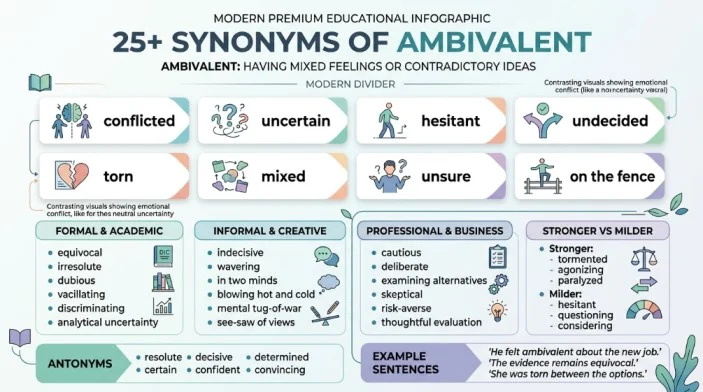
When writing an email, essay, caption, or professional message, repeating ambivalent can make your wording feel limited. Searching for synonyms of ambivalent can help you describe mixed feelings, uncertainty, hesitation, or conflicting attitudes with greater precision.
The best alternative depends on what you actually mean. Conflicted highlights an internal struggle, uncertain emphasizes a lack of confidence, hesitant focuses on reluctance to act, and mixed works well for straightforward everyday language. Choosing the right synonym makes your message clearer and helps readers understand exactly what kind of uncertainty or emotional conflict you intend to express.
What Are the Best Synonyms of “Ambivalent”?
Ambivalent describes having mixed or conflicting feelings, attitudes, or opinions about something. The best synonyms include conflicted for emotional struggle, uncertain for doubt, hesitant for reluctance, undecided for an unresolved choice, and mixed for everyday communication. Conflicted and uncertain are especially useful in professional and academic writing.
Meaning, Tone, and Context
Simple Definition
Ambivalent means having two opposing or conflicting feelings, attitudes, or reactions toward the same person, situation, idea, or decision.
Someone who is ambivalent may feel both positive and negative about something at the same time. For example, a person might be excited about moving to a new city but also sad about leaving friends behind.
The word does not always mean that someone has no opinion. It often means that two competing reactions exist together.
Part of Speech
Ambivalent is an adjective.
Example:
“She felt ambivalent about accepting the promotion.”
The related noun is ambivalence, which refers to the state of having conflicting feelings or attitudes.
Example:
“His ambivalence about the decision was obvious.”
Overall Tone
Ambivalent is generally neutral, although the context can make it sound negative.
It does not automatically suggest that someone is confused or incapable of making a decision. Instead, it emphasizes the coexistence of opposing feelings or attitudes.
Formality Level
Ambivalent is a neutral to formal vocabulary choice.
It works naturally in:
- Academic writing
- Professional communication
- Psychology discussions
- Essays
- Reports
- Literary analysis
- Thoughtful personal writing
In casual conversation, simpler alternatives such as unsure, conflicted, or on the fence may sound more natural.
Common Uses
Native English speakers commonly use ambivalent when discussing:
- Feelings about relationships
- Major life decisions
- Political opinions
- Career choices
- Social issues
- Personal beliefs
- Changes or transitions
- Conflicting attitudes
- Difficult choices
- Positive and negative reactions
Word Forms
| Word | Part of Speech | Example |
|---|---|---|
| Ambivalent | Adjective | “She is ambivalent about the proposal.” |
| Ambivalence | Noun | “His ambivalence was easy to notice.” |
| Ambivalently | Adverb | “She responded ambivalently to the suggestion.” |
A useful distinction is that ambivalent describes the person or attitude, while ambivalence names the state itself.
When and How to Use “Ambivalent”
Use ambivalent when someone genuinely experiences conflicting feelings or attitudes toward the same thing. It is especially useful when simply saying “unsure” would miss the fact that the person has reasons pulling them in opposite directions.
Professional
“The leadership team remains ambivalent about expanding into the international market.”
This suggests that the team sees both advantages and disadvantages.
Academic
“Participants expressed ambivalent attitudes toward the proposed policy.”
This works well when a group has both favorable and unfavorable reactions.
Workplace
“I feel ambivalent about taking on the additional responsibilities.”
The speaker recognizes both positive and negative aspects of the opportunity.
Personal
“She was ambivalent about moving closer to her family.”
The decision creates competing emotional reactions.
“I’m somewhat ambivalent about the proposal because it offers clear benefits but also creates additional costs.”
This gives the reader a balanced explanation instead of simply saying the writer is unsure.
Resume
The word ambivalent is rarely appropriate for a resume because resumes generally emphasize confidence, achievements, and clear professional value.
Instead of:
“Ambivalent about relocating for the position.”
Use:
“Open to relocation for the right opportunity.”
Social Media
“I’m feeling pretty ambivalent about leaving my hometown.”
Here, ambivalent works because the writer is expressing mixed emotions in a personal context.
Best Synonyms of “Ambivalent”
No synonym is identical to ambivalent in every situation. The best choice depends on whether you want to emphasize emotional conflict, uncertainty, hesitation, indecision, neutrality, or opposing opinions.
Professional Writing: Conflicted
Conflicted is a strong professional alternative when a person is struggling between competing considerations.
“The committee was conflicted about approving the proposal.”
It sounds natural when the issue involves competing priorities.
Academic Writing: Mixed
For academic discussions, mixed can be useful when describing reactions, attitudes, or responses that contain both positive and negative elements.
“The participants had mixed reactions to the intervention.”
For more formal analysis, conflicting or ambivalent may be more precise.
Business Communication: Uncertain
Uncertain is useful when the main issue is doubt about an outcome or decision.
“Investors remain uncertain about the company’s future direction.”
It is more direct than ambivalent when conflicting emotions are not the main point.
Casual Conversation: On the Fence
On the fence is a natural informal expression for someone who has not decided between two options.
“I’m still on the fence about buying the car.”
It works especially well in conversation and informal messages.
Emotional Writing: Conflicted
Conflicted often carries more emotional weight than uncertain.
“He felt conflicted about leaving the people he loved.”
It clearly suggests an internal emotional struggle.
Creative Writing: Torn
Torn is an expressive alternative that can add emotional tension to storytelling.
“She was torn between following her dreams and staying with her family.”
It is particularly effective when a character faces two emotionally meaningful choices.
Resume Writing: Open to
Ambivalent generally does not belong on a resume. If you want to communicate flexibility rather than uncertainty, open to is a better choice.
“Open to opportunities in both marketing and communications.”
Workplace Communication: Hesitant
Hesitant works when someone is reluctant to act or make a decision.
“The employee was hesitant to accept the new assignment.”
It focuses more on reluctance than on having two opposing feelings.
Stronger Meaning: Torn
Torn can communicate a strong internal conflict, especially when the decision involves important personal values or relationships.
“She was torn between two equally attractive opportunities.”
Softer Meaning: Unsure
Unsure is a milder and more conversational alternative.
“I’m unsure whether this is the right choice.”
It communicates uncertainty without suggesting a deep emotional conflict.
When Not to Use “Ambivalent”
When You Simply Mean “Uncertain”
Ambivalent implies conflicting feelings, while uncertain can simply mean that you do not know what will happen.
Less precise:
“The weather forecast is ambivalent.”
Better:
“The weather forecast is uncertain.”
Why: Weather cannot have conflicting feelings. Uncertain describes an unclear outcome.
When Someone Has Already Made a Decision
If someone has made a clear choice, ambivalent is usually inappropriate.
Less effective:
“She was ambivalent after accepting the job.”
Better:
“She felt conflicted about accepting the job.”
Why: The person can make a decision while still experiencing conflicting emotions.
When You Mean Simple Hesitation
If someone is reluctant to act, hesitant may be more accurate.
Less precise:
“He was ambivalent about signing the form.”
Better:
“He was hesitant to sign the form.”
Why: The second sentence focuses specifically on reluctance.
When You Need Very Casual Language
Ambivalent can sound more formal than necessary in everyday conversation.
Formal:
“I’m ambivalent about the restaurant.”
Casual:
“I’m on the fence about the restaurant.”
Why: The informal expression sounds more natural in relaxed conversation.
When You Mean Complete Neutrality
Ambivalent does not necessarily mean neutral.
Less accurate:
“She was ambivalent and had no opinion about the issue.”
Better:
“She was neutral on the issue.”
Why: Ambivalence involves competing reactions, while neutrality can mean neither side is preferred.
Words Commonly Confused With “Ambivalent”
| Word | Difference | When to Use It | Example |
|---|---|---|---|
| Uncertain | Means lacking confidence or knowledge about something. | Use it when the outcome or answer is unclear. | “We are uncertain about the results.” |
| Hesitant | Focuses on reluctance to act. | Use it when someone pauses before making a move. | “She was hesitant to accept the offer.” |
| Indecisive | Describes difficulty choosing between options. | Use it when someone repeatedly struggles to make a decision. | “He can be indecisive when choosing restaurants.” |
| Conflicted | Emphasizes opposing feelings, values, or priorities. | Use it for emotional or internal struggles. | “She felt conflicted about leaving.” |
| Undecided | Means no final choice has been made. | Use it when a decision remains open. | “The voters are still undecided.” |
| Neutral | Means not favoring either side. | Use it when someone deliberately avoids taking a position. | “The organization remained neutral.” |
Best Synonyms of “Ambivalent” by Context
| Context | Best Synonym | Why It Works | Example |
|---|---|---|---|
| Formal writing | Conflicted | Clearly conveys opposing reactions. | “The author appears conflicted about the issue.” |
| Academic writing | Mixed | Works well for mixed attitudes or reactions. | “Students reported mixed feelings.” |
| Professional communication | Uncertain | Clearly communicates doubt. | “The team remains uncertain about the outcome.” |
| Business emails | Unsure | Direct and accessible. | “I’m unsure whether this approach will work.” |
| Resume writing | Open to | Replaces uncertainty with professional flexibility. | “Open to relocation for suitable roles.” |
| Workplace communication | Hesitant | Emphasizes reluctance to act. | “She was hesitant to approve the request.” |
| Casual conversation | On the fence | Natural and informal. | “I’m on the fence about going.” |
| Everyday speaking | Unsure | Simple and widely understood. | “I’m unsure what to choose.” |
| Creative writing | Torn | Adds emotional tension. | “He was torn between duty and love.” |
| Storytelling | Conflicted | Shows an internal struggle. | “She felt conflicted about her decision.” |
| Emotional writing | Torn | Expresses strong competing emotions. | “I was torn between staying and leaving.” |
| Strong emphasis | Deeply conflicted | Intensifies the emotional struggle. | “He was deeply conflicted about the decision.” |
| Mild tone | Unsure | Communicates doubt without strong emotion. | “I’m unsure about the plan.” |
| Social media captions | On the fence | Conversational and relatable. | “Still on the fence about this one.” |
| American English | Conflicted | Very natural in everyday American English. | “I’m conflicted about the move.” |
How to Choose the Best Synonym of “Ambivalent”
Start by identifying what kind of uncertainty you want to describe.
- If two feelings are competing: choose conflicted.
- If you lack confidence or information: choose uncertain or unsure.
- If you are reluctant to act: choose hesitant.
- If you cannot decide: choose undecided or indecisive, depending on the context.
- If two choices are pulling you in different directions: choose torn.
- If you want an informal expression: use on the fence.
- If you want to emphasize balanced reactions: choose mixed.
The audience also matters. Academic writing often benefits from conflicted, mixed, or uncertain, while casual conversation usually sounds more natural with unsure, torn, or on the fence.
Real Life Examples of “Ambivalent”
School
Original:
“The student was ambivalent about joining the debate club.”
More precise:
“The student was hesitant to join the debate club because she wanted to participate but worried about the time commitment.”
College
“Many students felt conflicted about choosing a major because they had several strong interests.”
Here, conflicted emphasizes competing preferences.
Workplace
“The manager was uncertain about adopting the new software until the team completed its testing.”
The issue is uncertainty about an outcome rather than emotional conflict.
Business
“The board had mixed reactions to the proposed expansion.”
Mixed works well because the board did not respond uniformly.
“I’m still unsure whether the revised schedule will work for everyone.”
This sounds more natural and direct than using ambivalent in a routine email.
Resume
Instead of writing:
“Ambivalent about relocating.”
Use:
“Open to relocation for the right opportunity.”
This presents flexibility rather than indecision.
Conversation
“I’m on the fence about going to the concert.”
The informal expression fits ordinary conversation.
Storytelling
“She was torn between returning home and pursuing the career she had worked years to build.”
Torn creates a stronger emotional image.
Blogging
“I have mixed feelings about remote work. The flexibility is excellent, but the lack of face to face interaction can be difficult.”
This phrase is accessible and clearly explains both sides.
Social Media
“Still on the fence about whether I should make the move.”
The expression feels natural for an informal caption.
25 Best Synonyms of “Ambivalent”
| Synonym | Simple Meaning | Best Used For | Example Sentence |
|---|---|---|---|
| Conflicted | Having opposing feelings | Emotional and professional contexts | “She felt conflicted about accepting the offer.” |
| Uncertain | Not sure about something | Decisions and outcomes | “The team remains uncertain about the result.” |
| Unsure | Not confident about a choice | Everyday conversation | “I’m unsure whether this is the right option.” |
| Hesitant | Reluctant to act | Decisions and actions | “He was hesitant to make the change.” |
| Undecided | Without a final choice | Elections and decisions | “The committee remains undecided.” |
| Indecisive | Struggling to choose | Repeated decision difficulty | “She becomes indecisive when several options look appealing.” |
| Torn | Pulled between alternatives | Emotional choices | “He was torn between two career paths.” |
| Mixed | Containing different reactions | Opinions and responses | “The proposal received mixed reactions.” |
| Doubtful | Having doubts | Beliefs and expectations | “She was doubtful that the plan would succeed.” |
| Questioning | Having reservations or doubts | Beliefs and decisions | “He remained questioning about the long term benefits.” |
| Reluctant | Unwilling or resistant | Actions | “She was reluctant to leave her position.” |
| Confused | Unable to understand or decide clearly | Situations involving unclear choices | “He was confused about which option to select.” |
| Divided | Split between opposing views | Groups and opinions | “The committee was divided over the proposal.” |
| Unresolved | Not settled or decided | Issues and feelings | “Her feelings about the decision remained unresolved.” |
| Equivocal | Deliberately unclear or noncommittal | Formal writing | “His response was equivocal.” |
| Noncommittal | Avoiding a definite position | Professional discussions | “The spokesperson remained noncommittal.” |
| Wavering | Changing between choices or opinions | Decisions | “He was wavering between the two offers.” |
| Unsettled | Not emotionally or mentally resolved | Personal situations | “She felt unsettled about the move.” |
| At odds | In conflict with each other | Opposing ideas or feelings | “His ambitions were at odds with his responsibilities.” |
| In two minds | Having difficulty choosing | British English | “She was in two minds about the proposal.” |
| Double minded | Having conflicting intentions or views | Less common formal or religious contexts | “He seemed double minded about the agreement.” |
| Ambiguous | Open to multiple interpretations | Statements and meanings | “The policy wording was ambiguous.” |
| Unclear | Not easy to understand or determine | Information and decisions | “The company’s position remains unclear.” |
| Questionable | Causing doubt | Claims and decisions | “The decision was questionable.” |
| Neutral | Not favoring either side | Opinions and positions | “She remained neutral during the debate.” |
Some of these words overlap with ambivalent but are not interchangeable in every sentence. For example, ambiguous normally describes unclear meaning, not mixed feelings, while neutral means neither side is favored rather than both sides being emotionally compelling.
Synonyms of “Ambivalent” by Usage
Professional vs Personal Synonyms
In professional settings, choose words that clearly identify the type of uncertainty.
Professional choices:
- Uncertain
- Conflicted
- Hesitant
- Noncommittal
- Undecided
Personal choices:
- Unsure
- Torn
- Conflicted
- Mixed
- On the fence
For example, “The committee was uncertain about the proposal” sounds appropriate in a report, while “I’m on the fence about it” sounds natural when talking with a friend.
Formal vs Conversational Synonyms
Formal writing benefits from precise vocabulary.
Reports: conflicted, uncertain, equivocal
Essays: conflicted, mixed, uncertain
Business writing: uncertain, hesitant, noncommittal
Presentations: mixed, divided, uncertain
Emails: unsure, uncertain, hesitant
Casual conversations: unsure, torn, on the fence
Texting: unsure, torn, on the fence
The goal is not to choose the most complicated word. The strongest choice is the one that communicates the intended meaning naturally.
Academic Synonyms
Academic writing often needs a distinction between emotional conflict, uncertainty, and disagreement.
Conflicted works when a person or group has competing attitudes.
“Participants appeared conflicted about the ethical implications.”
Mixed works well when describing varied or positive and negative reactions.
“The intervention received mixed responses.”
Uncertain is appropriate when knowledge or prediction is limited.
“Researchers remain uncertain about the long term effects.”
Equivocal can describe a response that does not provide a clear commitment.
“The findings were equivocal.”
These distinctions make academic writing more precise.
Professional and Business Synonyms
Resumes: Avoid ambivalent when possible. Use open to when you want to express flexibility.
Interviews: Use thoughtful, open to, or considering when describing options constructively.
Meetings: Use uncertain or hesitant when discussing reservations.
Presentations: Use mixed when reporting different reactions.
Performance reviews: Use hesitant when discussing reluctance to adopt a process.
Client communication: Use uncertain when the facts or outcome are not settled.
Business emails: Use unsure for everyday internal communication and uncertain for more formal messages.
Creative and Literary Synonyms
Creative writing gives you more freedom to emphasize emotion.
Torn suggests a character being pulled between two meaningful choices.
“She was torn between loyalty and freedom.”
Conflicted highlights an internal struggle.
“He felt conflicted about betraying his closest friend.”
Wavering suggests movement between alternatives.
“Her confidence kept wavering as the deadline approached.”
Divided can create a sense of internal or external opposition.
“His heart was divided between the life he knew and the future he imagined.”
Slang or Modern Synonyms
There is no single slang word that perfectly replaces ambivalent.
The informal expression on the fence is the closest common conversational alternative when someone cannot choose between options.
Acceptable:
“I’m still on the fence about moving.”
Avoid in:
- Academic papers
- Formal reports
- Professional research
- Legal documents
In those settings, uncertain, undecided, or conflicted will usually be more appropriate.
Strongest to Mildest Synonyms
There is no universal intensity ranking because these words emphasize different dimensions of uncertainty. Still, they can be grouped roughly by how strongly they communicate internal conflict.
Mild
- Unsure
- Uncertain
- Undecided
These words communicate doubt without necessarily suggesting strong emotion.
Moderate
- Hesitant
- Mixed
- Questioning
- Wavering
These suggest a more noticeable struggle or lack of commitment.
Strong
- Conflicted
- Divided
- Reluctant
- Torn
These words can communicate significant emotional or practical tension.
Very Strong
- Deeply conflicted
- Torn between competing values
- Strongly divided
These expressions emphasize substantial internal or external opposition.
Emotional vs Neutral Synonyms
Emotional Synonyms
These alternatives communicate stronger personal tension.
- Torn
- Conflicted
- Wavering
- Unsettled
- Divided
Use them when discussing relationships, major life choices, personal beliefs, or emotionally difficult situations.
Neutral Synonyms
These communicate uncertainty without adding much emotion.
- Uncertain
- Unsure
- Undecided
- Unclear
- Noncommittal
These are better for reports, emails, workplace communication, and objective explanations.
Antonyms of “Ambivalent”
| Antonym | Meaning | Example Sentence |
|---|---|---|
| Certain | Completely sure | “She was certain about her decision.” |
| Decisive | Able to make choices confidently | “The manager was decisive during the crisis.” |
| Resolved | Having reached a firm decision | “He felt resolved about moving forward.” |
| Committed | Firmly dedicated to a choice or position | “They are committed to the new strategy.” |
| Determined | Strongly intending to achieve something | “She was determined to finish the project.” |
| Sure | Confident that something is true or right | “I’m sure this is the best option.” |
| Unwavering | Not changing in belief or purpose | “Her support remained unwavering.” |
| Clear | Free from uncertainty | “His position on the matter was clear.” |
| Definite | Clearly established or decided | “They reached a definite agreement.” |
| Firm | Strongly fixed or settled | “She remained firm in her decision.” |
| Certain minded | Firmly settled in one’s view | “He was certain minded about the plan.” |
| Single minded | Focused on one goal or purpose | “She was single minded in pursuing her goal.” |
| Supportive | Favoring or backing something | “The board was supportive of the proposal.” |
| Opposed | Clearly against something | “Several members were opposed to the change.” |
| Unanimous | Completely in agreement | “The committee reached a unanimous decision.” |
Comparison: “Ambivalent” vs Similar Words
Ambivalent vs Uncertain
Main Difference
Ambivalent means having conflicting feelings or attitudes. Uncertain means lacking confidence or knowledge about something.
Which Is Stronger?
Neither is inherently stronger. Ambivalent is more specific because it suggests opposing reactions.
Which Is More Formal?
Both work in formal writing.
When to Use Each
Use ambivalent when two attitudes coexist. Use uncertain when you simply do not know or cannot predict something.
Examples
Ambivalent:
“She was ambivalent about accepting the promotion.”
Uncertain:
“She was uncertain whether the promotion would improve her career.”
Ambivalent vs Hesitant
Main Difference
Ambivalent describes mixed feelings. Hesitant describes reluctance or delay before acting.
Which Is Stronger?
Ambivalent can describe deeper emotional conflict, while hesitant focuses on behavior.
Which Is More Formal?
Both are neutral and appropriate in professional writing.
When to Use Each
Use hesitant when someone is reluctant to take action.
Examples
Ambivalent:
“He was ambivalent about moving abroad.”
Hesitant:
“He was hesitant to sign the contract.”
Ambivalent vs Indecisive
Main Difference
Ambivalent refers to conflicting feelings or attitudes. Indecisive often describes a person’s difficulty making choices.
Which Is Stronger?
Indecisive can sound more critical because it may describe a recurring personality trait.
Which Is More Formal?
Both can be used formally, but ambivalent is often more neutral.
When to Use Each
Use indecisive when the problem is difficulty choosing.
Examples
Ambivalent:
“She had ambivalent feelings about the move.”
Indecisive:
“He was indecisive about which apartment to rent.”
Ambivalent vs Conflicted
Main Difference
These words are very close. Conflicted usually emphasizes an active internal struggle, while ambivalent can describe the coexistence of opposing attitudes without suggesting intense distress.
Which Is Stronger?
Conflicted often sounds more emotionally intense.
Which Is More Formal?
Both work well in academic and professional contexts.
When to Use Each
Use conflicted when the emotional struggle is central.
Examples
Ambivalent:
“She felt ambivalent about the policy.”
Conflicted:
“She felt conflicted because the policy benefited her team but harmed another department.”
Ambivalent vs Undecided
Main Difference
Undecided means no final choice has been made. Ambivalent means opposing feelings or attitudes are present.
Which Is Stronger?
Ambivalent can suggest a deeper emotional or psychological conflict.
Which Is More Formal?
Both are suitable for general and professional communication.
When to Use Each
Use undecided when the final choice is still open.
Examples
Ambivalent:
“He was ambivalent about changing careers.”
Undecided:
“He was undecided about which career to pursue.”
Ambivalent vs Neutral
Main Difference
Neutral means not taking either side. Ambivalent means having competing reactions toward the same subject.
Which Is Stronger?
Ambivalent suggests more internal complexity.
Which Is More Formal?
Both work in formal contexts.
When to Use Each
Use neutral when someone intentionally avoids favoring one side.
Examples
Ambivalent:
“She was ambivalent about the proposal because she saw both benefits and drawbacks.”
Neutral:
“She remained neutral during the debate.”
Common Phrases and Expressions with “Ambivalent”
Ambivalent About
Meaning
This is the most common structure for describing mixed feelings toward something.
Example Sentence
“I’m ambivalent about accepting the position because the salary is attractive, but the commute is difficult.”
Feel Ambivalent About
Meaning
Used when explicitly describing someone’s emotional reaction.
Example Sentence
“She feels ambivalent about returning to her hometown.”
Remain Ambivalent About
Meaning
Shows that mixed feelings continue over time.
Example Sentence
“The board remains ambivalent about expanding the program.”
Deeply Ambivalent
Meaning
Emphasizes particularly strong or complicated mixed feelings.
Example Sentence
“He was deeply ambivalent about leaving a company he had worked for years.”
Ambivalent Attitude
Meaning
Describes an attitude containing opposing reactions.
Example Sentence
“The survey revealed an ambivalent attitude toward the proposed changes.”
Ambivalent Feelings
Meaning
Refers directly to mixed emotional responses.
Example Sentence
“She had ambivalent feelings about becoming a parent.”
Ambivalent Response
Meaning
Describes a response that shows mixed or conflicting reactions.
Example Sentence
“The proposal received an ambivalent response from employees.”
Common Mistakes to Avoid
1. Treating “Ambivalent” as a Simple Synonym for “Uncertain”
Incorrect:
“The scientist was ambivalent about whether the experiment would succeed.”
Better:
“The scientist was uncertain about whether the experiment would succeed.”
Why:
If the person simply lacks confidence about an outcome, uncertain is more precise.
2. Using “Ambiguous” for Mixed Feelings
Incorrect:
“She was ambiguous about her feelings.”
Better:
“She was ambivalent about her feelings.”
Why:
Ambiguous usually describes language, information, or situations that can have multiple interpretations. Ambivalent describes conflicting feelings or attitudes.
3. Using “On the Fence” in Formal Academic Writing
Incorrect:
“The researchers were on the fence about the findings.”
Better:
“The researchers were uncertain about the findings.”
Why:
On the fence is an informal idiom and may sound too casual in academic writing.
4. Confusing Ambivalence With Indecision
Incorrect:
“She is ambivalent because she always takes a long time to choose.”
Better:
“She is indecisive because she often takes a long time to choose.”
Why:
Indecision concerns difficulty making choices. Ambivalence specifically involves competing feelings or attitudes.
5. Using an Overly Dramatic Synonym
Incorrect:
“He was torn about which brand of cereal to buy.”
Better:
“He was undecided about which cereal to buy.”
Why:
Torn can imply meaningful emotional conflict. It may sound exaggerated for an ordinary, low stakes choice.
6. Using “Ambivalent” When Someone Is Clearly Neutral
Incorrect:
“The judge was ambivalent during the debate.”
Better:
“The judge remained neutral during the debate.”
Why:
Neutrality means avoiding preference, while ambivalence involves competing feelings or attitudes.
7. Replacing Every Use With the Same Synonym
Incorrect:
“She was conflicted about the job, conflicted about the city, and conflicted about the schedule.”
Better:
“She was conflicted about the job, uncertain about the city, and hesitant about the schedule.”
Why:
Each alternative communicates a slightly different type of doubt, making the writing more precise and less repetitive.
Frequently Asked Questions
1. What are the best synonyms of “ambivalent”?
The best synonyms of ambivalent include conflicted, uncertain, hesitant, undecided, torn, mixed, unsure, and on the fence. The ideal choice depends on whether you mean emotional conflict, doubt, reluctance, or indecision.
2. What are the best formal synonyms of “ambivalent”?
Strong formal alternatives include conflicted, uncertain, equivocal, noncommittal, divided, and mixed. For academic or professional writing, choose the word that most precisely identifies whether the issue involves doubt, opposing attitudes, or lack of commitment.
3. What are common informal synonyms of “ambivalent”?
Common informal alternatives include unsure, torn, on the fence, and mixed. These expressions work naturally in conversations, texts, social media, and personal writing, although on the fence is best avoided in highly formal contexts.
4. What is another word for “ambivalent” in professional writing?
Conflicted, uncertain, hesitant, and noncommittal are useful professional alternatives. Choose conflicted for competing considerations, uncertain for doubt, and hesitant when reluctance to act is the main issue.
5. What is the difference between “ambivalent” and “uncertain”?
Ambivalent means having conflicting feelings or attitudes, while uncertain means lacking confidence or knowledge. Someone can be uncertain without having opposing feelings, so the two words are not interchangeable in every context.
6. What is the opposite of “ambivalent”?
The opposite of ambivalent depends on the intended contrast. Useful opposites include certain, decisive, committed, resolved, firm, and unwavering. These words describe clear, settled, or firmly held positions rather than conflicting reactions.
Conclusion
Ambivalent describes a state of having conflicting feelings, attitudes, or reactions toward the same subject. It is a useful neutral to formal word, particularly when you want to show that a person recognizes both positive and negative sides of an issue.
The best alternatives depend on the context. Use conflicted for internal emotional struggle, uncertain for doubt, hesitant for reluctance, undecided for an unresolved choice, torn for stronger emotional tension, and on the fence for casual conversation.
There is no single synonym that works perfectly everywhere. To improve your vocabulary, identify the exact kind of uncertainty you mean before choosing from the synonyms of ambivalent, then select the word that best matches your audience, tone, and purpose.
Read More Related Articles:
- 25+ Synonyms of Resume | Meanings, Uses, Examples, and …
- 25+ Synonyms of Bridge | Meanings, Uses, Examples, and …
- 25+ Synonyms of Sincerely | Meanings, Uses, Examples, and …