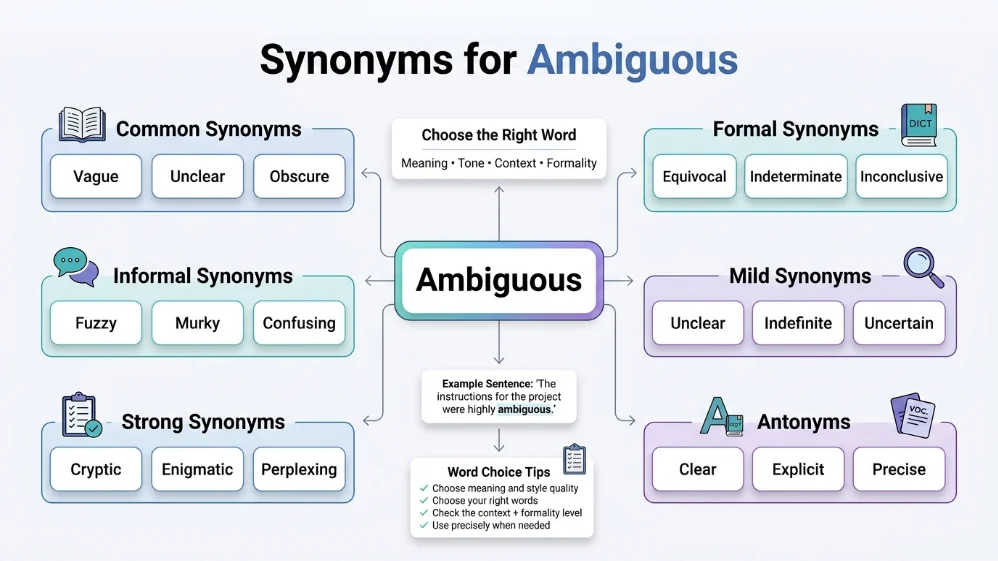
Finding the best synonyms for ambiguous is about more than replacing one word with another. While vague, unclear, equivocal, and obscure are common alternatives, each carries a slightly different meaning and fits different situations. The right choice depends on your sentence, audience, tone, and the level of uncertainty you want to express.
you’re writing an essay, editing a report, preparing business communication, or improving everyday vocabulary, understanding these subtle differences helps your writing become more accurate and natural. This guide explains the meaning of ambiguous, explores its strongest synonyms, and shows when each alternative works best.
Best Synonyms for Ambiguous
The best synonyms for ambiguous are vague, unclear, equivocal, and obscure. Each word describes something that can be understood in more than one way or lacks clear meaning. The best option depends on the tone, context, and degree of uncertainty you want to express.
| Situation | Best Synonym |
|---|---|
| Everyday writing | Vague |
| Business communication | Unclear |
| Academic writing | Equivocal |
| Literature | Ambivalent (when referring to mixed feelings) |
| Legal documents | Open to interpretation |
| Technical writing | Indeterminate |
What Does Ambiguous Mean?
The word ambiguous describes something that has more than one possible meaning or is not expressed clearly enough to produce one definite interpretation. An ambiguous statement, sentence, instruction, or situation can confuse readers because multiple interpretations seem possible.
Part of Speech:
Adjective
Simple Definition:
Having more than one possible meaning or lacking enough clarity to be understood in one clear way.
People often use ambiguous when discussing:
- Writing
- Speech
- Instructions
- Laws
- Contracts
- Literature
- Conversations
- Messages
- Signs
- Decisions
Example Sentences
- The manager gave an ambiguous answer that left everyone uncertain about the deadline.
- Her text message sounded ambiguous, making it difficult to know what she actually meant.
Core Meaning of Ambiguous
At its core, ambiguous refers to uncertainty in meaning.
Instead of presenting one clear idea, an ambiguous word, sentence, or situation allows multiple reasonable interpretations. Sometimes this ambiguity happens by accident because the wording is unclear. In other cases, it is intentional, especially in literature, poetry, advertising, or diplomacy, where leaving room for interpretation can create interest or avoid direct commitment.
Imagine receiving the instruction:
“Finish the report after reviewing the manager.”
Did the writer mean:
- review the manager’s comments,
- review the manager,
- or meet with the manager first?
The sentence creates confusion because its structure allows different interpretations. That is exactly what makes it ambiguous.
Ambiguity does not always mean something is incorrect. Writers sometimes use it deliberately to encourage readers to think more deeply, while professionals usually avoid it to prevent misunderstandings.
Grammar and Usage Notes
Understanding how ambiguous works in sentences makes it easier to choose the right synonym.
Part of Speech
Ambiguous is an adjective.
It describes nouns by showing that they are unclear or open to more than one interpretation.
Examples:
- ambiguous language
- ambiguous statement
- ambiguous response
- ambiguous instructions
- ambiguous evidence
Common Sentence Patterns
The word commonly appears in patterns such as:
- be ambiguous about something
- remain ambiguous
- become ambiguous
- sound ambiguous
- intentionally ambiguous
- deliberately ambiguous
- legally ambiguous
- morally ambiguous
Examples:
- The contract remains ambiguous.
- His explanation sounded ambiguous.
- The policy became ambiguous after the revision.
Common Collocations
Writers frequently pair ambiguous with nouns like:
- wording
- language
- phrase
- answer
- message
- response
- instruction
- question
- policy
- rule
- evidence
- statement
- expression
- situation
- conclusion
These combinations sound natural because they involve communication or interpretation.
When “Ambiguous” Sounds Natural
Use ambiguous when something genuinely has multiple possible meanings.
Good examples include:
- ambiguous email
- ambiguous contract
- ambiguous instructions
- ambiguous comment
- ambiguous expression
- ambiguous law
In these cases, readers or listeners cannot confidently determine one intended meaning.
When Another Synonym Works Better
Sometimes another word communicates your idea more precisely.
- Use vague when information lacks enough detail.
- Use unclear when something is difficult to understand.
- Use equivocal when someone intentionally avoids giving a direct answer.
- Use obscure when meaning is hidden or difficult to recognize.
- Use indefinite when information has not yet been decided.
Choosing the right synonym makes your writing more accurate because not every unclear statement is truly ambiguous.
Best Synonyms for Ambiguous
The table below highlights the most useful alternatives and shows where each one works best.
| Synonym | Meaning | Tone | Best Use Case | Example Sentence |
|---|---|---|---|---|
| Vague | Lacking detail or precision | Neutral | Everyday writing | His instructions were too vague to follow. |
| Unclear | Difficult to understand | Neutral | Business communication | The report contains several unclear points. |
| Equivocal | Open to more than one interpretation, often intentionally | Formal | Academic and legal writing | The witness gave an equivocal answer. |
| Obscure | Hard to understand because meaning is hidden | Formal | Literature and analysis | The author’s message remained obscure. |
| Indefinite | Not clearly defined | Formal | Technical and professional writing | The timeline is still indefinite. |
| Cryptic | Deliberately mysterious or puzzling | Informal | Conversation and media | She posted a cryptic message online. |
| Inconclusive | Not leading to a definite conclusion | Formal | Research and investigations | The evidence remains inconclusive. |
| Questionable | Open to doubt | Neutral | Reviews and discussions | The explanation seems questionable. |
| Open to interpretation | Capable of being understood in different ways | Neutral | Professional writing | The policy is open to interpretation. |
| Dubious | Uncertain or doubtful | Neutral | Opinion writing | His explanation sounded dubious. |
Common Synonyms for Ambiguous
These are the alternatives people use most often in everyday conversation and writing.
Vague
Meaning: Not expressed clearly or with enough detail.
Best Context: Casual conversation, workplace communication, school writing, and everyday descriptions.
Example:
The directions were so vague that we got lost before reaching the destination.
Unclear
Meaning: Difficult to understand because important information is missing or confusing.
Best Context: Emails, reports, presentations, customer communication, and instructions.
Example:
The meeting agenda was unclear, so nobody knew which topic would be discussed first.
Equivocal
Meaning: Deliberately avoiding a direct or definite answer.
Best Context: Academic papers, legal writing, journalism, and political analysis.
Example:
The spokesperson gave an equivocal response instead of answering the question directly.
Obscure
Meaning: Hidden, difficult to understand, or not immediately obvious.
Best Context: Literature, historical writing, philosophy, and criticism.
Example:
The poem contains several obscure references that require careful interpretation.
Cryptic
Meaning: Intentionally mysterious or difficult to interpret.
Best Context: Social media, entertainment, mystery stories, and casual conversation.
Example:
His cryptic comment left everyone wondering what had happened.
Indefinite
Meaning: Not clearly decided or defined.
Best Context: Planning, scheduling, business, and project management.
Example:
The launch date remains indefinite until testing is complete.
Inconclusive
Meaning: Not providing a clear answer or final result.
Best Context: Scientific studies, investigations, research, and legal cases.
Example:
The laboratory results were inconclusive, so additional testing was required.
Open to Interpretation
Meaning: Capable of being understood in several reasonable ways.
Best Context: Contracts, policies, laws, literature, and formal writing.
Example:
Several clauses in the agreement are open to interpretation, creating uncertainty for both parties.
Formal Synonyms for Ambiguous
Formal writing often requires words that sound precise and objective. The following alternatives work well in academic papers, legal documents, business reports, and professional communication.
Equivocal
Meaning: Open to multiple interpretations or intentionally avoiding a clear position.
Best for: Academic writing, legal documents, political analysis, and formal reports.
Example:
The witness gave an equivocal statement that did not clearly support either side.
Indeterminate
Meaning: Not clearly established or impossible to determine with certainty.
Best for: Scientific writing, research papers, and technical documentation.
Example:
The cause of the system failure remains indeterminate.
Indefinite
Meaning: Not clearly defined, limited, or settled.
Best for: Business writing, contracts, and project planning.
Example:
The agreement extends for an indefinite period.
Obscure
Meaning: Difficult to understand because the meaning is hidden or not immediately obvious.
Best for: Literary analysis, criticism, and scholarly writing.
Example:
The author’s final paragraph is intentionally obscure.
Open to Interpretation
Meaning: Able to be understood in more than one reasonable way.
Best for: Legal writing, policies, and professional communication.
Example:
Several sections of the policy remain open to interpretation.
Inconclusive
Meaning: Failing to provide a definite conclusion.
Best for: Research, investigations, and medical reports.
Example:
The initial findings were inconclusive, requiring additional testing.
Informal Synonyms for Ambiguous
Casual conversations usually favor simple words over technical vocabulary. These alternatives sound natural in everyday speech, text messages, blogs, and social media.
Vague
Tone: Neutral and conversational.
Best Use: When someone gives too little information.
Example:
Your explanation is a little vague.
Fuzzy
Tone: Friendly and informal.
Best Use: Describing ideas or plans that are not well defined.
Example:
I still have a fuzzy understanding of the new rules.
Murky
Tone: Informal and descriptive.
Best Use: Situations that seem confusing or difficult to understand.
Example:
The details of the deal are still murky.
Cryptic
Tone: Casual with a hint of mystery.
Best Use: Social media posts, conversations, or mysterious messages.
Example:
She shared a cryptic caption that everyone tried to decode.
Confusing
Tone: Very common and easy to understand.
Best Use: Everyday communication.
Example:
The instructions were confusing, so I asked for help.
Strong Synonyms for Ambiguous
Some alternatives express greater uncertainty or suggest that the lack of clarity is significant. These words should be used carefully because they create a stronger impression.
Equivocal
This word often suggests someone is intentionally avoiding a direct answer.
Example:
The politician remained equivocal throughout the interview.
Cryptic
This implies deliberate mystery rather than simple confusion.
Example:
His cryptic warning made everyone uneasy.
Obscure
This suggests the meaning is deeply hidden or difficult to discover.
Example:
The historical manuscript contains several obscure references.
Enigmatic
This describes someone or something that is mysterious and difficult to understand.
Example:
The artist became famous for her enigmatic paintings.
Note: Enigmatic is related to ambiguous, but it often emphasizes mystery instead of multiple meanings.
Perplexing
This highlights that something causes confusion.
Example:
The judge’s decision seemed perplexing to many observers.
Mild Synonyms for Ambiguous
Sometimes strong words sound too dramatic. These softer alternatives fit situations where you simply want to indicate a lack of complete clarity.
Unclear
A safe choice for almost every type of writing.
Example:
The final paragraph remains unclear.
Vague
Suggests missing detail rather than multiple meanings.
Example:
The instructions were vague.
Uncertain
Works when information has not yet been confirmed.
Example:
The project timeline is still uncertain.
Indefinite
Useful when discussing dates, plans, or limits.
Example:
The meeting has been postponed for an indefinite period.
Questionable
Suggests doubt without sounding overly critical.
Example:
His explanation seems questionable.
Synonyms for Ambiguous by Context
Different situations call for different vocabulary. Choosing a synonym that matches the setting makes your writing sound more natural and precise.
Everyday Conversation
Simple words are usually the best choice in daily communication.
Recommended synonyms:
- vague
- unclear
- confusing
- fuzzy
Example:
Your message was vague, so I wasn’t sure what you meant.
Professional Writing
Business communication values clarity and precision.
Recommended synonyms:
- unclear
- indefinite
- open to interpretation
- inconclusive
Example:
The proposal contains several unclear sections that require revision.
Academic Writing
Formal writing often benefits from more precise language.
Recommended synonyms:
- equivocal
- indeterminate
- obscure
- inconclusive
Example:
The evidence remains inconclusive, preventing a firm conclusion.
Creative Writing
Novelists and storytellers sometimes use ambiguity intentionally.
Recommended synonyms:
- enigmatic
- cryptic
- mysterious
- obscure
Example:
The stranger’s smile was enigmatic, leaving everyone curious.
Legal Writing
Legal language must minimize misunderstanding.
Recommended synonyms:
- equivocal
- open to interpretation
- indefinite
Example:
The disputed clause is open to interpretation.
Personal Communication
Friendly conversations usually sound best with familiar vocabulary.
Recommended synonyms:
- vague
- unclear
- confusing
Example:
Could you explain that again? It still sounds unclear.
Another Word for Ambiguous in a Sentence
These examples demonstrate how different synonyms can replace ambiguous depending on the situation.
- His answer was vague, leaving everyone with more questions.
- The instructions remained unclear despite several revisions.
- The witness offered an equivocal response during questioning.
- Several passages in the novel are intentionally obscure.
- The scientist described the results as inconclusive.
- Her social media post contained a cryptic message.
- The agreement was open to interpretation by both parties.
- The project’s completion date remains indefinite.
- The manager gave a confusing explanation of the policy.
- The detective found the suspect’s remarks perplexing.
- His intentions remained enigmatic throughout the story.
- The company’s announcement sounded uncertain.
- The report included several questionable conclusions.
- The discussion became murky after new information appeared.
- The committee considered the available evidence indeterminate.
Ambiguous Synonyms Compared
| Synonym | Meaning | Tone | Intensity | Best Use Case |
|---|---|---|---|---|
| Vague | Lacks detail | Neutral | Low | Everyday writing |
| Unclear | Difficult to understand | Neutral | Low | Business communication |
| Equivocal | Intentionally avoids clarity | Formal | High | Academic and legal writing |
| Obscure | Hidden or difficult to understand | Formal | Medium | Literature and analysis |
| Cryptic | Deliberately mysterious | Informal | High | Conversation and fiction |
| Indefinite | Not clearly defined | Formal | Low | Planning and scheduling |
| Inconclusive | No definite result | Formal | Medium | Research and investigations |
| Enigmatic | Mysterious and puzzling | Literary | High | Creative writing |
Key Differences
- Vague usually means there is not enough detail.
- Unclear simply means something is hard to understand.
- Ambiguous means there are two or more possible interpretations.
- Equivocal often suggests deliberate avoidance of a direct answer.
- Cryptic emphasizes mystery rather than uncertainty.
- Obscure focuses on hidden or difficult meaning instead of multiple meanings.
Although these words overlap, they are not always interchangeable. Understanding these distinctions helps you choose the most accurate expression for your sentence.
Words Similar to Ambiguous
The following words belong to the same semantic field but are not always exact synonyms.
| Related Word | Relationship | Difference |
|---|---|---|
| Mysterious | Creates curiosity | Focuses on the unknown rather than multiple meanings |
| Uncertain | Indicates lack of certainty | Refers to doubt instead of unclear wording |
| Confusing | Causes misunderstanding | Describes the effect on the reader |
| Complex | Difficult because of many parts | Does not necessarily have multiple meanings |
| Doubtful | Suggests uncertainty | Often relates to belief rather than language |
| Indistinct | Not clearly defined | Usually refers to appearance or sound |
| Abstract | Based on ideas rather than physical things | Not inherently ambiguous |
| Misleading | Gives the wrong impression | May be clear but inaccurate |
| Puzzling | Difficult to understand | Emphasizes confusion rather than interpretation |
| Mysterious | Hard to explain | Often involves secrecy instead of ambiguity |
For example, a sentence can be complex without being ambiguous, and something can be confusing because it contains too much information rather than multiple meanings. Understanding these differences helps you choose words that accurately express your intended meaning.
Antonyms of Ambiguous
Antonyms describe language or situations that are clear, definite, and easy to understand. If ambiguous suggests multiple possible meanings, these words express the opposite.
| Antonym | Meaning | Example Sentence |
|---|---|---|
| Clear | Easy to understand | The teacher gave a clear explanation of the lesson. |
| Definite | Fixed and certain | We finally received a definite answer. |
| Explicit | Stated clearly with no room for doubt | The contract includes explicit payment terms. |
| Unambiguous | Having only one meaning | The instructions were unambiguous and easy to follow. |
| Precise | Exact and accurate | Her precise wording prevented misunderstandings. |
| Specific | Clearly identified or detailed | Please provide specific examples in your report. |
| Certain | Free from doubt | The outcome became certain after the final vote. |
| Straightforward | Simple and direct | His explanation was straightforward and easy to understand. |
When to Use These Antonyms
Use these words whenever you want to emphasize clarity instead of uncertainty. They are especially useful in academic writing, professional communication, legal documents, and instructional content where precision matters.
How to Choose the Right Synonym for Ambiguous
Not every synonym works equally well in every sentence. The best choice depends on what you want readers to understand.
Match the Context
Think about where your writing will appear.
- Use vague for everyday conversations.
- Use equivocal in legal or academic writing.
- Use cryptic when describing mysterious messages.
- Use unclear for workplace communication.
Match the Tone
Formal writing benefits from professional vocabulary, while casual writing sounds better with simpler words.
For example:
- Academic paper → equivocal
- Business email → unclear
- Text message → vague
- Novel → enigmatic
Consider the Intensity
Some words express stronger uncertainty than others.
Mild:
- unclear
- vague
- indefinite
Moderate:
- obscure
- inconclusive
Strong:
- equivocal
- cryptic
- enigmatic
Choosing the right level of intensity helps your writing sound balanced and natural.
Think About Your Audience
Write with your readers in mind.
General audiences usually understand words like:
- vague
- unclear
- confusing
Specialized readers may expect:
- equivocal
- indeterminate
- inconclusive
Using familiar vocabulary improves readability without sacrificing accuracy.
Check Whether the Synonym Is Exact
Some related words belong to the same topic but do not mean exactly the same thing.
For example:
- Confusing describes the effect on the reader.
- Mysterious emphasizes secrecy.
- Complex refers to something with many parts.
- Ambiguous specifically means something has more than one possible interpretation.
Understanding these distinctions prevents inaccurate word choices.
Keep the Sentence Natural
Always read your sentence after replacing a word. If the new version sounds awkward or changes the intended meaning, choose another synonym.
Natural writing is always more effective than using a complicated word simply because it sounds sophisticated.
Common Mistakes When Using Synonyms for Ambiguous
Replacing words without considering their meanings can make writing less accurate. These are the mistakes people make most often.
Choosing the Wrong Tone
A formal word may sound unnatural in casual conversation.
Less natural:
The movie was equivocal.
Better:
The movie was confusing.
Using a Word That Is Too Strong
Words like cryptic or enigmatic suggest mystery, not just uncertainty.
Only use them when mystery is actually part of the meaning.
Using Formal Words in Casual Writing
Everyday conversations rarely need technical vocabulary.
Instead of:
The message was indeterminate.
Say:
The message was unclear.
Using Casual Words in Professional Writing
Professional documents should sound precise.
Instead of:
The policy is kind of fuzzy.
Write:
The policy is unclear.
Assuming Every Synonym Means the Same Thing
Although many words appear in thesaurus lists, they often have different shades of meaning.
For example:
- vague ≠ ambiguous
- mysterious ≠ ambiguous
- confusing ≠ ambiguous
Always check whether the replacement preserves your original meaning.
Treating Related Words as Exact Synonyms
Words in the same semantic field may describe similar ideas without being interchangeable.
For instance:
A scientific result can be inconclusive, but it is not necessarily ambiguous.
Ignoring Context
The same synonym may sound perfect in one sentence and awkward in another.
Always choose the word that fits the topic, audience, and purpose of your writing.
Quick Synonym List for Ambiguous
Common Synonyms
- vague
- unclear
- obscure
- confusing
- indefinite
- uncertain
Formal Synonyms
- equivocal
- indeterminate
- inconclusive
- open to interpretation
- obscure
- indefinite
Informal Synonyms
- vague
- fuzzy
- murky
- confusing
- cryptic
Strong Synonyms
- equivocal
- cryptic
- enigmatic
- obscure
- perplexing
Mild Synonyms
- unclear
- vague
- uncertain
- indefinite
- questionable
Related Words
- mysterious
- complex
- doubtful
- puzzling
- indistinct
- misleading
- abstract
FAQs
What is the best synonym for ambiguous?
The best synonym depends on the context. For most situations, vague, unclear, equivocal, and obscure are the strongest alternatives. Choose the one that best matches your intended tone and meaning.
What is another word for ambiguous?
Another word for ambiguous is “vague” or “unclear.” In formal writing, words like equivocal and indeterminate may be more appropriate.
What is a formal synonym for ambiguous?
Equivocal is one of the most common formal synonyms. Other good choices include indeterminate, inconclusive, and open to interpretation, depending on the context.
What is an informal synonym for ambiguous?
Vague is the most common informal synonym. Other casual alternatives include fuzzy, murky, and confusing.
What is a stronger word for ambiguous?
Equivocal, cryptic, and enigmatic are stronger choices because they suggest greater uncertainty, intentional mystery, or deliberate avoidance of clarity.
What is a milder word for ambiguous?
Unclear is one of the mildest alternatives. It simply means something is difficult to understand without suggesting multiple interpretations.
What words are similar to ambiguous?
Related words include confusing, mysterious, complex, puzzling, uncertain, and indistinct. While these words share similar ideas, they do not always replace ambiguous exactly.
What is the opposite of ambiguous?
The opposite of ambiguous is unambiguous. Other antonyms include clear, explicit, definite, precise, and specific, all of which describe language that leaves little or no room for misunderstanding.
How do I choose the right synonym for ambiguous?
Start by considering your audience, purpose, and writing style. Then select a synonym that matches the required level of formality and accurately conveys the degree of uncertainty or lack of clarity you want to express.
Conclusion
Finding the best synonyms for ambiguous is about understanding more than simple word replacement. Although words like vague, unclear, equivocal, obscure, and cryptic are closely related, each carries its own tone, level of formality, and specific meaning.
Before choosing a synonym, think about your audience, the context, and the message you want to communicate. A carefully selected word makes your writing clearer, more natural, and more precise. By understanding these subtle differences, you can express ideas with greater confidence and avoid misunderstandings in both professional and everyday communication.
Read More Related Articles:
Synonyms for Regret | Meaning, Examples, and Better Word …
Synonyms for Empty | Meaning, Examples, and Better Word …