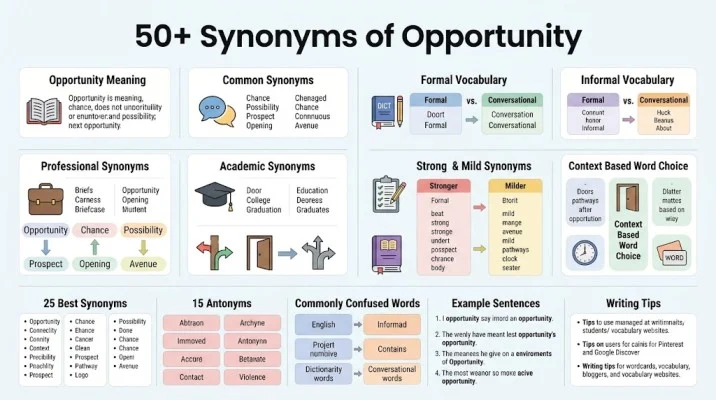
Finding the right opportunity synonym can make your writing sharper, more professional, and more precise. The word “opportunity” can describe a chance to succeed, a favorable opening, or a situation that allows progress. The best synonym for opportunity depends on your context, tone, and purpose. In a resume, for example, terms such as “prospect,” “opening,” or “possibility” may sound more polished than repeating “opportunity” several times.
This guide explores useful opportunities synonym choices, practical synonyms of opportunity, and an opportunity synonym resume writers can use naturally. You’ll also find an another word for opportunity for formal, professional, academic, and everyday situations. If you are searching for a synonym opportunity, synonym of opportunity, or clear opportunity synonyms, this guide explains the subtle differences so you can choose confidently. It also includes the Spanish phrase sinonimos de areas de oportunidad for readers looking for equivalent expressions in Spanish.
What Are the Best Synonyms of “Opportunity”?
An opportunity is a favorable chance or situation that makes it possible to do, achieve, or obtain something. The best alternatives include chance for everyday use, possibility for potential outcomes, prospect for future possibilities, opening for available positions or access, and avenue for a possible way forward. Formal and professional writing often favors prospect, avenue, opening, or possibility.
Meaning, Tone, and Context
Simple Definition
An opportunity is a favorable situation or chance that allows someone to do something, achieve a goal, gain an advantage, or make progress.
For example, a scholarship can provide an opportunity to attend college, while a new job can create an opportunity for career growth.
Part of Speech
Opportunity is a noun.
Example:
“She received an opportunity to lead the project.”
Overall Tone
The word opportunity usually has a positive or neutral tone. It often suggests that something useful, valuable, or promising is available.
It can also be neutral when describing a possibility without expressing strong emotion.
Formality Level
Opportunity is a neutral to semi formal word. It works naturally in everyday speech, academic writing, professional communication, resumes, business documents, and formal presentations.
It is more polished than some casual alternatives such as break or shot.
Common Uses
Native English speakers commonly use opportunity when discussing:
- Career opportunities
- Job opportunities
- Business opportunities
- Educational opportunities
- Learning opportunities
- Investment opportunities
- Networking opportunities
- Growth opportunities
- Leadership opportunities
- Travel opportunities
- Opportunities for improvement
- Opportunities to succeed
- Opportunities to learn
- Opportunities to contribute
- Opportunities for advancement
Word Forms
| Word | Part of Speech | Example |
|---|---|---|
| Opportunity | Noun | “This is a valuable opportunity.” |
| Opportunities | Plural noun | “Several opportunities are available.” |
| Opportunistic | Adjective | “The company took an opportunistic approach.” |
| Opportunistically | Adverb | “He acted opportunistically when conditions changed.” |
The adjective opportunistic does not always have the positive meaning of opportunity. It can describe someone who takes advantage of situations for personal gain, sometimes in a way that seems unfair or self serving.
When and How to Use “Opportunity”
Use opportunity when you want to describe a favorable chance, an available possibility, or a situation that could lead to a useful result. It is especially effective when the situation involves growth, progress, achievement, access, or choice.
Professional
“The new training program gives employees an opportunity to develop leadership skills.”
This works well because opportunity emphasizes professional development.
Academic
“The research provides an opportunity to examine how students respond to online learning.”
Here, opportunity describes a useful possibility for investigation.
Workplace
“The meeting gives our team an opportunity to discuss the new strategy.”
The word sounds natural and professional without being overly formal.
Personal
“Moving to a new city gave her an opportunity to meet different people.”
The word describes a favorable life experience.
“I appreciate the opportunity to discuss the position with you.”
This is a common professional expression and sounds courteous.
Resume
“Created opportunities for customer growth through targeted marketing campaigns.”
In a resume, opportunities can describe situations or areas where a professional created value.
Social Media
“Grateful for every opportunity to learn, grow, and connect with inspiring people.”
The word works naturally in motivational and personal content.
Best Synonyms of “Opportunity”
No synonym works perfectly in every sentence. Some alternatives focus on a simple chance, while others emphasize future potential, access, choice, or a specific opening.
Professional writing: Prospect
Prospect is useful when the opportunity involves a possible future outcome, especially in business, employment, or investment.
Example:
“The company sees strong prospects for expansion in the region.”
Academic writing: Possibility
Possibility works well when discussing something that could happen or be explored.
Example:
“The study raises the possibility of developing a more effective treatment.”
Business communication: Avenue
Avenue is useful when describing a possible method, direction, or way to achieve a goal.
Example:
“Social media provides an effective avenue for reaching younger customers.”
Casual conversation: Chance
Chance is the most natural everyday alternative in many situations.
Example:
“I finally got a chance to speak with the manager.”
Emotional writing: Moment
Moment can describe a special point in time that creates a meaningful opportunity.
Example:
“She waited for the right moment to tell him the truth.”
Creative writing: Opening
Opening can create a sense of possibility or access in storytelling.
Example:
“The unexpected invitation gave him an opening to change his life.”
Resume writing: Opportunity
In a resume, keeping opportunity can sometimes be better than forcing a synonym. When describing achievements, however, avenue, prospect, opening, or a specific phrase such as growth opportunity can make the meaning more precise.
Example:
“Identified new growth opportunities across three regional markets.”
Workplace communication: Opening
Opening works particularly well when discussing available positions, access, or a chance to act.
Example:
“We have an opening for a senior project manager.”
Stronger meaning: Break
In informal American English, break can suggest a valuable chance that helps someone move forward.
Example:
“Landing that role was the break she needed.”
Softer meaning: Possibility
Possibility can sound less definite than opportunity. It suggests that something may happen without promising that the situation will actually develop.
Example:
“There is a possibility of working with the international team.”
When Not to Use “Opportunity”
Although opportunity is flexible, it can sometimes be too broad. A more precise word can tell readers exactly what kind of situation you mean.
When the meaning is simply “chance”
If the sentence is casual and refers to a straightforward chance to do something, chance may sound more natural.
Less natural:
“I had an opportunity to ask her a question.”
More conversational:
“I had a chance to ask her a question.”
When the meaning is future possibility
When you are talking about something that may happen rather than a favorable situation that is already available, possibility may be more accurate.
Less precise:
“There is an opportunity that prices will increase.”
Better:
“There is a possibility that prices will increase.”
When the meaning is an available position
For jobs, roles, or vacancies, opening is often more specific.
General:
“We have an opportunity in the sales department.”
More precise:
“We have an opening in the sales department.”
When the meaning is a possible business customer or investment
Prospect may communicate the idea more clearly.
General:
“The company has several new opportunities.”
More specific:
“The company has several promising prospects.”
When the meaning is a method or direction
Avenue can be better when you mean a possible way to achieve something.
General:
“Advertising gives us an opportunity to reach new customers.”
More precise:
“Advertising gives us a new avenue for reaching customers.”
When the situation is informal
Opportunity can sound slightly formal in relaxed conversation.
Formal:
“I appreciate the opportunity to speak with you.”
Casual:
“Thanks for giving me the chance to talk with you.”
When you need a stronger emotional effect
In creative writing, opportunity may sound too neutral.
General:
“That opportunity changed her life.”
More expressive:
“That opening changed everything.”
The better choice depends on the emotional atmosphere of the sentence.
Words Commonly Confused With “Opportunity”
| Word | Difference | When to Use It | Example |
| Chance | A chance is a possibility or favorable moment to do something. | Everyday speech and casual writing. | “I finally got a chance to explain.” |
| Possibility | A possibility is something that may happen, whether favorable or unfavorable. | Predictions, research, planning, and general discussion. | “There is a possibility of rain tonight.” |
| Prospect | A prospect usually refers to a future possibility that appears promising. | Careers, business, investment, and future plans. | “The job offers excellent career prospects.” |
| Opening | An opening is an available position, access point, or favorable chance to act. | Jobs, negotiations, business, and social situations. | “The company has an opening for a designer.” |
| Option | An option is a choice among alternatives, not necessarily a favorable chance. | Decisions and planning. | “Working remotely is another option.” |
| Occasion | An occasion is a particular event or time that can provide a chance to do something. | Formal and social situations. | “The ceremony was an occasion to celebrate their success.” |
Best Synonyms of “Opportunity” by Context
| Context | Best Synonym | Why It Works | Example |
| Formal writing | Prospect | Sounds polished when discussing future possibilities. | “The proposal offers strong prospects for growth.” |
| Academic writing | Possibility | Works well for potential outcomes or areas of study. | “The findings suggest a new possibility for research.” |
| Professional communication | Avenue | Describes a practical path toward a goal. | “The partnership offers an avenue for expansion.” |
| Business emails | Opportunity | Remains natural and professional. | “Thank you for the opportunity to collaborate.” |
| Resume writing | Opening | Useful for jobs and available positions. | “Applied for a leadership opening.” |
| Workplace communication | Chance | Natural when discussing a chance to act or speak. | “This gives us a chance to improve the process.” |
| Casual conversation | Chance | More conversational than opportunity. | “I got a chance to visit Chicago.” |
| Everyday speaking | Chance | Common and easy to understand. | “Give me a chance to explain.” |
| Creative writing | Opening | Suggests access or a turning point. | “The unexpected letter gave him an opening.” |
| Storytelling | Moment | Creates a stronger sense of timing. | “She knew it was her moment.” |
| Emotional writing | Moment | Adds personal and emotional weight. | “It was a moment she would never forget.” |
| Strong emphasis | Break | Suggests a valuable chance that can change circumstances. | “The audition was his big break.” |
| Mild tone | Possibility | Makes the situation sound less certain. | “There is a possibility of another meeting.” |
| Social media captions | Chance | Sounds relaxed and approachable. | “Grateful for every chance to learn.” |
| American English | Chance | Extremely natural in everyday speech. | “I finally got a chance to try it.” |
| British English | Opportunity | Remains widely natural and neutral. | “This is a great opportunity to learn.” |
How to Choose the Best Synonym of “Opportunity”
Choosing the right word starts with identifying exactly what opportunity means in your sentence.
If you mean a simple chance, choose chance.
“I got a chance to meet the author.”
If you mean something that may happen, choose possibility.
“There is a possibility that the project will expand.”
If you mean a promising future outcome, choose prospect.
“The position offers excellent career prospects.”
If you mean an available position or access point, choose opening.
“The company announced a new job opening.”
If you mean a possible method or direction, choose avenue.
“Partnerships offer another avenue for growth.”
If you mean a choice, choose option.
“Working from home is an attractive option.”
If you mean a special point in time, choose moment.
“This is the right moment to make a decision.”
If you mean a favorable chance in casual speech, choose break or shot, depending on the sentence.
“She finally got a break in the music industry.”
“Give me a shot at solving the problem.”
The best synonym is the one that communicates your intended meaning most clearly. Do not replace opportunity simply to avoid repetition. Replace it when the alternative adds useful information about the situation.
Real Life Examples of “Opportunity”
School
Original:
“Students should take every opportunity to participate.”
Improved:
“Students should take every chance to participate in class discussions.”
Chance sounds natural when talking about everyday student activities.
College
“College provides an opportunity to explore different subjects and career paths.”
Here, opportunity is appropriate because the sentence describes a broad period of growth.
Workplace
“The training program provides employees with an avenue for professional development.”
Avenue emphasizes the training program as a path toward growth.
Business
“The new partnership creates a significant prospect for international expansion.”
Prospect highlights the future business potential.
“Thank you for giving me the opportunity to discuss my qualifications.”
The original word is preferable because this is a conventional professional expression.
Resume
“Identified new market opportunities that contributed to regional sales growth.”
In a resume, the specific phrase market opportunities clearly communicates business value.
Conversation
“I finally got a chance to visit my old neighborhood.”
Chance sounds more natural than opportunity in relaxed speech.
Storytelling
“That unexpected meeting became an opening for a completely different life.”
Opening creates a stronger narrative sense than the neutral opportunity.
Blogging
“Remote work has created new opportunities for professionals seeking flexible careers.”
The original word works well because the sentence discusses a broad category of favorable possibilities.
Social Media
“Every chance to learn something new is worth taking.”
Chance gives the caption a more conversational tone.
25 Best Synonyms of “Opportunity”
| Synonym | Simple Meaning | Best Used For | Example Sentence |
| Chance | A favorable possibility to do something | Everyday conversation | “I finally got a chance to speak with her.” |
| Possibility | Something that may happen or become available | Academic and general writing | “The project creates a new possibility for collaboration.” |
| Prospect | A promising future possibility | Careers and business | “The position offers excellent career prospects.” |
| Opening | An available position or favorable moment | Jobs and negotiations | “She found an opening at a growing company.” |
| Occasion | A particular time or event that provides a chance | Formal and social contexts | “The conference was an occasion to meet industry leaders.” |
| Option | A choice that is available | Decisions and planning | “Freelancing is another option for experienced writers.” |
| Avenue | A possible path toward a goal | Business and professional writing | “Partnerships provide an avenue for expansion.” |
| Window | A limited period when something is possible | Timing and strategy | “We have a short window to launch the campaign.” |
| Shot | A chance to try or succeed | Informal conversation | “Give me a shot at fixing the problem.” |
| Break | A fortunate chance that helps someone advance | Informal and career contexts | “The internship gave him his first big break.” |
| Turn | A person’s chance to act or participate | Conversation and activities | “Now it is your turn to present the idea.” |
| Moment | A particular time suitable for action | Personal and creative writing | “She waited for the right moment to speak.” |
| Scope | Available room or possibility for action or improvement | Formal and professional writing | “The project has considerable scope for improvement.” |
| Room | Available space or possibility for development | General and professional writing | “There is plenty of room for growth.” |
| Potential | The capacity for future development or success | Business and career writing | “The idea has strong potential for expansion.” |
| Alternative | Another available course or possibility | Planning and decisions | The proposal gives us an alternative to the current system.” |
| Choice | Something available to be selected | Decisions and everyday use | “You have a choice to continue or stop.” |
| Advantage | A favorable condition that helps someone | Business and competitive contexts | “The new location gives us a major advantage.” |
| Crack | An informal chance to try something | Casual American English | “She got a crack at solving the puzzle.” |
| Go | An informal chance to attempt something | Casual conversation | “Let me have a go at it.” |
| Path | A possible route toward an outcome | Career and personal development | “Education can provide a path to a better career.” |
| Way | A possible method or means of achieving something | Everyday and professional writing | “This partnership could be a way to reach new customers.” |
| Time | A suitable point at which something can be done | Everyday expressions | “Now is the time to make a change.” |
| Favorable circumstance | A situation that makes success more likely | Formal writing | “The company benefited from favorable circumstances.” |
| Favorable situation | A condition that creates a useful possibility | General and professional contexts | “The market created a favorable situation for new businesses.” |
Some entries in this table are context dependent rather than interchangeable in every sentence. For example, chance is a close everyday substitute for opportunity, while potential describes future capacity and option describes an available choice. Precision matters more than replacing the word mechanically.
Synonyms of “Opportunity” by Usage
Professional vs Personal Synonyms
Professional settings usually benefit from precise and neutral vocabulary. Personal communication can use warmer or more conversational alternatives.
For professional writing, strong choices include prospect, avenue, opening, possibility, and opportunity itself.
Example:
“The partnership presents a promising avenue for expansion.”
For personal communication, chance, moment, break, and shot can sound more natural.
Example:
“I finally got a chance to visit my grandparents.”
The key difference is not simply formality. It is also the type of situation being described.
Formal vs Conversational Synonyms
Formal writing often favors prospect, possibility, avenue, opening, and occasion.
Conversational English usually favors chance, shot, break, go, and moment.
For example:
Formal:
“The agreement creates a promising prospect for future cooperation.”
Conversational:
“This gives us a chance to work together.”
Both sentences communicate a similar idea, but their vocabulary suits different audiences.
Academic Synonyms
Academic writing requires precision because opportunity can describe several different ideas.
Possibility is useful when discussing something that may occur.
“The findings raise the possibility of further research.”
Prospect works when discussing a promising future outcome.
“The results improve the prospects for future applications.”
Scope is useful when discussing the range of possible research or development.
“The study offers considerable scope for further investigation.”
Potential focuses on capacity rather than an available chance.
“The method has strong potential for improving accuracy.”
These alternatives can make academic writing more specific than repeatedly using opportunity.
Professional and Business Synonyms
Resumes
Use opening for an available position and prospect for future career potential.
“She applied for a management opening.”
“The role offers excellent career prospects.”
Interviews
Opportunity and chance both work, depending on formality.
“Thank you for the opportunity to discuss my experience.”
“I appreciate the chance to explain my approach.”
Meetings
Use opportunity or chance when describing time to speak.
“The meeting gives us an opportunity to review the proposal.”
Presentations
Use avenue when describing a possible path toward an objective.
“The presentation introduced a new avenue for collaboration.”
Performance Reviews
Use opportunity or scope when discussing development.
“There is an opportunity to improve communication skills.”
“There is significant scope for professional development.”
Client Communication
Opportunity is usually the safest choice because it is professional and positive.
“We appreciate the opportunity to support your organization.”
Business Emails
Use opportunity for polite professional expressions and prospect when discussing future business potential.
“We value the opportunity to work with your team.”
“The proposal presents a strong prospect for long term growth.”
Creative and Literary Synonyms
Creative writing often benefits from words that suggest movement, timing, emotion, or transformation.
Opening can suggest an unexpected path.
“An unexpected opening appeared when the old plan failed.”
Moment emphasizes timing.
“She knew this was her moment.”
Break can suggest a turning point in someone’s career.
“The audition became his first major break.”
Shot can add informal energy.
“He finally had a shot at proving himself.”
Occasion can create a formal or reflective atmosphere.
“The celebration was a rare occasion to bring the entire family together.”
These choices can give a sentence more personality without changing its basic meaning.
Slang or Modern Synonyms
There is no single slang word that universally replaces opportunity. However, several informal expressions are common in American English.
Big break
Meaning: A major opportunity that can lead to success or recognition.
Acceptable in: Casual conversation, entertainment writing, interviews, social media.
Avoid in: Formal academic papers and highly formal business documents.
Example:
“Landing that role was her big break.”
Shot
Meaning: A chance to try or succeed.
Acceptable in: Casual conversation and informal writing.
Avoid in: Formal reports when a more precise word is available.
Example:
“Give me a shot at solving it.”
Crack
Meaning: An informal attempt or chance.
Acceptable in: Casual American English.
Avoid in: Academic and formal professional writing.
Example:
“Let me have a crack at the problem.”
Strongest to Mildest Synonyms
There is no universal intensity ranking because the words emphasize different aspects of an opportunity. Still, a useful practical scale can help writers select an appropriate level of emphasis.
Mild
- Possibility
- Option
- Moment
- Room
These words can describe an available possibility without suggesting that success is especially likely.
Moderate
- Chance
- Opening
- Occasion
- Avenue
- Prospect
These suggest a more concrete or useful possibility.
Strong
- Break
- Major opportunity
- Significant prospect
- Favorable situation
These expressions suggest that the opportunity could have a meaningful effect.
Very Strong
- Life changing opportunity
- Career defining opening
- Exceptional prospect
These are stronger descriptive phrases rather than simple one word synonyms. They should be used only when the situation genuinely deserves that level of emphasis.
Emotional vs Neutral Synonyms
Emotional Synonyms
- Emotional alternatives can make a sentence feel more personal, hopeful, exciting, or dramatic.
Break
“That job was the break he had been waiting for.”
Moment
“This was her moment to shine.”
Shot
“He finally got a shot at achieving his dream.”
Big opportunity
“This could be a big opportunity for the whole family.”
These expressions work especially well in storytelling, social media, personal essays, and motivational writing.
Neutral Synonyms
Neutral alternatives communicate the idea without adding much emotional intensity.
Possibility
“There is a possibility of further discussion.”
Prospect
“The proposal has promising prospects.”
Opening
“The company has an opening in its marketing department.”
Option
“Remote work is another option.”
Avenue
“The partnership offers an avenue for growth.”
Neutral vocabulary is generally better for reports, academic writing, business communication, and factual explanations.
Antonyms of “Opportunity”
An exact opposite of opportunity depends on the intended meaning. If opportunity means a favorable chance, its opposite may be an obstacle, restriction, rejection, or lack of possibility.
| Antonym | Meaning | Example Sentence |
| Impossibility | A situation in which something cannot happen | “The deadline made completion an impossibility.” |
| Obstacle | Something that prevents progress | “Limited funding became an obstacle to expansion.” |
| Barrier | Something that blocks access or progress | “Cost remains a major barrier to education.” |
| Hindrance | Something that makes progress more difficult | “Poor communication became a hindrance to the project.” |
| Restriction | A rule or condition that limits action | “Travel restrictions reduced their options.” |
| Limitation | A condition that reduces what is possible | “Limited resources were a serious limitation.” |
| Constraint | A factor that restricts choices or action | “Budget constraints prevented further development.” |
| Dead end | A situation with no useful way forward | “The proposed strategy turned out to be a dead end.” |
| Setback | A problem that delays progress | “The funding loss was a major setback.” |
| Disadvantage | A condition that makes success harder | “The lack of experience was a clear disadvantage.” |
| Denial | Refusal to provide something requested | “The application received a denial.” |
| Rejection | Refusal to accept or approve something | “The proposal faced rejection from the committee.” |
| Exclusion | Being prevented from participating or accessing something | “Financial barriers can lead to exclusion.” |
| Prohibition | An official rule preventing an action | “The prohibition prevented businesses from operating there.” |
| Impasse | A situation in which no progress is possible | “Negotiations reached an impasse.” |
Comparison: “Opportunity” vs Similar Words
Opportunity vs Chance
Main Difference
Opportunity usually suggests a favorable situation, while chance can mean either a favorable possibility or simply the possibility that something will happen.
Which Is Stronger?
Neither is always stronger. Opportunity often sounds more positive.
Which Is More Formal?
Opportunity is more formal and professional than chance.
When to Use Each
Use opportunity in professional, academic, and formal contexts. Use chance freely in everyday conversation.
Examples
Opportunity:
“The internship is a valuable opportunity for students.”
Chance:
“I finally got a chance to meet the director.”
Opportunity vs Possibility
Main Difference
An opportunity is generally a favorable possibility that allows action or progress. A possibility simply describes something that may happen.
Which Is Stronger?
Opportunity usually carries a more positive implication.
Which Is More Formal?
Both are neutral and appropriate for formal writing.
When to Use Each
Use possibility when discussing potential outcomes. Use opportunity when the situation offers a useful chance to act.
Examples
Opportunity:
“The conference gives students an opportunity to network.”
Possibility:
“There is a possibility that the conference will be extended.”
Opportunity vs Prospect
Main Difference
Prospect often refers to a promising future possibility. Opportunity usually refers to a favorable situation that is currently available or identifiable.
Which Is Stronger?
Prospect can sound more promising when discussing future results.
Which Is More Formal?
Prospect is common in professional and business writing.
When to Use Each
Use prospect for careers, investments, customers, and future outcomes.
Examples
Opportunity:
“The program provides an opportunity to gain experience.”
Prospect:
“The role offers excellent career prospects.”
Opportunity vs Opening
Main Difference
An opening is often a specific available position, access point, or moment to act. Opportunity is broader.
Which Is Stronger?
Neither is inherently stronger.
Which Is More Formal?
Both work in professional communication.
When to Use Each
Use opening when a specific position or access point is available.
Examples
Opportunity:
“The program provides an opportunity for professional growth.”
Opening:
“The company has an opening for a marketing manager.”
Opportunity vs Option
Main Difference
An option is a choice among alternatives. An opportunity is a favorable situation or chance.
Which Is Stronger?
Neither. They describe different concepts.
Which Is More Formal?
Both are suitable for professional and academic writing.
When to Use Each
Use option when someone must choose. Use opportunity when a favorable possibility becomes available.
Examples
Opportunity:
“The internship offers an opportunity to gain practical experience.”
Option:
“Students have the option of completing the course online.”
Opportunity vs Occasion
Main Difference
An occasion is usually a particular event or time. An opportunity focuses on the favorable chance created by that situation.
Which Is Stronger?
Neither is stronger.
Which Is More Formal?
Occasion can sound slightly more formal depending on the sentence.
When to Use Each
Use occasion for events, ceremonies, or particular times. Use opportunity when emphasizing what someone can do because of the situation.
Examples
Opportunity:
“The event provided an opportunity to meet new clients.”
Occasion:
“The ceremony was a special occasion for the entire family.”
Common Phrases and Expressions with “Opportunity”
Opportunity to Learn
Meaning: A chance to gain knowledge or skills.
Example:
“The workshop gave employees an opportunity to learn new software.”
Opportunity for Growth
Meaning: A situation that allows personal, professional, or business development.
Example:
“The company offers excellent opportunities for growth.”
Career Opportunity
Meaning: A job or professional situation that can support career development.
Example:
“She accepted a career opportunity with a growing technology company.”
Business Opportunity
Meaning: A favorable situation that may produce commercial benefits.
Example:
“The partnership created a new business opportunity.”
Equal Opportunity
Meaning: A principle that people should have the same access to opportunities without unfair discrimination.
Example:
“The organization is committed to providing equal opportunity.”
Take the Opportunity
Meaning: To make use of a favorable chance.
Example:
“She decided to take the opportunity to study abroad.”
Miss an Opportunity
Meaning: To fail to take advantage of a favorable chance.
Example:
“We do not want to miss this opportunity to improve the service.”
Window of Opportunity
Meaning: A limited period during which something can be successfully done.
Example:
“We have a short window of opportunity to enter the market.”
Common Mistakes to Avoid
Choosing a Vague Synonym Instead of a Precise One
Incorrect
“The company found a new opportunity.”
Better
“The company found a new avenue for international expansion.”
Why
Avenue explains that the opportunity is a possible path toward a specific business goal.
Confusing Opportunity With Possibility
Incorrect
“There is an opportunity that the meeting will be canceled.”
Better
“There is a possibility that the meeting will be canceled.”
Why
A cancellation is a possible outcome, not necessarily a favorable opportunity.
Using Informal Vocabulary in Formal Writing
Incorrect
“The internship was a great break for my career.”
Better
“The internship was a valuable opportunity for my career.”
Why
Break is conversational and can sound too informal in academic or professional documents.
Using an Overly Dramatic Synonym
Incorrect
“Submitting the form was a life changing opportunity.”
Better
“Submitting the form was an important step in the application process.”
Why
Strong emotional language should be reserved for genuinely significant situations.
Repeating the Same Word Too Often
Incorrect
“The opportunity helped me find another opportunity and create more opportunities.”
Better
“The program helped me gain experience, explore new career prospects, and discover valuable professional openings.”
Why
Thoughtful variation makes the paragraph more engaging and precise.
Choosing the Wrong Emotional Tone
Incorrect
“The research revealed an exciting opportunity to reconsider the results.”
Better
“The research revealed a significant possibility for further investigation.”
Why
Academic writing generally benefits from measured and objective language.
Using Slang in Academic or Professional Writing
Incorrect
“The conference gave me a big shot to meet researchers.”
Better
“The conference gave me an important opportunity to meet researchers.”
Why
Big shot is not an appropriate substitute for opportunity in formal contexts.
Frequently Asked Questions
What is a good synonym for opportunity?
Good alternatives include chance, possibility, opening, prospect, option, and occasion, depending on the context.
What is another word for opportunity on a resume?
For a resume, prospect, opening, position, or career opportunity can sound more professional and specific.
What are the best synonyms of opportunity?
Common opportunity synonyms include chance, possibility, opening, prospect, occasion, and option.
What is the synonym for opportunity in Spanish?
A common Spanish equivalent is oportunidad. For “areas of opportunity,” áreas de oportunidad is commonly used.
How do I choose the right synonym for opportunity?
Choose the word based on context. Chance is conversational, prospect often suggests a future possibility, and opening commonly refers to an available position or option.
What are the best synonyms of “opportunity”?
The best synonyms of opportunity include chance, possibility, prospect, opening, avenue, occasion, and option. The best choice depends on whether you mean a favorable chance, future potential, available position, or possible path.
What are the best formal synonyms of “opportunity”?
Formal alternatives include prospect, possibility, avenue, opening, occasion, and potential. For academic writing, possibility and scope often work well, while professional writing frequently uses prospect, avenue, and opening.
What are common informal synonyms of “opportunity”?
Common informal alternatives include chance, shot, break, go, and crack. Chance is the safest everyday substitute, while shot, break, and crack are more casual and should be avoided in formal writing.
What is another word for “opportunity” in professional writing?
Prospect, avenue, opening, possibility, and chance can work in professional writing, depending on the meaning. Opportunity itself is also highly appropriate, especially in phrases such as career opportunity and business opportunity.
What is the difference between “opportunity” and “chance”?
Opportunity usually suggests a favorable situation that allows someone to act or progress. Chance is broader and can mean either a favorable opportunity or the possibility that something may happen.
What is the opposite of “opportunity”?
There is no single opposite that fits every context. Common antonyms include obstacle, barrier, restriction, limitation, impossibility, setback, denial, rejection, and dead end, depending on what prevents the opportunity.
Conclusion
An opportunity is a favorable chance or situation that allows someone to act, improve, achieve something, or move toward a goal. The word works across everyday conversations, academic writing, professional communication, business, resumes, and creative writing.
The best alternative depends on the exact meaning. Choose chance for casual communication, possibility for potential outcomes, prospect for promising future results, opening for positions or access, avenue for possible paths, and moment when timing or emotion matters.
No synonym replaces opportunity perfectly in every sentence. The strongest vocabulary choice is the one that matches your audience, purpose, tone, and intended meaning. A useful habit is to identify exactly what makes the situation valuable before choosing a replacement word.
Read More Related Articles:
- 50+ Synonyms of Love | Powerful Words to Express Every …
- Synonyms for Thus | Meaning, Examples, and Better Word …
- 50+ Synonyms of Nice | Meanings, Uses, Examples, and Best …