Happiness can sound simple, but the right word can make your writing warmer, sharper, and more expressive. If you are looking for a happy synonym, there are many options, including joyful, cheerful, delighted, pleased, content, and glad. The best choice depends on the feeling, intensity, and context you want to convey. Exploring happy synonyms can help you avoid repetition while making your speech and writing more natural.
Understanding the synonyms of happy also makes it easier to choose accurate synonyms for happy in everyday, academic, or professional writing. If you need a synonym for happy, a synonym of happy, or simply want to know what is the synonym of happy, context matters. The same principle applies when exploring what is the synonyms of happy, synonyms happy, or the synonym of happy. Each alternative carries its own tone and meaning, so choosing carefully leads to clearer, more effective communication.
What Are the Best Synonyms of “Happy”?
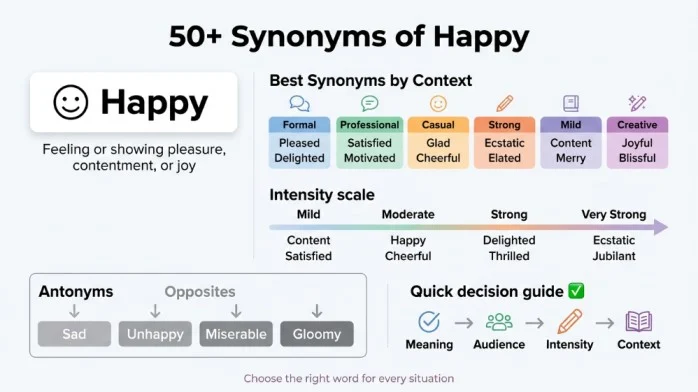
Happy describes a state of pleasure, contentment, or joy. The best synonyms include joyful, cheerful, delighted, elated, ecstatic, and content. Choose pleased for professional writing, content for academic contexts, glad for casual conversation, elated for emotional expression, blissful for creative writing, and ecstatic for intense joy.
Meaning, Tone, and Context
Simple Definition
Happy means feeling or showing pleasure, contentment, or joy. It refers to a positive emotional state that can range from quiet satisfaction to overwhelming excitement.
Part of Speech
Happy is an adjective.
Overall Tone
The word has a positive and uplifting tone. It expresses warmth, satisfaction, or joy without being overly formal or dramatic.
Formality Level
Happy is considered neutral. It works well in both formal and informal communication. It appears naturally in business writing, academic papers, workplace discussions, everyday conversations, emails, and presentations.
Common Uses
Native English speakers commonly use happy when talking about:
- Happy moments
- Happy memories
- Happy relationships
- Happy events
- Happy feelings
- Happy outcomes
- Happy days
- Happy experiences
- Happy celebrations
- Happy lives
Word Forms
| Word Form | Example |
|---|---|
| Adjective | happy |
| Noun | happiness |
| Adverb | happily |
| Related Form | happiness, happily |
| Opposite Form | sad, unhappy |
When and How to Use “Happy”
The word happy works well whenever you want to express a positive emotional state. However, choosing a more specific synonym can make your message clearer and more impactful.
Professional Context
“I am happy to announce the completion of our quarterly report.”
Academic Context
“Participants in the study reported feeling happy with their overall life satisfaction.”
Workplace Context
“My manager was happy with the results of the team’s efforts.”
Personal Context
“I felt truly happy when I saw my family after a long time away.”
Email Context
“I am happy to confirm our meeting for next Tuesday at 10 AM.”
Resume Context
“I am happy to contribute my skills to a dynamic and growing organization.”
Social Media Context
“Feeling so happy today. Life is good.”
Best Synonyms of Happy
The word happy is useful because it fits almost every type of writing, but no single synonym works perfectly in every situation. Some alternatives emphasize intense joy, while others highlight quiet contentment, cheerful disposition, or professional approval. Choosing the right synonym helps your writing sound more natural and precise.
Professional Writing: Pleased
Pleased is one of the best professional alternatives to happy. It shows satisfaction without being overly emotional.
Example: “I am pleased to share the results of our latest campaign.”
Why it works: Business writing benefits from measured language, and pleased communicates approval professionally.
Academic Writing: Content
In essays, research papers, and reports, content is often a better choice than happy because it suggests quiet, lasting satisfaction.
Example: “The participants reported feeling content with their living conditions.”
Why it works: It sounds objective, measured, and academically appropriate.
Business Communication: Delighted
Delighted expresses enthusiasm in a professional manner. It sounds warm yet appropriate for formal settings.
Example: “We are delighted to partner with your organization.”
Why it works: It immediately communicates positive engagement without losing professionalism.
Casual Conversation: Glad
For everyday speaking, glad sounds natural and friendly without becoming overly formal.
Example: “I’m glad you could make it to the party.”
Why it works: Native English speakers frequently use glad to express happiness about specific events.
Emotional Writing: Elated
When discussing significant achievements or heartfelt moments, elated is usually more expressive than happy.
Example: “She was elated when she received the scholarship offer.”
Why it works: It emphasizes intense positive emotion and excitement.
Creative Writing: Blissful
Creative writing often benefits from descriptive vocabulary. Blissful helps create stronger imagery and peaceful scenes.
Example: “They enjoyed a blissful afternoon by the lake.”
Why it works: It captures the reader’s attention and adds depth to storytelling.
Resume Writing: Motivated
Recruiters appreciate language that connects happiness to productivity and drive.
Example: “Motivated professional seeking new challenges in a dynamic environment.”
Why it works: It sounds concise, professional, and achievement-focused.
Workplace Communication: Satisfied
Satisfied demonstrates that expectations have been met. It is neutral and professional.
Example: “My supervisor is satisfied with my performance this quarter.”
Why it works: It communicates approval without emotional excess.
Stronger Meaning: Ecstatic
When you need stronger emphasis, ecstatic is one of the best replacements for happy.
Example: “He was ecstatic when he learned about the promotion.”
Why it works: It suggests overwhelming, almost uncontrollable joy.
Softer Meaning: Cheerful
Sometimes you want to describe a pleasant disposition without making it sound extreme.
Example: “She has a cheerful personality that brightens the office.”
Why it works: It gives a gentle, positive description without exaggeration.
When Not to Use “Happy”
Although happy is versatile, it is not always the most effective word. In many situations, a more specific synonym communicates your message more clearly.
When It Sounds Too General
Sometimes happy is too broad and fails to explain the depth of the emotion.
Less Effective: “I was happy about the promotion.”
Better: “I was thrilled about the promotion.”
Why: Thrilled communicates excitement more effectively than happy.
When Greater Intensity Is Needed
If the situation involves life-changing events or overwhelming joy, happy may sound too weak.
Less Effective: “She was happy when she won the award.”
Better: “She was ecstatic when she won the award.”
Why: Ecstatic communicates overwhelming joy and celebration.
In Academic Writing
Academic writing usually favors more precise vocabulary.
Less Effective: “The participants were happy with the program.”
Better: “The participants expressed satisfaction with the program.”
Why: Satisfaction is more objective and commonly used in research writing.
On a Resume
General wording often reduces the impact of your professional description.
Less Effective: “Happy to work in a team environment.”
Better: “Motivated to collaborate in team environments.”
Why: Motivated connects positive feelings to professional drive.
In Creative Writing
Using happy repeatedly can make storytelling feel flat and uninteresting.
Less Effective: “It was a happy day.”
Better: “It was a blissful day.”
Why: Blissful creates stronger imagery and leaves a lasting impression.
When Expressing Professional Approval
Happy can sound too personal for official feedback.
Less Effective: “My manager was happy with my work.”
Better: “My manager was satisfied with my work.”
Why: Satisfied is more professional and appropriate for performance discussions.
Words Commonly Confused With “Happy”
| Word | Difference | When to Use It | Example |
|---|---|---|---|
| Glad | Expresses pleasure about a specific event. | Casual reactions, daily situations. | “I am glad you enjoyed the meal.” |
| Joyful | Suggests deeper, more profound happiness. | Celebrations, spiritual moments. | “The joyful crowd sang together.” |
| Content | Describes quiet satisfaction and peace. | Reflective writing, life satisfaction. | “She felt content with her simple life.” |
| Cheerful | Describes an outward demeanor or disposition. | Describing personalities, appearances. | “She has a cheerful smile.” |
| Delighted | Stronger and more formal than happy. | Formal reactions, good news. | “We were delighted to receive your invitation.” |
| Ecstatic | Expresses extreme, overwhelming happiness. | Life-changing events. | “He was ecstatic when he won.” |
Best Synonyms of Happy by Context
| Context | Best Synonym | Why It Works | Example |
|---|---|---|---|
| Formal Writing | Pleased | Polite and professional | “I am pleased to share the results.” |
| Academic Writing | Content | Measured and precise | “Participants reported being content.” |
| Professional Communication | Delighted | Enthusiastic yet professional | “We are delighted to partner with you.” |
| Business Emails | Pleased | Clear and appropriate | “I am pleased to confirm the meeting.” |
| Resume Writing | Motivated | Connects happiness to productivity | “Motivated to achieve team goals.” |
| Workplace Communication | Satisfied | Indicates expectations met | “My supervisor is satisfied with my work.” |
| Casual Conversation | Glad | Simple and friendly | “I am glad you could come.” |
| Everyday Speaking | Happy | Natural and common | “I am so happy today.” |
| Creative Writing | Blissful | Adds depth and imagery | “They enjoyed a blissful afternoon.” |
| Storytelling | Joyful | Conveys warmth and celebration | “The joyful reunion brought tears.” |
| Emotional Writing | Elated | Conveys intense emotion | “She was elated by the news.” |
| Strong Emphasis | Ecstatic | Expresses overwhelming joy | “He was ecstatic about the win.” |
| Mild Tone | Cheerful | Gentle and positive | “She has a cheerful personality.” |
| Social Media Captions | Thrilled | Casual and engaging | “I am thrilled to share this news.” |
Synonyms of Happy by Usage
The word happy works in almost every situation, but choosing a more specific synonym makes your writing stronger and more natural. The sections below explain which alternatives fit different types of communication.
Professional vs Personal Synonyms
- Professional communication requires measured vocabulary, while personal conversations sound better with simpler, more relatable words.
Professional Synonyms:
| Synonym | Best Used For | Why It Works |
|---|---|---|
| Pleased | Professional correspondence | Shows satisfaction formally |
| Satisfied | Performance reviews | Indicates expectations met |
| Delighted | Client communication | Expresses enthusiasm professionally |
| Motivated | Resumes, interviews | Connects happiness to productivity |
| Content | Professional writing | Suggests quiet satisfaction |
| Appreciative | Thank-you notes | Expresses gratitude professionally |
Recommendation: Use pleased, satisfied, delighted, or motivated in resumes, business emails, presentations, and reports because they sound more professional than happy.
Personal Synonyms:
| Synonym | Best Used For | Example |
|---|---|---|
| Glad | Daily conversations | “I’m glad you called.” |
| Happy | General use | “I’m happy for you.” |
| Cheerful | Describing people | “She’s always so cheerful.” |
| Thrilled | Exciting news | “I’m thrilled for you!” |
| Joyful | Special moments | “It was a joyful day.” |
Recommendation: In conversations with friends and family, natural words like glad, cheerful, and thrilled often sound better than overly formal alternatives.
Formal vs Conversational Synonyms
Choosing the right level of formality helps your writing match the audience.
| Situation | Best Synonyms |
|---|---|
| Reports | Significant, Satisfying |
| Essays | Content, Joyful |
| Business Writing | Pleased, Delighted |
| Presentations | Appreciative, Encouraged |
| Professional Emails | Pleased, Delighted |
| Casual Conversations | Glad, Happy, Cheerful |
| Text Messages | Happy, Glad, Thrilled |
Example:
- Formal: “The committee was pleased with the results.”
- Conversational: “I’m so happy for you.”
Academic Synonyms
Academic writing benefits from vocabulary that sounds precise and objective.
Content: Suggests measured satisfaction without emotional excess.
Example: “The participants reported feeling content with their living conditions.”
Satisfied: Indicates that expectations were met in a neutral way.
Example: “The students expressed satisfaction with the course structure.”
Pleased: Polite and appropriate for academic correspondence.
Example: “The faculty was pleased with the student submissions.”
Joyful: Works for qualitative research describing emotional states.
Example: “The joyful responses indicated positive outcomes.”
Recommendation: For essays and research papers, content, satisfied, and pleased usually sound stronger and more authoritative than happy.
Professional and Business Synonyms
Professional settings require vocabulary that conveys competence and positive engagement.
Pleased: Shows satisfaction without being overly emotional.
Example: “I am pleased with the quarterly results.”
Satisfied: Demonstrates that goals were met.
Example: “Our clients are satisfied with the service.”
Delighted: Shows enthusiasm without losing professionalism.
Example: “We are delighted to welcome you to our team.”
Motivated: Connects happiness to productivity and drive.
Example: “Motivated employees contribute more effectively.”
Appreciative: Expresses gratitude professionally.
Example: “I am appreciative of the team’s hard work.”
Recommendation: Use these words in resumes, interviews, meetings, presentations, business emails, and client communication to sound more professional.
Creative and Literary Synonyms
Creative writing benefits from expressive vocabulary that creates emotion and imagery.
Blissful: Suggests perfect, peaceful happiness.
Example: “The couple spent a blissful afternoon on the beach.”
Joyful: Conveys warmth and celebration.
Example: “The joyful celebration brought the community together.”
Jubilant: Expresses triumphant, exuberant happiness.
Example: “The jubilant crowd celebrated the championship.”
Radiant: Describes a person who glows with happiness.
Example: “She looked radiant on her wedding day.”
Exuberant: Suggests energetic and enthusiastic joy.
Example: “The exuberant child could not stop dancing.”
These words make stories, speeches, and descriptive writing more engaging.
Slang or Modern Synonyms
There are no true slang synonyms for happy, but native speakers often use casual expressions in everyday conversation.
| Expression | Meaning | Appropriate For | Avoid In |
|---|---|---|---|
| Psyched | Excited and happy | Friends, social media | Academic papers |
| Stoked | Extremely excited | Casual speech | Professional reports |
| Pumped | Excited and eager | Social media, sports | Formal writing |
| Over the moon | Extremely happy | Everyday speech | Business writing |
Example:
- Casual: “I’m so stoked about the concert.”
- Formal: “I am thrilled about the opportunity.”
Strongest to Mildest Synonyms
The following scale shows how different synonyms express different levels of happiness.
| Intensity | Synonyms |
|---|---|
| Mild | Content, Pleased, Satisfied |
| Moderate | Happy, Cheerful, Glad |
| Strong | Delighted, Joyful, Thrilled |
| Very Strong | Ecstatic, Elated, Overjoyed, Jubilant, Blissful |
Understanding the Scale:
- Content suggests quiet satisfaction.
- Pleased shows approval and satisfaction.
- Happy is the general term for positive feeling.
- Delighted expresses strong pleasure.
- Joyful conveys deep happiness.
- Elated shows intense excitement.
- Ecstatic expresses overwhelming joy.
Emotional vs Neutral Synonyms
Some synonyms express strong feelings, while others simply communicate satisfaction.
Emotional Synonyms:
| Synonym | Best Used For |
|---|---|
| Joyful | Celebrations, spiritual moments |
| Elated | Significant achievements |
| Ecstatic | Life-changing events |
| Blissful | Perfect, peaceful moments |
| Jubilant | Triumphant celebrations |
| Overjoyed | Reunions, good news |
These words add emotion and help readers connect with the message.
Neutral Synonyms:
| Synonym | Best Used For |
|---|---|
| Content | Life satisfaction |
| Pleased | Professional contexts |
| Satisfied | Performance reviews |
| Glad | Casual reactions |
| Cheerful | Describing personalities |
Neutral words communicate happiness without adding unnecessary emotional intensity.
Antonyms of Happy
| Antonym | Meaning | Example Sentence |
|---|---|---|
| Sad | Feeling unhappiness | She felt sad after hearing the news. |
| Unhappy | Not happy | He was unhappy with the decision. |
| Miserable | Extremely unhappy | The miserable weather ruined the trip. |
| Depressed | Very sad over a long time | He felt depressed and isolated. |
| Gloomy | Dark and depressing | She had a gloomy outlook on life. |
| Melancholy | Deep, sad reflection | The melancholy music made him cry. |
| Sorrowful | Full of sorrow | The sorrowful farewell was emotional. |
| Downcast | Sad or disappointed | He looked downcast after the loss. |
| Disheartened | Feeling discouraged | She felt disheartened by the criticism. |
| Dejected | Low in spirits | He was dejected after the rejection. |
| Despondent | Without hope | The despondent patient lost motivation. |
| Forlorn | Lonely and sad | The forlorn child sat alone. |
| Mournful | Full of sadness | The mournful song brought tears. |
| Woeful | Full of sorrow | The woeful situation was tragic. |
| Crestfallen | Disappointed and sad | She was crestfallen when she heard the news. |
Comparison: “Happy” vs Similar Words
Happy vs Glad
Main Difference: Glad is often used to express pleasure about a specific event. Happy describes a broader, more general emotional state.
Which Is Stronger? Happy is generally stronger because it describes a more lasting or deeper feeling.
Which Is More Formal? Both are neutral, but glad is slightly more casual.
When to Use Each: Use glad for quick reactions. Use happy for overall satisfaction.
Examples:
- Happy: “I am happy with my life.”
- Glad: “I am glad you called.”
Happy vs Joyful
Main Difference: Joyful suggests deeper, more profound happiness. Happy is more casual and everyday.
Which Is Stronger? Joyful is much stronger and more meaningful.
Which Is More Formal? Joyful is more formal and literary.
When to Use Each: Use joyful for significant, celebratory moments. Use happy for everyday emotions.
Examples:
- Happy: “I am happy to see you.”
- Joyful: “The joyful celebration brought the community together.”
Happy vs Content
Main Difference: Content describes quiet satisfaction and peace. Happy is more active and expressive.
Which Is Stronger? Happy is stronger in terms of expressiveness.
Which Is More Formal? Content is slightly more formal and measured.
When to Use Each: Use content for peaceful satisfaction. Use happy for expressive joy.
Examples:
- Happy: “She is happy with her job.”
- Content: “He is content with his simple life.”
Happy vs Delighted
Main Difference: Delighted is stronger and more formal. It suggests great pleasure about a specific thing.
Which Is Stronger? Delighted is much stronger.
Which Is More Formal? Delighted is more formal.
When to Use Each: Use delighted for formal reactions. Use happy for general contexts.
Examples:
- Happy: “I am happy to help.”
- Delighted: “We are delighted to welcome you.”
Happy vs Ecstatic
Main Difference: Ecstatic expresses extreme, overwhelming happiness. Happy is moderate.
Which Is Stronger? Ecstatic is extremely strong.
Which Is More Formal? Ecstatic is neutral but intense.
When to Use Each: Use ecstatic only for life-changing moments. Use happy for everyday positivity.
Examples:
- Happy: “I am happy about the promotion.”
- Ecstatic: “She was ecstatic when she won the award.”
Happy vs Cheerful
Main Difference: Cheerful describes an outward demeanor. Happy describes an internal state.
Which Is Stronger? They are similar in strength but differ in focus.
Which Is More Formal? Cheerful is slightly more casual.
When to Use Each: Use cheerful for describing appearance or personality. Use happy for describing feelings.
Examples:
- Happy: “I feel happy today.”
- Cheerful: “She has a cheerful smile.”
Common Phrases and Expressions with “Happy”
| Phrase | Meaning | Example Sentence |
|---|---|---|
| Happy Birthday | A greeting used to celebrate someone’s birthday. | “I wish you a very happy birthday.” |
| Happy New Year | A greeting used at the beginning of a new year. | “We wish you a happy New Year.” |
| Happy Ending | A positive or satisfying conclusion. | “The movie had a happy ending.” |
| Happy Medium | A balance between extremes. | “We need to find a happy medium.” |
| Happy Camper | A person who is satisfied and content. | “He was not a happy camper after the delay.” |
| Happy Hour | A period when drinks are sold at reduced prices. | “Let’s meet during happy hour.” |
| Happy-Go-Lucky | Carefree and unconcerned. | “She has a happy-go-lucky personality.” |
Common Mistakes to Avoid
1. Choosing a Vague Synonym Instead of a Precise One
Incorrect: “I am happy about the results.”
Better: “I am satisfied with the results.”
Why: Satisfied is more specific and professional.
2. Using Informal Words in Formal Writing
Incorrect: “I am thrilled to share the report.”
Better: “I am pleased to share the report.”
Why: Formal documents require precise and professional vocabulary.
3. Choosing an Overly Strong Synonym
Incorrect: “I was ecstatic about the sandwich.”
Better: “I was happy about the sandwich.”
Why: Reserve ecstatic for genuinely life-changing moments.
4. Repeating “Happy” Too Often
Incorrect: “I am happy with my job. I am happy with my home. I am happy with my life.”
Better: “I am satisfied with my job. I am content with my home. I am happy with my life.”
Why: Using varied vocabulary improves readability and style.
5. Confusing “Happy” with “Cheerful”
Incorrect: “I feel cheerful today because of the good news.”
Better: “I feel happy today because of the good news.”
Why: Cheerful describes an outward disposition, while happy describes an internal feeling.
6. Using Emotional Words in Academic Writing
Incorrect: “The results were joyful.”
Better: “The results were positive.”
Why: Academic writing generally prefers objective language.
7. Overusing Strong Synonyms
Incorrect: “I am ecstatic about every meal I eat.”
Better: “I am happy about my meals, but I was ecstatic about the celebration dinner.”
Why: Saving stronger words for genuinely significant moments makes them more effective.
Frequently Asked Questions
What is a synonym for happy?
Common synonyms for happy include joyful, cheerful, delighted, pleased, content, glad, and blissful. The best choice depends on the situation and level of emotion.
What are the synonyms of happy?
Happy synonyms include joyful, cheerful, delighted, glad, pleased, content, satisfied, upbeat, and elated. Each word can express a slightly different feeling.
What is another synonym for happy?
A useful synonym for happy is joyful. Other options include cheerful, glad, pleased, content, and delighted.
What is the synonym of happy in English?
The synonym of happy depends on context. Glad and pleased are common everyday choices, while delighted and elated express stronger happiness.
What are the best synonyms for happy?
The best synonyms for happy include joyful, cheerful, delighted, glad, pleased, content, and elated. Choose one based on tone and emotional strength.
1. What are the best synonyms of “happy”?
The best synonyms depend on the context. For formal writing, use pleased or delighted. For casual conversation, use glad or cheerful. Intense emotion, use ecstatic or elated. For quiet satisfaction, use content.
2. What are the best formal synonyms of “happy”?
Strong formal alternatives include pleased, delighted, content, satisfied, and joyful. These words work well in academic papers, business reports, and professional correspondence.
3. What are common informal synonyms of “happy”?
Common informal alternatives include glad, cheerful, thrilled, psyched, and stoked. These words sound natural in everyday conversations and social media posts.
4. What is another word for “happy” in professional writing?
In professional communication, excellent alternatives include pleased, satisfied, delighted, and motivated. These words make reports, emails, resumes, and presentations sound more polished.
5. What is the difference between “happy” and “joyful”?
Happy describes general pleasure or contentment. Joyful describes a deeper, more profound happiness often associated with celebration or spiritual meaning. Joyful is stronger and more formal than happy.
6. What is the opposite of “happy”?
The most common opposites include sad, unhappy, miserable, depressed, gloomy, and melancholy. Each describes a negative emotional state.
Conclusion
The word happy is one of the most common adjectives in English, but using it repeatedly can make your writing feel repetitive. Learning the best synonyms of happy helps you express your ideas with greater accuracy, stronger style, and better clarity.
you’re writing an essay, preparing a business presentation, updating your resume, or having a casual conversation, no single synonym fits every situation. Words like joyful, cheerful, delighted, elated, ecstatic, and content each carry unique meanings and should be chosen based on your audience, tone, and purpose.
A simple way to improve your vocabulary is to pause before writing happy and ask yourself what kind of happiness you want to express. Choosing the most appropriate synonym will make your writing more engaging, professional, and natural.
Read More Related Articles:
- Synonyms for Regret | Meaning, Examples, and Better Word Choices
- Best Words to Replace “Align” in Every Context