Clear communication often depends on choosing the right transition word, and synonyms of however can make your writing smoother, more engaging, and easier to understand. Whether you’re writing an academic paper, business email, blog post, or everyday message, repeating the same connector weakens your content. Learning better alternatives helps improve readability, strengthens your arguments, and creates a more natural writing style that keeps readers interested from beginning to end.
Many writers search for synonyms of however to avoid repetition while keeping the same contrast or opposing idea. From formal expressions to conversational alternatives, the right replacement depends on tone and context. This guide highlights the best options, explains when to use each one, and provides practical examples so you can write with greater confidence, clarity, and impact.
What Are the Best Synonyms of “However”?
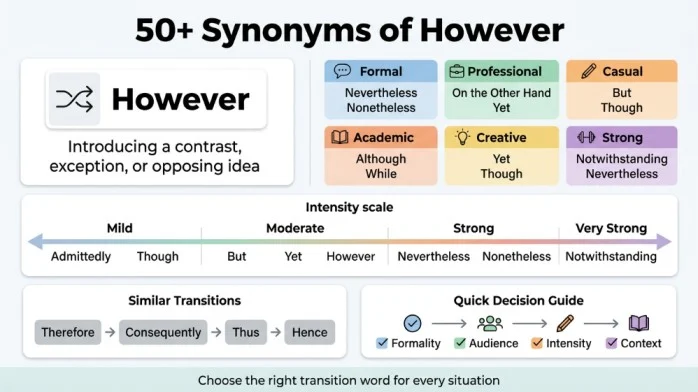
However is a conjunctive adverb used to introduce a contrast, exception, or opposing idea. The best synonyms include nevertheless, nonetheless, yet, but, although, though, whereas, and on the other hand. Choose nevertheless for formal writing, but for casual conversation, although for academic writing, yet for emotional contrast, and on the other hand for comparing two ideas.
Meaning, Tone, and Context
Simple Definition
The word however is used to introduce a statement that contrasts with or seems to contradict something that has been said previously. It signals a shift in thought, an exception, or an opposing perspective.
Part of Speech
However is a conjunctive adverb (also called a transitional adverb).
Overall Tone
However is neutral. It does not add strong emotion to a sentence, but it creates a logical relationship between ideas.
Formality Level
However is considered neutral to formal. It appears naturally in academic writing, business reports, essays, professional emails, presentations, and formal speeches. In casual conversation, shorter words like but, yet, or though are more common.
Common Uses
Native English speakers commonly use however when:
- Introducing a contrasting idea
- Showing an exception to a previous statement
- Transitioning to a different perspective
- Presenting an opposing argument
- Adding a surprising or unexpected point
- Connecting two related but different ideas
- Creating flow between paragraphs
Word Forms
| Form | Word |
|---|---|
| Conjunctive Adverb | however |
| Related Forms | nevertheless, nonetheless, notwithstanding |
| Opposite Function | therefore, consequently, thus (show similarity rather than contrast) |
When and How to Use “However”
The word however works well whenever you need to introduce a contrast or exception. However, choosing a more specific synonym can make your writing clearer and more impactful. Here are seven realistic examples showing how however is used in different contexts.
Professional
“The project was completed on time. However, the budget exceeded the original estimate.”
Academic
“The results support the hypothesis. However, further research is needed to confirm the findings.”
Workplace
“Our team worked efficiently. However, we encountered unexpected technical difficulties.”
Personal
“I enjoy my job. However, I sometimes miss working remotely.”
“We appreciate your interest in our services. However, we are unable to offer a discount at this time.”
Resume
“I have extensive experience in marketing. However, my background also includes significant work in data analysis.”
Social Media
“The weather was perfect for the event. However, attendance was lower than expected.”
Best Synonyms of “However”
The word however is useful because it fits almost every type of writing, but no single synonym works perfectly in every situation. Some alternatives emphasize contrast, while others highlight exceptions, concessions, or opposing viewpoints. Choosing the right synonym helps your writing sound more natural and precise.
Professional Writing: Nevertheless
Nevertheless is one of the strongest professional alternatives to however. It shows that something remains true despite what was just mentioned.
Example:
“The company faced significant challenges. Nevertheless, it achieved record profits.”
Why it works:
Business writing often benefits from words that emphasize resilience and determination. Nevertheless communicates persistence despite obstacles.
Academic Writing: Nonetheless
In essays, research papers, and reports, nonetheless is often a better choice than however because it sounds more formal and measured.
Example:
“The study had several limitations. Nonetheless, the findings provide valuable insights.”
Why it works:
It sounds objective, formal, and academically appropriate.
Casual Conversation: But
For everyday speaking, but sounds natural and familiar without becoming overly formal.
Example:
“I wanted to go to the party, but I was too tired.”
Why it works:
Native English speakers frequently use but in casual conversation because it is short and direct.
Emotional Writing: Yet
When discussing personal experiences, emotions, or surprising outcomes, yet often sounds more expressive than however.
Example:
“She was exhausted after the long journey, yet she couldn’t stop smiling.”
Why it works:
Yet adds a subtle emotional weight that however lacks. It suggests something unexpected or remarkable.
Creative Writing: Though
Creative writing often benefits from more flexible transitions. Though helps create a natural, conversational flow in storytelling.
Example:
“He was terrified of speaking in public. His voice was steady, though.”
Why it works:
Though can appear at the end of a sentence, giving creative writers more stylistic freedom.
Resume Writing: While
Recruiters frequently see while because it effectively contrasts two related points in a professional context.
Example:
“While my primary expertise is in finance, I have also developed strong project management skills.”
Why it works:
It sounds concise, professional, and achievement-focused.
Workplace Communication: On the Other Hand
When comparing two options or perspectives, on the other hand is a clear and balanced alternative.
Example:
“The first proposal is cost-effective. On the other hand, the second option offers better long-term value.”
Why it works:
It immediately signals that you are presenting a different perspective.
Stronger Emphasis: Notwithstanding
When you want to emphasize that something remains true despite obstacles, notwithstanding is a powerful formal alternative.
Example:
“Notwithstanding the challenges, the team delivered exceptional results.”
Why it works:
It communicates determination and resilience while maintaining a formal tone.
Softer Contrast: Admittedly
When you want to acknowledge a counterpoint without making it sound confrontational, admittedly is a gentle alternative.
Example:
“The proposal has some weaknesses. Admittedly, it also offers several advantages.”
Why it works:
It creates a balanced, thoughtful tone.
When Not to Use “However”
Although however is versatile, it is not always the most effective word. In many situations, a more specific synonym communicates your message more clearly.
When It Makes Writing Repetitive
Using however repeatedly can make your writing sound mechanical and dull.
Less Effective:
“The team worked hard. However, the deadline was missed. however, they received positive feedback. However, improvements are still needed.”
Better:
“The team worked hard. Nevertheless, the deadline was missed. They received positive feedback. Still, improvements are needed.”
Why:
Varied transitions make writing more engaging and professional.
In Casual Conversation
In everyday speech, however can sound overly formal or stiff.
Less Effective:
“I wanted to go to the movies. However, I was too tired.”
Better:
“I wanted to go to the movies, but I was too tired.”
Why:
But is shorter, more direct, and sounds natural in conversation.
When a Simpler Transition Is Available
Sometimes a shorter word is more effective than however.
Less Effective:
“The product is expensive. However, it is high quality.”
Better:
“The product is expensive, but it is high quality.”
Why:
But is simpler and more direct.
In Academic Writing When Formality Is Expected
In academic writing, however sometimes sounds too conversational. Use more formal alternatives.
Less Effective:
“The results were consistent. However, more research is needed.”
Better:
“The results were consistent. Nonetheless, more research is needed.”
Why:
Nonetheless sounds more academic and measured.
When Contrasting Two Points Equally
If you are presenting two balanced perspectives, however may not provide enough clarity.
Less Effective:
“The policy has benefits. However, it also has drawbacks.”
Better:
“The policy has benefits. On the other hand, it also has drawbacks.”
Why:
On the other hand clearly signals a comparison of two ideas.
In Short Sentences
Using however in a short sentence can sound unnatural or overly formal.
Less Effective:
“It rained. However, we enjoyed the day.”
Better:
“It rained, but we enjoyed the day.”
Why:
But is more natural in short, simple sentences.
Words Commonly Confused With “However”
| Word | Difference | When to Use It | Example |
|---|---|---|---|
| But | Shorter and more direct than however. Used to connect two ideas in the same sentence. | Casual writing, everyday conversation, informal emails. | “I wanted to go, but I was tired.” |
| Yet | Suggests something surprising or unexpected. Adds emotional weight. | Creative writing, emotional contexts, storytelling. | “She was exhausted, yet she continued running.” |
| Although | Introduces a concession at the beginning of a sentence. | Academic writing, formal essays, complex sentences. | “Although it was raining, we decided to go.” |
| Though | Similar to although but more flexible. Can appear at the end of a sentence. | Casual writing, creative writing, conversation. | “It was raining. We went anyway, though.” |
| Nevertheless | Formal and emphatic. Shows that something remains true despite what was said. | Business writing, formal reports, professional communication. | “The risks were high. Nevertheless, we proceeded.” |
| While | Used to contrast two ideas that occur at the same time. | Professional writing, academic writing, resumes. | “While I enjoy writing, I also love editing.” |
Best Synonyms of “However” by Context
| Context | Best Synonym | Why It Works | Example |
|---|---|---|---|
| Formal Writing | Nevertheless | Sounds professional and precise. | “The proposal had flaws. Nevertheless, it was approved.” |
| Academic Writing | Nonetheless | Fits research and essays naturally. | “The results are promising. Nonetheless, more data is needed.” |
| Professional Communication | On the Other Hand | Clearly signals a different perspective. | “The first option is cheaper. On the other hand, the second is more reliable.” |
| Business Emails | However | Appropriate and professional. | “We appreciate your feedback. However, we cannot make changes at this time.” |
| Resume Writing | While | Concise and achievement-focused. | “While my background is in finance, I have extensive marketing experience.” |
| Workplace Communication | Yet | Emphasizes unexpected results. | “The project was complex, yet the team delivered on time.” |
| Casual Conversation | But | Short, direct, and natural. | “I wanted to go, but I was busy.” |
| Everyday Speaking | Though | Flexible and conversational. | “It was expensive. It was worth it, though.” |
| Creative Writing | Yet | Adds emotional depth and imagery. | “The night was dark, yet the stars shone brightly.” |
| Storytelling | Though | Creates natural narrative flow. | “He was afraid. He kept walking, though.” |
| Emotional Writing | Yet | Expresses surprising outcomes. | “She was heartbroken, yet she found the strength to smile.” |
| Strong Emphasis | Notwithstanding | Indicates resilience despite obstacles. | “Notwithstanding the difficulties, we succeeded.” |
| Mild Tone | Admittedly | Acknowledges a point without confrontation. | “The proposal has flaws. Admittedly, it also has strengths.” |
| Social Media Captions | But | Short and engaging. | “The weather was perfect, but the lines were long.” |
| American English | However | Widely used in all contexts. | “It was late. However, we decided to continue.” |
| British English | Nevertheless | Common in formal and professional writing. | “The risks were considerable. Nevertheless, we pressed on.” |
Synonyms of “However” by Usage
Professional vs Personal Synonyms
- Professional communication requires precise vocabulary, while personal conversations sound better with simpler, more relatable words.
Professional Synonyms:
- Nevertheless – Best for reports, policies, and formal communication.
- Nonetheless – Appropriate for academic and business writing.
- On the Other Hand – Useful for comparing options.
- While – Effective in resumes and professional documents.
- Yet – Works well in professional writing to show unexpected results.
Recommendation: Use nevertheless, nonetheless, while, and yet in business emails, presentations, and reports because they sound more polished than however.
Personal Synonyms:
- But – Best for everyday conversation.
- Though – Natural and flexible in casual speech.
- Yet – Adds emotion to personal stories.
- Still – Useful for showing persistence.
Recommendation: In conversations with friends and family, natural words like but, though, and still often sound better than formal alternatives.
Formal vs Conversational Synonyms
Choosing the right level of formality helps your writing match the audience.
| Situation | Best Synonyms |
|---|---|
| Reports | Nevertheless, Nonetheless |
| Essays | Although, Nonetheless |
| Business Writing | Nevertheless, Yet |
| Presentations | On the Other Hand, Yet |
| Professional Emails | However, Nevertheless |
| Casual Conversations | But, Though |
| Text Messages | But, Though |
Example:
- Formal: “The results were inconclusive. Nonetheless, the research provides valuable insights.”
- Conversational: “The test didn’t go well, but I learned a lot.”
Academic Synonyms
Academic writing benefits from vocabulary that sounds precise and objective.
Nonetheless – Commonly used in research papers and formal essays.
Example: “The findings are preliminary. Nonetheless, they suggest a clear trend.”
Although – Best for introducing concessions at the beginning of a sentence.
Example: “Although the sample size was small, the results were statistically significant.”
While – Useful for contrasting two related points.
Example: “While the study focused on adults, the findings may apply to younger populations.”
On the Other Hand – Effective when comparing two perspectives.
Example: “On the other hand, the alternative approach yielded different results.”
Yet – Appropriate when discussing surprising outcomes.
Example: “The experiment was flawed, yet it produced valuable data.”
Recommendation: For essays, research papers, and academic discussions, nonetheless, although, and while usually sound stronger and more authoritative than however.
Professional and Business Synonyms
Business communication often requires concise and specific language.
Nevertheless – Perfect for reports and formal communications.
Example: “Sales declined in the first quarter. Nevertheless, the company remains optimistic.”
Yet – Highlights unexpected or impressive outcomes.
Example: “The project faced many obstacles, yet the team delivered exceptional results.”
On the Other Hand – Useful for comparing business strategies.
Example: “The first strategy is low-cost. On the other hand, the second offers better growth potential.”
While – Frequently appears in resumes and job descriptions.
Example: “While my primary role was in sales, I also developed strong analytical skills.”
Notwithstanding – Emphasizes resilience in professional contexts.
Example: “Notwithstanding the economic downturn, the company expanded its operations.”
Recommendation: Use these words in resumes, interviews, meetings, presentations, business emails, and client communication to sound more professional.
Creative and Literary Synonyms
Creative writing benefits from expressive vocabulary that creates emotion and imagery.
Yet – Adds emotional depth and surprise.
Example: “The night was cold, yet her heart was warm.”
Though – Creates natural, conversational flow in storytelling.
Example: “He had no reason to trust her. He did, though.”
Still – Emphasizes persistence or continuation.
Example: “The obstacles seemed insurmountable. Still, they pressed forward.”
Nevertheless – Adds a formal tone to literary works.
Example: “The storm raged outside. Nevertheless, she felt at peace.”
Yet – Expresses unexpected outcomes in dramatic situations.
Example: “He lost everything, yet he never lost hope.”
These words make stories, speeches, and descriptive writing more engaging.
Strongest to Mildest Synonyms
The following scale shows how different synonyms express different levels of contrast and emphasis.
| Intensity | Synonyms |
|---|---|
| Mild | Admittedly, Though |
| Moderate | But, Yet, However |
| Strong | Nevertheless, Nonetheless, Yet |
| Very Strong | Notwithstanding, Despite That |
Understanding the Scale:
- Admittedly gently acknowledges a counterpoint.
- Though adds a soft contrast.
- But provides a direct contrast.
- Yet emphasizes unexpected outcomes.
- However gives clear contrast.
- Nevertheless emphasizes persistence despite obstacles.
- Notwithstanding stresses resilience in difficult situations.
Emotional vs Neutral Synonyms
Some synonyms express feelings, while others simply communicate contrast.
Emotional Synonyms:
- Yet – Best for surprising or emotional outcomes.
- Still – Suggests persistence and determination.
- Though – Adds a conversational emotional tone.
- Nevertheless – Emphasizes resilience and determination.
Example: “She was exhausted, yet she continued to fight.”
Neutral Synonyms:
- However – Standard contrast.
- But – Direct contrast.
- On the Other Hand – Balanced comparison.
- While – Objective contrast.
- Whereas – Formal comparison.
Example: “The first option is cheaper, whereas the second is more reliable.”
Antonyms of “However” (Transition Words Showing Similarity)
| Antonym | Meaning | Example Sentence |
|---|---|---|
| Therefore | As a result | The project was delayed. Therefore, we extended the deadline. |
| Consequently | As a direct result | The data was corrupted. Consequently, the study was repeated. |
| Thus | In this way | The evidence was clear. Thus, the hypothesis was confirmed. |
| Hence | For this reason | The system failed. Hence, we needed a replacement. |
| Accordingly | In a way that is appropriate | The situation changed. Accordingly, we adjusted our strategy. |
| So | As a result | The meeting was cancelled, so we rescheduled. |
| Then | At that time or as a consequence | The plan was approved. Then, we began implementation. |
| As a Result | Because of this | The team worked hard. As a result, they met the deadline. |
| For This Reason | For this specific purpose | The research was flawed. For this reason, the results were questioned. |
| Consequently | Following from this | The policy changed. Consequently, procedures were updated. |
| Accordingly | In accordance with this | The requirements changed. Accordingly, we revised our approach. |
Comparison: “However” vs Similar Words
However vs But
Main Difference: But is shorter, more direct, and used to connect two ideas in the same sentence. However is more formal and often starts a new sentence.
Which Is Stronger? However is slightly stronger because it signals a more deliberate shift in thought.
Which Is More Formal? However is more formal.
When to Use Each: Use but for casual writing. Use however for formal writing.
Examples:
- However: “The project was challenging. However, we completed it on time.”
- But: “The project was challenging, but we completed it on time.”
However vs Yet
Main Difference: Yet suggests something surprising or unexpected. However is more neutral.
Which Is Stronger? Yet is stronger because it adds emotional weight.
Which Is More Formal? However is more formal.
When to Use Each: Use yet for creative writing and emotional contexts. Use however for neutral contrast.
Examples:
- However: “The task was difficult. However, he succeeded.”
- Yet: “The task was difficult, yet he succeeded.”
However vs Although
Main Difference: Although introduces a concession at the beginning of a sentence. However introduces a contrast after a statement.
Which Is Stronger? Both are similar in strength but used differently.
Which Is More Formal? Both are formal.
When to Use Each: Use although at the start of a sentence. Use however to introduce a new sentence or clause.
Examples:
- Although: “Although it was raining, we went for a walk.”
- However: “It was raining. However, we went for a walk.”
However vs Though
Main Difference: Though is more flexible and can appear at the end of a sentence. However is more formal and usually appears at the start.
Which Is Stronger? However is stronger and more formal.
Which Is More Formal? However is more formal.
When to Use Each: Use though for casual writing and conversation. Use however for formal writing.
Examples:
- However: “The food was expensive. However, it was delicious.”
- Though: “The food was expensive. It was delicious, though.”
However vs Nevertheless
Main Difference: Nevertheless emphasizes that something remains true despite what was said. However simply introduces a contrast.
Which Is Stronger? Nevertheless is stronger because it suggests determination or persistence.
Which Is More Formal? Nevertheless is more formal.
When to Use Each: Use nevertheless to emphasize resilience. Use however for general contrast.
Examples:
- However: “The risks were high. However, we decided to proceed.”
- Nevertheless: “The risks were high. Nevertheless, we decided to proceed.”
However vs On the Other Hand
Main Difference: On the other hand introduces a different perspective or comparison. However introduces a general contrast.
Which Is Stronger? Neither is stronger. They serve different purposes.
Which Is More Formal? On the other hand is slightly more formal and balanced.
When to Use Each: Use on the other hand when comparing two ideas. Use however for general contrast.
Examples:
- However: “The product is popular. However, it has some flaws.”
- On the Other Hand: “The product is popular. On the other hand, it has some flaws.”
Common Phrases and Expressions with “However”
| Phrase | Meaning | Example Sentence |
|---|---|---|
| However that may be | Despite what was said | “He made several mistakes. However that may be, he is still a valuable employee.” |
| However you look at it | From any perspective | “However you look at it, the decision was difficult.” |
| However long it takes | No matter the time required | “We will finish this project, however long it takes.” |
| However hard you try | No matter the effort | “However hard you try, some things cannot be changed.” |
| However much | To whatever extent | “However much you practice, you will still make mistakes.” |
Common Mistakes to Avoid
1. Using However as a Conjunction in a Single Sentence
Incorrect:
“He was tired, however he continued working.”
Better:
“He was tired. However, he continued working.” OR “He was tired, but he continued working.”
Why:
However is a conjunctive adverb and should connect two independent clauses with a period or semicolon. But is a conjunction and can connect them in one sentence.
2. Using However Too Often
Incorrect:
“The project was delayed. However, the team worked hard. however, they missed the deadline. However, the client was understanding.”
Better:
“The project was delayed. Nevertheless, the team worked hard. They still missed the deadline. However, the client was understanding.”
Why:
Repeating however makes writing feel repetitive and mechanical.
3. Placing However in the Wrong Position
Incorrect:
“The project was delayed however, we finished it on time.”
Better:
“The project was delayed. However, we finished it on time.” OR “The project was delayed; however, we finished it on time.”
Why:
However should be placed after a period or semicolon when starting a new sentence.
4. Using However in Casual Conversation
Incorrect:
“I wanted to go to the store. However, it was closed.”
Better:
“I wanted to go to the store, but it was closed.”
Why:
But is shorter, more direct, and sounds natural in conversation.
5. Confusing However with Although
Incorrect:
“However it was raining, we went to the park.”
Better:
“Although it was raining, we went to the park.”
Why:
Although introduces a concession at the beginning of a sentence. However introduces contrast after a statement.
6. Using However for Comparison Instead of On the Other Hand
Incorrect:
“The first plan is cheaper. However, the second is more reliable.”
Better:
“The first plan is cheaper. On the other hand, the second is more reliable.”
Why:
On the other hand clearly signals a comparison of two equal ideas.
7. Forgetting the Comma After However
Incorrect:
“The project was delayed. However we finished it on time.”
Better:
“The project was delayed. However, we finished it on time.”
Why:
A comma is required after however when it begins a sentence.
Frequently Asked Questions
What are the best formal synonyms of “however”?
Strong formal alternatives include nevertheless, nonetheless, notwithstanding, and on the other hand. These words work well in academic papers, reports, and professional communication.
What are common informal synonyms of “however”?
Common informal alternatives include but, though, still, and yet. These words sound natural in everyday conversations and social media posts.
What is another word for “however” in professional writing?
In professional communication, excellent alternatives include nevertheless, on the other hand, yet, and while. These words make reports, emails, and presentations sound more precise and polished.
What is the difference between “however” and “nevertheless”?
However introduces a general contrast. Nevertheless emphasizes that something remains true despite what was said, suggesting determination or persistence.
What is the opposite of “however”?
The opposite words include therefore, consequently, thus, hence, so, and as a result. These words show similarity or cause-and-effect relationships rather than contrast.
Conclusion
The word however is one of the most common transitional words in English, but using it repeatedly can make your writing feel repetitive. Learning the best synonyms of however helps you express contrast and exceptions with greater accuracy, stronger style, and better clarity.
You’re writing an essay, preparing a business presentation, updating your resume, or having a casual conversation, no single synonym fits every situation. Words like nevertheless, nonetheless, but, yet, although, though, and on the other hand each carry unique meanings and should be chosen based on your audience, tone, and purpose.
A simple way to improve your writing is to pause before writing however and ask yourself how strong the contrast is and what tone you want to create. Choosing the most appropriate synonym will make your writing more engaging, professional, and natural.
Read More Related Articles:
Synonyms for Regret | Meaning, Examples, and Better Word Choices
Best Words to Replace “Align” in Every Context