Some words leave a lasting impression because they express connection, emotion, and meaning with remarkable depth. That is why many writers, students, and professionals search for synonyms of resonate when they want to make their ideas sound more powerful without repeating the same expression. The right alternative can add clarity, strengthen your message, and help your writing match the tone of any audience.
Understanding the best synonyms of resonate also makes it easier to choose words that fit different situations, from formal documents to everyday conversations. You are creating compelling content, polishing an essay, or improving business communication, knowing the most suitable alternatives will make your writing more natural, engaging, and impactful while expanding your vocabulary with confidence.
What Are the Best Synonyms of “Resonate”?
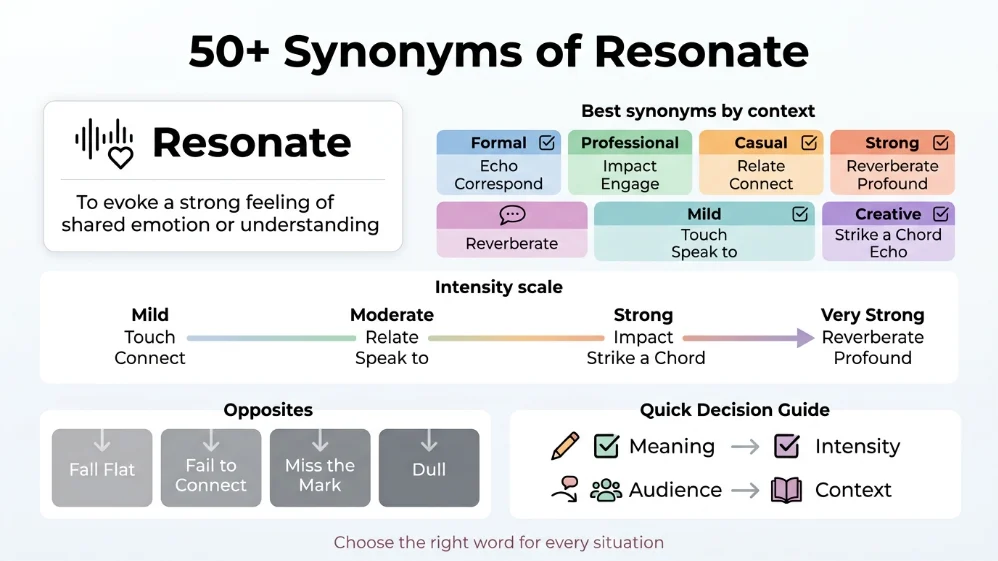
Resonate means to produce a deep, full sound or to evoke a strong feeling of shared emotion or understanding. The best synonyms include echo, reverberate, connect, strike a chord, relate, speak to, ring true, impact, and move. Choose echo for sound-related contexts, connect for personal relationships, strike a chord for emotional writing, ring true for authenticity, and impact for professional or business communication.
Meaning, Tone, and Context
Simple Definition
The word resonate has two primary meanings. First, it means to produce or be filled with a deep, full, echoing sound. Second, and more commonly in modern usage, it means to evoke a strong feeling of shared emotion or understanding. When something resonates with you, it feels meaningful, familiar, or significant.
Part of Speech
Resonate is a verb.
Overall Tone
The word has a neutral to positive tone. It suggests connection, impact, and significance. It often carries emotional weight without being overly dramatic.
Formality Level
Resonate is considered neutral to somewhat formal. It appears naturally in professional writing, public speaking, marketing, personal reflection, and creative writing. It is appropriate for both formal and informal communication.
Common Uses
Native English speakers commonly use resonate when talking about:
- Emotional connections
- Shared experiences
- Memorable speeches or stories
- Music and sound
- Marketing and branding
- Personal relationships
- Cultural moments
- Ideas that feel true or meaningful
- Art and creativity
- Inspirational messages
Word Forms
| Word Form | Example |
|---|---|
| Verb | resonate |
| Noun | resonance |
| Adjective | resonant |
| Adverb | resonantly |
| Related Form | resonance, resonant, resonating |
| Opposite Form | fail to connect, fall flat |
When and How to Use “Resonate”
The word resonate works well whenever you want to describe a meaningful connection or a lasting impact. However, choosing a more specific synonym can make your message clearer and more impactful.
Professional
“The CEO’s vision resonated with the entire leadership team.”
Academic
“The researcher’s findings resonated with earlier studies in the field.”
Workplace
“Her presentation resonated with colleagues who faced similar challenges.”
Personal
“His story resonated with me because I experienced something similar.”
“I hope this message resonates with you and encourages you to share your thoughts.”
Creative Writing
“The melody resonated through the empty hall, lingering long after the music stopped.”
Social Media
“This quote resonated with so many of you, and I’m grateful for your responses.”
Best Synonyms of Resonate
The word resonate is useful because it works in both literal and figurative contexts. However, no single synonym works perfectly in every situation. Some alternatives emphasize emotional connection, while others highlight sound, impact, or authenticity. Choosing the right synonym helps your writing sound more natural and precise.
Professional Writing: Impact
Impact is one of the strongest professional alternatives to resonate. It shows that something has a measurable effect.
Example: “The new strategy impacted the company’s growth significantly.”
Why it works: Professional writing benefits from clear and measurable language, and impact communicates influence without ambiguity.
Academic Writing: Correspond
In essays, research papers, and reports, correspond is often a better choice than resonate because it highlights alignment or agreement.
Example: “The study’s conclusions correspond with earlier research findings.”
Why it works: It sounds objective, formal, and academically appropriate.
Business Communication: Connect
Connect is a versatile word that expresses shared understanding or relevance in a professional setting.
Example: “The brand’s message connected with its target audience.”
Why it works: It communicates relevance and engagement without sounding overly emotional.
Casual Conversation: Relate
For everyday speaking, relate sounds natural and conversational.
Example: “I totally relate to what you’re saying.”
Why it works: Native English speakers frequently use relate to express shared feelings or experiences.
Emotional Writing: Strike a Chord
When discussing personal experiences, memories, or emotions, strike a chord is usually more expressive than resonate.
Example: “Her words struck a chord with everyone in the room.”
Why it works: It emphasizes emotional connection and memorability.
Creative Writing: Echo
Creative writing often benefits from descriptive vocabulary. Echo helps create vivid imagery.
Example: “The laughter echoed through the empty streets.”
Why it works: It captures the reader’s imagination and adds depth to storytelling.
Resume Writing: Influence
Recruiters frequently see words like influence because they highlight impact and leadership.
Example: “Influenced key decisions that shaped company strategy.”
Why it works: It sounds concise, professional, and achievement-focused.
Workplace Communication: Engage
Engage emphasizes active participation and connection.
Example: “The training program engaged employees from all departments.”
Why it works: It communicates involvement and positive response.
Stronger Meaning: Reverbate
When you need stronger emphasis on sound or impact, reverberate is one of the best replacements for resonate.
Example: “The announcement reverberated throughout the organization.”
Why it works: It suggests a powerful and far-reaching effect.
Softer Meaning: Touch
Sometimes you want to describe a gentle or mild emotional effect.
Example: “Her kindness touched everyone she met.”
Why it works: It gives balanced emphasis without exaggeration.
When Not to Use “Resonate”
Although resonate is versatile, it is not always the most effective word. In many situations, a more specific synonym communicates your message more clearly.
When It Sounds Too Abstract
Sometimes resonate is too vague and fails to explain the nature of the connection.
Less Effective: “The message resonated.”
Better: “The message connected with the audience on an emotional level.”
Why: Connected clearly explains the relationship between the message and the audience.
When Greater Urgency Is Needed
If the situation involves immediate impact or significant consequences, resonate may sound too mild.
Less Effective: “The warning resonated with the team.”
Better: “The warning had a profound impact on the team.”
Why: Profound impact communicates urgency and seriousness.
In Academic Writing
Academic writing usually favors more precise vocabulary.
Less Effective: “The findings resonate with prior research.”
Better: “The findings correspond with prior research.”
Why: Correspond is more objective and commonly used in research writing.
On a Resume
General wording often reduces the impact of your achievements.
Less Effective: “Resonated with clients.”
Better: “Influenced client decisions through strategic communication.”
Why: Influence is more measurable and action-oriented.
In Creative Writing
Using resonate repeatedly can make storytelling feel abstract.
Less Effective: “The memory resonated with her.”
Better: “The memory echoed in her mind.”
Why: Echo creates stronger imagery and leaves a lasting impression.
When Expressing Personal Feelings
If something matters because of emotion rather than intellectual agreement, choose a more expressive word.
Less Effective: “Your story resonated with me.”
Better: “Your story moved me deeply.”
Why: Move communicates emotional impact more directly.
Words Commonly Confused With “Resonate”
| Word | Difference | When to Use It | Example |
|---|---|---|---|
| Echo | Focuses on sound or repetition | Sound, literal or figurative repetition | “Her words echoed in his mind.” |
| Reverberate | Suggests a strong, lasting effect | Major announcements, lasting impact | “The news reverberated across the country.” |
| Relate | Focuses on shared experience | Personal conversations | “I can relate to what you’re going through.” |
| Connect | Emphasizes relationship or understanding | Marketing, relationships, ideas | “The audience connected with the speaker.” |
| Impact | Focuses on measurable effect | Professional, business contexts | “The decision impacted company profits.” |
| Strike a Chord | Focuses on emotional resonance | Emotional moments, memories | “The song struck a chord with listeners.” |
Best Synonyms of “Resonate” by Context
| Context | Best Synonym | Why It Works | Example |
|---|---|---|---|
| Formal Writing | Echo | Precise and professional | “The sentiment echoed across the organization.” |
| Academic Writing | Correspond | Objective and formal | “The findings correspond with the hypothesis.” |
| Professional Communication | Connect | Clear and engaging | “The brand connected with its audience.” |
| Business Emails | Impact | Direct and professional | “The changes impacted our quarterly results.” |
| Resume Writing | Influence | Action-oriented and concise | “Influenced strategic decisions for the company.” |
| Workplace Communication | Engage | Emphasizes participation | “The workshop engaged all team members.” |
| Casual Conversation | Relate | Natural and conversational | “I can relate to that experience.” |
| Everyday Speaking | Connect | Simple and clear | “I really connected with that movie.” |
| Creative Writing | Echo | Descriptive and vivid | “The sound echoed through the valley.” |
| Storytelling | Reverberate | Strong and dramatic | “His actions reverberated through history.” |
| Emotional Writing | Strike a Chord | Expressive and memorable | “The poem struck a chord with readers.” |
| Strong Emphasis | Profound | Indicates deep significance | “The experience had a profound effect.” |
| Mild Tone | Touch | Gentle and understated | “Her kindness touched everyone.” |
| Social Media Captions | Connect | Engaging and relatable | “This message connected with so many of you.” |
| American English | Connect | Widely used and natural | “The speech connected with the audience.” |
| British English | Strike a Chord | Common in literary contexts | “The story struck a chord with British readers.” |
Synonyms of “Resonate” by Usage
The word resonate works in almost every situation, but choosing a more specific synonym makes your writing stronger and more natural. The sections below explain which alternatives fit different types of communication.
- Professional vs Personal Synonyms
Professional communication requires precise vocabulary, while personal conversations sound better with simpler, more relatable words.
Professional Synonyms
| Synonym | Best Used For | Why It Works |
|---|---|---|
| Impact | Reports, strategies | Shows measurable effect |
| Connect | Branding, marketing | Expresses relevance |
| Influence | Leadership, decisions | Communicates impact |
| Engage | Training, presentations | Shows active participation |
| Correspond | Research, analysis | Indicates agreement or alignment |
Recommendation
Use impact, connect, influence, or engage in resumes, business emails, presentations, and reports because they sound more precise than resonate.
Personal Synonyms
| Synonym | Best Used For | Example |
|---|---|---|
| Relate | Relationships | “I can relate to your experience.” |
| Connect | Friendships | “We really connected.” |
| Touch | Emotional moments | “His words touched my heart.” |
| Strike a Chord | Meaningful experiences | “The story struck a chord.” |
| Speak to | Personal relevance | “That really spoke to me.” |
Recommendation
In conversations with friends and family, natural words like relate, connect, and touch often sound better than overly formal alternatives.
Formal vs Conversational Synonyms
Choosing the right level of formality helps your writing match the audience.
| Situation | Best Synonyms |
|---|---|
| Reports | Correspond, Echo |
| Essays | Correspond, Echo |
| Business Writing | Impact, Engage |
| Presentations | Connect, Impact |
| Professional Emails | Connect, Impact |
| Casual Conversations | Relate, Connect |
| Text Messages | Connect, Relate |
Example
Formal: “The findings correspond with previous research.”
Conversational: “I can really relate to that.”
Academic Synonyms
Academic writing benefits from vocabulary that sounds precise and objective.
Correspond
Commonly used when discussing alignment or agreement with existing research.
Example: “The results correspond with the theoretical framework.”
Echo
Useful for describing how findings reflect or support earlier work.
Example: “The study echoes earlier findings on the subject.”
Connect
Appropriate when discussing relationships between variables or concepts.
Example: “The research connects social behavior with environmental factors.”
Align
Useful for describing how research fits with broader theories.
Example: “The conclusions align with established scientific principles.”
Recommendation
For essays and research papers, correspond, align, and echo usually sound stronger and more authoritative than resonate.
Professional and Business Synonyms
Business communication often requires concise and specific language.
Impact
Perfect for describing results and outcomes.
Example: “The campaign impacted sales significantly.”
Connect
Essential for branding, marketing, and relationship-building.
Example: “The brand connected with its target demographic.”
Influence
Describes decisions and leadership effectively.
Example: “He influenced the strategic direction of the company.”
Engage
Frequently appears in training, presentations, and workplace communication.
Example: “The training program engaged employees at all levels.”
Correspond
Useful for aligning strategies with goals.
Example: “The proposal corresponds with company objectives.”
Recommendation
Use these words in resumes, interviews, meetings, presentations, business emails, and client communication to sound more professional.
Creative and Literary Synonyms
Creative writing benefits from expressive vocabulary that creates emotion and imagery.
Echo
Adds vivid sound imagery.
Example: “The laughter echoed through the empty hall.”
Reverberate
Suggests powerful, lasting effects.
Example: “The decision reverberated through the community.”
Strike a Chord
Expresses emotional connection memorably.
Example: “The speech struck a chord with everyone present.”
Speak to
Shows personal relevance in a literary way.
Example: “The novel spoke to the struggles of ordinary people.”
Touch
Conveys gentle emotional impact.
Example: “The kindness touched his heart.”
These words make stories, speeches, and descriptive writing more engaging.
Slang or Modern Synonyms
There are very few true slang synonyms for resonate, but native speakers often use casual expressions.
| Expression | Meaning | Appropriate For | Avoid In |
|---|---|---|---|
| Hit home | Felt personally meaningful | Casual conversation | Formal writing |
| Speak to someone | Relate to or connect with | Everyday speech | Academic papers |
| Hit different | Felt especially meaningful | Social media, casual | Professional writing |
Example
Casual: “That quote really hit home for me.”
Formal: “The message resonated with the audience.”
Strongest to Mildest Synonyms
The following scale shows how different synonyms express different levels of impact and emotional connection.
| Intensity | Synonyms |
|---|---|
| Mild | Touch, Connect |
| Moderate | Relate, Speak to, Correspond |
| Strong | Echo, Impact, Strike a Chord |
| Very Strong | Reverberate, Profound |
| Extreme | Resound, Pervade |
Understanding the Scale
- Touch simply suggests a gentle emotional effect.
- Connect shows relationship or understanding.
- Relate indicates shared experience.
- Correspond suggests agreement or alignment.
- Impact highlights measurable influence.
- Strike a Chord emphasizes emotional connection.
- Echo suggests repetition or reflection.
- Reverberate implies powerful, lasting effects.
- Profound indicates deep significance.
Emotional vs Neutral Synonyms
Some synonyms express feelings, while others simply communicate connection or alignment.
Emotional Synonyms
| Synonym | Best Used For |
|---|---|
| Strike a Chord | Deep emotional moments |
| Touch | Gentle emotional impact |
| Resonate | Personal or cultural connection |
| Speak to | Personal relevance |
| Move | Strong emotional effect |
These words add emotion and help readers connect with the message.
Neutral Synonyms
| Synonym | Best Used For |
|---|---|
| Correspond | Academic writing |
| Echo | Sound or repetition |
| Connect | General understanding |
| Impact | Measurable effect |
| Relate | Shared experience |
Neutral words communicate connection or alignment without adding unnecessary emotion.
Antonyms of Resonate
| Antonym | Meaning | Example Sentence |
|---|---|---|
| Fall flat | Fail to connect | His speech fell flat with the audience. |
| Fail to connect | Not create understanding | The message failed to connect with listeners. |
| Miss the mark | Fail to achieve intended effect | The campaign missed the mark. |
| Dull | Lacking excitement | The presentation was dull and uninteresting. |
| Flat | Without emotion | Her performance felt flat. |
| Uninspiring | Not motivating | The speech was uninspiring. |
| Ignore | Pay no attention to | The audience ignored the speaker. |
| Disconnect | Lack of understanding | There was a disconnect between the message and the audience. |
| Fade | Gradually disappear | The memory faded over time. |
| Bounce off | Fail to affect | The criticism bounced off him. |
| Alienate | Cause to feel isolated | The message alienated some listeners. |
| Bore | Cause to feel uninterested | The lecture bored the students. |
| Misfire | Fail to achieve intended effect | The joke misfired completely. |
| Overshadow | Reduce the importance of | The mistake overshadowed her achievements. |
| Dismiss | Reject as unimportant | He dismissed her concerns entirely. |
Comparison: “Resonate” vs Similar Words
Resonate vs Echo
Main Difference: Resonate emphasizes emotional or intellectual connection. Echo focuses on repetition or reflection, often related to sound.
Which Is Stronger? Resonate is stronger in emotional contexts. Echo is stronger in literal or auditory contexts.
Which Is More Formal? Both are neutral, but resonate is more common in figurative, professional use.
When to Use Each: Use resonate for emotional connection. Use echo for sound or repetition.
Examples:
- Resonate: “The message resonated with the audience.”
- Echo: “Her words echoed in his mind.”
Resonate vs Reverberate
Main Difference: Resonate suggests meaningful connection. Reverberate suggests a powerful, lasting effect that spreads widely.
Which Is Stronger? Reverberate is considerably stronger.
Which Is More Formal? Both are suitable for formal writing, but reverberate is often more dramatic.
When to Use Each: Use reverberate for significant, far-reaching impacts.
Examples:
- Resonate: “The speech resonated with the crowd.”
- Reverberate: “The decision reverberated across the industry.”
Resonate vs Relate
Main Difference: Resonate emphasizes emotional or intellectual connection. Relate focuses on shared experiences or understanding.
Which Is Stronger? Resonate is slightly stronger in emotional contexts.
Which Is More Formal? Resonate is more formal. Relate is more conversational.
When to Use Each: Use relate for personal conversations. Use resonate for professional or formal contexts.
Examples:
- Resonate: “The message resonated with her values.”
- Relate: “I can relate to what you’re saying.”
Resonate vs Connect
Main Difference: Resonate emphasizes meaningful impact. Connect emphasizes relationship or understanding.
Which Is Stronger? Resonate is stronger in emotional contexts.
Which Is More Formal? Both are neutral, but connect is more common in everyday speech.
When to Use Each: Use resonate for deeper significance. Use connect for general understanding.
Examples:
- Resonate: “The speech resonated with the audience.”
- Connect: “The audience connected with the speaker.”
Resonate vs Impact
Main Difference: Resonate focuses on connection and emotion. Impact focuses on measurable effect or influence.
Which Is Stronger? Impact is stronger in terms of measurable change.
Which Is More Formal? Impact is more commonly used in professional and business writing.
When to Use Each: Use resonate for emotional or intellectual connection. Use impact for measurable outcomes.
Examples:
- Resonate: “Her message resonated with the team.”
- Impact: “Her message impacted the team’s performance.”
Resonate vs Strike a Chord
Main Difference: Resonate is a general term for connection. Strike a chord specifically emphasizes emotional or nostalgic resonance.
Which Is Stronger? Strike a chord is emotionally stronger in personal contexts.
Which Is More Formal? Resonate is more formal. Strike a chord is more conversational and expressive.
When to Use Each: Use strike a chord for emotional moments. Use resonate for general connection.
Examples:
- Resonate: “The idea resonated with the committee.”
- Strike a Chord: “The song struck a chord with the audience.”
Common Phrases and Expressions with “Resonate”
| Phrase | Meaning | Example Sentence |
|---|---|---|
| Resonate with someone | Have a meaningful effect | “The story resonated with readers worldwide.” |
| Resonate deeply | Have a strong emotional impact | “His words resonated deeply with her.” |
| Resonate across | Spread through a group | “The message resonated across generations.” |
| Resonate in | Have an effect within | “The theme resonated in the community.” |
| Resonate throughout | Spread widely | “The announcement resonated throughout the organization.” |
Common Mistakes to Avoid
1. Using It When You Mean “Relate”
Incorrect: “I resonate with your experience.”
Better: “I can relate to your experience.”
Why: Resonate is usually used for ideas, messages, or stories, not for personal feelings. Relate is better for shared experiences.
2. Using a General Word Instead of a Specific One
Incorrect: “The message resonated.”
Better: “The message connected with the audience on an emotional level.”
Why: Connection clearly explains the nature of the relationship.
3. Using It in Academic Writing When “Correspond” Works Better
Incorrect: “The findings resonate with prior research.”
Better: “The findings correspond with prior research.”
Why: Correspond is more objective and academically appropriate.
4. Confusing “Resonate” with “Reverberate”
Incorrect: “The joke resonated through the room.”
Better: “The joke echoed through the room.”
Why: Echo is better for sound. Resonate is better for emotional impact.
5. Overusing Strong Synonyms
Incorrect: “Every email resonated with everyone.”
Better: “The important messages resonated with the team.”
Why: Saving stronger words for genuinely significant situations makes them more effective.
6. Using It for Sound When “Echo” Is Clearer
Incorrect: “The music resonated through the hall.”
Better: “The music echoed through the hall.”
Why: Echo is the more precise and natural word for literal sound.
7. Using Emotional Words in Academic Writing
Incorrect: “The results resonated with the hypothesis.”
Better: “The results align with the hypothesis.”
Why: Academic writing generally prefers objective language.
Frequently Asked Questions
What are the best synonyms of “resonate”?
The best synonyms of resonate include echo, connect, relate, impact, strike a chord, reverberate, speak to, and touch. The right choice depends on your context, audience, and writing purpose.
What are the best formal synonyms of “resonate”?
Strong formal alternatives include correspond, echo, connect, impact, and align. These words work well in academic papers, reports, and professional communication.
What are common informal synonyms of “resonate”?
Common informal alternatives include relate, connect, strike a chord, and speak to. These expressions sound natural in everyday conversations and social media posts.
What is another word for “resonate” in professional writing?
In professional communication, excellent alternatives include impact, connect, influence, and engage. These words make reports, emails, resumes, and presentations sound more precise and polished.
What is the difference between “resonate” and “reverberate”?
Resonate emphasizes meaningful connection or emotional impact. Reverberate emphasizes a powerful, lasting effect that spreads widely, often in a physical or metaphorical sense.
What is the opposite of “resonate”?
The most common opposites include fall flat, fail to connect, miss the mark, disconnect, and ignore. Each describes a situation where communication fails to have the intended effect.
Conclusion
The word resonate is a powerful and versatile verb that describes meaningful connection and lasting impact. However, using it repeatedly can make your writing feel repetitive. Learning the best synonyms of resonate helps you express your ideas with greater accuracy, stronger style, and better clarity.
You’re writing a speech, preparing a marketing presentation, updating your resume, or having a casual conversation, no single synonym fits every situation. Words like echo, connect, relate, impact, strike a chord, and reverberate each carry unique meanings and should be chosen based on your audience, tone, and purpose.
A simple way to improve your vocabulary is to pause before writing resonate and ask yourself whether you mean emotional connection, intellectual agreement, sound, or measurable influence. Choosing the most appropriate synonym will make your writing more engaging, professional, and natural.
Read More Related Articles:
Synonyms for Regret | Meaning, Examples, and Better Word Choices
Best Words to Replace “Align” in Every Context