You’re writing an email, polishing a resume, preparing a school assignment, or publishing a blog post, using the same word repeatedly can make your writing feel repetitive. If you’ve searched for synonyms of important, you’re likely looking for stronger, more natural words that better match your message and improve the overall quality of your writing.
The word important is useful in almost every type of communication, but it doesn’t always express the exact level of meaning you intend. Sometimes you need a word that sounds more professional, more academic, more emotional, or more persuasive. This guide explores the best alternatives, explains when each synonym works best, and helps you choose the right word with confidence.
What Are the Best Synonyms of “Important”?
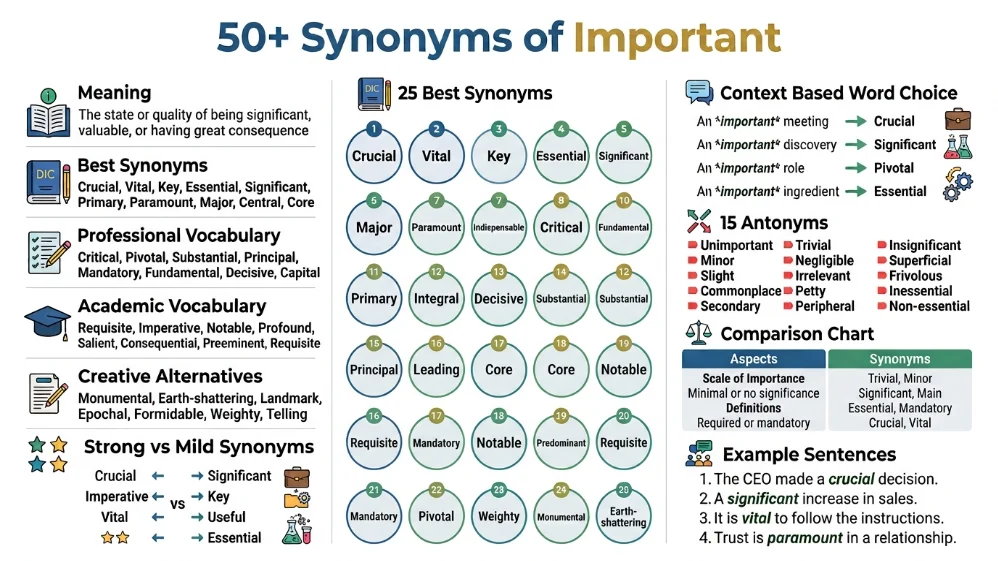
Important describes something that has value, influence, or a meaningful effect. The best synonyms include essential, significant, crucial, critical, vital, key, fundamental, and major. Choose significant for academic writing, essential for professional communication, critical for urgent situations, meaningful for emotional writing, and remarkable for creative storytelling.
Meaning, Tone, and Context
Simple Definition
The word important describes a person, idea, event, object, or action that has value, influence, or a strong effect. It refers to something that deserves attention because it matters.
Part of Speech
Important is an adjective.
Overall Tone
The word usually has a neutral to positive tone. It highlights significance without adding strong emotion.
Formality Level
Important is considered neutral, making it suitable for both formal and informal communication. It appears naturally in business writing, academic papers, workplace discussions, everyday conversations, emails, and presentations.
Common Uses
Native English speakers commonly use important when talking about:
- Important decisions
- Important information
- Important meetings
- Important deadlines
- Important responsibilities
- Important skills
- Important people
- Important events
- Important lessons
- Important goals
Word Forms
| Word Form | Example |
|---|---|
| Adjective | important |
| Noun | importance |
| Adverb | importantly |
| Related Form | importantly, importance |
| Opposite Form | unimportant |
When and How to Use “Important”
The word important works well whenever you want to show that something has value or deserves attention. However, choosing a more specific synonym can make your message clearer and more impactful.
Professional
“The client shared several important project requirements before the meeting.”
Academic
“It is important to understand the research methodology before analyzing the results.”
Workplace
“Employee safety is important for maintaining a productive work environment.”
Personal
“Spending quality time with family is important to me.”
“Please review this important announcement before the end of the day.”
Resume
“Managed several important company initiatives that improved operational efficiency.”
Social Media
“Today marks an important milestone in my career, and I’m grateful for everyone who supported me.”
Best Synonyms of Important
The word important is useful because it fits almost every type of writing, but no single synonym works perfectly in every situation. Some alternatives emphasize urgency, while others highlight value, influence, necessity, or emotional significance. Choosing the right synonym helps your writing sound more natural and precise.
Professional Writing: Essential
Essential is one of the strongest professional alternatives to important. It shows that something is necessary rather than simply valuable.
Example:
“Clear communication is essential for maintaining strong client relationships.”
Why it works:
Business writing benefits from precise language, and essential clearly communicates necessity.
Academic Writing: Significant
In essays, research papers, and reports, significant is often a better choice than important because it highlights measurable value or impact.
Example:
“The research revealed significant differences between the two groups.”
Why it works:
It sounds objective, formal, and academically appropriate.
Business Communication: Critical
Critical expresses urgency and indicates that success or failure depends on something.
Example:
“Meeting the launch deadline is critical to the project’s success.”
Why it works:
It immediately communicates high priority and serious consequences.
Casual Conversation: Major
For everyday speaking, major sounds natural without becoming overly formal.
Example:
“Buying a house is a major decision.”
Why it works:
Native English speakers frequently use major to describe something with great importance.
Emotional Writing: Meaningful
When discussing personal experiences, memories, or relationships, meaningful is usually more expressive than important.
Example:
“Our conversation was incredibly meaningful.”
Why it works:
It emphasizes emotional value instead of practical importance.
Creative Writing: Remarkable
Creative writing often benefits from descriptive vocabulary. Remarkable helps create stronger imagery.
Example:
“It became a remarkable moment that changed his life forever.”
Why it works:
It captures the reader’s attention and adds depth to storytelling.
Resume Writing: Key
Recruiters frequently see the word key because it quickly highlights primary responsibilities or achievements.
Example:
“Led key operational initiatives that improved productivity.”
Why it works:
It sounds concise, professional, and achievement-focused.
Workplace Communication: Vital
Vital emphasizes that something is necessary for success or smooth operations.
Example:
“Employee training is vital for maintaining quality standards.”
Why it works:
It communicates necessity while maintaining a professional tone.
Stronger Meaning: Crucial
When you need stronger emphasis, crucial is one of the best replacements for important.
Example:
“Customer satisfaction is crucial for long-term business growth.”
Why it works:
It suggests that success depends on the situation.
Softer Meaning: Notable
Sometimes you want to recognize something without making it sound extremely important.
Example:
“The company made notable improvements during the year.”
Why it works:
It gives balanced emphasis without exaggeration.
When Not to Use “Important”
Although important is versatile, it is not always the most effective word. In many situations, a more specific synonym communicates your message more clearly.
When It Sounds Too General
Sometimes important is too broad and fails to explain why something matters.
Less Effective
“Communication is important.”
Better
“Communication is essential for building trust with clients.”
Why
Essential clearly explains that communication is necessary, not merely valuable.
When Greater Urgency Is Needed
If the situation involves deadlines, emergencies, or serious consequences, important may sound too weak.
Less Effective
“This deadline is important.”
Better
“This deadline is critical to the project’s success.”
Why
Critical communicates urgency and high priority.
In Academic Writing
Academic writing usually favors more precise vocabulary.
Less Effective
“The findings are important.”
Better
“The findings are significant.”
Why
Significant is more objective and commonly used in research writing.
On a Resume
General wording often reduces the impact of your achievements.
Less Effective
“Managed important projects.”
Better
“Managed key strategic projects.”
Why
Key immediately highlights major responsibilities.
In Creative Writing
Using important repeatedly can make storytelling feel flat.
Less Effective
“It was an important day.”
Better
“It was a remarkable day.”
Why
Remarkable creates stronger imagery and leaves a lasting impression.
When Expressing Personal Feelings
If something matters because of emotion rather than necessity, choose a more expressive word.
Less Effective
“Your friendship is important to me.”
Better
“Your friendship is meaningful to me.”
Why
Meaningful communicates emotional significance more naturally.
Words Commonly Confused With “Important”
| Word | Difference | When to Use It | Example |
|---|---|---|---|
| Significant | Focuses on measurable impact or influence. | Academic writing, reports, and research. | “The study produced significant results.” |
| Essential | Means absolutely necessary. | Instructions, professional writing, and workplace communication. | “Regular backups are essential for protecting data.” |
| Critical | Highlights urgency or serious consequences. | Emergencies, deadlines, and business priorities. | “Quick action was critical during the crisis.” |
| Valuable | Emphasizes usefulness or worth. | Advice, skills, resources, and experience. | “Her experience proved valuable to the team.” |
| Influential | Describes someone or something that affects others. | Leadership, media, history, and public figures. | “She became an influential business leader.” |
| Meaningful | Focuses on emotional or personal significance. | Relationships, memories, and personal writing. | “We had a meaningful conversation after dinner.” |
Best Synonyms of Important by Context
| Context | Best Synonym | Why It Works | Example |
|---|---|---|---|
| Formal Writing | Essential | Sounds precise and professional. | “Accurate records are essential.” |
| Academic Writing | Significant | Fits research and essays naturally. | “The findings were significant.” |
| Professional Communication | Critical | Highlights urgency and priorities. | “Client satisfaction is critical.” |
| Business Emails | Key | Concise and professional. | “Please review the key updates.” |
| Resume Writing | Key | Emphasizes major achievements. | “Managed key company initiatives.” |
| Workplace Communication | Vital | Stresses necessity for success. | “Safety training is vital.” |
| Casual Conversation | Major | Sounds natural in daily speech. | “That’s a major decision.” |
| Everyday Speaking | Big | Common informal alternative. | “It’s a big opportunity.” |
| Creative Writing | Remarkable | Adds vivid description. | “It was a remarkable journey.” |
| Storytelling | Pivotal | Shows a turning point. | “That meeting was pivotal.” |
| Emotional Writing | Meaningful | Expresses personal value. | “It was a meaningful experience.” |
| Strong Emphasis | Crucial | Indicates success depends on it. | “Timing is crucial.” |
| Mild Tone | Notable | Gives moderate emphasis. | “There were notable improvements.” |
| Social Media Captions | Major | Sounds engaging and natural. | “Today was a major milestone!” |
| American English | Key | Frequently used in business and media. | “That’s the key issue.” |
| British English | Crucial | Common in formal and everyday usage. | “This is crucial to the plan.” |
Synonyms of Important by Usage
The word important works in almost every situation, but choosing a more specific synonym makes your writing stronger and more natural. The sections below explain which alternatives fit different types of communication.
Professional vs Personal Synonyms
Communication requires precise vocabulary, while personal conversations sound better with simpler, more relatable words.
Professional Synonyms
| Synonym | Best Used For | Why It Works |
|---|---|---|
| Essential | Reports, policies | Shows that something is necessary. |
| Critical | Business priorities | Emphasizes urgency and importance. |
| Key | Meetings, presentations | Highlights the main point or responsibility. |
| Strategic | Business planning | Focuses on long-term goals. |
| Vital | Workplace communication | Indicates something is necessary for success. |
| Significant | Professional reports | Sounds formal and objective. |
Recommendation
Use essential, critical, key, or strategic in resumes, business emails, presentations, and reports because they sound more precise than important.
Personal Synonyms
| Synonym | Best Used For | Example |
|---|---|---|
| Meaningful | Relationships | “Your support was meaningful.” |
| Major | Daily conversations | “This is a major decision.” |
| Big | Casual speaking | “Today is a big day.” |
| Special | Personal events | “It was a special moment.” |
| Valuable | Advice and experience | “Your advice is valuable.” |
Recommendation
In conversations with friends and family, natural words like big, major, and meaningful often sound better than overly formal alternatives.
Formal vs Conversational Synonyms
Choosing the right level of formality helps your writing match the audience.
| Situation | Best Synonyms |
|---|---|
| Reports | Significant, Essential |
| Essays | Fundamental, Significant |
| Business Writing | Critical, Strategic |
| Presentations | Key, Vital |
| Professional Emails | Essential, Key |
| Casual Conversations | Major, Big |
| Text Messages | Big, Huge (informal) |
Example
Formal
“The findings are significant for future research.”
Conversational
“That’s a big improvement.”
Academic Synonyms
Academic writing benefits from vocabulary that sounds precise and objective.
Significant
Commonly used when discussing research results or measurable impact.
Example
“The study identified several significant differences.”
Fundamental
Best for explaining basic principles or core concepts.
Example
“Critical thinking is fundamental to scientific research.”
Essential
Ideal when describing something required for understanding or success.
Example
“Accurate citations are essential in academic writing.”
Consequential
Useful when discussing outcomes or long-term effects.
Example
“The policy had consequential effects on public education.”
Crucial
Appropriate when emphasizing something that directly affects success.
Example
“Time management is crucial during examinations.”
Recommendation
For essays and research papers, significant, fundamental, and essential usually sound stronger and more authoritative than important.
Professional and Business Synonyms
Business communication often requires concise and specific language.
Essential
Perfect for procedures, policies, and requirements.
Example
“Effective communication is essential for customer satisfaction.”
Critical
Highlights urgent priorities.
Example
“Meeting the project deadline is critical.”
Strategic
Describes decisions connected to long-term planning.
Example
“The company developed a strategic marketing plan.”
Key
Frequently appears in resumes and presentations.
Example
“She managed several key client accounts.”
Vital
Shows something is necessary for business success.
Example
“Employee engagement is vital to organizational growth.”
Recommendation
Use these words in resumes, interviews, meetings, presentations, business emails, and client communication to sound more professional.
Creative and Literary Synonyms
Creative writing benefits from expressive vocabulary that creates emotion and imagery.
Remarkable
Adds admiration and vivid description.
Example
“It was a remarkable achievement.”
Meaningful
Expresses emotional importance.
Example
“They shared a meaningful conversation.”
Memorable
Highlights experiences that leave a lasting impression.
Example
“It became a memorable summer.”
Pivotal
Shows an event that changes everything.
Example
“That meeting became a pivotal moment in her career.”
Paramount
Suggests the highest level of importance.
Example
“Protecting the children remained paramount.”
These words make stories, speeches, and descriptive writing more engaging.
Slang or Modern Synonyms
There are very few true slang synonyms for important, but native speakers often use casual expressions.
| Expression | Meaning | Appropriate For | Avoid In |
|---|---|---|---|
| Big | Important | Everyday conversations | Academic papers |
| Huge | Very important | Friends, social media | Business reports |
| A big deal | Something important | Casual speech | Formal writing |
Example
Casual:
“That’s a big deal.”
Formal:
“That issue is critical to the project’s success.”
Strongest to Mildest Synonyms
The following scale shows how different synonyms express different levels of importance.
| Intensity | Synonyms |
|---|---|
| Mild | Notable, Valuable |
| Moderate | Major, Key, Meaningful |
| Strong | Significant, Essential, Vital |
| Very Strong | Crucial, Critical, Paramount, Indispensable |
Understanding the Scale
- Notable simply deserves attention.
- Major shows above-average importance.
- Significant highlights measurable impact.
- Essential means necessary.
- Vital indicates something is required for success.
- Crucial suggests success depends on it.
- Critical adds urgency.
- Paramount places something above every other priority.
- Indispensable means impossible to do without.
Emotional vs Neutral Synonyms
Some synonyms express feelings, while others simply communicate importance.
Emotional Synonyms
| Synonym | Best Used For |
|---|---|
| Meaningful | Relationships |
| Memorable | Personal experiences |
| Precious | Family and friendships |
| Remarkable | Inspirational stories |
| Special | Celebrations and milestones |
These words add emotion and help readers connect with the message.
Neutral Synonyms
| Synonym | Best Used For |
|---|---|
| Significant | Academic writing |
| Essential | Instructions |
| Critical | Business communication |
| Key | Professional documents |
| Fundamental | Education |
| Major | General writing |
| Strategic | Corporate communication |
Neutral words communicate importance without adding unnecessary emotion.
Antonyms of Important
| Antonym | Meaning | Example Sentence |
|---|---|---|
| Unimportant | Not significant | The spelling mistake was unimportant. |
| Insignificant | Having little impact | The difference was insignificant. |
| Trivial | Of little value | They argued about a trivial matter. |
| Minor | Small in importance | It was only a minor issue. |
| Irrelevant | Not related to the topic | That information is irrelevant. |
| Worthless | Having no value | The damaged coupon became worthless. |
| Meaningless | Without purpose | The numbers seemed meaningless alone. |
| Inconsequential | Producing little effect | The delay was inconsequential. |
| Negligible | Too small to matter | The increase was negligible. |
| Ordinary | Not special | It was an ordinary afternoon. |
| Commonplace | Very common | Smartphones are now commonplace. |
| Secondary | Less important | Cost became a secondary concern. |
| Optional | Not required | Attendance was optional. |
| Disposable | Easily replaced | The cup was disposable. |
| Nonessential | Not absolutely necessary | Decorations are nonessential purchases. |
Comparison: “Important” vs Similar Words
Although important is a versatile word, several similar words carry different shades of meaning. Understanding these differences helps you choose the most accurate word for each situation.
Important vs Significant
Main Difference
Important is a general word that describes something with value or relevance. Significant emphasizes measurable impact, influence, or meaningful results.
Which Is Stronger?
Significant is usually stronger because it suggests noticeable effects or consequences.
Which Is More Formal?
Significant is more common in academic, scientific, and professional writing.
When to Use Each
Use important for everyday communication and general writing.
Use significant when discussing research, statistics, reports, or meaningful changes.
Examples
Important:
“Regular exercise is important for good health.”
Significant:
“The study revealed significant improvements in student performance.”
Important vs Essential
Main Difference
Important means something matters.
Essential means something is absolutely necessary.
Which Is Stronger?
Essential is stronger because it implies something cannot be omitted.
Which Is More Formal?
Both work well in formal writing, but essential sounds more precise.
When to Use Each
Use important for general emphasis.
Use essential when something is required.
Examples
Important:
“Planning is important.”
Essential:
“Planning is essential for project success.”
Important vs Critical
Main Difference
Critical highlights urgency and serious consequences.
Important simply indicates value or significance.
Which Is Stronger?
Critical is considerably stronger.
Which Is More Formal?
Both are suitable for professional writing, but critical is especially common in business, healthcare, and emergency situations.
When to Use Each
Choose critical when immediate attention is required.
Examples
Important:
“Communication is important.”
Critical:
“Communication is critical during emergencies.”
Important vs Vital
Main Difference
Vital means necessary for success, health, or survival.
Important has a broader meaning.
Which Is Stronger?
Vital expresses greater necessity.
Which Is More Formal?
Both fit professional writing.
When to Use Each
Use vital when something is indispensable for achieving success.
Examples
Important:
“Sleep is important.”
Vital:
“Sleep is vital for maintaining good health.”
Important vs Key
Main Difference
Key refers to the main or central part of something.
Important describes overall value.
Which Is Stronger?
Neither is stronger. They emphasize different ideas.
Which Is More Formal?
Key is widely used in business and workplace communication.
When to Use Each
Use key to identify the primary factor or responsibility.
Examples
Important:
“Experience is important.”
Key:
“Experience is a key qualification for this position.”
Important vs Crucial
Main Difference
Crucial suggests that success or failure depends on something.
Important simply expresses significance.
Which Is Stronger?
Crucial is much stronger.
Which Is More Formal?
Both are suitable for formal writing, but crucial adds greater emphasis.
When to Use Each
Use crucial for major decisions, deadlines, and high-stakes situations.
Examples
Important:
“This meeting is important.”
Crucial:
“This meeting is crucial for the future of the company.”
Common Phrases and Expressions with “Important”
| Phrase | Meaning | Example Sentence |
|---|---|---|
| Important decision | A choice with lasting consequences | Choosing a career is an important decision. |
| Important role | A significant responsibility | She played an important role in the project. |
| Important information | Details that require attention | Please read the important information carefully. |
| Important point | A key idea or fact | The speaker explained an important point. |
| Important factor | Something that influences the outcome | Experience is an important factor in hiring. |
| Important issue | A serious topic or problem | Climate change remains an important issue. |
| Important milestone | A major achievement | Graduation is an important milestone in life. |
| Important lesson | A valuable piece of knowledge | The experience taught me an important lesson. |
Common Mistakes to Avoid
1. Using a General Word Instead of a Specific One
Incorrect
“This report is important.”
Better
“This report is essential for tomorrow’s meeting.”
Why
Essential clearly explains that the report is necessary.
2. Using Informal Words in Formal Writing
Incorrect
“This is a big issue.”
Better
“This is a significant issue.”
Why
Formal documents require precise and professional vocabulary.
3. Choosing an Overly Strong Synonym
Incorrect
“Bringing a notebook is critical.”
Better
“Bringing a notebook is important.”
Why
Reserve critical for situations involving serious consequences.
4. Repeating “Important” Too Often
Incorrect
“Important skills are important because important people value important work.”
Better
“Essential skills are valuable because successful professionals appreciate meaningful work.”
Why
Using varied vocabulary improves readability and style.
5. Confusing “Important” with “Influential”
Incorrect
“She is an important writer because she changed literature.”
Better
“She is an influential writer because she changed literature.”
Why
Influential emphasizes the ability to affect others.
6. Using Emotional Words in Academic Writing
Incorrect
“The results were meaningful.”
Better
“The results were significant.”
Why
Academic writing generally prefers objective language.
7. Overusing Strong Synonyms
Incorrect
“Every assignment is crucial.”
Better
“Most assignments are important, but the final project is crucial.”
Why
Saving stronger words for genuinely serious situations makes them more effective.
Frequently Asked Questions
1. What are the best synonyms of “important”?
The best synonyms of important include essential, significant, critical, crucial, vital, key, major, and fundamental. The right choice depends on your audience, tone, and writing purpose.
2. What are the best formal synonyms of “important”?
Strong formal alternatives include significant, essential, critical, fundamental, paramount, and consequential. These words work well in academic papers, reports, and business communication.
3. What are common informal synonyms of “important”?
Common informal alternatives include big, major, a big deal, and meaningful, depending on the context. These expressions sound natural in everyday conversations and social media posts.
4. What is another word for “important” in professional writing?
In professional communication, excellent alternatives include essential, key, critical, strategic, and vital. These words make reports, emails, resumes, and presentations sound more precise and polished.
5. What is the difference between “important” and “significant”?
Important is a broad term that describes value or relevance. Significant emphasizes measurable impact, influence, or meaningful results, making it more common in academic and professional writing.
6. What is the opposite of “important”?
The most common opposites include unimportant, insignificant, trivial, irrelevant, minor, and nonessential. Each describes something with little value, impact, or necessity.
Conclusion
The word important is one of the most common adjectives in English, but using it repeatedly can make your writing feel repetitive. Learning the best synonyms of important helps you express your ideas with greater accuracy, stronger style, and better clarity.
You’re writing an essay, preparing a business presentation, updating your resume, or having a casual conversation, no single synonym fits every situation. Words like essential, significant, critical, vital, key, and crucial each carry unique meanings and should be chosen based on your audience, tone, and purpose.
A simple way to improve your vocabulary is to pause before writing important and ask yourself why something matters. Choosing the most appropriate synonym will make your writing more engaging, professional, and natural.
Read More Related Articles:
Synonyms for Regret | Meaning, Examples, and Better Word Choices
Best Words to Replace “Align” in Every Context