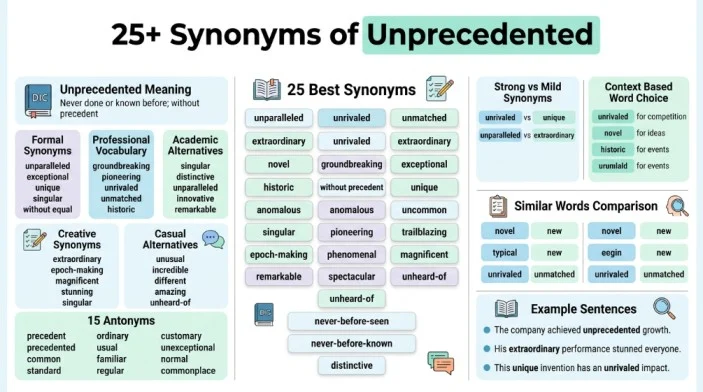
When writing an essay, business report, news article, resume, or social media caption, people often reach for the word unprecedented to describe something that has never happened before. The problem is that repeating the same impressive sounding word can make otherwise strong writing feel predictable. Learning the synonyms of unprecedented gives you more precise ways to describe rarity, novelty, scale, or historical importance.
Not every alternative means exactly the same thing. Words such as unparalleled, unheard of, extraordinary, and never before seen emphasize different aspects of the original idea. Choosing carefully helps your writing communicate whether something is genuinely new, unusually large, extremely rare, or simply unlike anything that came before.
What Are the Best Synonyms of “Unprecedented”?
Unprecedented means something that has never happened, existed, or been experienced before. The best alternatives include unparalleled, unheard of, never before seen, without precedent, and historic. For formal writing, use unparalleled or without precedent. For casual English, never before seen is natural, while extraordinary works well for emotional or creative writing.
Meaning, Tone, and Context
Simple Definition
Unprecedented describes something that has no known earlier example or that has never occurred in a similar way before.
For example:
“The city experienced an unprecedented rise in housing demand.”
This means the increase was unlike anything previously experienced in that context.
The word can refer to an event, situation, achievement, decision, level, increase, crisis, discovery, or development.
Part of Speech
Unprecedented is an adjective.
It normally appears before a noun:
“The company achieved unprecedented growth.”
It can also appear after a linking verb:
“The level of interest was unprecedented.”
Overall Tone
The tone of unprecedented is generally neutral, but it can become positive or negative depending on what it describes.
Positive:
“The athlete achieved unprecedented success.”
Negative:
“The region faced unprecedented challenges.”
Neutral:
“The study recorded unprecedented levels of participation.”
Formality Level
Unprecedented is a formal to neutral word. It is especially common in journalism, academic writing, business communication, government reports, research, and professional discussions.
It can also appear in everyday conversation, although simpler expressions such as never before seen or something we’ve never experienced before may sound more natural.
Common Uses
Native English speakers commonly use unprecedented with words such as:
- unprecedented growth
- unprecedented demand
- unprecedented success
- unprecedented challenges
- unprecedented access
- unprecedented change
- unprecedented levels
- unprecedented opportunity
- unprecedented circumstances
- unprecedented event
- unprecedented achievement
- unprecedented crisis
Word Forms
There is no commonly used noun, verb, or adverb form that directly functions as a natural everyday equivalent of unprecedented.
The related noun precedent is important, however. A precedent is an earlier example or action that can guide a later decision.
Precedent:
“The court’s decision established a new precedent.”
Unprecedented:
“The court made an unprecedented decision.”
These words are related, but they are not interchangeable.
When and How to Use “Unprecedented”
Use unprecedented when you want to communicate that something has no meaningful previous example or has reached a level that has not been experienced before.
The word works best when the claim of novelty is meaningful and supportable. Avoid using it simply as a stronger sounding replacement for large, important, or unusual.
Professional
“The company experienced unprecedented demand after launching its new service.”
Here, the word emphasizes that the level of demand was unlike previous experience.
Academic
“The researchers observed unprecedented changes in the regional ecosystem.”
The term works when the research indicates that the changes differ substantially from earlier observations.
Workplace
“The team faced unprecedented operational challenges during the transition.”
This communicates that the situation was unlike previous workplace conditions.
Personal
“She experienced unprecedented support from her community.”
The word emphasizes an unusually high level of support compared with her previous experience.
“We are currently dealing with unprecedented demand, so response times may be longer than usual.”
This is appropriate for a professional email when the situation genuinely exceeds normal expectations.
Resume
“Led the team through an unprecedented expansion into five new markets.”
On a resume, the word can add impact, but it should be used only when the achievement truly had no close previous example.
Social Media
“This year’s event attracted an unprecedented number of visitors.”
The word works naturally when describing a record or genuinely new level of participation.
Best Synonyms of “Unprecedented”
No synonym completely replaces unprecedented in every situation. The best choice depends on whether you want to emphasize a lack of previous examples, exceptional quality, unusual scale, historical importance, or extreme rarity.
Professional Writing: Unparalleled
Unparalleled means unmatched by anything similar. It is particularly useful when describing performance, quality, success, expertise, or achievement.
“The company has built an unparalleled reputation for customer service.”
Academic Writing: Novel
Novel emphasizes something new or original rather than something that has never happened at all.
“The study introduces a novel approach to language assessment.”
Use novel when discussing ideas, methods, findings, or approaches.
Business Communication: Extraordinary
Extraordinary works when something is far beyond what is normal or expected.
“The business achieved extraordinary growth this quarter.”
Casual Conversation: Never Before Seen
Never before seen is clear and natural in everyday communication.
“We’ve seen a level of demand that’s never been seen before.”
Emotional Writing: Extraordinary
Extraordinary can communicate admiration, surprise, or emotional intensity.
“Her extraordinary courage inspired everyone around her.”
Creative Writing: Unparalleled
Unparalleled adds a strong sense of distinction without sounding overly conversational.
“The kingdom had known an era of unparalleled prosperity.”
Resume Writing: Groundbreaking
Groundbreaking is effective when an achievement introduced something genuinely new or changed an established approach.
“Developed a groundbreaking training system that transformed employee onboarding.”
Workplace Communication: Exceptional
Exceptional is useful when describing performance or results that stand clearly above normal expectations.
“The team delivered exceptional results under difficult conditions.”
Stronger Meaning: Unheard Of
Unheard of strongly emphasizes that something was previously unknown or considered extremely unusual.
“Such a rapid expansion was unheard of in the industry.”
Softer Meaning: Unusual
Unusual is a safer alternative when something is simply different from what is normal. It does not make the strong claim that nothing similar has ever happened.
“The company experienced an unusual increase in demand.”
When Not to Use “Unprecedented”
When the Situation Is Merely Unusual
Unprecedented makes a much stronger claim than unusual.
Less precise:
“We had unprecedented traffic at the restaurant.”
Better if similar crowds have happened before:
“We had unusually high traffic at the restaurant.”
When You Mean Large
Something can be large without being unprecedented.
Less precise:
“The company received unprecedented revenue.”
Better:
“The company received record revenue.”
Use record when the main point is that a previous high was exceeded.
When You Mean Important
Importance and novelty are different concepts.
Less precise:
“This is an unprecedented decision.”
Better:
“This is a significant decision.”
If the decision matters greatly but has happened before, significant is more accurate.
When You Mean Excellent
An achievement can be excellent without being completely new.
Less precise:
“She delivered unprecedented performance.”
Better:
“She delivered exceptional performance.”
When You Are Writing Informally
In casual conversation, unprecedented can sound unnecessarily formal.
Formal:
“The situation is unprecedented.”
Casual:
“We’ve never dealt with anything like this before.”
When the Claim Cannot Be Supported
Because unprecedented suggests a lack of meaningful precedent, it should not be used casually when you have no basis for making that claim.
Instead of:
“This is an unprecedented invention.”
Consider:
“This is an innovative invention.”
Innovative makes a claim about originality without insisting that nothing comparable has ever existed.
Words Commonly Confused With “Unprecedented”
| Word | Difference | When to Use It | Example |
|---|---|---|---|
| Unparalleled | Means unmatched rather than literally never occurring before. | Achievements, quality, success, performance. | “The athlete achieved unparalleled success.” |
| Unusual | Means different from what is normal. | Everyday situations that are uncommon. | “The weather has been unusual this week.” |
| Extraordinary | Means far outside the ordinary range. | Impressive events, people, results, or circumstances. | “She showed extraordinary determination.” |
| Novel | Means new or original. | Research, methods, ideas, technology. | “The researchers proposed a novel method.” |
| Historic | Means important in history or likely to be remembered historically. | Major events and decisions. | “The agreement marked a historic moment.” |
| Record breaking | Means reaching a level that exceeds a previous recorded best. | Sports, sales, attendance, performance. | “The company reported record breaking sales.” |
Best Synonyms of “Unprecedented” by Context
| Context | Best Synonym | Why It Works | Example |
|---|---|---|---|
| Formal writing | Without precedent | Directly emphasizes the absence of an earlier example. | “The ruling was without precedent.” |
| Academic writing | Novel | Clearly identifies a new method or idea. | “The paper presents a novel framework.” |
| Professional communication | Unparalleled | Sounds polished and emphasizes distinction. | “The service offers unparalleled reliability.” |
| Business emails | Extraordinary | Natural when describing unusual circumstances. | “We experienced extraordinary demand.” |
| Resume writing | Groundbreaking | Highlights innovative achievement. | “Developed a groundbreaking platform.” |
| Workplace communication | Exceptional | Describes results above normal expectations. | “The team delivered exceptional results.” |
| Casual conversation | Never before seen | Easy for most readers to understand. | “It was something never before seen here.” |
| Everyday speaking | Never experienced before | Sounds natural and explanatory. | “We’ve never experienced anything like this before.” |
| Creative writing | Unparalleled | Adds distinction and dramatic weight. | “He possessed unparalleled courage.” |
| Storytelling | Extraordinary | Creates a sense of surprise and wonder. | “An extraordinary journey began that night.” |
| Emotional writing | Remarkable | Expresses admiration without making a literal novelty claim. | “Her recovery was remarkable.” |
| Strong emphasis | Unheard of | Strongly suggests that something was previously unknown. | “Such behavior was unheard of in the industry.” |
| Mild tone | Unusual | Avoids an overly strong claim. | “The results were unusual.” |
| Social media captions | Historic | Works well for major memorable events. | “A historic day for the team.” |
| American English | Unprecedented | Standard and widely understood. | “The region experienced unprecedented growth.” |
| British English | Unprecedented | Also standard British usage. | “The country faced unprecedented pressure.” |
How to Choose the Best Synonym of “Unprecedented”
Start by identifying what you actually mean.
- If you mean nothing similar has happened before, use without precedent, unheard of, or never before seen.
- If you mean something is unmatched, choose unparalleled.
- If you mean something is new or original, choose novel or innovative.
- If you mean something is unusually impressive, choose extraordinary, remarkable, or exceptional.
- If you mean a major historical event, historic may be more appropriate.
Consider Your Audience
- For an academic audience, novel and significant can be more precise.
- For business readers, unparalleled, exceptional, and extraordinary often sound natural.
- For everyday readers, never before seen is clearer than highly formal alternatives.
Consider Emotional Strength
- Use unusual when you want a mild description.
- Use extraordinary for stronger admiration or surprise.
- Use unheard of when you want to stress how unfamiliar or shocking something is.
- Use unprecedented when the absence of a meaningful previous example is the central point.
Real Life Examples of “Unprecedented”
School
Original:
“The school had unprecedented attendance.”
More precise:
“The school recorded its highest attendance in a decade.”
The second sentence is better when you have a specific historical comparison.
College
“The university introduced a novel approach to student assessment.”
Here, novel is more natural than unprecedented because the focus is on a new approach.
Workplace
“The department experienced unprecedented demand during the product launch.”
This works when demand truly exceeded anything the department had previously experienced.
Business
“The company achieved record sales during the final quarter.”
Record is preferable when there is a documented previous sales figure to compare against.
“We are facing unusually high demand, so some orders may take longer to process.”
This is more measured than claiming the demand is unprecedented.
Resume
“Introduced a groundbreaking customer support system that reduced response times.”
Groundbreaking emphasizes innovation and achievement.
Conversation
“I’ve never seen anything like this before.”
This is usually more natural in conversation than unprecedented.
Storytelling
“The discovery opened the door to an extraordinary new chapter.”
Extraordinary adds narrative energy without making an absolute historical claim.
Blogging
“The platform experienced unprecedented growth after introducing its new creator tools.”
This works when the growth genuinely represents a level not previously reached.
Social Media
“A historic night for the team, with record attendance and an unforgettable atmosphere.”
Here, historic and record provide more specific information than simply saying everything was unprecedented.
25 Best Synonyms of “Unprecedented”
| Synonym | Simple Meaning | Best Used For | Example Sentence |
|---|---|---|---|
| Unparalleled | Not matched by anything similar | Achievement and quality | “The company provides unparalleled customer support.” |
| Unheard of | Previously unknown or extremely unusual | Strong informal emphasis | “Such a result was unheard of in the field.” |
| Extraordinary | Far beyond what is ordinary | People, events, results | “She demonstrated extraordinary leadership.” |
| Novel | New or original | Research and ideas | “The researchers developed a novel technique.” |
| Groundbreaking | Introducing something genuinely new | Innovation and achievement | “The team created a groundbreaking technology.” |
| Exceptional | Far above normal | Performance and quality | “He delivered exceptional results.” |
| Unusual | Different from what is normal | Mild descriptions | “The region experienced unusual weather.” |
| Historic | Important in history | Major events | “The agreement was a historic achievement.” |
| Record breaking | Exceeding a previous record | Sports and business | “The company reported record breaking sales.” |
| Innovative | Featuring new ideas or methods | Products and processes | “The startup developed an innovative solution.” |
| Remarkable | Worthy of special attention | Achievements and events | “Her progress was remarkable.” |
| Extraordinary | Exceptionally unusual or impressive | Emotional and descriptive writing | “The rescue required extraordinary courage.” |
| Phenomenal | Extremely impressive | Informal and promotional writing | “The campaign generated phenomenal interest.” |
| Unmatched | Having no equal | Skills and performance | “She has unmatched expertise in the field.” |
| Unrivaled | Having no competitor or equal | Competition and quality | “The brand has an unrivaled reputation.” |
| Unexampled | Having no previous example | Highly formal writing | “The event represented an unexampled challenge.” |
| Without precedent | Having no earlier comparable example | Legal and formal writing | “The ruling was without precedent.” |
| Incomparable | Too different or exceptional to compare | Quality and experiences | “The location offers an incomparable view.” |
| Astonishing | Extremely surprising | Emotional and descriptive writing | “The project achieved astonishing results.” |
| Phenomenal | Remarkably great or impressive | Casual and promotional contexts | “The product received phenomenal attention.” |
| Extraordinary | Outside normal experience | General emphasis | “The circumstances were extraordinary.” |
| Rare | Uncommon or infrequent | Mild descriptions | “The species is rare in this region.” |
| Uncommon | Not frequently encountered | Everyday writing | “The level of cooperation was uncommon.” |
| Unrivalled | Having no equal, especially in British usage | Formal British English | “The institution has an unrivalled reputation.” |
| Never before seen | Not previously observed | General and visual descriptions | “The audience witnessed a never before seen display.” |
Usage note: Some alternatives overlap in meaning, but they are not interchangeable in every sentence. In particular, rare, unusual, extraordinary, historic, and record breaking describe different qualities from the strict idea of having no previous precedent.
Synonyms of “Unprecedented” by Usage
Professional vs Personal Synonyms
Professional writing benefits from precise alternatives such as unparalleled, exceptional, groundbreaking, and without precedent.
Personal communication usually sounds more natural with extraordinary, remarkable, or never before seen.
For example:
Professional:
“The company delivered unparalleled service during the expansion.”
Personal:
“I’ve never experienced anything like it.”
Formal vs Conversational Synonyms
Formal alternatives include:
- without precedent
- unparalleled
- unexampled
- groundbreaking
- novel
Conversational alternatives include:
- never before seen
- never experienced before
- unheard of
- unusual
- something we’ve never seen
A business report might say:
“The decision was without precedent.”
A casual speaker might say:
“We’ve never dealt with anything like this before.”
Academic Synonyms
Academic writing often requires a distinction between something being genuinely unprecedented and something merely being new.
Novel is especially useful for a new method, theory, model, or approach.
Unprecedented is better when the evidence supports the stronger claim that there is no comparable previous occurrence.
Significant is appropriate when the focus is on importance or measurable impact rather than novelty.
Example:
“The researchers proposed a novel model for analyzing the data.”
This does not necessarily mean no comparable model has ever existed.
Professional and Business Synonyms
- For resumes, groundbreaking, exceptional, and unparalleled can communicate achievement effectively.
- For interviews, extraordinary or exceptional may sound more natural.
- For meetings and presentations, unprecedented works when discussing genuinely new circumstances.
- For client communication, extraordinary can be useful when describing unusual demand or circumstances without sounding excessively technical.
- For business emails, unusual may be preferable when you want to avoid making an absolute claim.
Creative and Literary Synonyms
Creative writing gives you more freedom to choose expressive alternatives.
Extraordinary can create wonder.
Remarkable can express admiration.
Unparalleled can establish grandeur.
Astonishing can heighten surprise.
Never before seen can create a vivid visual impression.
Example:
“Beyond the mountains stood an unparalleled city, unlike anything she had ever imagined.”
Slang or Modern Synonyms
There is no single slang word that perfectly replaces unprecedented.
Informal expressions such as never seen before, nothing like it, and totally unheard of can communicate similar ideas in casual speech.
Avoid these expressions in academic papers, formal reports, and professional documents unless the surrounding tone is intentionally conversational.
Strongest to Mildest Synonyms
The intensity of an alternative depends on what aspect of unprecedented you want to emphasize.
Mild
- Uncommon
- Unusual
- Rare
These words indicate that something is not typical, but they do not claim it has never happened before.
Moderate
- Remarkable
- Extraordinary
- Exceptional
- Historic
These emphasize unusual quality, importance, or impact.
Strong
- Unparalleled
- Unmatched
- Unrivaled
- Groundbreaking
These suggest a very high level of distinction.
Very Strong
- Unprecedented
- Without precedent
- Unheard of
- Never before seen
These expressions make the strongest claims about the absence of previous examples.
Emotional vs Neutral Synonyms
Emotional Synonyms
Use these when you want to communicate surprise, admiration, excitement, or dramatic impact:
- extraordinary
- astonishing
- phenomenal
- remarkable
- groundbreaking
Example:
“Her extraordinary achievement inspired thousands of people.”
Neutral Synonyms
Use these when you want to communicate information without adding strong emotion:
- unprecedented
- novel
- unusual
- without precedent
- uncommon
Example:
“The researchers observed an unprecedented pattern in the data.”
The neutral option is usually better for academic, technical, and objective writing.
Antonyms of “Unprecedented”
| Antonym | Meaning | Example Sentence |
|---|---|---|
| Precedented | Having an earlier example or precedent | “The decision was precedented by several earlier rulings.” |
| Common | Frequently occurring | “The condition is common in this region.” |
| Usual | Normal or expected | “The meeting followed the usual procedure.” |
| Typical | Representative of what normally happens | “This is typical behavior for the species.” |
| Ordinary | Not unusual or exceptional | “It began as an ordinary afternoon.” |
| Routine | Regularly repeated | “The inspection was a routine procedure.” |
| Standard | Accepted as normal or established | “The company followed standard practices.” |
| Traditional | Based on established practices | “They used a traditional method.” |
| Established | Already accepted or developed | “The team followed an established process.” |
| Familiar | Known from previous experience | “The situation felt familiar to everyone.” |
| Expected | Anticipated or predicted | “The increase was expected.” |
| Predictable | Likely to happen in a known way | “The outcome was predictable.” |
| Conventional | Following customary practices | “The company chose a conventional approach.” |
| Regular | Occurring repeatedly or normally | “The service operates on a regular schedule.” |
| Normal | Consistent with what is usual | “The results were within the normal range.” |
Comparison: “Unprecedented” vs Similar Words
Unprecedented vs Unparalleled
Main Difference
Unprecedented focuses on having no meaningful previous example. Unparalleled focuses on having no equal or comparable match.
Which Is Stronger?
Neither is universally stronger. Unprecedented is stronger for novelty, while unparalleled is stronger for unmatched quality or performance.
Which Is More Formal?
Both are appropriate in formal writing.
When to Use Each
Use unprecedented for events or situations. Use unparalleled for achievements, quality, skill, or performance.
Examples
Unprecedented:
“The region experienced unprecedented growth.”
Unparalleled:
“The company offers unparalleled service.”
Unprecedented vs Unusual
Main Difference
Unusual means uncommon or different from normal. Unprecedented makes the much stronger claim that there is no meaningful earlier example.
Which Is Stronger?
Unprecedented is stronger.
Which Is More Formal?
Both are neutral, but unprecedented sounds more formal.
When to Use Each
Use unusual when something is simply uncommon. Use unprecedented when its lack of precedent matters.
Examples
Unprecedented:
“The city faced unprecedented flooding.”
Unusual:
“The city experienced unusually heavy rain.”
Unprecedented vs Extraordinary
Main Difference
Extraordinary means far outside what is normal. It does not necessarily mean something has never happened before.
Which Is Stronger?
They emphasize different qualities. Unprecedented emphasizes novelty, while extraordinary emphasizes exceptional character.
Which Is More Formal?
Both work in formal and general writing.
When to Use Each
Use extraordinary for impressive people, actions, and results. Use unprecedented for new situations or levels.
Examples
Unprecedented:
“The company experienced unprecedented demand.”
Extraordinary:
“The company achieved extraordinary results.”
Unprecedented vs Novel
Main Difference
Novel means new or original. Unprecedented suggests that there is no comparable previous occurrence.
Which Is Stronger?
Unprecedented generally makes the stronger claim.
Which Is More Formal?
Novel is especially common in academic and scientific writing.
When to Use Each
Use novel for methods, ideas, theories, and approaches.
Examples
Unprecedented:
“The event created unprecedented challenges.”
Novel:
“The researchers developed a novel method.”
Unprecedented vs Historic
Main Difference
Historic describes something important in history or likely to be remembered. Unprecedented describes something without a meaningful precedent.
Which Is Stronger?
Neither is inherently stronger. They emphasize different qualities.
Which Is More Formal?
Both work well in professional and formal writing.
When to Use Each
Use historic when historical importance is the focus. Use unprecedented when novelty is the focus.
Examples
Unprecedented:
“The country experienced unprecedented economic growth.”
Historic:
“The agreement marked a historic moment.”
Unprecedented vs Record Breaking
Main Difference
Record breaking means exceeding a previous recorded best. Unprecedented means having no meaningful previous example.
Which Is Stronger?
Unprecedented can be broader, while record breaking provides a more specific comparison.
Which Is More Formal?
Both are widely used.
When to Use Each
Use record breaking when an established record has been exceeded.
Examples
Unprecedented:
“The organization faced unprecedented demand.”
Record breaking:
“The organization recorded record breaking attendance.”
Common Phrases and Expressions with “Unprecedented”
Unprecedented Growth
Meaning: Growth at a level not previously experienced.
Example:
“The technology sector experienced unprecedented growth during the period.”
Unprecedented Demand
Meaning: Demand that is unusually high compared with previous experience.
Example:
“The store struggled to meet unprecedented demand.”
Unprecedented Success
Meaning: A level of success without a meaningful previous comparison.
Example:
“The campaign achieved unprecedented success among younger audiences.”
Unprecedented Challenges
Meaning: Difficulties unlike those previously experienced.
Example:
“The organization faced unprecedented challenges during the transition.”
Unprecedented Opportunity
Meaning: An opportunity unlike previous ones.
Example:
“The new technology created an unprecedented opportunity for small businesses.”
Unprecedented Access
Meaning: A level or type of access that was previously unavailable or uncommon.
Example:
“The platform gives researchers unprecedented access to real time data.”
Unprecedented Levels
Meaning: Amounts or degrees that have not previously been experienced.
Example:
“The region recorded unprecedented levels of participation.”
Common Mistakes to Avoid
1. Treating “Unprecedented” as a Synonym for “Important”
Incorrect:
“This is an unprecedented issue for the company.”
Better:
“This is a significant issue for the company.”
Why:
If the issue matters greatly but has occurred before, significant is more accurate.
2. Using It When You Mean “Unusual”
Incorrect:
“The employee arrived at an unprecedented time.”
Better:
“The employee arrived at an unusual time.”
Why:
An unusual time does not necessarily have no previous precedent.
3. Using It for Any Large Number
Incorrect:
“The store had unprecedented sales of 500 units.”
Better:
“The store had record sales of 500 units.”
Why:
Record is appropriate when you are comparing the figure with a documented previous high.
4. Using “Novel” When You Mean “Never Before Happened”
Incorrect:
“The event was novel in the region.”
Better:
“The event was unprecedented in the region.”
Why:
Novel describes something new, but it does not always communicate the absence of any previous comparable event.
5. Overusing Strong Language
Incorrect:
“The company experienced unprecedented changes every month.”
Better:
“The company experienced significant changes every month.”
Why:
Constantly calling ordinary changes unprecedented weakens the word’s impact.
6. Using Informal Expressions in Academic Writing
Incorrect:
“The experiment produced results we’d never seen before.”
Better:
“The experiment produced unprecedented results.”
Why:
The second version is more concise and appropriate for formal academic prose when the claim is supported.
7. Assuming “Unprecedented” Means Positive
Incorrect assumption:
“Unprecedented” always describes something impressive or beneficial.
Better understanding:
The word simply indicates a lack of meaningful precedent. It can describe positive, negative, or neutral situations.
“The country faced unprecedented economic difficulties.”
Frequently Asked Questions
1. What are the best synonyms of “unprecedented”?
The best synonyms of unprecedented include unparalleled, unheard of, extraordinary, novel, groundbreaking, exceptional, and without precedent. The best choice depends on whether you mean new, unmatched, unusual, or historically significant.
2. What are the best formal synonyms of “unprecedented”?
The strongest formal alternatives include without precedent, unparalleled, unexampled, groundbreaking, and novel. Choose based on meaning because these words emphasize different qualities rather than serving as perfect replacements.
3. What are common informal synonyms of “unprecedented”?
Common informal alternatives include never before seen, nothing like it, never experienced before, and unheard of. These expressions are easier to understand in casual conversations than highly formal alternatives.
4. What is another word for “unprecedented” in professional writing?
Unparalleled, exceptional, groundbreaking, and extraordinary are useful professional alternatives. Use unparalleled for unmatched quality, groundbreaking for innovation, and exceptional for outstanding performance.
5. What is the difference between “unprecedented” and “unparalleled”?
Unprecedented means there is no meaningful previous example, while unparalleled means something has no equal or comparable match. An event can be unprecedented without being the best or most impressive example of its kind.
6. What is the opposite of “unprecedented”?
Common opposites include precedented, usual, common, typical, routine, ordinary, standard, and established. The best antonym depends on whether you mean familiar, normal, repeated, or previously established.
Conclusion
Unprecedented describes something that has no meaningful previous example or has occurred at a level unlike what came before. It is a strong, useful word for formal writing, journalism, business communication, academic discussion, and situations where novelty is the central idea.
The best alternatives depend on context. Choose unparalleled for something unmatched, novel for a new idea or method, extraordinary for something exceptional, groundbreaking for innovation, historic for historical importance, and unusual when you only need a mild description.
No synonym works perfectly in every situation. Before replacing unprecedented, identify whether you want to emphasize novelty, rarity, scale, importance, innovation, or exceptional quality. A practical vocabulary habit is to define the exact idea you want to communicate first, then choose the word that expresses that idea most precisely.
Read More Related Articles:
- 25+ Synonyms of Resume | Meanings, Uses, Examples, and …
- 25+ Synonyms of Bridge | Meanings, Uses, Examples, and …
- 25+ Synonyms of Sincerely | Meanings, Uses, Examples, and …