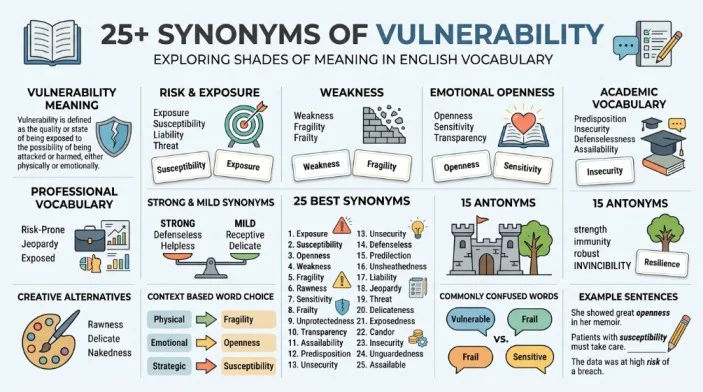
When writing an essay, business report, personal caption, or professional email, repeating the word vulnerability can make your language feel limited. The synonyms of vulnerability vary depending on whether you mean emotional openness, physical weakness, exposure to danger, a security risk, or susceptibility to harm.
Choosing the right alternative makes your meaning much clearer. For example, susceptibility works well when discussing health or risk, exposure fits security and environmental contexts, weakness can describe a specific limitation, and openness often works better when discussing emotions. The goal is not simply to replace vulnerability, but to choose a word that communicates the exact type of vulnerability you mean.
What Are the Best Synonyms of “Vulnerability”?
The best synonyms of vulnerability depend on context. Susceptibility and exposure work well for risk, weakness and frailty describe limited strength, while openness and emotional exposure fit personal situations. In professional or academic writing, susceptibility, sensitivity, exposure, insecurity, and lack of protection can provide greater precision.
Meaning, Tone, and Context
Simple Definition
Vulnerability describes a condition in which a person, system, place, or situation is open to harm, damage, attack, criticism, or emotional pain.
The word can describe both physical and emotional conditions. A computer network can have a vulnerability, while a person can show vulnerability by openly expressing difficult feelings.
Part of Speech
Vulnerability is a noun.
The related adjective is vulnerable.
Examples:
“The software contains a security vulnerability.”
“She showed vulnerability when she talked about her fears.”
Overall Tone
The tone of vulnerability is usually neutral, but it can become positive, negative, or emotional depending on context.
In cybersecurity, vulnerability usually points to a weakness or risk.
In personal communication, vulnerability can suggest honesty, courage, trust, or emotional openness.
Formality Level
Vulnerability is a neutral to moderately formal word. It works naturally in academic writing, professional communication, psychology discussions, cybersecurity reports, journalism, social conversations, and everyday speech.
Common Uses
Native English speakers commonly use vulnerability in several areas.
Emotional situations
“Sharing his vulnerability helped him build stronger relationships.”
Cybersecurity
“The company discovered a vulnerability in its software.”
Health
“Older adults may have greater vulnerability to certain infections.”
Business
“The analysis identified several vulnerabilities in the supply chain.”
Relationships
“Emotional vulnerability can strengthen trust between partners.”
Physical safety
“The storm exposed the vulnerability of coastal communities.”
Social issues
“Economic hardship can increase a family’s vulnerability.”
Word Forms
| Form | Word |
|---|---|
| Noun | vulnerability |
| Adjective | vulnerable |
| Related noun | vulnerability |
| Related concept | susceptibility |
| Opposite concept | resilience, protection, security |
There is no common everyday verb or adverb form directly derived from vulnerability.
When and How to Use “Vulnerability”
Use vulnerability when you need to describe exposure to harm, weakness, susceptibility, or emotional openness. The surrounding context determines which meaning readers will understand.
Professional
“The risk assessment identified a significant vulnerability in the company’s payment system.”
Here, vulnerability refers to a weakness that could create risk.
Academic
“The study examines the vulnerability of low income communities to environmental changes.”
This usage focuses on susceptibility to external conditions.
Workplace
“The manager encouraged employees to discuss concerns without fearing that vulnerability would affect their careers.”
Here, the word refers to emotional openness.
Personal
“Admitting that I needed help required a level of vulnerability I was not used to showing.”
The word describes emotional openness and the possibility of being hurt or judged.
“The security team is investigating a potential vulnerability identified during the system review.”
This is appropriate for professional and technical communication.
Resume
“Identified system vulnerabilities and recommended measures to reduce security risks.”
In a resume, the related concept is usually expressed through a concrete achievement rather than simply stating vulnerability.
Social Media
“There is strength in vulnerability when you feel safe enough to share your real experiences.”
This use is emotional and reflective rather than technical.
Best Synonyms of “Vulnerability”
No single synonym perfectly replaces vulnerability in every sentence. The word can refer to susceptibility, weakness, exposure, emotional openness, insecurity, or lack of protection, so the best alternative depends on the exact meaning.
Professional Writing: Susceptibility
Susceptibility is a strong professional alternative when vulnerability means being easily affected by a particular risk or condition.
“The report examined the company’s susceptibility to supply chain disruptions.”
It sounds precise and analytical.
Academic Writing: Susceptibility
In academic writing, susceptibility is particularly useful when discussing how likely a person, population, organism, or system is to be affected by something.
“The research examined children’s susceptibility to environmental stress.”
Business Communication: Exposure
Exposure works well when a company, system, investment, or process is open to a particular risk.
“The audit revealed significant exposure to financial risk.”
Casual Conversation: Openness
When vulnerability means sharing personal thoughts or emotions, openness often sounds more natural in everyday conversation.
“Her openness made it easier for everyone to trust her.”
Emotional Writing: Emotional Exposure
Emotional exposure emphasizes the risk involved in revealing personal feelings.
“Writing about his loss required considerable emotional exposure.”
Creative Writing: Fragility
Fragility can add emotional or descriptive depth when vulnerability involves delicate physical, emotional, or situational conditions.
“Beneath his confidence was a quiet fragility.”
Resume Writing: Weakness
In a resume, vulnerability is rarely the strongest choice because resumes usually focus on strengths, risks managed, or problems solved. Weakness can be useful when describing a problem that was identified and corrected.
“Identified security weaknesses and implemented stronger access controls.”
Workplace Communication: Sensitivity
Sensitivity can work when vulnerability refers to being particularly affected by a situation.
“The team showed sensitivity to employees facing personal challenges.”
Stronger Meaning: Exposure
When you want to emphasize that something is directly open to harm or risk, exposure can be stronger and more concrete.
“The outdated system created significant exposure to cyberattacks.”
Softer Meaning: Openness
When discussing personal relationships, openness is often gentler and more positive than vulnerability.
“Her openness encouraged honest communication.”
When Not to Use “Vulnerability”
Although vulnerability is versatile, there are situations where another word communicates the idea more accurately.
When “Vulnerability” Is Too General
Less precise:
“The company has vulnerability to market changes.”
Better:
“The company has susceptibility to sudden market changes.”
Why:
Susceptibility directly communicates that the company is likely to be affected.
When “Vulnerability” Is Too Vague
Less precise:
“The software has several vulnerabilities.”
Better:
“The software has several security weaknesses.”
Why:
The revised sentence tells readers what type of vulnerability is being discussed.
When a More Technical Word Is Needed
Less precise:
“The patient has vulnerability to infection.”
Better:
“The patient has greater susceptibility to infection.”
Why:
Susceptibility is more precise when discussing a tendency to be affected by a disease or condition.
When the Emotional Meaning Is Intended
Less natural:
“He demonstrated vulnerability by telling his friend how he felt.”
Alternative:
“He showed openness by telling his friend how he felt.”
Why:
Openness can sound warmer and less focused on the possibility of emotional harm.
When You Mean Physical Weakness
Less precise:
“The old bridge showed vulnerability.”
Better:
“The old bridge showed signs of structural weakness.”
Why:
The revised expression identifies the specific type of problem.
When You Mean Direct Risk
Less precise:
“The organization has vulnerability to fraud.”
Better:
“The organization has significant exposure to fraud.”
Why:
Exposure emphasizes direct contact with or openness to a particular risk.
When You Mean Lack of Protection
Less precise:
“The community faced vulnerability during the storm.”
Better:
“The community faced a serious lack of protection during the storm.”
Why:
The replacement explains what created the risk.
Words Commonly Confused With “Vulnerability”
Susceptibility
Difference: Susceptibility means being likely to be affected or harmed by something.
When to Use It: Use it for health, environmental, social, and technical risks.
Example:
“Some plants have greater susceptibility to extreme temperatures.”
Weakness
Difference: Weakness refers to a specific limitation or lack of strength.
When to Use It: Use it when you can identify the particular flaw or limitation.
Example:
“Poor password management was a major weakness in the system.”
Fragility
Difference: Fragility suggests that something can be easily damaged, broken, or emotionally affected.
When to Use It: Use it for delicate physical, emotional, or social conditions.
Example:
“The crisis revealed the fragility of the local economy.”
Exposure
Difference: Exposure focuses on being open to a particular risk, influence, or danger.
When to Use It: Use it in cybersecurity, finance, health, and environmental contexts.
Example:
“The company reduced its exposure to financial losses.”
Insecurity
Difference: Insecurity often describes uncertainty, lack of confidence, or a feeling of being unsafe.
When to Use It: Use it primarily for emotional, social, or personal situations.
Example:
“His insecurity made him hesitant to speak in meetings.”
Helplessness
Difference: Helplessness means feeling or being unable to control a situation or prevent harm.
When to Use It: Use it when vulnerability involves a lack of power or control.
Example:
“The child felt a sense of helplessness during the emergency.”
Best Synonyms of “Vulnerability” by Context
| Context | Best Synonym | Why It Works | Example |
|---|---|---|---|
| Formal writing | Susceptibility | Precise and analytical | “The report examined susceptibility to external risks.” |
| Academic writing | Susceptibility | Clearly describes likelihood of being affected | “The study measured susceptibility to stress.” |
| Professional communication | Exposure | Communicates direct risk | “The audit identified exposure to financial loss.” |
| Business emails | Weakness | Useful for specific problems | “We identified a weakness in the current process.” |
| Resume writing | Weakness | Works when describing problems solved | “Addressed security weaknesses across multiple systems.” |
| Workplace communication | Sensitivity | Fits situations involving personal concerns | “The discussion required sensitivity to employee needs.” |
| Casual conversation | Openness | Sounds natural for emotional contexts | “Her openness helped everyone feel comfortable.” |
| Everyday speaking | Weakness | Simple and widely understood | “The design has one obvious weakness.” |
| Creative writing | Fragility | Adds descriptive and emotional depth | “His confidence concealed a deep fragility.” |
| Storytelling | Exposure | Creates a sense of risk | “The journey left them exposed to danger.” |
| Emotional writing | Openness | Gives a warmer tone | “Her openness brought them closer.” |
| Strong emphasis | Exposure | Highlights direct risk | “The system faces serious exposure to attacks.” |
| Mild tone | Sensitivity | Softer than vulnerability in some personal contexts | “The subject requires sensitivity.” |
| Social media captions | Openness | Natural and positive | “There is courage in openness.” |
| American English | Vulnerability | Common and versatile | “Showing vulnerability can strengthen relationships.” |
| British English | Vulnerability | Also natural and widely understood | “The report highlighted community vulnerability.” |
How to Choose the Best Synonym of “Vulnerability”
Choosing the right synonym starts with identifying exactly what kind of vulnerability you mean.
If You Mean “Likely to Be Harmed”
Choose susceptibility.
“The region’s susceptibility to flooding has increased.”
If You Mean “A Specific Flaw”
Choose weakness.
“The audit uncovered a weakness in the security system.”
If You Mean “Open to Risk”
Choose exposure.
“The company reduced its exposure to market volatility.”
If You Mean “Emotional Openness”
Choose openness.
“Her openness made the conversation more honest.”
If You Mean “Delicate or Easily Damaged”
Choose fragility.
“The crisis exposed the fragility of the relationship.”
If You Mean “Lack of Confidence or Security”
Choose insecurity.
“His insecurity affected the way he communicated.”
If You Mean “Lack of Power”
Choose helplessness.
“The situation left the residents with a feeling of helplessness.”
Consider Your Audience
Academic readers usually respond well to precise terms such as susceptibility and exposure.
General readers may understand weakness, openness, and lack of protection more quickly.
Consider Emotional Strength
Openness often sounds positive.
Vulnerability can sound emotionally exposed.
Fragility suggests delicacy.
Helplessness carries a stronger negative emotional meaning.
Consider Your Writing Purpose
- For a cybersecurity report, use security weakness, exposure, or susceptibility.
- For a personal essay, use openness, emotional exposure, or insecurity.
- For a research paper, use susceptibility, sensitivity, or exposure, depending on the exact relationship being described.
Real Life Examples of “Vulnerability”
School
Original:
“The article discusses the vulnerability of children to online misinformation.”
Improved:
“The article examines children’s susceptibility to online misinformation.”
Why: Susceptibility gives the academic sentence greater precision.
College
Original:
“The research explores vulnerability among older adults.”
Improved:
“The research explores the susceptibility of older adults to social isolation.”
Why: The revised version identifies what affects the group.
Workplace
Original:
“The discussion revealed some vulnerability in the team’s workflow.”
Improved:
“The discussion revealed a weakness in the team’s workflow.”
Why: Weakness clearly identifies a problem that can potentially be corrected.
Business
Original:
“The company is vulnerable to supply chain disruptions.”
Improved:
“The company has significant exposure to supply chain disruptions.”
Why: Exposure works naturally in business risk discussions.
Original:
“We identified a vulnerability in the system.”
Improved:
“We identified a security weakness in the system.”
Why: The revised version immediately identifies the type of vulnerability.
Resume
Original:
“Responsible for identifying vulnerabilities.”
Improved:
“Identified security weaknesses and implemented measures to reduce operational risk.”
Why: The second version describes an actual professional contribution.
Conversation
Original:
“I appreciate your vulnerability.”
Alternative:
“I appreciate your openness.”
Why: Openness can sound warmer and more conversational in personal communication.
Storytelling
Original:
“She noticed his vulnerability.”
Improved:
“She noticed the fragility beneath his confident appearance.”
Why: Fragility creates a more descriptive and literary effect.
Blogging
Original:
“Vulnerability can affect small businesses.”
Improved:
“Small businesses may have greater exposure to unexpected financial risks.”
Why: The revised sentence identifies the type of vulnerability being discussed.
Social Media
Original:
“Vulnerability is not always weakness.”
Improved:
“Emotional openness is not the same as weakness.”
Why: Openness gives the statement a more positive and accessible tone.
25 Best Synonyms of “Vulnerability”
Not all of these words are interchangeable in every context. Each represents a closely related meaning or a specific sense of vulnerability, so the best choice depends on what kind of risk, weakness, or openness you want to describe.
| Synonym | Simple Meaning | Best Used For | Example Sentence |
|---|---|---|---|
| Susceptibility | Likelihood of being affected | Health, research, risk | “The study examined susceptibility to infection.” |
| Exposure | Being open to risk or harm | Business, security, finance | “The company reduced its exposure to risk.” |
| Weakness | A specific limitation or flaw | Systems, skills, organizations | “The audit found a weakness in the process.” |
| Fragility | Ease of being damaged | Relationships, economies, physical conditions | “The crisis revealed the fragility of the market.” |
| Insecurity | Lack of confidence or safety | Personal and emotional contexts | “Her insecurity affected her confidence.” |
| Sensitivity | Tendency to be strongly affected | Health, emotions, social issues | “The material has sensitivity to heat.” |
| Openness | Willingness to reveal thoughts or feelings | Relationships, communication | “His openness encouraged honest discussion.” |
| Helplessness | Lack of power or control | Emotional and difficult situations | “The victims described feelings of helplessness.” |
| Defenselessness | Lack of ability to protect oneself | Safety, physical danger | “The isolated location created defenselessness.” |
| Susceptibleness | Being easily affected | General risk discussions | “The species’ susceptibleness to disease concerns researchers.” |
| Delicacy | A condition requiring careful treatment | Emotional or physical situations | “The delicacy of the situation required patience.” |
| Tenderness | Emotional softness or sensitivity | Relationships, literature | “His response showed tenderness rather than anger.” |
| Powerlessness | Lack of control or influence | Social and personal contexts | “The experience left her feeling powerless.” |
| Precariousness | Lack of stability or security | Finance, politics, living conditions | “The crisis highlighted the precariousness of the economy.” |
| Instability | Lack of steadiness or reliability | Systems, relationships, economies | “Political instability increased the region’s risk.” |
| Risk | Possibility of harm or loss | Business, safety, finance | “The assessment identified a serious risk.” |
| Danger | Possibility of serious harm | Physical and general contexts | “The damaged structure posed a danger to residents.” |
| Peril | Serious and immediate danger | Formal or dramatic writing | “The expedition faced considerable peril.” |
| Lack of protection | Absence of safety or defense | Security and safety | “The lack of protection increased the residents’ risk.” |
| Deficiency | Lack of something needed | Systems, resources, organizations | “A deficiency in security controls created problems.” |
| Limitation | Something that restricts ability | Skills, systems, resources | “Limited funding became a major limitation.” |
| Shortcoming | A specific failure or weakness | Performance, plans, organizations | “The review identified a shortcoming in the policy.” |
| Flaw | An imperfection that creates a problem | Designs, systems, arguments | “The software contained a serious flaw.” |
| Vulnerableness | The condition of being vulnerable | Formal or specialized discussion | “The analysis considered the system’s vulnerableness.” |
| Exposure risk | The possibility created by being exposed | Security and professional contexts | “The assessment measured employee exposure risk.” |
Synonyms of “Vulnerability” by Usage
Professional vs Personal Synonyms
Professional writing usually requires precise language that identifies the source or type of risk.
Use susceptibility, exposure, weakness, deficiency, and shortcoming when discussing organizations, systems, processes, or measurable risks.
Personal communication often benefits from softer alternatives such as openness, insecurity, sensitivity, or emotional exposure.
Compare:
“The system has a security weakness.”
with:
“She showed emotional openness.”
The underlying idea is related, but the contexts are completely different.
Formal vs Conversational Synonyms
For reports and formal writing, consider:
Susceptibility
Exposure
Precariousness
Deficiency
Powerlessness
For everyday communication, consider:
Weakness
Openness
Insecurity
Lack of protection
Formal vocabulary is useful when precision matters, but simpler words are often clearer for general audiences.
Academic Synonyms
Academic writing benefits from words that describe the relationship between a subject and a risk.
Susceptibility is useful when something is likely to be affected.
Sensitivity works when the degree of response to a condition matters.
Exposure is appropriate when contact with a risk or influence is central.
Precariousness can describe unstable social, economic, or political conditions.
Example:
“The study examined the population’s susceptibility to environmental stress.”
This is more precise than simply writing:
“The study examined the population’s vulnerability.”
Professional and Business Synonyms
For resumes, interviews, meetings, presentations, performance reviews, client communication, and business emails, choose words that identify the actual problem.
Resume: Use weakness, security gap, or risk when describing problems you solved.
Interview: Use weakness when discussing a personal limitation and explain how you improved it.
Meetings: Use risk, exposure, or weakness for business issues.
Presentations: Use exposure or susceptibility when discussing risk.
Performance reviews: Use development area or limitation when appropriate.
Client communication: Use risk or exposure rather than unnecessarily dramatic language.
Example:
“Our assessment identified several areas of exposure and recommended controls to reduce risk.”
This sounds more useful than repeatedly describing everything as a vulnerability.
Creative and Literary Synonyms
Creative writing allows more expressive alternatives.
Fragility can suggest hidden emotional weakness.
Delicacy can create a sense of carefulness.
Tenderness can emphasize emotional softness.
Powerlessness can intensify a character’s lack of control.
Helplessness can emphasize emotional distress.
Example:
“Behind her calm expression was a quiet fragility that few people noticed.”
This creates a stronger literary image than simply saying:
“She was vulnerable.”
Slang or Modern Synonyms
There is no universally accepted slang synonym that replaces vulnerability across contexts.
Informal expressions such as letting your guard down can communicate emotional vulnerability in conversation.
“He finally let his guard down and talked about what had happened.”
This expression is natural in casual speech, but it should generally be avoided in academic papers, technical reports, and formal business writing.
Strongest to Mildest Synonyms
There is no single objective intensity ranking for all synonyms of vulnerability, because the words describe different dimensions. However, they can be grouped according to how strongly they emphasize danger, weakness, or emotional exposure.
| Level | Useful Words | Typical Effect |
|---|---|---|
| Mild | Openness, sensitivity, delicacy | Suggests limited or manageable exposure |
| Moderate | Vulnerability, weakness, susceptibility | Clearly identifies a condition of risk or weakness |
| Strong | Exposure, fragility, insecurity | Highlights greater risk, instability, or emotional sensitivity |
| Very Strong | Helplessness, defenselessness, powerlessness, peril | Emphasizes lack of protection, control, or safety |
The strongest word is not always the best word. A technical report may need susceptibility, while a personal essay may be better served by openness.
Emotional vs Neutral Synonyms
Emotional Synonyms
These alternatives tend to carry more personal or emotional weight.
Openness: Often positive and relational.
Insecurity: Usually suggests uncertainty or lack of confidence.
Fragility: Suggests delicate emotional or physical conditions.
Helplessness: Conveys a strong feeling of lacking control.
Powerlessness: Highlights an inability to influence events.
Tenderness: Can suggest emotional sensitivity in literary contexts.
Neutral Synonyms
These words communicate risk or weakness with less emotional coloring.
Susceptibility
Exposure
Weakness
Sensitivity
Risk
Deficiency
Limitation
Use neutral terms in research papers, reports, technical documents, and business communication when emotional interpretation is unnecessary.
Antonyms of “Vulnerability”
The opposite of vulnerability depends on what kind of vulnerability is being discussed. For emotional vulnerability, confidence or emotional security may be the opposite. For physical or technical vulnerability, protection, security, and resilience are more appropriate.
| Antonym | Meaning | Example Sentence |
|---|---|---|
| Security | Protection from harm or risk | “The new system provides stronger security.” |
| Protection | Measures that prevent harm | “The equipment offers protection from extreme weather.” |
| Resilience | Ability to recover from difficulty | “The community showed remarkable resilience.” |
| Strength | Ability to withstand pressure or harm | “The structure has enough strength to withstand the load.” |
| Stability | Condition of being steady and secure | “Financial stability reduced the company’s risk.” |
| Safety | Freedom from significant danger | “The new procedures improved workplace safety.” |
| Invulnerability | Resistance to harm or attack | “No system can guarantee complete invulnerability.” |
| Independence | Ability to function without reliance on others | “Financial independence gave her greater control.” |
| Confidence | Belief in one’s abilities or judgment | “His confidence improved after more training.” |
| Self reliance | Ability to manage without outside help | “The program encourages self reliance.” |
| Defensibility | Ability to be protected or defended | “The system’s defensibility improved after the update.” |
| Preparedness | Readiness to handle a threat or difficulty | “Preparedness reduced the effects of the storm.” |
| Fortitude | Mental strength during difficulty | “She demonstrated remarkable fortitude.” |
| Empowerment | Increased ability to control circumstances | “Education can promote economic empowerment.” |
| Robustness | Ability to withstand stress or failure | “The software’s robustness was tested under heavy demand.” |
Comparison: “Vulnerability” vs Similar Words
Vulnerability vs Susceptibility
Main Difference
Vulnerability is a broad term for being open to harm or weakness. Susceptibility specifically emphasizes how likely something is to be affected by a particular influence or condition.
Which Is Stronger?
Neither is automatically stronger. Susceptibility is more specific when probability or tendency is the main point.
Which Is More Formal?
Susceptibility is especially useful in academic, scientific, medical, and technical writing.
When to Use Each
Use vulnerability for broad discussions of risk.
Use susceptibility when explaining how easily something can be affected.
Examples
Vulnerability:
“The report examined the vulnerability of coastal communities.”
Susceptibility:
“The study measured the community’s susceptibility to flooding.”
Vulnerability vs Weakness
Main Difference
Vulnerability describes exposure to harm. Weakness usually identifies a particular flaw or limitation.
Which Is Stronger?
Weakness can sound more direct because it points to a specific problem.
Which Is More Formal?
Both are appropriate, but vulnerability is more common in technical risk discussions.
When to Use Each
Use weakness when you can identify what is wrong.
Use vulnerability when discussing the broader risk created by that weakness.
Examples
Vulnerability:
“The system has several vulnerabilities.”
Weakness:
“Poor access controls are a major weakness.”
Vulnerability vs Fragility
Main Difference
Vulnerability means being open to harm. Fragility suggests that something can be easily damaged, broken, or destabilized.
Which Is Stronger?
Fragility often creates a stronger sense of delicacy.
Which Is More Formal?
Both can be formal, although fragility is particularly effective in economic, social, emotional, and literary contexts.
When to Use Each
Use vulnerability for risk.
Use fragility for delicate conditions.
Examples
Vulnerability:
“The region’s vulnerability increased after the storm.”
Fragility:
“The crisis exposed the fragility of the local economy.”
Vulnerability vs Exposure
Main Difference
Exposure emphasizes being open to a specific danger, influence, or risk.
Which Is Stronger?
Exposure can sound stronger when the risk is direct.
Which Is More Formal?
Both are common in professional and technical writing.
When to Use Each
Use exposure in risk assessments, cybersecurity, finance, and environmental discussions.
Examples
Vulnerability:
“The company identified a vulnerability in its network.”
Exposure:
“The outdated network increased the company’s exposure to attacks.”
Vulnerability vs Insecurity
Main Difference
Vulnerability can refer to many forms of exposure to harm. Insecurity often refers to uncertainty, lack of confidence, or a feeling of being unsafe.
Which Is Stronger?
Insecurity can carry stronger emotional meaning in personal contexts.
Which Is More Formal?
Both are suitable for formal writing when used accurately.
When to Use Each
Use insecurity when confidence or emotional safety is the main concern.
Examples
Vulnerability:
“The conversation required emotional vulnerability.”
Insecurity:
“Her insecurity made her reluctant to share her opinion.”
Vulnerability vs Helplessness
Main Difference
Vulnerability means being open to possible harm. Helplessness means lacking the ability or power to prevent or change what is happening.
Which Is Stronger?
Helplessness usually carries a stronger negative emotional meaning.
Which Is More Formal?
Both are acceptable in formal writing, depending on the subject.
When to Use Each
Use helplessness when lack of control is central to the meaning.
Examples
Vulnerability:
“The experience made him aware of his vulnerability.”
Helplessness:
“The situation left him with a deep sense of helplessness.”
Common Phrases and Expressions with “Vulnerability”
Emotional Vulnerability
Meaning: Openness to emotional risk or willingness to reveal personal feelings.
Example:
“Emotional vulnerability can create deeper connections when trust is present.”
Show Vulnerability
Meaning: To openly reveal feelings, fears, uncertainty, or personal difficulties.
Example:
“The leader showed vulnerability by admitting that she did not have every answer.”
Vulnerability to Risk
Meaning: A condition in which someone or something is particularly open to a specific danger.
Example:
“The assessment measured the company’s vulnerability to financial risk.”
Vulnerability Assessment
Meaning: A systematic examination designed to identify weaknesses or security risks.
Example:
“The IT department completed a vulnerability assessment of the network.”
Security Vulnerability
Meaning: A weakness in a system that could potentially be exploited or cause harm.
Example:
“The software update fixed a serious security vulnerability.”
Human Vulnerability
Meaning: The natural possibility of being affected physically, emotionally, or socially.
Example:
“The novel explores human vulnerability in times of crisis.”
Embrace Vulnerability
Meaning: To accept openness and emotional risk rather than always trying to hide weakness.
Example:
“The speaker encouraged the audience to embrace vulnerability.”
Vulnerability to Change
Meaning: A condition in which something can be strongly affected by changing circumstances.
Example:
“Small businesses may face greater vulnerability to sudden economic changes.”
Common Mistakes to Avoid
1. Treating Every Synonym as Interchangeable
Incorrect:
“The patient’s exposure to infection was high.”
Better:
“The patient’s susceptibility to infection was high.”
Why:
Exposure and susceptibility describe different relationships. Exposure concerns contact with a risk, while susceptibility concerns the likelihood of being affected.
2. Using “Weakness” for Every Type of Vulnerability
Incorrect:
“Her emotional weakness helped strengthen the relationship.”
Better:
“Her emotional openness helped strengthen the relationship.”
Why:
Weakness can imply deficiency, while openness better captures positive emotional honesty.
3. Using Informal Language in Formal Writing
Incorrect:
“The company is wide open to problems.”
Better:
“The company has significant exposure to risk.”
Why:
The second sentence is clearer and more appropriate for a professional report.
4. Choosing an Overly Dramatic Word
Incorrect:
“The minor design issue created extreme helplessness.”
Better:
“The minor design issue revealed a weakness.”
Why:
Helplessness describes a lack of power or control, not simply a technical flaw.
5. Repeating “Vulnerability” Too Often
Incorrect:
“The report discusses vulnerability in employees, vulnerability in systems, and vulnerability in communities.”
Better:
“The report examines emotional insecurity among employees, technical weaknesses in systems, and community susceptibility to external risks.”
Why:
The revised version identifies the specific meaning in each context.
6. Confusing Vulnerability With Weakness
Incorrect:
“Showing vulnerability always means admitting weakness.”
Better:
“Showing vulnerability can involve openness without necessarily indicating weakness.”
Why:
Vulnerability can involve emotional honesty, while weakness refers more specifically to a limitation or deficiency.
7. Using Technical Terms Without Context
Incorrect:
“The community has high susceptibility.”
Better:
“The community has high susceptibility to flooding.”
Why:
Susceptibility normally needs a clear indication of what the subject is likely to be affected by.
Frequently Asked Questions
What is a good vulnerability synonym?
Good options include weakness, susceptibility, exposure, insecurity, fragility, and openness, depending on the context.
What is another word for vulnerability?
Weakness is a common alternative, while susceptibility or exposure may be more precise in specific contexts.
What are the common synonyms for vulnerability?
Common synonyms for vulnerability include weakness, fragility, susceptibility, exposure, insecurity, defenselessness, and sensitivity.
What is the synonym for vulnerability in English?
In English, weakness, susceptibility, exposure, fragility, and insecurity can work as synonyms, depending on the intended meaning.
What is the vulnerability meaning and its synonyms?
Vulnerability refers to a state of being easily harmed, affected, attacked, or emotionally exposed. Its synonyms include weakness, susceptibility, fragility, and exposure.
What is another word for vulnerabilities?
Depending on the context, another word for vulnerabilities can be weaknesses, risks, exposures, flaws, or susceptibilities.
What does a vulnerability thesaurus include?
A vulnerability thesaurus typically includes related words such as weakness, fragility, susceptibility, exposure, insecurity, and defenselessness.
What are vulnerability synonyms in English?
Common vulnerability synonyms in English include weakness, susceptibility, fragility, exposure, insecurity, sensitivity, and defenselessness.
What are the best synonyms of “vulnerability”?
The best synonyms of vulnerability include susceptibility, exposure, weakness, fragility, insecurity, sensitivity, openness, helplessness, and powerlessness. The best choice depends on whether you mean risk, weakness, emotional openness, or lack of protection.
What are the best formal synonyms of “vulnerability”?
The strongest formal alternatives include susceptibility, exposure, sensitivity, precariousness, deficiency, and powerlessness. Academic and professional writers should select the word that most precisely identifies the type of risk or weakness involved.
What are common informal synonyms of “vulnerability”?
Common informal alternatives depend on context. Weakness, openness, insecurity, and expressions such as letting your guard down can work in everyday conversation, especially when discussing emotional vulnerability.
What is another word for “vulnerability” in professional writing?
In professional writing, useful alternatives include exposure, susceptibility, weakness, risk, deficiency, and security gap. Choose exposure for direct risk and weakness when identifying a specific problem that can be corrected.
What is the difference between “vulnerability” and “susceptibility”?
Vulnerability is broader and describes openness to harm, while susceptibility specifically emphasizes the likelihood of being affected by something. For example, a person can be vulnerable to illness because they have greater susceptibility to infection.
What is the opposite of “vulnerability”?
Common opposites include security, protection, resilience, strength, stability, safety, invulnerability, confidence, preparedness, and robustness. The best antonym depends on whether vulnerability refers to physical risk, emotional exposure, or technical weakness.
Conclusion
Vulnerability describes a condition of being open to harm, risk, emotional pain, attack, or damage. Its best alternatives depend heavily on context. Susceptibility is useful for likelihood of being affected, exposure emphasizes direct risk, weakness identifies a specific flaw, fragility highlights delicacy, and openness works well for emotional situations.
There is no perfect replacement in every sentence. The strongest choice depends on your audience, tone, purpose, and the exact meaning you want to communicate.
When choosing among the synonyms of vulnerability, first identify what kind of vulnerability you mean, then select the word that expresses that specific idea most naturally.
Read More Related Articles:
- 25+ Synonyms of Resume | Meanings, Uses, Examples, and …
- 25+ Synonyms of Bridge | Meanings, Uses, Examples, and …
- 25+ Synonyms of Sincerely | Meanings, Uses, Examples, and …