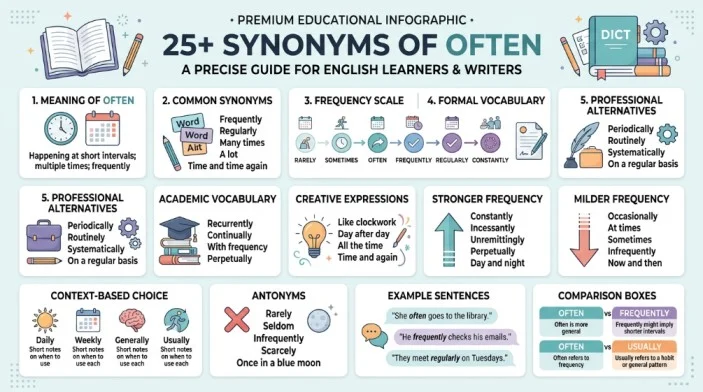
When writing emails, essays, captions, resumes, or blog posts, it is easy to use often again and again. The word is natural and useful, but repeating it can make your writing feel predictable. Finding the right synonym of often can help you describe frequency more precisely while keeping your sentences natural.
Words such as frequently, regularly, commonly, and repeatedly are useful alternatives, but they do not all mean exactly the same thing. Some emphasize how many times something happens, while others suggest a routine, a habit, or repeated action. Choosing the right word improves clarity, tone, and communication without making your writing sound unnecessarily complicated.
What Are the Best Synonyms of “Often”?
The best synonyms of often include frequently, regularly, commonly, repeatedly, routinely, habitually, and many times. Frequently is the closest general alternative, while regularly emphasizes a pattern or routine. For formal and academic writing, frequently and commonly work well. Casual writing can use often, regularly, or many times naturally.
Meaning, Tone, and Context
Simple Definition
Often means happening many times or frequently, but not necessarily every time. It describes a repeated action, event, situation, or condition that occurs more than occasionally.
For example:
“She often reads before going to bed.”
This means reading happens regularly or many times, although it does not necessarily happen every night.
Part of Speech
Often is an adverb.
It modifies a verb or sometimes an entire clause by showing how frequently something happens.
Examples:
“They often visit their grandparents.”
“He often works late.”
“Often, the simplest solution is the best.”
Overall Tone
Often has a neutral tone. It does not normally express positive or negative emotion by itself.
The emotional meaning comes from the surrounding sentence.
“She often helps her neighbors.”
This sounds positive because helping is positive.
“He often misses deadlines.”
This sounds negative because missing deadlines is undesirable.
Formality Level
Often is a neutral word that works comfortably in formal, semi formal, and informal English.
It is appropriate for:
- Academic essays
- Business emails
- Workplace communication
- Everyday conversation
- Resumes
- Blog posts
- Social media
- Personal writing
Because it is already natural in professional and academic English, there is usually no need to replace it simply to sound more sophisticated.
Common Uses
Native English speakers commonly use often when describing:
- Repeated habits
- Regular activities
- Frequent events
- Common situations
- Recurring problems
- Repeated mistakes
- Frequent communication
- Typical experiences
- Personal routines
- Workplace activities
Examples:
“I often drink coffee in the morning.”
“Customers often ask about delivery times.”
“This issue often occurs during busy periods.”
Word Forms
Often does not have a large family of direct word forms because it is an adverb.
Related words include:
- Often, adverb
- Frequent, adjective
- Frequently, adverb
- Frequency, noun
- Infrequent, adjective
- Infrequently, adverb
The opposite frequency idea is commonly expressed with words such as rarely, seldom, infrequently, and never.
When and How to Use “Often”
Use often when you want to show that something happens many times but you do not need to give an exact frequency.
It is especially useful when the precise number of occurrences is unknown, unnecessary, or difficult to measure.
Professional
“Our team often reviews customer feedback before making product changes.”
Academic
“Students often perform better when they receive clear instructions.”
Workplace
“Employees often use this system to track project progress.”
Personal
“I often call my parents on weekends.”
“We often receive questions about our return policy.”
Resume
“Often collaborated with cross functional teams to improve project efficiency.”
Social Media
“We often forget how much progress we make until we look back.”
These examples show why often remains useful even when many alternatives are available. It is simple, flexible, and rarely sounds out of place.
Best Synonyms of “Often”
No synonym of often is identical in every context. The best choice depends on whether you want to emphasize frequency, routine, repetition, common occurrence, or habitual behavior.
Professional Writing: Frequently
Frequently is one of the closest replacements for often.
“The department frequently reviews its operating procedures.”
It works well in professional reports because it sounds precise without being overly formal.
Academic Writing: Frequently
Frequently is also a strong choice for academic writing.
“Students frequently encounter this problem during the early stages of research.”
It clearly communicates repeated occurrence without adding unnecessary emotion.
Business Communication: Regularly
Regularly is especially useful when an action follows a consistent pattern.
“The team regularly reviews sales performance.”
Use regularly when you want to suggest an established routine rather than simply repeated occurrence.
Casual Conversation: A Lot
A lot is a natural informal expression when describing something that happens frequently.
“I go there a lot.”
It sounds conversational, but it is generally less suitable for academic papers or formal business documents.
Emotional Writing: Time and Again
Time and again emphasizes repeated experiences and can add emotional weight.
“Time and again, she proved that persistence could change the outcome.”
It is more expressive than the neutral often.
Creative Writing: Repeatedly
Repeatedly works well when repetition itself matters to the story.
“He repeatedly returned to the old house.”
It draws attention to the repeated action rather than simply stating that it happened frequently.
Resume Writing: Regularly
Regularly is useful on resumes when describing recurring responsibilities.
“Regularly communicated with clients to resolve account issues.”
It gives the reader a clear sense that the activity was part of an ongoing responsibility.
Workplace Communication: Frequently
Frequently is useful when discussing recurring workplace situations.
“Managers frequently review these reports.”
It sounds professional while remaining easy to understand.
Stronger Meaning: Constantly
Constantly is much stronger than often and suggests something happens continuously or with very little interruption.
“The system is constantly being updated.”
Do not use it when you only mean something happens many times.
Softer Meaning: Occasionally
Occasionally means sometimes, but less frequently than often.
“We occasionally meet after work.”
It is useful when you want to reduce the frequency suggested by often.
When Not to Use “Often”
When You Need to Show a Consistent Routine
Often does not necessarily tell the reader that something happens according to a predictable schedule.
Less precise:
“We often hold team meetings.”
More precise:
“We regularly hold team meetings.”
Why:
Regularly suggests an established pattern, while often only tells the reader that meetings happen many times.
When You Need to Emphasize Repetition
If the repeated action itself is important, repeatedly can be clearer.
Less precise:
“The customer often contacted the support team.”
Stronger:
“The customer repeatedly contacted the support team.”
Why:
Repeatedly focuses attention on the fact that the action happened again and again.
When the Frequency Is Extremely High
Often may be too weak if something happens almost continuously.
Less precise:
“She often checks her phone.”
Stronger:
“She constantly checks her phone.”
Why:
Constantly suggests a much higher frequency.
When Something Happens Only Occasionally
Using often can exaggerate the frequency.
Less accurate:
“I often visit that restaurant.”
If you go there only a few times a year, a better choice is:
“I occasionally visit that restaurant.”
When You Need a More Formal Academic Expression
There is nothing wrong with often in academic writing, but frequently or commonly may sometimes sound more precise.
“This problem frequently appears in older studies.”
The alternative works particularly well when discussing recurring patterns.
When You Need to Describe a Habit
Habitually can be more specific when the behavior is a repeated personal habit.
“He habitually arrived early for work.”
This emphasizes a settled pattern of behavior.
When You Mean “In Most Cases”
Usually may be better when you are describing what normally happens rather than simply something that happens many times.
“Customers usually receive a response within two business days.”
Often and usually overlap, but they are not identical.
Words Commonly Confused With “Often”
Frequently
Difference:
Frequently means happening many times. It is one of the closest alternatives to often.
When to Use It:
Use it in academic, professional, and general writing.
Example:
“The software is frequently updated.”
Regularly
Difference:
Regularly suggests a repeated pattern or routine.
When to Use It:
Use it when something happens according to a recurring schedule or established habit.
Example:
“She regularly exercises before work.”
Usually
Difference:
Usually means what happens in most cases or under normal circumstances.
When to Use It:
Use it when describing a typical situation.
Example:
“The store usually closes at 9 p.m.”
Sometimes
Difference:
Sometimes means on some occasions, but it does not necessarily suggest high frequency.
When to Use It:
Use it when an event happens occasionally.
Example:
“I sometimes work from home.”
Constantly
Difference:
Constantly suggests very high frequency or continuous repetition.
When to Use It:
Use it when something happens almost continuously or seems never to stop.
Example:
“The children were constantly asking questions.”
Repeatedly
Difference:
Repeatedly emphasizes that an action happens again and again.
When to Use It:
Use it when repetition is more important than general frequency.
Example:
“The machine repeatedly failed during testing.”
Best Synonyms of “Often” by Context
| Context | Best Synonym | Why It Works | Example |
|---|---|---|---|
| Formal writing | Frequently | Clear and professional | “The issue frequently appears in reports.” |
| Academic writing | Frequently | Fits objective discussion | “Researchers frequently examine this pattern.” |
| Professional communication | Regularly | Suggests an established practice | “We regularly review performance data.” |
| Business emails | Frequently | Natural and polished | “We frequently receive similar requests.” |
| Resume writing | Regularly | Shows recurring responsibility | “Regularly communicated with clients.” |
| Workplace communication | Frequently | Clearly describes repeated events | “Employees frequently use this tool.” |
| Casual conversation | A lot | Sounds natural and informal | “I travel there a lot.” |
| Everyday speaking | Often | Simple and natural | “I often cook at home.” |
| Creative writing | Repeatedly | Emphasizes recurrence | “She repeatedly returned to the garden.” |
| Storytelling | Time and again | Adds emphasis and rhythm | “Time and again, he ignored the warning.” |
| Emotional writing | Time and again | Creates stronger feeling | “Time and again, her family supported her.” |
| Strong emphasis | Constantly | Indicates very high frequency | “He constantly checks his messages.” |
| Mild tone | Occasionally | Reduces frequency | “We occasionally meet for coffee.” |
| Social media captions | Often | Short and familiar | “We often forget to celebrate small wins.” |
| American English | Frequently | Widely understood and natural | “The service frequently receives positive reviews.” |
| British English | Frequently | Also natural in British English | “The issue frequently appears in reports.” |
How to Choose the Best Synonym of “Often”
The easiest way to choose a synonym is to identify exactly what you mean by the frequency.
If You Mean “Many Times”
Choose frequently.
“The error frequently occurs.”
If You Mean “According to a Routine”
Choose regularly.
“The team regularly meets on Mondays.”
If You Mean “Again and Again”
Choose repeatedly.
“He repeatedly asked the same question.”
If You Mean “As a Common Occurrence”
Choose commonly.
“This expression is commonly used in everyday English.”
If You Mean “As a Habit”
Choose habitually.
“She habitually arrives early.”
If You Mean “Almost All the Time”
Choose constantly or continually, depending on the context.
“The machine is constantly monitored.”
If You Mean “Sometimes, But Not Frequently”
Choose occasionally.
“We occasionally eat out.”
If You Mean “In Most Cases”
Choose usually.
“The package usually arrives within three days.”
Before replacing often, ask yourself whether you are describing frequency, routine, repetition, habit, or a typical pattern. That small distinction usually leads to a better word choice.
Real Life Examples of “Often”
School
Basic:
“Students often struggle with difficult vocabulary.”
Improved:
“Students frequently struggle with unfamiliar academic vocabulary.”
College
Basic:
“College students often use online resources.”
Improved:
“College students frequently use online resources when conducting research.”
Workplace
Basic:
“Employees often attend training sessions.”
Improved:
“Employees regularly attend training sessions throughout the year.”
Business
Basic:
“Customers often request faster delivery.”
Improved:
“Customers frequently request faster delivery options.”
Basic:
“We often receive this question.”
Improved:
“We frequently receive this question from new customers.”
Resume
Basic:
“Often worked with different departments.”
Improved:
“Regularly collaborated with multiple departments to improve project coordination.”
Conversation
Basic:
“I often go for a walk after dinner.”
Natural alternative:
“I regularly go for a walk after dinner.”
Storytelling
Basic:
“He often returned to the old neighborhood.”
More expressive:
“He repeatedly returned to the old neighborhood, hoping to recover a forgotten memory.”
Blogging
Basic:
“Readers often make this mistake.”
Improved:
“Readers frequently make this mistake when writing formal emails.”
Social Media
Basic:
“We often forget to appreciate small moments.”
More expressive:
“We often overlook the small moments that make life meaningful.”
25 Best Synonyms of “Often”
| Synonym | Simple Meaning | Best Used For | Example Sentence |
|---|---|---|---|
| Frequently | Many times | Formal and general writing | “The system is frequently updated.” |
| Regularly | At repeated or expected intervals | Routines and workplaces | “She regularly checks her email.” |
| Repeatedly | Again and again | Repeated actions | “He repeatedly requested clarification.” |
| Commonly | In many cases or among many people | Academic and general writing | “This term is commonly used in medicine.” |
| Routinely | As part of a regular routine | Professional settings | “The team routinely checks the equipment.” |
| Habitually | As an established habit | Personal behavior | “He habitually arrives early.” |
| Usually | In most normal cases | General patterns | “The office usually opens at eight.” |
| Continually | Repeatedly over a period | Ongoing situations | “The policy is continually reviewed.” |
| Constantly | Very frequently or almost continuously | Strong emphasis | “She constantly checks for updates.” |
| Consistently | In a steady or dependable pattern | Performance and behavior | “The company consistently meets its targets.” |
| Recurrently | Happening again over time | Formal and technical writing | “The problem recurs recurrently during testing.” |
| Repeatedly | Many separate times | Formal and general use | “The warning was repeatedly ignored.” |
| Many times | On numerous occasions | Everyday English | “I have visited that museum many times.” |
| Time and again | Repeatedly over time | Storytelling and emotional writing | “Time and again, she showed remarkable courage.” |
| Again and again | Repeatedly | Conversational and creative writing | “He read the letter again and again.” |
| Over and over | Repeatedly | Casual speech and storytelling | “The child watched the video over and over.” |
| Time after time | Repeatedly on many occasions | Emphasis and storytelling | “Time after time, the team overcame setbacks.” |
| Habitually | As a regular personal practice | Behavior and habits | “She habitually takes notes during meetings.” |
| Day after day | Repeatedly on successive days | Creative and descriptive writing | “He returned to the library day after day.” |
| Week after week | Repeatedly each week | Ongoing activities | “The meetings continued week after week.” |
| Month after month | Repeatedly over successive months | Long term situations | “The project improved month after month.” |
| Year after year | Repeatedly over successive years | Long term patterns | “The festival attracts visitors year after year.” |
| On many occasions | Many separate times | Formal writing | “The issue has been discussed on many occasions.” |
| At frequent intervals | Repeatedly at relatively short intervals | Technical or formal writing | “The equipment should be inspected at frequent intervals.” |
| More often than not | In most instances | General observation | “More often than not, preparation leads to better results.” |
Note: Some entries above are frequency expressions rather than single word replacements. They are useful alternatives when the sentence needs a more specific sense of repetition or frequency.
Synonyms of “Often” by Usage
Professional vs Personal Synonyms
Professional writing usually benefits from precise words such as frequently, regularly, routinely, consistently, and commonly.
“The department regularly reviews customer complaints.”
Personal communication can use simpler expressions.
“I often visit my grandparents.”
“I see them a lot.”
For professional documents, avoid replacing often with casual expressions such as a lot unless the context is intentionally informal.
Formal vs Conversational Synonyms
- For reports, essays, and presentations, use frequently, commonly, regularly, routinely, or repeatedly when the meaning fits.
- For emails, often and frequently are both natural.
- For casual conversations and texting, often, a lot, again and again, and over and over can work depending on the sentence.
Academic Synonyms
Academic writing often benefits from:
- Frequently
- Commonly
- Regularly
- Repeatedly
- Consistently
- Routinely
- Use frequently when you simply mean something happens many times.
- Use commonly when describing something that is widespread or typical.
- Use consistently when the pattern is dependable.
- Use repeatedly when recurrence itself matters.
Professional and Business Synonyms
- For resumes, regularly and consistently are particularly useful because they can describe recurring responsibilities or dependable performance.
“Regularly coordinated project schedules across multiple departments.”
- For interviews and performance reviews:
“I consistently met quarterly performance goals.”
- For meetings:
“The team regularly reviews these metrics.”
- For client communication:
“We frequently receive requests for customized solutions.”
Creative and Literary Synonyms
Creative writing can use expressions that create rhythm and emotional emphasis.
Time and again:
“Time and again, she returned to the place where her journey began.”
Again and again:
“He read the message again and again.”
Over and over:
“The memory played over and over in his mind.”
These expressions can create a stronger sense of repetition than neutral often.
Slang or Modern Synonyms
There is no single slang word that perfectly replaces often.
In casual American English, a lot is a common informal expression.
“I go there a lot.”
It is natural in conversation and social media, but it is generally not the best choice for academic papers, formal reports, resumes, or professional documents.
Strongest to Mildest Synonyms
Frequency words do not form a perfect universal intensity scale because each one measures frequency differently. Still, a practical guide can help show the general relationship.
Mild
Occasionally
Something happens from time to time, but not frequently.
Moderate
Sometimes
Something happens on some occasions.
Often
Something happens many times.
Strong
Frequently
Something happens at a high frequency.
Regularly
Something happens repeatedly according to a pattern.
Repeatedly
Something happens again and again.
Very Strong
Constantly
Something happens extremely frequently or appears almost continuous.
The exact frequency always depends on context. For example, what one person considers often may seem occasional to someone else.
Emotional vs Neutral Synonyms
Emotional Synonyms
These expressions can create emphasis or emotional rhythm:
- Time and again
- Again and again
- Over and over
- Time after time
Example:
“Time and again, she proved that failure did not define her.”
These choices are useful in storytelling, speeches, personal essays, and emotional writing.
Neutral Synonyms
These are better when you simply want to communicate frequency:
- Frequently
- Regularly
- Commonly
- Usually
- Routinely
- Repeatedly
Example:
“Employees frequently use the online portal.”
The sentence communicates information without adding emotional emphasis.
Antonyms of “Often”
English has fewer exact one word antonyms for often than it has synonyms. The clearest opposite frequency terms describe low frequency or no occurrence. Some entries below are multiword expressions rather than single word antonyms because English commonly expresses frequency contrasts this way.
| Antonym or Frequency Contrast | Meaning | Example Sentence |
|---|---|---|
| Rarely | Not often | “She rarely eats fast food.” |
| Seldom | Not often, uncommon | “He seldom misses a deadline.” |
| Infrequently | At low frequency | “The service is used infrequently.” |
| Hardly ever | Almost never | “I hardly ever watch television.” |
| Scarcely ever | Almost never | “They scarcely ever disagree.” |
| Barely ever | Almost never | “She barely ever complains.” |
| Almost never | Very close to never | “We almost never cancel meetings.” |
| Never | At no time | “He never forgets a birthday.” |
| Not often | Less frequently | “We do not often eat out.” |
| Once in a while | Occasionally | “I visit that café once in a while.” |
| Only occasionally | At infrequent times | “The issue occurs only occasionally.” |
| Sporadically | Irregularly and infrequently | “The signal appears sporadically.” |
| Intermittently | Occurring with pauses between events | “The connection worked intermittently.” |
| At rare intervals | At widely separated times | “The organization publishes updates at rare intervals.” |
| Very rarely | At an exceptionally low frequency | “The two departments communicate very rarely.” |
The strongest direct opposites are rarely, seldom, infrequently, hardly ever, almost never, and never. Terms such as sporadically and intermittently are useful when irregularity is part of the meaning, rather than simply low frequency.
Comparison: “Often” vs Similar Words
Often vs Frequently
Main Difference
Both describe something that happens many times. Frequently is slightly more formal and is especially common in academic and professional writing.
Which Is Stronger?
Neither is consistently stronger. They often communicate a similar level of frequency.
Which Is More Formal?
Frequently is generally more formal.
When to Use Each
Use often for everyday communication and frequently when a polished or formal tone is useful.
Examples
Often:
“We often discuss new ideas.”
Frequently:
“Researchers frequently discuss this issue.”
Often vs Regularly
Main Difference
Often focuses on frequency. Regularly suggests a recurring pattern or routine.
Which Is Stronger?
Neither is inherently stronger.
Which Is More Formal?
Both are suitable for professional writing.
When to Use Each
Use regularly when the activity follows a dependable pattern.
Examples
Often:
“I often exercise.”
Regularly:
“I regularly exercise before work.”
Often vs Usually
Main Difference
Often means many times. Usually means in most cases or under normal circumstances.
Which Is Stronger?
Neither is stronger because they describe different frequency ideas.
Which Is More Formal?
Both are neutral.
When to Use Each
Use usually when describing the normal outcome. Use often when emphasizing repeated occurrence.
Examples
Often:
“Customers often ask for discounts.”
Usually:
“Customers usually receive a confirmation email.”
Often vs Sometimes
Main Difference
Sometimes suggests an occasional occurrence, while often suggests a higher frequency.
Which Is Stronger?
Often generally indicates greater frequency.
Which Is More Formal?
Both are neutral.
When to Use Each
Use sometimes when something happens on some occasions but not frequently.
Examples
Often:
“I often work late.”
Sometimes:
“I sometimes work late.”
Often vs Constantly
Main Difference
Often indicates frequent occurrence. Constantly suggests extremely high frequency or near continuous repetition.
Which Is Stronger?
Constantly is considerably stronger.
Which Is More Formal?
Both are grammatically appropriate, but constantly adds much stronger emphasis.
When to Use Each
Use constantly only when the frequency genuinely deserves strong emphasis.
Examples
Often:
“He often checks his phone.”
Constantly:
“He constantly checks his phone during meetings.”
Often vs Repeatedly
Main Difference
Often focuses on how frequently something happens. Repeatedly emphasizes that an action happens again and again.
Which Is Stronger?
Repeatedly can sound stronger because it draws attention to recurrence.
Which Is More Formal?
Both are suitable for formal writing.
When to Use Each
Use repeatedly when the repeated action is especially relevant.
Examples
Often:
“The customer often contacted the company.”
Repeatedly:
“The customer repeatedly contacted the company about the unresolved issue.”
Common Phrases and Expressions with “Often”
Phrase: Often Used
Meaning: Something is used many times or by many people.
Example:
“This phrase is often used in everyday conversation.”
Phrase: Often Seen
Meaning: Something is frequently observed.
Example:
“This pattern is often seen in successful businesses.”
Phrase: Often Found
Meaning: Something commonly exists in a particular place or situation.
Example:
“These plants are often found near streams.”
Phrase: More Often Than Not
Meaning: Something happens in most cases, although not every time.
Example:
“More often than not, careful preparation leads to better results.”
Phrase: Often Enough
Meaning: Frequently enough to notice or make something meaningful.
Example:
“She visits the museum often enough to know the staff well.”
Phrase: Often Times
Meaning: A phrase intended to mean frequently or in many cases.
Example:
“Oftentimes, simple solutions are the most effective.”
In careful formal writing, often or frequently is usually cleaner than oftentimes.
Phrase: Often Associated With
Meaning: Frequently connected with something.
Example:
“This style is often associated with traditional architecture.”
Phrase: Often Overlooked
Meaning: Something is frequently ignored or forgotten.
Example:
“Sleep is often overlooked when people discuss productivity.”
Common Mistakes to Avoid
Mistake 1: Treating Every Frequency Word as an Exact Synonym
Incorrect:
“The office regularly closes at different times.”
Better:
“The office often closes at different times.”
Why:
Regularly suggests a predictable pattern. If the closing times vary without a fixed schedule, often may communicate the idea more accurately.
Mistake 2: Confusing “Often” With “Usually”
Incorrect:
“The store often opens at 9 a.m.”
If 9 a.m. is the normal opening time, usually may be better.
Better:
“The store usually opens at 9 a.m.”
Why:
Usually focuses on what normally happens.
Mistake 3: Using “Constantly” for Ordinary Frequency
Incorrect:
“I constantly go to the gym twice a week.”
Better:
“I regularly go to the gym twice a week.”
Why:
Twice a week is a regular routine, not continuous activity.
Mistake 4: Using Casual Expressions in Formal Writing
Incorrect:
“The company gets complaints a lot.”
Better:
“The company frequently receives complaints.”
Why:
Frequently provides a more polished choice for professional writing.
Mistake 5: Choosing a Synonym That Changes the Meaning
Incorrect:
“The researchers regularly found the same result.”
Better:
“The researchers frequently found the same result.”
Why:
If the researchers found the result many times but there was no fixed pattern, frequently is more accurate than regularly.
Mistake 6: Repeating “Often” Too Many Times
Incorrect:
“Customers often call us. They often ask questions, and they often request updates.”
Better:
“Customers frequently call us. They regularly ask questions and often request updates.”
Why:
Careful variation improves readability while preserving the intended frequency.
Mistake 7: Using “Oftentimes” Everywhere
Incorrect:
“Oftentimes, employees need additional training.”
Better:
“Often, employees need additional training.”
Why:
Often is shorter, natural, and completely sufficient in most modern American English writing.
Frequently Asked Questions
What are the best synonyms of “often”?
The best synonym of often depends on context. Frequently is the closest general alternative, while regularly suggests routine, repeatedly emphasizes recurrence, and commonly describes something that happens or occurs widely.
What are the best formal synonyms of “often”?
The strongest formal synonyms include frequently, regularly, commonly, routinely, repeatedly, and consistently. Frequently is usually the safest direct replacement in academic, professional, and formal writing.
What are common informal synonyms of “often”?
In casual American English, a lot can replace often in many sentences. Expressions such as again and again and over and over also work in informal or conversational contexts when repetition is important.
What is another word for “often” in professional writing?
Frequently and regularly are excellent professional alternatives. Use frequently for repeated occurrence and regularly when the action happens according to an established routine or schedule.
What is the difference between “often” and “frequently”?
Often and frequently have very similar meanings and can often replace each other. Frequently tends to sound slightly more formal, while often is especially natural in everyday American English.
What is the opposite of “often”?
Common opposites of often include rarely, seldom, infrequently, hardly ever, almost never, and never. The best choice depends on how strongly you want to express low or nonexistent frequency.
Conclusion
Often is a neutral adverb used to show that something happens many times. It works naturally in conversation, academic writing, business communication, emails, blogs, and professional documents, so it should not be replaced simply for the sake of using more advanced vocabulary.
The best alternative depends on the intended meaning. Choose frequently for a close general replacement, regularly for routine activity, repeatedly for recurring actions, commonly for widespread occurrence, habitually for established behavior, and constantly when the frequency is exceptionally high.
There is no single perfect synonym for every sentence. Always consider the meaning, audience, tone, writing purpose, and level of frequency before changing the word. A useful vocabulary habit is to identify the exact idea you want to express first, then choose the word that communicates that idea most naturally. This approach will help you use every synonym of often with greater confidence.
Read More Related Articles:
25+ Synonyms, Meanings, Uses, Examples, and Best …
Meaning, Uses, Examples, and the Best Synonym of Complain
25+ Synonyms of Frequency | Meanings, Uses, Examples …











1 thought on “25+ Synonyms of Often | Meanings, Uses, Examples, and Best Alternatives”