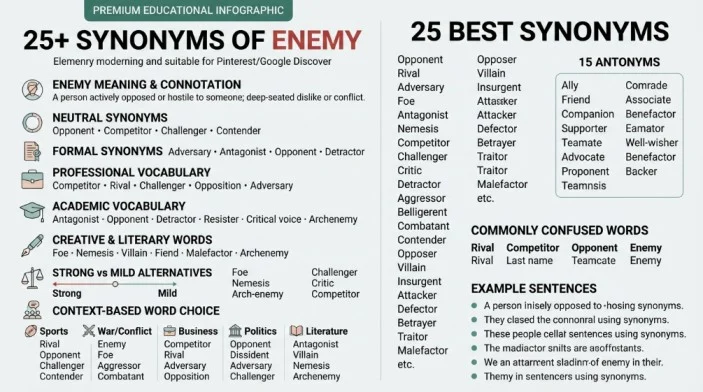
Words like enemy can sound strong, but they do not always fit every situation. A writer describing a personal conflict, a historical rival, a military opponent, or a competitive relationship may need a more precise expression. Choosing the right synonym of enemy can change the tone of a sentence from neutral and formal to emotional or confrontational. The best alternative depends on context, relationship, and the level of hostility you want to communicate.
English offers several words that overlap with enemy, including opponent, rival, adversary, foe, and antagonist. However, these words are not always interchangeable. As a vocabulary-focused guide, this article explores their meanings, nuances, examples, and appropriate uses so you can select a word that communicates your exact idea. The goal is not simply to replace enemy, but to make your writing clearer, more natural, and more precise.
What Are the Best Synonyms of “Enemy”?
An enemy is a person, group, or force that actively opposes or intends harm toward another. Common synonyms include adversary, opponent, foe, rival, antagonist, hostile, nemesis, challenger, and combatant. For formal writing, adversary works well. Nutral contexts, use opponent. For literary writing, foe or nemesis can be more expressive.
Meaning, Tone, and Context
Simple Definition
An enemy is a person, group, organization, or force that is opposed to another and may seek to defeat, damage, or harm them.
The word can describe serious conflict, but its exact strength depends on context. Calling someone an enemy is usually stronger than calling them an opponent because enemy often suggests hostility rather than simple competition.
Part of Speech
Enemy is primarily a noun.
Examples:
- “The army faced a powerful enemy.”
- “Fear can become an enemy of progress.”
- “The two nations were once enemies.”
Overall Tone
The word enemy generally has a negative and hostile tone when it refers to a person or group.
However, it can be used figuratively without describing an actual person.
Examples:
- “Procrastination is the enemy of productivity.”
- “Time became his greatest enemy.”
- “Poor planning can be an enemy of success.”
In these examples, enemy means something that creates an obstacle or works against a desired result.
Formality Level
Enemy is a neutral and widely accepted English word. It can appear in casual conversation, academic writing, journalism, literature, political discussion, and professional communication.
Some alternatives have a more specific register.
| Word | General Tone | Formality |
|---|---|---|
| Enemy | Hostile | Neutral |
| Opponent | Neutral conflict | Neutral |
| Adversary | Serious opposition | Formal |
| Rival | Competitive | Neutral |
| Foe | Hostile or literary | Neutral to literary |
| Antagonist | Opposing force | Formal or literary |
| Nemesis | Powerful or persistent opponent | Literary or expressive |
| Combatant | Participant in conflict | Formal |
| Competitor | Competitive | Professional or neutral |
Common Uses
Native English speakers commonly use enemy when discussing:
- Military conflicts
- International relations
- Personal hostility
- Political disputes
- Competition
- Fiction and storytelling
- Historical events
- Sports rivalries
- Business competition
- Figurative obstacles
Word Forms
The most common related forms are:
- Enemy, noun
- Enemies, plural noun
- Enemy’s, possessive noun
- Enemies’, plural possessive noun
English does not commonly use enemy as a verb or adjective.
When and How to Use “Enemy”
Use enemy when the relationship involves genuine hostility, opposition, or an intention to defeat or harm. If the relationship involves ordinary competition without hostility, a word such as rival or opponent is usually more accurate.
Professional Context
“Poor communication can become an enemy of effective teamwork.”
This figurative use works when describing something that actively prevents a positive result.
Academic Context
“Propaganda often portrayed the opposing nation as an enemy.”
Here, enemy describes a group viewed as hostile within a historical or political context.
Workplace Context
“Competition should not turn a colleague into an enemy.”
This sentence distinguishes healthy competition from personal hostility.
Personal Context
“She considered dishonesty an enemy of trust.”
The word is being used figuratively to describe something that damages a relationship.
Email Context
“Unclear instructions can become the enemy of a successful project.”
This use is appropriate when discussing an obstacle in professional communication.
Resume Context
A direct reference to enemy is uncommon on a resume. Professional writing usually focuses on achievements and challenges rather than personal conflict.
Instead of:
“I defeated my enemies in difficult negotiations.”
Use:
“I successfully managed challenging negotiations with competing stakeholders.”
Social Media Context
“Self doubt can be the enemy of progress.”
This figurative use is natural for motivational content.
Best Synonyms of “Enemy”
No synonym of enemy works perfectly in every situation. The most accurate choice depends on whether you mean a person who actively wants to harm someone, a competitor, a person on the opposing side, or a fictional character who creates conflict.
Professional Writing
Adversary is a strong choice when discussing serious opposition in a professional or formal setting.
Example:
“The company developed a strategy to compete effectively against its primary adversary.”
Academic Writing
Adversary, opponent, and antagonist can work well depending on the subject.
Example:
“The author presents the political leader as an opponent of the proposed reform.”
Business Communication
Competitor is usually better than enemy when discussing another company.
Example:
“Our main competitor recently introduced a similar product.”
Calling another business an enemy can sound unnecessarily aggressive.
Casual Conversation
Rival or opponent often sounds more natural when discussing competition.
Example:
“Our biggest rival has a strong team this season.”
Emotional Writing
Foe can add emotional force, especially in personal or literary writing.
Example:
“Fear became her greatest foe.”
Creative Writing
Nemesis, foe, and antagonist can create stronger storytelling effects.
Example:
“The hero finally confronted his longtime nemesis.”
Resume Writing
Avoid enemy and most hostile alternatives. Professional resumes generally use terms such as competitor, challenger, or competing organization when competition needs to be mentioned.
Example:
“Developed strategies that increased market share against major competitors.”
Workplace Communication
Opponent or counterpart may be more appropriate depending on the situation.
Example:
“The negotiation team reached an agreement with its primary opponent.”
Stronger Meaning
Nemesis can suggest a particularly persistent or formidable opponent.
Example:
“The detective finally caught his longtime nemesis.”
Softer Meaning
Opponent is usually a softer alternative because it describes someone on the other side of a disagreement, contest, or competition without necessarily implying hatred.
Example:
“She respected her opponent throughout the debate.”
When Not to Use “Enemy”
The word enemy is powerful. Using it when the situation only involves disagreement or competition can make your writing sound unnecessarily hostile.
When the Word Is Too General
If you know exactly how the other person opposes someone, use a more specific term.
Less precise:
“He is my enemy.”
More precise:
“He is my rival in the competition.”
The second sentence explains that the relationship is competitive rather than hostile.
When the Word Is Too Vague
If the problem is a specific obstacle, identify the obstacle.
Less effective:
“Stress is my enemy.”
Better:
“Chronic stress is a major obstacle to maintaining a healthy routine.”
The second sentence gives readers more information.
When the Word Is Too Formal or Dramatic
In ordinary workplace disagreements, enemy can sound exaggerated.
Less natural:
“My coworker is my enemy.”
Better:
“My coworker is my opponent in this discussion.”
The alternative keeps the focus on the disagreement.
When the Word Is Too Informal
Enemy itself is not particularly informal, but casual expressions such as nemesis can sometimes feel too dramatic for formal business communication.
Less appropriate:
“Our company’s nemesis introduced another product.”
Better:
“Our main competitor introduced another product.”
When the Word Is Too Weak
In a military or serious conflict, rival may not communicate enough hostility.
Less precise:
“The soldiers prepared to face their rivals.”
Better:
“The soldiers prepared to face the enemy.”
The original context requires a word that clearly identifies hostile forces.
When the Word Is Too Strong
For a sports competition, enemy may suggest unnecessary hostility.
Less appropriate:
“The team defeated its enemy.”
Better:
“The team defeated its opponent.”
Opponent describes competitive opposition without suggesting personal hatred.
When the Word Sounds Outdated
Enemy itself is not outdated. However, some literary alternatives may sound old fashioned in ordinary modern conversation.
For example, foe is perfectly understandable but can sound poetic or dramatic.
Modern:
“The team defeated its opponent.”
Literary:
“The hero defeated his ancient foe.”
Words Commonly Confused With “Enemy”
Opponent
Difference: An opponent is someone on the other side of a contest, debate, argument, or competition. The relationship does not necessarily involve hostility.
When to Use It: Use opponent for sports, debates, elections, competitions, and disagreements.
Example: “The candidate answered her opponent’s criticism calmly.”
Rival
Difference: A rival competes with someone for the same goal, position, recognition, or success.
When to Use It: Use rival when competition is the central idea.
Example: “The two companies have been rivals for years.”
Adversary
Difference: An adversary is someone who actively opposes another person or group. It can suggest a serious conflict.
When to Use It: Use adversary in formal, political, legal, military, or strategic contexts.
Example: “The negotiator remained calm while dealing with a determined adversary.”
Antagonist
Difference: An antagonist is a person, character, or force that opposes another, especially the main character in a story.
When to Use It: Use it in literature, film, storytelling, psychology, or discussions of conflict.
Example: “The novel’s antagonist creates obstacles for the main character.”
Foe
Difference: Foe means an enemy or opponent, but it often has a literary, poetic, historical, or dramatic quality.
When to Use It: Use foe in creative writing or when a more expressive style is appropriate.
Example: “The warrior stood face to face with his oldest foe.”
Nemesis
Difference: A nemesis is a particularly persistent, powerful, or troublesome opponent.
When to Use It: Use it when one opponent repeatedly challenges or defeats another.
Example: “The detective finally caught the criminal who had become his nemesis.”
Best Synonyms of “Enemy” by Context
| Context | Best Synonym | Why It Works | Example |
|---|---|---|---|
| Formal writing | Adversary | Sounds serious and precise. | “The leader negotiated with his adversary.” |
| Academic writing | Opponent | Works well for opposing views. | “The theory’s opponents presented alternative evidence.” |
| Professional communication | Competitor | Avoids unnecessary hostility. | “Our competitor released a new service.” |
| Business emails | Competitor | Fits commercial situations. | “We need to understand what our competitors are offering.” |
| Resume writing | Competitor | Keeps language professional. | “Analyzed competitor strategies to improve market positioning.” |
| Workplace communication | Opponent | Appropriate for disagreements. | “The proposal received criticism from its main opponent.” |
| Casual conversation | Rival | Natural for competition. | “Our biggest rival won the game.” |
| Everyday speaking | Opponent | Neutral and widely understood. | “She faced a strong opponent.” |
| Creative writing | Foe | Adds dramatic or literary flavor. | “The knight confronted his ancient foe.” |
| Storytelling | Antagonist | Clearly identifies an opposing character. | “The antagonist drives the story’s central conflict.” |
| Emotional writing | Foe | Adds expressive force. | “Loneliness became her greatest foe.” |
| Strong emphasis | Nemesis | Suggests a formidable recurring opponent. | “The villain became the hero’s nemesis.” |
| Mild tone | Opponent | Avoids implying hatred. | “His opponent challenged the decision.” |
| Social media captions | Rival | Short and engaging. | “A friendly rivalry makes every game better.” |
| American English | Opponent | Very common in sports and competition. | “The team prepared for its next opponent.” |
| British English | Adversary | Common in formal contexts, though usage varies. | “The politician faced a strong adversary.” |
How to Choose the Best Synonym of “Enemy”
The best synonym depends on what you actually mean.
If You Mean Hostile Opposition
Choose enemy or adversary.
Example:
“The country faced a powerful adversary.”
If You Mean Competition
Choose rival or competitor.
Example:
“Our main competitor entered the market.”
If You Mean the Other Side of a Contest
Choose opponent.
Example:
“She defeated her opponent in the final round.”
If You Mean a Story Character
Choose antagonist.
Example:
“The antagonist challenges the hero throughout the novel.”
If You Want a Literary Tone
Choose foe.
Example:
“The warrior refused to surrender to his ancient foe.”
If You Mean a Persistent Personal Challenger
Choose nemesis.
Example:
“The detective finally solved the case that had consumed his struggle with his nemesis.”
Consider Your Audience
A school essay may benefit from adversary or opponent. A business report generally needs competitor. A fantasy story may sound better with foe or nemesis.
Consider Emotional Strength
Use opponent for mild opposition and enemy for genuine hostility. Reserve nemesis for particularly persistent or formidable conflict.
Consider Your Writing Purpose
Your purpose should guide the vocabulary.
| Purpose | Recommended Word |
|---|---|
| Academic essay | Opponent |
| Business report | Competitor |
| Workplace discussion | Opponent |
| Military context | Enemy |
| Political analysis | Adversary |
| Fiction | Antagonist |
| Poetry | Foe |
| Dramatic storytelling | Nemesis |
| Sports | Opponent or rival |
| Personal conflict | Adversary or enemy |
Real Life Examples of “Enemy”
School
Instead of writing:
“An enemy is someone you do not like.”
A more precise sentence is:
“An enemy is someone who actively opposes or intends to harm another person or group.”
College
“The essay examines how the government portrayed its political opponents as enemies.”
This wording distinguishes political opposition from actual personal hostility.
Workplace
“Poor communication can become an enemy of productivity.”
The word is figurative because poor communication is an obstacle rather than a person.
Business
“The company monitors its competitors to understand changes in the market.”
Competitors is more appropriate than enemies in a professional business context.
“Please review the proposal carefully because unclear pricing could become an obstacle during negotiations.”
This is more precise than calling a business challenge an enemy.
Resume
“Conducted competitor research and identified opportunities for market growth.”
This professional wording is much more appropriate than referring to business competitors as enemies.
Conversation
“He’s not my enemy. We simply disagree about the issue.”
This example shows why enemy should not be confused with ordinary disagreement.
Storytelling
“The hero entered the castle knowing that his greatest foe was waiting inside.”
Foe gives the sentence a dramatic literary tone.
Blogging
“Procrastination is often the enemy of consistent content creation.”
The figurative use makes the idea more memorable.
Social Media
“Fear can become your greatest enemy when you’re trying to achieve a new goal.”
This is a natural motivational use of the word.
25 Best Synonyms of “Enemy”
| Synonym | Simple Meaning | Best Used For | Example Sentence |
|---|---|---|---|
| Adversary | A person or group that actively opposes another | Formal and serious conflict | “The negotiator studied his adversary carefully.” |
| Opponent | Someone on the other side of a contest or disagreement | Sports, debates, politics | “She respected her opponent after the debate.” |
| Rival | Someone competing for the same goal | Business, sports, personal competition | “The two teams have been rivals for decades.” |
| Foe | An enemy or opponent | Literary and dramatic writing | “The knight faced his oldest foe.” |
| Antagonist | A person or force that opposes another | Fiction and storytelling | “The antagonist creates the story’s central conflict.” |
| Nemesis | A persistent or formidable opponent | Dramatic and expressive writing | “The detective finally defeated his nemesis.” |
| Competitor | Someone competing for success or customers | Business and professional writing | “The company responded to a new competitor.” |
| Challenger | Someone trying to defeat or surpass another | Sports, politics, business | “The challenger gained support during the campaign.” |
| Combatant | Someone engaged in armed conflict | Military and historical contexts | “Each combatant followed the rules of engagement.” |
| Hostile | Someone or something showing opposition or aggression | Formal descriptions | “The group faced a hostile force.” |
| Aggressor | A person or group that initiates an attack | Military and political writing | “The report identified the aggressor.” |
| Opposer | Someone who actively resists something | General opposition | “She became a vocal opposer of the proposal.” |
| Competitor | A person or organization seeking the same goal | Business and sports | “The competitor introduced a lower priced product.” |
| Contestant | Someone participating against others in a competition | Games and contests | “Each contestant prepared carefully for the final.” |
| Antagonist | An opposing person or force | Literature and storytelling | “The antagonist challenges the hero at every turn.” |
| Counterpart | Someone on the other side of a situation | Diplomacy and professional contexts | “The minister met with his foreign counterpart.” |
| Opposition | A person, group, or force resisting something | Politics and formal writing | “The proposal faced strong opposition.” |
| Persecutor | Someone who repeatedly harms or harasses another | Historical and social contexts | “The victim escaped from her persecutor.” |
| Threat | A person or thing capable of causing harm | Security and risk discussions | “The organization identified a serious threat.” |
| Adversary | A serious opposing force | Strategic discussions | “The team prepared for a highly skilled adversary.” |
| Rival | A competitor seeking the same outcome | Everyday and professional contexts | “Her longtime rival entered the competition.” |
| Foeman | An old fashioned term for an enemy | Historical or literary writing | “The warrior watched his foeman approach.” |
| Antagonist | An opposing character or force | Fiction | “The antagonist drives the conflict forward.” |
| Foe | A hostile opponent | Poetry and dramatic writing | “The hero would not retreat from his foe.” |
| Nemesis | A particularly troublesome opponent | Dramatic descriptions | “The villain became the hero’s greatest nemesis.” |
Editorial note: Some entries above overlap in meaning because English has several words for different types of opposition. In polished writing, choose the word that matches the relationship rather than treating every alternative as a perfect replacement.
Synonyms of “Enemy” by Usage
Professional vs Personal Synonyms
Professional communication usually benefits from neutral vocabulary. Calling another company or employee an enemy can create an unnecessarily aggressive tone.
For business, competitor, rival, and opponent are usually better.
For personal conflict, adversary, opponent, or enemy may be appropriate depending on the seriousness of the relationship.
Formal vs Conversational Synonyms
Formal writing often favors adversary, opponent, antagonist, and competitor.
Conversational English commonly uses rival, opponent, and enemy.
For texting, simple language is generally preferable. A sentence such as “He’s my rival” sounds more natural than using a highly literary term such as foe unless the speaker is being humorous or dramatic.
Academic Synonyms
Academic writing should distinguish between hostility and disagreement.
- Use opponent when discussing someone who disagrees with a theory or argument.
- Use adversary when describing serious strategic opposition.
- Use antagonist when discussing a literary character or opposing force.
Example:
“The author’s principal opponents argued that the evidence was insufficient.”
This is more objective than saying:
“The author’s enemies rejected the theory.”
Professional and Business Synonyms
- For resumes, use competitor when discussing another company.
- For interviews, use challenger or competitor when discussing market competition.
- For meetings, use opponent when discussing an opposing position.
- For presentations, use competitor when comparing products or services.
- For performance reviews, avoid language that frames colleagues as enemies.
- For client communication, use neutral terms such as counterpart, competitor, or opposing party depending on the situation.
- For business emails, competitor is usually the safest choice.
Creative and Literary Synonyms
Creative writing gives you more freedom.
Foe can create a classic or poetic feeling.
Nemesis suggests a powerful recurring opponent.
Antagonist clearly identifies the force working against the protagonist.
Adversary creates a serious and strategic atmosphere.
Example:
“The hero had defeated countless foes, but this adversary was different.”
Slang or Modern Synonyms
There is no single slang word that universally replaces enemy.
Informal expressions such as hater can describe someone who strongly criticizes or dislikes another person, especially in online communication. However, hater does not always mean an actual enemy.
Example:
“Ignore the haters and focus on your goals.”
Use this expression in casual speech and social media, not in academic papers, resumes, or formal reports.
Strongest to Mildest Synonyms
The intensity of an enemy related word depends heavily on context.
Mild
Opponent
This usually indicates that two sides disagree or compete.
Mild to Moderate
Rival
This emphasizes competition rather than hostility.
Moderate
Adversary
This suggests more serious opposition.
Strong
Enemy
This generally indicates hostility or opposition with a greater sense of conflict.
Very Strong or Expressive
Nemesis
This suggests a particularly persistent, formidable, or personally significant opponent.
The scale is not absolute. For example, adversary can sound stronger than enemy in a formal strategic context, while enemy may be stronger in an everyday personal context.
Emotional vs Neutral Synonyms
Emotional Synonyms
These words can create stronger feelings or dramatic imagery:
- Foe
- Nemesis
- Enemy
- Aggressor
- Persecutor
Use them when the conflict itself is central to the message.
Neutral Synonyms
These alternatives communicate opposition without necessarily adding emotional hostility:
- Opponent
- Rival
- Competitor
- Challenger
- Counterpart
Neutral vocabulary is especially useful for professional, academic, and analytical writing.
Antonyms of “Enemy”
| Antonym | Meaning | Example Sentence |
|---|---|---|
| Friend | A person who has a positive relationship with another | “She has been my friend since childhood.” |
| Ally | A person or group that supports another | “The two countries became allies.” |
| Supporter | Someone who backs a person or cause | “He is a strong supporter of the organization.” |
| Partner | Someone who works together with another | “The company found a reliable business partner.” |
| Companion | Someone who spends time with another | “Her dog was her constant companion.” |
| Associate | A person connected through work or activity | “He met a former business associate.” |
| Collaborator | Someone who works with another toward a shared goal | “She became an important collaborator on the project.” |
| Teammate | A member of the same team | “His teammate helped him finish the assignment.” |
| Confidant | A trusted person with whom private matters are shared | “Her sister was her closest confidant.” |
| Supporter | Someone who provides approval or assistance | “The candidate thanked every supporter.” |
| Accomplice | A person who cooperates with another, usually in wrongdoing | “The investigation identified his accomplice.” |
| Benefactor | Someone who provides financial or other support | “The museum received help from a generous benefactor.” |
| Protector | Someone who keeps another person safe | “The guardian acted as her protector.” |
| Peacemaker | Someone who helps opposing sides reach peace | “The diplomat worked as a peacemaker.” |
| Friend | Someone with whom there is mutual affection or trust | “He considered his former rival a close friend.” |
Comparison: “Enemy” vs Similar Words
Enemy vs Opponent
Main Difference
An enemy generally implies hostility. An opponent simply means someone on the other side of a competition, debate, or disagreement.
Which Is Stronger?
Enemy is stronger.
Which Is More Formal?
Opponent is often more useful in neutral formal writing.
When to Use Each
Use enemy for genuine hostility. Use opponent for sports, elections, debates, and competitions.
Examples
Enemy: “The soldiers prepared to defend the city from the enemy.”
Opponent: “The candidate responded respectfully to her opponent.”
Enemy vs Rival
Main Difference
A rival competes for the same goal. An enemy is defined more by hostility than competition.
Which Is Stronger?
Enemy is stronger.
Which Is More Formal?
Both are neutral, but rival is common in business and sports.
When to Use Each
Use rival for competition. Use enemy for serious hostility.
Examples
Enemy: “The army defended the city from its enemy.”
Rival: “The two companies are fierce rivals.”
Enemy vs Adversary
Main Difference
Both describe opposition, but adversary often sounds more formal and strategic.
Which Is Stronger?
Neither is always stronger. Context determines the intensity.
Which Is More Formal?
Adversary is more formal.
When to Use Each
Use adversary in political, legal, strategic, or formal contexts.
Examples
Enemy: “The soldiers moved toward the enemy.”
Adversary: “The negotiator studied his adversary’s position.”
Enemy vs Antagonist
Main Difference
An antagonist is an opposing character or force, particularly in a story. An enemy can refer to real people, groups, or figurative obstacles.
Which Is Stronger?
Enemy generally carries more direct hostility.
Which Is More Formal?
Antagonist is more specialized.
When to Use Each
Use antagonist in literature, film, and storytelling.
Examples
Enemy: “The country faced a powerful enemy.”
Antagonist: “The antagonist attempts to stop the hero.”
Enemy vs Foe
Main Difference
Foe means an enemy or opponent but often sounds more literary, poetic, or dramatic.
Which Is Stronger?
The emotional strength can be similar, but foe often feels more dramatic.
Which Is More Formal?
Neither is especially formal. Foe has a more literary style.
When to Use Each
Use enemy for ordinary modern communication. Use foe for creative or expressive writing.
Examples
Enemy: “The army confronted the enemy.”
Foe: “The hero finally faced his ancient foe.”
Enemy vs Nemesis
Main Difference
A nemesis is a particularly persistent or formidable opponent. The word suggests a specific opponent who repeatedly causes difficulty.
Which Is Stronger?
N emesis can sound more dramatic because it implies an unusually powerful or persistent opponent.
Which Is More Formal?
Enemy is more neutral. Nemesis is more expressive.
When to Use Each
Use nemesis in storytelling, dramatic descriptions, or figurative language.
Examples
Enemy: “The soldiers approached the enemy.”
Nemesis: “The detective finally confronted his longtime nemesis.”
Common Phrases and Expressions with “Enemy”
Enemy of Progress
Meaning: Something that prevents progress or makes improvement difficult.
Example Sentence:
“Fear of failure can become an enemy of progress.”
Enemy of Success
Meaning: A person, habit, or condition that makes success harder to achieve.
Example Sentence:
“Poor planning is often the enemy of success.”
Common Enemy
Meaning: A threat or opposing force that two or more groups share.
Example Sentence:
“The two communities united against a common enemy.”
Public Enemy
Meaning: A person widely regarded as dangerous or harmful to society.
Example Sentence:
“The criminal became known as a public enemy.”
Enemy Territory
Meaning: An area controlled by an opposing or hostile group.
Example Sentence:
“The soldiers moved carefully through enemy territory.”
Enemy Lines
Meaning: The defensive positions or area controlled by an opposing force.
Example Sentence:
“The rescue team had to move beyond enemy lines.”
Make an Enemy
Meaning: To cause someone to become hostile toward you.
Example Sentence:
“Be careful not to make an enemy during a disagreement.”
Mortal Enemy
Meaning: A particularly serious or lifelong enemy.
Example Sentence:
“The two characters become mortal enemies after the betrayal.”
Common Mistakes to Avoid
Choosing “Enemy” for Ordinary Competition
Incorrect:
“Our company needs to defeat its enemies.”
Better:
“Our company needs to outperform its competitors.”
Why:
Business competition does not necessarily involve hostility. Competitors is more professional and accurate.
Confusing Enemy With Opponent
Incorrect:
“My opponent hates me because we are playing tennis.”
Better:
“My opponent is competing against me in the tennis match.”
Why:
An opponent does not necessarily dislike you.
Using a Literary Word in Formal Business Writing
Incorrect:
“Our biggest foe released a new product.”
Better:
“Our biggest competitor released a new product.”
Why:
Foe sounds dramatic and literary, while competitor is standard business vocabulary.
Using “Nemesis” for Every Difficult Person
Incorrect:
“My teacher is my nemesis because she gave me homework.”
Better:
“My teacher is strict, and she gives us challenging assignments.”
Why:
Nemesis suggests a particularly persistent or formidable opponent. It is too dramatic for an ordinary inconvenience.
Repeating “Enemy” Too Often
Incorrect:
“The enemy approached the enemy camp while the enemy soldiers prepared for the enemy attack.”
Better:
“The opposing forces approached the camp while the soldiers prepared for the attack.”
Why:
Strategic variation improves readability and avoids unnecessary repetition.
Using an Overly Strong Word
Incorrect:
“My classmate is my enemy because we disagreed about the project.”
Better:
“My classmate is my opponent in the project discussion.”
Why:
A disagreement does not automatically create an enemy.
Using “Hater” in Formal Writing
Incorrect:
“The author responded to online haters in the research paper.”
Better:
“The author addressed criticism from online commentators.”
Why:
Hater is informal and strongly associated with casual online language.
Frequently Asked Questions
What is another word for enemy?
A common alternative is opponent, but words such as adversary, rival, foe, and antagonist may fit different contexts.
What are the best synonyms for enemy?
Common enemy synonyms include foe, adversary, opponent, rival, antagonist, and hostile. The best choice depends on the situation and tone.
What is a synonym for enemy in formal writing?
Adversary is a strong formal alternative to enemy. Opponent can also work when describing competition or conflict without implying hostility.
What is a synonym for a mortal enemy?
Archenemy or bitter enemy can describe someone who is a person’s strongest or most persistent enemy.
What is the synonym of enemy?
The most common synonyms of enemy are foe, adversary, opponent, rival, and antagonist.
What are the synonyms of enemies?
Depending on context, enemies can be replaced with foes, adversaries, opponents, rivals, or antagonists.
What does an enemy thesaurus include?
An enemy thesaurus typically lists related words such as foe, adversary, opponent, rival, and antagonist, along with variations based on context.
What are the synonyms of enemies in different contexts?
For military conflict, foes or hostiles may fit. For competition, rivals or opponents are often more appropriate.
What are the best synonyms of “enemy”?
The best synonyms of enemy include adversary, opponent, rival, foe, antagonist, nemesis, competitor, and challenger. Choose based on context because these words differ in hostility, competition, formality, and emotional intensity.
What are the best formal synonyms of “enemy”?
The strongest formal alternatives include adversary, opponent, antagonist, combatant, and aggressor. Adversary works especially well for serious strategic opposition, while opponent is more neutral and suitable for academic analysis.
What are common informal synonyms of “enemy”?
Common conversational alternatives include rival and opponent, depending on the situation. Online speakers may also use hater, but that word is informal and does not always mean an actual enemy.
What is another word for “enemy” in professional writing?
Competitor is usually the best alternative when discussing businesses. Opponent works for disagreements or negotiations, while adversary fits serious strategic or formal situations.
What is the difference between “enemy” and “opponent”?
An enemy generally involves hostility or harmful opposition, while an opponent is simply someone on the other side of a competition, debate, argument, or contest. An opponent does not necessarily have negative feelings.
What is the opposite of “enemy”?
The most direct opposites of enemy include friend and ally. The best choice depends on the relationship. Friend suggests personal affection or trust, while ally emphasizes cooperation toward a shared goal.
Conclusion
An enemy is a person, group, or force that actively opposes another, often with hostility or an intention to cause harm. However, many situations require a more precise word. Opponent works for neutral competition, rival emphasizes competition, adversary suits serious opposition, competitor fits business writing, and foe or nemesis can add dramatic force to creative writing.
The best synonym of enemy depends on the relationship, audience, tone, and purpose of your sentence. A strong vocabulary is not about replacing every word with something more complicated. It is about choosing the word that communicates your exact meaning most clearly.
Read More Related Articles:
- 25+ Synonyms of Existence | Meanings, Uses, Examples, and …
- Synonyms for Thus | Meaning, Examples, and Better Word …
- Meaning, Uses, Examples, and the Best Synonym of Complain